South African scientists say new variant may have increased transmissibility
South African scientists said they identified a new coronavirus variant with a concerning number of mutations.
The so-called C.1.2. variant was first identified in May in the South African provinces of Mpumalanga and Gauteng, where Johannesburg and the capital, Pretoria, are situated, the scientists said in a research paper. By August 13, it had been found in six of South Africa’s nine provinces as well as the Congo, Mauritius, Portugal, New Zealand and Switzerland.
The mutations on the virus “are associated with increased transmissibility” and an increased ability to evade antibodies, the scientists said. “It is important to highlight this lineage given its concerning constellation of mutations.”
Changes in the virus have driven successive waves of the coronavirus with the delta variant, first found in India, now pushing up infection rates across the world. Mutations are first classified as variants of interest by the World Health Organization. Once they are identified as being more severe or transmissible, they’re termed variants of concern.
C.1.2. evolved from C.1., a lineage of the virus that dominated infections in the first wave of the virus in South Africa in mid-2020. It has between 44 and 59 mutations from the original virus detected in Wuhan in China.
The research was published by South African groups including the KwaZulu-Natal Research Innovation and Sequencing Platform, known as Krisp, and the National Institute for Communicable Diseases.
In May, the variant accounted for 0.2% of the genomes sequenced in the country. That rose to 1.6% in June and 2% in July.
“We are currently assessing the impact of this variant on antibody neutralization” in both vaccinated and unvaccinated individuals, the scientists said.
South African scientists also discovered the beta variant in 2020. They have stressed that the country’s advanced ability to sequence the genomes of the virus enables the identification of new strains, they could have originated elsewhere.
China restricts young people to playing video games three hours a week
China announced Monday that it is banning minors from playing video games during the school week and can only play for an hour on Fridays, weekends and holidays.
The new rule comes from China’s video game regulator, the National Press and Publication Administration, which did not respond to requests for comment.
The policy is slated to take effect by September 1.
China has established extensive rules about minors and playing video games in the past, after blaming games for causing nearsightedness and addiction in youth. In 2019, the government announced that gamers under 18 had to stop playing between 10 p.m. and 8 a.m., and only game for 90 minutes on weekdays. In 2018, Beijing stopped approving video games for publication for nearly nine months, hurting the bottom line for massive Chinese companies like NetEase and Tencent.
The Chinese government plans to enforce the ban by requiring minors to register to games with their real names and requiring gaming companies to ask for real names. Some game companies have already begun to use a real name-based registration system to limit playtime, such as Tencent asking for real names with its wildly successful mobile hit, “Honor of Kings.”
Tencent said in a statement on its official WeChat account that it firmly supports the new rule and will make every effort to follow it. It said that the company had been implementing ways to keep minors from being addicted to games since 2017.
“While China’s government has been positive on video games recently and has promoted segments such as esports and cloud gaming as key growth areas, gaming addiction among minors is viewed as a negative output of the popularity of video games in society,” said Lisa Cosmas Hanson, president at research firm Niko Partners. China’s esports scene has grown considerably over the years, and players in esports typically train for hours a day at a young age, the firm noted.
It is possible for children to get around the ban if they were to use the accounts of adults, Niko pointed out. The government is asking for family cooperation to prevent that tactic.
The overall impact of the new ban is still unclear, as the government expands upon previous restrictions. Minors in China are already banned from spending more than 400 yuan (about $62) a month on games. Tencent said in an earnings call that players under 16 years old only account for 2.6% of total spending from customers.
Earlier last week, South Korea announced it would end a law that kept people under 16 from playing games between midnight and 6 a.m. Parents and guardians can instead arrange times for children to play.
Console gaming in China was banned for over a decade, up until 2015. Even today, most gamers in China gravitate toward PC and mobile gaming, with companies like Nintendo and Sony slowly making inroads in often minuscule console sales.
Responding against a ransomware attack resulting to a data breach
It is common news that the implications and costs of cyberattacks are significant and damaging to the victim, both on an individual or business level.
In fact, our Kaspersky IT Security Economics 2020 report showed that, on global average, a breach costs an enterprise $1.09m and a small to medium-sized business (SMB) $101k in 2020. However, with the world becoming increasingly digital, and cyberthreats more complex and sophisticated, there is a growing need to protect oneself from falling victim to cybercrime.
For instance, ransomware attacks in Southeast Asia detected by Kaspersky researchers revealed that since 2018, the number of ransomware detections (prevented attacks) in the region – Singapore, Indonesia, Malaysia, Philippines, Thailand, Vietnam – actually decreased. 2018 saw the highest number of detections recorded at 4,185,703 prevented attacks, where detected incidents in 2017 fell to 3,865,645, and further decreased to 1,418,085 in 2020. However, while these numbers reflect a decreasing ransomware incident trend, we also see the extent of attacks and severity of each attack to be increasing. These ransomware attacks have also become more high profile, and from what we observe so far, there is no clear indication that specific industries are being targeted. What we have seen are that companies with a huge repository of customer data will continue to be targets. What to do if you experience a security breach Organizations that suffered breaches may affect their customers’ personal information so as a customer of a major company affected by a cyberattack that resulted to a data breach, act quickly to ensure your safety.
Remember that a security breach on one account could mean that other accounts are also at risk, especially if they share passwords or if you regularly make transactions between them. • If a breach involves your financial information, notify your banks immediately.
• Change the passwords on all your accounts. If there are security questions and answers or PIN codes attached to the account, you should change these too.
• You might consider a credit freeze. This stops anyone using your data for identity theft.
• Check your credit report to ensure you know if anyone is applying for debt using your details.
• Try to find out exactly what data might have been stolen. That will give you an idea of the severity of the situation. For instance, if tax details and SSNs have been stolen, you’ll need to act fast to ensure your identity isn’t stolen. This is more serious than simply losing your credit card details.
• Don’t respond directly to requests from a company to give them personal data after a data breach; it could be a social engineering attack. Take the time to read the news, check the company’s website, or even phone their customer service line to check if the requests are legitimate.
• Be on your guard for other types of social engineering attacks. For instance, a criminal who has accessed a hotel’s accounts, even without financial data, could ring customers asking for feedback on their recent stay. At the end of the call, having established a relationship of trust, the criminal could offer a refund of parking charges and ask for the customer’s card number in order to make the payment. Most customers probably wouldn’t think twice about providing those details if the call is convincing.
• Monitor your accounts for signs of any new activity. If you see transactions that you don’t recognize, address them immediately. Organizations of all sizes are urged to follow the advice below in order to help them mitigate cyberattacks and potentially reduce costs if they suffer a data breach: • Plan your breach recovery strategy. The best time to prepare for recovery from a breach is before it happens. Take one step today, maybe start to look at how your organization would detect a breach, or how you can test the detection capabilities you have.
• Ensure the organization is using the latest version of its chosen operating systems, with auto-update features enabled to ensure the software is always up to date.
• Adopt endpoint solutions, like Kaspersky Integrated Endpoint Security. It enables vulnerability assessment and patch management, to reduce the risk of vulnerabilities being exploited by cybercriminals. This can automatically eliminate vulnerabilities in infrastructure software, proactively patch them and download essential software updates. It also provides behavior detection and exploit prevention mechanisms that discover and stop suspicious endpoint activity.
• Educate employees on the importance of regularly updating technology and software. For example, IT training courses from the Kaspersky Automated Security Awareness Platform and Kaspersky Adaptive Online Training cover this topic.
• Invest in building a cyber-aware culture. Strengthen cyber-awareness training for all employees. This can help your employees work together more effectively in the face of a common cybercriminals, and appreciate the difficulties the security team faces keeping the organization safe. Protection against ransomware – what companies should pay attention to As with other forms of malware, careful action and the use of excellent security software are steps in the right direction when it comes to combatting ransomware. Of particular importance with regard to this type of malware is the creation of backups, as this allows you to be well prepared even in a worst-case scenario. In addition, Kaspersky encourages organizations to follow these best practices that help you safeguard your organization: • Always keep software updated on all the devices, to prevent attackers from infiltrating your network by exploiting vulnerabilities.
• Focus your defense strategy on detecting lateral movements and data exfiltration to the internet. Pay special attention to the outgoing traffic to detect cybercriminals’ connections. Set up offline backups that intruders cannot tamper with. Make sure you can quickly access them in an emergency when needed.
• Enable ransomware protection for all endpoints. There is a free Kaspersky Anti-Ransomware Tool for Business that shields computers and servers from ransomware and other types of malware, prevents exploits and is compatible with already installed security solutions.
• Install anti-APT and EDR solutions, enabling capabilities for advanced threat discovery and detection, investigation and timely remediation of incidents. All of the above is available within Kaspersky Expert Security framework.
• On top of end point and awareness, also talk about investing in a security team and SOC, and get access to threat intelligence information and regularly up-skill them with professional training, as well as have threat hunting software to identify breaches by aggressive criminal groups.
Test Drive: The $2 million Bacalar shows off the best of Bentley
If you want a Bentley Bacalar, youre too late.
Each of the 12 individuals worldwide who purchased the $2 million open-top two-seater has already spent many months developing personalized exterior paint schemes, unique tones for the Beluga leather seats, and detailed stitching patterns. The car, which was first announced in 2020, is built on the underpinnings of the Continental GT Speed Convertible but has a totally unique body-and is the first two-seat Bentley in nine decades.
It was built by the 40 artisans who at the brand’s Mulliner program at its Crewe, England headquarters. As the first of its kind in Bentley’s modern Mulliner operation, it is the crowning example of the kind of small-batch, highly specialized cars Mulliner aims to produce. Mulliner collections include classic models built anew, like the Bentley Blower continuation cars; extreme-luxury focused versions of existing cars from the Bentley model range; and 100% Coachbuilt cars like the Bacalar.
Test Drive: The $2 million Bacalar shows off the best of Bentley
Bentley could have easily sold more than twice the amount it produced, Mike Rocco, Bentley’s vice president for sales and operations, told me in Carmel, Calif.
Since the Bacalar and Bentley in general are in such high demand, won’t Bentley increase the supply? Neither Rocco nor Timothy Hannig, the spokesman for the Mulliner department, would commit on the record to a definitive yes, but they didn’t exactly say no, either.
It all made me eager to drive the thing. If more Bacalar-like Bentleys are coming down the pike, we will indeed need to know how they drive. Prospective clients and Anglophiles alike will want a taste.
Here’s a quick answer: Divinely.
I recently drove a “Scarab Green” Bacalar test car in along 17-Mile Drive, just a nine-iron shot away from the Pebble Beach Golf Links. (While 12 Bacalars were sold, 13 were made-I drove lucky number 13.) While it wasn’t enough of a jaunt to do a proper review-the speed limit along that road is 25mph, and I cannot comment on any speeds that may or may not have been higher than that-it was enough to convince me this handsome Brit will more than fulfill its raison d’être as the perfect holiday coach built for two.
Please note: It doesn’t come with a top-at all-and the compromised trunk will fit two small duffels, nothing more, so this is not daily driver material.
Bacalar comes with a 6-liter W12 engine that feels as powerful as a tank (650 bhp) and an active all-wheel-drive system that works with scalpel precision as it varies the torque split between front and rear wheels. The car uses rear-wheel drive as much as possible during normal driving for optimum efficiency and dynamic performance, but I never felt the switch.
Its carbon ceramic brakes and balanced contact with the road installed great confidence as I rolled through the deep fog of the peninsula, past hills of sea grass and oatmeal-colored sand.
Yes, it is based on the Continental GT Speed Convertible, but it has 100% unique body panels, sharing only the door handles with the GT, since those contain the hardware for keyless entry. The rear “Barchetta”-style clamshell and top deck of the Bacalar are crafted from lightweight aluminum; the doors and everything else on the body are made from carbon fiber.
Shared mechanics aside, the Bacalar felt far slinkier and more ethereal to drive than its Continental GT siblings. It felt quicker to jump to high speeds, more focused around corners, and more nuanced between gears-and the Continental GT is among the top three best all-around cars I have ever driven.
It also looks far more striking in person than it does in pictures. Some who saw it in person in Carmel or later on social media expressed surprise and curiosity about it, as if its announcement in March 2020 had completely passed them over, coronavirus notwithstanding. Some referred to the Bacalar-so named after a pristine lake in Mexico-as the “Bentley Balaclava” or “Bentley Baclava.” Others had no idea about its origins at all.
Which is fine. Amid the endless procession of special-edition and limited versions of these hyperprofitable, upper-echelon conveyances, they tend to blend together. I also blame a certain quality about Bentley bodies that, especially in darker tones of paint, tends to present them more like bricks than they actually are.
Up close, where the eye can bend around its subtle corners, the Bacalar is a delight. Its double-bubble back and air vents along the hood and sides do just enough to rough up its otherwise stately and smooth Bentley body. The complex geometric stitching on the seats, the intense azure of the dashboard clock dial (colored to match the famous blue water of the white limestone-lined lake), the woolen bags placed so thoughtfully in their compartments behind the seats-they don’t translate well in the highly modified glamour shots and renderings that seem to define automotive press photos these days.
Frankly, they don’t need to. Social media’s self-appointed critics and TikTok stars aren’t the audience here.
No, the Bacalar reveals itself most fully in real life, not on virtual land. That’s how it should be. If I could afford it, I’d buy it without hesitation. If you missed the first dozen, you’re probably not completely out of luck. You may simply be early for the next round.
The Thai public may start getting booster doses by October as large vaccine shipments are expected to start arriving soon.
The original plan was to start administering booster shots in November.
Dr Opas Karnkawinpong, director-general of the Department of Disease Control, said the Public Health Ministry should approve the plan by the end of the month before it is announced officially by the Centre of Covid-19 Situation Administration (CCSA).
Opas said some 20 million doses of the Covid-19 vaccine will be available by October, so it should be possible to provide booster shots to people who have already received their two jabs.
He explained that the third or booster dose should be of a different sort. For instance, recipients of two doses of the inactivated Sinovac jab will possibly get a viral vector vaccine like AstraZeneca or an mRNA one like Pfizer.
However, he said, this combination will be confirmed after it has been considered at the next CCSA meeting.
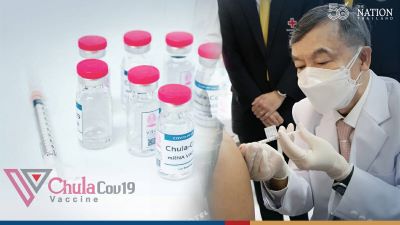
Chula mRNA vaccine in line for April rollout after Delta success
Chulalongkorn University researchers have launched the second human trial of Chula-Cov19 mRNA vaccine, after the Phase 1 trial greatly boosted volunteers’ antibodies against the Covid virus.
The vaccine proved effective against all four variants of the virus in Phase 1 and is expected to be registered by the Thai Food and Drug Administration (FDA) in April next year, said Chula.
The vaccine “can induce a very strong antibody response, [which is] as good as Pfizer”, said Dr Kiat Ruxrungtham, director of the Chula-Cov19 mRNA development programme and founder of the Chula Vaccine Research Centre behind ChulaCov-19.
On Saturday, researchers declared “satisfactory” results from the first trial on 72 volunteers – 36 aged 18-55 and 36 aged 65-75. After being injected with the mRNA vaccine, Phase 1 volunteers developed 94-per-cent protection against Covid-19 symptoms, with high antibody activation. The vaccine also stimulated T-cell immunity, which helps to kill the virus in the cells of infected people.
The vaccine was effective against the original strain as well as its four main variants, namely Alpha, Beta, Gamma and Delta. Delta currently accounts for more than 90 per cent of new infections in Thailand.
Volunteers experienced mild to moderate side effects in the seven days after vaccination. Most of the symptoms – pain at the injection spot, fatigue, low fever and chills – occurred after the second shot and lasted 1-3 days. The vaccine is now on track to become Southeast Asia’s first mRNA jab. Chula-Cov19 has a longer storage life than other mRNA vaccines, said Dr Kiat.
The vaccine can also be produced quickly as it does not require large production facilities. Results of previous tests in mice indicated that the vaccine is non-toxic, can prevent symptoms, reduces the viral load in the nose and lungs, and halts its spread into the bloodstream.
The second phase involves a 2a trial on 150-300 volunteers followed by a 2b trial on 5,000 volunteers in October. If all goes well, a third and final-phase trial will be conducted on 15,000-30,000 volunteers. “The vaccine should be registered by April 2022 if possible,” said Kiat.
Stamp Fairtex on Potentially Facing Angela Lee: A Dream Come True
Former two-sport ONE World Champion Stamp Fairtex of Thailand says she is completely focused on her upcoming bout at ONE: EMPOWER against rival Alyona Rassohyna. However, the 23-year-old from Pattaya cant help but imagine the possibilities of potentially facing her idol, reigning ONE Womens Atomweight World Champion Angela Lee down the line.
Stamp and Rassohyna face each other in the quarterfinal round of the highly anticipated ONE Women’s Atomweight World Grand Prix, which commences this Friday night, September 3 at the aforementioned EMPOWER event, live from the Singapore Indoor Stadium.
The winner of the tournament earns the right to challenge Lee for the ONE World Title, which CEO Chatri Sityodtong says could happen as early as November.
“I’ve been extremely focused on my MMA game, especially this year. I can say I’m ready to fight anyone, including Angela [Lee]. I’ve been training non-stop,” Stamp said.
“It will be a dream if I win this tournament and face Angela for the belt. She’s my idol and if we fight, I do not care if I win or lose. I just want the chance.”
But before she can even think of a shot at the belt, Stamp has to make it to the next round of the tournament, and to do that, she has to get past the rematch with Rassohyna.
Stamp battled Rassohyna to a controversial submission loss back in February. After dominating the majority of the fight, the Ukrainian caught the Thai fighter in a deep guillotine, forcing a questionable tap.
The referee stopped the contest, and declared Rassohyna the victor. However, Stamp immediately protested the stoppage, claiming that no ‘tap’ took place.
Stamp has since come to terms with the tumultuous result, and is now focused on getting the win back in the rematch.
“Some people say I tapped, and some say I didn’t. I’d like to thank all of my fans who understand and continue to support me,” Stamp said.
Stamp-Fairtex-Alyona-Rassohyna-UNBREAKABLE
“I still insist I didn’t tap, but the angle that the referee saw was a tap, so I respect his decision. I’ve accepted that I did make a mistake and I’ve moved on. However, I need to be careful in this rematch. It is an opportunity to correct what I did wrong in the last fight.”
Stamp-Fairtex-Alyona-Rassohyna-UNBREAKABLE
The ONE Women’s Atomweight World Grand Prix brings together eight of the best atomweight fighters in the world, all competing to become the #1-contender for the ONE Women’s Atomweight World Title.
Stamp enters the tournament as the highly impressive former ONE Atomweight Kickboxing and Muay Thai World Champion. Her transition to mixed martial arts competition has been equally as impressive. Stamp made her MMA debut in 2018, and has since gone 5-1 with four finishes.
“It’s such an honor for me to be selected to participate among the top eight female martial artists in this tournament. I’m happy to be able to represent Thailand. This is something that I’m very proud of,” Stamp said.
“I’ve been focused on both Muay Thai and MMA training. My only objective is to win this fight. On top of that, physically and mentally, I’m a hundred percent ready. I’m just focusing on coming into this fight in amazing shape, and I’m ready to go.”
Ngern Tid Lor PCL is IFC’s First Investment in a Non-Banking Financial Institution in Thailand
IFC combines investment and advisory to foster sustainable economic growth in Thailand’s private sector. As of June 2021, IFC’s committed portfolio in Thailand is $875 million.
Small businesses will have improved access to finance with IFC’s first investment in a non-banking financial institution (NBFI) in Thailand, Ngern Tid Lor Public Company Limited (TIDLOR). The latest investment from IFC aims to support a resilient recovery by promoting business growth, creating jobs, and fostering financial inclusion.
IFC’s financing package of up to $100 million (about 3,000 million Thai baht) loan will allow TIDLOR to increase its lending to micro, small, and medium enterprises (MSMEs in the country). IFC will also mobilize international investors to help TIDLOR access diversified funding and support the company to improve its credit risk management framework.
Ngern Tid Lor PCL is IFC’s First Investment in a Non-Banking Financial Institution in Thailand
MSMEs represent 86 percent of Thailand’s labor force and account for 45 percent of the nation’s gross domestic product (GDP). Yet, even before COVID-19, MSMEs in Thailand had an estimated financing gap of $41 billion, accounting for 10.3 percent of the country’s GDP. With the pandemic, they face several challenges including order cancellation, reduced sales, disrupted supply chains, and shortage of working capital. Also, MSME lending by banks has been tighter due to higher non-performing loan (NPL) ratios.
“In the face of an ongoing crisis, IFC’s investment will allow TIDLOR—an affiliate of Bank of Ayudhya Public Company Limited (BAY)—to strengthen our balance sheet as we execute on our strategy to promote financial inclusion with a digital- and data-driven approach, ” said Piyasak Ukritnukun, Managing Director of Ngern Tid Lor Public Company Limited.
NBFIs that are focused on lending remain small in scale, accounting for less than five percent of the total assets of Thailand’s financial system. This is primarily because NBFIs do not accept deposits, lack diversified funding sources, and target informal workers, individual entrepreneurs, and MSMEs that have no fixed asset collateral and are perceived as high risk.
“In line with IFC’s strategic priorities in Thailand, IFC’s investment will help increase accessible, convenient, and affordable financial services for MSMEs, which is critical to promote employment and sustainable development,” said Jane Yuan Xu, IFC Country Manager for Thailand and Myanmar. “IFC’s support will also inspire confidence among potential international investors while having a catalytic effect on competitors, accelerating economic recovery in Thailand,” Xu added.
IFC combines investment and advisory to foster sustainable economic growth in Thailand’s private sector. As of June 2021, IFC’s committed portfolio in Thailand is $875 million.
Easing of lockdown expected to strengthen baht though worries on Covid remain
The baht opened at 32.44 to the US dollar on Tuesday, unchanged from Monday’s closing rate.
The Thai currency is likely to move between 32.35 and 32.50 during the day, Krungthai Bank market strategist Poon Panichpibool said.
The baht was likely to strengthen due to economic recovery from the easing of the lockdown, which prompted foreign investors to invest in Thai assets last week.
Poon was concerned about the Covid-19 situation in Thailand, as he was not sure if the spread of the virus had been contained because enough proactive testing was not being done. The positive rate in Thailand was higher than 20 per cent, while the World Health Organization recommends it should be lower than 5 per cent.
He added that the baht was likely to fluctuate and weaken as the situation did not clearly point to improvement. He suggested keeping an eye on the virus situation 3-4 weeks after the first week of the lockdown easing.
The support level of the baht would be from 32.30 to 32.40, which is the price range importers are waiting for to buy dollars.
The Bank of Thailand might help the baht avoid volatility and ensure it moves within its range in the short term.
Gasoline jumps, oil falls as Ida landfall seen sparing rigs
U.S. gasoline futures jumped after Hurricane Ida barreled ashore in Louisiana, disrupting processing facilities. Oil reversed early gains as local rigs may have escaped significant damage and the OPEC+ producers cartel is expected on Wednesday to endorse a supply increase.
Gasoline for October spiked more than 4% in New York before paring its advance, while West Texas Intermediate crude fell around 1%. Last week, WTI rallied 10% as investors wagered global demand would recover from the setback posed by the spread of the delta coronavirus variant.
Both crude oil and gasoline have been hit by volatile trading this month as investors weighed the challenge to consumption posed by the resurgence of the pandemic in parts of Asia, the U.S. and Europe. This week, traders will focus on the fallout from Ida, as well as the likelihood that the Organization of Petroleum Exporting Countries and its allies will go ahead with an increase in output when they meet.
“The market will be looking at the product stocks and the risks of onshore damage from Ida,” said Matt Stanley, a senior broker at Star Fuels in Dubai. “Now that the storm has made landfall it looks like the worst is past for the offshore platforms and over the next couple of days operators can look at getting those back up.”
Gulf of Mexico producers shut in more than 1.7 million barrels a day of crude output — about 15% of the total for the U.S. — ahead of the storm. The focus for crude markets is now shifting back to the virus and OPEC+, Stanley said.
Refiners including Valero Energy Corp. shut about 12% of U.S. oil-processing capacity as a precaution ahead of the Category 4 storm, which has stronger winds than Katrina in 2005. Colonial Pipeline Co., the operator of the largest fuel-distribution system from the refining centers in Texas and Louisiana to customers across the eastern U.S., idled its main network.
Gasoline prices in the southeast U.S. could climb heading into the end of summer if refineries suffer extensive damage or can’t get power and are forced to stay shut for an extended period, adding to the price inflation hitting Americans. Traders in Europe have already been preparing to fill any gap in supplies at New York Harbor, provisionally chartering tankers. Still, those would take as much as two weeks to cross the Atlantic.
“For a Category 4, you could be looking at four to six weeks or more of downtime for the refineries,” said Andy Lipow, president of Lipow Oil Associates LLC in Houston.
Ida, which came ashore about 60 miles (97 kilometers) south of New Orleans, drove up ocean levels as much as 16 feet (4.9 meters). The hurricane’s 150-mph winds tie Louisiana’s record set by Laura in 2020 and a 19th-century storm.




 Test Drive: The $2 million Bacalar shows off the best of Bentley

 Stamp-Fairtex-Alyona-Rassohyna-UNBREAKABLE
 Stamp-Fairtex-Alyona-Rassohyna-UNBREAKABLE
 Stamp-Fairtex-Alyona-Rassohyna-UNBREAKABLE
 Ngern Tid Lor PCL is IFC’s First Investment in a Non-Banking Financial Institution in Thailand

 SootinClaimon.Com