The baht opened at 33.35 to the US dollar on Tuesday, weakening from Monday’s closing rate of 33.34.
The Thai currency is likely to move between 33.30 and 33.45 during the day, Krungthai Bank market strategist Poon Panichpibool predicted.
Poon said the baht is still pressured by weakening factors than strengthening in the short term. Foreign investors might sell more Thai bonds amid concerns that bond issues in the future might be more than expected after the Thai government raised the public debt ceiling and borrowed more.
Some investors have stopped speculating that the baht will strengthen and sold short-term bonds, due to worries of a new Covid-19 wave.
Poon added that the baht was pressured by the strengthening dollar from the risk-off state in the market. The baht was also pressured by the weakening yuan that affected the Asian currencies market from Evergrande’s default.
The key resistance level for the baht would be at 33.50 to the dollar. Poon speculated that the rising price of gold might prompt some investors to sell while the gold price rebounds.
The rise in gold price might help the baht strengthen because investors who sell gold in dollars will exchange them back to the baht.
While voters prepare to render their verdict on Prime Minister Justin Trudeaus government at the polls on Monday, the market is taking a distinctly downbeat view of the local currency, despite recent buoyancy in resource prices.
Indeed the rise in global commodity costs could even become a headwind for the country’s economy rather than a tailwind as concerns about domestic inflation take center stage for citizens, politicians and central bankers alike.
The loonie, as it is affectionately dubbed because of the bird that graces Canada’s coinage, has been one of the worst-performing developed-market currencies in the second half of this year. After outstripping all its Group-of-10 counterparts in the first six months of 2021, it’s fallen 3.6% since June 30. And activity within derivative markets suggests there could be more pain to come for the currency even as the Bank of Canada starts to pave the way for monetary policy tightening.
“It’s been pretty clear over the last week or two that the CAD is just not responding to some of the positive fundamental impulses in the way we would have expected,” said Shaun Osborne, chief currency strategist at Scotiabank. “I suspect the CAD may continue to struggle a little bit.”
On Monday, the loonie was the second-worst performing G-10 currency amid a broad stock and commodity rout, as investors weighed the impact of China’s struggling real estate sector.
ADVERTISEMENT
In the options market, the right to sell the Canadian dollar versus the greenback in three months’ time has been rising in cost relative to the price of purchase rights. So-called risk reversals, which compare the costs of these puts and calls, this month reached levels unseen since June 2020, suggesting increased interest in hedging against Canadian dollar losses.
One- and three-month implied volatility measures have ticked up in recent weeks, suggesting that some investors are bracing for an increase in activity.
Positioning data from the Commodity Futures Trading Commission also shows a dialing back of Canadian dollar bullishness. While speculators maintain a net long position, it has fallen notably from its recent peak in mid July, while asset managers are also holding smaller bullish positions than they were a couple of months ago.
All this comes even as the Bloomberg Commodity Index has risen 2% since June 30, although crude oil is around 4.2% lower.
Opinion polls in Canada have indicated that Trudeau’s Liberals are in a tough fight to remain in power, despite promises to boost spending. While elections have not typically been a source of major investor disquiet when it comes to Canada, there are a number of elements to this year’s battle between Trudeau and Conservative challenger Erin O’Toole which could potentially sway markets.
The biggest risk will be if a minority government is formed and is unable to make any headway on policy decisions, potentially triggering another election in the not-too-distant future, according to Toronto-Dominion Bank analyst Mark McCormick. This could lead to elevated volatility in the short-run, he said.
Another major potential impact is on the monetary policy backdrop. The central bank’s five-year inflation targeting mandate is up for renewal this year and there is a chance that Bank of Canada Governor Tiff Macklem might request more flexibility, so whoever is in power could hold the key to that.
O’Toole has said he favors the inflation target at 2% as regular people struggle to make ends meet. Trudeau said that families, not monetary policy, would be his government’s top economic priority and wants to continue with increased stimulus.
New data released Wednesday showed year-on-year consumer-price gains accelerated to 4.1% in August, the fastest inflation since 2003 and the fifth consecutive reading above the Bank of Canada’s 3% cap. That landscape of accelerating inflation will, of course, be critical for monetary policy: The BOC boss said earlier this month he intends to scale back bond purchases as the economy recovers, leaving open the possibility for higher rates if consumer costs keep on rising. But it will also potentially have an effect on the election result itself, the kinds of fiscal policy that emerge in its wake and the eventual decision surrounding the BOC mandate.
“Election outcomes can have an impact on fiscal policy which reverberates into monetary policy or vice-versa,” said Tom Nakamura, a portfolio manager at AGF Management. “There is some concern about the election.”
Looming over all this is the specter of the U.S. monetary policy decision this Wednesday. Any notable signals from the Federal Reserve about its potential timeline for asset-purchase tapering or interest-rate hikes are likely to have a significant impact on risk assets around the world, including the Canadian dollar and the commodities complex.
“It’s clear the Fed is going to start the taper process this year and at the same time we reached peak BOC hawkishness,” said McCormick. “The biggest driver of loonie now is the outlook for the dollar and global risk sentiment.”
U.S. stocks climbed from the lowest levels of the day following a rout sparked by investor angst over Chinas real-estate sector and Federal Reserve tapering.
The S&P 500 was down about 2%, after slumping as much as 2.9%, the biggest one-day slide since October 2020. Treasuries gained along with the dollar before Wednesday’s Fed meeting, where policy makers are expected to start laying the groundwork for paring stimulus.
“If the market is ripe for a correction, ’tis the season for one,” said Anne Wickland, Portfolio Manager at Easterly Investment Partners LLC. “Most selloffs seem to occur at the end of the third quarter, beginning of the fourth as investors start to adjust future expectations.”
The Stoxx Europe 600 index dropped 1.7% to a two-month low. Raw materials led the broad-based retreat as iron ore extended a slump below $100 a ton and base metals declined after China stepped up restrictions on industrial activity.
Hong Kong shares slumped amid the biggest selloff in property stocks in more than a year as traders tracked the risk of contagion from the debt crisis at developer China Evergrande Group, which is fueling new fears about China’s growth path.
“China is not investable, not at this point — even on a government level because you just really don’t know what protection you’re going to have or what the currency is going to do,” Ed Yardeni, president of Yardeni Research, said in an interview on Bloomberg TV.
Aside from Evergrande and the prospect of reduced Fed stimulus, financial markets also face risks from uncertainty over the outlook for President Joe Biden’s $4 trillion economic agenda as well as the need to raise or suspend the U.S. debt ceiling. Investors were already fretting over a slowing global recovery from the pandemic and inflation stoked by commodity prices.
ADVERTISEMENT
Treasury Secretary Janet Yellen said the U.S. government will run out of money to pay its bills sometime in October without action on the debt ceiling, warning of “economic catastrophe” unless lawmakers take the necessary steps.
Meanwhile, emerging-market stocks headed for their biggest drop in a month, while Russia’s ruble and Chile’s peso led developing-nation currency declines. Bitcoin briefly fell below $43,000. WTI crude oil extended a drop toward $70 a barrel.
– – –
Some of the main moves in markets:
-The S&P 500 fell 2.2%
-The Nasdaq 100 fell 2.7%
-The Dow Jones Industrial Average fell 2.2%
-The MSCI World index fell 2%
– – –
-The Bloomberg Dollar Spot Index rose 0.2%
-The euro was little changed at $1.1727
-The British pound fell 0.6% to $1.3658
-The Japanese yen rose 0.5% to 109.41 per dollar
– – –
–The yield on 10-year Treasuries declined five basis points to 1.31%
–Germany’s 10-year yield declined four basis points to -0.32%
–Britain’s 10-year yield declined five basis points to 0.79%
– – –
–West Texas Intermediate crude fell 1.9% to $70.62 a barrel
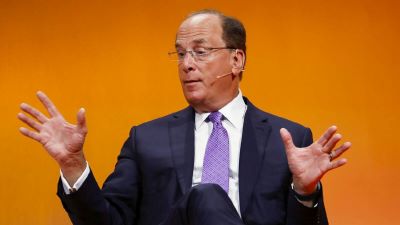
Bill Gates raised more than $1 billion in corporate funding for Breakthrough Energy Catalyst, drawing on BlackRocks Larry Fink and Microsofts Satya Nadella to rally support for some of the worlds most demanding clean-energy projects.
BlackRock is making a five-year, $100 million grant from its charitable foundation. Microsoft and the other backers — General Motors, Bank of America, American Airlines, Boston Consulting and ArcelorMittal — are providing a mix of equity capital and so-called offtakes, or purchase agreements tied to the projects.
“We’re not doing this to make money,” Fink, BlackRock’s CEO, said in an interview together with Gates on Bloomberg Television. “We’re doing this to seed these ideas, to rapidly accelerate ideas.”
Gates established Breakthrough Energy Catalyst to accelerate the commercial viability of four key solutions to the climate crisis: green hydrogen, sustainable aviation fuel, long-duration battery storage and carbon capture from the air. In practice, Catalyst will supply the cash needed to get capital-intensive projects off the ground, before debt financing and government funds can be raised to cover the remaining 90% of the cost.
Today, none of those four solutions is cheap enough to spur widespread adoption. For example, jet fuel derived from more-sustainable sources such as industrial waste or alcohol is about five times as expensive as kerosene.
ADVERTISEMENT
Ideally, the Catalyst projects will, by operating at scale, prove that the underlying technology can be cost-competitive and eliminate the “green premium” over conventional standards.
“The model here is what happened with wind and solar and lithium-ion,” Gates said. “Those products had very high prices compared to conventional techniques, and fortunately Germany and Japan and other buyers funded the scale-up, and now those products fit the normal sort of client-investing metrics.”
The difference now is speed. Governments that signed the Paris Agreement on climate in 2015 are racing to meet a mid-century goal of reaching net zero, which requires not only emissions cuts but also removing carbon dioxide from Earth’s atmosphere.
Nine of the world’s largest economies and many companies, including BlackRock, have pledged to reach that target.
“The pathway for solar and wind, that was a 30-year pathway to make it competitive with hydrocarbons,” Fink said. “We don’t have 30 years. We don’t have 10 years.”
Gates, who has estimated the cost of reaching net-zero emissions at $50 trillion, is hoping his program becomes a model for public-private cooperation to address the threat of climate change.
In August, Catalyst agreed to raise $1.5 billion in return for billions more in support, some of it contingent on legislation from the U.S. Department of Energy. Separately, Catalyst committed $500 million in June in return for matching funds from the European Commission and European Investment Bank for a similar effort across the Atlantic.
Gates first pitched Nadella and then Fink, who said he in turn had some “very serious conversations” persuading fellow CEOs to back Catalyst. ArcelorMittal is making a $100 million equity investment over five years, and American Airlines also is contributing $100 million. The other partners didn’t detail their involvement.
Up-front expense and scalability are two major differences between most tech products and clean-energy solutions. While little to no capital may be required to develop a smartphone app, even a pilot project in carbon capture can cost tens of millions of dollars.
Also, large investors have mostly steered clear of ambitious green undertakings because of uncertain returns. Gates himself has noted publicly that he “lost a lot of money” on battery development.
Fink, who oversees almost $10 trillion in assets at BlackRock, said there’s an “enormous” amount of capital waiting to invest in technology proven to reduce the green premium.
“I’m not frightened about where the money’s coming from,” he said. “I just want to make sure that we have the science and technology and the viability. Once we know that, the capital will be there.”
Coinciding with the infusion of new cash and commitments, Catalyst is inviting would-be projects to fill out a request for information. That’ll be followed by a more precise and technical request for proposal, or RFP, possibly by the end of the year.
Gates, in the interview, laid out a timeline and some parameters:
–Catalyst will start funding projects in 2022, probably several in each area.
–Funding will cover early-stage costs such as design and add up to “maybe 10%” of the total cost.
–The plan is to recruit a total of about 20 companies as anchor partners and increase the pool of private capital to $3 billion.
–Green hydrogen and sustainable jet fuel are advanced enough that they could “get to a low price” in three to four years.
“I’d be very disappointed if we don’t see a dramatic reduction in the green premium, even in less than five years,” Gates said. “Because that should let us do two rounds of projects, the first projects and then take the learning from those first two and a half years and do a second round that will bring the costs down even further.”
Catalyst is the latest in a series of initiatives that Gates has founded under the Breakthrough Energy banner. A venture-capital arm, Breathrough Energy Ventures, raised some of its money from billionaires Jeff Bezos and Michael Bloomberg, the founder of Bloomberg LP, the parent company of Bloomberg News. Catalyst is run separately and funded independently.
The State Fiscal Policy Committee on Monday approved raising Thailand’s public debt ceiling from 60 per cent to 70 per cent of GDP.
The new limit would be proposed at Tuesday’s Cabinet meeting for approval, said Finance Minister Arkhom Termpittayapaisith.
The committee, which is chaired by Prime Minister General Prayut Chan-o-cha, said it approved the hike in case the government needs to borrow more money in the medium term.
A Finance Ministry source said raising the debt ceiling would aid the government in setting its budget deficit for fiscal year 2022, which starts next month.
The government has so far borrowed 1.5 trillion baht to fund Covid-19 relief and stimulus programmes, 500 billion baht of which was approved this year. However, Bank of Thailand Governor Sethaput Suthiwartnarueput recently urged the government to borrow another 1 trillion baht to aid recovery from the pandemic.
The committee said Thailand’s fiscal position remains healthy with good debt-repayment capability.
The Stock Exchange of Thailand (SET) Index closed at 1,603.06 on Monday, down 22.59 points or 1.39 per cent. Transactions totalled 85.01 billion baht with an index high of 1,620.72 and a low of 1,601.16.
In the morning session, Krungsri Securities forecast the index would fluctuate between 1,615 and 1,635 points due to lack of positive sentiment.
It said uncertainty over a US corporate tax hike and investors’ move to delay investment to hear the result of the US Federal Open Market Committee session on September 21-22 would pressure the index.
“However, mass buy-ups of stocks which gained specific positive sentiment and whose third-quarter profit is expected to rise would help boost the index,” Krungsri Securities said.
The 10 stocks with the highest trade value today were KBANK, PTT, KCE, SCGP, BANPU, TTA, DELTA, ADVANC, HANA and PTTGC.
A report released recently by NCD Alliance during the Annual Global Week for Action on Non-Communicable Diseases (NCDs), calls for integration of NCDs prevention and care into global health initiatives and universal health coverage.
Jointly produced by the George Institute for Global Health and NCD Alliance, the report makes a call for breaking down the existing silos in global health, and reorienting NCDs services to be people-centric and to be integrated. It argues that political commitments to integrate NCDs care and control with services for priority groups – such as people living with HIV, people affected by TB and malaria, and key populations from reproductive, maternal, neonatal and child health programmes – have not translated into reality on the ground in low- and middle-income countries.
Ignoring the interconnections between these target populations, and the reality of the epidemiological shift to NCDs, is resulting in drastic consequences, more so as co-morbidities between infectious diseases and NCDs are becoming more entrenched.
Even though NCDs are the leading causes of death and disability worldwide, and co-morbidities between infectious diseases and NCDs are becoming more entrenched, healthcare in many countries does not yet respond to the needs of people living with NCDs. Covid has further intensified the need to ensure that people can more easily access simultaneous services that prevent and treat both infectious diseases such as HIV, TB and malaria, and NCDs such as cardiovascular diseases, cancers, respiratory diseases, and diabetes.
At an event organised during the report launch, the NCDs community and experts voiced their concerns and shared personal experiences regarding NCDs care and control, especially in low- and middle-income countries.
Integrated healthcare is a compelling need since very long!
ADVERTISEMENT
Global health data is an evidence that year after year, infectious diseases and NCDs have been deeply entrenched but our healthcare responses have failed to integrate effectively to prevent needless human suffering and avert untimely deaths. Even progress on health and development cross-connections has been abysmal – for instance, malnutrition and TB both continue to fuel each other.
Katie Dain, who leads the global NCD Alliance said that, “Integrated care is the future of healthcare. The reality today is that ever more people are living with multiple chronic conditions. If we have to mount an effective public health response to the world’s biggest killer NCDs, we need to ensure that people living with NCDs are recognised as equal partners with the government, the scientific community and the private sector, across policy development, implementation and monitoring, and accountability. When policies, programmes and services are co-designed with communities they are much more likely to be relevant and appropriate to their needs, scalable and sustainable. It is nothing about us without us.”
70% global deaths attributed to NCDs
NCDs account for 70% of the global deaths, killing 41 million people worldwide every year. and almost 66% of these deaths are linked to preventable causes like tobacco, alcohol, unhealthy diets, physical inactivity and air pollution. Also, the great majority (15 million) of these deaths are in people between 30 and 70 years. Then again, as per a Lancet Commission Report, 1 in 3 diseases affecting the poorest 1 billion people globally are NCDs and half of these are affecting children and young adults.
Even before the Covid pandemic less than 20 countries were on track to achieve SDGs target 3.4 (that is, reducing by one-third premature mortality from NCDs, by 2030). One of the reasons for this lack of progress could be a chronic lack of investments, as less than 2% of global financing is directed towards NCDs prevention and care even when NCDs are the major drivers of death and disease worldwide.
Globally, health systems are inequitable, inefficient and underfunded. Global health and development communities have for too long overlooked NCDs by either wrongly treating them as rich countries’ issues, or they have dismissed NCDs care as too costly. This reflects in deeply entrenched silos in global health programmes and funding, which is a real barrier to developing nations in adapting to real health needs. This siloed approach to treat all these diseases as very separate programmes is counterproductive, said Nina Renshaw, Policy and Advocacy Director, NCD Alliance.
Information is power: treatment literacy helps
Sally Agallo, a patient advocate from Kenya, shared her personal experience as a person living with HIV as well as cancer. Despite enormous odds, she somehow managed to live with HIV, which she contracted in the 90s, when no treatment was available for it. But it was not easy. She had severe mental health issues, lost two babies and faced stigma from her husband and in laws.
For Sally, lack of information about the disease is the biggest road block. “As a patient advocate I can say that a lot of people are dying not because of their disease but because of lack of information and because of not getting the required care. Lack of information also brings stigma. My husband left me when I was diagnosed with cervical cancer because he thought I could not give him a baby. What really helped me was treatment literacy training. If this compact model (of sharing correct information and treatment literacy with the patients) can be borrowed for all NCDs it would be very good. Another hurdle is the cost of treatment, which is very high. And the doctor’s room is a place where one cannot bargain”, she says.
Sally cautions that information sharing and treatment literacy training should not leave anyone behind. We must include each and everyone, including those who are visually or hearing impaired or differently abled.
People-centric approach
Jaime Barba, from Mexico is a Covid survivor who is also living with chronic obstructive pulmonary disorder (COPD), as a consequence of his tobacco smoking. He lamented that some decision makers pretend to believe that people with NCDs either do not exist or that they are collateral damages and so they do not pay any attention to them.
Comparing the NCD response to a bicycle factory that manufactures the best bicycles aimed at winning races, but with hardly any focus on the persons or the community for whom they are meant, he said that the people living with NCDs, should not be made to ride bicycles that are either too small or too big for them to fit in. “Policy makers should heed our experiences, and our needs for an efficient response. Active participation of people living with NCDs will help to change the system and focus action on people”.
Covid has further increased mortality in people living with NCDs. Their prognosis has been more severe and their access to healthcare services for their existing health conditions has been severely reduced due to the pandemic. Like many others, Jaime has not been able to visit any doctor in the past 18 months for he could not get any appointment. Then he tested positive for Covid in October 2020. He managed to survive, but psychologically it devastated him. For many days he lived with the fear of impending death. Even now, after 6 months, he suffers from post Covid problems. Some of his colleagues died for want of timely medical care- one died due to shortage of drugs to treat her hypertension.
Holistic healthcare approach
Guro Sorenson, Head Nurse at International Health Care Centre in Accra, Ghana, roots for a fully integrated and client-centred healthcare services. Although the main focus of the facility where she works are HIV positive persons, it also works as a general clinic and provides a variety of healthcare services, including for NCDs, for all. So any person who comes to the facility goes through the same patient flow at the facility. They are all seen by the same staff in the same consulting room and they all pick their medication at the same pharmacy.
“As a service provider we must provide holistic care, and when services are integrated it becomes easy to provide full care for the client. It also helps to ensure treatment adherence. In case of a client who comes because of HIV status, we are also able to take care of their other existing conditions like hypertension, diabetes etc. To our clients we are basically a one stop shop for several health services and that makes it much more convenient for them”, she says.
Global charter on meaningful involvement of people with NCDs
The NCD Alliance has also recently launched the inaugural Global Charter on Meaningful Involvement of People Living with NCDs, aiming to harness the value of lived experience in health policy, programming, and decision-making. The Global Charter lays out 10 key strategies to guarantee that the voices and concerns of people living with NCDs are considered in the response to the epidemic. It underlines that meaningful involvement is crucial at all stages – from design and planning, through to implementation, monitoring and evaluation of NCD initiatives.
By Shobha Shukla – CNS (Citizen News Service), shared under Creative Commons (CC)
(Shobha Shukla is the award-winning founding Managing Editor and Executive Director of CNS (Citizen News Service) and is a feminist, health and development justice advocate. She is a former senior Physics faculty of prestigious Loreto Convent College and current Coordinator of Asia Pacific Regional Media Alliance for Health and Development (APCAT Media). Follow her on Twitter @shobha1shukla or read her writings here http://www.bit.ly/ShobhaShukla)
The Thailand Food and Drug Administration (FDA) has yet to approve giving Sinopharm Covid-19 vaccine to children aged over three years due to inadequate information on safety and efficiency, FDA secretary-general Paisan Dankhum said on Monday.
“Sinopharm’s importer, Bio Genetech Ltd, has applied to extend the use of Sinopharm vaccine for children aged 3-17 after it had been previously approved for use in people aged 18 years and above,” he said. “However, FDA committee and experts from various agencies agreed on September 10 that there is not enough information on the safety and effectiveness of the vaccine in children aged 3-17 years, therefore the FDA did not approve the use of Sinopharm vaccine for this age group.”
Paisan added that the FDA has informed Bio Genetech to urgently submit additional documentation that support the use of the vaccine in children of that age group, including statistics from countries that have approved the use of Sinopharm in children such as China and United Arab Emirates.
The Sinopharm inactivated vaccine has been approved for use in Thailand in an emergency situation since May 28. According to statistics from Chulabhorn Royal Academy, more than 6.3 million doses of Sinopharm vaccine have been provided nationwide.
Bangkok Governor Aswin Kwanmuang said on Monday that in order to reopen the city to vaccinated foreign tourists without having to quarantine, three conditions must be met.
▪︎At least 70 per cent of Bangkok’s population must be vaccinated with two doses. The city estimates to achieve this target by October 22, followed by a seven- to 14-day interval to allow the immunity of new recipients to start rising.
▪︎ New daily infections must show a decreasing trend. Current daily infections in Bangkok are 2,700 to 2,800 people on average.
▪︎ The number of hospitalised patients should continue to decrease.
Bangkok was initially slated to reopen on October 1, but Tourism and Sports Minister Phiphat Ratchakitprakarn said the deadline should be moved back to October 15 as only 37 per cent of residents had been vaccinated.
On Wednesday, officials of the Bangkok Metropolitan Administration will hold an online meeting with the Phuket “sandbox” team to exchange experiences and draft tourism plans for the capital.
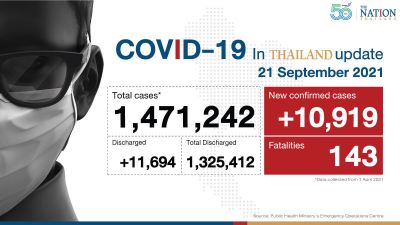
Ministry of Public Health reported on Tuesday (September 21) morning that in the past 24 hours there are 10,919 new patients who tested positive for Covid-19, 422 of whom have been found in prisons.
Death toll increased by 143, while 11,694 patients were cured and allowed to leave hospitals.
Cumulative cases in the country are at 1,500,105 with 15,612 total deaths.









 SootinClaimon.Com