India, Australia discuss Afghanistan crisis after Taliban takeover
India and Australia discuss the prevailing crisis in Afghanistan, maritime security in the Indo-Pacific region and cooperation in multilateral formats on Saturday in New Delhi.
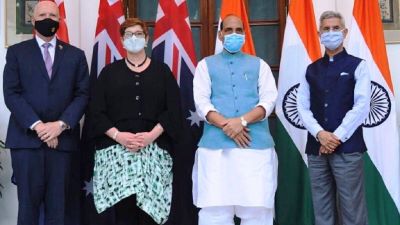
India on Saturday hosted the first-ever 2+2 ministerial dialogue in New Delhi with Australia. Defence Minister Rajnath Singh and External Affairs Minister S. Jaishankar met Australian counterparts — Defence Minister Peter Dutton and Foreign Minister Marise Payne — and discussed the crisis in Afghanistan arising out of the Taliban takeover.
After an in-depth discussion on bilateral and regional issues, Defence Minister Rajnath Singh said that the 2+2 dialogue signifies the importance of the India-Australia Comprehensive Strategic Partnership.
India and Australia share an important partnership that is based on a shared vision of a free, open, inclusive and prosperous Indo-Pacific region. “As two democracies we have a common interest in peace and prosperity of the entire region,” he said.
Singh said, “We have discussed various institutional frameworks for wide-ranging collaboration including defence cooperation and fight against the global pandemic. We exchanged views on Afghanistan, Maritime Security in the Indo-Pacific, cooperation in multilateral formats and other related topics.
During the discussions, both sides emphasised the need to ensure free flow of trade, adherence to international rules and norms and sustainable economic growth in the entire region.
On the bilateral defence cooperation, Singh said that both the countries have decided to expand military engagements across services, facilitate greater defence information sharing and work closely for mutual logistic support.
“In the context of Defence Cooperation, both sides were glad to note continued participation of Australia in the Malabar Exercises. We invited Australia to engage India’s growing defence industry and to collaborate in co-production and co-development of defence equipment,” he said.
The 2+2 dialogue is the outcome of a decision made at the India-Australia leaders’ virtual summit in June 2020 to elevate bilateral relations to a comprehensive strategic partnership. India and Australia admit that diplomatic ties between the two countries are at an all-time high right now.
PM agrees on pilot plan to welcome foreign tourists to Phú Quốc starting October
HÀ NỘI — Prime Minister Phạm Minh Chính has agreed in principle with the Ministry of Culture, Sports and Tourisms proposal on a pilot plan to welcome international tourists with vaccine passports to Phú Quốc resort island in the southern province of Kiên Giang for six months from October.
In a document issued on September 10, Deputy PM Vũ Đức Đam on behalf of the PM, asked the provincial People’s Committee to coordinate with the Ministry of Health, the Ministry of Culture, Sports and Tourism and relevant agencies to collect opinions from organisations, associations and businesses in order to develop and issue a specific plan for the implementation.
The Ministry of Health will work with the Ministry of Information and Communications, the Ministry of Public Security and the Ministry of Foreign Affairs in guiding the issuance of certificates of vaccination against COVID-19, and distributing vaccines to swiftly inoculate people living and working in Phú Quốc island city.
The ministries of Culture, Sports and Tourism; Health; Public Security; National Defence; Foreign Affairs; Transport; and Information and Communications and related agencies are required to coordinate with, guide and support the provincial People’s Committee in implementing the plan.
According to a draft pilot scheme, the plan targets foreign tourists who have been fully vaccinated against COVID-19 or those with certificates of recovery from COVID-19 recognised by an authorised agency in Việt Nam.
Eligible tourists should be given their second shots at least 14 days and no more than 12 months before entry. For those who have recovered from COVID-19, the time from hospital discharge to their entry date must not exceed 12 months. Travellers will be requested to take a RT-PCR test within 72 hours prior to their departure, and certified negative for COVID-19 in English by authorities of the country that conduct the test.
The scheme will be applied for visitors who have registered to join package tours of travel agencies.
Some potential markets which also have high vaccination coverage or having COVID-19 outbreaks were listed as selections, such as East Asia, Europe, the US, the Middle East, and Oceanian countries.
General Director of the Việt Nam National Administration of Tourism (VNAT) Nguyễn Trùng Khánh said Phú Quốc needs to speed up the vaccination for its residents, and those that will directly involved in welcoming and serving holiday makers.
Attention should be paid to developing a specific plan for the pilot programme related to medical regulations, immigration procedures, procedures to welcome and serve tourists at accommodation establishments, tourist attractions, and plans for handling medical incidents.
Phú Quốc is one of the eight “green zone” (COVID-19 free) districts and cities of the southern province of Kiên Giang. It has to date recorded five COVID-19 infections which have been successfully treated.
Under the draft plan, Kiên Giang needs to prepare human resources, materials, medical equipment and supplies, strengthen testing capacity, ensure safety plans for disease prevention and settlement of incidents.
It is also supposed to work with the tourism ministry to make a list of businesses, hotels, resorts, accommodation venues and sightseeing destinations that are ready and capable of welcoming international tourists. — VNS
LANGKAWI: The beautiful beaches and duty-free shops here will be under the spotlight come Malaysia Day when some 3,000 fully vaccinated holidaymakers make their way to this island resort under the new tourism bubble plan.
Langkawi Development Authority (Lada) chief executive officer Nasaruddin Abdul Muttalib said to prevent the spread of Covid-19, visitors must strictly adhere to the standard operating procedure and try to avoid crowded places.
“They should come early to prevent overcrowding at the airport or ferry terminals.
“They should also book their hotel or entrance ticket to places of attraction early to avoid a long queue.“Under the new normal, it’s a must for them to practise self-control by following all the standard operating procedures and avoid going to congested places,” he added.
Nasaruddin said the first batch of 3,000 visitors were expected to arrive on the first day by flight and some by sea from the Kuala Perlis ferry terminal.
“There will be 12 flights offered by several airline companies, but coming by boat is only from the Kuala Perlis terminal since the Kuala Kedah jetty has been under enhanced MCO since Monday,” he said when contacted.
Nasaruddin said flights and boat trips to Langkawi might be increased upon demand.
“It is good to start slow, so that tourists and tourism players can get familiarised with the SOP and movement control on the island.
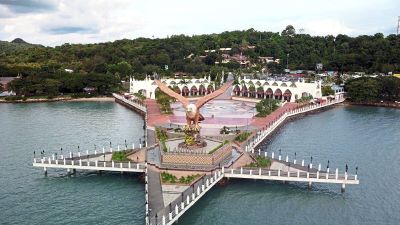
“Local visitors can enjoy Langkawi’s attractions such as the Eagle Square, Langkawi Cable Car, Underwater World Langkawi and Pantai Cenang during their trip to the island,” he added.
Nasaruddin said the reopening of Langkawi was made with careful attention and Lada had sought advice from the state Health Department, the National Security Council, and the Tourism, Arts and Culture Ministry.
Langkawi OCPD Asst Comm Shariman Ashari said tourists should strictly follow the SOP while on the island to prevent any chain of infection from taking root.
“They should practise the new norms, such as wearing face masks and observing physical distancing while visiting Langkawi.
“Comply with the tourism bubble SOP that will be issued in the near future, including obtaining travel permits from the police.
“The police will continue with our SOP compliance operation and will take action against those who violate it,” he added.
ACP Shariman also said police would assign personnel at entry points to Langkawi and would have additional manpower at public places to ensure SOP compliance.
Malindo Air public relations and government affairs director Raja Sa’adi Raja Amrin said there would be six flights from Subang to Langkawi and one from Kuala Lumpur International Airport (KLIA) to Langkawi starting Sept 16.
“Malindo Air does not offer any direct flights from Penang to Langkawi.
“However, passengers may fly to Langkawi from Penang by connecting flights via Subang Airport.
“Malindo Air also offers flights to Langkawi from KLIA,” he said in a statement to The Star.
Raja Sa’adi said the company was positive about the response to Langkawi in line with the travel bubble programme.
He added that for the month of September, an average of 55% of flight tickets to the island had been sold since the programme was announced.
“The company believes the reopening of Langkawi as a travel bubble will be of enormous value to the revival of the hard-hit aviation and tourism industries.
“Everyone in the company has been fully vaccinated to create a safer environment for our staff and customers,” he said.
Tourism, Arts and Culture Minister Datuk Seri Nancy Shukri is expected to visit the island resort on Wednesday to monitor preparations for the reopening.
She said only those who have been fully vaccinated would be allowed to visit Langkawi from Sept 16 onwards.
However, those who come from enhanced MCO areas would not be entitled to the pioneer travel bubble project relaxation.
9/11: 20 years on, Chinatown left behind in Manhattan renewal
Steven Wong was one of the volunteers to enter the World Trade Center site after terrorists attacked it 20 years ago.
Nine years later, the New Yorker was diagnosed with pulmonary fibrosis, an incurable scarring of the lungs, one of the diseases that has been connected to Ground Zero exposure. He also has asthma.
Wong received US$90,000 in compensation for his illness. But “that was nothing”, he said.
Wong said that, because of his lung disease, he was in a weakened state when he became infected with the coronavirus in early March 2020.
“My lungs are too fragile to fight against any virus. I’m 66 years old this year. How many years are there left for me?” Wong said.
When American Airlines Flight 11 struck the North Tower of the New York landmark, Wong was on Baxter Street in Chinatown.
“People were screaming, and I heard someone say the World Trade Center exploded, and someone asked, ‘Are they filming a movie?’ It was such a bright sunny day. I saw steel flakes flying in the air everywhere like snowflakes. Those steel flakes were so bright under the sun, they blurred my eyes.”
He said he called his wife as soon as possible and told her “we need to pick up our kids from school, now”.
Then they walked the streets of Chinatown for three hours. “Nothing was there, no cars, nothing,” Wong said.
He remembered that even Confucius Plaza, a building more than a kilometer from the World Trade Center, was covered with a thick layer of black dust. So were the plants outside, and they were dead, he said.
Wong is now the president of the Hotel Chinese American Association and one of the co-founders of a New York-based Asian-American advocacy group, the Coalition of Asian Americans for Civil Rights.
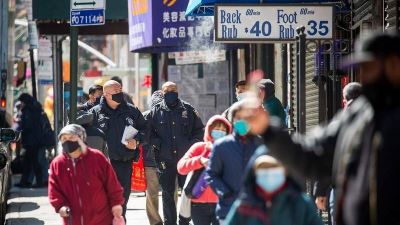
Much of Lower Manhattan has seen a dramatic revival post Sept 11, but Wong said Chinatown hasn’t.
In the first six months, Chinatown’s major businesses lost 60 to 100 percent in their revenue, according to a study by the Asian American Federation of New York.
In the first two weeks after the attacks, three-quarters of Chinatown’s workforce, about 25,000 workers, became unemployed, according to the study, and three months later, nearly 8,000 workers remained unemployed.
While millions of dollars in federal grants and assistance poured into Lower Manhattan for businesses, small businesses in Chinatown received almost one-third less funding than those in other communities, John Wang, the president of the Asian American Business Development Center, told China Daily.
“Many Chinatown businesses trade with cash; they could not show the government good business data to apply for loans or grants,” said Wang.
Wong said a continuing problem in Chinatown since the terror attacks has been a stretch of Park Row. It has historically been a major four-lane artery linking the city’s financial district to Chinatown.
It also hugs the length of the New York Police Department’s headquarters, but it has been closed to civilian traffic since the Sept 11 attacks. The police department asserts that it is necessary to protect its headquarters from a truck bomb attack.
“Before the terrorist attacks, tourist buses could drive into Chinatown from Park Row and parked in the nearby area to wait for their passengers,” Wong said. “There is no parking lot in Chinatown now, nor can the tourist buses come in. The tourism industry in Chinatown has never recovered after the attacks. But Lower Manhattan is full of vigor.”
Messages of unity, resolve mark 20th anniversary of 9/11 attacks
WASHINGTON – The greatest lesson from the Sept 11, 2001, attacks on the United States was the value of national unity, said President Joe Biden, as the country on Saturday (Sept 11) marked the 20th anniversary of the single largest loss of life from a foreign attack on American soil.
“We learnt that unity is the one thing that must never break. Unity is what makes us who we are,” Mr Biden said in his pre-taped video message.
“That is the central lesson… that at our most vulnerable, in the push and pull of all that makes us human, in the battle for the soul of America, unity is our greatest strength,” he said.
“We are unique in the history of the world because we are the only nation based on an idea… that everyone is created equal and should be treated equally throughout their lives. That is the task before us. To once again, lead not just by the example of our power, but by the power of our example.”
Sombre ceremonies in New York City, Arlington in Virginia and Shanksville in Pennsylvania marked the 20th anniversary of the terrorist attacks that killed 2,977 people from 90 nations.
Mr Biden visited all three sites, starting with New York City, where he was joined by former presidents Bill Clinton and Barack Obama, among others. They held a moment of silence at 8.46am to mark the time the first plane hit.
In his video message on the eve of the anniversary, Mr Biden said the US witnessed not only heroism, but also “the darker forces of human nature”.
“Fear and anger, resentment and violence against Muslim Americans, true and faithful followers of a peaceful religion. We saw a national unity bend,” he said.
That day in 2001, 19 militants associated with the Al-Qaeda terrorist group hijacked four commercial airplanes. Two were flown into the Twin Towers of New York’s World Trade Center, which collapsed. A third was flown into the Pentagon in Arlington just outside Washington, DC.
Crew members and passengers on a fourth plane, which was turned to head to the Capitol in Washington DC, fought with the hijackers; the plane crashed in a field near Shanksville.
Several family members of the victims in the attack in New York spoke at the ceremony, their voices often cracking with emotion.
Mr Biden said: “No matter how much time has passed, these commemorations bring everything painfully back.”
America would also “never stop” hunting down terrorists who sought to harm the nation, he warned.
The event, which reverberated across the world and sparked two wars – with the United States invading Afghanistan in 2001 and Iraq in 2003 – was marked elsewhere too.
Britain’s Queen Elizabeth, in a message to Mr Biden on Saturday, said: “My thoughts and prayers – and those of my family and the entire nation – remain with the victims, survivors and families affected, as well as the first responders and rescue workers called to duty.”
“It reminds me that as we honour those from many nations, faiths and backgrounds who lost their lives, we also pay tribute to the resilience and determination of the communities who joined together to rebuild.”
In Australia, Prime Minister Scott Morrison wrote in an opinion piece: “Sept 11 reminded us that freedom is always fragile.”
“That day was an attack on free peoples everywhere. It was an attack on our way of life and the values of liberal democracy. Despite the pain inflicted on that day, the terrorists ultimately failed in their attempts to crush our resolve and change our way of life.”
French President Emmanuel Macron tweeted: “We will #NeverForget. We will always fight for freedom.”
Indian Prime Minister Narendra Modi said the events of Sep 11, 2001, were “attacks on humanity”.
In an opinion piece in The Straits Times, Singapore Prime Minister Lee Hsien Loong wrote: “Our world changed overnight.”
“We discovered right here among us a terrorist group having a common ideology and direct links with Al-Qaeda in Afghanistan – the Jemaah Islamiah (JI) group.”
JI’s plans for attacks in Singapore were swiftly disrupted, he noted.
And “in an existential crisis, Singaporeans instinctively pulled together, and responded strongly and cohesively to keep ourselves safe”.
On his Facebook page, Mr Lee wrote: “On the 20th anniversary of 9/11, let us resolve to fortify ourselves so that should we ever face another such test one day, we will come through again, stronger, as one united people.”
In the US, the commemorations have been clouded by the swift return to power in Afghanistan, on the back of a chaotic US withdrawal, of the Taliban – the same regime that gave shelter to the perpetrators of the attacks and has never condemned Al-Qaeda for them.
Mr Lee, on a cautionary note, wrote in ST: “And now that the US has left Afghanistan, we will have to watch closely how the situation there develops, whether groups based in Afghanistan will again threaten our security, and where else new fronts of terrorism may emerge.”
Vietnam prepares to welcome international visitors at selected destinations
HCM CITY — In addition to previous plans to open Phú Quốc Island to international tourists, Hạ Long, Hội An, Nha Trang and Đà Lạt will also welcome tourists this year, under a plan developed by the Ministry of Culture, Sports and Tourism (MoCST).
The MoCST has issued a plan to stimulate travel demand, restore the tourism industry, and resume travel activities in late 2021 and early 2022 while ensuring the dual goals of disease prevention and control and socio-economic development.
It will create favourable conditions for domestic and international tourists who have valid vaccination travel certificates.
Phú Quốc in Kiên Giang Province will be the first locality to welcome international visitors in October, followed by Hạ Long in Quảng Ninh Province, Hội An in Quảng Nam Province, Nha Trang in Khánh Hoà Province and Đà Lạt in Lâm Đồng Province.
In addition to safety measures such as 5K rules and improving medical capacity to prevent the outbreak of COVID-19, the Ministry will prioritise COVID-19 vaccinations for local residents and employees in these tourism centres.
Existing tourism campaigns including “Vietnamese people traveling to Việt Nam” and “Safe and attractive local tourism” will continue, together with other programmes helping local businesses sell their tourism products at preferential prices.
Tourism products post-COVID-19 will be associated with sustainability, nature and healthcare, according to the plan. Night tourism and eco-tourism will be invested in and developed as well.
In order to start the stimulus programme, the tourism industry is expected to upgrade existing applications such as “Safe Việt Nam Tourism”, local medical declaration systems, vaccination certification systems and information systems about current tourist attractions.
The ministry has also proposed a preferential credit programme for business recovery activities and smooth employee payments. Relevant authorities are encouraged to advise local People’s Committees before rolling out the official campaigns.
Prime Minister Phạm Minh Chính had previously instructed authorities to pilot Phú Quốc as a safe destination for international tourists.
The Government plans to launch a pilot inbound tourism programme with an aim to lure 2-3 million foreign arrivals to Phú Quốc Island by the year end, according to the Prime Minister.
Addressing the cabinet meeting on Monday, PM Chính underscored that containing COVID-19 outbreak was now the highest priority while gradually reopening economic activities in safe areas.
He called for doubling efforts to get the COVID-19 pandemic under control by the end of the month but preventive measures needed to remain in place due to the shortage of vaccines.
According to Foreign Minister Bùi Thanh Sơn, head of the Government’s working group on COVID-19 vaccine diplomacy, Việt Nam had received 33 million doses of vaccines as of September 4 and the figure is expected to increase to around 50 million doses by the end of September.
As planned, on Thursday, the MoCST, together with the Việt Nam National Administration of Tourism (VNAT), discussed the detailed plan for Phú Quốc with the Kiên Giang Province People’s Committee.
Chairman of the VNAT Nguyễn Trùng Khánh said the pilot plan to welcome international tourists to Phú Quốc had been sent to relevant ministries and agencies for comments.
Accordingly, Phú Quốc will experimentally open to receive foreign visitors for a period of six months, expected from October 2021. If necessary, the time will be adjusted appropriately, depending on the actual conditions.
International tourists subjected to the piloted programme are those who have a certificate of full vaccination against COVID-19 accepted by Vietnamese authorities with the duration of the second injection not later than 14 days and not more than 12 months before the time of entry.
They should also satisfy other requirements including a certificate of recovery from COVID-19 recognised by a Vietnamese authority.
The time since they were released from the hospital after treatment until the entry date must not exceed 12 months. They must be tested for SARS-CoV-2 by RT-PCR/RT-LAMP method within 72 hours before departure and be certified by the competent authority of the country conducting the test (written in the English language) with negative results.
They should have registered to participate in the package tour programme of a travel agency.
Khánh also requested the People’s Committee of Kiên Giang Province to coordinate with the Ministry of Health to complete two vaccinations against COVID-19 for people and workers in Phú Quốc City before implementing the pilot plan.
The MoCST will take prime responsibility and coordinate with related ministries and agencies in selecting international tourist markets from countries and territories during the time of the pilot.
Those markets should have high potential, safety, and quality in COVID-19 prevention and control, such as some regions in Northeast Asia, Europe, the United States, the Middle East and Australia. Foreign tourists can enter by air via charter flights or commercial flights.
Lâm Đồng welcomes visitors
A number of tourism activities have resumed in Lâm Đồng Province. The provincial People’s Committee requires all tourism accommodation establishments of two stars or more to host no more than two people per room and operate at a capacity not exceeding 50 per cent.
Locals are allowed to take part in some sports activities, but only up to 50 per cent of people compared to normal days can experience indoor sports services.
Barbers and beauty salons, along with dining services, are open at 50 per cent capacity.
Checkpoints to prevent and control the COVID-19 outbreak within the province have been temporarily suspended. However, Lâm Đồng will continue to maintain checkpoints at the province’s gateways to neigbouring provinces to ensure the dual goals of disease prevention and control and socioeconomic development. VNS
#SootinClaimon.Com : ขอบคุณแหล่งข้อมูล : หนังสือพิมพ์ The Nation.
[Myanmar] Domestic fuel prices rise by 70 to 80 percent over the past seven months
Domestic fuel prices have risen by 70 to 80 per cent, depending on the type, over the past seven months, and the price of octane 95 Ron is increased to K1,160 per liter, according to fuel stations.
The fuel prices of September 9 are as per following: K1,160 per liter for 95 Ron, K1,140 per liter for 92 Ron, K1,115 per liter for premium diesel and K1,110 per liter for diesel, according to fuel stations.
On February 2, the fuel prices are as per following: K750 per liter for 95 Ron, K625 per liter for 92 Ron, K670 per liter for premium diesel and K660 per liter for diesel, according to figures released by the Myanmar Petroleum Trade Association (MPTA).
For more than seven months, the domestic fuel prices are increased by K410 per liter for 95 Ron, K515 per liter for 92 Ron (about 80 per cent), K445 per liter for premium diesel (about 70 per cent) and K450 per liter for diesel (about 70 per cent), respectively.
Myanmar imported around six million tonnes of fuel annually, according to the Ministry of Commerce.
In the first seven months of the current fiscal year, Myanmar imported just US$ 1.2 billion worth of 2.7 million tonnes of fuel, down more than one million tonnes from the same period last year, according to an official from the ministry.
In the first seven months of the current fiscal year, fuel imports fell by 1.002 million tonnes, reduced in value of US$ 663.347 million from a year earlier.
During that period, 1.66 million tonnes of diesel was imported, valued at US$ 721.173 million. It was down to more than 650,000 tonnes, down more than US$ 430 million from the same period last year.
Korea, China may be part of expert group monitoring Fukushima water release
The International Atomic Energy Agency will send a group of experts, possibly including some from South Korea and China, to the wrecked Fukushima nuclear power plant in December to monitor the safety and transparency of Japan’s planned disposal of treated radioactive water, an official from the agency said Thursday.
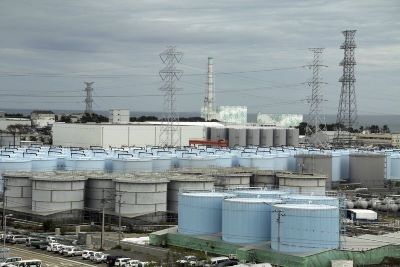
Fishers in Japan and neighboring countries, including China and Korea, reacted angrily to the Japanese government’s decision in April to dump the 1.25 million tons of wastewater it has collected since the Fukushima Dai-ichi nuclear plant was crippled by a 2011 earthquake and tsunami. The release is set to start in the spring of 2023, and the procedure is expected to take several decades.
In mind of the international community’s safety and transparency concerns, Japan requested the nuclear watchdog’s assistance to conduct reviews on the water treatment and discharge process, and to determine whether it meets safety standards.
An IAEA team led by Lydie Evrard, head of the agency’s department of nuclear security, is in Japan through Friday to meet with Japanese officials to discuss details about the monitoring process and also to visit the Fukushima site.
During a press conference in Japan, Evrad stressed that the IAEA is firmly committed to ensuring that the review is comprehensive and objective and that the results are conveyed to the international community.
She added that the IAEA will dispatch an 11-member multinational team of experts to Fukushima in December for the review, which may include experts from Korea and China.
The expert team will be asked to assess the water to be released and to evaluate the safety of the release process and the impact of its radiation on people and the environment, in accordance with IAEA safety standards.
She stressed that her team will listen to “different concerns from various stakeholders,” saying the main objective of the review is to be objective and transparent with a science-based approach.
The Japanese government and the plant’s operator, Tokyo Electric Power Company Holdings, decided to go ahead with the release in April after years of heated debate and despite protests from neighboring countries.
Japan said the decision was unavoidable, with storage space for the radioactive water expected to run out next summer.
It insists the wastewater will be filtered and diluted to remove all radioactive substances except tritium, which it says is harmless to humans in small doses.
The decision, however, was met with fierce backlash from neighbors including Korea, China and Russia, as well as from the Japanese fishing industry and environmental activists around the world. Opponents say the sheer volume of water to be released could affect human health, food safety and the maritime environment.
Last month, Korea expressed “strong regret” upon news reports that TEPCO planned to build an undersea tunnel to release the radioactive water from the power plant into the sea.
Koo Yoon-cheol, head of the Office of Government Policy Coordination, condemned Japan for unilaterally pursuing its plan without any prior consultations with Seoul or seeking its consent. He called on Japan to “immediately halt” the disposal plan and to communicate sufficiently beforehand with neighboring countries.
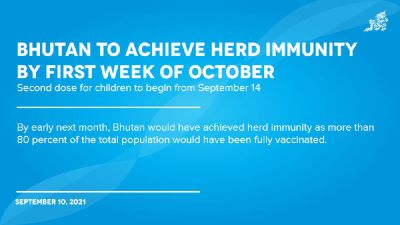
Bhutan to achieve herd immunity by first week of October
Second dose for children to begin from September 14
By early next month, Bhutan would have achieved herd immunity as more than 80 percent of the total population would have been fully vaccinated.
This would be possible following the complete immunisation (two doses) of some 60,000 children between the age of 12 and 17 years, which begins next week.
The health ministry will roll out the second round of vaccination for children in this age group between September 14 and 18. Simultaneously, the first dose of vaccine for children in this age group in the seven remaining dzongkhags would also begin.
A member of the National Immunisation Technical Advisory Group (NI-TAG), Dr Sonam Wangchuk said that with the arrival of 198,900 doses of Pfizer vaccine recently, the health ministry plans to fully vaccinate more than 59,700 children (12 to 17 years) in 13 dzongkhags and some 16,000 children in the remaining seven dzongkhags.
“Once we complete the vaccination programme, the overall vaccine coverage would be more than 80 percent,” he said, adding that the remaining 16,000 children would receive their second dose by the end of October.
Besides the 4,500 plus children in Phuentsholing and Samtse, who received the Pfizer vaccine in July, most of the eligible children have received the Moderna vaccine. However, this time, all eligible children will receive the Pfizer vaccine.
“Interchangeability between Pfizer and Moderna vaccine is recommended. People should not confuse this as mix-and-match because both the vaccines are mRNA type, manufactured by two different companies,” said Dr Sonam Wangchuk.
He said that vaccination for children would be conducted at the respective schools across all the dzongkhags.
Despite the holidays in Thimphu, Dr Sonam Wangchuk said that the coverage should not be hampered as most of the students would be vaccinated before the holidays — between September 14 and 15. “Should there be any additional students who had not received the vaccine then, we can continue after the holidays.”
The government spent over Nu 101.377 million to procure 198,900 doses of Pfizer vaccine earlier this week.
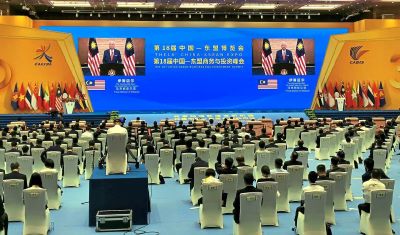
NANNING: Malaysia has proposed a cross-border mechanism between Asean and China that introduces a travel bubble and quarantine arrangement to revive the economy.
Prime Minister Datuk Seri Ismail Sabri Yaakob said recognising the vaccination certificates issued by the countries was also another area for consideration.
“By removing unnecessary barriers to trade and by rolling back on new restrictive trade measures, we could place ourselves on a steady path for economic recovery and growth.
“As such, we will be in a much better position to revive not only the tourism industry but also our people-to-people connectivity,” he said in a pre-recorded speech at the opening of the 18th China-Asean Expo (CAExpo) and China-Asean Business and Investment Summit here yesterday.
“Cross-border travel bubble is vital for recovery. We have to strive to keep the supply chain connectivity uninterrupted and to facilitate the movement of essential goods and services.
“This is critical for small and medium enterprises (SMEs), which form the backbone of our economy,” he said.
Ismail Sabri also called for Asean and its partners to intensify open trade and investment while strengthening the Regional Comprehensive Economic Partnership (RCEP).
RCEP is a free trade agreement signed in November last year by the 10 Asean members, Australia, China, Japan, New Zealand and South Korea after eight years of negotiations.
“This has demonstrated that we are committed to the transnational supply chains and keeping markets open amid the ravages of a global pandemic.
“RCEP provides immense opportunities to bolster regional supply chains and for businesses to diversify production networks.
“As we transform adversity into opportunity, this agreement will serve as an integral tool that helps us navigate our regions towards recovery and future growth,” he added.
As this year marks the 30th anniversary of the establishment of dialogue relations between Asean and China, Ismail Sabri said he was heartened to see the relations gaining strength over the years.
In 2020, China remained Malaysia’s largest export destination for the 12th consecutive year, with a total value of US$37.92bil (RM157.3bil), contributing to 16.2% of the country’s total export.
The annual CAExpo is the main Chinese exhibition participated by the Malaysian business community.
This year, 58 Malaysian companies are showcasing their products at the four-day event until Sept 13. The number was greatly reduced by over 300% last year due to cross-border restrictions and controls brought on by the Covid-19 pandemic.




 SootinClaimon.Com