The price of gold rose by Bt400 per baht weight in morning trade today (August 5), the Gold Traders Association reported.
As of 9.25am, the buying price of a gold bar was Bt29,350 per baht weight and selling price Bt29,450, while gold ornaments cost Bt28,819.16 and Bt29,950, respectively.
At close on Monday, the buying price of a gold bar was Bt28,950 per baht weight and selling price Bt29,050, while gold ornaments cost Bt28,425 and Bt29,550, respectively.
The Comex (Commodity Exchange) gold price to be delivered in December rose by US$34.7, or 1.75 per cent, to $2,021 (Bt62,684.07) per ounce, a new high at yesterday’s close.
The gold price rose more than $2,000 per ounce on hopes of a $1-trillion US economic stimulus package. Meanwhile, the decline in the US bond yield and a weakening dollar also boosted the gold price.
The Stock Exchange of Thailand (SET) Index rose by 0.83 points, or 0.06 per cent, to 1,331.64 this morning (August 5).
A stock analyst at Krungsri Securities expected the index to rise between 1,335 and 1,340 points before falling as the market gained positive sentiment from progress in negotiations between the US Congress and White House on $1-trillion (Bt31.05 trillion) economic stimulus measures.
“Besides, investments gained positive sentiment from US factory orders in June, which increased by 6.2 per cent, and the rising crude oil price,” the analyst said.
However, he said volatility caused by weak listed companies’ second-quarter performance and mass sell-offs in response to technical indicators would see a drop in the index.
“We advise investors to follow a key Monetary Policy Committee meeting today. The interest rate is expected to be maintained at 0.5 per cent,” the analyst added.
He recommended that investors buy:
> Energy stocks that benefit from the rising crude oil price, such as PTT, PTTEP, Top, PTTGC, IRPC, SPRC, and IVL.
> Stocks whose second-quarter performance is expected to improve, such as Top, PTTGC, SPRC, BGrim, CPF, TU, Asian, Tasco, STA, STGT, AP, PRM, PTL, AJ, CBG, TQM, JMT, Chayo, PTG, and BCH.
The SET Index rose 9.58 points, or 0.72 per cent, to close at 1,330.81 yesterday. The volume of total transactions was Bt55.13 billion, with an index high of 1,338.08 and a low of 1,328.13.
By Syndication Washington Post, Bloomberg · Brendan Walsh · BUSINESS U.S. equities eked out a gain as investors tried to gauge the outlook for a stimulus bill to blunt the economic impact of the coronavirus pandemic.
The S&P 500 Index ended 0.4% higher after wavering between small losses and gains throughout the day. Energy companies led the advance as crude climbed. Financial shares suffered as American International Group Inc. fell after posting a $7.9 billion loss. Treasurys rose. Argentina’s overseas notes rallied after the government reached a $65 billion restructuring deal with creditors.
With the S&P 500 less than 3% off its pre-pandemic high, U.S. equity investors are closely monitoring efforts in Washington to negotiate a new virus relief package that many see as key to keeping the economy afloat. The pressure is building as negotiators seek to shrink the wide gap that remains between Republicans and Democrats.
“We see U.S. stocks at risk of fading fiscal stimulus,” BlackRock Investment Institute strategists led by Mike Pyle wrote in a note. “U.S. employment figures are in focus this week as this fiscal cliff nears and the pandemic’s spread in Sunbelt states is starting to affect economic activity.”
Elsewhere, shares dipped in Europe, with Diageo Plc tumbling after bar closures sapped sales. Major indexes rose more than 1% in Japan and Hong Kong.
West Texas-grade crude oil rose past $41 a barrel after the biggest gain in almost two weeks Monday. Spot gold reached an intraday record.
These are some of the main moves in markets:
Stocks
– The S&P 500 Index rose 0.4% as of 4 p.m. EDT.
– The Stoxx Europe 600 Index fell 0.1%.
– The MSCI Asia Pacific Index increased 2%.
Currencies
– The Bloomberg Dollar Spot Index slipped 0.2%.
– The euro rose 0.3% to $1.1801.
– The Japanese yen rose 0.3% to 105.67 per dollar.
Bonds
– The yield on 10-year Treasurys decreased five basis points to 0.51%.
– Britain’s 10-year yield fell two basis points to 0.074%.
– Germany’s 10-year yield dipped three basis points to -0.55%.
Commodities
– West Texas Intermediate crude rose 1.5% to $41.61 a barrel.
Commercial bank have said that the Covid-19 outbreak will make more customers opt for online services.
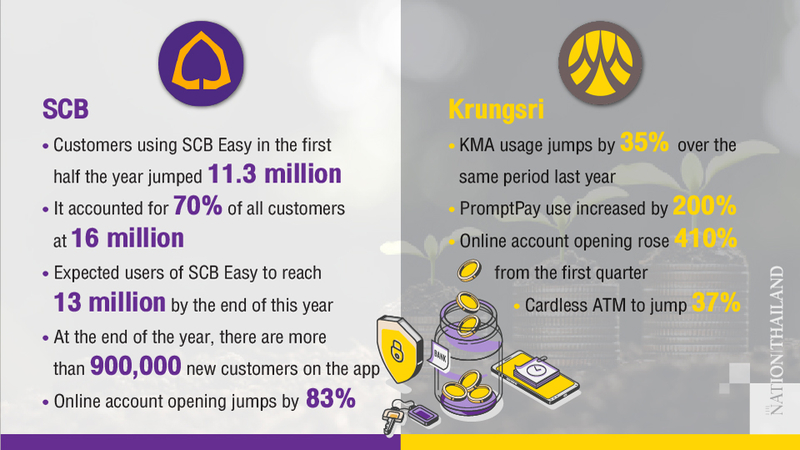
Siam Commercial Bank (SCB) saw 900,000 customers opt for online banking, while the number of online accounts jumped by 83 per cent, with the number of online customers expected to reach 13 million by the year-end.
Krungsri revealed that its app usage had jumped 41 per cent, while account opening had surged 410 per cent, showing all banks encountering additional challenges and faced with the need to accelerate the promotion of mobile-production to attract customers online.
SCB president Arak Sutivong said that in the past 2-3 years, the bank had seen a shift in customers who have increasingly migrated to digital channels, especially with financial transactions via mobile banking while the advent of a new species of coronavirus, or Covid-19, has become a catalyst for faster change in consumer behaviour.
He expected more focus on mobile banking when the Covid-19 pandemic is fully contained. The SCB Easy App downloads is expected to increase to 13 million from 11.3 million users in the first half of the year, accounting for about 70 per cent of the total 16 million SCB customers.
This year, the bank has 898,000 new customers with a 71 per cent active user ratio. In addition, online account opening has grown by over 83 per cent. Digital loan applications via digital lending SCB Easy also increased with an increase of approximately 41 per cent.
Meanwhile, Rottapron Ekabutr, senior executive of Krungsri Bank, said that the number of transactions via the bank’s mobile banking channel KMA saw a big leap after the Covid-19 crisis. The number of KMA users has increased by 35 per cent and the number of active accounts or continuous transactions increased by 50 per cent compared to the same period last year.
PromptPay transactions via KMA showed a 200 per cent growth over the previous year. Likewise, the amount of online savings accounts opened throughNational Digital ID authentication and Krungsri i-Confirm service has seen high growth. The number of accounts opened has seen a 410 per cent growth compared to the first quarter of the year, while the total amount of financial transactions in the second quarter was 740 million items with a total value of over Bt302 billion.
“When looking at past financial transactions, both money transfers, PromptPay, and non-ATM money withdrawals the Covid-19 crisis is the accelerator that makes every transaction grow online. For example, money transfers grew by 80 per cent, payments for administrative goods grew by 21 per cent, additional top-ups 24 per cent and cardless ATM up to 2.7 million times, or an increase of approximately 37 per cent from the same period last year,” said Rottapron.
However, he believes that these changes in consumer behaviour will accelerate Thailand’s progress to a cashless society. Therefore, it is a challenge for all banks to accelerate and develop mobile apps to suit the new lifestyle along with system security. The banks must accelerate the development of the business model to be able to present new products and services that meet the needs of customers, he said.
The Eastern Economic Corridor (EEC) Office of Thailand has recently called on Thai embassies in 30 countries to approach foreign firms to invest in the EEC, the office’s secretary-general Kanit Sangsubhan said.
He said the EEC’s main targets are firms in technology, logistics, medical and health sectors, adding that in France, EEC has been eyeing aviation firms, while in the US it is wooing logistic companies.
He added that the office will propose to the Cabinet this month a plan to develop a 2,000 to 3,000-rai smart city in the region to accommodate the million or so people expected to migrate to the EEC in the next 20 years.
Uncertainty over weak profit forecasts, political issues, and the global economic freeze are hammering the Stock Exchange of Thailand (SET) Index, said an expert at Tisco Securities.
Senior Tisco Securities strategist Apichat Poobunjirdkul said the Thai stock market is currently facing a correction and is likely to rise at lower rate than global indices for a while.
He said the market is currently under pressure from three factors:
1. Weak market profit forecasts: According to Bloomberg Consensus, second-quarter profits of 133 securities accounting for 76 per cent of total market capitalisation are expected to total Bt90.1 billion, down 49 per cent year on year, but up 17 per cent quarter on quarter.
“However, listed companies’ second-quarter performances showed total net profit of Bt41.2 billion, down 14 per cent from the market expectation due to banks’ move to set up allowances for doubtful debts to deal with future economic risks,” Apichat said.
“Also, we expect other stock analysts to cut their profit forecasts for listed companies further because profit in the first half of this year accounts for 35 per cent of the full-year forecast.”
2. Political issues: US-China tensions are likely to escalate as Donald Trump ups accusations against Beijing to increase his credibility with voters ahead of the US presidential election on November 3, while the political outlook in Thailand remains gloomy.
“We expect the [Thai] Cabinet reshuffle to occur this month as this will help relieve pressure among government coalition parties and enable government and civil servants to work as normal,” Apichat said.
“We advise investors to monitor the government’s work after the Cabinet reshuffle, debate on the 2021 budget, and political protests after the state of emergency expires.”
3. The global economic freeze: The world economy will weaken because economic stimulus measures are set to expire soon.
“Meanwhile, moves to impose additional measures will be delayed or insufficient to cope with the Covid-19 fallout, forcing countries to impose lockdown measures again,” Apichat predicted.
He advised investors to buy when the index falls below 1,300, focusing on stocks that show good performance and better profit forecasts, and pay interim dividends,.
“Recommended stocks in August were AP, CPF, DCC, PRM, SMPC, and TVO,” he added.
“The index’s support level this month is between 1,300 and 1,305, while the resistance level is 1,350.”
ADB loan of Bt48bn will not strain public debt, says govt
EconAug 05. 2020Credit : Public Debt Management Office, data as of June 30.
By The Nation
The Cabinet on Tuesday (August 4) approved the Finance Ministry’s proposal to borrow US$1.5 billion (Bt48 billion) from the Asian Development Bank. The loan will be used to finance Covid-19 recovery projects, said Rachada Dhnadirek, deputy government spokeswoman.
The new loan would not raise public debt in a foreign currency too high, she assured.
The ADB loanwill raise foreign currency debt to 2.46 per cent of total public debt, well within the prudent limit set at 10 per cent, she said.
The new $1.5 billion loan will be based on an exchange rate of Bt32 per dollar, equivalent to Bt48 billion. The interest rate charge is floated and referenced the six month average LIBOR rate plus 0.5 per cent risk premium. The government must pay interest every six months, or on February 15 and August 15. The ADB will also collect an annual fee of 0.15 per cent.
Regarding principal repayment, the first $500 million must be paid within 10 years, with a three-year grace period. The remaining $1 billion loan is for five years with a three-year grace period.
The first repayment on the $500 million loan is due on August 15, 2023 and the final amount on February 15, 2030.
The first repayment on the 1 billion is due on August 15, 2023 and the last instalment on June 30, 2025.
According to the Public Debt Management Office, as of June 30, Thailand’s public debt stood at Bt7.4 trillion, or 44.76 per cent of GDP. Foreign currency debt was at 1.90 per cent of total public debt – a relatively low level.
The Asian Development Bank (ADB) is loaning Thailand Bt46.7 billion (US$1.5 billion) to combat the impact of Covid-19.
“ADB is committed to providing timely support to Thailand and helping reduce the pandemic’s social and economic impacts on the country,” said ADB president Masatsugu Asakawa. “Our budget support will help fund the government’s relief packages, which aim to better prepare the country’s healthcare system for possible future waves of Covid-19, protect the vulnerable, support small and medium-sized enterprises in industries most affected by the outbreak such as tourism and manufacturing, and provide overall economic stimulus.”
ADB said Thailand remains highly vulnerable to the pandemic due to its deep integration with regional and global economies. Potential surges in Covid-19 cases could overwhelm the Thai health system, warned the bank.
ADB forecast Thailand’s economy to contract by 6.5 per cent in 2020, down from its December 2019 projection of 3 per cent growth. It said that given the country’s strong regional trade, investment and labour links, an economic crisis in Thailand could spill over into neighbouring countries like Cambodia, Laos, Myanmar and Vietnam.
Said Santi Promphat, Thailand’s acting finance minister: “[W]e believe that ADB support to member economies, including Thailand, in response to the Covid-19 pandemic will alleviate social and economic impacts in Thailand and the region.”
The loan agreement is expected to be signed by ADB and Finance Ministry representatives by the end of August in Bangkok.
ADB’s “Covid-19 Active Response and Expenditure Support (CARES) Programme” aims to restore growth and set the stage for targeted ADB private sector operations to support recovery in priority areas such as infrastructure, trade, and supply chain finance. ADB said it will also set up a framework for policy dialogue with the government on crisis response and economic recovery.
The CARES Programme is funded through the Covid-19 pandemic response option (CPRO), established in April as part of ADB’s $20-billion expanded assistance for developing member countries.
Thai government stimulus packages total Bt2.25 trillion for fiscal years 2020 and 2021, the bank noted. That includes about Bt1.2 trillion in cash assistance to 16 million informal workers and 10 million farmer households; supporting the economic and social recovery; and strengthening the healthcare system. SMEs in tourism and other sectors are provided tax incentives, as well as soft loans and debt suspension from the Bank of Thailand. The government has also drawn up a post-Covid-19 economic recovery plan. ADB estimates the stimulus packages could increase economic output by Bt1.6 trillion, or 10.1 per cent of gross domestic product.
ADB is preparing a new country partnership strategy with Thailand, which will support the economic recovery with a pipeline of green and climate-resilient infrastructure projects. The strategy will also focus on rebuilding regional cooperation through the Greater Mekong Subregion working groups on tourism, trade, transport, and health.
The Stock Exchange of Thailand (SET) Index rose 9.58 points or 0.72 per cent to close at 1,330.81 today (August 4). The volume of total transactions was Bt55.135 billion with an index high of 1,338.08 and a low of 1,328.13.
In the morning session, a stock analyst at Krungsri Securities said he expected the index to rebound between 1,330 and 1,335 before falling, as economic data from US and Europe showed signs of markets rebounding after the easing of lockdown measures.
“The price of oil dropped after the US and Euro-zone manufacturing purchasing managers index rose to 54.2 and 51.8, respectively,” the analyst said.
“The market also gained positive sentiment after a US pharmaceutical company said it had started the final phase of tests on a Covid-19 antibody.”
However, he said, uncertainty over United States’ $1-trillion economic relieve measures and listed companies’ second-quarter performance will pressure the index.
The top 10 stocks with the highest trade value today were PTT, DELTA, AOT, MINT, CPALL, GULF, STGT, CPF, KBANK, and EA.
As of 4.30pm, the price of crude oil dropped by $0.52 or 1.27 per cent to $40.49 per barrel, while gold rose by $5.60 or 0.28 per cent, to $1,991.90 per ounce.
Other Asian indices were mixed:
Japan’s Nikkei Index closed at 22,573.66, up 378.28 points, or 1.70 per cent.
China’s Shanghai SE Composite Index closed at 3,371.69, up 3.72 points, or 0.11 per cent, while Shenzhen SE Component Index closed at 13,860.46, down 104.10 points, or 0.75 per cent.
Hong Kong’s Hang Seng Index closed at 24,946.63, up 488.50 points, or 2.00 per cent.
South Korea’s KOSPI Index closed at 2,279.97, up 28.93 points, or 1.29 per cent.
Taiwan’s TAIEX Index closed at 12,709.92, up 196.89 points, or 1.57 per cent.
Almost 80 per cent of chief executive officers of large organisations in Thailand hope the new Cabinet will be able to start working immediately and with a deep understanding of local and foreign economies, according to a Krungthep Turakit newspaper survey of 100 CEOs in various sectors.
The CEOs also expected the new Cabinet to be able to work closely with the private sector.
Most of them wanted to see a strong and professional economic team in the new Cabinet.
Around 45.5 per cent expected the Cabinet reshuffle to improve implementation of economic policies, while 38.4 per cent thought the situation would remain unchanged.
Almost three-quarters (71 per cent) of CEOs wanted the new Cabinet to immediately launched short- and long-term stimulus packages to maintain economic momentum.
Asked about a possible second wave of Covid-19 in Thailand, more than 77.8 per cent said the government should have a plan to deal with a surge via collaboration with the private sector, toughened measures at tourist attractions, shopping malls and restaurants, and speeding up vaccine development.
Almost 50 per cent of CEOs believed the business sector situation would worsen in the last five months of this year if there is no vaccine. More than 50 per cent believed the Thai economy will shrink by 10 per cent this year.
The CEOs were split on whether the state of emergency should remain in place. Forty-nine per cent said it should stay while another 49 per cent said it was not necessary.
Of the total, over 50 per cent said the state of emergency had a slight impact on their businesses, while 14 per cent said it had a major impact.
Of the total CEO respondents, 21.4 per cent were from finance sector, 17.3 per cent from the energy sector, 16.3 per cent from the production sector, 16.3 per cent from the ICT sector, 15.3 per cent from the tourism sector, and the rest from export, property, auto, consumer goods, retail, agriculture and media.


 Kanit Sangsubhan
 Credit : Public Debt Management Office, data as of June 30.