Volatile months ahead for Thai bourse: experts #ศาสตร์เกษตรดินปุ๋ย

#ศาสตร์เกษตรดินปุ๋ย : ขอบคุณแหล่งข้อมูล : หนังสือพิมพ์ The Nation.

Volatile months ahead for Thai bourse: experts

EconAug 04. 2020

By The Nation

The Thai stock market would face volatility in the remaining five months of this year, asset management experts predicted. They expect the Stock Exchange of Thailand (SET) Index to move between 1,300 and 1,400 at the year-end,

Wiput Uaanant, Krungsri Asset Management’s chief equity investment officer said the Thai stock market in the remaining five months of this year would move in a narrow range compared to the first half of this year.

“The SET index at the year-end is expected to be at 1,400 as we expect the country’s economy and companies’ profits to recover gradually from the lockdown easing and monetary policy,” he said.

“Besides, the low interest rate will also help boost investment in stocks.”

He advised investors to monitor the Covid-19 impact on the economy closely.

“We recommend increasing investment in companies that benefit from the economic recovery, such as the commercial group,” he said.

He added that stocks the company weighted more than the market were food and beverage, and information and communications technology, while stocks that the company weighted less than the market were hotel, restaurant and logistics.

Theeranat Rujimethapass, Tisco Asset Management’s president, said the company expected the index at the year-end to move between 1,300 and 1,350.

“The index would rise slightly as foreign funds may flow into the market because of the low interest rate and high liquidity, while the Thai economy would recover gradually,” he said.

“Therefore, we advise investors to pick up stocks with good fundamentals and that pay high dividends.”

Somchai Amornthum, Krungthai Asset Management’s assistant to the chief executive officer of the Strategic Asset Allocation and Fund Marketing Department, expected the index at the year-end to be at 1,350 as listed companies’ profits are expected to drop by 22 per cent.

“The Thai stock market would face volatility in the remaining five months of this year even though the country’s economy may be better than in the first half of this year,” he said.

“However, the index would rise more than expected if it gains positive sentiment from news on the development of a Covid-19 vaccine.”

He advised investments in stocks that benefit from a low interest rate and show good performance.


SET rises on strong US and euro-zone economic data, Covid-19 drug news #ศาสตร์เกษตรดินปุ๋ย

#ศาสตร์เกษตรดินปุ๋ย : ขอบคุณแหล่งข้อมูล : หนังสือพิมพ์ The Nation.

SET rises on strong US and euro-zone economic data, Covid-19 drug news

EconAug 04. 2020

By The Nation

The Stock Exchange of Thailand (SET) Index rose by 9.72 points, or 0.74 per cent, to 1,330.95 on Tuesday morning.

A stock analyst at Krungsri Securities expected the index to rebound between 1,330 and 1,335 before falling, as the US and Europe’s economic data have rebounded after easing lockdown measures.

“Oil price increased after the US and euro-zone manufacturing purchasing managers index (PMI) rose to 54.2 and 51.8, respectively,” the analyst said.

“Also, the market gained positive sentiment from Covid-19 antiviral drug news after Eli Lilly & Co, a US pharmaceutical company, said it was conducting the final phase of the LY-CoV555 drug test.”

However, the analyst added that uncertainty over the US US$1-trillion economic relief measures and listed companies’ second-quarter performance would pressure the index.

The SET Index closed at 1,321.23 on Monday (August 3), down 7.30 points or 0.55 per cent. Total transactions amounted to Bt54.716 billion with an index high of 1,325.31 and a low of 1,311.25.

He recommended that investors buy:

▪︎ Energy stocks that benefit from rising crude oil price, such as PTT, PTTEP, TOP, PTTGC, IRPC, SPRC and IVL.

▪︎Electronic stocks that benefit from work from home and 5G trends, such as KCE, DELTA, HANA and SVI.

▪︎ Stocks whose second-quarter performance will improve, such as TOP, PTTGC, SPRC, SCC, BGRIM, CKP, CPF, TU, ASIAN, TASCO, STA, STGT, AP, PRM, PTL, AJ, CBG, TQM, JMT, CHAYO, PTG and BCH.

Gold price gains marginally from strengthening dollar #ศาสตร์เกษตรดินปุ๋ย

#ศาสตร์เกษตรดินปุ๋ย : ขอบคุณแหล่งข้อมูล : หนังสือพิมพ์ The Nation.

Gold price gains marginally from strengthening dollar

EconAug 04. 2020

By The Nation

The price of gold dropped by Bt50 per baht weight in morning trade on Tuesday (August 4), the Gold Traders Association reported.

As of 9.25am, the buying price of a gold bar was Bt28,950 per baht weight and selling price Bt29,050, while gold ornaments cost Bt28,425 and Bt29,550, respectively.

At close on Monday (August 3), the buying price of a gold bar was Bt29,000 per baht weight and selling price Bt29,100, while gold ornaments cost Bt28,470.48 and Bt29,600, respectively.

The Comex (Commodity Exchange) gold price to be delivered in December rose by 40 cents, or 0.02 per cent, to US$1,986.30 (Bt61,792.94) per ounce at yesterday’s close.

Gold closed in positive territory due to uncertainty following the Covid-19 impact, which continues to boost the demand for gold as a safe-haven asset. However, the strengthening dollar has caused the gold price to rise slightly.

Nasdaq sets a record as tech jumps #ศาสตร์เกษตรดินปุ๋ย

#ศาสตร์เกษตรดินปุ๋ย : ขอบคุณแหล่งข้อมูล : หนังสือพิมพ์ The Nation.

Nasdaq sets a record as tech jumps

EconAug 04. 2020

By Syndication Washington Post, Bloomberg · Claire Ballentine · BUSINESS, US-GLOBAL-MARKETS 

Stocks advanced, with tech shares leading the way, amid positive economic data and after the White House was said to consider acting on its own to boost unemployment benefits.

The Nasdaq 100 reached a record as traders sought out companies poised to do best in a stay-at-home economy. Apple Inc. set an all-time high and Microsoft Corp. gained as it tried to salvage a deal for the U.S. operations of TikTok. Europe’s benchmark gauge rose the most in two weeks after the euro area’s first manufacturing expansion in one-and-a-half years.

The dollar bounced higher following its worst July in a decade and Treasurys fell across the yield curve as data showed U.S. manufacturing expanded in July at the fastest pace since March 2019.

Stocks got a lift as the White House was said to be exploring whether President Donald Trump can act on his own to extend enhanced unemployment benefits. Investors are entering August looking past the disturbing rate of coronavirus infections and scattered moves to return major cities to lockdowns.

“Momentum begets more momentum, and the markets have been overbought we believe, but the demand to buy has been there,” said Bob Phillips, managing principal at Spectrum Management Group. “There’s a big desire from both parties to get some kind of stimulus passed. The way the market is reacting, I think the market is expecting that.”

Meanwhile, tension between the U.S. and China emerged as another threat to risk appetite. Trump said TikTok will have to close its U.S. operations by Sept. 15 — unless there’s a deal to sell the social media network’s American operations.

Elsewhere, equities rose in Japan and China, where mainland-listed technology stocks surged on expectations of support from Beijing in response to U.S. moves against Chinese-owned software companies. West Texas-grade oil traded around $41 a barrel as OPEC+ producers started supplying more crude to a global market where many countries are still struggling to contain the coronavirus.

These are some of the main moves in markets:

Stocks

–The S&P 500 Index advanced 0.7% as of 4 p.m. EDT.

–The Stoxx Europe 600 Index gained 2.1%.

–The MSCI Asia Pacific Index rose 0.4%.

Currencies

–The Bloomberg Dollar Spot Index climbed 0.3%.

–The euro decreased 0.1% to $1.1763.

–The Japanese yen weakened 0.1% to 105.98 per dollar.

Bonds

–The yield on 10-year Treasurys climbed two basis points to 0.55%.

–Britain’s 10-year yield fell one basis point to 0.10%.

–Germany’s 10-year yield was little changed at -0.525%.

Commodities

–West Texas Intermediate crude rose 1.5% to $40.87 a barrel.

–Gold rose 0.1% to $1,977 an ounce.

–Copper rose 1.6% to $2.9145 per pound.

Virus, drought slash agricultural GDP by 5.1% #ศาสตร์เกษตรดินปุ๋ย

#ศาสตร์เกษตรดินปุ๋ย : ขอบคุณแหล่งข้อมูล : หนังสือพิมพ์ The Nation.

Virus, drought slash agricultural GDP by 5.1% 

EconAug 04. 2020

By The Nation

Thai agricultural gross domestic product has plunged 5.1 per cent in the first half of this year, said the Agricultural Economics Office.

Drought and the Covid-19 pandemic has caused revenue from agriculture to contract sharply year on year, said Rapibhat Chandarasrivongs, Office secretary-general.

A months-long drought until early this year disrupted production of rice, tapioca and sugar cane, while disease also affected production of some crops, he said on Monday (August 3). However, livestock production rose 5.5 per cent year on year, compared with crops’ contraction of 7 per cent, he said. Meanwhile the virus outbreak hit farm exports.

On the bright side, Thai farm products, especially safe and high-quality foods, could take advantage of growing market demand for healthy products, he said.

Meanwhile farmers and businesses could sell more products via a combination of online and offline channels, he suggested.

Agricultural GDP for 2020 is expected to contract by 1.3 to 2.3 per cent. Increased rainfall over the wet season may increase production of farm products, said the Office.

UTCC predicts 9.4% GDP contraction, up to Bt3trn in losses #ศาสตร์เกษตรดินปุ๋ย

#ศาสตร์เกษตรดินปุ๋ย : ขอบคุณแหล่งข้อมูล : หนังสือพิมพ์ The Nation.

UTCC predicts 9.4% GDP contraction, up to Bt3trn in losses

EconAug 04. 2020Thanawat Polvichai, rector at UTCCThanawat Polvichai, rector at UTCC

By The Nation

The Covid-19 outbreak has punched a Bt2-trillion hole in the Thai economy, according to the University of the Thai Chamber of Commerce (UTCC), which has cut its projection for this year’s GDP to a 9.4 per cent contraction.

The coronavirus outbreak has already cost Thai economy Bt2.1 trillion, which could rise to Bt3 trillion if the economy does not recover in the second half of the year, said Thanawat Polvichai, rector at UTCC.

The university has almost doubled its projection of economic contraction in 2020 from 4.9 per cent to 9.4 per cent, said Thanawat, who is also chief adviser to the Centre for Economic and Business Forecasting at the UTCC.

The pandemic has severely impacted tourism, hotels, restaurants, trade, logistics and entertainment worth about Bt1.5 trillion. Meanwhile manufacturing and exports have taken a Bt500-billion hit. Drought has caused extra damage worth Bt76 billion, he said.

Exports are expected to sink this year by 10.2 per cent, gross investment by 8 per cent, and foreign tourists by 82.3 per cent to 7.03 million.

The economy in the second quarter is expected to contract by 15 per cent, further than the previous historic low of 12 per cent in the second quarter of 1998 during the Asian financial crisis, he noted.

The latest projected GDP revision is based on the assumption that the global infection rate will continue, fuelled by the second wave starting in June and having now passed the 18 million mark.

“Given the intensity of infection globally, the Thai government’s plan to welcome tourists under the travel bubble idea is unlikely to take off this year,” he said.

He also pointed out that not much of the Bt400 billion government recovery package has yet been injected into the economy.

The government should launch more stimulus packages in order to encourage consumption, he said.

Meanwhile small and medium-sized enterprises continued to face difficulty in obtaining credit despite the Bank of Thailand implementing a Bt500-billion soft loan scheme via commercial banks. He said the banks were demanding collaterals from borrowers, resulting in most SMEs being unable to access the loans.

If SMEs could not get liquidity, they will layoff about 1.9 million workers this year, he warned.

In its survey of 800 SMEs this month, the UTCC’s Centre for Economic and Business Forecasting found that 61.7 per cent of complained of being hit hard by the virus crisis, 26.9 per cent medium-hard and 11.2 per cent mildly hit.

Tourism, hotels, restaurants, health and beauty, and jewellery and handicraft are among the businesses hardest hit by virus outbreak.

The auto parts industry is among the most vulnerable as it cannot survive the downturn for more than three months.

Meanwhile food and beverage, jewellery and ornaments, wholesale, travel and recreational, hotels and accommodation, logistics, construction and property developers, are able to keep business running for six months.

Able to maintain businesses for as much as nine months are textile and fashion, handicraft, plastic and rubber production, printing, furniture and wood products, retail, restaurants and beauty service.

SMEs are demanding soft loans, a debt moratorium and tax cuts, according to the UTCC survey.

Business sentiment improves over three months, says central bank #ศาสตร์เกษตรดินปุ๋ย

#ศาสตร์เกษตรดินปุ๋ย : ขอบคุณแหล่งข้อมูล : หนังสือพิมพ์ The Nation.

Business sentiment improves over three months, says central bank

EconAug 04. 2020

By The Nation

In July, the Business Sentiment Index (BSI) had risen for three consecutive months to 42.9 in almost all sectors, with the exception of electrical appliances, though the overall index and sector sub-indices were still below the 50-threshold, reflecting low confidence even with signs of recovery, according to Bank of Thailand.  

The three-month expected BSI rose from 47 last month to 48.6 due to improved outlook in almost all sectors, especially the automotive sector, whose index floated above the 50 threshold for two months running.

Confidence in the manufacturing sector grew mainly from optimism in machinery and automotive sectors, partly due to the launch of new models at the recent motor show event. Confidence in the non-manufacturing sector also improved, partly due to improved confidence in transportation and construction sectors. 

However, the BSI in all sector sub-indices was below the 50-threshold, reflecting that most respondents were still concerned about fragile business conditions from both sluggish demand and a higher chance of a second-wave of Covid-19 infections. 

The three-month expected BSI rose to 48.6 due mainly to improved outlook in almost all sectors, especially positive views of respondents in the automotive sector reflected by the above 50-threshold for a second month running. This is possibly because the motor show helped stimulate domestic bookings. 

Similarly, the sub-indices of hotel and restaurant and transportation sectors improved significantly due to domestic tourism stimulus packages. However, the index of hotel and restaurant sector was still below the 50-threshold, showing that most respondents did not expect healthy business conditions, as revenue from domestic tourist spending cannot offset revenue lost from foreign tourists.

Covid-19 to slash Bt3.1trn from global remittances: ADB #ศาสตร์เกษตรดินปุ๋ย

#ศาสตร์เกษตรดินปุ๋ย : ขอบคุณแหล่งข้อมูล : หนังสือพิมพ์ The Nation.

Covid-19 to slash Bt3.1trn from global remittances: ADB 

EconAug 03. 2020

By The Nation

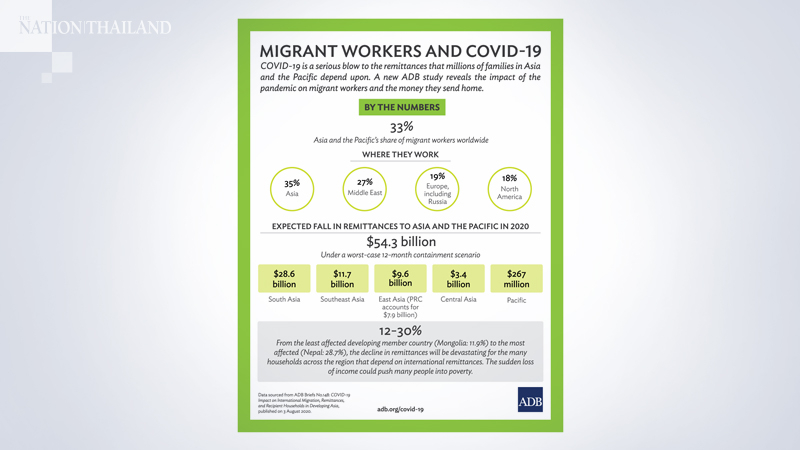
The global economy could lose more than $100 billion (Bt3.1 trillion) in remittances, warns a report by the Asian Development Bank. It adds that governments need to act fast to protect the most vulnerable in society from this loss of vital income.

Migrant workers are among the groups hardest hit by the Covid-19 pandemic, with many facing scant job security and limited access to social assistances, the report noted. Large-scale unemployment and wage reduction among migrant workers also threaten the wellbeing of many households in Asia and the Pacific who depend on remittances to meet their daily needs.

“Based on our worst-case scenario, where the Covid-19 economic impact persists throughout the year and dissipates halfway in the last three months of the outbreak, global remittances will fall by $108.6 billion [Bt3.393 trillion] in 2020,” the report said – an 18.3-per-cent drop on expected remittances. 

It added that remittances to Asia and the Pacific would fall by $54.3 billion, equivalent to 19.8 per cent of remittances in 2018.

By subregion, remittances in South Asia are expected to fall furthest, by $28.6 billion (24.7 per cent of 2018 receipts), followed by remittances to Central Asia ($3.4 billion, 23.8 per cent), Southeast Asia ($11.7 billion, 18.6 per cent), and East Asia ex-People’s Republic of China and Japan (1.7 billion, 16.2 per cent). Remittances to the Pacific will also fall ($267 million, 13.2 per cent).

The majority of the decline in remittance flows to the region is explained by a $22.5 billion fall in remittances from the Middle East, which accounts for 41.4 per cent of the total remittance loss in Asia. This is followed by a $20.5 billion slump in remittances from the United States, (37.9 per cent of total). The fall in remittances from the EU and the United Kingdom accounts for 6.3 per cent of the total, or $3.4 billion. The decline from Russia amounts to $2.1 billion, of which $2 billion reflects the decline in remittances going to Central Asia.

By percentage, the Middle East and the Russia experienced the sharpest decline – over a third – primarily reflecting the effects of low demand and oil prices on remittances.

The bank urged governments in the region to help manage the impact of Covid-19 on remittances by extending temporary social services to assist stranded and returning migrants, providing income support to poor remittance-recipient families, and designing health, labour, and skills policies to help migrants return to their jobs, or be employed in their home countries.

Egat awaits new energy minister before finalising crude palm oil purchase #ศาสตร์เกษตรดินปุ๋ย

#ศาสตร์เกษตรดินปุ๋ย : ขอบคุณแหล่งข้อมูล : หนังสือพิมพ์ The Nation.

Egat awaits new energy minister before finalising crude palm oil purchase

EconAug 03. 2020

By The Nation

The Electricity Generating Authority of Thailand (Egat) has slowed down procurement of another 100,000 tons of crude palm oil (CPO) as required by a Cabinet resolution, as it is waiting for the new energy minister’s policy.

Tawatchai Jakpaisal, Egat’s deputy governor for fuel, cited the Cabinet’s resolution on July 14, which asked Egat to consider buying 100,000 tonnes of CPO for reserve in electricity generaion and to absorb excess stock.

Egat recently told the Ministry of Energy that they should wait for the policy from the new Minister of Energy.

The bidding for the purchase of the remaining 37,550 tons of CPO has been done as specified by the Department of Internal Trade at Bt23.25 per kilogram. When calculated together with the transportation cost of Bt0.90 per kilogram, the purchase of this CPO would require a total budget of Bt900 million.

Last year, Egat had procured CPO in accordance with the government’s policy to help farmers, totalling 360 billion tons, using a budget of over Bt5 billion. Egat has already received more than Bt2 billion from the government. The remaining approximately Bt2.2 million has been requested by Egat before proceeding with purchases in the future.

Egat recently received financial support from the government — Bt525 million from the fiscal year budget, Bt1.2 billion credit for the public service account but recently approved only Bt829 million.

Egat’s three-year LNG import plan targeted 0.4 million tons at the end of the 2021, 1.9 million tons in 2022 and 1.5 million tons in 2023. The import quantity will have to be reviewed according to the situation or change in policy from the new energy minister.

Cabinet nod awaited for 160 state projects to lift economy #ศาสตร์เกษตรดินปุ๋ย

#ศาสตร์เกษตรดินปุ๋ย : ขอบคุณแหล่งข้อมูล : หนังสือพิมพ์ The Nation.

Cabinet nod awaited for 160 state projects to lift economy

EconAug 01. 2020Danucha PichayananDanucha Pichayanan

By The Nation

The subpanel tasked with screening state projects will propose another 160 projects to the Cabinet for consideration this week, subpanel chairman Danucha Pichayanan said.

These projects, estimated to cost Bt800 million, cover 58 provinces, added Danucha, who also serves as deputy secretary-general of the National Economic and Social Development Council.

The project development has been implemented under a Bt400-billion budget out of the economic stimulus package of Bt1.9 trillion to lift the battered economy.

The Cabinet in April approved a Bt1.9-trillion package to relieve the impact of the Covid-19 outbreak.

The first decree will transfer Bt80 billion to Bt100 billion to the central budget to use as stimulus funds. The second permits the Bank of Thailand to use up to Bt900 billion for measures to boost the economy.

The third decree allows the Finance Ministry to borrow up to Bt1 trillion, of which Bt600 billion will be used for cash handouts and public health and Bt400 billion will be spent on economic recovery measures.Of the Bt400 billion, one part is for state agencies to develop projects to boost the grass roots economy, and the balance for infrastructure development and to boost domestic consumption.