EEC joins hands with Huawei to prepare Thailand for digital future
Mar 19. 2021
By THE NATION
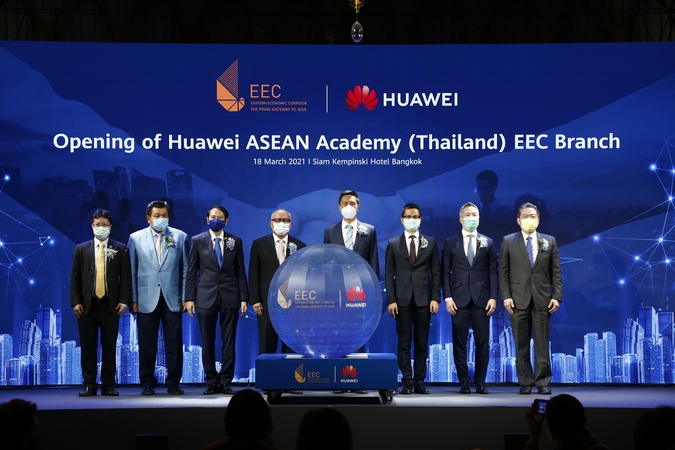
The Eastern Economic Corridor Office (EECO) and Huawei signed a memorandum of understanding that aims to make Thailand a digital hub of the region besides producing a digital workforce to meet the country’s emerging needs. The digital talent collaboration in conjunction with Huawei Asean Academy (Thailand) EEC branch aims to groom 30,000 digital workers within the next three years.
The MoU signing ceremony was witnessed by Supattanapong Punmeechaow, Deputy Prime Minister for Economy and Minister of Energy, and Yang Xin, chargé d’affaires of the Embassy of China in Thailand, at Siam Kempinski Hotel in Bangkok.
Supattanapong Punmeechaow, DPM and Energy Minister
Kanit Sangsubhan, EECO secretary-general and Abel Deng, CEO of Huawei Technologies (Thailand), signed the MoU.
“I am grateful to the EEC for cooperating with Huawei to contribute significantly to Thailand’s digital economy,” Supattanapong said.
“In addition to the MoU signing, I would also like to congratulate on the opening of the Huawei Asean Academy (Thailand) EEC branch in Chonburi. The four cooperation frameworks comprise: creating a knowledge base, experts and platforms; building an ecosystem that facilitates digital development; organising trainings to improve digital and 5G capacities; building a certification programme to create a standard for the target industries. This will significantly enable Thailand to move forward to Thailand 4.0,” the deputy PM said.
Kanit Sangsubhan, Secretary General of EEC Office
Yang said: “Despite the impact of the Covid-19 pandemic and the global economic downturn, we are very pleased to see that high-tech-led cooperation in digital economy and innovation is increasingly becoming an important new highlight of China-Thailand cooperation. In this process, Huawei has been deeply involved in Thailand for many years. It has made every effort to promote Thailand to become the first country in Southeast Asia to have commercial 5G services. Today, the Huawei Asean Academy (Thailand) EEC branch is officially established. We believe it will help cultivate more talented personnel in communications technology management and professional techniques in Thailand, help Thailand become a data centre in Southeast Asia, and create a new model of China-Thailand digital economy cooperation.”
In collaboration with Huawei, EEC aims to organise digital development courses for students and IT-related workers to train 6,000 people within 2021 and 30,000 in 2024.
“Today marks another key milestone in our efforts,” Kanit said. “The collaboration between EEC and Huawei through the Huawei Asean Academy (Thailand) EEC branch is going to combine forces which I believe would lead to digital transformation in all industries not only in Thailand but also in Asean to another level.”
Abel Deng, Huawei Thailand CEO
Abel Deng, CEO of Huawei Thailand, thanked the EECO, adding, “Huawei believes that the key to drive digital development lies in an upskilled talent foundation. We will proactively enable Thailand to become the Asean digital hub through this MoU and the Huawei Asean Academy (Thailand) EEC branch. Together with the EECO, Burapha University, all our stakeholders and friends in the EEC, we are committed to fulfilling our mission of ‘Grow in Thailand, Contribute to Thailand’ by being a technology-leading and trusted ICT partner, proactive digital transformation enabler, and continuous social value contributor, bringing digital to every person, home and organisation, for a fully connected, intelligent Thailand!”
The MoU is seen as an important milestone for digital talent development in the EEC to support the use of 5G technology.
In 2020, Huawei helped organise digital training for government, enterprises, SMEs and startups for over 16,000 people.
The Stock Exchange of Thailand (SET) Index closed at 1,563.96 on Friday, down 4.86 points or 0.31 per cent. Total transactions amounted to Bt88.71 billion with an index high of 1,566.67 and a low of 1,554.96.
In the morning session, a Krungsri Securities analyst predicted the SET would fall to a support line at 1,555-1,560 points as the US bond yield rose amid uncertainty over inflation, and the oil price fell after lockdowns were reimposed in Europe.
“Also, mass sell-offs of Thai shares after the FTSE re-weighted Thai stocks from 2.3 per cent to 2.25 per cent will pressure the index,” the analyst said.
The 10 stocks with the highest trade value today were OR, PTT, DELTA, PTTEP, CPALL, GUNKUL, BBL, PTTGC, CPF and IVL.
Other Asian indices were on the slide:
Japan’s Nikkei Index closed at 29,792.05, down 424.70 points or 1.41 per cent.
China’s Shang Hai SE Composite Index closed at 3,404.66, down 58.40 points or 1.69 per cent, while Shenzhen SE Component Index closed at 13,606.00, down 357.92 points or 2.56 per cent.
Hong Kong’s Hang Seng Index closed at 28,990.94, down 414.78 points or 1.41 per cent.
South Korea’s KOSPI closed at 3,039.53, down 26.48 points or 0.86 per cent.
Taiwan’s TAIEX Index closed at 16,070.24, down 217.60 points or 1.34 per cent.
The Stock Exchange of Thailand (SET) Index dropped by 4.22 points, or 0.27 per cent, to 1,564.60 in the morning session on Friday.
A Krungsri Securities analyst predicted the SET would fall to the support line between 1,555 and 1,560 points due to rising bond yield amid uncertainty over inflation and falling oil price after many European countries reimposed lockdown measures.
The US bond yield had risen over 1.7 per cent, while oil price had fallen below US$60 per barrel on Thursday.
“Besides, mass sell-offs of Thai shares after the FTSE rebalanced Thai stocks from 2.3 per cent to 2.25 per cent would pressure the index,” an analyst said.
He recommended investors buy:
▪︎ AOT, MINT, CENTEL, AAV, BA, CPN, CRC and MAJOR, which benefit from positive news of the Covid-19 vaccine in Thailand.
▪︎ HANA, KCE, TU and CPF, which benefit from the weakening baht.
▪︎ CBG, ICHI, SAPPE, RBF, DOD, IP, TACC, GUNKUL and KISS, which benefit from positive news on hemp production and its general use.
The SET Index closed at 1,568.82 on Thursday, up 2.06 points or 0.13 per cent. Total transactions amounted to Bt81 billion with an index high of 1,583.30 and a low of 1,567.67.
The price of gold dropped by Bt50 per baht weight in the morning trade on Friday, the Gold Traders Association reported.
As of 9.33am, the buying price of a gold bar was Bt25,250 per baht weight and selling price Bt25,350 while gold ornaments cost Bt24,801.76 and Bt25,850, respectively.
On Thursday’s close, the buying price of a gold bar was Bt25,300 per baht weight and selling price Bt25,400 while gold ornaments cost Bt24,847.24 and Bt25,900, respectively.
Spot gold price fell to US$1,731 (Bt53,513) per ounce after rising by $5.4 to $1,732.5 on Thursday, due to the US Federal Reserve’s signal that it would maintain interest rate at a low level until 2023. But gold gained some positive sentiment from the fall in the US stock market.
Hong Kong gold dropped by HK$60 to $16,040 (Bt63,846) per tael, the Chinese Gold and Silver Exchange Society reported.
By Syndication Washington Post, Bloomberg · Claire Ballentine, Vildana Hajric
Stocks fell from record highs, oil slumped and Treasury yields touched some of the highest levels in more than a year amid concern the Federal Reserve risks letting inflation accelerate.
The rout in risk assets picked up in the afternoon, starting with a sell-off in crude. Oil plunged 8% on concern new restrictions in Europe will hamper demand. Two weeks ago it soared past $65 a barrel to the highest in almost two years.
The spike in Treasury yields dented demand for tech shares with high valuations, sending the Nasdaq 100 Index tumbling 3.1%. Swings in asset prices also picked up as they often do around major expirations of options and futures contracts, such as tomorrow’s ‘quadruple witching’ event.
“We’re seeing a pattern where an uncomfortable spike in the 10-year Treasury reminds equity investors that their tech stocks are trading well above average,” said Mike Bailey, director of research at FBB Capital Partners.
Ten-year Treasury yields climbed to 1.75% for the first time since January 2020, while the 30-year breached 2.5% for the first time since August 2019 in the wake of Wednesday’s Federal Reserve meeting. Fed Chairman Jerome Powell’s apparent willingness to keep pumping support into the economy and let it run hotter has spurred bets on faster growth and inflation, sending market expectations of price pressures to multi-year highs.
Oil plunged as vaccination efforts in some parts of the world stalled, casting uncertainty over the speed of an economic recovery and a full rebound in global oil demand. West Texas Intermediate crude futures declined for a fifth session, the longest stretch of daily losses in more than a year.
U.S. curve climbed on the Fed’s assurance of support
Read: Treasury Yields Top 1.75% After Powell Spurs Bets on Inflation
In Asia and Europe, stocks were boosted by lingering enthusiasm from the Fed’s outlook for stronger growth. Automakers and banks, which tend to outperform during cyclical upswings, were higher in Europe. Japan’s Topix jumped past the 2,000 mark for the first time since 1991, becoming the region’s top-performing major equity index this year.
Japan’s government bond yields rose on a Nikkei report that the Bank of Japan is considering widening the trading range around the 10-year target, which could spur concerns about policy tightening.
These are some of the moves in markets:
Stocks
The S&P 500 Index sank 1.5% to 3,915.50 as of 4:02 p.m. EDT, the lowest in more than a week on the largest tumble in three weeks.
The Dow Jones industrial average sank 0.5% to 32,862.37, the biggest dip in two weeks.
The Nasdaq Composite Index sank 3% to 13,116.17, the lowest in more than a week on the largest tumble in three weeks.
The Nasdaq 100 Index sank 3.1% to 12,789.14, the lowest in more than a week on the biggest tumble in three weeks.
The Stoxx Europe 600 Index rose 0.4% to 426.59.
Currencies
The Bloomberg Dollar Spot Index rose 0.5% to 1,139.39, the biggest advance in more than a week.
The euro fell 0.5% to $1.1915, the largest fall in more than a week.
The British pound fell 0.3% to $1.3928.
South Africa’s rand weakened 0.9% to 14.7799 per dollar, the largest fall in more than a week.
Bonds
The yield on two-year Treasurys gained two basis points to 0.16%, the highest in more than a week on the biggest advance in more than a week.
The yield on 10-year Treasurys jumped eight basis points to 1.72%, the highest in about 14 months.
The yield on 30-year Treasurys gained five basis points to 2.47%, the highest in almost 20 months.
Germany’s 10-year yield climbed three basis points to -0.26%, the highest in almost three weeks.
Britain’s 10-year yield increased five basis points to 0.875%, the highest in more than 21 months.
Commodities
West Texas Intermediate crude sank 8% to $59.41 a barrel, hitting the lowest in almost four weeks with its fifth straight decline and the largest tumble in 11 months.
Gold weakened 0.6% to $1,734.60 an ounce, the biggest fall in more than a week.