CPF banks on overseas expansion to fuel growth #ศาสตร์เกษตรดินปุ๋ย

#ศาสตร์เกษตรดินปุ๋ย : ขอบคุณแหล่งข้อมูล : หนังสือพิมพ์ The Nation

https://www.nationthailand.com/business/30379838?utm_source=category&utm_medium=internal_referral

CPF banks on overseas expansion to fuel growth

Dec 25. 2019
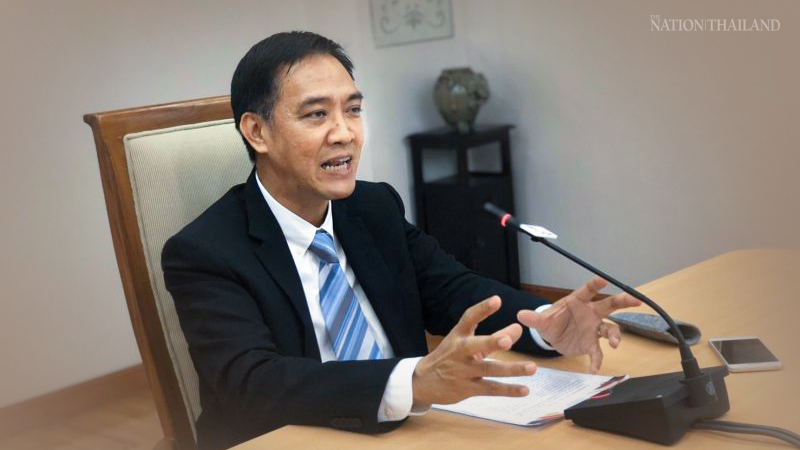
Charoen Pokphand Foods PLC (CPF) aims to expand its overseas business and is confident of its financial performance in 2019 meeting targets thanks to positive returns from investments in Thailand and 17 countries, chairman of CPF’s executive committee, Adirek Sripratak, says.

Charoen Pokphand Foods PLC (CPF) aims to expand its overseas business and is confident of its financial performance in 2019 meeting targets thanks to positive returns from investments in Thailand and 17 countries, chairman of CPF’s executive committee, Adirek Sripratak, says.
By The Nation

890 Viewed

Charoen Pokphand Foods PLC (CPF) aims to expand its overseas business and is confident of its financial performance in 2019 meeting targets thanks to positive returns from investments in Thailand and 17 countries, chairman of CPF’s executive committee, Adirek Sripratak, said.

His statement echoed a belief that amid weakening purchasing power, the food business will thrive due to persistent demands especially for the products that are safe, traceable, as well as environmentally and community-friendly.

“CPF is the producer of reasonable protein-rich food, be they chicken, pork, shrimps, fish and eggs, which are all people’s main staple. Importantly, CPF adopts an integrated production process. I’m confident that CPF’s business will experience no negative impacts and will flourish as always,” he said.

Adirek revealed that in 2020 CPF will maintain its focus on growing its business, which entails additional investments in potential countries including the 17 countries where CPF’s businesses are located. Among the destinations with high growth opportunities are China, Vietnam, India, the Philippines, Russia and the United States.

CPF’s business growth has been driven mainly by overseas investments in 17 countries, which bring more than 70 per cent of the company’s revenue of more than Bt500 billion. The revenue generated in Thailand is approximately 27-28 per cent of total revenue while exports from Thailand constitute only 5 per cent. Though exports are affected by the dollar-baht exchange rate, imports of raw materials have balanced the foreign exchange impacts.

Adirek admitted that a drought, anticipated to be more severe next year, may negatively affect Thailand’s agricultural sector which relies heavily on water. However, he added that CPF’s livestock business was supported by abundant water sources but the company may face a slight increase in production cost due to the cyclical adjustment in raw material prices. Amid this situation, CPF will maintain its emphasis on production efficiency, cost management, and the quality of products and services, he said.

Outlook of the new emerging market landscape in 2020 #ศาสตร์เกษตรดินปุ๋ย

#ศาสตร์เกษตรดินปุ๋ย : ขอบคุณแหล่งข้อมูล : หนังสือพิมพ์ The Nation

https://www.nationthailand.com/business/30379835?utm_source=category&utm_medium=internal_referral

Outlook of the new emerging market landscape in 2020

Dec 26. 2019
By Manraj S. Sekhon,
Chief Investment Officer
Franklin Templeton Emerging Markets Equity

880 Viewed

“Emerging markets are at a rare inflection point with multiple crosscurrents. We believe they remain promising for investors who can overlook near-term volatility and invest for the long term.”

Emerging markets are at a rare inflection point with multiple crosscurrents. A combination of the ultra-loose monetary policy hangover from the global financial crisis, a low global growth environment from weak manufacturing and industrial activity, the continued rise of the consumer, and the disruption and opportunities of the new economy have provided a heady mix, said Manraj Sekhon,

Chief Investment Officer of Franklin Templeton Emerging Markets Equity.

Addressing uncertainties

While market sentiment in 2019 was weighed down by easing growth concerns, emerging market growth is forecast by the International Monetary Fund to accelerate in 2020 and remain more than double that of developed markets. Improving fiscal, economic and monetary policies and a renewed focus on structural reforms in many emerging markets has been gaining traction.

Supported by more conducive monetary policies in developed economies and easing inflationary pressures, central banks in emerging markets generally turned more dovish in 2019. We expect this trend to continue in 2020, as policymakers have greater flexibility in stimulating economic activity.

Although US-China trade tensions have de-escalated in the short term on rising expectations of a partial trade deal and plans for both countries to scale back tariffs, we expect the broader economic conflict to remain for some time. The impact from the trade conflict has not been limited to China. While US imports from China over the last year declined US$35 billion to US$497 billion, China’s imports from the United States decreased by more than US$40 billion to US$125 billion.Therefore, we believe a comprehensive agreement remains in the best interests of both sides. The Trump administration will be acutely aware of this heading into an election year.

Opportunities in 2020

China’s initiatives to strengthen and diversify its economy have been largely overshadowed by trade and slowing growth fears. The government’s focus on economic restructuring and long-term sustainable growth has led to an acceleration in the implementation of structural reforms and widespread industry consolidation, as well as the development of local supply chains in the technology space to replace US sources.

China will be a frontrunner in the 5G arena and is expected to have some 600 million 5G subscribers by 2025, or about 40 per cent of the forecasted 1.6 billion subscribers globally.

Together with artificial intelligence (AI) and robotics, this will help drive growth in China’s new economy as it strives to become less reliant on the United States. In our view, China will emerge stronger and more self-reliant with multiple pillars of economic support through this crisis.

Taiwan is seeing some spillover benefits from the trade war as its companies start onshoring some operations. Government incentives to attract operations back to Taiwan mean that this will have ripple effects on the domestic economy.

As one of the largest and fastest growing markets for digital consumers, India is a market where disruptive technology is driving productivity and deflation more than generally expected, with value accruing to end-users. Key reforms including the recent reduction in corporate tax rates, measures to improve the regulatory environment and monetary easing will likely steady its economy.

In Brazil, optimism surrounding the government’s economic agenda has resulted in a more favorable investment climate. While the country’s economic recovery has been slower than expected, we believe government and central bank efforts are improving the country’s longer-term growth potential. Inflation has remained under control, allowing the central bank to ease rates to record lows to stimulate the economy. Social security reform is key to stimulating investment and credit, which will help improve economic activity and can significantly reduce Brazil’s fiscal deficit. A major privatisation plan has also been announced, and tax and other structural reforms should improve the ease of doing business.

New emerging market Landscape

The emerging market landscape continues to transform as policymakers focus on building resilience during times of stress. Emerging market economies are more diversified now, with domestic consumption and technology offering new drivers of growth, and are growing less reliant on low-cost manufacturing and commodities. Since the turn of the century, we have witnessed a significant increase in the trade value of high-tech goods being exported by emerging market countries.

We have also seen how companies are using innovation and technology to leapfrog and disrupt traditional business models. Areas such as e-commerce, digital banking and mobile computing will be fundamental drivers of emerging markets for years to come. Equally, fields such as AI, autonomous driving, robotics and the “Internet of Things” continue to attract investment, signaling strong longer-term prospects.

Staying the course

Much noise and conflicting signals dominated 2019, which led many investors to limit their risk appetite and discount the long-term growth drivers in emerging markets. While some of these uncertainties may persist in the near term, we believe it is essential to stay the course. The markets are just beginning to realise opportunities from technology disruption and the transition of businesses away from traditional models.

We believe the investment scope in the emerging world is wide and promising for investors who can overlook near-term volatility and invest for the longer term.

What are the risks?

All investments involve risks, including possible loss of principal. Stock prices fluctuate, sometimes rapidly and dramatically, due to factors affecting individual companies, particular industries or sectors, or general market conditions.

Special risks are associated with foreign investing, including currency fluctuations, economic instability and political developments. Investments in developing markets, of which frontier markets are a subset, involve heightened risks related to the same factors, in addition to those associated with these markets’ smaller size, lesser liquidity and lack of established legal, political, business and social frameworks to support securities markets. Because these frameworks are typically even less developed in frontier markets, as well as various factors including the increased potential for extreme price volatility, illiquidity, trade barriers and exchange controls, the risks associated with developing markets are magnified in frontier markets.

China’s imports of U.S. soy surge to highest in about two years #ศาสตร์เกษตรดินปุ๋ย

#ศาสตร์เกษตรดินปุ๋ย : ขอบคุณแหล่งข้อมูล : หนังสือพิมพ์ The Nation

https://www.nationthailand.com/business/30379846?utm_source=category&utm_medium=internal_referral

China’s imports of U.S. soy surge to highest in about two years

Dec 26. 2019
Soybeans are loaded into a truck at a grain elevator in Ohio, Illinois, on June 19, 2018. MUST CREDIT: Bloomberg photo by Daniel Acker

Soybeans are loaded into a truck at a grain elevator in Ohio, Illinois, on June 19, 2018. MUST CREDIT: Bloomberg photo by Daniel Acker
By Syndication Washington Post, Bloomberg · Bloomberg News

988 Viewed

China’s imports of U.S. soybeans rose to the highest in 20 months in November after more American cargoes cleared customs ahead of the signing of a partial trade deal in January.

China’s inbound shipments from the U.S. surged to 2.6 million tons, the highest since March 2018, and up from about 1.1 million tons in October. China imported almost no U.S. soybeans in November last year, customs data show.

Chinese companies are likely to continue purchasing American soybeans as the two countries are expected to sign the partial trade deal in early January.China has been issuing regular tariff waivers for domestic firms to buy U.S. soybeans.The waivers cover the 30% retaliatory tariffs on American soybeans.China’s total commitments in the current marketing year hit 10.5 million tons, compared with 2 million tons the previous year, U.S. Department of Agriculture data showed.

China is reviewing retaliatory tariff exemptions for $60 billion of U.S. goods and will release a list of products eligible for an exemption at an “appropriate time,” China’s customs said in a statement.

Retail petrol prices to come down by Bt1/litre #ศาสตร์เกษตรดินปุ๋ย

#ศาสตร์เกษตรดินปุ๋ย : ขอบคุณแหล่งข้อมูล : หนังสือพิมพ์ The Nation

https://www.nationthailand.com/business/30379839?utm_source=category&utm_medium=internal_referral

Retail petrol prices to come down by Bt1/litre

Dec 25. 2019
Energy Minister Sontirat Sontijirawong

Energy Minister Sontirat Sontijirawong
By THE NATION

1,127 Viewed

Retail prices of all petrol types will be cut by Bt1 per litre from December 26 to January 10 next year, following a resolution of the Oil Fund’s administration committee on Wednesday (December 25) to lower contributions to the fund.

Energy Minister Sontirat Sontijirawong said the move will ease the cost of living. The Oil Fund had Bt38.409 billion as of December 24.

Sontirat also outlined the ministry’s missions next year under the Energy For All policy.

He said he would push hard for the negotiations between Thailand and Cambodia early next year on the overlapping sea area. There has been much progress in the country’s framework for negotiations , he added.

The ministry also aims to finish early next year the revision of five long-term comprehensive energy plans.

The ministry is promoting the use of B10 diesel and all petrol stations nationwide have been instructed to make B10 diesel available from March 2020. The sale volume of B10 is expected to reach 57 million litres per day by the middle of next year.

Border trade drops 2.97 per cent in first 11 months of year #ศาสตร์เกษตรดินปุ๋ย

#ศาสตร์เกษตรดินปุ๋ย : ขอบคุณแหล่งข้อมูล : หนังสือพิมพ์ The Nation

https://www.nationthailand.com/business/30379834?utm_source=category&utm_medium=internal_referral

Border trade drops 2.97 per cent in first 11 months of year

Dec 25. 2019
By The Nation

956 Viewed

Border trade in the first 11 months of 2019 fell 2.94 per cent year on year to Bt1.23 trillion, the Department of Foreign Trade under the Commerce Ministry revealed.

Keerati Rushchano, director-general of the department, said that Malaysia remained Thailand’s top trade partner among border countries with Bt476 billion, down 8.76 per cent, followed by Laos Bt181 billion, Myanmar Bt180 billion and Cambodia Bt146 billion while border trade with the southern province of China was worth Bt118 billion — up 25.31 per cent — followed by Singapore Bt67 billion and Vietnam Bt60 billion.

The lower border trade was attributed to the baht’s appreciation, the global economic slowdown, and the trade war between the US and China.

Trade with Malaysia has decreased constantly due to fall in exports of rubber products and computers, exports of diesel, car and parts to Laos declined, while exports of cattle products, diesel oil products, non-alcoholic beverages, fabric and threads to Myanmar decreased.

Meanwhile, exports to South China grew 25.31 per cent. The most favourable products were fresh fruit and vegetables, computer parts and dried longan. The trade situation with Singapore worsened due to a decrease in the export of combustion machines, computers and circuits while exports of fresh fruit and vegetables, non-alcoholic drinks and dried longan to Vietnam declined.

Govt revenue up 5 per cent in the first two months of fiscal year 2020 #ศาสตร์เกษตรดินปุ๋ย

#ศาสตร์เกษตรดินปุ๋ย : ขอบคุณแหล่งข้อมูล : หนังสือพิมพ์ The Nation

https://www.nationthailand.com/business/30379833?utm_source=category&utm_medium=internal_referral

Govt revenue up 5 per cent in the first two months of fiscal year 2020

Dec 25. 2019
 Lavaron Sangsnit, director-general of the Fiscal Policy Office

Lavaron Sangsnit, director-general of the Fiscal Policy Office
By THE NATION

1,306 Viewed

The government’s net revenue in the first two months of the current fiscal year — October to November — rose 4.7 per cent year on year to Bt413.6 billion, Lavaron Sangsnit, director-general of the Fiscal Policy Office, said on Wednesday. The revenue was 1.6 per cent higher than the target, he said.

The Excise Department collected Bt107.4 billion, jumping 36.8 per cent. But the Revenue Department saw its tax collection down by 8.1 per cent to Bt252.4 billion compared to the corresponding period last year. Customs Department revenue fell by 12.1 per cent to Bt17.4 billion. However, remittances from state-owned enterprises totalled Bt67.9 billion, up 12.4 per cent. Government budget disbursement in the two months was Bt 549.5 billion.

Treasury reserves stood at Bt340.8 billion.

Vietnam beauty market boasts excellent growth potential #ศาสตร์เกษตรดินปุ๋ย

#ศาสตร์เกษตรดินปุ๋ย : ขอบคุณแหล่งข้อมูล : หนังสือพิมพ์ The Nation

https://www.nationthailand.com/business/30379830?utm_source=category&utm_medium=internal_referral

Vietnam beauty market boasts excellent growth potential

Dec 25. 2019
Customers shop for cosmetics at a supermarket in HCM City. — VNS Photo Xuân Hương

Customers shop for cosmetics at a supermarket in HCM City. — VNS Photo Xuân Hương
By Viet Nam News

1,336 Viewed

HCM CITY — The personal care sector has enjoyed strong growth of 7 per cent a year on average, higher than the fast moving consumers goods (FMCG) market, thanks to the skincare and make-up segment, according to a study by global data and consulting company Kantar Worldpanel.

Rapid economic growth and higher living standards are shaping changes in Vietnamese lifestyles and needs.

Urbanites now spend not only on basic products but also on aspirational demands.

Besides being able to afford advanced beauty products, Vietnamese women are not hesitant about paying more for premium products that are capable of bringing about significant skin improvements.

The cosmetic market has been offering a wide range of beauty products, welcoming new brands, new variants, and new formats every day, which effectively stimulates consumer spending.

Also, the current digital world has opened a new door for new players entering the market.

Health and beauty stores, including cosmetic stores and pharmacies, continue growing in importance thanks to the entry of new players like Pharmacity, Watsons and Hello Beauty.

This channel remains the key for beauty categories since shoppers can look for physical testing, professional advice and recommendations in real time.

Additionally, with digital transformation, these stores offer a “phygital” experience which brings together the best from online and brick-and-mortar stores.

Easy access to the internet, especially via mobile phones, enables Vietnamese consumers to keep abreast of beauty trends faster, research product information more easily and shop conveniently online.

Noticeably, 80 per cent of incremental spending on beauty products comes from online shopping, according to the latest Omnichannel report.

In order to bring an omnichannel shopping experience to consumers, a number of brands are starting to build their own retail formats such as websites, chains and, lately, subscription models.

The phenomenal growth in popularity of Korean culture is clear across multiple aspects of Vietnamese life from TV dramas, movies, music, and reality TV shows to cuisine, travel and beauty.

In cosmetics, South Korea ranked first among countries exporting to Việt Nam in 2018 with nearly a third of the market. Korean brands are consistently expanding as the fastest growing brands in terms of shopper base, predominantly in the make-up and mask segments.

Potential for growth

According to experts, there is enormous room for growth in many beauty categories, which are still underdeveloped.

The Kantar report said two out of five Vietnamese households have never bought beauty products. But following the global beauty trend, Vietnamese are more willing to stretch their budget for advanced beauty solutions such as skincare devices and beauty supplements.

The rising need for self-indulgence has led to a great opportunity for beauty care beyond facial care. Professional hair care products, hand and body care, nail styling are all emerging, and have great potential to attract spending in the years to come.

Tran Quang Thang, director of the HCM City Institute of Economics and Management, said, “The middle class, who spend a lot on cosmetics, is set to grow to 33 million by 2020.”

This again points to huge potential for growth.

Nguyen Van Minh, deputy chairman of the Vietnam Association of Essential Oils, Aromatherapy and Cosmetics, said many famous foreign cosmetic brands had entered by opening representative offices, companies and factories and through agents and distributors, including high-end brands like Esteé Lauder, Lancome, Shiseido, Fendi, Clairins, and L’Oreal.

Some local cosmetics brands such as Thorakao, Saigon Cosmetic, Lana, Biona, and Sao Thái Dương had also achieved a certain position in the market though they still held a small share. — VNS

Somkid outlines new tasks for economic and social development council #ศาสตร์เกษตรดินปุ๋ย

#ศาสตร์เกษตรดินปุ๋ย : ขอบคุณแหล่งข้อมูล : หนังสือพิมพ์ The Nation

https://www.nationthailand.com/business/30379828?utm_source=category&utm_medium=internal_referral

Somkid outlines new tasks for economic and social development council

Dec 25. 2019
By THE NATION

719 Viewed

Deputy Prime Minister Somkid Jatusripitak on Wednesday (December 25) assigned new tasks to the National Economic and Social Development Council (NESDC) to push forward the economy.

They have been asked to work with related state agencies to draw up plans for the next phase of the Eastern Economic Corridor (EEC) development, including plans to protect the environment and boost the incomes of people in the EEC.

The council will have to work closely with the Bank for Agriculture and Agricultural Cooperatives to design packages to solve the poverty problem and reduce the debt of people.

Moreover, it has to work with the Board of Investment (BOI) to create new tax incentive packages to create new economic activities.

Somkid also wants the council to seek ways to solve the debt problem of small and medium-sized enterprises.

He also told the council to work with related ministries to draw up a human resource development plan.

He added that the council and the BOI should work together to seek ways to boost the tourism sector to enable it to absorb the workforce laid off from the industrial sector.

Amnesty International urges govt. to stop harassing flash mob activists #ศาสตร์เกษตรดินปุ๋ย

#ศาสตร์เกษตรดินปุ๋ย : ขอบคุณแหล่งข้อมูล : หนังสือพิมพ์ The Nation

https://www.nationthailand.com/news/30379852?utm_source=category&utm_medium=internal_referral

Amnesty International urges govt. to stop harassing flash mob activists

Dec 26. 2019
By THE NATION

446 Viewed

Amnesty International, a UK-based non-governmental organization released a public statement on Tuesday (December 24) urging the Thai government to end the judicial harassment of the political opposition, human rights defenders and activists in Thailand who participated in peaceful protests.

Amnesty International was referring to the one-hour flash mob protest on December 14 at the Pathumwan skywalk in Bangkok, led by Future Forward Party (FWP) leader, Thanathorn Juangroongruangkit, who said that the gathering of his supporters was just a precursor to the “real rally” in January.

After the event, Thanathorn and FWP members were summoned by the authorities for possible violation of laws in organizing the flash mob. Amnesty International therefore urged Thai government to stop using the provisions of the Public Assembly Act that excessively restrict the right to peaceful assembly, and Article 116 – Thailand’s sedition law – which is extensively used to stifle peaceful dissent of activists, human rights defenders, journalist and lawyer.

Thanathorn decided to organize the event after the Election Commission petitioned the Constitutional Court to dissolve Future Forward Party over Thanathorn’s Bt191-million loan, which it alleged was illegal for a political party. On November 20, the Constitutional Court unseated Thanathorn as a member of Parliament. The court ruled that he had registered to run in the March election while still holding shares in a media company, in violation of the law.


The full statement is as follow:

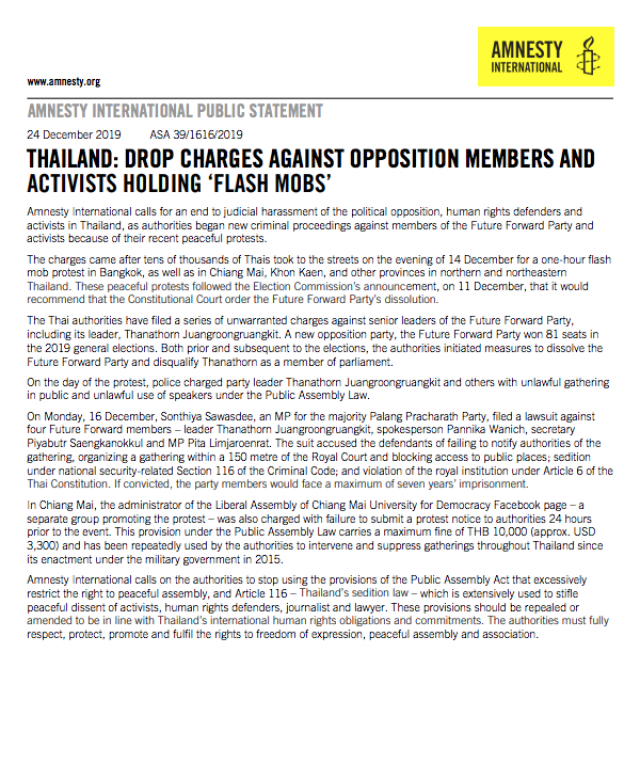
THAILAND: DROP CHARGES AGAINST OPPOSITION MEMBERS AND ACTIVISTS HOLDING ‘FLASH MOBS’

Amnesty International calls for an end to judicial harassment of the political opposition, human rights defenders and activists in Thailand, as authorities began new criminal proceedings against members of the Future Forward Party and activists because of their recent peaceful protests.

The charges came after tens of thousands of Thais took to the streets on the evening of 14 December for a one-hour flash mob protest in Bangkok, as well as in Chiang Mai, Khon Kaen, and other provinces in northern and northeastern Thailand. These peaceful protests followed the Election Commission’s announcement, on 11 December, that it would recommend that the Constitutional Court order the Future Forward Party’s dissolution.

The Thai authorities have filed a series of unwarranted charges against senior leaders of the Future Forward Party, including its leader, Thanathorn Juangroongruangkit. A new opposition party, the Future Forward Party won 81 seats in the 2019 general elections. Both prior and subsequent to the elections, the authorities initiated measures to dissolve the Future Forward Party and disqualify Thanathorn as a member of parliament.

On the day of the protest, police charged party leader Thanathorn Juangroongruangkit and others with unlawful gathering in public and unlawful use of speakers under the Public Assembly Law.

On Monday, 16 December, Sonthiya Sawasdee, an MP for the majority Palang Pracharath Party, filed a lawsuit against four Future Forward members – leader Thanathorn Juangroongruangkit, spokesperson Pannika Wanich, secretary Piyabutr Saengkanokkul and MP Pita Limjaroenrat. The suit accused the defendants of failing to notify authorities of the gathering, organizing a gathering within a 150 metre of the Royal Court and blocking access to public places; sedition under national security-related Section 116 of the Criminal Code; and violation of the royal institution under Article 6 of the Thai Constitution. If convicted, the party members would face a maximum of seven years’ imprisonment.

In Chiang Mai, the administrator of the Liberal Assembly of Chiang Mai University for Democracy Facebook page–a separate group promoting the protest – was also charged with failure to submit a protest notice to authorities 24 hours prior to the event. This provision under the Public Assembly Law carries a maximum fine of THB 10,000 (approx. USD 3,300) and has been repeatedly used by the authorities to intervene and suppress gatherings throughout Thailand since its enactment under the military government in 2015.

Amnesty International calls on the authorities to stop using the provisions of the Public Assembly Act that excessively restrict the right to peaceful assembly, and Article 116 – Thailand’s sedition law –which is extensively used to stifle peaceful dissent of activists, human rights defenders, journalist and lawyer. These provisions should be repealed or amended to be in line with Thailand’s international human rights obligations and commitments. The authorities must fully respect, protect, promote and fulfil the rights to freedom of expression, peaceful assembly and association.

Constitutional Court accepts petition for FWP dissolution #ศาสตร์เกษตรดินปุ๋ย

#ศาสตร์เกษตรดินปุ๋ย : ขอบคุณแหล่งข้อมูล : หนังสือพิมพ์ The Nation

https://www.nationthailand.com/news/30379832?utm_source=category&utm_medium=internal_referral

Constitutional Court accepts petition for FWP dissolution

Dec 25. 2019
By THE NATION

1,805 Viewed

The Constitutional Court on Wednesday (December 25) accepted the petition from the Election Commission of Thailand for the dissolution of the Future Forward Party (FWP), according to Section 72 and Section 92(3) of the Political Party Organic Law B.E. 2560.

Section 72 prohibits political parties and their officers from receiving donation of money or assets from any sources which they know are unlawful or have reasonable doubts of it being unlawful.

Section 92(3) allows the Constitutional Court to consider dissolving any political party that violates Section 72.

In the next step, the court will send a copy of the petition to FWP, giving it an opportunity to explain the allegation within 15 days after receiving the copy.

On December 11, the Election Commission filed a petition to the Constitutional Court, asking it to consider dissolving FWP over a loan of Bt191 million from its leader Thanathorn Juangroongruangkit to the party which may have violated the election and political party laws.

Regarding the petition made by lawyer Nuttaporn Toprayoon on June 18, accusing FWP leader Thanathorn Juangroongruangkit, FWP secretary-general Piyabutr Saengkanokkul and four FWP board members of attempting to overthrow the democratic regime with the king as the head of state according to Section 49 in the 2017 Constitution, the court said the case had enough evidences for the trial to continue without further investigation, according to Section 58(1) of the Constitutional Court’s Trial Procedures Organic Law B.E. 2561.

The Constitutional Court therefore will continue the trial and will read its verdict on Tuesday (January 21) at 11.30 am.