New Year gift in store for SMEs, says Somkid #ศาสตร์เกษตรดินปุ๋ย

#ศาสตร์เกษตรดินปุ๋ย : ขอบคุณแหล่งข้อมูล : หนังสือพิมพ์ The Nation

https://www.nationthailand.com/business/30379762?utm_source=category&utm_medium=internal_referral

New Year gift in store for SMEs, says Somkid

Dec 24. 2019
Deputy PM Somkid Jatusripitak

Deputy PM Somkid Jatusripitak
By THE NATION

1,733 Viewed

As a New Year gift to Small and Medium-sized Enterprises (SMEs), Deputy Prime Minister Somkid Jatusripitak said on Monday (December 23) that he had ordered the setup of a working panel, tasked with preparing support measures to ease their financial burden.

The committee will comprise representatives from the Finance Ministry, Bank of Thailand, the Thai Bankers’ Association and the private sector. The measures are expected to be submitted to the Cabinet on January 7, 2020.

SME owners will return from their New Year break to good news, Somkid said.

He added that Prime Minister Prayut Chan-o-cha had asked related parties to look into the procurement law, in order to seek access for SMEs to participate in bidding for state projects.

U.S. new-home sales rise to cap best three months since 2007 #ศาสตร์เกษตรดินปุ๋ย

#ศาสตร์เกษตรดินปุ๋ย : ขอบคุณแหล่งข้อมูล : หนังสือพิมพ์ The Nation

https://www.nationthailand.com/business/30379772?utm_source=category&utm_medium=internal_referral

U.S. new-home sales rise to cap best three months since 2007

Dec 24. 2019
By Syndication Washington Post, Bloomberg · Vince Golle 

1,352 Viewed

Sales of new U.S. homes increased in November, capping the best three months for demand since 2007 and reflecting sustained momentum in a residential real estate market that’s helping to underpin the economy.

Single-family home sales rose 1.3% to a 719,000 annualized pace from a downwardly revised October, government data showed Monday. In the three months through November, purchases averaged a 720,000 pace, the strongest in 12 years. An index of U.S. homebuilder stocks pared losses following the report.

Increased demand for new homes is being fueled by historically cheap borrowing costs, the lowest jobless rate since the 1960s and stronger income growth. The strength in housing should continue to fuel gains in residential construction, a direct input into the government’s calculation of gross domestic product.

At the same time, low supplies continue to put upward pressure on prices, offsetting some of the boost in affordability from low interest rates and wage gains. The median sales price of a new home increased 7.2% from a year earlier to $330,800 in November.

Following a separate report Monday showing a slight gain in core capital goods orders, the home-sales figures underscore consumer-led economic growth as business- investment cutbacks restrain manufacturing.

Data last week showed sales of previously owned homes, which make up the vast majority of the market, declined in November as lean inventory continued to restrain an industry with otherwise solid growth. New-home sales are considered a timelier barometer than those of previously- owned homes, which are calculated when contracts close.

Purchases of new homes rose in two of four U.S. regions, led by a 52.4% surge in the Northeast and a 7.5% gain in the West, which recorded its highest sales level in two years.

Economists in Bloomberg’s survey projected an annualized pace of 732,000 new-home sales for November after a previously reported 733,000 a month earlier. Estimates ranged from 696,000 to 765,000.

The supply of homes at the current sales rate dropped to 5.4 months from 5.5 months in November. The number of new homes for sale held at 323,000.

The number of properties sold for which construction hadn’t yet started increased, while the number of partially built dwellings climbed to the highest level since July 2016. The figures indicate a robust pipeline for homebuilders.

Changes in the seasonally adjusted data are volatile and have a wide margin of error. There’s a 90% chance that the monthly percentage change was between a 9.7% decline and a 12.3% increase, according to the U.S. Census Bureau. The report is published jointly by Census and the Department of Housing and Urban Development.

Blockchain, alternative energy to disrupt power industry #ศาสตร์เกษตรดินปุ๋ย

#ศาสตร์เกษตรดินปุ๋ย : ขอบคุณแหล่งข้อมูล : หนังสือพิมพ์ The Nation

https://www.nationthailand.com/business/30379763?utm_source=category&utm_medium=internal_referral

Blockchain, alternative energy to disrupt power industry

Dec 24. 2019
 Several manufacturers and retailers such as Tesco and BigC have deployed solar cell panels on their rooftops, says Prasit Siritiprussamee, director of engineering and regulatory department at the office of the Energy Regulatory Commission.

Several manufacturers and retailers such as Tesco and BigC have deployed solar cell panels on their rooftops, says Prasit Siritiprussamee, director of engineering and regulatory department at the office of the Energy Regulatory Commission.
By Wichit Chaitrong

The Nation

2,405 Viewed

The arrival of blockchain technology and alternative energy will disrupt the current electricity generating and trading system, say experts.

As the slide in solar cell price continues with increasing numbers of businesses and households turning to solar energy, power supply and consumption will see a dramatic change.

Several manufacturers and retailers such as Tesco and BigC have deployed solar cell panels on their rooftops, said Prasit Siritiprussamee, director of engineering and regulatory department at the office of the Energy Regulatory Commission.

Should storage technology progress, then it would disrupt the way we produce and trade electricity, he said at seminar recently hosted by the Economic Reporters Association.

Currently, Electricity Generating Authority of Thailand(Egat) is the only   buyer of power from large plants. However, in the near future, there would be multiple buyers while a large number of households will also become  electricity producers, he said.

Blockchain technology will lead to a new system of electricity trading where peer to peer transaction is a possibility as opposed to  producers selling only to Egat.

There are eight peer to peer energy trading projects being tested in sandbox experiment by the Energy Regulatory Commission. Small production has the advantage of staying closer to consumers, meaning that energy loss and energy transmission cost is lower.

“About 200 applicants filed for the sandbox experiment but only eight were accepted. We figured that the rest could learn from these pilot projects. Also, it would spare them the expenses involved in an experiment,” he said.

The new way of electricity production and trading have the potential to disrupt the existing system.

If more small producers join in, large electricity generating plants run by state enterprises would have to reduce production capacity which might affect their previous investments.

Those who still buy electricity from the Metropolitan Electricity Authority and Provincial Electricity Authority might have to shoulder higher cost of excessive investment in large electricity plants.

Prasit said that regulators must ensure a smooth transition to the scenario of multiple-producers and buyers of electricity. Asked about when the big change will happen, he replied that nobody know what would happen after the next three years,

Sathapon Patanakuha, CEO and founder of Smart Contract, said his company has been facilitating peer to peer energy trading among households and factories via blockchain technology. Home owners could sell and buy electricity produced by roof top solar panels among themselves.

Alternative energy, mainly solar energy, is estimated to account for 9 per cent of total supply in Thailand.

It remain a small proportion but growing fast, Sathapon said.

Meanwhile, Veerapol Chirapraditkul, director of the Energy Fund Administration Institute, said state enterprises must get a fare share from previous investment in electricity infrastructure because new producers will still depend on power lines and other facilities for energy trade.

SET index barely up at 0.04% #ศาสตร์เกษตรดินปุ๋ย

#ศาสตร์เกษตรดินปุ๋ย : ขอบคุณแหล่งข้อมูล : หนังสือพิมพ์ The Nation

https://www.nationthailand.com/business/30379759?utm_source=category&utm_medium=internal_referral

SET index barely up at 0.04%

Dec 23. 2019
By The Nation

909 Viewed

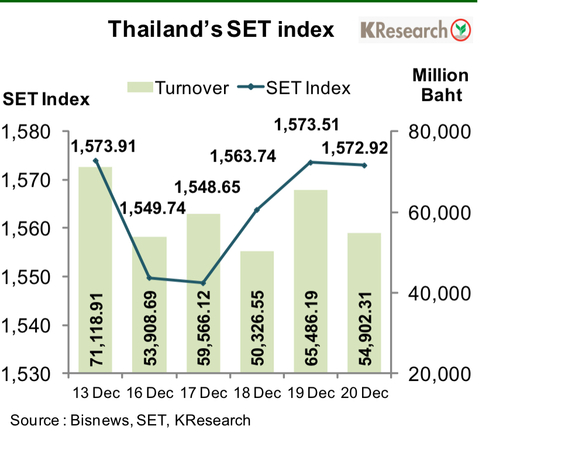
The SET Index on Monday (December 23) closed at 1,573.57, barely changing from Friday’s close, up 0.04 per cent with turnover of Bt42.9 billion. KSecurities predicts resistance at 1,590 and 1,600 for this week.

Investors were disappointed with November exports, which declined by 7.39 per cent year-on-year to US$19.7 billion (Bt593.5 billion), compared to market forecasts of a 4.5 per cent decrease and following a 4.5 per cent drop in October. Total exports between January and November shrank 2.8 per cent from the corresponding period a year earlier. The Commerce Ministry predicts exports will grow by 3 per cent this year, while most research houses forecast negative growth.

Regarding the SET index outlook for this week until December 27, Kasikorn Securities expects the SET to touch 1,565 to 1,555 points, but face resistance at 1,590 to 1,600 points. The key issues to watch include November exports, year-end window dressing, the US-China trade situation and Brexit. Important US indicators include November new home sales and durable goods orders. Other international factors that warrant close monitoring include the latest Bank of Japan minutes, Japan’s November industrial production and retail sales, plus China’s November industrial profits.

The SET index on Friday closed near previous week’s level, ending at 1,572.92 points, down 0.06 per cent over the week. The average daily trading value was Bt56.8 billion, down 4.32 per cent over-week. The MAI closed at 310.49 points, down 1.4 per cent over-week. The SET index dropped early in the week on sell-offs by foreign and institutional investors amid concerns over domestic political issues, although there were signs of easing trade tensions between the US and China.

However, the SET rebounded midweek, supported by large-cap stock purchases, especially in the banking and telecommunication sectors, as a result of window dressing and long-term equity funds as well as retirement mutual funds investment, added Kasikorn Securities.

Court dismisses Thanathorn’s misconduct lawsuit against EC officials #ศาสตร์เกษตรดินปุ๋ย

#ศาสตร์เกษตรดินปุ๋ย : ขอบคุณแหล่งข้อมูล : หนังสือพิมพ์ The Nation

https://www.nationthailand.com/news/30379798?utm_source=category&utm_medium=internal_referral

Court dismisses Thanathorn’s misconduct lawsuit against EC officials

Dec 24. 2019
Thanathorn Juangroongruangkit

Thanathorn Juangroongruangkit
By THE NATION

1,520 Viewed

The Central Criminal Court for Corruption and Misconduct Cases on Tuesday (December 24) dismissed a case in which Future Forward Party leader Thanathorn Juangroongruangkit sued Election Commission chairman Itthiporn Boonprakong and seven EC officials for what he claimed was violation of Article 69 of the Election Commission Organic Law BE 2560 and for professional misconduct under Article 157 of the Criminal Code.

Thanathorn claimed the defendants unfairly rushed the investigation of the case involving him holding shares in V-Luck Media, which has caused him damage, forcing him to lose his MP status and defaming him.

The Election Commission investigation eventually led to a Constitutional Court verdict which saw Thanathorn losing his member of Parliament status on May 23. The court found he had registered to run in the March election while holding shares in a media company, in violation of the law.

Police to summon Thanathorn over skywalk gathering #ศาสตร์เกษตรดินปุ๋ย

#ศาสตร์เกษตรดินปุ๋ย : ขอบคุณแหล่งข้อมูล : หนังสือพิมพ์ The Nation

https://www.nationthailand.com/news/30379756?utm_source=category&utm_medium=internal_referral

Police to summon Thanathorn over skywalk gathering

Dec 23. 2019
By The Nation

1,401 Viewed

Police will summon Future Forward Party leader Thanathorn Juangroongruangkit and party member Pirattachot Chantara-Khajon to Pathumwan police station on December 27 at 10 am after Palang Pracharath Party member Sonthiya Sawasdee filed a complaint against Thanathorn over a gathering on the Pathumwan intersection skywalk on December 14, Bangkok metropolitan police chief Pakkapong Pongpetra said on Monday (December 23).

Other core Future Forward members – secretary-general Piyabutr Saengkanokkul, spokeswoman Pannika Wanich and MP Pitha Limcharoenrat – have not received any summon yet.

Officers sent a letter of request to the Parliament president to issue a warrant for both Thanathorn and Pirattachot.

Pakkapong affirmed that there is no persecution in this case.

Police have accused them of violence under the Public Assembly Act of 2015, gathering without seeking permission, blocking or obstructing people from accessing a train station, obstructing the public from using a public place or causing unreasonable inconvenience to any person, and using an electric amplifier without notifying the police.

As workers grow disgruntled, China strikes at labor activists, jails U.S.-educated activist #ศาสตร์เกษตรดินปุ๋ย

#ศาสตร์เกษตรดินปุ๋ย : ขอบคุณแหล่งข้อมูล : หนังสือพิมพ์ The Nation

https://www.nationthailand.com/news/30379806?utm_source=category&utm_medium=internal_referral

As workers grow disgruntled, China strikes at labor activists, jails U.S.-educated activist

Dec 25. 2019
By The Washington Post · Gerry Shih 

480 Viewed

BEIJING – When the young labor activist and blogger Chen Weixiang helped street cleaners in southern China campaign for better wages by organizing demonstrations and publicizing their case online in 2014, he succeeded in winning them improved conditions.

When he tried again this month, acting for a different set of laborers, he did not.

Chinese authorities seized the prominent activist last week and punished him with a jail stint of at least two weeks for “provoking quarrels and stirring troubles,” according to a person with direct knowledge of his case who spoke on the condition of anonymity for fear of official reprisal.

The case of the U.S.-educated Chen, who ran a microblog called “Heart Sanitation,” illustrates how a brand of nonviolent labor activism that was once tolerated by Chinese authorities is now off-limits in a country facing stiff economic head winds and deepening political insecurity.

“What he was doing would be seen as normal in China, even in the early years of the Xi Jinping administration,” said Elaine Hui, a labor scholar at Pennsylvania State University who studied alongside Chen when he obtained a master’s degree there in 2016. “Now, there is zero tolerance for dissent.”

Chen’s penalty was relatively light by China’s standards. But he is likely the 140th worker, activist or student to be arrested or detained in the past 18 months, according to data kept by the China Labor Crackdown Concern Group, a coalition of Chinese and foreign activists and academics.

The labor crackdown amounts to one of the largest campaigns to suppress civil society groups in China under Xi, the Chinese leader who has spoken this year about the risks facing the ruling Communist Party as it navigates rising unemployment and the most difficult economic conditions in decades.

In meetings of senior officials in January, Xi stressed the need for a “high degree of vigilance” against political and economic challenges, while a key ally, Wang Huning, told cadres of the need to “defuse major risks” that could undermine the party’s rule.

In the past year, authorities have severely punished students from elite universities for trying to organize electronics workers. They have also sentenced several nonprofit workers and bloggers for advocating for sick construction workers. China’s government has not commented on the labor crackdown, and police in Guangzhou declined to answer questions about Chen.

Ground zero both for activists and the government response has been southern Guangdong province, which has been rocked by strikes, factory relocations and closures as China’s exports dip.

For years when the economy was booming, strikes and labor disputes were often overlooked as part of China’s maturation process, said Li Qiang, founder of China Labor Watch, a nonprofit based in New York.

Today, Li said, the government sees “labor friction like a furnace – it can ignite at any time.”

Meanwhile, a larger national conversation about social inequality and economic uncertainty has roiled Chinese society.

From January through the summer, professional soccer players who were not getting paid launched a public protest and likened their plight to that of migrant construction workers.

This month, the urban middle class turned against Huawei after former employees said they were wrongfully imprisoned after challenging the technology giant for compensation they said they were owed.

The stories struck a nerve. One popular Chinese blogger compared the firm to an “evil elephant” that used its clout to squash ordinary worker “ants.” Countless other posters on Weibo, China’s answer to Twitter, likened Huawei’s top executives to privileged royalty while employees toiled long hours and without protections. Huawei has accused the employees of extortion and denied wrongdoing.

Labor advocates say pressures on the working class in China’s south – and the prospect of mass, mobilized protesters – worry authorities most.

Sanitation workers and street cleaners – the type of workers Chen sought to help – have held 15 strikes this year, according to Geoff Crothall of China Labor Bulletin, a Hong Kong nonprofit. That’s up from 11 the previous year.

“There’s such an uptick, a critical load, in workers determined to defend their rights” compared with previous years, Crothall said. “That’s why the government sees it as such a sensitive issue.”

Chen’s arrest this month, his supporters say, would have been difficult to imagine in 2011, when he first became involved in the sanitation workers’ cause.

Still an undergraduate medical student at Sun Yat-sen University in Guangzhou, Chen observed campus cleaners holding protests to demand higher pay. He began interviewing street cleaners to weave together biographical essays that illustrated their poor working conditions and meager compensation – the kind of writing that would come to define his activism.

He abandoned his medical career and shifted into labor activism full-time by 2014, when he helped sanitation workers hold repeated strikes and mass demonstrations in southern China that resulted in the effective doubling of their minimum pay to $360 a month, said Yu Wucang, a sanitation worker who campaigned alongside Chen.

The most serious repercussion Chen faced then was that his university threatened to fail him. So he continued studies at Penn State – where he helped organize a graduate-student union – and later worked as an intern at the University of California at Berkeley.

He returned to China and became known for running the Heart Sanitation blog that solicited essays from street cleaners.

In recent months, Yu, the sanitation worker, said he discussed with Chen about posting less on social media as he saw other activists disappear one by one. Chen confessed that security officials were often summoning him for talks.

“I told him, don’t be too forward, don’t be too direct,” Yu said. “Maybe we have already done quite a lot for the cause.”

Chen went ahead last week and posted on his website the demands from 130 street cleaners for about $280,000 in wages they said they were owed.

Three days later, he was driven from his home in a minivan by roughly 10 security officials, his supporters said.

“In southern China, everyone is getting locked up,” Yu said.

How ISIS women and their children are being left stranded in the desert #ศาสตร์เกษตรดินปุ๋ย

#ศาสตร์เกษตรดินปุ๋ย : ขอบคุณแหล่งข้อมูล : หนังสือพิมพ์ The Nation

https://www.nationthailand.com/news/30379771?utm_source=category&utm_medium=internal_referral

How ISIS women and their children are being left stranded in the desert

Dec 24. 2019
Bint Fatma in her tent with her infant son in al-Hol on Dec. 5. MUST CREDIT: Photo by Alice Martins for The Washington Post.

Bint Fatma in her tent with her infant son in al-Hol on Dec. 5. MUST CREDIT: Photo by Alice Martins for The Washington Post.
By The Washington Post · Louisa Loveluck, Souad Mekhennet, Loveday Morris, Alice Martins 

849 Viewed

AL-HOL, Syria – Heavily pregnant and a continent from home, 21-year-old Bint Fatma could find no doctors in her corner of the internment camp.

She waited hours in the October sun, fearing she was about to lose her baby, before guards agreed to take her to a clinic. There were no doctors there either, she said, and so it was decided: She would go back to her tent and await whatever God intended.

Outside, the nights were getting cold, she recounted earlier this month; sickness was spreading like wildfire. Beyond the chain-link fences, a war was brewing.

As with thousands of women from around the world, Bint Fatma’s journey from the Netherlands to this camp in the desert had taken her through the Islamic State’s rise and fall and into the heart of a global debate. Governments worldwide have been wrestling with the question of whether women like Bint Fatma are conspirators or victims – and whether bringing them home is a moral imperative or a security risk. At stake, too, is the future of thousands of children born into the caliphate through no fault of their own.

Women contributed to the Islamic State’s propaganda and often became complicit in its crimes. Bint Fatma was among some 20,000 women who would stick it out to the end, when the last redoubt of the caliphate was overrun by U.S.-backed forces early this year and its final denizens were trucked to these tents in a dust bowl.

The Washington Post first met the young woman in late July near the entrance to the sprawling al-Hol camp in northeast Syria, home to about 70,000 women and children. Wearing a black burqa that concealed her growing belly, Bint Fatma removed her face covering for much of the interview, revealing brown eyes and slim features. She was garrulous, sometimes wary, and kept her eyes on her 3-year-old son throughout, soothing him gently as he scrambled around. The Washington Post has agreed to identify her by a family nickname only, out of concerns for her safety if it became widely known among camp residents she was speaking to the media.

With conditions deteriorating and radicals cementing control inside the camp, Bint Fatma described al-Hol as a “different world.” She wanted to go home to the Netherlands but knew the government was leery.

“I don’t know what my ending is,” she said.

As summer slipped into fall and debate raged back home, the need for that ending would become urgent. Her neighbors were trying to re-create their lost caliphate, enforcing its strictures with fear and violence. Then Turkey’s invasion of northern Syria placed the camp in peril and put her baby’s life in the balance.

The story of how her government – and others around the world – would decide the fate of the Islamic State women and children was fast becoming a historic test of what countries in the West and beyond were made of: Could they remain true to the principles they vaunted and still uphold the duty to safeguard their people?

– – –

Two weeks after her 16th birthday, Bint Fatma set off in 2014 for the caliphate, disguising her journey as a school trip, according to an account from her eldest sister, Meriam. Bint Fatma’s class was going to Belgium, she told her family, and they had no reason to be suspicious. She’d been to Berlin the year before, sending her family photographs of her wearing the Muslim veil, covering her head and shoulders, that she had recently adopted.

Her mother, a Moroccan immigrant, called Bint Fatma’s cellphone several times to check on her school trip. When there was no answer, it didn’t immediately ring alarm bells. But when she didn’t return home on the Friday, the family’s unease deepened with every passing hour. Meriam recalled in an interview that she had a bad feeling and had called their middle sister, asking her to search Bint Fatma’s bedroom.

“I have a ticket,” she reported over the phone.

“What ticket?”

It had taken Bint Fatma to Istanbul, and then, they knew, beyond. In some communities, unannounced trips to the Turkish city had become a shorthand for travels to the caliphate. “At that moment, everything comes together. All the signs you never saw – maybe saw but [didn’t] believe,” her eldest sister recalled.

The family had thought of itself as quite normal. Her sister said they celebrated Muslim holidays and her mother wore a traditional headscarf, but the three daughters were not overtly religious. Bint Fatma could barely speak Arabic and struggled to read the Koran. Teachers said they had noticed a change in her behavior but saw little cause for concern.

When Bint Fatma first wore a Muslim head covering out on a summer day in their hometown, Meriam had asked, “What are you wearing? It’s hot.” Bint Fatma hadn’t answered, her sister recalled.

Online, she lived in another world. Her social media feeds seemed to speak in unison, exhorting her to join their caliphate. “She was really fully convinced,” said a Dutch intelligence official tracking Bint Fatma’s case.

In an interview, Bint Fatma said she had seen the caliphate as a religious utopia. “I really came for Islamic laws, that’s it,” she said. The intelligence official said she had also traveled to Syria, probably aware that she would soon marry a radicalized Dutchman whom she had been speaking to online.

The Sunday after Bint Fatma left the Netherlands, she called her mother from the Turkish-Syrian border, according to Meriam’s account.

“Where are you?” the mother asked.

“Home,” said Bint Fatma.

Within a year, she was telling her family that they were betraying their religion and living in a land of apostates. When Islamic State suicide bombs ripped through a Brussels airport or a packed Parisian theater, Bint Fatma told her sister that the victims had been “unbelievers.”

By the end of 2016, the Dutch government had officially labeled her a terrorist.

– – –

Only a few countries have repatriated large numbers of women affiliated with the Islamic State. Kazakhstan and Indonesia, for example, have sought to rehabilitate their nationals and then reintegrate them into society. Far more countries have become embroiled in harsh public debates about whether their women – and even their children – deserve to be taken back and the threat they could pose if they are.

In Rotterdam on a recent day, Andre Seebregts, one of the most prominent advocates for bringing home women detained in Syria, leafed through printouts of some of his recent emails and social media messages.

“This is just a couple from last week,” he shared in his legal office. “You are not human. You are a rat,” he read from one expletive-laden missive. Another calls him a cancer and a tumor. “This was after I was on a talk show with another lawyer,” he explained.

“And then there’s this, what do you call it? A noose?” he said, putting down a picture of hangman’s rope received on Twitter.

Seebregts represents Bint Fatma and 17 other women detained in Syria in a high-profile court case, out of 22 who are fighting to return to the Netherlands along with their 56 children.

Dutch intelligence officials have warned that the role of women in the Islamic State should not be underestimated and those who chose to remain in the caliphate the longest could be the most dangerous. “These women have been exposed to jihadist ideology and violence for a longer time, and they have built an international jihadist network,” a 2017 report said. “It is probable that many of them will retain their jihadist ideas and connections after their return to the Netherlands.”

For politicians weighing the potential for political blowback and security officials weighing risks, the challenges are many.

With foreign security officials often unable or unwilling to visit northeast Syria’s displacement camps, there has been little chance for them to investigate whether women remain committed to the Islamic State’s extremist mission or are repentant or perhaps victims themselves. It is also not entirely clear who’s in the camps, run by the U.S.-backed Syrian Democratic Forces – for instance, how many Dutch women are being held or even who counts as Dutch. Although Bint Fatma was born and raised in the Netherlands, she is not officially a Dutch national because she left the country before she had a chance to claim her citizenship. But her first son, who is now 4 and whose late father was Dutch, is a Dutch citizen.

The children pose an even more daunting issue. More than two-thirds of the 70,000 people held in al-Hol are minors, the vast majority younger than 12. Many are dual nationals, born to parents of different origins.

The Brussels-based Egmont Institute recently estimated that there are at least 90 Dutch children in Syria and Iraq. Intelligence officials put the number with a “Dutch link” at 175.

Dutch advocates for bringing them home point to a May 2018 “long-term safety analysis” by the National Coordinator for Counterterrorism and Security. It noted that half of the children are younger than 4 and failing to retrieve them would pose more of a threat to national security.

“These toddlers and young children are of such a young age that indoctrination has not yet been able to have occurred,” said a redacted copy of the analysis seen by The Washington Post. “If a return does not take place, these children may pose a risk later in life.”

– – –

By February, the caliphate had withered from a land mass the size of Britain to a hamlet of hastily pitched tents. The U.S.-backed SDF had the place surrounded. Bint Fatma was among the last to leave.

Inside the Syrian village of Baghouz, the fight seemed almost apocalyptic. Explosions shook the earth. Bodies lay where they fell. Across the Euphrates River, Iraqi border guards shot men who tried to escape, and the water ran red with blood.

Bint Fatma said she walked out of the caliphate on Feb. 28, 4 1/2 years after her arrival and the mother of a dead fighter’s son. (She would soon learn she was also pregnant with the child of a Syrian fighter, whom she married after her first husband died.) Thousands of women and children had already departed.

Suspected fighters were carted off to prison as their families were trucked to al-Hol 200 miles to the north. By the time Bint Fatma and her young son arrived there, the camp’s population had swelled from 10,000 to 55,000, and a humanitarian disaster was brewing. Tents filled up. Aid workers were overwhelmed. Hundreds of infants had died on the nighttime drive to the camp, aid groups said.

By April, more than 9,000 foreign women and children had been segregated behind chain-link fences in a closely guarded patch known as the “annex.” Its inhabitants were among the most radical in the camp, officials and the women inside told reporters.

This was Bint Fatma’s new home.

As spring ended and summer scorched in, the camp was reaching a boiling point. She spent hours a day crouching in whatever shade she could find, moving with the shrinking shadows as the sun rose high in the sky. Boredom set in, with prayer times the only marker to divide the longest days.

And with the rising heat came anger, then fear. The camp’s most hard-line women started policing the behavior of others. Faces must be covered, they said. Gloves worn at all times. Repeat offenders were punished in the nighttime. Tents were burned. An Azerbaijani teenager was strangled by her grandmother for trying to abandon her niqab head covering. There were rumors about a Russian woman last seen when the camp’s new enforcers appeared at the door of her tent.

“They left with her,” Bint Fatma recalled during the July interview. “Nobody knew where she went.”

Back home, public debate over the future of women like her was escalating, yet no Dutch officials visited her, she said. But her lawyer, Seebregts, did. She implored him for help when he came to find her amid the sprawl: “Because I’m so young, I came so young,” she recalled telling him.

Acknowledging that she would probably be jailed upon returning to the Netherlands, she saw the prospect of being abandoned in Syria as worse, especially because of her son. “He finds it normal to see weapons, to hear shots in the morning,” she said, as the anxious boy tried to wrap himself inside the folds of her robe.

“What are they going to do with us?”

– – –

Turkey’s invasion of northern Syria in early October, targeting rival Kurdish forces, sent sudden shudders through the camp. As Turkish-backed militias advanced, foreign aid groups pulled out of al-Hol and other camps, fearing for their safety. Soldiers from the Kurdish-led SDF abandoned nearby checkpoints to fight on the battlefront.

Inside al-Hol, the rumor mill was going crazy. Some women told Bint Fatma that their food market was about to close, she said. Others spoke of new advances by Syrian government forces, which were seeking to recapture territory lost during the country’s long civil war, and warned anyone who would listen that imprisoned husbands would be killed and women probably raped.

“I am very scared,” Bint Fatma said in an interview last month. She added, “If our country doesn’t take us back, we will try to do everything to escape from this camp, even if we need to walk through the desert.”

Attempts to break out of the detention camps had soared, guards said, with an increasing number of women slipping out through the flimsy wire fences when night fell. Two Dutch women held in the nearby Ain Issa camp managed to flee, crossing into Turkey and making their way to the Dutch Embassy in Ankara, the Turkish capital, in hopes of being taken back.

In the Netherlands, the government cabinet and security services were resisting efforts to repatriate anyone with suspected Islamic State links or their children. Prime Minister Mark Rutte, who said in 2015 that he would prefer Dutch Islamic State members “die in the desert” rather than return, remained adamantly opposed. There was more sympathy in the parliament and public, but opponents were still the majority. A poll showed that 60% of Dutch citizens rejected bringing back even children under 6.

“It’s an emotional debate,” said Marion van San, a researcher at Rotterdam’s Erasmus University who wrote a book on Dutch and Belgian Islamic State families. From her contact with women in the camps, she estimated that only about 10% have shunned the Islamic State’s ideology.

“But even then, you cannot punish a child when the mother is still supporting ISIS,” she said. “You cannot say you’re not allowed to come back to Holland. Then you punish them again for what their mothers do or what their mothers think.”

Sjoerd Sjoerdsma, a parliamentarian from the Democrats 66 party, acknowledged that people like Bint Fatma had rejected much of what the Netherlands believes it stands for.

“These are people who committed horrible, perhaps the worst crimes you can commit as a human being,” he said in an interview. But he continued, “There’s another scenario that will be deeply, deeply unpopular in the Netherlands. And that is these people returning under the radar to Europe and to the Netherlands and committing terrorist acts on our soil.”

The case against women and children would be stronger if women weren’t slipping back anyway, he said. “There’s a clear need for us to take these people back here to at least know where they are, to have them in detention and to get them tried,” he said.

– – –

In mid-November, a Dutch judge ruled in the case brought by Bint Fatma’s lawyer that the Netherlands had to do everything it could to bring the children home. That meant repatriating the women, too, if that’s what it took to bring back the children.

“The children cannot be held responsible for the actions of their parents, however serious these may be,” the court said. “The children are victims of their parents.”

The statement added that the women “were aware of the crimes being committed by [the Islamic State] and must be tried.”

The victory was short-lived. The Dutch government appealed, and within weeks, the decision was overturned. The higher court accepted the government’s argument that the decision about whether to repatriate the women and children should be a political one and that judges should not make foreign or diplomatic policy.

For Seebregts, it was an unexpected reversal.

“What our argument boils down to is that if there is a threat of serious harm to fundamental human rights of Dutch citizens, then the Dutch government is obligated to do everything it can to stop that,” he said. “The Dutch authorities in this case can do that relatively easily. And it can only be done one way: by taking the women and the children out of that situation that they are in.”

Seebregts is now mounting an appeal to the Dutch supreme court. He has asked for the decision to be expedited given the urgent situation in the camps, and he said he hopes for a ruling by next month.

In his hate mail is a note that reads: “If there is an attack in the Netherlands by that scum that you’re trying to get here and the blood is on your hands. Remember that.”

He says his conscience is clear.

“I really hope it doesn’t happen, but the way I feel is that from a national security perspective, this is the safest thing we can do,” he said. “This is not just the opinion of some fringe lawyers.”

– – –

In al-Hol, Bint Fatma’s contractions had started. The pain shook her body in bursts; she was terrified. During the birth of her first child, she had lost a lot of blood, and in this small tent in the desert, a repeat experience could mean losing the new one – or worse.

There was no medication, she said. A friend covered her mattress with a plastic sheet. If the tent had been larger, Bint Fatma would have walked up and down, she recounted during an interview earlier this month. Instead, she gripped one of the poles so tightly that she almost brought the whole structure down on their heads. Her infant son was born after six hours.

Bint Fatma was exhausted; the 4-year-old couldn’t wait to tell people. Once the baby was washed and wrapped up tight, his brother came in to kiss him, a tender moment as the family’s situation seemed worse than ever.

Clutching the newborn tight during the interview, Bint Fatma was exhausted. “I just hope that Holland takes us back, I’m so done,” she said. “I’m so finished.”

She has started to explain to her older son that their homecoming might result in her arrest. He understands, she says, but also wants to meet his grandmother and to jump in the hometown swimming pool that his mother has described in bedtime stories.

With winter setting in, Bint Fatma can sometimes see their breath rising in the night. The infant is sick. The older boy speaks little and is only now learning Quranic Arabic in another woman’s tent.

In the words he can manage, he tells her: “Mama, I want to go to Grandma. I want to go now.

“Let the airplane come?”

A girl said she found a plea for help in her Christmas card. The seller is investigating. #ศาสตร์เกษตรดินปุ๋ย

#ศาสตร์เกษตรดินปุ๋ย : ขอบคุณแหล่งข้อมูล : หนังสือพิมพ์ The Nation

https://www.nationthailand.com/news/30379770?utm_source=category&utm_medium=internal_referral

A girl said she found a plea for help in her Christmas card. The seller is investigating.

Dec 24. 2019
By The Washington Post · Hannah Knowles ·

921 Viewed

A British retailer with thousands of stores around the world said Sunday that it has suspended work with a Chinese factory as it investigates allegations of forced labor behind its Christmas cards – spurred by a plea for help that a 6-year-old girl reportedly found scrawled in her family’s purchase.

Supermarket chain Tesco said it has also stopped selling the cards after the Sunday Times described an all-caps note, attributed to foreign prisoners in Shanghai, that urges its reader to contact a human rights group. The report, which Tesco’s supplier and the Chinese government have strongly disputed, follows years of other notes allegedly penned by abused workers that have raised concerns among unsuspecting shoppers and prompted inquiries.

Tesco said in a statement that it was stunned by the accusations of forced labor and would cut ties with the cards’ supplier if it was found to have violated Tesco’s rules against prison labor. The company said it has a “comprehensive auditing system,” adding that the cards’ supplier “was independently audited as recently as last month” and that no evidence of wrongdoing surfaced.

The supplier Tesco says it is investigating, Zhejiang Yunguang Printing, has denied any use of forced labor. The company told the Global Times in China that it was not aware of the allegations until foreign media outlets reached out.

“We have never been involved in such activities that the media reported,” a representative who declined to give a name told CNN Monday, adding that the company is “investigating whether those cards were printed by us” and saying it thinks “someone is smearing us.”

A spokesperson for China’s Foreign Ministry, Sheng Guang, said at a Monday news conference that officials have verified no foreign inmates in Shanghai’s Qingpu prison are made to work against their will. Guang denounced a “drama choreographed” by the author of the Sunday Times story.

The supplier did not immediately respond to The Washington Post’s inquiries, nor did the Chinese Embassy.

The upheaval started with a holiday purchase that supports Tesco’s charity, the London family said in an interview posted by the BBC. Florence Widdicombe was looking through the cards her mother picked up – she wanted to write to her friends at school – when she starting laughing, her father said.

“Mom, look – somebody’s already written in this card,” Ben Widdicombe recounted his daughter saying to his wife.

A closer look revealed a note claiming to be from foreign inmates in China’s Qingpu prison “forced to work against our will,” he said. The note reportedly asked the reader to contact a “Mr. Peter Humphrey” – a British journalist and former private investigator who spent about two years in the prison and who would bring the allegations of mistreatment into the public eye this weekend with a Sunday Times article.

At first, Ben Widdicombe said, he suspected a prank.

“But on reflection, we realized it was actually potentially quite a serious thing,” he said.

He messaged Humphrey on LinkedIn on Monday, the journalist would recount later.

The Post could not independently confirm the Widdicombes’ account, but the report raises serious questions about the festive cards that Tesco says allow it to donate hundreds of thousands of dollars each year to charitable causes in Britain.

Humphrey said he believes the note was written by ex-cellmates whom he met after his corporate fraud investigations drew the ire of the Chinese government, landing him and his wife in prison on “bogus charges that were never heard in court.” He said he reached out to other former inmates, who confirmed that people in his old unit have been forced to do assembly and packaging.

Foreign prisoners in Qingpu have been working on Tesco Christmas cards and gift tags for at least two years, Humphrey says he was told.

“I’m pretty sure this was written as a collective message,” Humphrey told the BBC of the note that Ben Widdicombe passed on to him. “Obviously one single hand produced this capital letters’ handwriting and I think I know who it was, but I will never disclose that name.”

Humphrey, who did not immediately respond to The Post, told CNN that China’s denials of forced labor were unsurprising.

Notes alleging worker abuse in China have shocked consumers before. In 2013, The New York Times reported, a former prisoner whose story led to a documentary claimed responsibility for a letter found by an Oregon mother in Halloween decorations from Kmart. The Beijing man said he’d stuffed 20 letters into items bound for the West over his years in a labor camp.

“Sir: If you occasionally buy this product, please kindly resend this letter to the World Human Right Organization,” the Halloween decorations note is said to have read. “Thousands people here who are under the persecution of the Chinese Communist Party Government will thank and remember you forever.”

The next year, a woman in Northern Ireland found an alarming note in a pair of pants that was attributed to prisoners, the BBC wrote.

“We work 15 hours per day and the food we eat wouldn’t even be given to dogs or pigs,” the note claimed, according to news reports.

A more recent story, from 2017, involved another Christmas card: A woman in Britain told Reuters that she found a scrawled note inside a card from the supermarket Sainsbury’s that was signed in Mandarin, “Third Product Shop, Guangzhou Prison, Number 6 District.”

Humphrey told the BBC that conditions in Qingpu were poor while he was imprisoned but that work was optional, a way to earn money for soap or toothpaste or biscuits. That seems to have changed, he said, pointing to censorship as a possible reason that those still jailed have not contacted him directly.

“So they resorted,” he wrote, “to the Qingpu equivalent of a message in a bottle.”

Tokyo Games to get boost from sea, sky #ศาสตร์เกษตรดินปุ๋ย

#ศาสตร์เกษตรดินปุ๋ย : ขอบคุณแหล่งข้อมูล : หนังสือพิมพ์ The Nation

https://www.nationthailand.com/news/30379765?utm_source=category&utm_medium=internal_referral

Tokyo Games to get boost from sea, sky

Dec 24. 2019
Vapor trails from jets flown by Blue Impulse, the Air Self-Defense Force's acrobatic squadron, form the Olympic logo over the old National Stadium at the 1964 Tokyo Games. MUST CREDIT: Japan News-Yomiuri file photo

Vapor trails from jets flown by Blue Impulse, the Air Self-Defense Force’s acrobatic squadron, form the Olympic logo over the old National Stadium at the 1964 Tokyo Games. MUST CREDIT: Japan News-Yomiuri file photo
By Syndication Washington Post, The Japan News-Yomiuri 

620 Viewed

TOKYO – Organizers of the 2020 Tokyo Games are hoping to entertain visitors from the ground, air and sea before and during next year’s sports extravaganza.

The Tokyo Organizing Committee of the Olympic and Paralympic Games and the Tokyo metropolitan government have mooted the idea of operating a ferry service to transport spectators from central Tokyo to venues on the coast so that passengers will be able to enjoy views of the capital while traveling to Games venues.

Meanwhile, the Air Self-Defense Force’s acrobatic squadron Blue Impulse will create the Olympic logo with the vapor trails of their jets at a ceremony in March to mark the arrival of the Olympic torch from Greece at the ASDF’s Matsushima Air Base in Miyagi Prefecture.

A ferry will take passengers from Hinode wharf near JR Hamamatsucho Station in Minato Ward to the Sea Forest Waterway, the location of the rowing and canoe events, and to the Sea Forest Cross-Country Course, where the equestrian events will take place.

Transportation is not the only purpose of the ferry service: It is also a way to promote some of the city’s attractions.

The organizing committee and the metropolitan government will include the idea of a ferry service in the Games’ overall transportation plan to be compiled soon. They are currently discussing the possibility of using passenger boats with a maximum capacity of 300 to 500 people with a private company.

Up to 16,000 spectators will visit each of the two venues during the Games. However, getting to the venues takes about 15 to 20 minutes by bus or taxi from the nearest train stations. The organizers hope to use the city’s waterways to solve some of the transportation challenges that may arise, such as congestion on nearby roads.

The Yumeno Ohashi bridge in the Daiba waterfront area will have a replica of the cauldron that will be lit throughout the Games at the National Stadium in Shinjuku Ward. Ferries are likely to pass near this site if the service is realized.

“From the boats, passengers will be able to see the cauldron as well as Tokyo Tower, making the service a part of the omotenashi hospitality [we hope to offer],” a source close to the organizers said.

The Olympic torch will be lit in Greece on March 12 and arrive in Japan on March 20, when the plane carrying it is scheduled to land at the ASDF’s Matsushima Base.

ASDF aircraft will form the Olympic logo in the sky with colored vapor trails during a ceremony to mark the arrival of the torch, re-creating a similar aerial display that was staged at the 1964 Tokyo Games.

Colored vapor trails have not been used in exhibition flights by the Blue Impulse since 1998, when the ASDF received complaints that vehicles parked near the venue of an aerial display were smeared with spots of ink from the vapor trails of planes flying at low altitudes.

The Defense Ministry and the Self-Defense Forces are studying ways to use colored vapor that will have little impact on surrounding areas.