[Travel Bits] Festivals and sights across Korea #ศาสตร์เกษตรดินปุ๋ย

#ศาสตร์เกษตรดินปุ๋ย : ขอบคุณแหล่งข้อมูล : หนังสือพิมพ์ The Nation

https://www.nationthailand.com/travel/30379697?utm_source=category&utm_medium=internal_referral

[Travel Bits] Festivals and sights across Korea

Dec 21. 2019
By By Yoon Min-sik
The Korea Herald

2,874 Viewed

Little Prince Starlight Festival of Petite France (1) The sixth Little Prince Starlight Festival of Petite France will be held at the Petite France Park in Gapyeong, Gyeonggi Province, until Feb. 29.

The annual festival is inspired by the southern French town of Montpellier. In addition to beautiful lighting at night, another highlight is the 30-meter light tunnel installed next to a round structure modeled after asteroid B 612, home of the Little Prince from Antoine de Saint-Exupery’s book.

There will also be other events, such as marionette performances.

Tickets cost 10,000 won for adults, 8,000 won for teenagers and 6,000 won for children.

For more information in Korean, English or Chinese, visit http://www.pfcamp.com.

Busan Christmas Tree Festival (2)

The annual Busan Christmas Tree Festival is being held along the streets of Gwangbok-ro in Jung-gu, Busan, through Jan. 5, 2020.

Lights, concerts, a giant Christmas tree, street performances and other events create a festive mood.

Visitors of all ages are welcome, free of charge.

For more information in Korean, English, Japanese or Chinese, call the travel hotline at 1330. The homepage (bctf.kr) is only in Korean.

Lotte World Make a Miracle Winter Festival (3)

The annual Lotte Word Make a Miracle Winter Festival is currently underway and will continue until Dec. 31. Visitors can see Christmas decorations and experience attractions such as Santa’s Village and the Happy Christmas Parade.

For more information in Korean, English, Japanese or Chinese, visit the homepage at adventure.lotteworld.com.

E-World Starlight Festival (4)

The E-World Starlight Festival in Daegu features 10 million lights in a large area around E-World and 83 Tower. Hot air balloons, illuminated roses and mask light decorations are all part of this carnival-like festival.

Large trees are decorated along the 200-meter Light Road, as well as the Umbrella Road, Carnival Road and a photo zone with 1,000 lights. Some 10,000 light-emitting diode roses cover the “proposal stairs.”

The festival runs until March 1.

For more information in Korean, English, Japanese or Chinese, call the travel hotline at 1330. The homepage (www.eworld.kr) is only in Korean.

Herb Island Light Festival (5)

The Herb Island Lighting Festival creates a romantic ambiance with beautiful lighting displays. Visitors can enjoy the pink wish tunnel, sparkling buildings, Santa Village, photo zone and other twinkling places.

It is open to visitors of all ages, and tickets cost 9,000 won. It is held until April 30, 2020. Children, senior citizens, people with disabilities and groups of 20 or more get in for 7,000 won per person.

For more information in Korean, English or Chinese, visit http://www.herbisland.co.kr.

TAT event takes you back in time to the era of King Narai #ศาสตร์เกษตรดินปุ๋ย

#ศาสตร์เกษตรดินปุ๋ย : ขอบคุณแหล่งข้อมูล : หนังสือพิมพ์ The Nation

https://www.nationthailand.com/travel/30379720?utm_source=category&utm_medium=internal_referral

TAT event takes you back in time to the era of King Narai

Dec 22. 2019
By The Nation

152 Viewed

The Tourism Authority of Thailand (TAT) Lopburi Office is inviting tourists to travel back in time and “experience the glorious era of King Narai the Great” at the 33rd King Narai Reign Fair. Also referred to as the Ayutthaya Period, King Narai the Great ruled the kingdom more than 300 years ago.

The highlight of the 10-day event, which begins on February 14, 2020 will be a parade through the town to pay homage to King Narai the Great along with a light-and-sound presentation as well as cultural displays and traditional dances. Performances start at 3pm. The opening ceremony will be at 6.30pm at King Narai’s Palace.

A traditional market will provide a variety of traditional food and beverages, including simulated ancient Thai “bullet money”.

The event ends on February 23.

Traveling the loneliest road #ศาสตร์เกษตรดินปุ๋ย

#ศาสตร์เกษตรดินปุ๋ย : ขอบคุณแหล่งข้อมูล : หนังสือพิมพ์ The Nation

https://www.nationthailand.com/lifestyle/30379718?utm_source=category&utm_medium=internal_referral

Traveling the loneliest road

Dec 22. 2019
Marlene Kennedy visits her husband at Emerald Nursing & Rehab in Cozad, Neb., more than 50 miles from their home in Broken Bow. Earl Kennedy, 88, has Parkinson's disease. MUST CREDIT: Washington Post photo by Michael S. Williamson

Marlene Kennedy visits her husband at Emerald Nursing & Rehab in Cozad, Neb., more than 50 miles from their home in Broken Bow. Earl Kennedy, 88, has Parkinson’s disease. MUST CREDIT: Washington Post photo by Michael S. Williamson
By The Washington Post · Eli Saslow 


282 Viewed

BROKEN BOW, Neb. – She had been waiting more than a week for the black ice to melt and the farm roads to clear, but Marlene Kennedy, 84, was unwilling to wait any longer.

Marlene Kennedy, left, and her daughter Deb Kennedy at Emerald Nursing & Rehab in Cozad, Neb., after visiting Marlene's husband and Deb's father, Earl Kennedy, a resident there. MUST CREDIT: Washington Post photo by Michael S. Williamson

Marlene Kennedy, left, and her daughter Deb Kennedy at Emerald Nursing & Rehab in Cozad, Neb., after visiting Marlene’s husband and Deb’s father, Earl Kennedy, a resident there. MUST CREDIT: Washington Post photo by Michael S. Williamson

+++

The family-owned Evans Feed in Broken Bow, Neb., is opposite the grocery store where Earl stocked shelves for 47 years. MUST CREDIT: Washington Post photo by Michael S. Williamson

The family-owned Evans Feed in Broken Bow, Neb., is opposite the grocery store where Earl stocked shelves for 47 years. MUST CREDIT: Washington Post photo by Michael S. Williamson

She changed into snow boots, tucked her heart medication into her purse, and stepped out to the porch. She held onto a railing with one hand and to her daughter with the other, inching down the frozen walkway toward her garage, trying not to think about her husband’s slip and fall, which had shattered his hip and eventually forced him into a nursing home located more than an hour away.
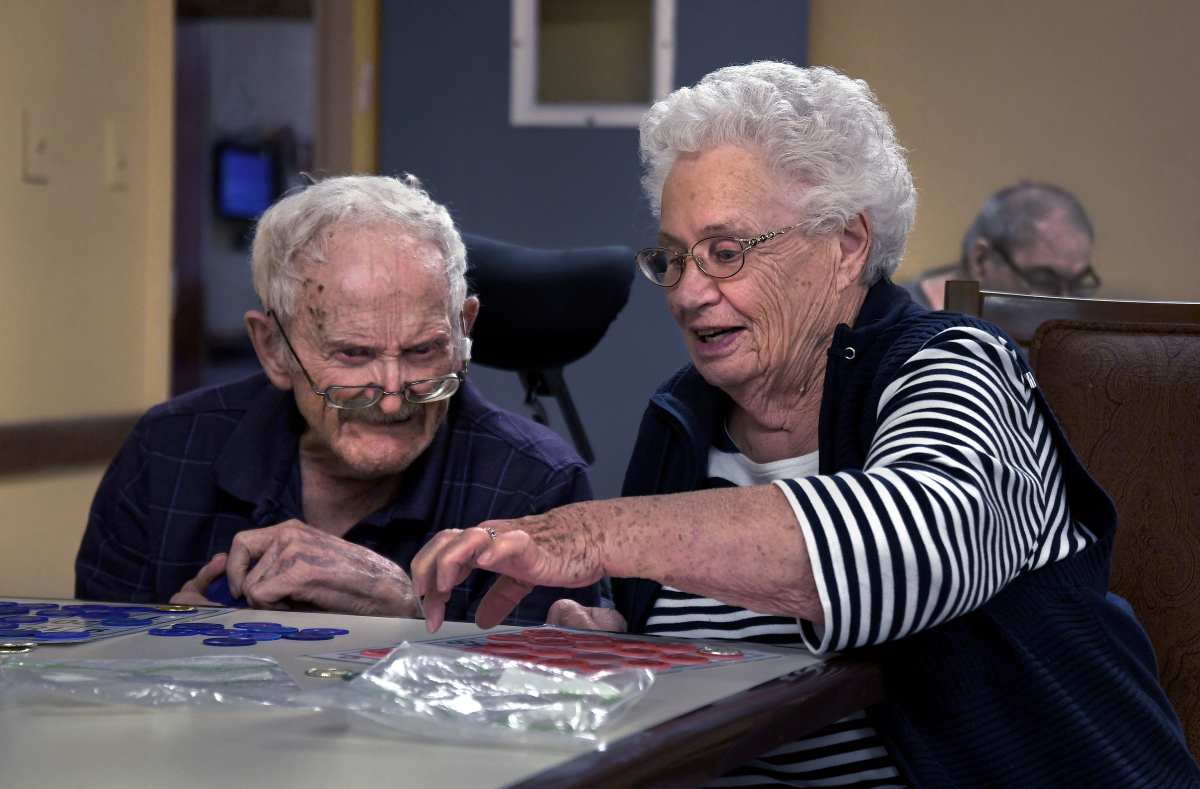
Marlene helps Earl play bingo at Emerald Nursing & Rehab, his new care home. She now faces long trips to see her husband. MUST CREDIT: Washington Post photo by Michael S. Williamson

Marlene helps Earl play bingo at Emerald Nursing & Rehab, his new care home. She now faces long trips to see her husband. MUST CREDIT: Washington Post photo by Michael S. Williamson

It had been 10 days since her last visit to see him, the longest they’d been apart in 63 years of marriage. He had Parkinson’s disease, which made it impossible for him to talk on the phone. She’d called the nursing staff for daily updates, and they said her husband seemed quiet, and he was losing his appetite.

“Why is it still so bad out here?” Marlene asked. Her feet skidded on the ice, and she wrapped her arm around her daughter’s shoulder as they moved closer to the car.

“Maybe it would be easier in a few hours, once the sun warms up,” said her daughter, Deb Kennedy, 51.

“No. I’m at the end of my rope already,” Marlene said. “Poor Earl’s probably wondering if we left him alone down there.”

In the first months after her husband’s fall, Marlene had helped Earl Kennedy move into a nursing home three minutes from their house in Broken Bow, a town of 3,000, close enough that she could visit him twice a day. But then that nursing home went bankrupt and closed in May, one of more than 260 rural nursing facilities across the country to shut down for financial reasons in the past three years, sending another family on a desperate search for the basic medical care that is disappearing from rural America.

Marlene tried to get Earl into the only other nursing home in Broken Bow, but that facility had managed to stay solvent in part by limiting the number of residents on Medicaid, as Earl was, because the federal program pays nursing homes in Nebraska about $40 less per day than the cost of providing care. The nursing homes in Ainsworth and Minden had already closed, and the one located next to a grain elevator in Callaway was running a waiting list. The best option Marlene could find was a shared room in the town of Cozad, more than 50 miles away down remote two-lane roads, and Marlene had been making the trip back and forth several times each week ever since.

This time, Deb had offered to drive her, and they rode away from the single-story house where Marlene and Earl had raised four children, and then past the grocery store where he had stocked shelves for 47 years. They continued beyond the feedlots on the outskirts of town, dense with cattle covering the hillsides. The road narrowed through a maze of cornfields. Frozen snow crunched beneath the tires and wind beat against the windows as they drove for miles without seeing another car.

“There’s a dip coming up here,” Marlene told her daughter, as the road climbed over a frozen creek.

“Where? I don’t see it.”

“Believe me. It’s there,” she said. “I’ve done this enough to know.”

She and Earl had rarely traveled outside of Nebraska, and they’d never been on an airplane. Many of their trips together in recent years had been medical trips, the escalating cost of a life spent in rural America, which in the past decade has lost at least 250 maternity wards, 115 hospitals, 3,500 primary care doctors, 2,000 medical specialists and hundreds of nursing homes. Marlene and Earl had traveled together to Lincoln for a heart operation, Kearney for an ankle, Grand Island for a hip, Omaha for corneal transplants, and then finally to Cozad in the back of a nursing home transport van for what Marlene feared would be Earl’s final trip. He was almost 88, and he could no longer walk or eat solid foods. Marlene had already paid for their adjacent cemetery plots in Broken Bow, where Earl had spent his entire adult life, but there was no place left in town where he could live safely until he died.

Deb slowed to pass a tractor. Marlene waved to the driver and then stared out the window, where rolling hills went on for miles. The prairie was empty except for hay bales and a few pieces of farming equipment left out in the snow.

“You all right?” Deb asked. “You seem quiet.”

“This drive always feels long,” Marlene said. “You spend your whole life tied up right next to somebody, and then you don’t get to be there for the hardest parts. It doesn’t seem natural.”

“You didn’t have a choice,” Deb said.

“No, but that doesn’t stop me from worrying about him,” Marlene said, because that was what she’d been doing for much of the past week and a half as she waited for the weather to improve. She’d worried that Earl’s bed was pressed too close to the window on subfreezing nights, and that the khakis she’d bought for him to wear weren’t thick enough, and that he was losing too much weight to keep himself warm, and that if he wasn’t warm he wouldn’t be able to sleep. She’d worried about what he might be doing if he wasn’t sleeping, since his eyesight made it difficult for him to read or watch TV or do much of anything except move back and forth from his bed to his wheelchair, in which case 10 days might have felt to him like forever. She’d worried he felt confused by her absence, or upset, or scared, or even abandoned.

“I’d be with him every day if I could,” Marlene said. “He knows that, right?”

“Of course. He knows we all want to be there,” Deb said. She drove by a large grain elevator and turned into the town of Cozad, parking in front of a small nursing home. She opened the passenger door and reached down to help her mother out of the car. “I bet you’ll feel better once you get a chance to visit with him,” she said.

“I don’t like being a visitor,” Marlene said. “I’m not a visitor to him.”

– – –

They walked down a tiled hallway with fluorescent lighting to a small room with an American flag taped beside the door. Marlene stepped into the front half of the room, which for the past 15 years had belonged to Earl’s new roommate, Oscar. He waved from his wheelchair, and then Marlene pulled back a curtain to reveal the back half of the room, where Earl was in the same position as she’d last seen him, 10 days earlier. He sat in his wheelchair with his body bent over to the right, wearing a baseball cap on his head and a kerchief to protect his shirt. He faced a TV that wasn’t on and a window with a view of snow-covered recycling bins. Marlene put her hand on his shoulder and leaned down to kiss his forehead.

“I missed you, Earl,” she said. “I missed you so bad I couldn’t stand it.”

He smiled at her and nodded. He reached over to his bed and picked up a holiday card he’d received from one of their great-grandchildren. He’d shown it to Marlene on her last visit, and now he handed it to her again.

“Isn’t that something,” she said, rubbing his back, pulling over a chair until it was pressed right up against his. She set the card down and rested her head against his shoulder.

“I missed you, Earl,” she said again. “Did you miss me?”

“Well,” he said. His lips tried to form more words, but they wouldn’t come. He’d been working with a speech therapist to fight back the advance of Parkinson’s and maintain his ability to eat, swallow and speak, but lately Marlene thought he had fewer good days than bad. She leaned in and tried to read his lips, smiling at him, waiting for him to talk as she rubbed his shoulders. His mind was still sharp, and some days his sentences came more easily as time went along. She believed the kind and respectful thing to do was to stay patient and wait through the silence, until after a few moments of watching Earl struggle, she decided the kinder thing was to break it.

“I wanted to come just about every day, but this weather had other ideas,” she told him. “You missed me, though, Earl. Didn’t you?”

“Well,” he said again. He smiled and reached over to wrap his arm around her shoulder.

“Yeah, I knew it,” she said. “You missed me. And what all did I miss here?”

“Well, the usual,” he said, beginning to find his voice. He pointed out toward the weekly schedule that was posted on the wall: a resident social hour at 8 a.m., three pureed meals in the cafeteria each day, bingo on Wednesdays and Fridays, Bible study on Tuesdays, “Wheel of Fortune” in the community room each night. Five residents had died in the past few weeks, and each time the nursing staff had made up the bed with a red rose and a copy of the same poem on the pillow: “I am home in heaven, dear ones; Oh so happy and so bright!”

“I suppose you didn’t miss much,” Earl said. “Life in a rest home. We rest.”

Marlene laughed. “You never were much of a complainer,” she said.

“No,” he said. “I guess not.”

They sat together holding hands as Marlene straightened Earl’s hat and smoothed the wrinkles out of his khakis. Sometimes during their visits, she took him into the cafeteria to play board games or read to him aloud from Philippians, but they spent most of their time together in silence.

“I like sitting with you like this,” Earl said.

His half of the room was barely large enough to fit a bed, a chair, and a handful of mementos. There were photos on the wall of his friends, his grandchildren, and his great-grandchildren, many of whom lived near Broken Bow and were too far away from Cozad to make regular visits. There was a prayer book from the country church where he’d met Marlene in 1954, and a few awards from the grocery store where he’d started out making $60 a week and then stayed on for nearly five decades.

“A life lived right,” read one of those employee plaques, which the store had given to him to commemorate his retirement at age 76, and Earl believed that declaration to be true. He’d raised four successful children, taught Sunday school, worked at the store six days each week, and come home most afternoons to eat lunch with Marlene. Their family had never earned more than $35,000 in a year, but somehow they had managed to send the children to college, stay out of debt, pay off their house, and even build up some savings – most of which had vanished in less than two years to pay for Earl’s nursing care in Broken Bow.

After that he was forced to rely on Medicaid, which meant that like most rural Nebraskans, he was dependent on a nursing system that was collapsing and scattering the poorest residents across the plains. Some of his friends from the home in Broken Bow had ended up in Omaha, Wyoming or North Dakota, and Earl had been moved out of a town where he knew almost everybody to a place where he knew almost nobody, and where the one constant was Marlene.

“It’s getting to be that time,” she said, as she looked out the window. They’d been sitting together for a few hours. The sun dipped down toward the cornfields, and the wind picked up and started whipping snow off the ground. Soon it would be dusk, when the roads started to refreeze and deer began to dart across the prairie.

“You should go,” Earl said. “I’m okay.”

“Another minute,” she said. She held his hand, and she thought she could feel it beginning to shake. She’d noticed that sometimes his Parkinson’s symptoms seemed to worsen at the end of their visits. “I’ll be back soon,” she said. “The weather coming up looks pretty good.”

“When you can,” he said. “I’ll be all right.”

“Soon,” she said again.

“Well,” he said. He patted her arm. He tried to say something more, but his hands were shaking harder now, and the words weren’t coming. Marlene leaned in and waited, watching his lips. “I’m okay,” he said again. “It’s okay,” he said, until finally Marlene squeezed his hand, forced herself up, and started walking out toward the car.

– – –

Earl watched out the window as the sky turned dark. His room was quiet, but in the hallway he could hear the sounds of oxygen machines and beeping call lights. Nurses wheeled residents into the cafeteria for bingo, and the food staff prepared creamy potatoes for dinner.

By all appearances, the nursing home was a place of routine and stability, but in fact it was facing the same financial pressures that had shut down 31 nursing homes in Nebraska in the past several years. A few months before, it had come within days of being the 32nd, after failing to meet payroll and making plans to transfer all 65 residents. The facility had been rescued out of bankruptcy at the last moment by a new ownership group from New York, and now the staff was trying help the nursing home save money however it could.

Lately, one strategy involved making trips to the shuttered nursing home in Broken Bow to salvage whatever supplies were left inside.

“I’ll be back in a few hours,” said Kiley Goff, the head administrator in Cozad, as she left a staff meeting and walked out to her truck to make her fourth trip to Broken Bow in the past month. Her bosses had purchased the building there, given her a key and allowed her to take whatever she needed for the nursing home in Cozad, which turned out to be almost everything. Their facility was almost 70 years old, and some of the rooms still had hand-crank medical beds. For one of her trips to Broken Bow, she’d rented a U-Haul and hired teenagers on the local high school wrestling team to help her load it with a dozen electric beds, a few couches, a washer and dryer, wooden doors, a bathtub, a fireplace, wall art and hundreds of pounds of linens.

This time she was hoping to find water pitchers, dishware and holiday decorations. “Any little thing we find is something we don’t have to buy,” she said.

She was a trained speech pathologist who had recently switched to management, and she’d spent the past year learning the difficult math of nursing home finances. The Medicaid reimbursement rate in Nebraska and most other states had stayed relatively flat for the past several years, even as medical costs rose by more than 20 percent. Her nursing home in Cozad received $152 per day for each Medicaid resident, far short of the $200-per-day cost of providing care. To make up for that loss, nursing homes typically charged much higher rates for people paying with their own money, a strategy that worked in urban areas where about half of residents could afford to pay out of pocket. But in rural Nebraska, only 35 percent of nursing home residents had money to pay for their own care, and in Cozad, it was less than 20 percent.

The result was that urban nursing homes had been able to remain relatively stable even as care disappeared from disproportionately older, poorer and rural areas of the country, where an elderly population that was projected to double in size over the next 20 years would have fewer places to go.

Goff drove by the feedlots on the edge of Broken Bow, stopped at the railroads tracks for a passing coal train, and then parked at a low-slung building across from a hardware store. Snow piled against the doorway and a broken-down medical van sat out front. She pushed open the front door and light streamed into the building. She could see down a long hallway, where medical lights flashed red against the walls and a broken fire alarm kept going off.

The nursing home had emptied out within just a few weeks in May once the closing was announced, as 46 residents and 65 staff members scrambled for places to go, but everything else had remained inside. There were wheelchairs in the front lobby, Bibles left open in the chapel, and plastic Easter eggs scattered in the hall. Goff grabbed an empty plastic bin from the front closet and started walking through the facility, opening closets and drawers to look for holiday decorations she could use in Cozad.

She found a stuffed Santa and some holiday lights in a closet. She went through the physical therapy room, the beauty parlor, and then into the secure memory care wing. “A Safe and Happy Forever Home,” read a framed cross-stitch near the entrance to what had once been the area for residents with Alzheimer’s or dementia, who tended to thrive on consistency, and who had since been uprooted to places all over Nebraska without understanding where or why.

Goff found a small Christmas tree in a closet and a package of unopened tablecloths in the cafeteria. Her phone rang, and she set down her bin to answer.

It was one of her staff members in Cozad, wanting to know when she’d be back. “I’m almost done,” she said. “It always feels weird in here.”

She pressed the phone to her ear, carried the bin of decorations out to her truck, and locked the nursing home’s front door.

“There’s still so much good stuff wasting away in here,” she told her employee. “We’ll need to come back with the trailer.”

– –

A three-minute drive away, in a house at the center of Broken Bow, Marlene was sorting through her own belongings, trying to compile the story of her last 63 years with Earl, just in case. She wanted to pick out photos for his funeral program. She wanted to be prepared with a eulogy. She needed to call their bank and switch all of their joint accounts into her name.

“You’re smart to prepare early,” a banker was telling her now, on the phone. “This way you can do some of it together.”

“Actually, he’s not here,” she said. “It’s just me.”

The walls of her living room were decorated with photos of the grandchildren whom Marlene sometimes felt guilty visiting without Earl, and mementos from the church she didn’t like attending without him, and plaques from the grocery store where she still sometimes expected to see him when she shopped. One picture showed Earl at his retirement celebration, when some former co-workers came back from out of state and the store offered free cake to the entire town. A few hundred people had come through the store that day to say goodbye. “A small town turns out to support one of its own,” read one local news story about that day, but on this day, Marlene was thinking about the things Broken Bow could no longer support, and the closed nursing home, and all of the people Earl was no longer able to see. Aside from their family, she thought he’d had two visitors in the past six months.

She turned on the TV to check the weather report. She put her heart medication into her purse. She inched down the driveway and into their 20-year-old car.

Earl had usually been the one who drove during their marriage, but Marlene had put 14,000 miles on the car in the past several months. She drove out of Broken Bow and past the feedlots on the edge of town. She turned through the cornfields. She went over the frozen creek. She slowed for the dip. She waved to a tractor. She went by the grain elevator. She looked out the front windshield at the rolling prairie and counted off the long miles, until she was parked in front of the nursing home and walking into Earl’s room.

She saw him looking out the window and waiting in his chair, where she’d left him a few days earlier and would soon have to leave him again.

“I’m here,” she said, putting her arm on his shoulder. “I’ll stay for as long as I can.”

Sensational 60 gives Jazz one-stroke edge in Thailand Masters #ศาสตร์เกษตรดินปุ๋ย

#ศาสตร์เกษตรดินปุ๋ย : ขอบคุณแหล่งข้อมูล : หนังสือพิมพ์ The Nation

https://www.nationthailand.com/sport/30379715?utm_source=category&utm_medium=internal_referral

Sensational 60 gives Jazz one-stroke edge in Thailand Masters

Dec 22. 2019

 Jazz Janewattananond (Photo credit to Jirawat Srikong)

Jazz Janewattananond (Photo credit to Jirawat Srikong)
By Lerpong Amsa-ngiam
THE NATION
962 Viewed

Pattaya – The Asian Tour No 1 of the year, Jazz Janewattananond, produced the best round of his career, firing a stunning third-round 60 to vie for his fourth victory of the Tour season in the US$500,000 Thailand Masters at the Phoenix Gold Golf and Country Club in Chonburi province on Saturday (December 21).


The world No 45, who just celebrated his third Asian Tour win of the season in the Indonesian Masters last Sunday, decorated his scorecard with 11 birdies, seven straight from holes 6-12, to head into the final round on 17 under-par-196, a shot ahead of Thomas Detry of Belgium.

Bad weather led to suspension of play for almost two hours but it failed to interrupt the momentum of the red-hot Thai who returned to the course to send home a six-foot birdie on the 16th hole and never looked back.

“I didn’t expect to play this well. I just went out there, trying to put up a good round. I was a bit tired from last week. I was struggling to finish the first two rounds, but today it’s a surprise,” said the 23-year-old, whose other victories happened in Singapore and South Korea this year.

Jazz or Atiwit really lived up to his label as the Tour 2019 No 1 player as he still remains in solid form despite playing for several weeks.

“I can tell myself that I’m Asian Tour No 1. I don’t have to prove myself anymore. It’s like a weight off my shoulder,” said Jazz, who won the Queen’s Cup at this course last year. “The conditions are different from last year. There’s a lot of good players. I have to perform well,” he added.

Thomas Detry 

Round-one leader Detry could have finished as joint leader but a bogey on the 17th hole saw him settle at lone second after a 66 and a total 16-under-par 197.

“My thought [on the score] was pretty average compared to Jazz’s. I saw his name on the leader’s board. It’s unbelievable he is one shot short off a 69. It could have been better but I made a clumsy mistake on the 17th. But a five-under still puts me in a good position for tomorrow,” said 26-year-old Detry, who is still in the chase for his first major Tour win.

Phachara Kongwatmai

Phachara Khongwatmai, after a 69, was at third on 199, followed by Kim Sihwan of South Korea (66) on 200. Tied on fifth with 201 were Filipino Miguel Tabuena (65) and three locals — Suteepat Prateeptienchai (65), Gunn Charoenkul (68) and Panuphol Pittayarat (68).

Architects and local governments alter designs of glass-covered buildings to protect birds #ศาสตร์เกษตรดินปุ๋ย

#ศาสตร์เกษตรดินปุ๋ย : ขอบคุณแหล่งข้อมูล : หนังสือพิมพ์ The Nation

https://www.nationthailand.com/edandtech/30379714?utm_source=category&utm_medium=internal_referral

Architects and local governments alter designs of glass-covered buildings to protect birds

Dec 22. 2019
Photo Credit: collisions.abcbirds.org

Photo Credit: collisions.abcbirds.org
By Special To The Washington Post · Erin Blakemore

Birds vs. glass

collisions.abcbirds.org

604 Viewed

Birds are winging their way somewhere unexpected: building codes.

Turns out that glass-covered buildings in modern cities can become graveyards for migrating birds, leading to hundreds of millions of bird deaths each year. Under pressure from conservation groups, architects and local governments are increasingly tweaking building codes to protect birds from hitting buildings.

This month, the New York City Council passed legislation that puts birds into its building code. It requires new construction and newly altered buildings to incorporate specially treated glass on the lowest 75 feet in an attempt to reduce the number of bird strikes.

As more and more buildings incorporate glass, the number of bird crashes has grown. According to a 2014 study, up to 599 million birds die every year when they hit buildings.

Most of the species at risk are migratory – and they crash because they cannot see glass. As they cruise toward reflections of trees, resting places or even themselves, birds court disaster. (Steady lights attract and confuse them at night, too.)

One notoriously bird-unfriendly building, New York’s Jacob K. Javits Convention Center, reduced bird deaths 90% when it incorporated glass with patterns during a 2015 renovation, according to the Audubon Society. A statewide bill to establish a building council to promote similar guidelines was recently vetoed by Democratic Gov. Andrew Cuomo.

New York isn’t the first city to adopt bird-friendly building rules: San Francisco has had similar standards since 2011, and the American Bird Conservancy says bird-friendly design is becoming recognized as part of sustainable design.

Even if you don’t live in a skyscraper, you can help protect birds from your windows. According to the American Bird Conservancy, 46% of bird crashes per year happen at homes, even ones with small amounts of glass.

To help, you can apply tempera paint to your windows, apply patterns of opaque tape or special translucent bird-smart tape, hang external screens or opt for vertical blinds indoors. Decals can help, too, with a caveat: You need a lot to deter birds. They should be spaced no more than two to four inches apart.

Want information on bird-friendly building? Visit Collisions.abcbirds.org.

Apple has secret team working on satellites to beam data to devices #ศาสตร์เกษตรดินปุ๋ย

#ศาสตร์เกษตรดินปุ๋ย : ขอบคุณแหล่งข้อมูล : หนังสือพิมพ์ The Nation

https://www.nationthailand.com/business/30379708?utm_source=category&utm_medium=internal_referral

Apple has secret team working on satellites to beam data to devices

Dec 22. 2019
By Syndication Washington Post, Bloomberg · Mark Gurman 
970 Viewed
Apple has a secret team working on satellites and related wireless technology, striving to find new ways to beam data such as internet connectivity directly to its devices, according to people familiar with the work.

The Cupertino, California-based iPhone maker has about a dozen engineers from the aerospace, satellite and antenna design industries working on the project with the goal of deploying their results within five years, said the people, who asked not to be identified discussing internal company efforts. Work on the project is still early and could be abandoned, the people said, and a clear direction and use for satellites hasn’t been finalized. Still, Apple Chief Executive Officer Tim Cook has shown interest in the project, indicating it’s a company priority.

Apple’s work on communications satellites and next-generation wireless technology means the aim is likely to beam data to a user’s device, potentially mitigating the dependence on wireless carriers, or for linking devices together without a traditional network. Apple could also be exploring satellites for more precise location tracking for its devices, enabling improved maps and new features.

It’s not clear if Apple intends to pursue the costly development of a satellite constellation itself or simply harness on-the-ground equipment that would take data from existing satellites and send it to mobile devices. Northrop Grumman, Lockheed Martin and Boeing are some of the biggest satellite makers. An Apple spokeswoman declined to comment.

Amazon.com plans to deploy more than 3,000 satellites as part of a future constellation. However, the industry is littered with failures. Iridium LLC filed for bankruptcy protection in 1999, and Teledesic abandoned its “internet from the sky” plan more than a decade ago. Newer efforts from Facebook, SpaceX and Amazon are a long way from generating revenue, and Apple rarely enters new categories without a clear way to make money.

“The lessons of prior failures like Iridium, Globalstar and Teledesic are that it’s really hard to find a viable business plan for multibillion-dollar satellite communications projects,” said Tim Farrar, a satellite expert and principal at TMF associates.

In recent months, Apple has started hiring new software and hardware experts for the team, seeking engineers with experience in designing components for communications equipment. The company has also hired additional executives from the aerospace and wireless data delivery fields.

The team is led by Michael Trela and John Fenwick, former aerospace engineers who helped lead satellite imaging company Skybox Imaging before it sold to Google in 2014. The pair led Google’s satellite and spacecraft operations until leaving together in 2017 to begin a new initiative at Apple, Bloomberg News reported at the time.

During their first year and a half at Apple, Trela and Fenwick explored the feasibility of developing satellite technology and understanding the problem they want to solve, and in recent months have started intensifying work on the project. The effort suffered a setback earlier this year when its previous leader, Greg Duffy, left Apple after joining in 2016. Duffy, the co-founder of camera startup Dropcam, which Google acquired in 2014, reported to Dan Riccio, Apple’s senior vice president of hardware engineering.

On his LinkedIn profile, Duffy said he worked on projects involving “satellite communications, wireless, and home products/technologies.” He declined to comment more specifically on his work at Apple.

Trela and Fenwick still work within Apple’s hardware engineering division, but now report to Riccio’s lieutenant in charge of iPhone engineering.

The team has recently added people from the wireless industry, including engineer Matt Ettus, who now helps lead the initiative, people familiar with the team said. Ettus is one of the foremost names in wireless technologies and created Ettus Research, a National Instruments-owned firm that sells wireless networking equipment.

Apple has also hired Ashley Moore Williams, a longtime executive from Aerospace who focused on communication satellites, and Daniel Ellis, a former Netflix executive who helped oversee the company’s Content Delivery Network, or CDN. Ellis has experience in building networks that can beam content and information on a global scale.

The work on satellite technology is one of several “special projects” — an Apple term for skunkworks initiatives or development of major new product categories — under way at the company.

As Bloomberg has previously reported, Apple also is working on a virtual reality headset to debut as early as 2021, augmented reality glasses for launch after that, MicroLED screens for future devices, new home products, self-driving car technology and a future Apple Watch that can analyze a user’s blood chemistry to determine glucose levels. Apple is also expanding its in-house chip development, seeking to replace Intel Corp. as its Mac processor maker, and Intel and Qualcomm as the providers of its modem component for phones.

Under Cook, Apple has rapidly expanded its research and development budget, spending $16 billion in the 2019 fiscal year, an increase of 14% from the prior year, according to company filings. One of Apple’s primary goals is to bring more of the technology behind its products in house, which is what work on satellites could eventually enable.


KT races ahead in 5G streaming games #ศาสตร์เกษตรดินปุ๋ย

#ศาสตร์เกษตรดินปุ๋ย : ขอบคุณแหล่งข้อมูล : หนังสือพิมพ์ The Nation

https://www.nationthailand.com/business/30379696?utm_source=category&utm_medium=internal_referral

KT races ahead in 5G streaming games

Dec 21. 2019
KT launches 5G cloud game streaming service (Lim Jeong-yeo/The Korea Herald)

KT launches 5G cloud game streaming service (Lim Jeong-yeo/The Korea Herald)
By By Lim Jeong-yeo
The Korea Herald

1,336 Viewed

Telecom firm KT said Friday it will launch a subscription-based 5G cloud gaming service in South Korea starting March, exclusive for its 5G users.

The first 10,000 KT users to download the game streaming app will be given a two-month free trial period to play some 50 games on the app. A thumb-sized detachable mini joystick developed by Motion Queen, will be given out to them for free, allowing for an immersive gaming experience without requiring a Bluetooth connection, KT said.

The company is the third of three Korean communications firms to announce the 5G cloud game business. Before KT, LG Uplus joined hands with Nvidia and SK Telecom with Microsoft, to stream the latter’s’ games on mobile devices.

LG Uplus provides the games on subscription terms. The service is currently in tests and is projected to fully launch in January.

SKT is testing four streaming games for a limited number of players, and has yet to announce a specific launch date in Korea or a payment structure.

Subscription-based streaming service has been popular for music in the 3G network and video for 4G. It’s evident the next streaming entertainment contents for the 5G network will be gaming, said KT officials at the service launch announcement event.

“To download and play 50 games on One Store, one needs 240 gigabytes of memory on a mobile device. By introducing a streaming app, we have drastically cut that down to 30 megabytes,” said Park Hyun-jin, senior vice president of KT’s 5G business unit.

“Cost-wise, these 50 game titles were a combined 950,000 won ($816), but our streaming app will only charge a designated monthly subscription fee,” Park said.

The game market is reaching its limits, said Park, stressing that the subscription-based streaming is the future.

The monthly fee is yet to be decided, and KT is open to user suggestions.

Sung Eun-mi, vice president of K’s 5G service department, explains the cutting-edge computing technology. (Lim Jeong-yeo/The Korea Herald)

Sung Eun-mi, vice president of K’s 5G service department, explains the cutting-edge computing technology. (Lim Jeong-yeo/The Korea Herald)

“KT will employ cutting-edge computing technology to provide super low-latency network service,” said Sung Eun-mi, vice president of KT’s 5G service department.

The technology creates network hubs in different regions, as it doesn’t have to reroute from the capital Seoul. Users living in the provincial areas can experience faster connections. The service will start in Korea’s second biggest city Busan and later spread to other regions according to the spread of game streaming app use, Sung said.

For the game streaming service, KT has partnered with Taiwans’ streaming solution company Ubitus.

Ubitus is the largest cloud provider in Japan, and has NIT Docomo as a partner, said Ubitus’ CEO Wesley Kuo at the KT event.

In March 2018, Ubitus serviced streaming games to Nintendo Switch and in October, for Vodafone Italy. It also has a strategic partnership with Alibaba to launch a global cloud gaming total solution.

In Korea, Ubitus has Samsung as its strategic investor. YouTube co-founder Steve Chen is also an investor and a special advisor.

In the long run, some 100 games will be available on the platform, including Deepsilver’s first-person shooter game Metro 2033 Redux, SNK’s combat game King of Fighters XIII and Volition’s Saints Row IV.

KT plans to gradually expand its game subscription service to television and personal computers.

Global market analysis firm IHS Markit estimated the cloud gaming market will grow sixfold from 2018’s $387 million to 2023’s $2.5 billion.

By Lim Jeong-yeo (kaylalim@heraldcorp.com)

HCM City wants its businesses to create global brands #ศาสตร์เกษตรดินปุ๋ย

#ศาสตร์เกษตรดินปุ๋ย : ขอบคุณแหล่งข้อมูล : หนังสือพิมพ์ The Nation

https://www.nationthailand.com/business/30379695?utm_source=category&utm_medium=internal_referral

HCM City wants its businesses to create global brands

Dec 21. 2019
Vissan is votes as one of the 27 most popular Vietnamese brand names in 2019 by Sài Gòn Giải Phóng (Liberated Sai Gon) newspaper’s readers. Photo courtesy of the company

Vissan is votes as one of the 27 most popular Vietnamese brand names in 2019 by Sài Gòn Giải Phóng (Liberated Sai Gon) newspaper’s readers. Photo courtesy of the company
By Viet Nam News

2,225 Viewed

HCM CITY— Ho Chi Minh City authorities are seeking to create favourable conditions for local businesses to develop trademarks and brands to compete with foreign rivals at home and abroad, its leader has said.

Nguyen Thanh Phong, chairman of the city People’s Committee, told a conference yesterday (December 20), “Developing trademarks and brand names for enterprises and their products is a sustainable advantage for them to affirm their position.”

Before attracting foreign companies, the city needs to ensure local players improve their competitiveness, innovate and, especially, develop brands and trademarks, he added.

Tran Vinh Tuyen, people’s committee vice chairman, said when the city has famous trademarks and brand names, its image and products would become globally renowned.

He instructed the city Department of Industry and Trade to set up institute a programme for developing such trademarks and brand names.

Phạm Thanh Kien, director of the Department of Industry and Trade, said, “Enterprises with products which have trademarks and brand names can sustain rapid growth in turnover and profit.”

Not only large companies but also small and medium-sized ones should pay more attention to this, he said.

“The department will continue to assist and train enterprises to address their problems in developing brands and, especially, trademark registration.”

It would help businesses take part in city promotion programmes that provide loans for developing and acquiring technologies, expanding production and entering global supply chains, he said.

Nguyen Quoc Thinh of the Institute for Brand and Competitiveness Strategy said HCM City needs several large enterprises to take the lead in developing trademarks and brands and then train others in the task.

The city’s brand name would develop based on its businesses’ brand names and trademarks rather than famous destinations, he added.

Nguyen Duc Son, CEO of US company Richard Moore Associates and chairman of Plato Academy, said the city and enterprises should apply international standards and new methodologies in branding.

Dr Vo Tri Thanh, a senior economist at the Central Institute for Economic Management (CIEM) and a member of the National Financial and Monetary Policy, said the city’s programme for developing brand names and trademarks should dovetail with the national branding strategy.

The conference was organised by the city People’s Committee. VNS

Northen provinces and cities to develop as a key economic hub #ศาสตร์เกษตรดินปุ๋ย

#ศาสตร์เกษตรดินปุ๋ย : ขอบคุณแหล่งข้อมูล : หนังสือพิมพ์ The Nation

https://www.nationthailand.com/business/30379694?utm_source=category&utm_medium=internal_referral

Northen provinces and cities to develop as a key economic hub

Dec 21. 2019
Seven provinces and cities in the north of Vietnam discussed mechanisms to form the Northern Key Economic Region (NKEC) of the country.—  Photo enternews.vn

Seven provinces and cities in the north of Vietnam discussed mechanisms to form the Northern Key Economic Region (NKEC) of the country.— Photo enternews.vn
By Viet Nam News

1,511 Viewed

HAI PHONG — Seven provinces and cities in the north of Vietnam discussed mechanisms to form the Northern Key Economic Region (NKEC) of the country.

The first forum of the NKEC was organised by the Vietnam Chamber of Commerce and Industry (VCCI), Business Forum Newspaper and the relating municipal departments of Planning and Investment in Hai Phong City yesterday.

Spanning more than 15,000 sq.km, NKEC includes seven provinces and cities, Hanoi, Hai Phong, Quang Ninh, Hai Duong, Hung Yen, Vinh Phuc and Bac Ninh.

As NKEC’s three pillars, Hanoi, Quang Ninh and Hai Phong have three airports and 44 industrial parks that are home to many key industries such as cement, cars, electricity.

Nguyen Hong Long, Deputy Head of the Steering Committee for Enterprise Innovation and Development told the forum: “NKEC contributed nearly 32 per cent of GDP and 31 per cent of the national budget.”

Earlier, Prime Minister Nguyen Xuan Phuc said together with maintaining the role of a political, economic, cultural and scientific centre for Vietnam, the NKEC should develop as an another economic hub with breakthroughs that helps restructure the economy and foster growth.

The PM told NKEC to become the country’s hub of processing and manufacturing industries; hi-tech agriculture; information technology, tourism and other services and later become a trading centre of the region and the world.

Attracting the private sector, NKEC still needs much improvement

Most recently, the city of Hai Phong agreed an investment project with VinFast manufacturing and trading complex in Van Phong and Nghia Lo communes, Cat Hai District.

Nguyen Van Thanh, deputy chairman of Hai Phong People’s Committee said private groups such as Vingroup, Sungroup, Geleximco, FLC had so far invested VNĐ200 trillion (US$8.6 billion) in the city.

Next Hai Phong, Hai Duong Province also received an investment project for an automobile assembly and manufacturing factory of Ford Vietnam Co., Ltd.

Hung Yen Province also has been receiving huge capital inflows from real estate companies such as Vingroup, T&T Group, Hoa Phat.

In Quang Ninh District, Sungroup has built and operated the first private airport of Vietnam, Van Don International Airport at the total investment of VNĐ7.4 trillion.

Seeing the potential of the NKEC, Long said: “It still relies mainly on the foreign direct investment (FDI) sector.”

He also added the remaining problem of the economic region included uneven development among localities in the region with low index of the Provincial Competitiveness Index (PCI).

“There are two provinces in the top ten and five in the top 20 but there are also two provinces at the bottom of the list.”

According to the Planning and Investment Ministry, the growth rate of the service industry which is the motivation of NKEC’s development, was not sustainable.

It increased by 9.05 per cent in 2016 but only 7.54 per cent last year. Export growth in 2018 only increased by 20 per cent, lower than the rate of 31.2 per cent in 2017.

The forum aims to receive contributions, analysis and policy recommendations from leading economic experts, investment organisations, and the business community to develop solutions to strengthen the investment resources for NKEC. — VNS

The art of imperfection: People are turning to robots to write their ‘handwritten’ cards #ศาสตร์เกษตรดินปุ๋ย

#ศาสตร์เกษตรดินปุ๋ย : ขอบคุณแหล่งข้อมูล : หนังสือพิมพ์ The Nation

https://www.nationthailand.com/news/30379717?utm_source=category&utm_medium=internal_referral

The art of imperfection: People are turning to robots to write their ‘handwritten’ cards

Dec 22. 2019
Engineers Michael Davis, left, and Justin Seganti work a printing machine on Nov. 5 at Handwrytten. MUST CREDIT: Photo for The Washington Post by Davis Winborne

Engineers Michael Davis, left, and Justin Seganti work a printing machine on Nov. 5 at Handwrytten. MUST CREDIT: Photo for The Washington Post by Davis Winborne
By The Washington Post · Abha Bhattarai 

180 Viewed

Roger and Vonita Byous were surprised when an anniversary card from their son arrived in the mail. They were even more surprised by the unrecognizable handwriting inside.

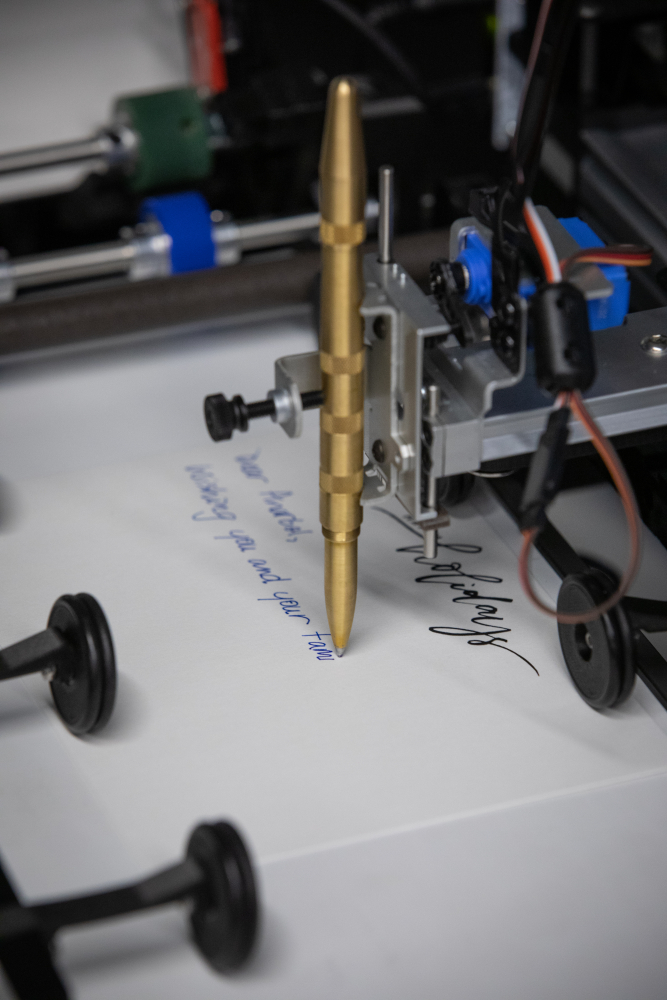
A printing robot begins a sample holiday card. MUST CREDIT: Photo for The Washington Post by Davis Winborne Photo by: Davis Winborne — For The Washington Post

A printing robot begins a sample holiday card. MUST CREDIT: Photo for The Washington Post by Davis Winborne Photo by: Davis Winborne — For The Washington Post

+++

A variety of cards hang on the wall in Handwrytten's shop. MUST CREDIT: Photo for The Washington Post by Davis Winborne

A variety of cards hang on the wall in Handwrytten’s shop. MUST CREDIT: Photo for The Washington Post by Davis Winborne

+++

“I just started wondering, ‘Whaaat?’ ” said Roger, 73. “It didn’t look quite right, but we couldn’t figure out why.”

It turned out, the Somerset, Kentucky, couple later learned, their son hadn’t picked up the pen that scripted his heartfelt congratulations on 48 years of wedded bliss. A robot had.

“It wasn’t exactly a personal touch,” Roger said, but “we’re glad he remembered us.”

Digitization has long reached deep into people’s lives: Family photos are in the cloud. Mom’s recipes are indexed on an app. Breakups can arrive overnight, via text. Now technology is being deployed to try to replicate a human touch, as a growing number of consumers turn to pen-wielding robots that can mimic the loops and patterns of the human hand.

A stack of completed cards waits to be packaged at Handwrytten. MUST CREDIT: Photo for The Washington Post by Davis Winborne

A stack of completed cards waits to be packaged at Handwrytten. MUST CREDIT: Photo for The Washington Post by Davis Winborne

These robot-scribed cards and letters are testing the proposition that machines can generate the intimacy of a handwritten note. Some services include smudges and ink blots in their mailings. Others program the robots to be imprecise – varying the pressure on the pens, for example, or inconsistently sizing characters and spacing – to make the writing appear believably human.

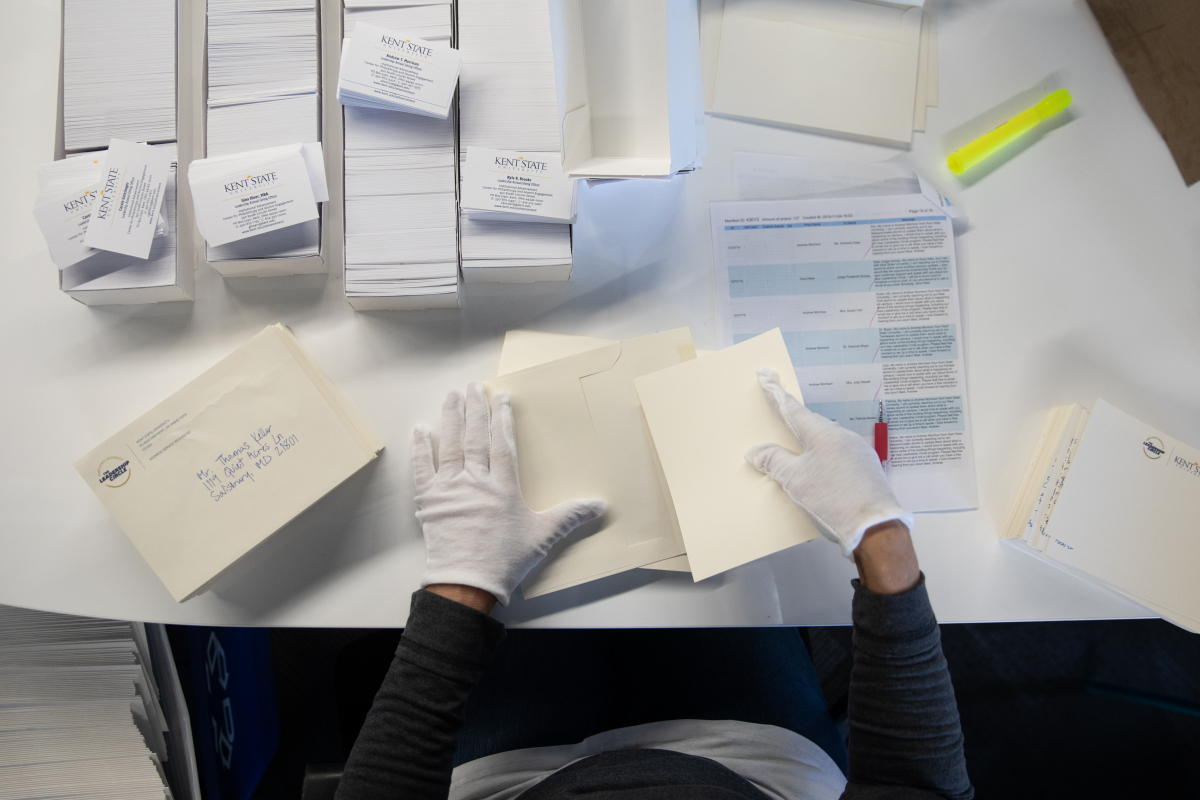
Darleen Douglas stuffs envelopes for mailing on Nov. 5. MUST CREDIT: Photo for The Washington Post by Davis Winborne

Darleen Douglas stuffs envelopes for mailing on Nov. 5. MUST CREDIT: Photo for The Washington Post by Davis Winborne

At Handwrytten, a fast-growing service in Phoenix, robots are outfitted with Pilot G2 pens in blue ink because, founder David Wachs says, it’s “more realistic-looking” than black. The pens also offer an advantage over even the most sophisticated printouts: The telltale imprint they leave on paper.

But the results can be clumsy, even unsettling. Critics bristle at the idea of outsourcing personal correspondence, saying it renders it meaningless. And they see it as one more example of how technology is being used to fake authenticity, even if it does not rise to the level of “deepfakes” or other digital manipulation.

“Having a robot write for you – it’s a rather clever business plan, but it seems like a complete betrayal,” said Ellen Handler Spitz, a senior lecturer in humanities at Yale University. “Handwritten notes are special precisely because they are intimate, because a part of your body is touching the paper, creating a personal connection.”

When the Byouses finally asked their son, Shanan, about the mysterious cursive on their card, he told them he used the Handwrytten app because it was cheaper – and easier – than going to the store, picking out a card and paying for postage. Plus, he said, he liked that he could schedule it ahead of time.

“To me, it’s the same, whether a robot writes it or I do,” said Shanan, 47, who works for an IT company in Atlanta. “What matters is that I was thinking of them.”

Just as well: Two weeks after their anniversary, another robot-written card arrived. This one wished his mother a happy birthday.

– – –

The robots are running nonstop at Wachs’ Phoenix warehouse, scribbling letters to Grandma, thank-you notes and, these days, holiday cards. Wachs used to make his living blasting millions of targeted text messages for corporate clients, until he became convinced there was a better way to get noticed.

“When you receive 200 emails a day, plus tweets and text messages, none of it stands out anymore unless it’s handwritten,” he said. “It’s become that much harder to get someone’s attention.”

Today, Wachs has 80 robots, and demand is so brisk that he builds two to three more each week to keep pace with 100,000 pieces of correspondence that go out monthly.

“We started with a basic idea: To figure out how to make sending a handwritten note as easy as sending a text message or email,” said Wachs, who founded Handwrittyn in 2014 after selling his mobile marketing agency.

His earliest clients included religious groups urging inmates to find salvation in Jesus, and grown children checking in with mom and dad. As business grew, his clientele extended to include luxury retailers, mortgage brokers, car manufacturers and nonprofit groups that pay about $3 per card.

The holidays are particularly busy, with December accounting for about 15% of the year’s sales. Wachs buys pens in packs of 1,452 and Forever stamps in spools of 10,000. Annual revenue, in the millions, is on track to triple this year.

In-house graphic designers create the company’s cards, a mix of traditional and cutesy patterns with sayings like “Peace on Earth” and “Cheers to the new year.” As for the writing itself, Handwrytten offers about 20 fonts with names like Executive Adam (all-caps and angular) and Loopy Ruthie (cursive and rounded).

Customers also can have their own handwriting replicated, for $1,000, by submitting multiple samples that include six versions of the alphabet and nearly a dozen nonsensical sentences like, “Did the keynote pharaoh drop a shoe in Cuba?” They can also add a real signature (for a one-time fee of $150), as well as foreign characters, hearts and smiley faces. The company has made about 60 custom fonts – mostly for politicians and business executives.

Wachs, who has degrees in computer science and economics from the University of Pennsylvania, makes the robots with a 3-D printer and laser cutter. But, he says, they’re slow. It takes four to five minutes to write a typical holiday card, though they offer at least one advantage. “They don’t take breaks like humans do.”

The robots work 24 hours a day and send Slack messages when they’re running out of paper or ink. Attending to their needs can be tedious: Pens dry up after about 150 pages, and the machines hold only about 50 sheets at a time. Handwrytten also has 25 human employees, including mobile developers, software engineers and staffers who stuff envelopes. (Robots, though, do the sealing and stamping.)

The company is among a growing number of card-writing services, each with its own spin. Felt in Telluride, Colorado, gives customers the option to write cards themselves using a finger or stylus on their phone screens. New York-based Postable allows users to schedule a year’s worth of birthday and anniversary cards. Other services take a decidedly old-school approach by hiring actual humans to write thousands of notes a week.

“As the world becomes more automated, our products become that much more effective,” said Anatoliy Birger, director of sales for Letter Friend, which typically charges $4 to $5 per human-written card. “We are filling a real need.”

– – –

Paras Shah sends nearly 100 cards a year – for graduations, weddings and sometimes just because. But he can’t remember the last time he actually picked up a pen to write one.

“I don’t actually want to do the writing,” the 28-year-old said. “My handwriting is pretty mediocre, and it just takes too much time.”

Shah, who lives in Austin, Texas, and works in oil and gas technology, says he has sent nearly 500 robot-written cards in varying fonts since 2013 and has, as he puts it, mostly gotten away with it. But he’s also been called out – once, by a West Texas oil professional who called him disingenuous, and another time by a friend who received an elaborate graduation card from Punkpost, a service that hires professional artists. Most of the time, though, he stays mum when friends compliment his “awesome handwriting.”

“I would never come clean,” he said. “Are you kidding me? That’s kind of the whole point.”

Writing has been a cornerstone of civilization since the Sumerians introduced cuneiform 5,000 years ago. But it wasn’t until the typewriter came along, about 150 years ago, that historians say handwriting took on new meaning as an intimate and revealing form of communication.

“Historically, people were trained to write as indistinguishably as possible – for your writing to look a certain way, that was a sign of education,” said Anne Trubek, author of “The History and Uncertain Future of Handwriting.” “But in the last 100, 150 years, we have decided that handwriting is an expression of the individual self, that it can provide a connection to history.”

Longhand, Trubek said, has become more valued in an era of digital correspondence. After years of retreat, state legislatures are beginning to reintroduce penmanship into elementary school curriculum. There are summer camps that teach cursive, and some college professors report a resurgence in students taking notes by hand.

Even so, written correspondence is on the decline. On average, American households now receive one personal letter every 10 weeks, according to the U.S. Postal Service, about half what they did a decade ago. Americans mailed 42 percent fewer holiday cards in 2018 than they did in 2008.

“Handwriting has become a way to show that you put time and effort into something,” Trubek said. “That’s the veneer people are yearning for.”

– – –

Sheldon Yellen, chief executive of Belfor Holdings, a Michigan-based company that offers disaster recovery services, writes well over 12,000 cards each year to his employees – and has no intention of stopping.

The 61-year-old began the tradition 30 years ago, when he had a staff of 19. But as the payroll has swelled to thousands, he has fine-tuned his system for organizing and mailing cards.

His assistants keep a suitcase filled with cards and pre-addressed envelopes on his private plane. He flies at least three days a week, he said, and uses a blue gel pen to write about 150 cards on each leg. When fatigue sets in, he does wrist rolls and finger stretches.

“Every time I get a few free minutes, I hand-write a card,” Yellen said. In all, he sends 9,200 birthday cards a year, plus a few thousand notes to say thank you, congratulations or get well soon.

“Doing this has helped build a culture of compassion, family and respect,” he said. Last year, on his 60th birthday, employees filled his office with 8,000 birthday cards.

Lately, though, he has been receiving letters from card-writing services, asking him for his business. He writes back to each one – by hand. “I tell them, ‘Thank you so much,’ ” he said. ” ‘However, I am still committed to personally handwriting my own cards.’ ”