Fund-raising rules set for SMEs, startups in planned bourse #ศาสตร์เกษตรดินปุ๋ย

#ศาสตร์เกษตรดินปุ๋ย : ขอบคุณแหล่งข้อมูล : หนังสือพิมพ์ The Nation

https://www.nationthailand.com/business/30379677?utm_source=category&utm_medium=internal_referral

Fund-raising rules set for SMEs, startups in planned bourse

Dec 20. 2019
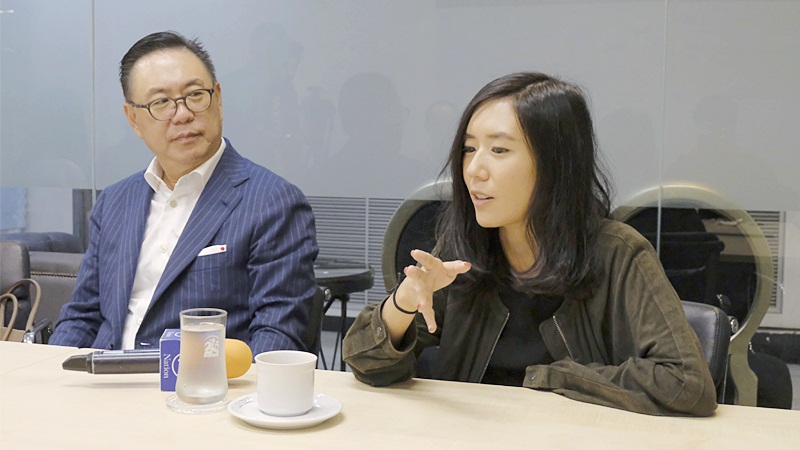
Secretary-general Ruenvadee Suwanmongkol

Secretary-general Ruenvadee Suwanmongkol
By THE NATION

886 Viewed

The Securities and Exchange Commission (SEC) and the SME Startup PE VC panel have agreed at a meeting on the preliminary rules for SMEs and startups to raise capital in the planned stock exchange.

Guidelines on the establishment of the bourse for SMEs and startups only were also discussed.

Those eligible to list must be of the status of company limited or public company limited with good governance records.

They will have to disclose information according to SEC rules.

Eligible investors in these companies must come under the categories of institutional investor, Private Equity (PE), Venture Capital (VC) or angle investor.

Retail investors can also participate, but they have to purchase shares via a brokerage agency.

The SEC will allow the establishment of funds to invest in the shares of these SMEs and startups. These funds must be managed by fund managers with expertise in the investment in SMEs and startups.

Secretary-general Ruenvadee Suwanmongkol said the SEC expected to finalise the rules in the first quarter of next year.

Services sector in focus as four-pronged strategy strives for export growth in 2020 #ศาสตร์เกษตรดินปุ๋ย

#ศาสตร์เกษตรดินปุ๋ย : ขอบคุณแหล่งข้อมูล : หนังสือพิมพ์ The Nation

https://www.nationthailand.com/business/30379672?utm_source=category&utm_medium=internal_referral

Services sector in focus as four-pronged strategy strives for export growth in 2020

Dec 20. 2019
By The Nation

1,109 Viewed

The International Trade Promotion Department (DITP) has come up with a four-point strategy for 2020 to ramp up exports.

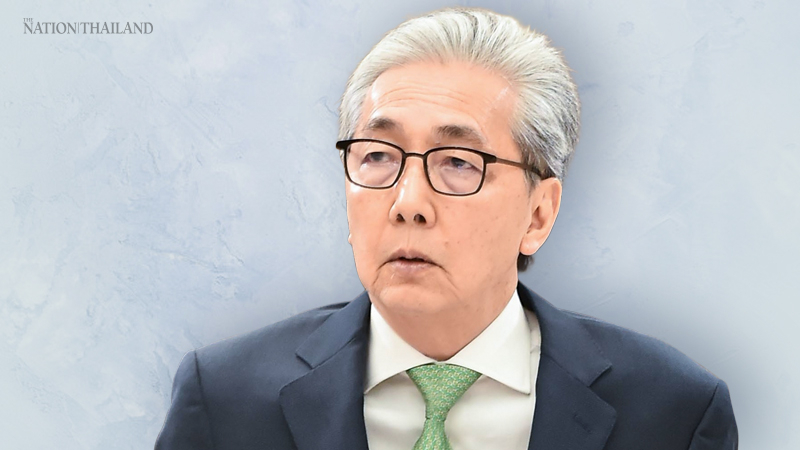
Somdet Susomboon, the department’s director-general, said there might be a little struggle to evaluate the export goal for 2020 as the economic situation has not yet recovered from the baht’s appreciation and trade war. He said they will try to achieve growth in the services sector, which is seen as having potential after Commerce Minister Jurin Laksanawisit went on several international trips to negotiate trade agreements and pushed for the Regional Comprehensive Economic Partnership (RCEP).

Thailand might get opportunities for food exports since many countries are facing unrest, and civilians have to store more food.

“We will have a commercial ambassador conceive the work policy and the export target for 2020 during the Bangkok Gems & Jewellery event in February 2020. The meeting with the private sector will discuss estimations for total export forecast for each market and then make a summary. Export potential is seen as positive in 2020.”

The four strategies to boost exports next year are:

1 Improve product channels by sending trade representatives to negotiate and expand markets: old markets ( China, Japan, Germany, England, EU), new market (India, Turkey, Sri Lanka, Bangladesh, South Africa); and restore markets (the Middle East region).

Jurin has negotiated with trade representatives from governments and the private sector, making 16 trips to 18 countries. In addition, the government is expanding its TOPTHAI Flagship further in large platforms; Bigbasket (India), Amazon (US and Japan), and Presto Mall (Malaysia).

2 Entrepreneur skill development with international business management and e-commerce courses to be offered in cooperation with the Panyapiwat Institute of Management.

3 Improve product quality by creating more brands from Thailand with QC licence such as TMark, DEMark, PM-Award, Thai Select, ELMA, etc.

4 Department to upgrade service and database with AI and business AI to make it easier and more accurate.

Somkid pushes for more fiscal, monetary measures to boost economic growth #ศาสตร์เกษตรดินปุ๋ย

#ศาสตร์เกษตรดินปุ๋ย : ขอบคุณแหล่งข้อมูล : หนังสือพิมพ์ The Nation

https://www.nationthailand.com/business/30379671?utm_source=category&utm_medium=internal_referral

Somkid pushes for more fiscal, monetary measures to boost economic growth

Dec 20. 2019
By The Nation

969 Viewed

Deputy Prime Minister Somkid Jatusripitak said Thailand still has a lot of room to grow, but it will need to deploy more economic instruments, especially through monetary and fiscal policies.

The government has issued many fiscal measures to stimulate the economy. However, according to the Financial Act and Government Procurement and Supplies Management Act, the government might struggle to issue more economic measures due to limits under the law, he said. The current economy needs more fiscal measures to push for growth, he said, adding: The Bank of Thailand [BOT] and the Finance Ministry must work in unison for a better economy.

Monetary policy plays a crucial role amid the economic situation, as it impacts both money stock and the currency exchange rate. The current strong baht affects the export sector and agricultural product prices, as exports rise but result in lower revenue, which affects domestic purchasing power and value-added tax collection.

“The BOT is the main organisation controlling monetary policy, in which the government cannot interfere. But I do believe the BOT has more monetary instruments to manage the baht’s appreciation other than adjusting the interest rate. The amount of money in the system needs to be stable and appropriate, not more or less,” said Somkid.

The deputy premier also encouraged the private sector to invest at home. “The BOT wants to drain excessive dollars through investments abroad, which will help weaken the baht. However, the private sector also needs to invest in the internal market to strengthen confidence in the economy.”

Army chief warns to look out for ‘proxy crisis’ #ศาสตร์เกษตรดินปุ๋ย

#ศาสตร์เกษตรดินปุ๋ย : ขอบคุณแหล่งข้อมูล : หนังสือพิมพ์ The Nation

https://www.nationthailand.com/news/30379669?utm_source=category&utm_medium=internal_referral

Army chief warns to look out for ‘proxy crisis’

Dec 20. 2019
By THE NATION

1,652 Viewed

The Army chief has pointed to a “proxy crisis” facing the country, in a veiled criticism of the “Run Against Dictatorship” campaign scheduled for early next year.

General Apirat Kongsompong, commander-in-chief of the Royal Thai Army, said on Friday (December 20) that the Army supported all kinds of physical activities to strengthen the mind and body, “However there are people who have ulterior motives and are trying to use these activities as a cover for other objectives, which defeat the purpose of physical training.”

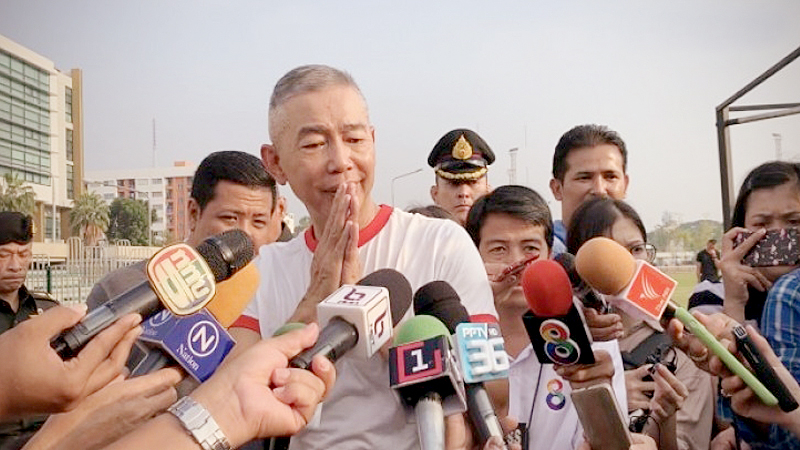
The “Run Against Dictatorship” campaign is scheduled for January 12, 2020. Future Forward Party leader Thanathorn Juangroongruangkit and his supporters are expected to take part in the event.

When asked about measures to handle a possible political rally and mob during New Year, Apirat said: “There’s no need to worry as Thailand has overcome various kinds of crises in the past. However, there’s a different kind of crisis that we need to prepare for and it’s ‘proxy crisis’.”

Apirat further explained that a proxy crisis was organised or manipulated by someone to fulfill their goals. “The mastermind probably realises it is not possible to fight the authority head-on, so a proxy is appointed to fight for them,” he said. “A proxy crisis is different from a proxy war; look up their definitions to see how they are different,” he said.

“No matter what kind of crisis we are facing, the most important thing is that everyone must obey the law,” he added. “If Thai people disobey the laws and the Constitution by ignoring the resolutions of judicial bodies, it will raise questions among foreign countries regarding the sanctity of our laws.”

When asked who he thought was the mastermind behind these proxies, Apirat said there could be many people who used different proxies for different purposes. “The unrest situation in the South and political demonstrations could be the work of these proxies, too” he added.

Possible software issue forces NASA to cancel Boeing Starliner attempt to dock with space station #ศาสตร์เกษตรดินปุ๋ย

#ศาสตร์เกษตรดินปุ๋ย : ขอบคุณแหล่งข้อมูล : หนังสือพิมพ์ The Nation

https://www.nationthailand.com/news/30379692?utm_source=category&utm_medium=internal_referral

Possible software issue forces NASA to cancel Boeing Starliner attempt to dock with space station

Dec 21. 2019
NASA Astronaut Mike Fincke makes remarks at the Kennedy Space Center Thursday in anticipation of Friday's test launch. Pictured, left to right, are Robert Cabana, director, Kennedy Space Center; Josh Cassada, Suni Williams, Nicole Mann, Chris Ferguson, Boeing, and NASA administrator Jim Bridenstine and his deputy Jim Morhard. MUST CREDIT: Washington Post photo by Jonathan Newton

NASA Astronaut Mike Fincke makes remarks at the Kennedy Space Center Thursday in anticipation of Friday’s test launch. Pictured, left to right, are Robert Cabana, director, Kennedy Space Center; Josh Cassada, Suni Williams, Nicole Mann, Chris Ferguson, Boeing, and NASA administrator Jim Bridenstine and his deputy Jim Morhard. MUST CREDIT: Washington Post photo by Jonathan Newton
By The Washington Post · Christian Davenport, Douglas MacMillan, Aaron Gregg

271 Viewed

CAPE CANAVERAL, Fla. – Boeing, still reeling from the crashes of two passenger jets that killed 346 people and led to the worldwide grounding of its most popular aircraft, suffered another major setback Friday when the craft it is designing to fly NASA astronauts to space failed to achieve the correct orbit, forcing the cancellation of its planned mission to the International Space Station.

Officials said they were investigating what caused the Starliner capsule’s main engine not to fire as scheduled to push it onto a path to rendezvous with the space station. But suspicion immediately fell on the capsule’s software, which was directing the uncrewed spacecraft’s operations after launch.

No one was on board the spacecraft and no one was hurt, but the problem reignited questions about Boeing’s procedures as NASA seeks to restore human spaceflight from U.S. soil. No American has flown into space from the United States since the space shuttle fleet was retired in 2011.

Boeing spokesman Gordon Johndroe said in an email to The Washington Post that there is “no direct comparison” between the Starliner’s failure on Friday and the two deadly crashes of 737 Max airliners, which were blamed on a software program called the Maneuvering Characteristics Augmentation System, or MCAS. Spaceflight software development “utilizes different approaches and people due to the unique mission demands and conditions,” Johndroe said.

But questions are sure to arise around whether Boeing’s divisions might share approaches to design, testing and evaluation that could result in shared problems with software, said Todd Curtis, an aviation safety analyst for the website AirSafe.com and a former Boeing engineer.

“Although they are different divisions, they are the same company, and they are in these spaces where assets from one part of the company can be used in a completely different part of the company,” Curtis said. He recalled that during his time in the commercial plane division, he was sometimes called on to help out with issues in the military aviation division.

“They can be working off shared documentation, shared procedures, or shared staff, or other shared resources used in different parts of the company,” he said. “Even though this is a space story today, 737 Max’s problems are in the back of people’s minds.”

Loren Thompson, a defense analyst who works with Boeing as well as some of its competitors, suggested Boeing’s problems with the 737 Max would inevitably affect Boeing’s other businesses.

“One thing that has allowed Boeing to take risks on the defense and space side is robust cash flow from their jetliner business,” Thompson said. “Now that that has been impaired, they may have to pull in their horns from taking risks.”

Boeing shares have tumbled 22 percent since the second crash of a 737 Max in March, erasing about $52 billion of its market value. The stock price fell more than 1.6 percent Friday, closing at $328 a share.

The failure of the Starliner capsule to achieve the correct orbit came after what appeared to be a flawless on-time liftoff at 6:36 a.m. Friday. The Atlas V rocket, operated by the United Launch Alliance, took off just before dawn. After a few minutes, the first engine cut off, the second stage took over, and finally the spacecraft was flying freely. At 31 minutes after launch, the Starliner’s main engine was supposed to ignite. It did not.

Boeing and NASA officials said they were gathering details about what went wrong and why, as they seek to bring the spacecraft back to the ground, most likely Sunday in New Mexico. The original plan had been for the craft to dock with the space station on Saturday, deliver holiday presents and supplies, and return to Earth on Dec. 28.

Officials painted a complicated picture of multiple miscues aboard the craft: In addition to the failure of the spacecraft’s computer to fire the engine to push it into the correct orbit, a timer aboard the spacecraft mistakenly thought that “orbital insertion burn” had taken place and ordered other thrusters to fire to keep the spacecraft on a straight and true trajectory.

By the time the crews on the ground figured out what was wrong and sent corrective instructions to the spacecraft, it had burned through so much fuel that officials decided they would need to abort the mission to the station and bring the spacecraft down.

NASA Administrator Jim Bridenstine said at a news conference Friday that the failure would not have been life-threatening had astronauts been onboard. He said that had the spacecraft been crewed, the mission might have been saved. “They are trained to deal with a situation where the automation is not working according to plan,” he said.

Bridenstine praised the quick thinking and professionalism of Boeing as it struggled to deal with a troubling situation. He and others said finding problems was the precise reason for the test program. On Thursday, he said he had complete confidence in Boeing.

“We’re very comfortable with Boeing as a company,” he said. “Look at the history that Boeing has delivered on behalf of the United States of America. There is a lot of history here. There is a lot of capability here.”

He added that NASA’s engineers had been “embedded side by side with Boeing’s engineers” and that “every piece of this spacecraft is being certified by NASA.”

The failure of the Starliner capsule comes at one of the darkest moment’s in Boeing’s more than 100-year history. The 737 Max remains grounded, nine months after the plane’s second crash in Ethiopia and a fix first promised by April has yet to be approved as more problems have come to light. Boeing’s chief executive, Dennis Muilenburg, was stripped of his title as chairman. One member of Congress, incensed over the problems with the 737 Max, accused the company of building “flying coffins.”

On Monday, Boeing announced it would halt production of the troubled airplane beginning in January, a hit to its bottom line that could send ripples across the U.S. economy. Southwest Airlines, the largest customer for the 737 Max, announced Tuesday it would not plan to fly the planes until April, and on Friday, United Airlines said it was pulling 737 Max jets from its flight schedules until June 4.

“We won’t put our customers and employees on that plane until regulators make their own independent assessment that it is safe to do so,” United spokesman Frank Benenati said in an email.

United has 14 737 Max jets in its fleet and is waiting on delivery of an additional 16, Benenati said.

Boeing also has suffered a number of problems with its Starliner spacecraft, originally scheduled to fly crews into space in 2017.

Last year, it discovered a propellant leak during a test of the capsule’s abort motor. The company fixed that problem, it said. But then last month, during a test of its abort systems, one of the three parachutes failed to deploy, apparently because someone had failed to hook the main chute to a drag chute that pulls it from the capsule.

Since the space shuttle was retired in 2011, the space agency has relied on Russia to ferry its astronauts to the space station, about 240 miles above Earth. Those seats cost about $84 million each.

In 2014, Boeing and SpaceX won contracts, worth $6.8 billion combined, to build spacecraft designed to restore human spaceflight from U.S. soil.

In March, SpaceX successfully flew its Dragon spacecraft without crews to the space station and is hoping to complete a test of its emergency abort system in January.

Before Friday’s launch, Bridenstine was bullish about the progress both companies were making and optimistic about the future.

“We’re moving into a new era,” he said Thursday. “We are going to launch American astronauts, on American rockets, from American soil for the first time since the retirement of the space shuttles.” The first flight with astronauts on board, he said would take place “in the first part of next year.”

Officials on Friday could not say what the next steps will be.

Jim Chilton, Boeing’s senior vice president for space and launch, said the company will focus on finding the “root cause of the failure,” but said “we don’t know why” the timer misfired. “The spacecraft was not on the timer we expected it to be on,” he said. “That was a surprise.”

It was unclear whether NASA would require Boeing to fly another test mission without crews on board before allowing its astronauts to fly in the Starliner. Bridenstine said he wouldn’t rule out a mission with crews on board, pointing out that the space shuttle had been piloted by astronauts, not computers.

A statement from Vice President Mike Pence, the Trump administration’s point man on crewed spaceflight, suggested the failure will not disrupt NASA’s schedule to fly Americans from U.S. soil next year. The statement said Pence had been briefed by Bridenstine, who assured him that “NASA will continue to test and improve, in order to return American astronauts to space on American rockets in 2020.”

Tsunami survivor to open international school under the theme of ‘generosity’ #ศาสตร์เกษตรดินปุ๋ย

#ศาสตร์เกษตรดินปุ๋ย : ขอบคุณแหล่งข้อมูล : หนังสือพิมพ์ The Nation

https://www.nationthailand.com/news/30379675?utm_source=category&utm_medium=internal_referral

Tsunami survivor to open international school under the theme of ‘generosity’

Dec 21. 2019
Howard Liang and his family

Howard Liang and his family
By Thanachart Chuengyaempin

945 Viewed

Tsunami survivors have come back to Thailand for the opening of an international school near Suvarnabhumi Airport under the theme of “Numchai”, or generosity, after being impressed by the generosity and kindness of Thai people during the time of disaster, which marks its 26th anniversary this month.

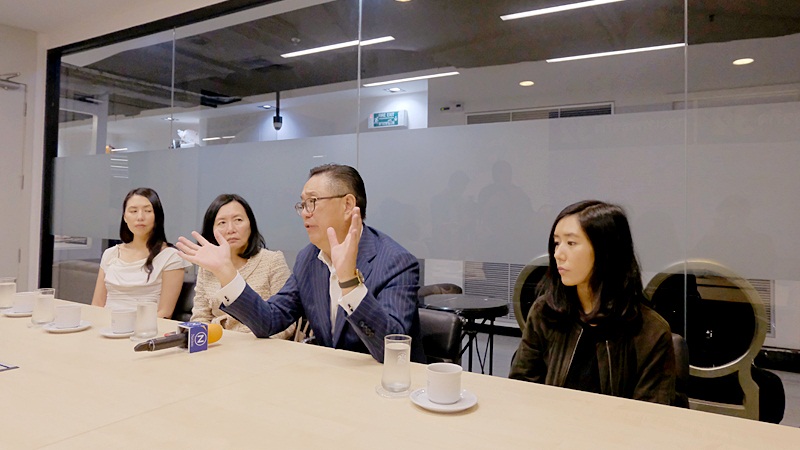
Hong Kong educational investor Howard Liang, 64, together with his wife Luanna Liang, 62, and two daughters – Chloe, 30, and Charmian, 26 – recounted that he and nineteen members of his family were in Phuket when the tsunami struck on December 23, 2004.

“Our two boats were crushed to pieces and we were separated,” he said. “Luckily waves carried me to an island, where local people helped evacuate me and other survivors to a high area where the tsunami waves could not reach.”

Charmian, who was twelve years old at that time, said that after her boat was hit by the waves, she first thought it was funny, but she was dragged under water and awoke to find herself on the same island.

“That memory is quite blurred to me because I was so young then, but I remember that local people suggested I head for high ground, from which my entire family were evacuated,” she explained.

The family and other survivors were sent for rehabilitation to a Takua Pa hospital and school the next day. At the school, the shoeless family met a man and his daughter, who took off their slippers and handed them to the family.

“He then disappeared and came back with more shoes for us,” Luanna said.

Takua Pa School was a place where Chloe was allowed to use one of two computers to contact her friend in Hong Kong. She came back a few years later and donated computers to the school to show her appreciation.

The generosity inspired Howard to think that “numchai” should be taught in Verso international school, which he plans to open in August 2020.

The school is presently under construction on 168 rai in Thana City village near Suvarnabhumi Airport.

“My school will be like a big apple if you see it from a plane,” he said. “It will have kindergarten to high school. However, in the first year of operation, the highest educational level will be grade eight.”

He said the target group of his school are those who live in nearby areas of Bangkok, Samut Prakarn, and Eastern Economic Corridor provinces. Tuition fees will range from Bt600,000 to Bt960,000 per year, depending on the students’ educational level.

“There are numerous wonderful international schools in Bangkok and my school is not going to compete with them,” said Howard. “We are giving parents a choice by providing courses that inspire students to think outside the box, with flexible classroom teaching.”

5m depositors had less than Bt50 in accounts #ศาสตร์เกษตรดินปุ๋ย

#ศาสตร์เกษตรดินปุ๋ย : ขอบคุณแหล่งข้อมูล : หนังสือพิมพ์ The Nation

https://www.nationthailand.com/news/30379682?utm_source=category&utm_medium=internal_referral

5m depositors had less than Bt50 in accounts

Dec 20. 2019
 Atchana Lamsam, right

Atchana Lamsam, right
By THE NATION

919 Viewed

Almost 5 million Thai depositors have less than Bt50 in their bank accounts, according to a recent joint study by Puey Ungphakorn Institute for Economic Research and Deposit Protection Agency on the savings behaviour of Thais.

The study was based on 80 million bank accounts worth Bt12 trillion as of June 2017.

The Puey Ungphakorn Institute’s section head of networking and communication, Atchana Lamsam said it was found that as of June 2017, 56.04 per cent of Thai people had commercial bank’s accounts.

Of the total depositors, half had less than Bt3,142 in their accounts.

Also, 32.8 per cent of the total or 12.2 million had an account balance less than Bt500 each, while 4.7 million had less than Bt50.

Only 0.2 per cent of total depositors had over Bt10 million in their accounts.

The study also found that bank customers with deposits of more than Bt3 million each, accounted for 10 per cent of the total.

However, their combined deposits account for 93 per cent of the total of Bt12 trillion in the Thai banking system.

Health centre lists top ten health issues in 2019 #ศาสตร์เกษตรดินปุ๋ย

#ศาสตร์เกษตรดินปุ๋ย : ขอบคุณแหล่งข้อมูล : หนังสือพิมพ์ The Nation

https://www.nationthailand.com/news/30379680?utm_source=category&utm_medium=internal_referral

Health centre lists top ten health issues in 2019

Dec 20. 2019
By The Nation

1,076 Viewed

Thai Health Centre under the Thai Health Promotion Foundation has listed ten health issues in the runup to 2020, warning the public to take precautions.

The ten issues are divided into three groups: children, working-age people, and the elderly. Also, there are two issues that can affect anyone.

In children, the issues are:

Stress or Depression: Statistics from the Department of Mental Health revealed that in 2019, there were six suicide attempts every hour in Thailand. More than 300 who had committed suicide successfully were children and teenagers, while the number seeking psychiatric help from the department increased.

The statistic also showed that the main causes of stress among children and teenagers were familial relationship, jobs and duties, being bullied and domestic violence.

“Most teens posted their suicidal messages on Twitter at 10pm on Tuesday and 7pm on Friday. If they received help in time, it can lessen the risk of suicide by half,” the official said.

Online threats: The survey conducted by Child Online Protection Action Thailand (COPAT) and Internet Foundation for the Development of Thailand found that Generation Z spent an average of 10.22 hours per day on the internet. In 2019, 31 per cent of children were the targets of cyber-bullying, 74 per cent have seen online pornographic materials, and 25 per cent admitted that they had had physical contact with strangers they met online.

“The research also stated that children who spend a lot of time online risk being bullied or becoming a cyber-bully themselves. Therefore, good relationships in the family and personal data protection will help prevent the risk from the start,” the official said.

Traffic and road accidents: Wearing a helmet while travelling on a motorcycle among teenagers decreased from 32 per cent in 2010 to 22 per cent in 2018, while 92 per cent of young children did not wear a helmet. Also, most injuries and deaths among children from motorcycle accidents occurred in lower-income regions.

“The foundation will collaborate with network partners in 283 risky districts to reduce accidents next year,” the official said.

Teenage pregnancy and infections: The number of teenage mothers has decreased, but the rate of sexually transmitted infections has tripled, especially syphilis and gonorrhea. The main cause is not wearing condoms when having sex.

The data from the Bureau of Epidemiology, Department of Disease Control in 2018 found that half of students in grade 11 and vocational certificate II used condom when having sex, but not using it when having sex with other women or men.

“According to an online survey, the reason teens did not use condom was because it was expensive or embarrassed when buying it. They prefer to use other methods instead, such as birth control pills,” the official said.

Understanding of e-sport: Becoming e-sport player is one of Thai children’s dream careers. The study found that discipline and time management are important factors for classifying professional players and game addicts. Besides, online gambling is also found in the competition.

In working age people, the issues are:

Diseases caused by eating: The top three causes of death for Thai people are still non-communicable diseases such as stroke, diabetes, and ischemic heart disease. Top Post’s survey of popular food in the previous year found that spicy and sweet flavour was popular among Thai people.

“People in working-age focused on extreme flavour, while teenagers were focused on appearance. Moreover, children and company workers eat little vegetables, so the foundation will hold a campaign to change people’s eating habits and enable them to access healthy foods,” the official said.

Cannabis: The Department of Medical Service has allowed the usage of cannabis in medical treatments for patients suffering nausea from chemotherapy, epilepsy, spasms with multiple sclerosis, and neuropathic pain.

“Cannabis was reportedly more beneficial than the department specified, so further research is required to make it more useful,” the official said.

Amomg the elderly, fake news is the top issue. The online survey found that top five of the most shared health-related fake news are porcupine flower, cannabis oil, energy cards, and the intelligence of children coming from their mothers.

“Most of the webpages publishing the fake news described themselves as news agencies, while webpages which provide facts was mostly news page,” the official said.

The issues the affect everyone:

PM2.5 dust particle: It was ranked as the fifth cause of death in 2015. The World Health Organisation announced that there are 7 million deaths from air pollution in 2016, in which 91 per cent occurred in Southeast Asia and the West Pacific countries.

“The statistic in Bangkok showed that PM2.5 occurred from January to March, posing serious risks to children and the elderly. The foundation will cooperate with Thailand Clean Air Network to prepare measures to tackle the dust particles in urban areas, ” the official said.

Food waste: Of the organic waste created in Thailand , at least 254 kilograms are food waste, 30 per cent over France and 40 per cent more than the United States.

“Waste management research by the Thailand Development Research Institute (TDRI) found that waste disposal by incineration or landfill is the least recommended method in many countries, but Thailand mostly uses this method. Therefore, the government sector should create motivation for entrepreneurs to reduce food waste by donating it or making use of it,” the official said.

Official added that these issues in 2020 are ongoing issues from this year and topics that were discussed throughout this year.

“Keeping an eye on these issues alone may not be a good choice, taking action to create change may be the solution,” official added.

Related Story:

Gen Z spend over 10 hours a day online, increasing chance of being cyber-bullied: expert

Close to 5m passengers expected at AOT airports from Dec 26 to Jan 5 #ศาสตร์เกษตรดินปุ๋ย

#ศาสตร์เกษตรดินปุ๋ย : ขอบคุณแหล่งข้อมูล : หนังสือพิมพ์ The Nation

https://www.nationthailand.com/news/30379678?utm_source=category&utm_medium=internal_referral

Close to 5m passengers expected at AOT airports from Dec 26 to Jan 5

Dec 20. 2019
By THE NATION

1,786 Viewed

The Airports of Thailand (AOT) expected a total of 4.93 million passengers passing through its six airports, from December 26 to January 5, increasing 2.29 per cent from the same period last year, AOT president Nitinai Sirismatthakarn said today (December 20).

AOT operates Suvarnabhumi International Airport, Don Mueang International Airport, Phuket International Airport, Chiang Mai International Airport, Mae Fah Luang – Chiang Rai International Airport, and Hat Yai International Airport.

Suvarnabhumi Airport is expected to see 2.27 million passengers during the period, up 0.93 per cent from last year, while Don Mueang Airport will see 1.33 million passengers, up 3.26 per cent.

Phuket Airport is expected to welcome 720,000 passengers, up 8.73 per cent, while 406,700 is expected for Chiang Mai Airport, up 0.35 per cent.

The passenger number of Hat Yai airport is expected at 100,000, down 13.64 per cent, while up to 100,000 is forecast for Mae Fah Luang – Chiang Rai International Airport, up 4.94 per cent from the same period last year.

Male baby blue bull joins inhabitants at Songkhla Zoo #ศาสตร์เกษตรดินปุ๋ย

#ศาสตร์เกษตรดินปุ๋ย : ขอบคุณแหล่งข้อมูล : หนังสือพิมพ์ The Nation

https://www.nationthailand.com/news/30379676?utm_source=category&utm_medium=internal_referral

Male baby blue bull joins inhabitants at Songkhla Zoo

Dec 20. 2019
By THE NATION

1,073 Viewed

Songkhla Zoo recently welcomed its latest inhabitant, a male nilgai born in the facility, said director Chalermwut Kasetsomboon on Friday (December 20).

“The newcomer, now one-month old, is in good healthy” he added. “Yesterday, we announced another new member, the albino Indian muntjac“.

Nilgai, or blue bull, is the largest Asian antelope, and also a ruminant in the spiral-horned animal family of Bovidae. Its appearance is a mix between a cow and a horse.

An outstanding feature of an adult male nilgai is its dark blue or dark grey hairs, matching its reference as a blue bull while a female nilgai displays reddish brown hairs. Female nilgai become sexually mature when two-year old as opposed to four or five years for males.

Nilgai breeds throughout the year with gestation period lasting around 240 to 258 days, giving births to one to two cubs each time.

The average lifespan of an nilgai is twenty-one years.

The antelope is a diurnal animal, which can be found in the lowland of Northern India and eastern Pakistan. It main diet is shrubs, grasses, leaves and fruits, and can live without water for many days.

Nilgai usually live near water sources in groups of fifteen to twenty each, but in winter the herbs could swell in numbers.

Video credit: Santipub Ramsuit