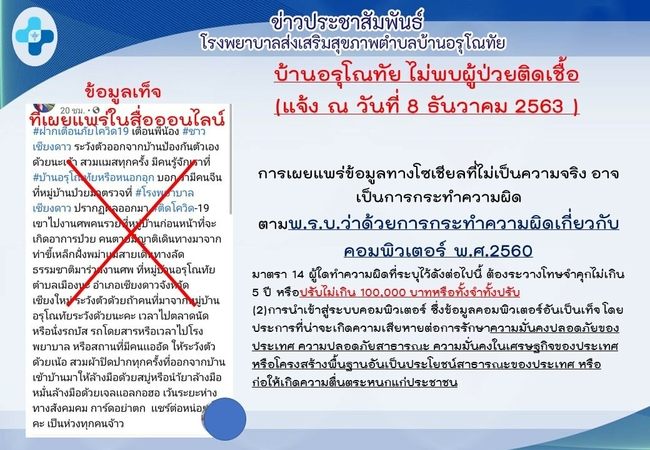
A Chiang Mai hospital has advised people not to believe or share news or Internet posts which claim that some Chinese nationals have tested positive for Covid-19 in Chiang Dao district, warning that sharing fake information via the Internet could violate the Computer-related Crime Act.
In a Facebook post on Wednesday, the Baan Arunothai Health Promotion Hospital in Chiang Dao flatly denied an Internet rumour that infected Chinese were found when they were receiving a health checkup at the hospital.
“The hospital has no Covid-19 inpatient, and it has found no infection whatsoever among persons receiving treatment at the hospital so far,” it said.
“Posting or sharing false information on the Internet is punishable by a maximum 5 years imprisonment and/or Bt100,000 fine under Article 14 of the Computer-related Crime Act BE 2560,” it warned.
The hospital also mentioned another rumour being shared online that the three provinces of Chiang Mai, Chiang Rai and Phayao would be shut down during the New Year holidays in a bid to prevent Covid-19 from spreading.
“We have contacted the Department of Disease Control and have been informed that this is false,” it said. “The DDC confirmed that there is no lockdown or city closures enforced at the moment, and asked people not to believe unconfirmed rumours or panic.
“People should stay tuned for updates from the government and maintain preventive measures to stay safe from Covid-19, including wearing face masks, washing your hands regularly and avoiding crowded areas,” the hospital added.
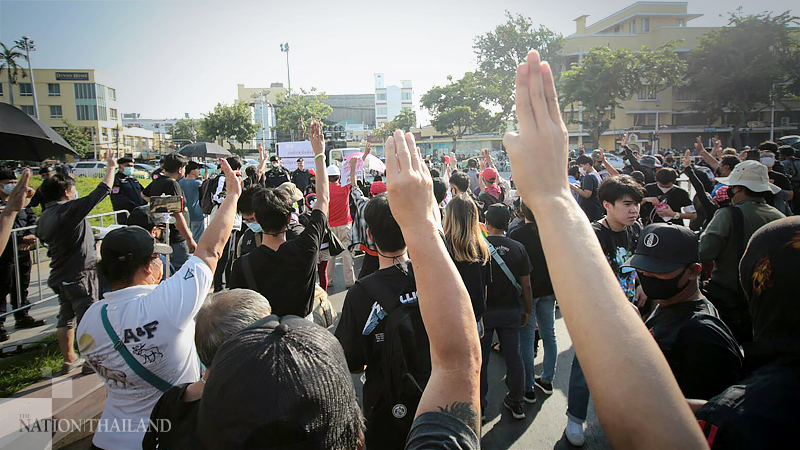
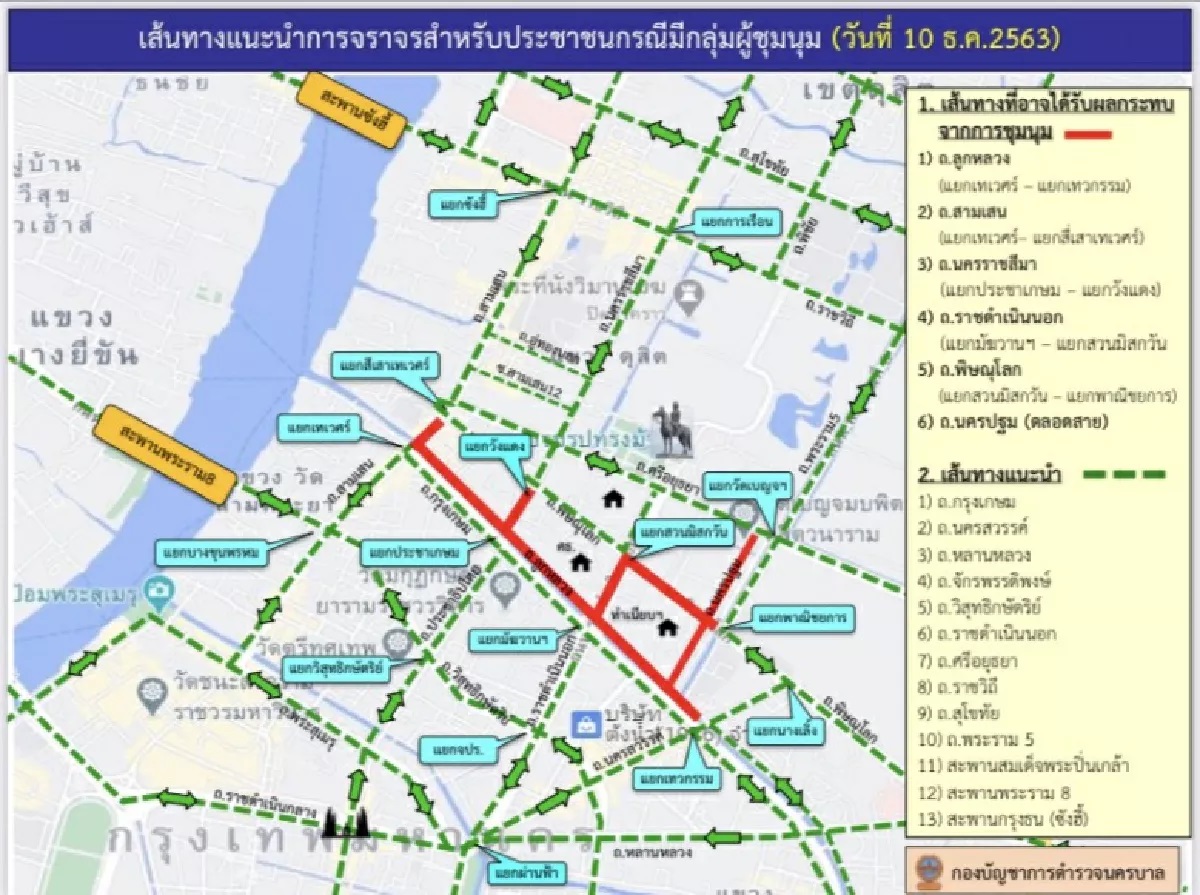
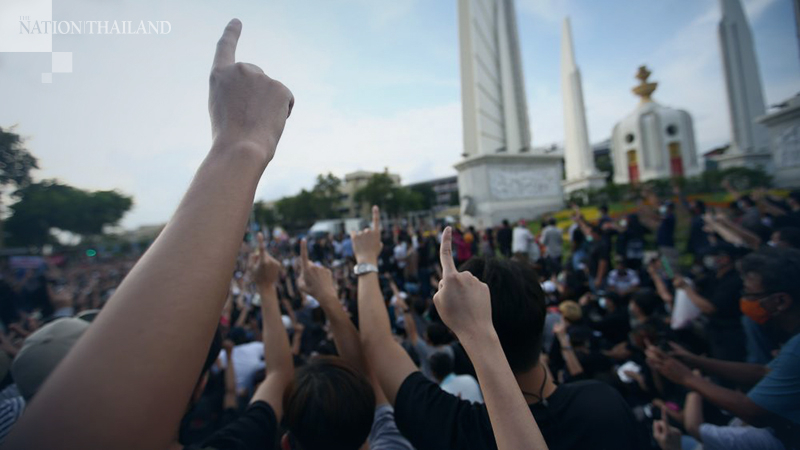
Bangkok police have advised motorists to avoid routes around the United Nations building located on Ratchadamnoen Nok Avenue in Phra Nakhon district on Thursday due to a planned political protest on Constitution Day.
The Ratsadon pro-democracy group announced on social media on Wednesday that they would hold a political rally in front of the UN building to force the government to revoke the draconian lese-majesty law, also known as Article 112.
“We expect traffic to be heavily congested around the UN building from early morning until the rally ends,” said deputy Metropolitan Police chief Pol Maj-General Jirasan Kaewsaeng-Ake. “Motorists are therefore advised to avoid these roads and connecting routes.”
They are:
1. Luk Luang Road
2. Samsen Road
3. Nakhon Ratchasima Road
4. Ratchadamnoen Nok Avenue
5. Phitsanulok Road
6. Nakhon Pathom Road
The police recommended that motorists instead use the following routes to bypass the rally venue:
1. Krung Kasem Road
2. Nakhon Sawan Road
3. Lan Luang Road
4. Chakkraphatdi Phong Road
5. Wisut Kasat Road
6. Sri Ayutthaya Road
7. Ratchawithi Road
8. Sukhothai Road
9. Rama V Road
10. Somdet Phra Pinklao Bridge
11. Rama VIII Bridge
12. Krung Thon Bridge
Jirasan added that the Metropolitan Police would deploy officers around the rally venue to facilitate traffic flow and minimise impact on motorists and pedestrians.
To inquire about traffic routes or request roadside assistance, contact hotline 1197, visit www.trafficpolice.go.th, or download the mobile application “M-Help Me”.
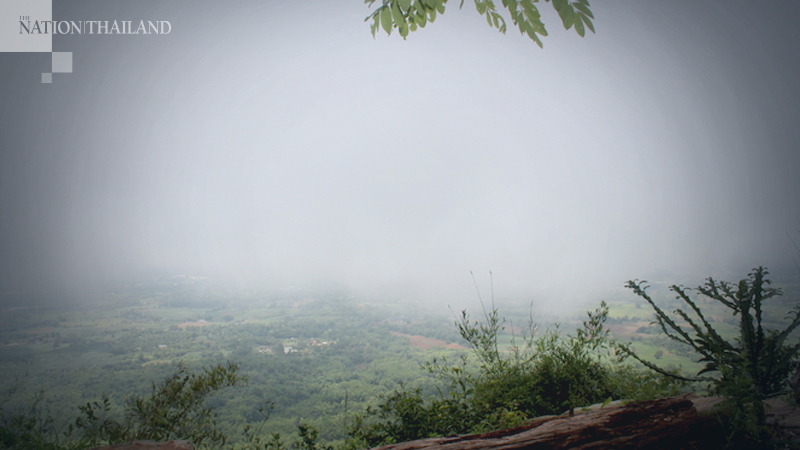
The North and the Northeast is seeing cool to cold weather, with mountaintops being cold to very cold and frost in some areas, the Meteorological Department said on Thursday, adding that the Central region and the East is also seeing a cool morning.
The department also said the weak northeast monsoon prevailing across the Gulf of Thailand and the South will bring less rain to those areas, though waves in the Gulf are about 1 metre high and 1-2 metres during thundershowers.
Here’s the weather forecast for the next 24 hours:
North: Cool to cold weather; temperature lows of 12-17 degrees and highs of 29-33 degrees Celsius. Temperature on hilltops is likely to drop to 1-10 degrees Celsius, with frost in some areas.
Northeast: Cool to cold weather with morning fog; temperature lows of 13-18 degrees and highs of 29-31 degrees Celsius. Temperature on hilltops is likely to drop to 7-13 degrees Celsius.
Central: Cool weather and fog in the morning; temperature lows of 18-21 degrees, highs of 31-33 degrees Celsius.
East: Cool weather and light fog in the morning; temperature lows of 20-23 degrees, highs of 32-33 degrees Celsius; waves a metre high and 1-2 metres offshore.
South (east coast): Partly cloudy with thundershowers in 20 per cent of the area; temperature lows of 21-24 degrees, highs of 31-32 degrees Celsius; waves a metre high and 1-2 metres during thundershowers.
South (west coast): Partly cloudy with thundershowers in 10 per cent of the area; temperature lows of 22-24 degrees, highs of 32-34 degrees Celsius; waves a metre high and 1-2 metres during thundershowers.
Bangkok and surrounding areas: Cool weather in the morning; temperature lows of 21-23 degrees, highs of 31-34 degrees Celsius.
The Siam Commercial Bank’s Economic Intelligence Centre (EIC) expects the Thai gross domestic product (GDP) next year to expand by 3.8 per cent on the back of improving global growth, fiscal stimulus packages and vaccine progress.
Global growth, however, is likely to get worse due to recent Covid-19 resurgences before improving. The recovery in 2021 is likely to be gradual, supported by vaccine progress, stimulus packages and less severe scarring effects.
However, most key economies (except China) in 2021 should remain below their pre-Covid levels in 2019. In late 2020, the Covid-19 resurgences in several countries should result in the tightening of lockdown measures and hence slow economic recovery in the near-term.
Looking forward, global economic recovery in 2021 will likely be gradual and uneven across countries and industries. Developed countries, which are expected to be vaccinated in the first half of the year, should recover faster compared to developing countries.
In Thailand, better-than-expected private consumption recovery in the third quarter of this year should result in smaller-than-expected GDP contraction in 2020.
In the third quarter of this year, Thailand’s GDP fell by -6.4 per cent year on year, supported by faster recovery in private consumption on the back of more holidays and stimulus packages.
However, recovery in the fourth quarter will likely slowdown somewhat due to Covid-19 resurgences in several countries, which should affect consumer confidence and domestic tourism. As a result, EIC expects Thai GDP growth this year to fall by -6.5 per cent versus its previous forecast of -7.8 per cent.
Looking forward, EIC expects the Thai economy next year to grow by 3.8 per cent due to the low base effect, global recovery, fiscal spending and additional stimulus packages as well as Covid-19 vaccine, which is expected to be distributed in the second half of 2021.
However, scarring effects should continue to pressure private domestic demand recovery. Public spending is likely to be a key supportive factor, especially public investment spending.
In addition, the Bt1-trillion recovery package still has about Bt500 billion ready to be disbursed in 2021.
Recently, the government also extended some co-pay measures, suggesting their ready stance to continue fiscal policy easing to support private consumption.
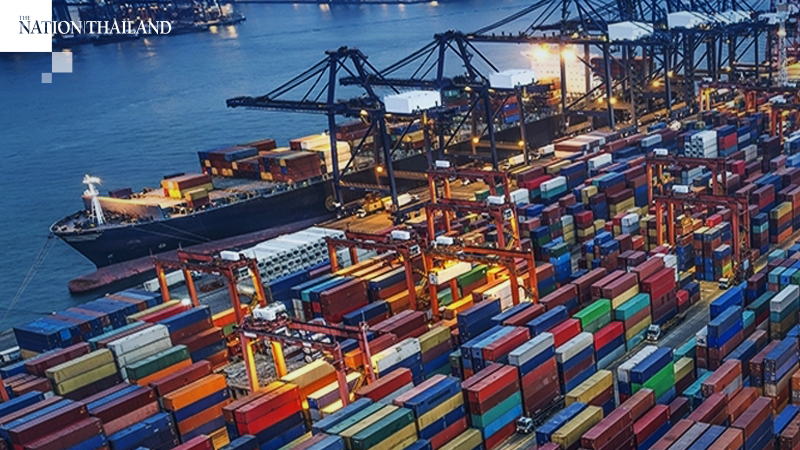
Thai exports in 2021 is expected to rebound and grow by 4.7per cent on the back of global economic and trade recovery. However, the severe shortage and hence rising cost on freight containers in late 2020 and early 2021 as well as strong baht due to weakening dollar should remain key headwinds for export recovery.
The progress in high efficacy rate vaccines, combined with Thailand as a production base for AstraZeneca, should support Thailand’s tourism recovery in the second half of next year, when both key foreign tourists’ countries and Thailand have been widely vaccinated.
On tourist arrival forecasts, EIC expects around 8 million foreign tourists in 2021, which remains significantly lower than the foreign tourist arrivals in 2019 (around 40 million).
Meanwhile, with material scarring effects on Thai economy, the effects should continue to pressure private consumption and investment recovery through:
• Fragile labour markets on the back of elevated unemployment, rising underemployment, and income slowdown,
• Bleak business registration and dissolution expected to continue, and
• Rising household debt to income ratio.
On monetary policy, EIC expects the Bank of Thailand to keep its policy rate at 0.5 per cent throughout 2021.
EIC expects strengthening Thai baht pressure to continue with the baht coming in the range of Bt29.5-Bt30.5 against the dollar at end-2021, mainly due to a weak greenback, resulting from global economic recovery, less volatile global trade tensions, larger US budget deficit, and hence capital inflows to emerging markets, including Thailand.
The key downside risks on the Thai economy in 2021 include Covid-19 resurgences and delay in wide vaccine distribution, and issues on political stability, which could impact investors’ confidence. The other risk is stronger Thai baht, compared with key trading partners, to impact external demand’s recovery.
The Stock Exchange of Thailand (SET) Index closed at 1,482.67 on Wednesday, up 3.75 points or 0.25 per cent. Total transactions amounted to Bt123.39 billion with an index high of 1,503.89 and a low of 1,474.83.
In the morning session, an analyst at Krungsri Securities expected the day’s index to rise to between 1,490 and 1,500 points on the influx of foreign funds in response to positive news of Covid-19 vaccines, adding that the positive sentiment was also benefiting large-cap stocks.
“However, we still advise investors to stick to short-term speculation as the SET will come under pressure from its tight valuation and mass sell-offs to reduce risks during the upcoming long holiday,” he said.
The 10 stocks with the highest trade value today were SAK, KBANK, DELTA, IRPC, ADVANC, PTT, SCB, SCGP, AOT and CPF.
As of 5pm, the price of oil rose by US$0.61 or 1.34 per cent to $46.21 per barrel, while gold dropped by $8.50 or 0.45 per cent, to $1,866.40 per ounce.
Other Asian indices were on the rise, except for Chinese indices:
Japan’s Nikkei Index closed at 26,817.94, up 350.86 points or 1.33 per cent.
China’s Shang Hai SE Composite Index closed at 3,371.96, down 38.21 points or 1.12 per cent, while Shenzhen SE Component Index closed at 13,716.53, down 257.36 points or 1.84 per cent.
Hong Kong’s Hang Seng Index closed at 26,502.84, up 198.28 points or 0.75 per cent.
South Korea’s KOSPI Index closed at 2,755.47, up 54.54 points or 2.02 per cent.
Taiwan’s TAIEX Index closed at 14,390.14, up 29.74 points or 0.21 per cent.
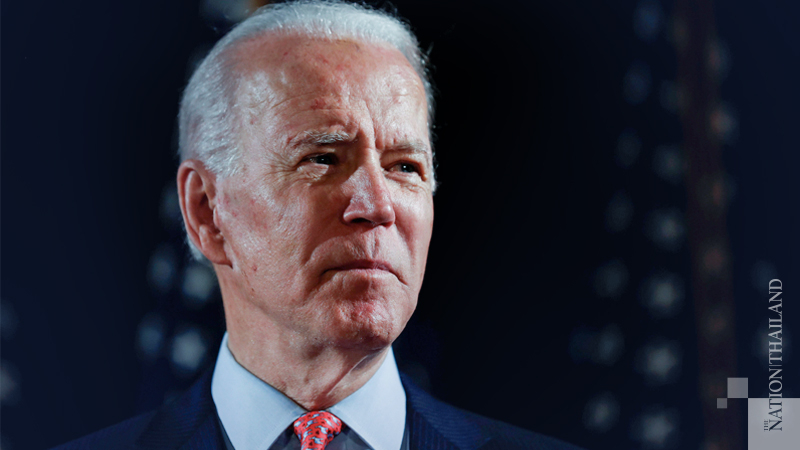
Despite a renewed emphasis on improving relations with traditional allies in Asia, US policy towards China is unlikely to change dramatically under President-elect Joe Biden’s administration, a new report by Moody’s Investors Service published on Wednesday shows.
“We do not expect the Biden administration to result in major changes in Asia credit, with any renewed pivot likely to run up against the reality of longer-term shifts underway that are increasing China’s centrality to the region,” said Nishad Majmudar, a Moody’s assistant vice president and analyst.
With ongoing trade frictions, Biden is unlikely to unwind the actions the Trump administration took against China. And Moody’s expects Biden to embrace recent outreach from the EU on adopting a unified trans-Atlantic approach against China on certain issues, while also searching for areas of cooperation with China’s President Xi Jinping.
“We expect Biden’s multilateral approach towards China will not stop ongoing structural shifts, including the restricting of supply chains and consolidation of the global economy into three distinct blocs, with potential negative credit effects for multinationals and export-oriented companies,” adds Majmudar.
Outside China, Biden’s policy may attempt to revise the “pivot to Asia” adopted by former president Barack Obama, aimed at increasing diplomatic and investment ties with the region.
Biden’s increased engagement in Asia would face a challenge from China’s growing centrality in the region, and could result in countries facing a choice between strengthening security ties with the US or deepening economic ties with China.
Meanwhile, the likely increased focus by the US under Biden on climate policy initiatives will increase longer term credit risks for industrial sectors prominent in many Asian countries, particularly power, automotive, oil and gas, and steel. Similarly, US financial regulators are more likely to follow European efforts pushing for greater financial disclosures of environmental risk, which could create pressure for Asian regulators to follow suit.
Delta Electronics’ share price rose by Bt68, or 20.8 per cent, to Bt395 per share in morning trade on Wednesday, but experts advised against investing in the company’s shares as its price was higher than the base value.
The price of Delta shares had risen more than Bt300 per share since yesterday as the company gained positive sentiment from the sharp rise of its subsidiary’s shares in Taiwan amid positive news of the firm’s Covid-19 test kit.
UOB Kay Hian strategist Kitpon Pripisankit said Delta’s share price went higher than many analysts’ forecast of between Bt200 and Bt250 per share.
“We advise investors to sell some of their Delta shares because its price has already responded to the above-mentioned positive sentiment,” he said.
Meanwhile, Yuanta Securities strategist Natapon Khamthakrue said Delta’s share price had risen higher than its base value and it would be listed on the SET50 Index again.
He added that Delta also gained positive sentiment from hopes over 5G and data centre trends, as well as speculation by Thai institutional investors.
“We advise investors to avoid buying Delta shares as its price would come under pressure from appreciation of the baht. Instead, we advise buying KCE Electronics shares as its price is cheap and is likely to move upside,” he said.
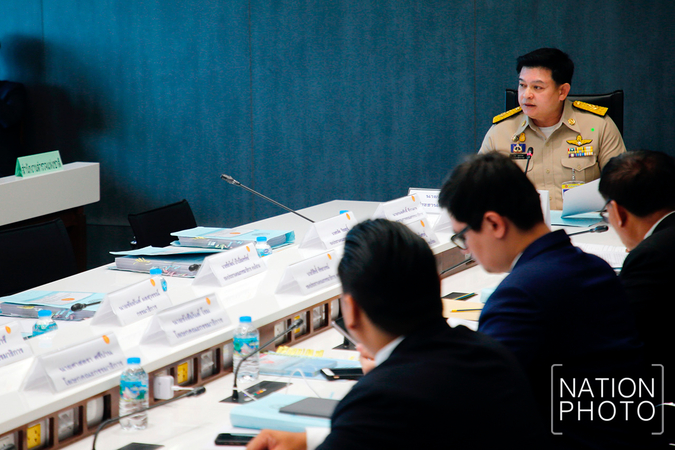
The government’s Committee on Law, Justice and Human Rights, chaired by Palang Pracharat MP Sira Jenjaka, met on Wednesday to discuss the enforcement of law during pro-democracy rallies.
Representatives of relevant agencies, including the five key leaders of the pro-democracy movement, namely Parit Chiwarak, Panusaya Sithijirawattanakul, Patsaravalee Tanakitvibulpon, Arnon Nampa and Panupong Jadnok, were invited to join the meeting. The protest leaders were supposed to provide information on alleged human-rights abuses during rallies.
However, Move Forward Party MP Rangsiman Rome said the protest leaders could not attend the meeting because they had to present themselves at police station to acknowledge charges of lese majeste and violation of the Computer Crimes Act. Rangsiman added that the protest leaders were ready to attend future panel meetings if possible.
Pro-democracy groups United Front of Thammasat and Demonstration as well as Mob Fest invited supporters via Facebook on Wednesday to participate in the “Abolish 112 and We Will Tell You” event at the October 14 Memorial in Bangkok’s Ratchadamnoen Road on Thursday.
An earlier Facebook post said the event was being held to mark Constitution Day and Human Rights Day.
The group said the event will run from 10am to 6pm and will feature academic speeches and exhibitions related to the lese majeste law. Musical performances are also pencilled in for the event.
The lese majeste law or Section 112 of the Criminal Code states that “whoever defames, insults or threatens the King, the Queen, the Heir-apparent or the Regent, will be punished with imprisonment of three to 15 years”.
Prime Minister Prayut Chan-o-cha has given police free rein to use this law against pro-democracy activists for the first time in two years.
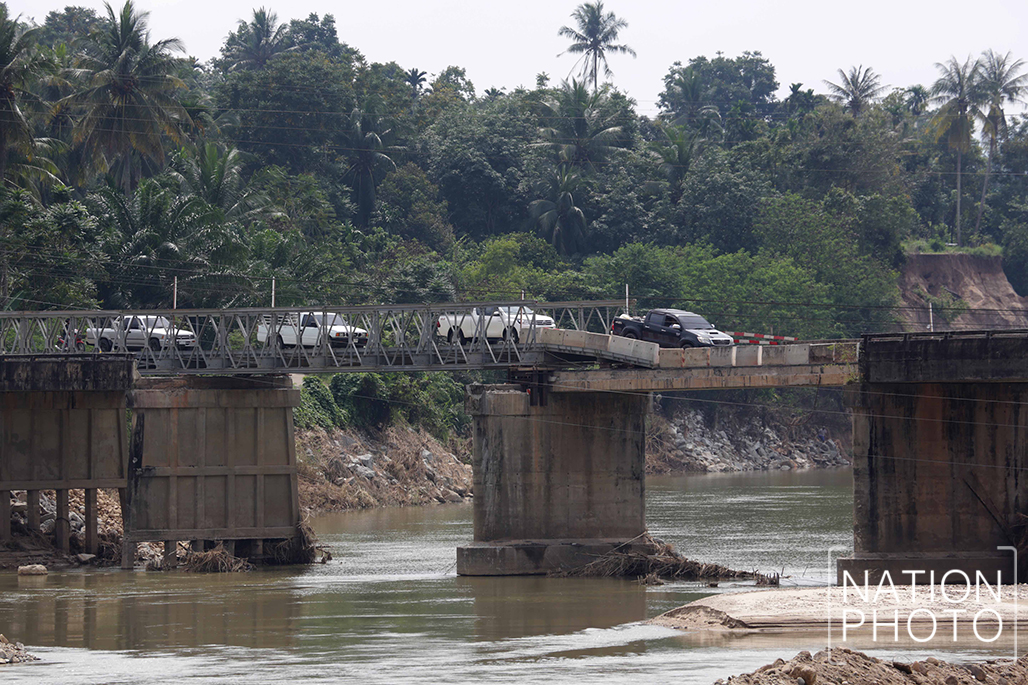
The construction of a temporary bridge linking Nakhon Si Thammarat’s Nopphitam and Krungching sub-districts has been completed after it was destroyed by flash floods on December 2.
The bridge was built by the Department of Rural Roads to facilitate travel.
The Department of Disaster Prevention and Mitigation has reported that 254,521 households in the provinces of Surat Thani, Nakhon Si Thammarat, Trang, Phatthalung and Songkhla are still struggling with floods.


 Photos by Charoon Thongnual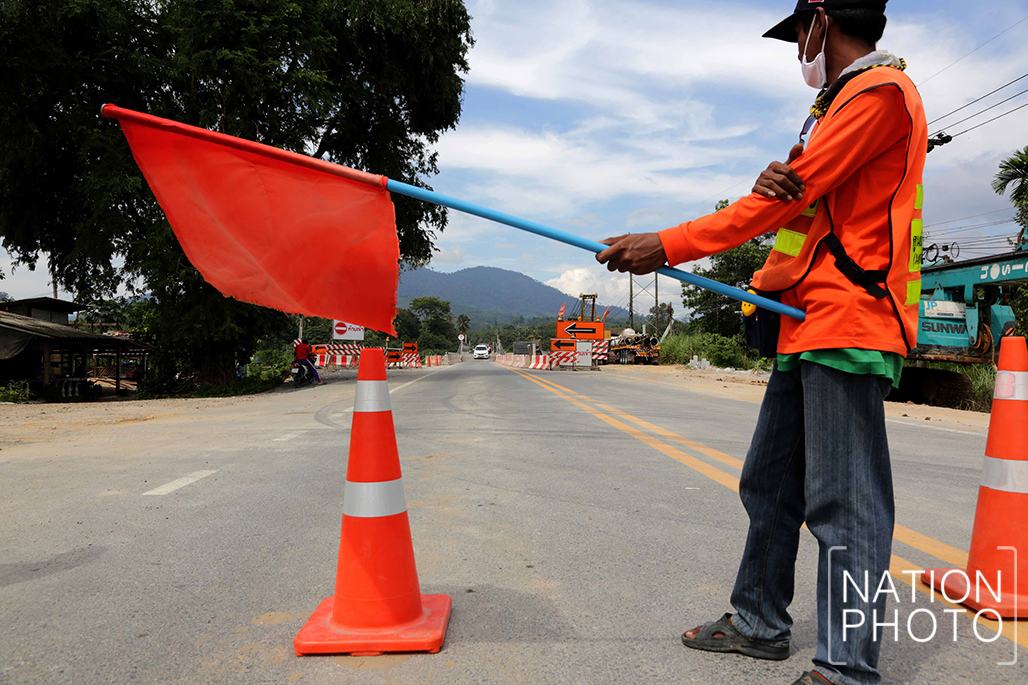
 The Department of Disaster Prevention and Mitigation has reported that 254,521 households in the provinces of Surat Thani, Nakhon Si Thammarat, Trang, Phatthalung and Songkhla are still struggling with floods.
 SootinClaimon.Com