The baht opened at 33.31 to the US dollar on Friday, weakening from Thursday’s close of 33.25 and sliding for the sixth successive week.
Krungthai Bank market strategist Poon Panichpibool predicted the Thai currency would move between 33.20 and 33.40 during the day.
Poon said that the baht is likely to swing in a wide range as the risk-averse market spurs the dollar to strengthen.
The baht was being supported by the return of foreign inflows to the Thai stock market and the falling crude oil price after the US announced it would release 1 million barrels from its reserve.
Poon warned investors to beware of currency market volatility after the US employment data is revealed tonight. A worse-than-expected recovery in the US labour market would pressure the dollar to weaken, he added. However, if the US data matches the forecast, the currency market would remain stable as it had already priced in the US Federal Reserve’s rate-rise signal.
Poon forecast the baht’s resistance level would be 33.50 to 33.70, at which point exporters might offload the dollar. The key support level would be 33 to 33.20, which would spur importers to purchase the greenback.
The currency market has been risk-off since February’s invasion of Ukraine by Russia and a lack of progress in ensuing peace talks.
Meanwhile, the Fed has signalled will hike the interest rate in May and in June meeting after US inflation in February reached 6.4 per cent, the highest level in 40 years.
Thailand’s exports of gems and jewellery saw a big jump in the first two months of this year due to the economic recovery in major buyer markets.
Exports of gems and jewellery had slowed down after the Covid-19 pandemic hit in 2020.
In January and February, Thailand exported US$2.07 billion (THB68.3 billion), up 101 per cent from the same period a year earlier, said Sumed Prasongpongchai, chief executive officer of the Gem and Jewellery Institute of Thailand (GIT), a public organisation.
Exports of gems and jewellery accounted for 4.7 per cent of total Thai exports during the period, he added.
Even with the exclusion of unprocessed gold, the exports of gems and jewellery in the first two months totalled $1.16 billion (THB38.3 billion), an increase of 41.9 per cent, according to Sumed.
He attributed the sharp gain to the economic recovery in many countries that are major purchasers of Thai gems and jewellery, including the United States, India, Hong Kong, Germany, and the United Kingdom. The recovery has led to higher purchasing power in those countries, he added.
The US remains the top export market for Thai gems and jewellery, with an increase of 52 per cent.
However, Sumed warned that the ongoing war between Russia and Ukraine would increase inflation in the countries that are major importers of gems and jewellery. Also, the Omicron variant has still caused many Covid-19 infections, while interest rates are on the rise.
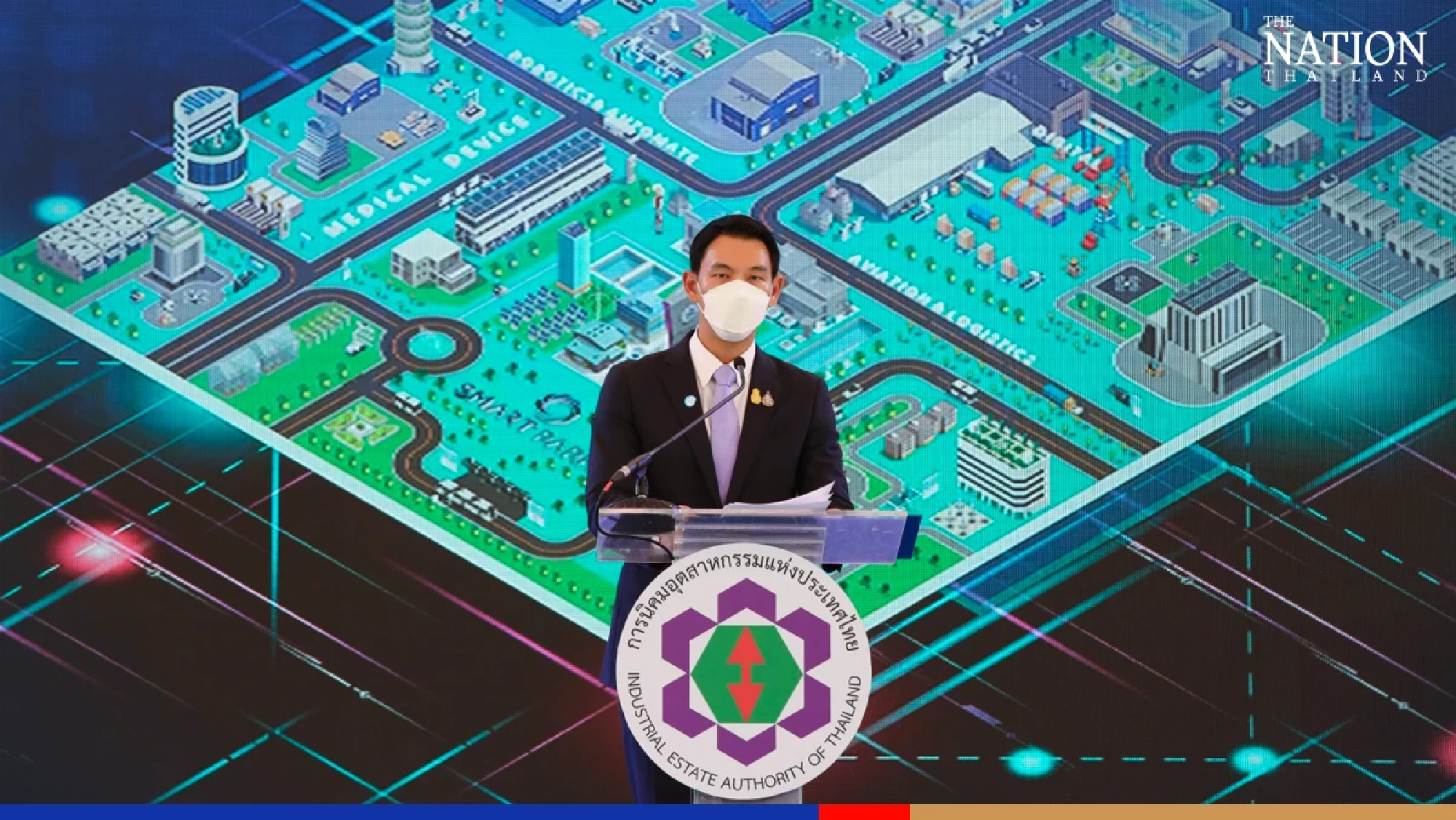
Prime Minister Prayut Chan-o-cha on Thursday pressed the button to officially start the construction of the Smart Park estate in the Eastern Economic Corridor.
In a teleconference ceremony from Government House, Prayut said in his opening speech that the Smart Park industrial estate project in the EEC is a part of the Thailand 4.0 policy of his government.
Prayut said the Smart Park project is a mechanism for driving the country’s economy through new S-Curve industries that will be drawn to the Smart Park zone in the future.
The prime minister said the new S-Curve industries, which will use advanced technologies, will be environmentally friendly and create a lot of jobs for local people.
Prayut said the cooperation by all sectors to push for the EEC and Smart Park project will create a strong and sustainable economy for the country.
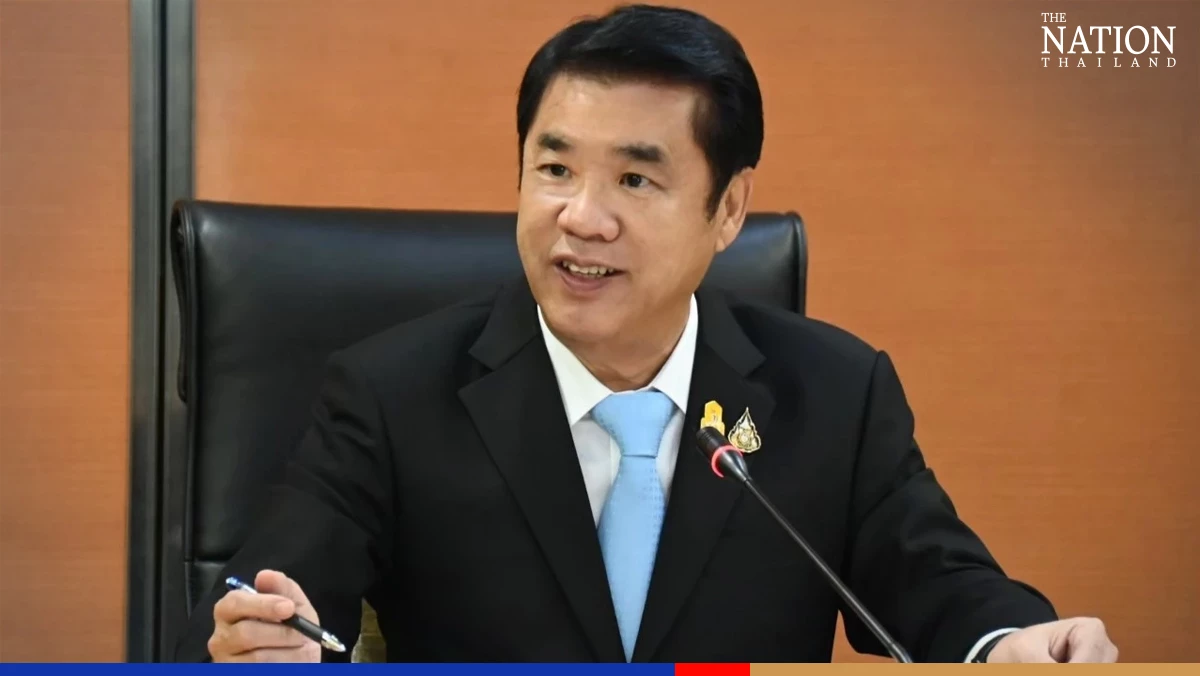
Industry Minister Suriya Jungrungreangkit said in his teleconference speech that the Smart Park project was approved by the Cabinet on September 29, 2020 to be built on a 1,400-rai plot in Tambon Huay Pong in Muang district of Rayong province.
The THB2.37-billion project will drive the country’s economy through investment in the high-tech industrial zone, Suriya said.
He said the ongoing construction is hiring about 200 workers and the construction will lead to circulation of THB24 million a year in the province.
Once the Smart Park industrial zone is open, it would create 7,400 jobs and a circulation of THB1.3 billion in the local economy a year, the minister added.
“From the plan, after the construction contract is signed, it will take three years to build Smart Park and it will be in operation in 2024,” Suriya said.
He said although the prime minister had just pressed the button to formally started the project, the construction had begun earlier. By March 21, 7.66 per cent of the construction had been completed, Suriya said.
Speaking on stage at the construction site, Industrial Estate Authority of Thailand governor Weerit Amrapal said the Smart Park project will cater to new S-Curve industries that use advanced technologies, which are environmentally friendly.
The new S-Curve industries include digital, robot, comprehensive medical, aviation and logistics industries, Weerit said.
He said the Smart Park would be ready to accommodate industries of the future because the zone will be equipped with all necessary facilities and all of its buildings will be constructed to international standards.
Finance Minister Arkhom Termpittayapaisith expects the gross domestic product in 2022 to expand 3.5 to 4.5 per cent, with exports in 2022 exceeding the estimated 5 per cent growth.
Arkhom was speaking at the annual general meeting of the Thai National Shippers’ Council on Wednesday.
“Although the ministry has set the GDP target at 4.5 per cent at most, we believe that with cooperation from the government and private sector we can push this up by 0.1 to 0.3 per cent, despite the Russia-Ukraine conflict,” he said.
“Exports have always been an integral part in pushing economic growth,” Arkhom noted.
“Last year exports expanded 17 per cent year on year, and in the first two months of 2022 we have already seen a 12 per cent expansion.
“A number of financial institutes have predicted that 2022 exports would see a 5 per cent expansion due to the impact of the Russia-Ukraine war, but the ministry believes we can achieve 10 per cent expansion through improvement of logistics and gaining new markets,” he said.
Arkhom said another factor that would help boost economic growth is tourism, but he did not expect it to fully recover just yet from the Covid-19 impact.
“In the past three months we have only seen around 400,000 foreign tourists entering Thailand. If this trend continues throughout the year, we will see just 1.6 million foreign visitors in 2022, which is significantly lower than the estimation,” he said.
“We can only hope the situation does not worsen after Songkran, which will enable the government to further ease travel and entry restrictions just like other countries are doing in this region.”
The Tourism Ministry estimates that Thailand will welcome at least 7 million foreign travellers in 2022, lower than the previous estimation of 10 million. Tourism revenue in 2022 is expected to rise to just 30 per cent of revenue in 2019, which was recorded at 3 trillion baht.
The baht opened at 33.25 to the US dollar on Thursday, strengthening from Wednesday’s close of 33.31.
Krungthai Bank market strategist Poon Panichpibool predicted the Thai currency would move between 33.15 and 33.40 during the day.
Poon said the baht was likely to swing in a wide range after strengthening suddenly on Wednesday due to a weakening dollar and the Monetary Policy Committee being of the opinion that the Thai economy is recovering, while its GDP growth projection did not decrease to a large extent.
However, the baht might be pressured to weaken due to uncertainty over Ukraine-Russia peace negotiations, but Poon believes the Thai currency will not weaken much because foreigners are returning to invest in Thai stocks. They have already purchased 7 billion baht of short-term bonds in the past two days, which reflects a decrease in the baht’s weakening.
Poon expects the support level to be 33.00-33.20 to the dollar, a level importers are waiting for to purchase the US currency.
The currency market meanwhile is closely watching whether upcoming Ukraine-Russia peace negotiations will be a success after reports that a battle was raging near Kyiv. Investors are also worried that the Thai economy will shrink after signs of an inverted yield curve in the US bond market.
Principal Thailand has introduced its Principal Global Innovation Fund (Principal Ginno), which enables investment in stocks of leading businesses that grow along with megatrends for sustainable returns, the company said in a press release.
Principal Thailand has introduced its Principal Global Innovation Fund (Principal Ginno), which enables investment in stocks of leading businesses that grow along with megatrends for sustainable returns, the company said in a press release.
With the metaverse receiving a positive response from the new generation, entrepreneurs and investors worldwide, people are clearly excited about future trends.
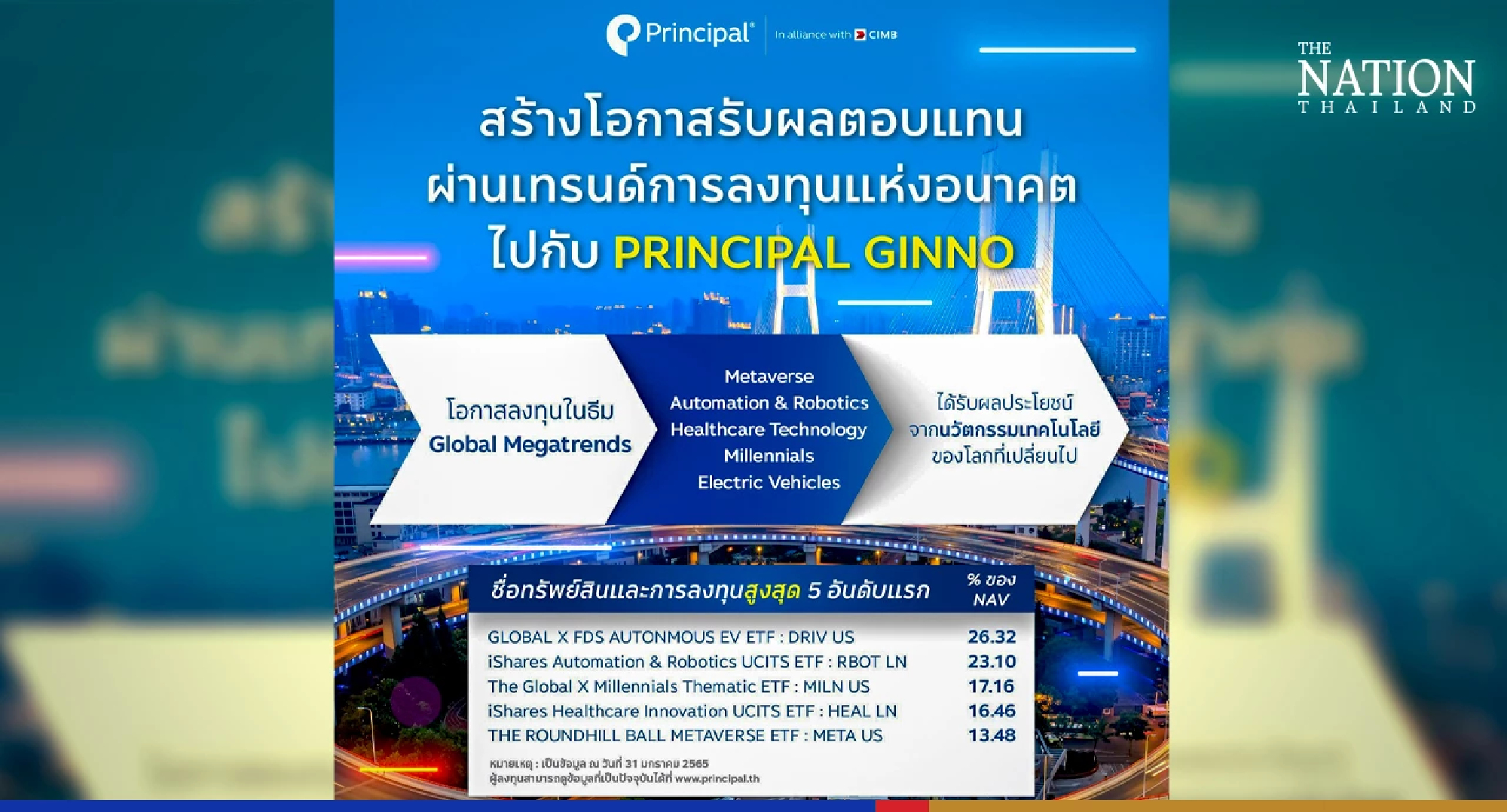
Principal Ginno is a “fund of funds” that focuses on investment in stocks of top companies that grow with megatrends, both in innovation and technology. This fund meets the needs of investors who want to gain appropriate returns amid global changes, the firm said.
The fund invests in five global megatrends that have grabbed people’s interest amid the Covid-19 crisis in the past two years:
Metaverse: this trend has been driven by a rapid change in technology and consumer behaviour. It enables people to carry out activities together in the virtual world, such as interaction, playing games and working by using virtual reality or augmented reality.
Automation & Robotics: artificial intelligence-related innovations and machines that enable businesses to boost efficiency at the workplace.
Electric vehicles (EVs): the transition from petrol cars to electric boosts the advancement of the automobile industry along with environmental consciousness. Meanwhile, the EV industry has expanded quickly, thanks to several governments advising their people to pay attention to reducing greenhouse gas emissions.
Healthcare technology: this covers treatment, prevention and development.
Millennials: people born between 1980 and 2000 will be the majority of consumers in the near future. This group immerses itself in technologies, so businesses usually focus on launching products to meet their needs of speed, convenience and modernity.
“Many accept and include technologies amid the Covid-19 crisis, which can be seen from a rise in the Thematic ETF Performance in 2020,” Principal Thailand said, adding that the price graph is likely to rise further.
However, the company advised investors to study the product characteristics, conditions, returns and risks before investing as Principal Ginno focuses on investment in the US and Japan and investors could face loss from the foreign exchange rate.
“But the company uses derivatives to prevent foreign exchange rate risk depending on the fund manager’s discretion. A fund’s past performance is not a guarantee of future performance,” Principal Thailand said.
Centara Hotels & Resorts (Centara), Thailand’s leading hotel operator, has revealed its expansion plans and strategic direction, including multiple new hotels, fresh destinations and new brand concepts.
The growth will help the group reach its long-term goal of becoming a top-100 global hotel operator within five years, Centara said. The vision will see it reach a total of 200 hotels and resorts by 2026, up from 88 properties at present, and with approximately half of that growth coming from destinations outside Thailand.
Centara has announced its intention to open eight new hotels and resorts this year. These properties will span Thailand, with openings in Bangkok, Korat and Ubon; and international destinations including, Laos, Oman and Qatar.
The group added that a core component of its growth strategy would be through collaboration with a strong development partner, specifically to launch new projects within Thailand, under both existing and new brands, and commencing this year.
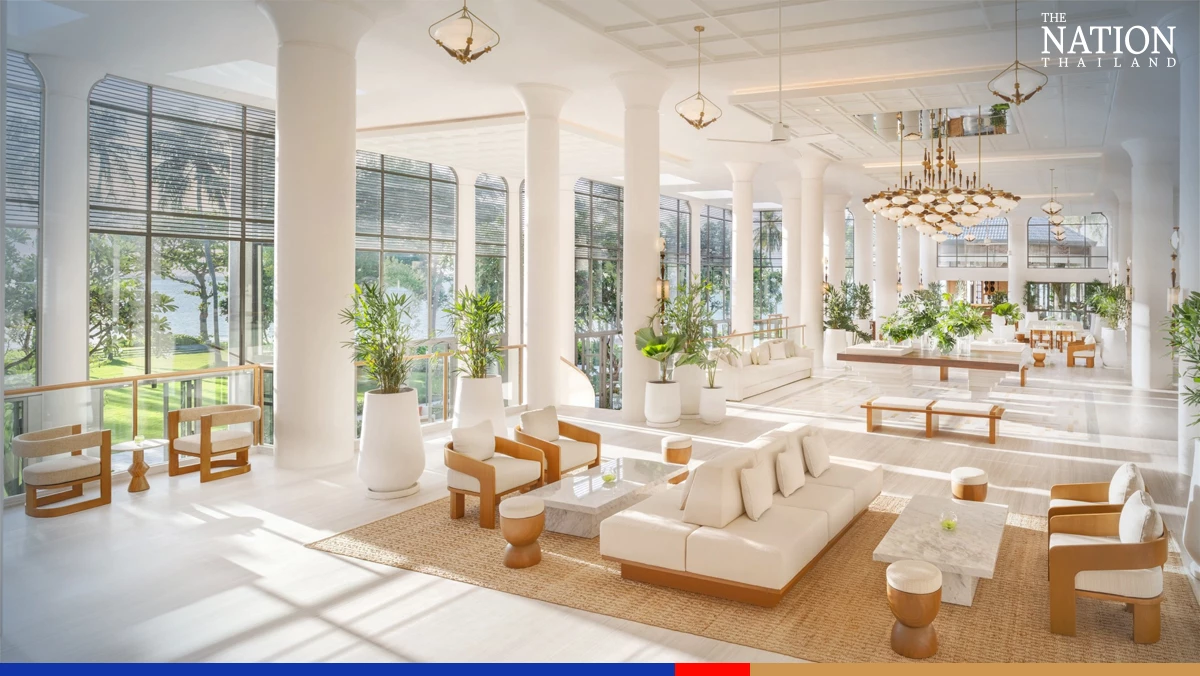
The luxurious Centara Reserve concept, which was launched in December last year with the debut of Centara Reserve Samui, will be enhanced with additional property in Krabi, and the group is also considering projects in up-and-coming Thai markets such as Koh Lanta and Cha-Am.
Centara is also exploring a new opportunity in the Medical Wellness segment with an established operator from Europe, and Koh Tao and Samui are the potential locations under discussion.
Centara Reserve Samui
Internationally, Centara said it has been given the green light to develop two new upscale resorts in the Maldives, following successful Environmental Impact Assessments for three idyllic islands in the Indian Ocean. These resorts are slated to open in 2024 and 2025, doubling Centara’s presence in the Maldives to four properties.
In Japan, a landmark high-rise hotel is currently under construction in Osaka, a joint venture between Centara, Taisei Corporation and Kanden Realty & Development, which will start welcoming guests in mid-2023, and in Vietnam, COSI Phu Yen Hotel is scheduled to open in 2023, marking this affordable lifestyle concept’s first location outside Thailand, Centara said.
“Centara’s international growth focus will be centred on Southeast Asia, the Indian Ocean, Japan, China, and the Middle East primarily, including Saudi Arabia following the recent normalisation of the country’s diplomatic relations with Thailand,” the company said, adding that the group is also considering options in Europe.
Centara Reserve Samui
Centara will evolve its business strategy to focus on emerging trends and market dynamics in the coming years, such as experiential travel and “workations”.
It also foresees a strong rebound in international long-haul and leisure business in Thailand, due to the country’s reopening strategy and vaccination programme.
“However, the remaining restrictions need to be removed imminently for the required potential to be reached,” the company said.
At an operational level, Centara will continue to invest in the latest technology following its recent overhaul of its technology architecture.
The group recently revamped its entire website, booking, property management and reservation platforms and is currently concluding the rollout of its industry-leading Customer Relationship Management solution.
The group is also focusing on talent development through effective staff training programmes and is further emphasising its focus on sustainable solutions, with a target of reducing energy and water usage by 20 per cent within 10 years and certifying 100 per cent of its portfolio with respected environmental accreditation bodies by 2025.
Centara Reserve Samui
“As the world emerges from the global pandemic and travel restrictions start to ease, we are highly optimistic that the hospitality industry will rebound rapidly,” said Centara CEO Thirayuth Chirathivat.
Despite the challenges of the last two years, he said Centara can reflect on its performance with pride.
“With multiple new hotels and resorts set to open in many dynamic markets, both in Thailand and overseas, including innovative brands, this is an exciting time for our company as we strive to become a top-100 global hotel operator,” he added.
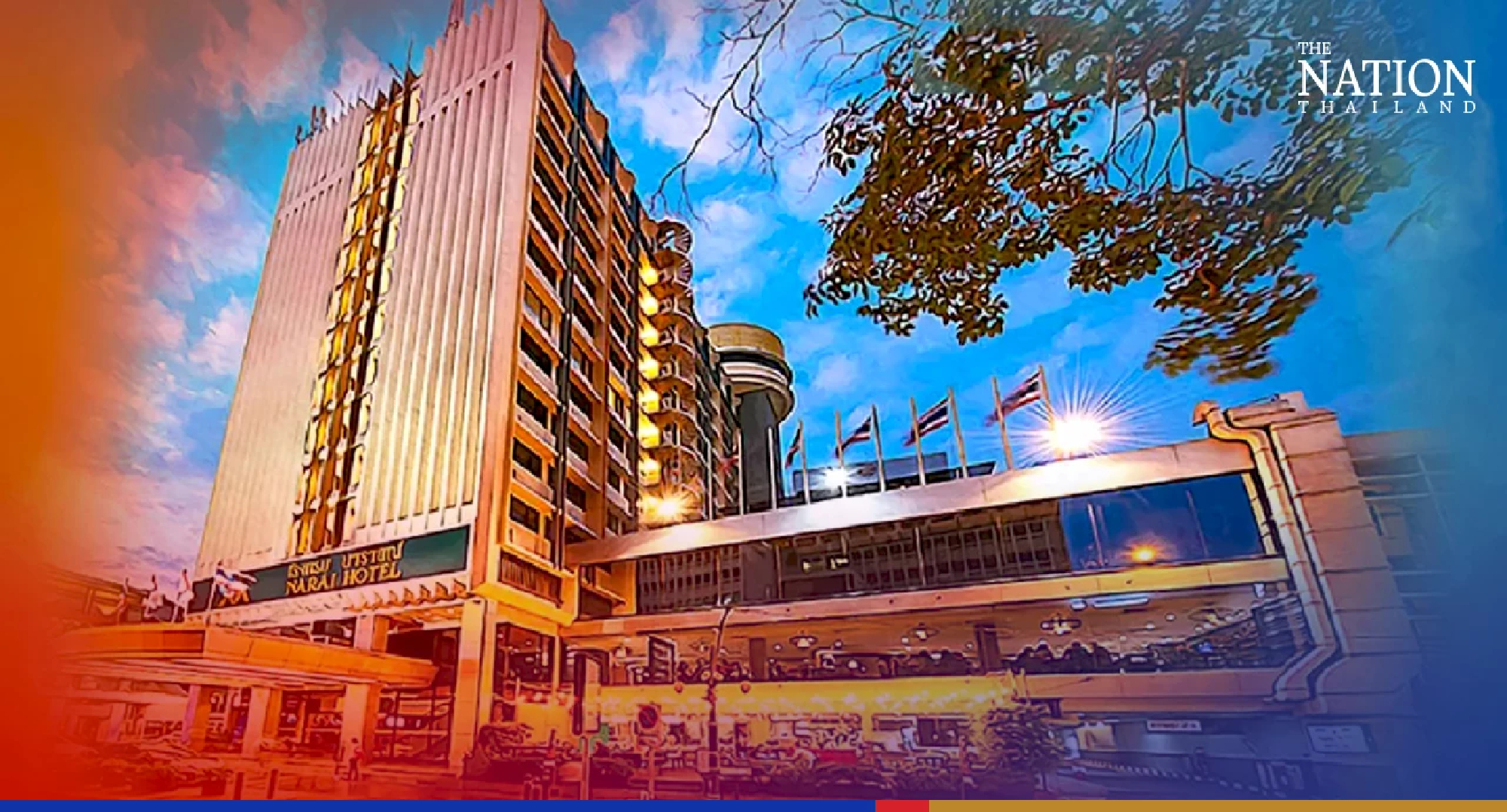
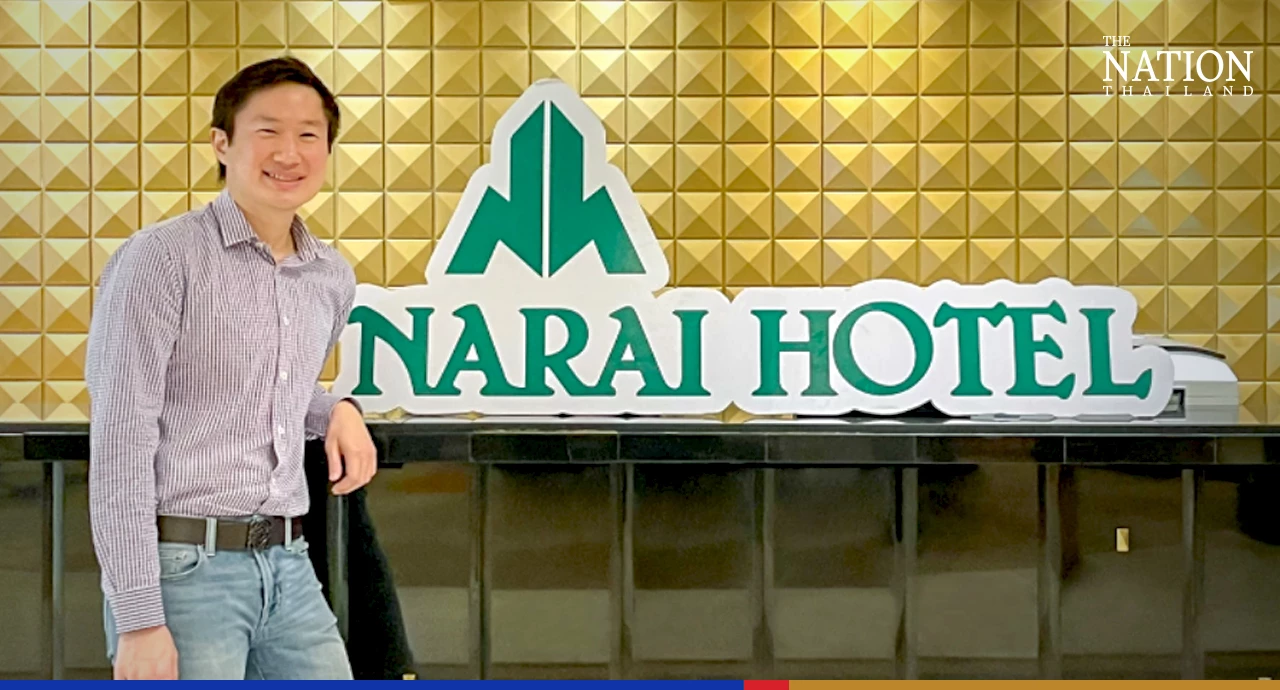
Narai Hospitality Group announced it would demolish its iconic Narai Hotel and the adjacent Triple Two Hotel in Bangkok’s Silom area in mid-2022 to build two new hotels with a budget of 10 billion baht on the 6-rai plot.
The four-star Narai Hotel had closed its doors since February 18 after 54 years in operation. When it opened in 1968, its 500 rooms made it one of the capital’s first massive hotels.
“The upcoming hotels will provide Silom with a new landmark, expected to open by 2026,” said group president Nathee Nithivasin.
“The two new hotels include the ‘new look’ 200-room Narai Hotel to be managed by the group’s foreign partners that feature entry level luxury four- to five-star services, and a 100-to-150-room six-star luxury hotel with full services comparable to international brands such as the Mandarin Oriental or Four Seasons.”
The new hotels will have a 7,000 square metre park between them and be linked by a canal and several walkways.
The park will be open to the general public too and serve as the city’s green lung.
“We had been planning this since 2017 but had to postpone it due to the Covid-19 situation,” said Nathee. “The group will use the latest technology in building demolition to minimise the impact on surrounding communities.
“The new hotels will also use a modern foundation system that is stronger and can accommodate future renovations, unlike the old Narai Hotel building, which was not flexible for adjustments.”
Room rates for the new Narai will average 5,000 baht per night. The old Narai Hotel rates were 1,000 to 2,000 baht per night for group tours.
Meanwhile, the room rate for the new six-star hotel will be at the same level as Mandarin Oriental or Four Seasons.
Narai Hospitality Group is also planning to renovate its Holiday Inn Mai Khao Beach Resort in Phuket, which was opened 10 years ago and now requires a makeover.
The Stock Exchange of Thailand (SET) Index is expected to fluctuate between 1,690 and 1,710 points on Thursday amid uncertainty over peace negotiations between Russia and Ukraine, Krungsri Securities said.
It pointed out that there was concern after fighting continued on the outskirts of Kyiv and Chernihiv despite Russia’s promise to reduce military operations to facilitate peace negotiations.
“However, foreign fund inflows in response to Thailand’s economic recovery and further easing of Covid-19 restrictions would help boost the index,” Krungsri Securities predicted.
It advised investors to follow the Opec+ meeting on Thursday as the group was expected to increase oil production by 400,000 barrels per day in line with a previous decision.
Krungsri Securities also recommended the purchase of the following stocks as an investment strategy:
• GPSC, BGrim, SCGP and EPG, which would benefit from falling oil prices.
• AOT, AAV, BA, Mint, Centel, ERW, CPN, CRC, HMPro, CPAll, Makro, Amata and WHA, which would gain from further easing of Covid-19 restrictions.
• OSP, CBG, ICHI and SNC, which would benefit from the upcoming tourism season.
The SET Index closed at 1,698.40 on Wednesday, up 8.66 points or 0.51 per cent. Transactions totalled 97.88 billion baht.
Thailand and the UK will hold the first Joint Economic and Trade Committee (JETCO) meeting in June on expanding investment and trade.
Auramon Supthaweethum, director-general of the Department of Trade Negotiations, was speaking after the department held a Senior Official Meeting with the UK on Friday.
They discussed holding the first JETCO at the ministerial level in June in London. They discussed the overall situation, economic policies, guidelines to improve trade and investment relations, and the preparation for JETCO.
They aim to improve the economic, trading, and investment relations as the UK has left the European Union. In March, Thailand and the UK had signed a memorandum of understanding to establish JETCO.
Auramon said, “The UK is advanced in digital, technology and services. It also has strict laws and regulations, especially for new areas such as environment, security and health. It is a good opportunity for Thailand to join hands with the UK, as Thailand has good products and services, and it can prepare to develop for the fast-changing world in the new era.
“The cooperation with the UK will be beneficial in exchanging experience and knowledge of research into future food, plant-based food, and regulations for the registration of health products.”
In 2021, the UK is Thailand’s 22nd biggest trade partner, the fourth biggest in Europe behind Germany, Switzerland, and the Netherlands. Trade value between the two nations was valued at US$5.533 billion (THB175.223 billion). Thailand exported to the UK goods and services worth $3.489 billion and imports from the UK were worth $2.044 billion.
Major Thai exports were processed chickens, motorcycles, jewels and accessories, tyre products, and cars. Major imported products included machines, circuit boards, paper pulp and paper scrap, and chemicals.





 The THB2.37-billion project will drive the country’s economy through investment in the high-tech industrial zone, Suriya said.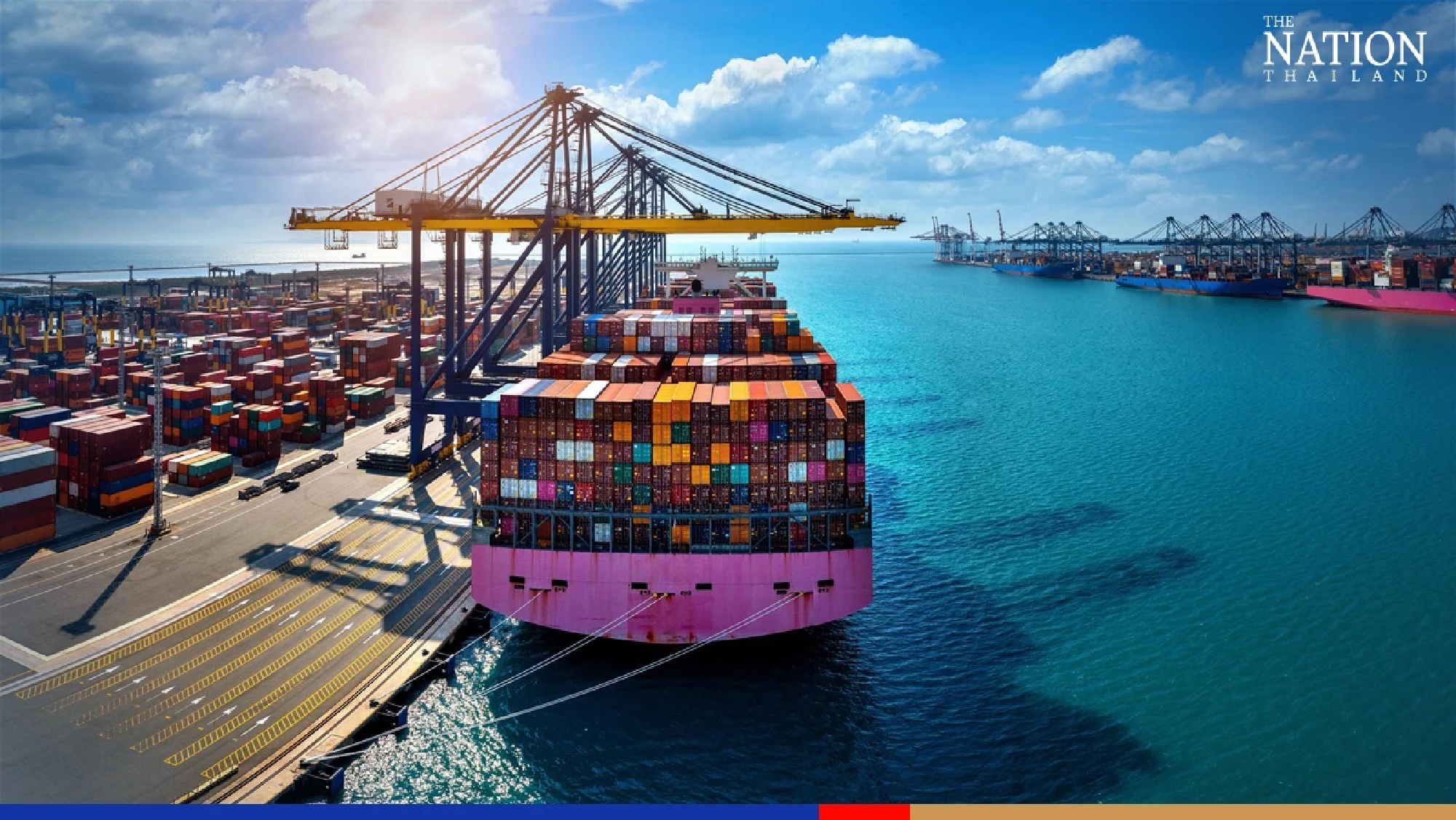


 Centara Reserve Samui
 Centara Reserve Samui
 Centara Reserve Samui