The new Laos-China railway, which will start running from Thursday, should serve as a good delivery channel for the agriculture industry, the Agriculture and Cooperatives Ministry said on Monday.
The railway will initially only provide freight services to Chinese companies based in Laos, transporting goods like rubber, dried cassava, industrial salt, ore, etc.
However, Thai businesses should be able to take advantage of the railway by travelling across the Thai-Laos Friendship Bridge to load cargo at the Vientiane Southern Cargo Terminal, the ministry’s spokesman, Chantanon Wannakhajorn said.
He said using the railway can shorten the transit time from two days by road to 10 to 15 hours.
China and Laos have set the goal of transporting 8 million tonnes of goods per year via the railway by 2025 and increasing that to 15 million tonnes per year by 2030.
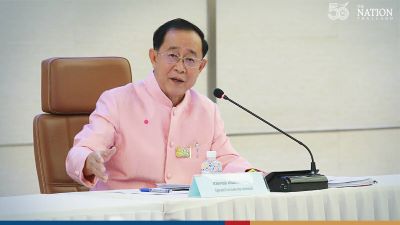
The Thai economy should grow by 3.5 to 4.5 per cent next year with the government’s planned spending of about 1 trillion baht, Finance Minister Arkhom Termpittayapaisith said on Monday.
“Asound fiscal policy is necessary to drive the economy, and I will ensure that the government spends money to nourish it,” he said.
Arkhom explained that the economic “nourishment” will come in the form of infrastructure and stimulus measures.
He also listed the factors that will affect the overall economic recovery and government policies next year, namely:
• Implementation of policies concerning the promises Thailand made at the United Nations Climate Change Conference (COP26).
• Boosting the use of digital infrastructure by government agencies as well as the capital market, cryptocurrencies and fintech.
• Unlocking international travel.
• Promoting more intense capital market development plans, especially in the digital industry.
• Pandemic situation, especially in relation to the new variant of concern, Omicron.
Arkhom also said that the economy is expected to grow 1 per cent with exports rising by around 17 per cent.
The Stock Exchange of Thailand (SET) Index closed at 1,589.69 on Monday, down 20.92 points or 1.30 per cent. Transactions totalled 115.80 billion baht with an index high of 1,617.55 and a low of 1,587.78.
The index dropped for the third day running after falling by 2.30 per cent on Friday and 0.08 per cent on Thursday due to uncertainty over the latest Omicron Covid-19 variant in Africa, plus the fresh coronavirus wave in Europe.
The 10 stocks with the highest trade value today were KBANK, AOT, SCB, PTT, BBL, STGT, JMART, CPALL, DELTA and ADVANC.
Other Asian indices were down with one exception:
Japan’s Nikkei Index closed at 28,283.92, down 467.70 points or 1.63 per cent.
China’s Shanghai SE Composite closed at 3,562.70, down 1.39 points or 0.039 per cent, while the Shenzhen SE Component closed at 14,810.20, up 33.03 points or 0.22 per cent.
Hong Kong’s Hang Seng Index closed at 23,852.24, down 228.28 points or 0.95 per cent.
South Korea’s KOSPI Index closed at 2,909.32, down 27.12 points or 0.92 per cent.
Taiwan’s TAIEX Index closed at 17,328.09, down 41.30 points or 0.24 per cent.
Digital marketing agency Primal, led by Forbes 30 under 30 Mark McDowell, joins global digital agency group with exclusive NFT project
Thailand’s fastest-growing digital agency didn’t get there by chance. Their rapid growth has been fuelled by their dedication to innovation and by constantly pushing the boundaries.
And they are at it again.
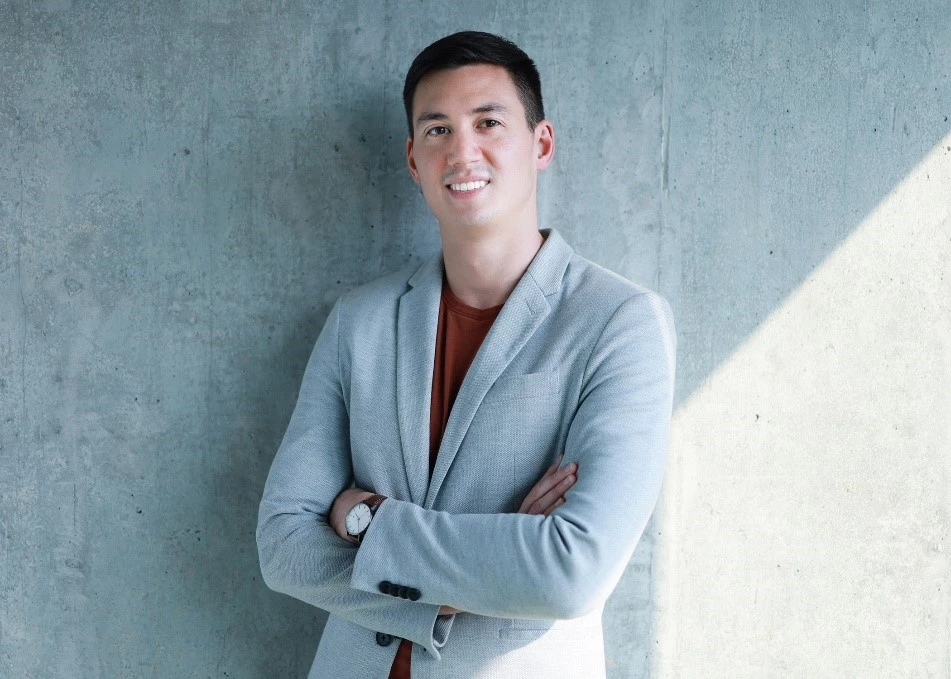
Headed up by Forbes 30 Under 30 Mark McDowell, Primal is a part of a larger network of agencies that are now being consolidated under one umbrella ‘superbrand’ – Superist.
With Primal leading the way, Superist is looking to make its mark on the global digital scene. As well as launching their new ‘superbrand’, Superist is also offering their own NFTs and plans to accept cryptocurrency for client payment in the upcoming months.
As part of its launch, Superist has released nine NFTs on OpenSea, each depicting a key leader in the global group. Each NFT also comes with one hour of each leader’s time, which can be redeemed straight away, or at a later date. The longer the owner of the NFT holds on to the time, the more valuable it becomes as the group achieves more success.
Digital marketing agency Primal, led by Forbes 30 under 30 Mark McDowell
The group, which is currently comprised of Appscore (Australia), Chili (Brazil, Panama, Mexico), CODI Agency (Australia) First Page (Australia, Hong Kong, Singapore), Lisnic (Australia), Primal (Malaysia and Thailand), Removify (Australia) and USEO (Middle East) provides a multitude of services including digital marketing, content creation, reputation management, app and website development, celebrity speakers and online mentoring.
“This is an exciting time for the agency as we use our regional experience in a more collaborative manner to deliver integrated results across the region and achieve strong growth for brands as a unified global group with a plethora of offerings”, says Primal CEO, Mark McDowell.
Primal CEO, Mark McDowell
Primal co-founder and Australian Rich-Lister Nick Bell is the driving force behind Superist. After recently launching the Australian arm of his agency First Page, Bell realised there was a gap in the market for a more dynamic and independent digital group that would make it easy for companies to achieve global digital success.
“As we aren’t a listed group, Superist is completely independent, meaning we don’t have to answer to shareholders so we can always put the needs of our clients first”, explains Bell. “We can push the boundaries with first to market initiatives that will help our clients stand out in the increasingly competitive digital landscape.”
Clients for the group include McDonald’s, Intel, Mercedes Benz, Uber, Colgate, L’Oreal, Bayer, Rolex, McLaren and the co-Founder of Netflix, Marc Randolph.
This is another activity from B. Braun that supports and protects Thai academic personnel and students from infection, and sustainably promotes health practices among the youth.
Mr. Sayan Roy (3rd from left), Managing Director of B. Braun (Thailand) Co., Ltd., together with representatives from B. Braun Thailand CSR Club, jointly delivers 13,000 bottles of alcohol-based hand sanitizer “Softa-Gel” to Mr. Thoetchat Chaipong (3rd from right), Assistant Secretary-General of the Basic Education Commission, Ministry of Education. This is another activity from B. Braun that supports and protects Thai academic personnel and students from infection, and sustainably promotes health practices among the youth.
PT Max Card members who also hold a state welfare card will be granted a 100 baht discount per person for the purchase of a gas cylinder at all PT stores nationwide.
PTG Group is offering a discount on LPG household gas cylinders to PT Max Card holders who also hold a state welfare card. This subsidy runs until the end of the year and is limited to 30,000 tanks worth a total of 3 million baht. Suwatchai Pitakwongsaporn, managing director of PTG Group subsidiary Atlas Energy, said PT Max Card members who also hold a state welfare card will be granted a 100 baht discount per person for the purchase of a gas cylinder at all PT stores nationwide. The discount applies to all sizes of tanks, ranging from 4 to 15 kilograms. “The aim of this promotion is to ease members’ burden amid the Covid-19 crisis and help the country pull through as soon as possible,” he said. Suwatchai said those eligible can also get the discount via https://pro.pt.co.th:8082/government_card/. Call (02) 032 8888 from 8am to 5pm for more information.
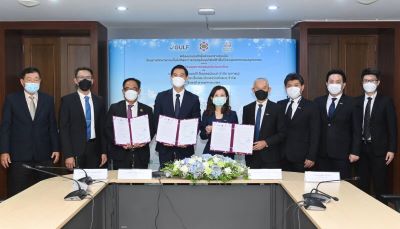
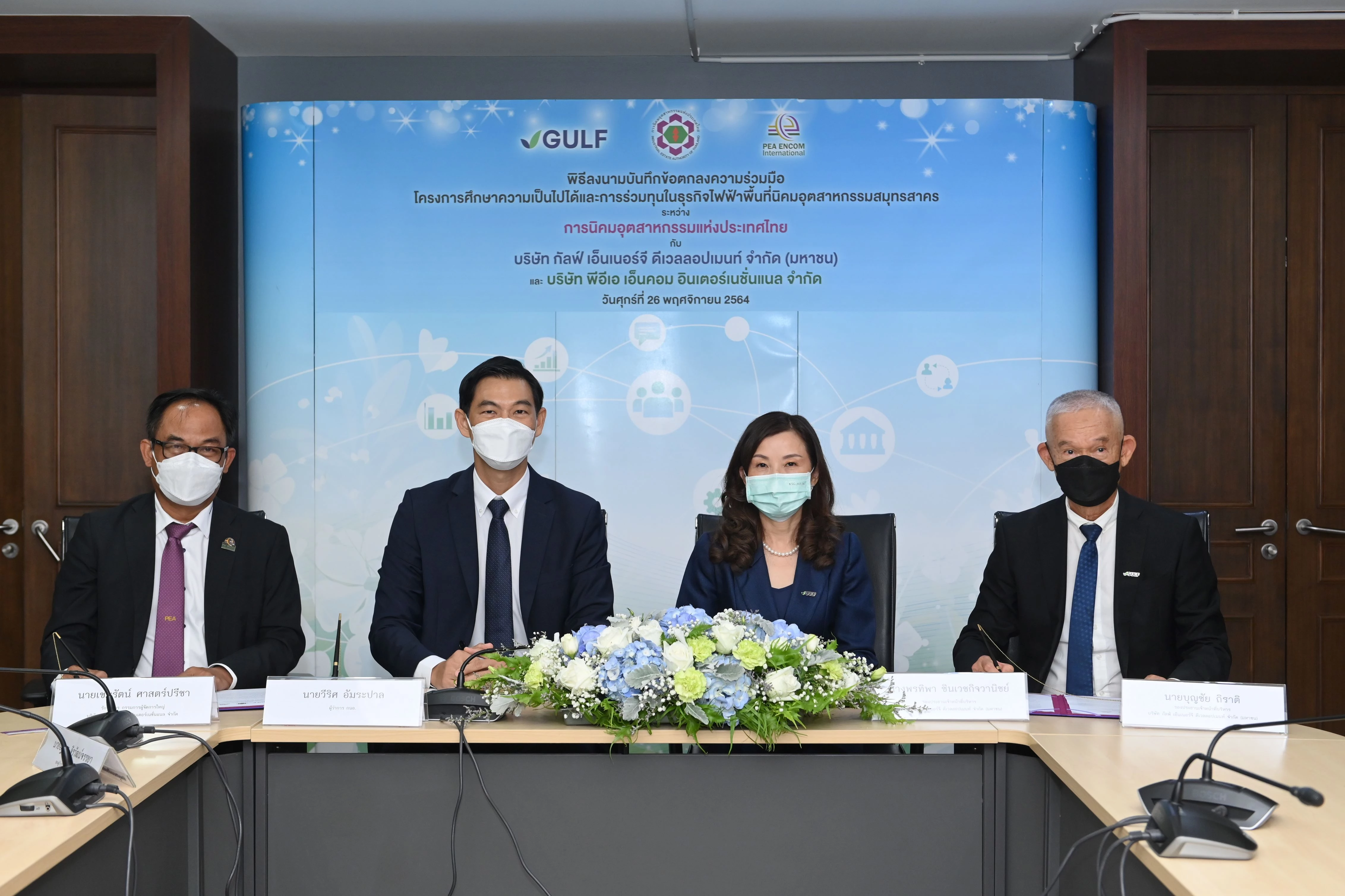
Gulf Energy Development Public Company Limited (GULF) has signed a Memorandum of Understanding (MoU) with the Industrial Estate Authority of Thailand (IEAT) and PEA ENCOM International Co. Ltd. (PEA ENCOM) for a joint study and investment in a power business in Samut Sakorn Industrial Estate.
Gulf Energy Development Public Company Limited (GULF) has signed a Memorandum of Understanding (MoU) with the Industrial Estate Authority of Thailand (IEAT) and PEA ENCOM International Co. Ltd. (PEA ENCOM) for a joint study and investment in a power business in Samut Sakorn Industrial Estate. The purpose is to jointly develop an independent power supply (IPS), microgrid and smart metering systems as well as an energy platform to serve the higher electricity demand of industrial customers. The MoU will be valid for a period of two years.
Mr. Veeris Ammarapala, Governor, IEAT, stated after the signing ceremony: “The mission of the IEAT is to acquire land and develop it into an industrial estate by providing utility services and facilities that accommodate business operations for the industrial and service sectors. The power system is considered the main factor in running the business along with other economic-related activities. This cooperation is to strengthen the stability of the power system in Samut Sakhon Industrial Estate and enhance confidence for operators and investors. Hopefully, the results of the study will turn out well and help optimize the power system of the industrial estate, which will subsequently drive the country’s economy, trade and investment.”
GULF teams up with IEAT and PEA ENCOM for the joint study and investment in a power business in Samut Sakorn Industrial EstateMs. Porntipa Chinvetkitvanit, Deputy Chief Executive Officer, GULF, said: “GULF is honored to be a trusted business partner of both the IEAT and PEA ENCOM in collaborating on this feasibility study for energy business development in Samut Sakhon Industrial Estate. This joint endeavor is in line with our company’s business direction as we are always on the lookout for new business opportunities. GULF is equipped with technology and investment funding plus a well-established and a globally-connected network with leading energy technology suppliers. GULF is ready to invest in energy innovations including renewable energy and the digital energy business to help strengthen the country’s energy security and drive towards the future of energy transition. We hope that this cooperation will be effective in meeting the electricity demand of the industrial sector and will support the sector striving forward.”
Mr. Khemmarat Sartpreecha, Acting Managing Director, PEA ENCOM, said: “PEA ENCOM is very pleased to have the opportunity to be a part of this feasibility study, jointly investing in a power business with the IEAT and GULF. The joint study and development of power plant is key infrastructure and an important factor in response to the growth of Thailand’s industrial sector. It will also boost industrial customers’ confidence as the strength and cooperation between partners will strengthen the stability of the electricity supply. The feasibility study on an IPS, microgrid, and smart metering as well as an energy platform will definitely transform the energy industry of the future as we move forward into the era of smart energy. PEA ENCOM hopes that this collaboration will lead the way for other business partnerships in the future.”
Siam Makro’s 218-billion-baht acquisition of Lotus’s stores from CP Retail Holding in September bumped the number of business liquidations in Thailand up by 31 per cent in October.
However, Thosapol Thangsubut, director-general of the Department of Business Development (DBD), said on Saturday that 5,555 new businesses valued at about 22 billion baht were registered in October. This was about 5 per cent lower than new businesses registered in September, but 3 per cent more compared to the same period last year.
He said 1,976 companies had shut down in October with total registered capital coming in at 207.65 billion baht, which was consistent with the trend of business closures over the past five years.
The registered capital of businesses that ceased operations in October surged by 3,502 per cent or 201.88 billion baht compared to September, and up 2,564 per cent compared to October last year.
“The registered capital numbers are high in October because CP Retail Holding, with a registered capital of 199.48 billion baht, had transferred a majority holding of its Lotus’s stores in Thailand and Malaysia to Siam Makro,” Thosapol said.
However, he added, that as of October 31, a total of 809,410 businesses with a capital value of 19.26 trillion baht were still in operation nationwide.
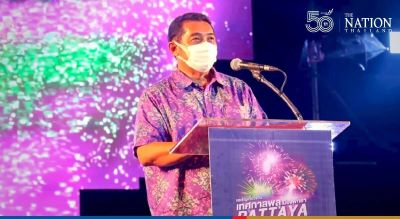
Pattaya City has all Covid-19 prevention measures in place to hold events safely, especially the New Year countdown, mayor Sonthaya Khunpluem said on Sunday.
He said he also hopes the Centre for Covid-19 Situation Administration (CCSA) will let Pattaya reopen pubs, bars, karaoke joints and other entertainment venues soon.
Sonthaya said the annual fireworks festival held over the weekend at Pattaya Central Beach was a resounding success thanks to the cooperation of the public and private sectors.
Pattaya ready for blockbuster yearend events, says mayor
He said this successful application of safety measures proves that Pattaya can serve as a model for other cities.
“We are confident that Pattaya will be safe if people do not let their guard down against Covid-19,” he said.
Pattaya ready for blockbuster yearend events, says mayor
Sonthaya also said visitors outside the event area will also be strictly screened to ensure they are not infected. The same measures were taken during the Pattaya Music Festival on November 12-13.
Pattaya ready for blockbuster yearend events, says mayor
The baht opened at 33.63 to the US dollar on Monday, weakening from the previous closing of 33.59.
The Thai currency is likely to move between 33.55 and 33.75 during the day and between 33.35 and 34 during the week, Krungthai Bank market strategist Poon Panichpibool predicted.
Poon said that the baht might continue to weaken due to the Omicron variant of Covid-19. However, Poon thought that the baht will not weaken much because the gold price will support the baht if it goes up. Exporters are also waiting to sell the dollar which causes the baht’s resistance level to be from 33.70 to 34.00 to the dollar.
The baht might be volatile as the market is in a risk-off situation might cause foreign investors to sell Thai stocks. Foreign investors also closed the risk after the baht suddenly weakened while foreign investors had sold 18 billion baht of short term bonds last week.
Poon said that the dollar might move sideways if the market is worried about the Covid-19 situation which will support safe-haven assets such as the Japanese Yen. The dollar will be supported if the US employment data is better than expected.
The market is waiting for the signal from US Federal Reserve officials that will affect the dollar’s direction. The dollar will strengthen if the Fed decided to decrease quantitive easing or increase policy interest rate next year.




 Digital marketing agency Primal, led by Forbes 30 under 30 Mark McDowell
 Primal CEO, Mark McDowell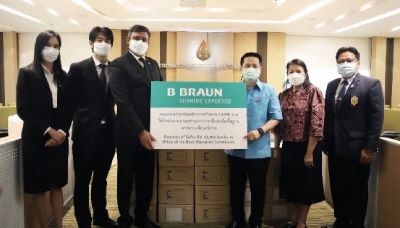

 GULF teams up with IEAT and PEA ENCOM for the joint study and investment in a power business in Samut Sakorn Industrial EstateMs. Porntipa Chinvetkitvanit, Deputy Chief Executive Officer, GULF, said: “GULF is honored to be a trusted business partner of both the IEAT and PEA ENCOM in collaborating on this feasibility study for energy business development in Samut Sakhon Industrial Estate. This joint endeavor is in line with our company’s business direction as we are always on the lookout for new business opportunities. GULF is equipped with technology and investment funding plus a well-established and a globally-connected network with leading energy technology suppliers. GULF is ready to invest in energy innovations including renewable energy and the digital energy business to help strengthen the country’s energy security and drive towards the future of energy transition. We hope that this cooperation will be effective in meeting the electricity demand of the industrial sector and will support the sector striving forward.”
 Pattaya ready for blockbuster yearend events, says mayor
 Pattaya ready for blockbuster yearend events, says mayor
 Pattaya ready for blockbuster yearend events, says mayor

