Importers buy dollars as baht slides towards 32 to the greenback
The baht opened at 31.93 to the US dollar on Tuesday, unchanged from Monday’s closing rate.
The Thai currency is likely to move between 31.85 and 32.00 during the day, Krungthai Bank market strategist Poon Panichpibool said.
He said the most important factor influencing the baht was the Covid-19 crisis in Thailand, and the vaccine distribution in the country.
Poon predicted that importers would buy dollars at this time as the baht has weakening.
He suggested that investors monitor if the baht weakens to 32 per US dollar. If the baht reaches that point, technically the currency will move further to 32.25 to 32.50, he added.
The price of gold in Thailand rose by THB50 per baht weight in morning trade on Tuesday.
The Gold Traders Association report at 9.26am showed buying price of a gold bar at THB26,850 per baht weight and selling price of THB26,950, while gold ornaments were priced at THB26,363.24 and THB27,450, respectively.
At close on Monday, the buying price of a gold bar was THB26,800 per baht weight and selling price THB26,900, while gold ornaments were priced at THB26,317.76 and THB27,400, respectively.
Spot gold price on Tuesday was US$1,775 (THB56,870) per ounce after Comex gold on Monday rose by $2.9 to $1,780.8 per ounce.
The gold market is keeping an eye on the US non-farm payroll in June in a bid to predict the Federal Reserve’s monetary policy.
Hong Kong gold price, meanwhile, dropped by HK$60 to $16,450 (THB67,899) per tael, the Chinese Gold and Silver Exchange Society reported.
U.K. regulator cracks down on Binance, the worlds biggest cryptocurrency exchange
A top financial regulator in Britain has ordered Binance, the worlds biggest cryptocurrency exchange, to cease regulated activity in the country, the latest effort by a world government to limit crypto-related businesses.
The Financial Conduct Authority followed its prohibitions on Binance Markets Limited with a warning to consumers to be wary of advertisements “promising high returns on investments in cryptoasset or cryptoasset-related products.” The move mirrors that of Japan, where finance regulators last week notified Binance that it is not authorized to do business in the country.
The regulatory warning shots highlights the inherent tension surrounding digital currency, which is finding cachet with a growing number of new investors and even has it encounters skepticism from governments and legacy financial institutions due to its volatility and its use by malicious actors to facilitate crime.
The crypto market’s extreme volatility was on display last week, as hundreds of billions of dollars in value evaporated on news of China’s crackdown on bitcoin mining. But as of Monday afternoon, bitcoin was trading up 5%, around $34,0000, and the total cryptocurrency market stood at $1.4 trillion, according to CoinMarketCap.
Consumers in the U.K. will still be able to use Binance for activities the FCA doesn’t regulate, such as buying and selling bitcoin. In an email to The Post, Binance said the FCA notice has “no direct impact” on the services provided on Binance.com
“We are aware of recent reports about an FCA UK notice in relation to Binance Markets Limited (BML). BML is a separate legal entity and does not offer any products or services via the Binance.com website,” Binance said in an email to The Post. “Binance acquired BML May 2020 and has not yet launched its UK business or used its FCA regulatory permissions. Our relationship with our users has not changed.”
The FCA has previously cautioned that scores of crypto companies that were seeking its approval could not meet requirements for preventing money laundering. The British financial watchdog named price volatility, consumer protection among its chief concerns about the cryptocurrency landscape, as well as charges and fees and misleading marketing materials.
“Investing in cryptoassets, or investments and lending linked to them, generally involves taking very high risks with investors’ money,” the FCA said in January. “If consumers invest in these types of product, they should be prepared to lose all their money.”
Binance, which according to its website hosts 2 billion trades a day, applied to register with the FCA but withdrew its application on May 17, the Wall Street Journal reported.
Just five crypto companies are currently registered with the FCA, including Gemini and Ziglu Limited, a British digital wallet company. The FCA recommends consumer withdraw their investments in unregistered assets or firms, as they are “operating illegally.”
Global adoption and investment in cryptocurrency isare rising just as some regulators are setting limitations and cracking down on crypto-related businesses. Others are grappling with how to design new rules to protect investors without stifling the potential for financial innovation.
In the U.S., the chair of the Securities and Exchange Commission has called for a federal watchdog to oversee crypto exchanges – the platforms where people can buy and sell tokens – since no single market regulator has clear jurisdiction over them. “Right now the exchanges trading in these crypto assets do not have a regulatory framework, either at the SEC or our sister agency, the Commodity Futures Trading Commission,” SEC Chair Gary Gensler told Congress last month.
ADVERTISEMENT
More recently, Biden administration officials have embarked on a review of potential oversight measures tied to the speculative trading of the crypto market and cryptocurrency’s potential uses to facilitate crime. Tax avoidance is another key issue that policymakers are focused on. The White House and the Treasury Department are backing a new plan to target cryptocurrency as part of a broader effort to ensure tax compliance.
While cryptocurrency investors in the U.S. can trade tokens and exchange them for cash, achieving some degree of mainstream adoption, investment vehicles offered through other types of assets are not yet widely available for digital currency. Some investment managers are seeking regulatory approval for bitcoin exchange traded funds, in an attempt to pull in additional investors similar to the way ETFs have broadened the appeal of investing in the stock market. Other financial services companies are seeking to place crypto alongside the basket of investments that comprise retirement plans.
Some of the worlds largest technology companies led stocks to a fresh record on Monday, extending a rally thats already added $6 trillion in value to the equity market this year.
After swinging between gains and losses throughout most of the session, the S&P 500 moved higher on news that Facebook Inc. won dismissal of two monopoly lawsuits. Some of the stay-at-home darlings like Apple Inc., Amazon.com Inc. and Zoom Video Communications Inc. climbed as last week’s reflation trade waned. Cruise operators and airlines sank as governments from Europe to Asia imposed new limits on travel from Britain — which is seeing a spike in coronavirus cases.
With stocks on track for one of their best first halves in history, the debate over elevated valuations is coming back to the forefront. The S&P 500 is trading above the average of the past decade and this quarter potentially marking the peak of a profit recovery from the depths of the pandemic. Meantime, demand for protection against losses in coming months has risen in the options market.
“Investors should not be looking for stocks to move higher in a straight line, but rather prepare for the economic recovery taking shape,” John Stoltzfus, chief investment strategist at Oppenheimer, wrote to clients. “We look for progress, not perfection in the economic data this week, with the potential for any disappointments to give rise to volatility, and with results that are better than expected likely to provide positive offsets.”
Traders awaited a batch of economic reports due this week, with one of the highlights being the jobs reading on Friday, which is forecast to show an acceleration in payrolls growth in June.
These are some of the main moves in markets:
Stocks
– The S&P 500 rose 0.2% as of 4 p.m. EDT
– The Nasdaq 100 rose 1.3%
– The Dow Jones industrial average fell 0.4%
– The MSCI World index was little changed
Currencies
– The Bloomberg Dollar Spot Index rose 0.1%
– The euro was little changed at $1.1925
– The British pound was little changed at $1.3874
– The Japanese yen rose 0.1% to 110.61 per dollar
Bonds
– The yield on 10-year Treasuries declined four basis points to 1.48%
– Germany’s 10-year yield declined four basis points to -0.19%
– Britain’s 10-year yield declined six basis points to 0.72%
Commodities
– West Texas Intermediate crude fell 1.6% to $72.88 a barrel
– Gold futures were little changed
Published : June 29, 2021
By : Syndication Washington Post, Bloomberg · Rita Nazareth, Vildana Hajric
Thai economy slowed in May as resurgent virus sapped recovery
Economic indicators showed the Thai economy slowed in May from the previous month, after the third wave of Covid-19 emerged in April.
However, the economy continued to grow from the same period last year, driven by exports, the Finance Ministry’s Fiscal Policy Office (FPO) reported.
Private consumption in May expanded from the same period last year but slowed compared to the previous month. May’s Consumer Confidence Index also dropped to 44.7 from 46.0 in April, as worry over the resurgent virus trumped fresh government aid measures. However, private consumption was supported by real farm income that continued to expand at 12.5 per cent per year.
Exports also expanded by an 11-year high of 41.6 per cent from the same period last year.
Figures for tourism in May showed 6,052 arrivals on Special Tourist Visas (STVs), including businesspeople and Thailand Privilege Cardholders. Most were from the United States, United Kingdom, Germany and Asean, while domestic tourism grew by 140.2 per cent from last year’s low base.
The FPO said economic stability remained sound in May, although prices rose. This was reflected by the headline inflation rate of 2.4 per cent and the core inflation of 0.5 per cent.
Meanwhile, the public debt/GDP ratio at the end of April stood at 54.9 per cent, which is still within the statutory 60 per cent limit.
Thailand’s external stability remains stable, said the FPO, and can withstand risks from global economic volatility since international reserves were high at $251.8 billion at the end of May.
SET dips again as new Covid restrictions come into force
The Stock Exchange of Thailand (SET) Index closed at 1,579.17 on Monday, down 3.50 points or 0.22 per cent. Transactions totalled THB68.83 billion with an index high of 1,581.34 and a low of 1,565.31.
In the morning session, Krungsri Securities forecast Monday’s index would fall to 1,570 points despite the US Federal Reserve signalling it was in no hurry to hike the interest rate, and the oil price continuing to rise.
It said the index would face pressure from the government’s move to impose new Covid-19 restrictions in Bangkok and 10 provinces from Monday, plus volatility of foreign fund flows.
The 10 stocks with the highest trade value today were AOT, BDMS, GUNKUL, KBANK, RCL, CHG, BCH, BANPU, KCE and SCGP.
Other Asian indices were mixed:
ADVERTISEMENT
Japan’s Nikkei Index closed at 29,048.02, down 18.16 points or 0.062 per cent.
China’s Shanghai SE Composite Index closed at 3,606.37, down 1.19 points or 0.033 per cent, while the Shenzhen SE Component Index closed at 15,150.17, up 146.32 points or 0.98 per cent.
Hong Kong’s Hang Seng Index closed at 29,268.30, down 19.92 points or 0.068 per cent.
South Korea’s KOSPI closed at 3,301.89, down 0.95 points or 0.029 per cent.
Taiwan’s TAIEX closed at 17,590.97, up 87.98 points or 0.50 per cent.
Suvarnabhumi to go digital next month as AOT works on upgrading six airports
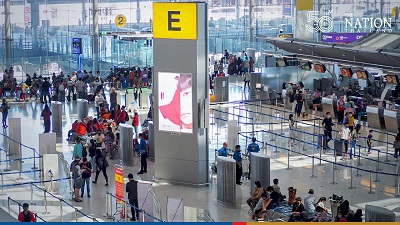
Airports of Thailand (AOT) is working on digitizing six airports, starting with Bangkok’s Suvarnabhumi Airport, in a bid to get ready for a potential influx of tourists once the world reopens next year.
“So far, AOT has developed the Greenfield system which allows passengers to use various services, such as check-in and baggage loading, via smartphone or automatic devices,” AOT president Nitinai Sirismatthakarn said on Monday.
He added that the new technology should be set up in six airports by next year, including Suvarnabhumi Airport, which should have the new system in place by July this year.
He added that the new system should be installed in Phuket International Airport by April or May next year.
“Passengers who do not have baggage can check-in via a kiosk at the airport or via the AOT smartphone application at home,” he said.
“If they need to load baggage, check-in counters will have a biometric system to verify passengers’ identity and they can load their luggage using the self-service baggage loader,” he said.
Nitinai added that airports will use a face recognition system to screen passengers instead of checking their ID cards.
He expects 73 million people, or at least half of the total
passengers before the Covid-19 era, to use these services next year.
“AOT will continue investing to support the return of tourists,” he said.
Nitinai reckoned that AOT will invest about 387 billion baht in the next 10 to 20 years, or twice the value of its total assets worth 180 billion baht.
The baht opened at 31.82 to the US dollar on Monday, weakening from Friday’s closing rate of 31.78.
The Thai currency is likely to move between 31.75 and 31.90 during the day and between 31.60 and 32.10 within this week, Krungthai Bank market strategist Poon Panichpibool said.
He said that the baht tended to weaken due to several factors – such as the dollar’s direction, and the funds flow of foreign investors in Thailand.
Poon predicted that the dollar would strengthen, if the US economy recovered more than observers expected, and Fed officials showed support for stricter fiscal measures.
Also, he added that the Covid-19 situation in Europe and Asia was another factor to support the dollar.
Regarding foreign investment, Poon said that the worsening Covid-19 crisis in Thailand had prompted foreign investors to sell their stocks, pressuring the baht to weaken. The market strategist said that the government must provide at least 500,000 jabs a day in order to make investors more confident in Thailand.
In addition, Poon said that JP Morgan had already changed the proportion of bonds in its Government Bond Index – Emerging Markets. “It was possible that foreign investors would sell their Thai bonds – worth around THB10 billion in total – in order to change their bond proportion,” he explained, adding that last week investors had sold THB4.3 billion worth of Thai bonds.
The important resistance for the baht is at 32 to the US dollar, Poon said.
Global Compact Network Thailand joins forces with “CEOs” to elevate business plan setting targets to reduce greenhouse gas emissions
• Global Compact Network Thailand joins hands with three CEOs of its leading members to share their visions for global sustainability during the UN Global Compact Virtual Leaders Summit 2021, hoping to drive the private sector to implement UN Sustainable Development Goals along with their business plans. Specifically, the business are urged to set targets for reducing greenhouse gas emission.
Global Compact Network Thailand (GCNT), a local network of UN Global Compact in New York, co-hosted UN Global Compact Virtual Leaders Summit 2021. This year CEOs of three leading Thai business organizations reflected on Thailand’s sustainability leadership and global transformation. Global warming was on the top of their agenda. The year 2021 is an important moment to drive the world towards net zero goal in support of the Paris Agreement, which aims to limit the rise of the world’s average temperature within 1.5 degrees celsius. In addition, the key messages shared by the top Thai CEOs are in line with the main objectives of GCNT, which aims to be the sustainability network working with key stakeholders to change the world during “A New Era of Action” as declared by the United Nations.
Ms. Thanyaporn Krichtitayawuth, Executive Director, Global Compact Network Thailand, said that Thailand has been honored for the second year by the UN Global Compact to co-host a global panel discussion with leading CEOs of Thai businesses. They have participated in 3 key sessions. Starting from the opening plenary of the Summit, Mr. Suphachai Chearavanont, CEO of Charoen Pokphand Group (C.P. Group) and Chairperson of Global Compact Network Thailand joined the high-level discussion, “Light the Way to Glasgow and Net-Zero: Credible Climate Action for a 1.5°C World.” Mr. Dan Pathomvanich, CEO of NR Instant Produce Public Company Limited, participated in the discussion, “A New Era of Action, Accelerate Climate Action: Raising Business Pathway to Decarbonization ” to combat climate change and add business solutions to reducing greenhouse gas emissions. Mr. Ho Ren Hua, CEO of Thai Wah Public Company Limited, participated in a plenary discussion on, “SDG Ambition: Mobilizing Ambition for Corporate Actions Towards the Global Goals.” The three leading Thai organizations reflected on the potential of the Thai business sector to make a difference in terms of sustainability on a global scale. They are an example of business organizations adopting Sustainable Development Goals (SDGs), have a clear and concrete plan, especially on climate change, with measurableoutcomes.
Mr. Suphachai Chearavanont, CEO of C.P. Group and Chairperson of Global Compact Network Thailand said that to reduce greenhouse gas emissions, we must start by raising awareness of the current unsustainable consumption patterns such as the long-standing overconsumption of natural resources, resulting in global warming. Being in the agri-food and retail businesses, C.P. Group works with more than 100,000 stakeholders and partners to manage our supply chain. Most importantly, we raise awareness of our more than 400,000 employees to pursue the same objective in sustainable business practices.
Over the next ten years, C.P. Group will draw from renewable energy for our 1,600 MegaWatts of energy need. At the same time, the Group aims to drive waste disposal, especially the food waste, in the entire process to zero.
He also urged all stock exchanges and the governments throughout the world to require all companies to report on their progress towards zero emissions. Such reports will help make the net zero by 2050 goal obtainable and tangible when the entire private sector races towards the same goal. Moreover, he stressed the importance of upgrading our educational system to include not only lessons on digital technology but also sustainability as part of the curriculum.
Mr. Dan Pathomvanich, CEO of NR Instant Produce Public Company Limited noted that NRF aimed to turn the world into carbon-free through changes in the food system. NRF aspires to become the world’s largest producer of plant-based protein and food. The company is going to build the world’s largest production network. From international brands, the network connects to start-ups, to supermarkets, to sustainable transition to low-carbon food production. The NRF’s priority is to manage its supply chain by conveying a clear policy from the CEO to the middle management and even the workers at the sourcing office. This will help ensure that the products’ quality meet the company’s standards.
He also pointed out the main challenge in the food business: Transition from agricultural production based on chemicals to non-chemical and bio-farming. Doing so will reduce the emissions of greenhouse gas in itself.
“COVID-19 has transformed the supply chain. Everyone wants to be healthy. Everyone wants clean food and wants it “NOW.” To fulfill people’s needs will drive the sector to overhaul its business plan towards sustainability and transform companies to become those of the 22nd century,” Mr. Dan said.
Mr. Ho Ren Hua, CEO of Thai Wah Public Company Limited, said that sustainability is part of Thai Wah’s core vision and its strategy on “Developing innovation and sustainability from farm to shelf.” The implementation of its strategy with all stakeholders throughout the value chain fits under 4 pillars: Farm, Factory, Family, and Food.
ADVERTISEMENT
Thai Wah is about to launch a new product this year: innovative and eco-friendly packaging. It is made of biodegradable plastic from tapioca starch, which, in addition to being 100% biodegradable, non-toxic and harmless, can help reduce greenhouse gas emissions. Thai Wah will be Thailand’s first pioneer of tapioca biodegradable plastic and aims to become one of the leading regional bioplastic manufacturers as part of its organization’s long-term reduction in greenhouse gas emissions. The company currently reviews the organization’s emissions report, which is expected to be completed by the second half of this year.
Thai Wah works with various partners, from research institutions, leading universities, and startups to develop prototypes of products that cater to customers as well as create economic values to society and the environment. “Sustainability cannot be created by one person but must be done through collaboration of all parties, both inside and outside the organization. Such collaboration will contribute towards innovation in no time, and of course, it is much better than working alone.” Mr. Ho Ren Hwa concluded.
Thailand Greenhouse Gas Management Organization (TGO), a public organization under the Ministry of Natural Resources and Environment, is responsible for supporting the reduction efforts of greenhouse gas emissions in Thailand. According to Mr. Kiatchai Maitriwong, Executive Director of TGO who also participated in the Leaders Summit, the TGO data indicated that companies in Thailand even further reduced their emissions to help alleviate climate change despite the COVID-19 pandemic. In 2020, 193 companies received carbon footprint certifications. Many companies have also undertaken projects to compensate for their carbon emissions. TGO collaborates with GCNT in technical areas to help companies set goals, audit and certify their emission reductions based on international standards.
Ms. Thanyaporn concluded, “Global Compact Network Thailand, in line with the UN Global Compact in New York, strongly encourages Thai businesses to seriously consider setting significant and measurable scientific targets in order to reduce greenhouse gas emissions. We all should take this as a new business opportunity. Global Compact Network Thailand will support Thai businesses in their efforts while driving the achievement of the UN Sustainable Development Goals.”
New Covid restrictions, volatile foreign funds flow dampen SET sentiment
The Stock Exchange of Thailand (SET) Index fell by 9.38 points, or 0.59 per cent, to 1,573.29 on Monday morning.
The SET Index closed at 1,582.67 on Friday, down 3.05 points or 0.19 per cent. Transactions totalled THB68.1 billion with an index high of 1,596.16 and a low of 1,577.63.
Krungsri Securities has forecast that the SET Index would fall to 1,570 points despite the US Federal Reserve signalling it was in no hurry to hike the interest rate, and oil price continuing to rise.
It said the index, instead, would be under pressure due to the government’s move to announce new restrictions to curb Covid-19 in Bangkok and 10 provinces, plus the volatility of foreign funds flow.
It recommended that investors buy:
▪︎ PTT, PTTEP and BANPU, which benefit from the rising oil price.
▪︎ HANA, KCE, TU and CPF, which benefit from the weakening baht.
▪︎ BCH, CHG, BDMS and CKP, whose second-quarter business turnover is expected to improve.