The price of gold dropped by Bt100 per baht weight in morning trade on Wednesday, the Gold Traders Association reported.
As of 9.25am, the buying price of a gold bar was Bt25,950 per baht weight and selling price Bt26,050 while gold ornaments cost Bt25,483.96 and Bt26,550, respectively.
At close on Monday, the buying price of a gold bar was Bt26,050 per baht weight and selling price Bt26,150 while gold ornaments cost Bt25,574.92 and Bt26,650, respectively.
The spot gold price moved to US$1,839 (Bt55,017) per ounce in the morning after rising by $3.30 to $1,837.50 per ounce on Tuesday on hopes of a rollout of fresh US economic stimulus measures and the weakening dollar.
The Hong Kong gold price meanwhile dropped by HK$40 to $16,980 (Bt65,526) per tael, the Chinese Gold and Silver Exchange Society reported.
By Syndication Washington Post, Bloomberg · Joanna Ossinger, Eric Lam
The frenzied rally in Bitcoin lost momentum on Tuesday after prices hit a new all-time high of $48,000.
The cryptocurrency pulled back in the early U.S. hours, trading up 2.9% on the day around $46,000. Prices are still up more than 30% since the beginning of February.
While the trading action was calmer, there’s still a fierce debate over whether Tesla’s $1.5 billion investment in Bitcoin will lead to other companies following suit. While crypto acolytes have been saying for some time that corporate adoption is imminent, in reality it had been limited to firms such as MicroStrategy Inc. and Square Inc.
“One by one, corporations will add Bitcoin to their balance sheets and it couldn’t get bigger than Tesla,” said Vijay Ayyar, head of Asia Pacific at cryptocurrency exchange Luno in Singapore. “Imagine if 100 companies start putting even 1% into Bitcoin, what that is going to do to demand and supply.”
While Tesla’s investment makes up about 8% of its most recent cash reserves, it’s a drop in the ocean compared to the holdings of America’s blue-chip corporates. The purchase is worth just 0.05% of the $2.79 trillion of cash and cash-equivalents held on the balance sheets of S&P 500 members, according to data compiled by Bloomberg.
For the likes of treasurers, the asset class is just too risky, according to James Angel, an associate professor at Georgetown University. There is no compelling business case for Tesla, or any other corporation, to speculate in Bitcoin, he said in e-mailed comments.
“Corporate cash managers are generally quite conservative and invest corporate cash balances in safe liquid assets,” Angel said. “Bitcoin is highly volatile and can easily go up or down 10% in a day or 50% in a year — certainly not a good short-term store of value.”
And while Tesla announced plans to accept Bitcoin for purchases, hardly anyone uses the cryptocurrency for anything beyond speculation. Data from New York-based blockchain researcher Chainalysis Inc. showed that only 1.3% of economic transactions came from merchants in the first four months of 2019.
“The crypto craze is entirely driven by short-term speculative momentum/mania,” Jeffrey Halley, a senior market analyst at Oanda Asia Pacific Pte, wrote in emailed comments. “For all the noise I keep hearing about how high Bitcoin may go, the noise around how it will be used in everyday life is deafeningly silent.”
Others disagree and insist there is growing interest from the corporate world. MicroStrategy’s CEO Michael Saylor last week hosted a seminar on corporate adoption and said beforehand that professionals from more than 1,400 firms were expected to join.
“Bitcoin as a corporate treasury asset is not yet a mainstream business strategy, but firms like MicroStrategy and now Tesla are highly visible advocates,” said Seamus Donoghue, vice president of sales and business development at digital infrastructure provider Metaco. “With such vocal sponsors leading corporate adoption, further adoption will follow much faster than currently expected.”
By Syndication Washington Post, Bloomberg · Olivia Raimonde
U.S. stocks halted a six-day winning streak as investors debated whether commitments by the Federal Reserve and the Biden administration to let the economy run hot will spark destabilizing inflation.
The S&P 500 Index edged lower from an all-time high after a 5.4% surge this month fueled by signs the Biden administration intends to pass a sizable aid bill while the central bank promises to keep rates pinned near zero. The Nasdaq 100 Index eked out a gain, while small caps notched the longest rally since December 2019. Treasuries advanced and the dollar fell for a third straight session.
Stretched valuations are giving investors pause as they cheer advancing vaccination efforts, rising stimulus prospects and a slowdown in coronavirus infections across the globe. With inflation expectations near the highest since 2013, questions have also begun to be raised about when the so-called reflation trade in bonds could start to threaten equities.
“We are getting to the point where we have to start worrying about the risk of how do we pull back on that stimulus, will it cause the economy to overheat, are these valuations becoming too expensive,” Saira Malik, Nuveen head of global equities, said on Bloomberg TV. “That is something we are going to be grappling with as the year goes on.”
Elsewhere, Brent oil hovered around $60 a barrel on signs the global market is tightening and demand is improving. Bitcoin pared an earlier jump to a record after Tesla Inc. bought $1.5 billion of the cryptocurrency.
These are the main moves in markets:
Stocks
– The S&P 500 fell 0.1% as of 4 p.m. EST.
– The Stoxx Europe 600 Index lost 0.1%.
– The MSCI Asia Pacific Index advanced 0.4%.
– The MSCI Emerging Market Index gained 0.7%.
Currencies
– The Bloomberg Dollar Spot Index dipped 0.5%.
– The euro advanced 0.6% to $1.2118.
– The British pound gained 0.5% to $1.3809.
– The onshore yuan strengthened 0.2% to 6.436 per dollar.
– The Japanese yen strengthened 0.6% to 104.57 per dollar.
Bonds
– The yield on 10-year Treasurys decreased two basis points to 1.15%.
– The yield on two-year Treasurys rose to 0.115%.
– Germany’s 10-year yield was flat near -0.45%.
– Britain’s 10-year yield fell to 0.461%.
– Japan’s 10-year yield advanced less than one basis point to 0.073%.
Commodities
– West Texas Intermediate crude rose 0.6% to $58.32 a barrel.
– Brent crude added 0.9% to $61.12 a barrel.
– Gold futures strengthened 0.1% to $1,836.10 an ounce.
The Industry Ministry forecasts over Bt500 million will be injected into new enterprises selected for its Startup Connect programme this year.
Run by the Department of Industrial Promotion (DIP), the national start-up promotion platform attracted more than Bt350 million in investment for entrepreneurs last year.
Startup Connect is designed to create market access and investor support for new enterprises – especially technology start-ups.
The pilot programme last year selected six entrepreneurs to present their business models to investors and venture capital firms. ECG-Research Co Ltd decided to invest more than Bt350 million in the six start-ups.
This year, the programme will progress in four steps:
First, the start-up network will be expanded by searching for potential entrepreneurs to develop skills and prepare business models to present to investors.
Second, the capital network will be expanded by creating a network of private companies interested in investing in entrepreneurs. Start-ups will also be promoted by Thai embassies to build confidence in business cooperation abroad.
Third, the market network will be expanded with a team of experts advising entrepreneurs on how to meet consumer needs and also operate their business with stability.
Fourth, the international network will be expanded for operators who are ready to expand overseas. These entrepreneurs will be promoted by Thai embassies as a guarantee of quality to boost investor confidence.
The 2021 Startup Connect programme has already selected 25 candidates out of 500 registrants for its training scheme.
By By Adi Pendyala, Senior Director, Aspen Technology
In 2021 and beyond, Industrial AI, as a new industry category will go mainstream – catalyzed by key business drivers, dimensions of readiness and adoption of real-world use cases. To set context, Industrial AI can be defined as a systematic, collaborative, and integrative discipline focusing on developing, embedding, and deploying various machine learning algorithms as fit-for-purpose, domain-specific industrial applications with sustainable business value.
Four business drivers for the adoption of Industrial AI
First, industrial organizations will start focusing on how AI can be applied to address domain-specific industrial challenges. This locks in AI-enabled use cases to tangible business outcomes, which clearly makes the case for widespread Industrial AI adoption.
Second, the barrier to AI adoption will be lowered, as a lack of AI expertise and in-house data science skills among industrial organizations has been a key bottleneck to wider Industrial AI enablement. More organizations will deploy targeted, embedded Industrial AI applications combining data science and AI with purpose-built software and domain expertise. Fit-for-purpose, embedded AI applications will empower users to tackle domain-specific functions efficiently and successfully with greater accuracy, reliability, quality, and sustainability across the industrial asset lifecycle – circumventing the need for niche data science expertise.
Third, organizations are increasingly valuing data as a critical driving force and have become laser-focused on amassing as much of it as possible. Data needs to be capitalized on and leveraged into actionable insights to be worthwhile. Organizations, especially those in capital-intensive industries, will need to shift gears from mass data collection to more strategic industrial data management, with specific focuses on data integration, mobility, and accessibility across the business. That opens the door for Industrial AI, and the underlying opportunity for AI-enabled technologies that will allow these organizations to reap the hidden value in their industrial data sets.
Finally, the biggest driver for Industrial AI is the undeniable productivity increases for capital-intensive process industries. Industrial AI enables next-generation asset optimization solutions to be implemented without needing to rely on large-scale data science expertise. This empowers industrial organizations to open the door to new levels of safety and productivity in their workplace, creating semi-autonomous and autonomous processes for collecting, aggregating, and conditioning live data, then feeding it into intelligence-rich applications. The end results are new insights, continuous operational improvements and faster and more accurate decision making.
Is your organization ready for Industrial AI?
Five dimensions to be Industry AI ready
First, companies need to have a clear action plan that maps AI to business goals, data objectives and KPIs to weave Industrial AI into your digital transformation strategy. Business leaders need to think more broadly than one-off use cases – and an action plan that aligns AI capabilities with overarching business goals does just that.
An overarching industrial data strategy is required – companies need to have accessible, valuable data that can be leveraged constructively by Industrial AI. Garbage in/garbage out is a data problem that afflicts the industrial sector as it does any other industry, so building a strategy around quality and efficient data flows is paramount. That means building a pipeline of industrial data that enables AI solutions to process different types and amounts of data required by each use case and application, and scaling this across the entire organization so that every user and function of the AI gets consistent performance and results.
A future-proof Industrial AI infrastructure necessitates the need to lay the groundwork for Industrial AI readiness, requiring a broad collaboration across industrial environments. In fact, the software, hardware, architecture, and personnel elements will form the building blocks of your Industrial AI infrastructure. And that infrastructure is what empowers organizations to take their Industrial AI proof-of-concepts and mature them into real, tangible solutions that drive ROI. An Industrial AI infrastructure needs to accelerate time to market, build operational flexibility and scalability into AI investments and seek to harmonize the AI model lifecycle across all applications.
Roles, skills, and training are critical. Executing Industrial AI properly relies on having the right people in charge of that execution. That means making a deliberate effort to cultivate the skills, mindsets and approaches needed to create and deploy AI-powered initiatives across the organization. Business leaders need to invest in significant levels of workforce retraining in the coming years to make sure their people are best equipped to deploy Industrial AI.
Finally, ethical and responsible AI use is predicated on transparency, and transparency involving keeping everyone in the loop: creating clear channels of communication, reliable process documentation and alignment across all stakeholders, so that everyone’s on the same page about the Industrial AI’s benefits, limits and uses. The whole premise of Industrial AI is bringing together the best of both worlds in people and AI, and making the two greater than the sum of their parts.
The above is just a guideline but it is worth approaching things with a holistic view that considers the technical, people and processes requirements, and ultimately lays out your organization’s own definition of success.
Top three use cases to bring your Industrial AI strategy to life
The starting point of any organizational strategy begins with identifying the business problems, corporate objectives, and strategic goals that Industrial AI can solve. Organizations looking to drive true business value can take inspiration from these three specific business use cases to unlock the power of Industrial AI, combining data science and AI with software and domain expertise to deliver comprehensive business outcomes for the specific business needs of capital-intensive industries.
Predictive maintenance is the single largest use case for Industrial AI, estimated to have made up more than 24 percent of the total market in 2019, according to the IoT Analytics research report referenced above. Predictive maintenance detects deviations from normal behavior and prescribe detailed actions to mitigate or solve future problems – all with the goal of optimizing output and reducing downtime.
The second use case focuses on quality and reliability. Quality shows how well an object performs its primary function, while reliability shows how well the object maintains its original level of quality over time, through various conditions. Both are significant measurements in an industrial setting and Industrial AI enables an organization to achieve a specific and accurate understanding of the two, saving time and money.
Third, process optimization leverages advanced ML methods, including reinforcement learning and sophisticated deep learning neural networks, to infer information and intelligence from different data sources, assets, and processes. With this, organizations can easily identify and mitigate inefficiencies, which have a direct impact on productivity – the primary economic driver of any industrial enterprise organization.
The use cases outlined above are a concise and clear starting point for any organization building out or redesigning their Industrial AI strategy, and hoping to accelerate time to value in turn.
ThaiHealth wins WHO award for outstanding contribution
Feb 04. 2021Public Health Minister Anutin Charnvirakul (right) congratulated ThaiHealth CEO Supreda Adulyanon
By THE NATION
The Thai Health Promotion Foundation (ThaiHealth) has won the Nelson Mandela Award for Health Promotion for 2021. The global award was conferred on Thailand for the first time by the World Health Organisation, in recognition of ThaiHealth’s “dedication to improving health conditions of the country’s 70 million population”.
ThaiHealth was selected from among eight candidates nominated by WHO member-countries around the world.
“This prestigious global recognition honours the entire ThaiHealth family, its partners and stakeholders working tirelessly to drive public awareness on health promotion and contribution to good health for all. This is not only for ThaiHealth but also for Thailand as a whole to continue improving health of our people, especially those who are vulnerable and facing health inequities,” said Dr Supreda Adulyanon, ThaiHealth CEO.
According to Dr Supreda, the award panel unanimously selected ThaiHealth due to five contributions:
1. Advocating for pro-health laws and policies, such as the Tobacco Control Act 2017 and a legal provision to restrict alcohol advertisement.
2. Shifting social norms towards a healthier and a more inclusive society by promoting alcohol-free social and cultural events, alcohol-free Buddhist Lent, and promoting work opportunities for the disabled.
3. Propagating an effective model for innovative health financing as well as providing technical support in setting up health promotion agencies in Mongolia, Malaysia, Vietnam, Laos and South Korea.
4. Reacting quickly to emerging needs including the Covid-19 “new normal”, by launching effective public communication campaigns, initiating new projects and reorienting existing projects.
5. Boosting health indicators by promoting physical activity and campaigns to cut alcohol and tobacco consumption.
ThaiHealth will receive the award at the 74th World Health Assembly in May this year.
Gulf Energy Development (Gulf) has acquired an additional 1.14 million shares to increase its stake in Intouch Holdings (INTUCH) to 15 per cent from 10 per cent, the Stock Exchange of Thailand (SET) reported on Thursday.
After the acquisition of these shares on January 28, Gulf’s holding in INTUCH rose to 480.97 million shares.
Yupapin Wangviwat, Gulf’s chief financial officer, said this move was in line with the board of director’s resolution.
The Stock Exchange of Thailand (SET) Index closed at 1,482.98 on Thursday, up 1.23 points or 0.08 per cent. Total transactions amounted to Bt77.84 billion with an index high of 1,492.39 and a low of 1,477.88.
In the morning session, Krungsri Securities expected the SET Index to fluctuate between 1,470 and 1,490 points despite hopes of fresh US stimulus measures, plus the rising oil price after US oil storage dropped to its lowest level in almost a year.
“The outflow of foreign funds will pressure the index,” Krungsri Securities added.
The 10 stocks with the highest trade value today were BBL, PTT, KBANK, IVL, SCB, CPALL, EA, GPSC, SCC and ADVANC.
As of 4.30pm, the price of oil rose by US$0.24 or 0.43 per cent to $55.93 per barrel, while gold dropped by $22.20 or 1.21 per cent to $1,812.90 per ounce.
Other Asian indices were on the fall:
Japan’s Nikkei Index closed at 28,341.95, down 304.55 points or 1.06 per cent.
China’s Shang Hai SE Composite Index closed at 3,501.86, down 15.45 points or 0.44 per cent, while Shenzhen SE Component Index closed at 15,105.94, down 127.21 points or 0.84 per cent.
Hong Kong’s Hang Seng Index closed at 29,113.50, down 193.96 points or 0.66 per cent.
South Korea’s KOSPI Index closed at 3,087.55, down 42.13 points or 1.35 per cent.
Taiwan’s TAIEX Index closed at 15,706.22, down 65.10 points or 0.41 per cent.
True Group gets three new top bosses to help turn it into a tech leader
Feb 03. 2021
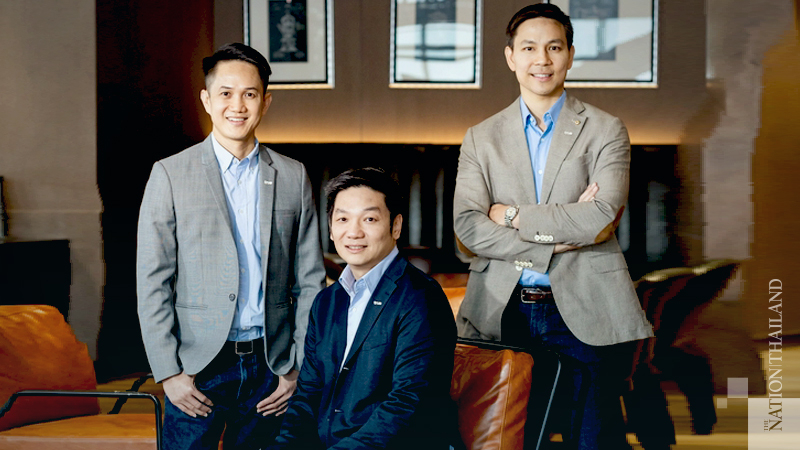
By The NationTrue Corporation’s board of directors appointed Manat Manavutiveth, Dr Teeradet Dumrongbhalasitr and Natwut Amornvivat as co-presidents responsible for strategic management and business operations of True Group.
They have been tasked with transforming the company in line with rapid socio-economic changes in Thailand, as well as enhancing the group’s innovation development capabilities to help it become a leading tech company in the digital era.
The company has also made Anat Mekpaiboonvatana and Sarit Jinnasith executive vice-chairpersons of True Corp’s executive committee.
The appointments are effective from Thursday onwards.
The Stock Exchange of Thailand (SET) Index rose by 7.41 points, or 0.50 per cent, to 1,489.16 in the morning session on Thursday.
The SET Index is expected to fluctuate between 1,470 and 1,490 points despite hopes over the rollout of fresh US economic stimulus measures, as well as the rising oil price after US oil storage dropped to its lowest level in almost a year, a Krungsri Securities analyst said.
“The outflow of foreign funds will pressure the index,” he added.
▪︎ ADVANC, INTUCH, AP, Siri and WHAUP, which pay high dividends.
The SET Index closed at 1,481.75 on Wednesday, down 4.50 points, or 0.30 per cent. Total transactions amounted to Bt79.48 billion, with an index high of 1,500.17 points and a low of 1,481.69.


 Adi Pendyala
 Public Health Minister Anutin Charnvirakul (right) congratulated ThaiHealth CEO Supreda Adulyanon