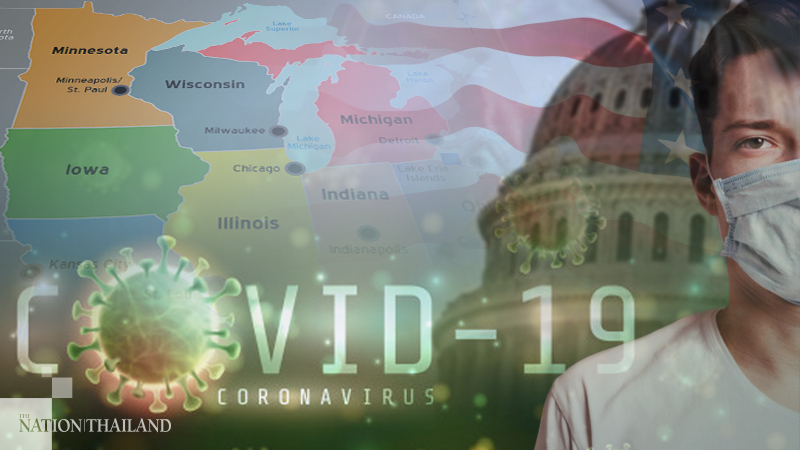
By The Washington Post · Derek Hawkins, Marisa Iati · NATIONAL, HEALTH Coronavirus infections are trending upward across the Midwest, raising concerns that those states are struggling to contain their outbreaks even as the nation’s total daily caseload continues to decline.
Seven-day averages for new cases rose over the past week in the Dakotas, Illinois, Minnesota, Kansas and Iowa, according to tracking by The Washington Post. North and South Dakota experienced the biggest jumps, with average daily caseloads up 23 percent and 34 percent, respectively.
Other states reported progress against the virus, though it appeared to be marginal in some places. Daily case averages declined by about 6 percent over the previous week in Wisconsin and fell by 10 to 20 percent in several other Midwestern states, according to The Post’s tracking.
Spikes in cases across the Midwest come as other regions of the country have reported gains against the virus after seeing infections surge over the summer. Nationwide, the seven-day average for new cases has steadily trended downward after peaking in late July.
Several cases in South Dakota have been linked to a motorcycle rally that drew hundreds of thousands of people to the city of Sturgis this month. Health officials there said Thursday that they were aware of fewer than 25 infections among attendees, but acknowledged that they could not identify every case that exists because of the event.
Three neighboring states have also announced infections among rally attendees, according to local news outlets: seven cases in Nebraska, 15 in Minnesota and “a few” in Wyoming.
CDC Director Robert Redfield warned of a “third wave in the heartland” if Midwestern states don’t follow guidance from health officials to slow the virus spread.
“Middle America right now is getting stuck,” he said in an interview this week with the Journal of the American Medical Association. “That is why it’s so important for Middle America to recognize the mitigation that we talked about.”
As cases have surged, President Donald Trump has taken aim at the pandemic response within his own administration.
On Saturday, he escalated his attacks on the Food and Drug Administration, tweeting a conspiracy theory about coronavirus treatments and stoking doubts about the agency’s decision to pull its emergency approval of the drug hydroxychloroquine.
In an early morning tweet, Trump made the baseless claim that “the deep state, or whoever” in the FDA was “making it very difficult for drug companies to get people in order to test vaccines and therapeutics.” He tagged FDA Commissioner Stephen Hahn, who was appointed by Trump last year, saying “they are hoping to delay the answer” until after the November election.
Trump also misleadingly claimed that “many doctors and studies disagree” with the FDA’s decision to revoke an emergency use authorization for hydroxychloroquine for treating covid-19, the disease caused by the coronavirus. The FDA said in June that the drug was ineffective and that potential benefits were outweighed by safety risks. Other research by the federal government and private institutions has found that hydroxychloroquine performs no better than a placebo in virus patients.
The president’s criticisms reflect a deepening politicization of federal health agencies and public health science as the virus rages around the country and the administration faces pressure to boost testing and develop a vaccine.
“This is really taking it to an unprecedented level,” Eric Topol, a cardiologist and director of the Scripps Research Translational Institute, said of Trump’s statements Saturday. “Every aspect of covid-19 – whether it’s diagnostic, therapeutic – every single aspect, through and through, is being overtaken by Trump.
“The whole idea is to promote human health and safety,” Topol added, “and this is all steps to compromise that.”
House Speaker Nancy Pelosi, D-Calif., also pushed back on Trump’s allegations, saying the FDA must ignore his political pressure and approve only treatments or vaccines that are safe and effective.
“The President’s dangerous attempt to inject himself into the scientific decisions of @US_FDA jeopardizes the health & well-being of all Americans,” she wrote on Twitter.
Trump’s remarks came just days after the administration barred the FDA from regulating a range of laboratory tests, including tests for the coronavirus. The move stunned public health experts, who warned that the shift could result in unreliable coronavirus tests coming to market and worsening the crisis if people get erroneous results.
The president also recently blamed the FDA for not yet authorizing the emergency use of convalescent plasma, a promising but unproven treatment. “You have lot of people over there that don’t want to rush things. They want to do it after November 3,” he said in a White House news briefing this week.
The decision to block the FDA from overseeing lab-developed tests drew a rare public rebuke from former FDA commissioner Scott Gottlieb, who suggested that the move could open the door for substandard tests.
Gottlieb, who served in the Trump administration from 2017 to 2019, noted in a widely circulated Twitter thread Saturday that the FDA had spent the past six months working with labs to develop hundreds of coronavirus tests. The new policy from the Department of Health and Human Services “could put this work at risk,” he said.
“Now, FDA’s ability to protect public health could be challenged. FDA might not be able to provide critical advice to test developers or take needed enforcement actions against bad tests,” Gottlieb wrote. “After all, how can FDA take action over something HHS says it doesn’t regulate?”
Gottlieb said a “plethora” of tests could enter the market and go directly to consumers without being vetted by the FDA for clinical accuracy first.
“Policies issued in the middle of this pandemic should be carefully considered for their impact on the crisis,” he said. “First do no harm.”
Administration officials told The Post this week that the policy, announced Wednesday on the HHS website, was made for legal reasons and that the FDA lacks the authority to regulate lab-developed tests.
The Trump administration has also sought to diminish the role of the Centers for Disease Control and Prevention in responding to the pandemic. Last month, the administration ordered hospitals to bypass the CDC in reporting data on covid-19 patients, causing the information to briefly disappear from the agency’s website. Officials reversed the decision after outcry from state governors and health experts who said they worried that the administration was manipulating the data for political purposes.
J&J plans huge vaccine study while Pfizer cites rapid enrollment
Health & BeautyAug 21. 2020The Johnson & Johnson logo is displayed outside the company’s headquarters in New Brunswick, N.J., on Aug. 1, 2020. MUST CREDIT: Bloomberg photo by Mark Kauzlarich.
By Syndication Washington Post, Bloomberg · Robert Langreth, Cristin Flanagan · BUSINESS, US-GLOBAL-MARKETS As the race for a covid-19 vaccine gets closer to the finish line, investors are parsing details of trial designs like never before as they handicap which is most likely to succeed.
Johnson & Johnson confirmed in an email Thursday that it plans to test its covid-19 vaccine in as many as 60,000 people, twice the number of other big trials being conducted in the U.S. The company first posted the design for the trial on Aug. 10, and it is set to begin in late September.
Meanwhile, Pfizer Inc. released favorable safety data from a Phase 1 trial of its vaccine. The New York-based company, which is developing its product with German partner BioNTech, hadn’t previously released safety data on the shot it will move into a final-stage trial.
“Investors are trying to decipher who’s going to be the winner and who might be left behind,” said Yaron Werber, a Cowen analyst, in an interview.
The Pfizer data support the company’s “slight lead” in the race, according to Werber. J&J researchers, meanwhile, “are buying themselves a lot of insurance” with an extra big trial aimed, he said, at making “sure they are coming out with positive data.”
Shares of both Pfizer and New Brunswick, New Jersey-based J&J gained on Thursday, rising 1.2% and 0.7%, respectively, in New York trading after the announcements.
There are more than 160 covid-19 vaccines being developed worldwide, and about 30 have entered human trials, according to the World Health Organization. Even before scientists know whether the inoculations will work, many of the furthest-along companies are already starting to produce the products and cutting deals to supply shots to governments worldwide.
In the U.S., two messenger RNA vaccines have entered final-stage trials, including Pfizer’s vaccine and a competing shot from the biotech company Moderna Inc.
“We can confirm that planning and recruitment is underway” for J&J’s Phase 3 trial, company spokesman Jake Sargent said in an email. The trial plan “is intended to be as robust as possible,” he said, and will be conducted in places with high rates of Covid-19, based on epidemiology and modeling data.
On the surface, the J&J trial will be about twice as big as the final-stage vaccine trial underway at Pfizer. In an interview, Philip Dormitzer, Pfizer’s vice president of viral vaccine research, said the the nation’s high infection rates means the company expects to hit the needed number of Covid-19 cases with 30,000 people or less.
If the incidence rate suddenly drops, the trial size could be increased, he said. The trial is enrolling rapidly and had more than 9,000 volunteers as of August 19th, he said in an interview.
“Things are going very quickly,” Dormitzer said. “We remain on target” to have results ready to submit to regulators in October.
The Food and Drug Administration is tentatively planning to hold an advisory panel meeting on October 22 to discuss covid-19 vaccines, according to Anand Shah, the agency’s deputy commissioner for medical and scientific affairs. Pfizer’s Dormitzer said he couldn’t say whether Pfizer would have results in time to present at this meeting.
Pfizer and BioNTech also posted Phase 1 data from its vaccine candidate on medRxiv.org, a preprint site for research results that haven’t yet been published.
The company has tested several messenger RNA vaccines in its phase 1 trial, and previously released safety results for one of them. But when it began large scale trials in late July, it used another RNA vaccine candidate that it hadn’t yet revealed early results from.
There was nothing mysterious about the switch, Dormitzer said. Pfizer got the safety data from the second vaccine candidate shortly before it began larger scale trials at the end of July. It appeared to be equally good at generating antibodies against the coronavirus as the first vaccine, but with fewer side effects.
That made the second vaccine the obvious choice to move into final-stage trials, he said. But because results were flowing in so fast and decisions were being made quickly, Dormitzer said there wasn’t time to compile and release the safety data for the second vaccine until now.
“It was a surprise,” that the second vaccine had fewer side effects, he said, calling the result a “bit of a vindication” of their strategy of testing multiple RNA vaccine candidates in Phase 1 trials, before selecting the best one for large-scale trials.
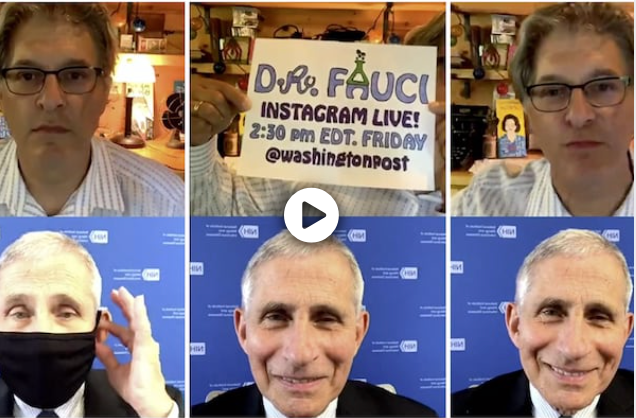
By The Washington Post · Geoff Edgers · NATIONAL, HEALTH, SCIENCE-ENVIRONMENT Every Friday and many Tuesday afternoons, national arts reporter Geoff Edgers hosts The Washington Post’s first Instagram Live show from his barn in Concord, Mass. So far, he has interviewed, among others, actress Tracee Ellis Ross, cellist Yo-Yo Ma, basketball legend Kareem Abdul-Jabbar and journalist Dan Rather.
Recently, Edgers chatted with Anthony Fauci, the director of the National Institute of Allergy and Infectious Diseases. Here are some excerpts from their conversation.
Q: Does it drive you nuts when you see photos of people crowded outside, like at the beach or a motorcycle rally? Does it make your blood boil?
A: The answer, Geoff, is yes. But my blood evaporates when I see people indoors in a bar or in a crowded area. It’s worse being indoors in a crowd without a mask, with poor ventilation, because outdoors is always better than indoors.
Q: Another thing that’s really been on everyone’s mind is how to send kids back to school. Tell me your views on that.
A: It really depends. First of all, I think it’s important for people to understand that college is different than elementary school because you have people coming in from all different parts of the country. In general, when you’re talking about schools, it depends on the location you’re talking about at the state, city and county level.
The Centers for Disease Control and Prevention comes out with the designation of green, yellow, red. If you are in a green zone, in general, there is a good degree of impunity, because of a lower risk of getting infected. If you’re in a red zone, then you really have to think twice about whether it’s prudent to bring the children back to school. If you’re in a yellow one, you should have a plan: Can you safeguard the health, the safety and the welfare of the children and the teachers? What do you do when a child gets infected? Do you have mask-wearing? Do you have the degree of physical separation? How long can you do outdoor classes? And what classes can you do outdoors? Can you keep children segregated when they’re outside playing? Because groups together are the things that do it, particularly indoors. So always remember outdoors, always better than indoors. Masks are very helpful.
Q: I’m drinking from a Dr. Fauci mug. I assume you’re not receiving any residuals from all of the products out there?
A: Absolutely not.
Q: I don’t know if you Google yourself or look on eBay, but is it strange to you that you’re a scientist and yet you’ve become kind of a folk hero?
A: Well, you know, I actually don’t pay attention to that because that could really be distracting. And I don’t pay attention to the death threats and the harassments either. So, yeah. We live in an extraordinary society where public health issues become so politicized and divisive that when you start talking about prudent things to do to preserve the public health, that’s actually considered by some, hopefully a really small minority, as something worthy of threatening you. I mean, that really is bizarre.
Q: You know, I flip around the channels at night, and I find this guy, you know, Tucker Carlson. You heard of him?
A: Yeah. He’s the guy that really loves me, right?
Q: The other night he called you Lord Fauci and said, “Has America put too much faith in just one man?” “Unelected Fauci has been leading this country” and “Fauci has made a lot of wrong predictions.” Does that get under your skin? Do you feel threatened or concerned when you see that sort of thing floating out there?
A: Well, I’m not concerned about what he says. Though you could say that when he does that, it triggers some of the crazies in society to start threatening me, actually threatening me, which happens.
Q: And you can’t always know everything, right?
A: Yeah. Science is an iterative, self-correcting process. When you’re involved with a static situation that doesn’t change, then the scientific facts and what you use as evidence to make decisions and policy recommendations shouldn’t change much at all. But when you’re dealing with a moving target, an evolving pandemic with which we’ve never had any prior experience, you’ve got to make decisions and recommendations based on the data and the evidence that you have at any given time. But as the situation evolves, so too will the evidence. So too will the data. And you need to be humble enough and flexible enough to change things based on what the latest data and evidence are. That is interpreted by some people as “Science is wrong, they’re changing their minds, they’re fooling us.” No. What you’re doing is you’re being flexible enough as you learn more and more to make the data and the evidence drive your recommendations.
Q: You hear all these stories about somebody who’s had it: “Oh, I’m fine.” I mean, my 99-year-old grandmother had it, showed no symptoms and was OK. But then you hear this heartbreaking story about a 35-year-old in perfect health who doesn’t make it or takes months and months to recover. Why are there so many variables in how people respond to the virus?
A: That’s the most important question, because it’s at the root of the misunderstanding, the real misunderstanding about this virus. So, as you know, I’ve been chasing viruses, as it were, and responding to outbreaks now for almost 40 years, right from the beginning of the HIV/AIDS epidemic, through pandemic flu, Ebola, Zika, anthrax, all that. This is the only pathogen I’ve ever seen that has such a wide range of manifestations that you have to scratch your head.
Q: Do you want to be back at the White House briefings? Or do you prefer to do what you’ve been doing, which is going all over the place and spreading this message?
A: I like it this way – where I can be on a discussion without being in a situation where it’s a perfect setup to pit one against the press. When you have the president there, everybody’s watching your every move. You put your hand here, you scratch your ear. You know, it’s not the right way to educate the public. So I much prefer the kinds of things we’re doing now where you get the opportunity one-on-one in a television interview, a radio interview or a podcast, Instagram.
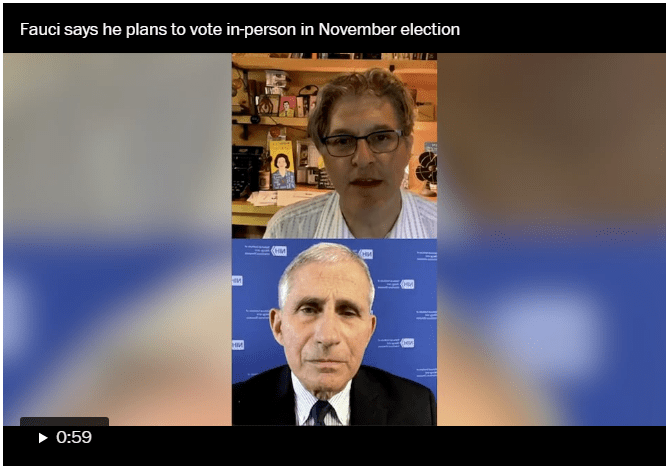
Q: We haven’t spoken about voting. Do you plan to vote in-person or mail in your ballot?
A: I likely will vote in person. But only under the circumstances that I see in grocery stores, what I see at Starbucks – six or more feet apart and don’t move until the person ahead of you does. I believe that the polling stations are going to do that, but I absolutely understand people who have a concern about that and they should be able to vote by mail.
Q: If you could, for those of us who sometimes wake up with this feeling of doom, how do we turn this around? How do we stop the suffering? Can you tell us what keeps you going and why we should be optimistic?
A: Well, that’s a good way to end the discussion, Geoff, because this will end. I mean, when you’re in something that’s so stressful, you have to worry about despair setting in. Like, “My God, I’m in a hopeless situation.” It’s not. It will end. We will get out of this and we will return to normal. Don’t give up. Don’t despair. Don’t throw caution to the wind. We can end this. The combination of pulling together with public health measures and the scientific advances of vaccines and therapies and preventions. I will guarantee you that.

 ผู้ป่วยโรคเบาหวานกับปัญหาสุขภาพของเหงือกและฟัน อีกเรื่องสำคัญที่เราต้องรู้!
 ผ.ศ.รัชนีวรรณ ขวัญเจริญ แนะ “โรคอะโครเมกาลี” กลุ่มอาการของโรคที่เกิดจากภาวะที่มีระดับฮอร์โมนที่เกี่ยวกับการเจริญเติบโตในเลือดสูงเกินปกติ ยิ่งพบเร็วรักษาเร็ว ยิ่งดี

 สูตินรีแพทย์และแพทย์ผู้เชี่ยวชาญด้านมะเร็งนรีเวช เผยปวดประจำเดือนรุนแรงหรือเรื้อรังนานๆ เสี่ยงเป็นโรคอะไรได้บ้าง พร้อมแนะวิธีแก้อาการปวดประจำเดือน
 การเปลี่ยนแปลงในผู้ที่เป็นโรคซึมเศร้า และโรคอื่นที่มีอาการคล้ายคลึงกับโรคซึมเศร้า

 แพทย์ผู้เชี่ยวชาญเผยการแพ้อาหารชนิด “แฝง” มีความแตกต่างจากการแพ้อาหารแบบเฉียบพลัน พร้อมแนะวิธีการสังเกตและการตรวจหา
 มะเร็งเต้านมกับความเข้าใจผิดที่ผู้หญิงต้องรู้ โดย นพ.สาธิต ศรีมันทยามาศ ศัลยแพทย์มะเร็งเต้านม ศูนย์เต้านมโรงพยาบาลมะเร็งกรุงเทพ วัฒโนสถ
 แชร์กันเยอะ!! ล้างพิษตับ กำจัดนิ่วในถุงน้ำดี ด้วยน้ำมันมะกอกผสมน้ำมะนาว เป็นไปได้จริงๆ หรืออิงนิยาย

 The Johnson & Johnson logo is displayed outside the company’s headquarters in New Brunswick, N.J., on Aug. 1, 2020. MUST CREDIT: Bloomberg photo by Mark Kauzlarich.