China slams Britain, saying it has no right to supervise Hong Kong #SootinClaimon.Com

#SootinClaimon.Com : ขอบคุณแหล่งข้อมูล : หนังสือพิมพ์ The Nation.

https://www.nationthailand.com/news/30403728

China slams Britain, saying it has no right to supervise Hong Kong

InternationalMar 16. 2021
By Syndication Washington Post, Bloomberg · Andrew Davis

China accused the U.K. of “groundless slanders” after the British government said Beijing’s crackdown on dissent in Hong Kong wasn’t in compliance with a treaty that paved the way for the city’s return to Chinese control.

“The U.K. has no sovereignty, jurisdiction or right of ‘supervision’ over Hong Kong after the handover, and it has no so-called ‘obligations’ to Hong Kong citizens,” China said in a statement posted Sunday on the website of its London embassy. “No foreign country or organization has the right to take the Joint Declaration as an excuse to interfere in Hong Kong affairs, which are China’s internal affairs.”

The statement came after U.K. Foreign Secretary Dominic Raab on Saturday said China is in a “state of ongoing noncompliance” with the 1984 treaty that paved the way for Hong Kong’s return to Chinese control. His remarks have gone further than previous comments by the U.K., which had called the changes a breach in the declaration.

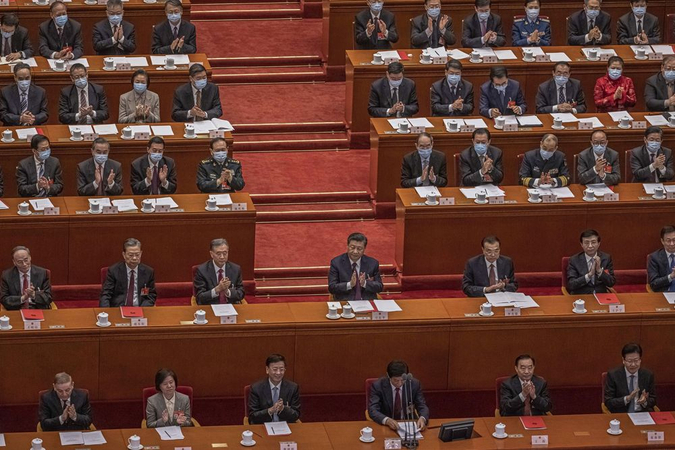
In recent days, Chinese lawmakers approved an overhaul of the city’s election system that threatens to stack its legislature with pro-Beijing loyalists. The move was the culmination of a series of steps to curb challenges to Chinese rule, including passage of a national security law that led to the arrest of dozens of democracy activists and prompted many to flee the city.

The election overhaul “is part of a pattern designed to harass and stifle all voices critical of China’s policies and is the third breach of the Joint Declaration in less than nine months,” Raab said. The U.K. decision was a “demonstration of the growing gulf between Beijing’s promises and its actions.”

The statement gave no indication of what the U.K. government would do if China doesn’t return to compliance with the Joint Declaration.

“The U.K. will continue to stand up for the people of Hong Kong,” Raab said. “China must act in accordance with its legal obligations and respect fundamental rights and freedoms in Hong Kong.”

China fired back in a 500-word statement asserting its control over the city. “Hong Kong is a special administrative region of China,” it said. “How to design and improve its electoral system is purely China’s internal affair and brooks no external interference.”

There was little London could do aside from voicing its displeasure, said Tim Summers, an assistant professor specializing in U.K.-China relations at the Chinese University of Hong Kong.

“The U.K. does not have any leverage to do much more,” he said. “There is no chance that Beijing is going to change course on the electoral reforms in Hong Kong because of the views of Western governments.”

China’s Hong Kong and Macao Affairs Office also responded to a statement by the Group of Seven nations that expressed “grave concerns” at the changes in the city’s electoral system.

The G-7 statement “distorts facts and makes irresponsible comments,” which are in violation of the international law and the norms of international relations, the Hong Kong and Macao Affairs Office said Sunday, calling it a “gross interference” in internal affairs.

Hong Kong was a British colony for more than 150 years until its return to China in 1997 after the two countries signed the Joint Declaration. The agreement gave control back to China in return for the city maintaining a “high degree” of autonomy. Yet under President Xi Jinping, China has moved to tighten its grip on the city; the crackdown accelerated after massive pro-democracy demonstrations broke out in 2019.

After passage of the national security law, the U.K. responded by offering a path to British citizenship for eligible Hong Kong residents.

China’s overhaul of Hong Kong’s legislature will give Beijing virtual veto power in the selection of the city’s leaders. China said the national security law was necessary to punish acts of secession, subversion of state power, terrorist activities or collusion with foreign entities. Dozens of opposition figures, including media tycoon Jimmy Lai and former student leader Joshua Wong, have been jailed under the law.

Scientific evidence points to safety of Covid-19, says AstraZeneca after blood clot fears #SootinClaimon.Com

#SootinClaimon.Com : ขอบคุณแหล่งข้อมูล : หนังสือพิมพ์ The Nation.

https://www.nationthailand.com/news/30403707

Scientific evidence points to safety of Covid-19, says AstraZeneca after blood clot fears

InternationalMar 15. 2021

By The Nation

British biopharmaceutical company AstraZeneca has reassured on the safety of its Covid-19 vaccine, saying its claim was based on clear scientific evidence.

“Safety is of paramount importance and the company is continually monitoring the safety of its vaccine,” the company said in a statement after cases of vaccinated people dying of thromboembolism a few days after injection.

Following recent concern raised around thrombotic events, AstraZeneca said a careful review of all available safety data of more than 17 million people vaccinated in the European Union and UK with Covid-19 vaccine “showed no evidence of an increased risk of pulmonary embolism, deep vein thrombosis [DVT] or thrombocytopenia, in any defined age group, gender, batch or in any particular country”.

So far across the EU and UK, there have been 15 events of DVT and 22 events of pulmonary embolism reported among those given the vaccine, based on the number of cases the company has received as of March 8. This is much lower than would be expected to occur naturally in a general population of this size and is similar across other licensed Covid-19 vaccines, the company said.

The monthly safety report will be made public on the European Medicines Agency website the following week, in line with exceptional transparency measures for Covid-19.

“Furthermore, in clinical trials, even though the number of thrombotic events was small, these were lower in the vaccinated group. There has also been no evidence of increased bleeding in over 60,000 participants enrolled,” the company said.

Ann Taylor, chief medical officer, said: “Around 17 million people in the EU and UK have now received our vaccine, and the number of cases of blood clots reported in this group is lower than the hundreds of cases that would be expected among the general population.

“The nature of the pandemic has led to increased attention in individual cases and we are going beyond the standard practices for safety monitoring of licensed medicines in reporting vaccine events, to ensure public safety.

“In terms of quality, there are also no confirmed issues related to any batch of our vaccine used across Europe, or the rest of the world. “Additional testing has, and is, being conducted by ourselves and independently by European health authorities and none of these re-tests have shown cause for concern.

“During the production of the vaccine, more than 60 quality tests are conducted by AstraZeneca, its partners and by more than 20 independent testing laboratories. All tests need to meet stringent criteria for quality control and this data is submitted to regulators within each country or region for independent review before any batch can be released to countries,” Taylor said.

The company said it was keeping this issue under close review but available evidence does not confirm that the vaccine is the cause. To overcome the pandemic, it is important that people get vaccinated when invited to do so.

Covid-19 vaccine AstraZeneca was co-invented by the University of Oxford and its spin-out company, Vaccitech.

It uses a replication-deficient chimpanzee viral vector based on a weakened version of a common cold virus (adenovirus) that causes infections in chimpanzees and contains the genetic material of the Sars-CoV-2 virus spike protein. After vaccination, the surface spike protein is produced, priming the immune system to attack the Sars-CoV-2 virus if it later infects the body.

The vaccine has been granted a conditional marketing authorisation or emergency use in more than 70 countries across six continents, and with the recent Emergency Use Listing granted by the World Health Organization accelerates the pathway to access in up to 142 countries through the Covax Facility.

London Metropolitan Police under pressure over clashes at Sarah Everard vigil #SootinClaimon.Com

#SootinClaimon.Com : ขอบคุณแหล่งข้อมูล : หนังสือพิมพ์ The Nation.

https://www.nationthailand.com/news/30403693

London Metropolitan Police under pressure over clashes at Sarah Everard vigil

InternationalMar 15. 2021

By The Washington Post · Karla Adam

LONDON – It’s an image that has Brits talking, and on Sunday prompted calls for the head of the London Metropolitan Police to resign.

A redheaded woman lies pinned to the ground. She seems to be shouting. Two uniformed police officers are holding her hands behind her back to handcuff her.

The woman was among thousands who attended a vigil Saturday in London’s Clapham Common for Sarah Everard, the 33-year-old marketing executive whose kidnap and killing has stunned the nation.

A police officer has been charged in her death.

Police urged people to stay away from the planned vigil with England still in lockdown. Organizers canceled the event after talks with police about its legality and safety broke down. But people went anyway.

Metropolitan Police Commissioner Cressida Dick, who holds the most powerful policing position in Britain, said Sunday she was not considering stepping down.

“We’re still in a pandemic, unlawful gatherings are unlawful gatherings, officers have to take action if people are putting themselves massively at risk,” she told reporters.

But many continued to question the way the police handled the event, as photos of male officers pinning a woman to the ground – at a vigil for a woman allegedly slain by a police officer – went viral.

Home Office minister Victoria Atkins was quizzed about the sensational images on Sunday morning talk shows.

“You’ll be very familiar with the picture that has been shown absolutely everywhere. What did you think when you saw it?” said the BBC’s Andrew Marr.

“I found it very upsetting, of course,” Atkins said.

Atkins told Sky’s Sophie Ridge show that the photograph was “something that the police will have to explain in their report to the Home Secretary.”

The police on Sunday defended their handling of the memorial.

“We absolutely did not want to be in a position where enforcement action was necessary,” assistant police commissioner Helen Ball said. “But we were placed in this position because of the overriding need to protect people’s safety.”

“Hundreds of people were packed tightly together, posing a very real risk of easily transmitting covid-19,” she said. She said “a small minority of people began chanting at officers, pushing and throwing items.”

Among the thousands who attended the vigil peacefully – Catherine, the Duchess of Cambridge, left flowers – a Washington Post reporter saw a small group of people hurling insults and objects at the police. One person smashed the rear view window of a police van. Many shouted “arrest your own” and “shame on you.”

As scenes of tussles from the vigil circulated online,politicians from across the political spectrum criticized the Metropolitan Police’s handling of the situation.

Home Secretary Priti Patel called the scenes at the vigil “upsetting” and said she had requested a full police report on the day’s developments. London Mayor Sadiq Khan said the police chiefs had failed to provide him with a satisfactory explanation of events and called for an independent investigation.

Police said four people were arrested for “public order offences and for breaches of the Health Protection Regulations.”

Liberal Democrat party leader Ed Davey was among those who called on the police commissioner to resign. Others said what’s needed is a more serious look at how to handle demonstrations during a pandemic.

Jess Phillips, the opposition Labour Party’s point person on domestic violence, said there were “many missed opportunities throughout the day for police to work with organizers to create a completely safe vigil so that people could go and have a moment of sorrow and a moment of resistance.”

Everard’s death has prompted a national outpouring of grief and anger. She was last seen at at 9:30 p.m. on March 3, walking home from a friend’s house in south London. Her body was later found in woods in Kent.

Wayne Couzens, 48, has been charged with kidnap and murder in her death. The Metropolitan Police say he joined the force in 2018; for the past year, his main job was patrolling diplomatic premises, mainly embassies. He previously held posts at Downing Street and the Palace of Westminster.

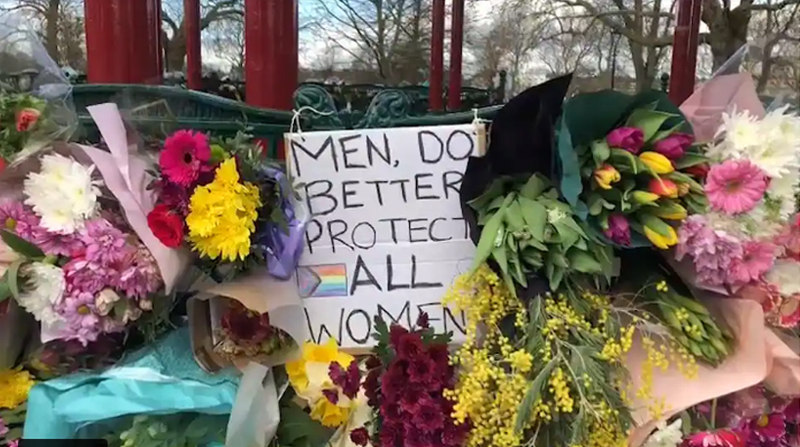
Women have shared stories online about their experiences feeling scared when walking alone at night, and are asking why more isn’t being done to tackle violence against women.

The redheaded woman in the photo, Patsy Stevenson, said she attended the vigil to support women who “cannot walk down the streets themselves because of the fear of men.”

She called the police actions “disgraceful.”

“Before then, it was just a peaceful protest,” she told the left-wing website Counterfire. “I was arrested by police for standing there. I wasn’t doing anything. They threw me to the floor. They have pictures of me on the floor being arrested. And I’m 5 foot 2 and I weigh nothing.”

Despite the cancellation, she said, people were going to attend, “because people were angry.”

India is the next big frontier for Netflix and Amazon. Now, the government is tightening rules on content. #SootinClaimon.Com

#SootinClaimon.Com : ขอบคุณแหล่งข้อมูล : หนังสือพิมพ์ The Nation.

https://www.nationthailand.com/news/30403692

India is the next big frontier for Netflix and Amazon. Now, the government is tightening rules on content.

InternationalMar 15. 2021

By The Washington Post · Niha Masih

NEW DELHI – The nine-part drama from Amazon promised to be India’s “House of Cards,” a gritty portrait of contemporary politics.

Instead, it nearly landed its creators in jail.

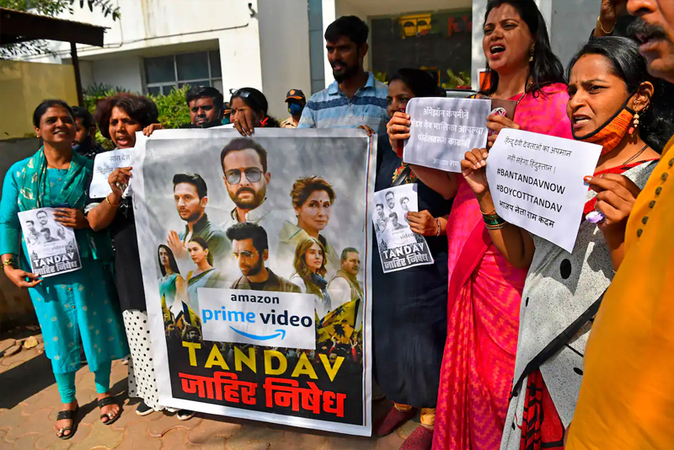
Within days of the release of the series in January, the streaming platform had become a target of Hindu nationalists angered by a brief scene depicting a Hindu god and remarks referencing India’s hierarchical caste system. At least 10 police complaints were filed against the makers, actors and Amazon executives in more than half a dozen states across the country. The makers of the drama, called “Tandav,” apologized and deleted the contentious scenes. But India’s top court refused to dismiss the police cases.

U.S. video streaming platforms like Netflix and Amazon Prime Video are looking to the Indian market to power their global growth. But their shows are facing the wrath of Hindu nationalists, often linked to the ruling Bharatiya Janata Party or BJP, which wields increasing clout over what is acceptable entertainment. Now, the government has stepped in, raising fears about shrinking space for creative freedom.

In November, the government brought streaming platforms under the purview of the information and broadcasting ministry, which has licensing and content censorship powers in mediums like cinema and television.

This year, the government announced rules that subject online news outlets and video content providers to extensive regulation. Under the new rules, “publishers” are required to appoint a local representative to act on every complaint within 15 days. These companies are also required to join an industry association led by a retired judge to ensure compliance. The third level of regulation falls to a government committee that has the power to censure, demand an apologyor order the deletion of content.

Experts say the web platforms may find it hard to push back against government regulations given what’s at stake. India is the fastest-growing market for video streaming platforms, according to an estimate by PricewaterhouseCoopers. It forecast India’s growth in the category to be over 28 percent by 2024, double the projected global growth.

Netflix has invested $400 million in the past two years to produce or license content in India. In 2018, Netflix CEO Reed Hastings said the company’s next 100 million users would come from India.

For Amazon, too, India is a key market. During his visit to the country last year, founder and CEO Jeff Bezos said the company would “double down” on its investment in India, citing its growing popularity. (Bezos owns The Washington Post.)

The new rules also include stringent provisions for social media giants such as Facebook and WhatsApp, requiring them to take down content deemed inappropriate in a short period of time and comply with court or government orders to identify creators.

While experts called the rules “unconstitutional,” the government has said they are “progressive, liberal and contemporaneous.”

India is not the only country where streaming sites have to contend with local restrictions. Last year, Netflix canceled a show in Turkey after the government refused to give permission to film the series over the inclusion of a gay character. In Saudi Arabia, the company pulled an episode of “Patriot Act” by comedian Hasan Minhaj that criticized Crown Prince Mohammed bin Salman.

Under Prime Minister Narendra Modi, a wave of Hindu nationalism has exacerbated religious tensions,jeopardizing India’s democratic status. This week, a report on global democracy downgraded the world’s largest democracy to an “electoral autocracy,” primarily due to a sharp decline in freedom of expression, the media, and civil society.

In January, a Muslim stand-up comic had to spend a month in jail following a complaint by the son of a BJP leader for a joke he did not make. Lower courts repeatedly denied him bail for “outraging religious feelings” under the “garb of standup comedy.” Later, the Supreme Court granted him bail.

Netflix, Amazon Prime Video and similar platforms are often credited with pushing the envelope on delicate subjects such as female sexuality or social justice. “Delhi Crime,” a fictionalized retelling of a brutal gang rape on Netflix, won an Emmy for Best Drama Series in 2020 – the first for an Indian show.

But the pushback is growing. Besides “Tandav,” the makers of “Mirzapur,” a crime thriller set in the eponymous small town in Uttar Pradesh, also on Amazon Prime Video, are also battling police complaints for “hurting religious sentiments.” Earlier, the member of Parliament from Mirzapur, an ally of the BJP, urged Modi to take action against the show for depicting the town as a den of violence.

Police from Uttar Pradesh, run by a hard-line Hindu monk from the BJP, traveled to Mumbai to investigate the case against Tandav and have questioned Amazon’s head of India Originals, Aparna Purohit. Rejecting her pre-arrest bail plea, a judge from a lower court said “sentiments of the majority community have been hurt” by the show.

This month, Amazon Prime Video stepped in with a fresh apology for the controversial scenes in “Tandav.” The statement said they respect the “diverse beliefs” of its viewers and “apologize unconditionally” to those who felt hurt.

On Thursday, the national agency in overseeing children’s rights asked Netflix to stop streaming its just-released show “Bombay Begums” over what it described as an “inappropriate” portrayal of children.

Representatives from the two companies declined to respond to questions about the impact of the new guidelines on their content and the ongoing police cases.

India’s internet boom is driven by the easy availability of cheap internet data plans and the proliferation of smartphones. There are more than 570 million internet users in India, with recent growth happening among rural populations.

“Every large platform is looking at India to give them the next phase of growth,” said Rajib Basu, the head of media and entertainment sector for PricewaterhouseCoopers in India. “It’s an English-speaking market and the biggest after China, which is not free. Nobody can ignore it.”

The new rules have created “panic,” said Karan Anshuman, one of the writers and directors of “Mirzapur,” the show targeted in police complaints.

Days after the rules were announced, Mint newspaper reported that Amazon Prime Video had shelved the second season of “Paatal Lok,” a sobering drama that had received praise for its unembellished depiction of discrimination and corruption.

Anshuman said that the signs were not encouraging for the creative industry.

“It’s too early to say how things are going to play out,” he said. But “we’re already doubting our own selves over whether something is too political.”

A battle resumes over Japan’s bizarre school rules #SootinClaimon.Com

#SootinClaimon.Com : ขอบคุณแหล่งข้อมูล : หนังสือพิมพ์ The Nation.

https://www.nationthailand.com/news/30403691

A battle resumes over Japan’s bizarre school rules

InternationalMar 15. 2021

By The Washington Post · Simon Denyer, Julia Mio Inuma

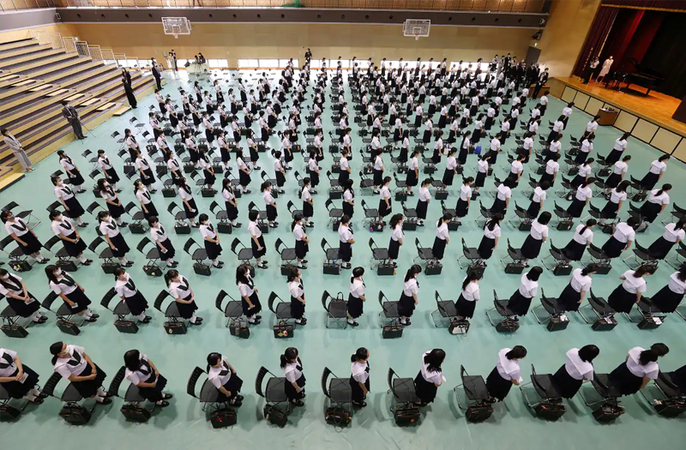
TOKYO – There is a saying in Japan: “When rules exist, they have to be obeyed.”

But there are surely few rules as pointless, divisive and cruel as the widely enforced regulation that Japanese schoolchildren must have straight jet-black hair, sociologists and activists say.

It is supposed to prevent rebellious students – girls and boys alike – from dyeing or perming their hair and encourage them to concentrate on their studies. But as with other rules here, including a ban on dating and a requirement that students wear white underwear, the result oftenfuels discrimination, crushes individuality and enforces a rigid conformity that holds Japan back, according to critics.

The battle to change the rules has been reignited by a court ruling in the western city of Osaka last month that awarded a former student $3,000 for “emotional distress” incurred after she was hounded out of high school because her hair wasn’t black enough. But the court controversially backed the school’s legal right to impose the rule.

The young woman’s lawyer, Yoshiyuki Hayashi, said his client, now 21, intends to appeal, saying her childhood was destroyed when she entered the Prefectural Kaifukan High School. By her second semester, she was ordered to dye her hair black every four days but was banned from classes and even excluded from a school trip because teachers decided it still “wasn’t black enough,” Hayashi says.

When she refused to keep dyeing her hair, she was told not to bother coming to school. Later, her parents tried to negotiate a way for her to return, only to find her desk had been removed from the classroom and another pupil assigned her school ID number.

“She was hit very hard psychologically,” Hayashi said. “At one point, it was so bad that just seeing herself in the mirror or seeing her hair caused her to hyperventilate.”

The woman, who declined to comment herself, had always wanted to attend university, he said, “but she became extremely mistrustful of people” to the extent she does not interact with many people outside her family. “She has now started a part-time job, but she is still struggling,” he said.

In a news conference after the ruling, principal Masahiko Takahashi said the school would not change its black hair policy but would “take more care.” Osaka’s prefectural government noted the court upheld the school’s rules but said the girl’s name shouldn’t have been removed from the school’s directory.

Nearly half of Tokyo’s public high schools require students whose hair is not black and straight to submit certification to prove it’s natural and not dyed or permed, according to a report by NHK, while the Mainichi newspaper found the proportion even higher in Osaka.

Miyuki Nozu, a 32-year-old woman now working with refugees, went to a private school that demanded students with brown or curly hair carry certification with them at all times. Eyebrows were regularly checked to make sure students had not plucked them, while socks had to be white and folded three times.

She says the rules make it much harder for immigrant and mixed-race children to feel they belong.

“Schools just assume without any thought that all Japanese people have black straight hair and girls should act a certain way,” she said. “But Japan is not a single-ethnicity nation anymore. Schools don’t realize society has changed and that they are forcing an outdated ideal on students. This proves they have no intention or ability to teach about diversity.”

Nozu said one of her classmates was labeled a “troublemaker” because she struggled to follow the rules, but went on to graduate top of her class at the prestigious Tokyo University of the Arts. Still, she said, “there are plenty of people who are repressed and lose their creativity.”

Kayoko Oshima, a law professor at Doshisha University who focuses on the issue, says some students are “emotionally damaged and lose their self-esteem” and can also be isolated and bullied by classmates who absorb the underlying ethos – that those who don’t conform don’t belong in Japanese society.

“In Japan, people have an impression that when someone stands out, they will be targeted or bullied,” she said. “So people learn not to stand out, and young people see this as a survival method. Teachers talk about individuality, and yet people’s uniqueness is crushed.”

In corporate Japan, that in turn creates an atmosphere in which people are often scared to speak out, particularly in meetings, and especially if they are women, Oshima and Nozu said.

In schools, it doesn’t stop at hair color. In the city of Nagasaki, nearly 60 percent of 238 public schools demand that pupils wear white underwear, NHK reported, with one student telling the broadcaster teachers regularly check their underwear when they change for gym class.

In Fukuoka, 57 out of 69 schools surveyed by the lawyers’ association had rules about underwear color, the Asahi newspaper reported. Some schools even reportedly asked pupils to remove their underwear if they broke the rules.

Yet pressure is growing for change.

A young Japanese woman has taken her Tokyo high school to court for abusing its power by asking her to “voluntarily withdraw” after she broke the rules by dating a boy in her class Even though she was just a few months from graduation, she felt obliged to drop out, Japan Today reported.

In 2018, when the Osaka case first came to court, Yuji Sunaga was so outraged that he helped start a campaign to “Stop Extreme School Rules” and collected 60,000 signatures for a petition demanding the government take action.

He says the rules not only entail discrimination but can also lead to sexual harassment. Strict uniform policies impose financial burdens on poor parents; rules requiring children to take all their textbooks home can cause back problems; and rules banning winter clothing or scarves can also damage children’s health. Some children may be driven to suicide, he says.

“Because of the rules, the children themselves exert peer pressure that everyone needs to conform, and this continues into adulthood like an obsession,” he said.

“Children’s self-esteem is plummeting, in some cases so low they are losing their will to live,” he said.

Myanmar junta imposes martial law in part of Yangon #SootinClaimon.Com

#SootinClaimon.Com : ขอบคุณแหล่งข้อมูล : หนังสือพิมพ์ The Nation.

https://www.nationthailand.com/news/30403690

Myanmar junta imposes martial law in part of Yangon

InternationalMar 15. 2021

By Syndication Washington Post, Bloomberg

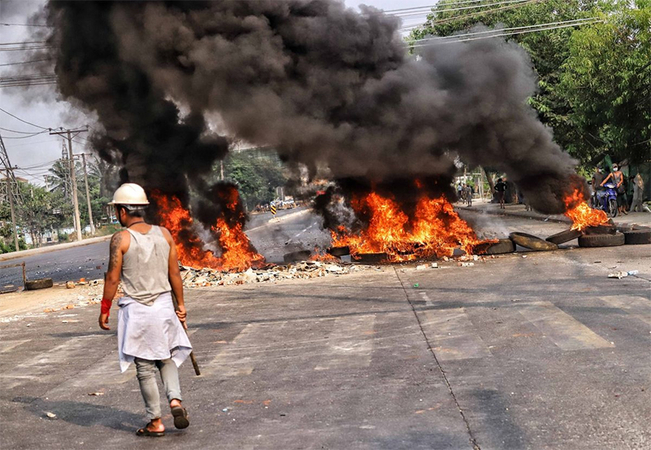
Myanmar’s junta declared “full martial law” late Sunday in parts of the commercial capital Yangon after clashes led to more deaths and Chinese-owned businesses were set on fire.

Coup leaders imposed the measure after the Chinese Embassy asked authorities to guarantee the safety of its investments and citizens. Military-run broadcaster Myawady announced that more than 2,000 protesters blocked roads over the weekend to prevent firefighters from putting out fires at several factories in industrial zones, which included Chinese businesses.

The martial law order applies to two densely populated townships in Yangon: Hlaing Thar Yar and Shwe Pyi Thar. It gave the head of the military’s Yangon command power “to endure safety, the rule of law and peace more effectively.”

“We urge Myanmar authorities to impose effective measures to end all acts of violence and to investigate and punish the perpetrators in accordance with the law,” the Chinese Embassy said in a statement late Sunday. The Global Times, a tabloid run by the Communist Party, said in an editorial on Monday that “those who maliciously defame China and instigate attacks against Chinese factories” must be “severely punished.”

The death toll continued to rise over the weekend as Myanmar authorities continue using force to quell persistent nationwide protests against the military coup of Feb. 1. At least seven people were confirmed dead Saturday, according to the United Nations Human Rights Office, bringing the total to 88 since the coup. Local media outlets reported that more than 50 protesters were killed in Yangon during crackdowns Sunday, mostly in the townships, though the figures could not be immediately corroborated.

The Special Advisory Council for Myanmar, a group of international experts consisting of former UN officials, said it has “grave concerns that a major military crackdown may be imminent, with fatal consequences.” The group called for “immediate international political intervention.”

“So far, the international response to the attempted coup has been weak,” the council said. “It is sending a dangerous message that the generals will continue to suffer no meaningful repercussions for their violent attacks on the Myanmar people.”

While the U.N. Security Council has condemned the violence, countries including China and Russia have opposed stronger language and sanctions against the Myanmar military leaders. China has said it maintains good relations with all parties in Myanmar and called for dialogue to prevent the situation from deteriorating.

The junta’s lead spokesman, Zaw Min Tun, reiterated on Thursday that minimal force was used to disperse protesters, even as witnesses say live bullets continued to be fired. He said security forces will continue to enter some properties to search for protest instigators in some townships, which he added was “to ensure safety and the rule of law.”

In Mandalay on Saturday, demonstrators took to the streets after deadly violence earlier in the day. Tens of thousands of engineers and engineering students chanted for an end to military dictatorship and the release of detained leaders including Aung San Suu Kyi, the deposed elected leader.

“Security forces are trying to scare us from joining street protests in the coming days,” said Aung Myo Nyunt, a 20-year-old student protester in Mandalay. “Their efforts will be in vain.”

Myanmar’s police detained 36 protesters in Mandalay on Saturday, according to state broadcaster MRTV. The television station accused Suu Kyi’s National League for Democracy of instigating protests and spurring unrest. On March 3, 21 protesters were killed, while 12 died in crackdowns Thursday.

Soldiers and riot police have forced striking public servants and employees in certain sectors to return to work as the civil disobedience movement threatens a collapse in services including banking, health care, education and transportation. The junta asked all banks to reopen on Monday, and it said actions would be taken if lenders do not obey.

Japan’s green future requires returning to its nuclear past #SootinClaimon.Com

#SootinClaimon.Com : ขอบคุณแหล่งข้อมูล : หนังสือพิมพ์ The Nation.

https://www.nationthailand.com/news/30403667

Japan’s green future requires returning to its nuclear past

InternationalMar 14. 2021Tokyo Electric Power Co.'s (Tepco) Fukushima Dai-Ichi nuclear power plant seen from Namie, Fukushima Prefecture, Japan, on March 8, 2021. MUST CREDIT: Bloomberg photo by Toru Hanai.Tokyo Electric Power Co.’s (Tepco) Fukushima Dai-Ichi nuclear power plant seen from Namie, Fukushima Prefecture, Japan, on March 8, 2021. MUST CREDIT: Bloomberg photo by Toru Hanai.
By Syndication Washington Post, Bloomberg · Tsuyoshi Inajima, Stephen Stapczynski, Shoko Oda

About once a month, the same group of two dozen Japanese government officials, company executives and professors file into a bland white and beige conference room at the nation’s economy, trade and industry ministry to plot its long-term energy future.

Each has a printed agenda, tablet computer and carton of green tea neatly laid out before them, and politely flips over a rectangular name card to request a turn to speak. Beneath the rigid formality, there’s an increasingly divisive debate: what’s the role of nuclear energy a decade after the Fukushima disaster.

Since Japan pledged in October to become carbon neutral by 2050, many among the advisory group have reached the same conclusion. To meet its global climate commitments, the country will need to restart almost every nuclear reactor it shuttered in the aftermath of the 2011 meltdowns, and then build more.

That’s a daunting technical challenge that will require the nation to rapidly accelerate the resumption of idled operations and find a permanent solution to the meddlesome problem of storing radioactive waste. Equally difficult for Prime Minister Yoshihide Suga’s government will be persuading wary regulators and a wide sweep of Japan’s public who harbor deep concerns over safety.

“We had better hurry and rebuild trust in nuclear power,” said Masakazu Toyoda, a member of the 24-strong government panel that’s devising new policies. “This is a matter of energy security.”

Japan must have 27 of its remaining 36 reactors online by 2030 to hit its obligations under the Paris climate accord, according to Toyoda. Other estimates put that figure at closer to 30. So far, only 9 units have been fired back up since a program of restarts began in 2015.

Nuclear now accounts for about 6% of Japan’s energy mix, down from roughly 30% of the Fukushima disaster. In the immediate aftermath, Japan closed all its 54 reactors, around a third of which were permanently scrapped.

More than 160,000 people were evacuated from the region surrounding the Fukushima Dai-Ichi plant after a magnitude 9 earthquake in March 2011, the biggest ever recorded to hit Japan, caused a massive tsunami that overwhelmed the facility, shut off power to cooling systems and led to meltdowns of three reactor cores.

The incident convinced some governments that nuclear power’s risks far outweighed its benefits, and prompted some including Germany and Taiwan to set deadlines to close down their fleets of plants. Mammoth costs of building new facilities, and frequent delays, have since served as other deterrents to the fuel’s revival.

Still, China plans to have 70 gigawatts of nuclear generation capacity by 2025 as it aims to zero out emissions by 2060. That’s the equivalent of adding about 20 new reactors.

Nuclear energy produces about 10% of the world’s electricity, down from a peak of 18% in the mid-1990s, and the construction of new plants lags far behind the pace of closures, according to the International Energy Agency.

On many fronts, nuclear power remains an almost perfect solution for a resource-poor island nation like Japan: it requires minimal overseas fuel, takes up little land-unlike solar and onshore wind-and produces carbon-free power around the clock. In fact, the government was targeting atomic energy to eventually be its main source of electricity right up until the Fukushima disaster.

Yet some 39% of Japanese people want all nuclear plants closed, according to a February survey. Many local, prefecture-level governments-which must sign off on reactor restart plans-have been reluctant to wave through approvals, while courts have supported requests to temporarily shut some operating reactors.

That opposition is problematic for a Japanese government that’s promised to lower emissions 26% by 2030 from 2013 levels under its Paris commitments, and is slated to review those targets this year and potentially make them stricter. “Japan will change its attitude toward nuclear builds somewhere on the road toward net-zero emissions,” said Frank Yu, an analyst at Wood Mackenzie.

Carbon dioxide intensity in Japan’s power sector surged in the years after the Fukushima incident as the nation turned to more polluting alternatives, according to IEA data. Today, fossil fuels such as liquefied natural gas and coal are used to generate most of Japan’s electricity.

Meeting the Paris goals alone will need Japan, the world’s fifth-largest greenhouse gas emitter, to hit an existing target for nuclear power to make up 20% to 22% of its energy mix by 2030. The more ambitious pledge for 2050 may require atomic power to claim an even greater share.

“Utilizing a certain amount of nuclear will be necessary for Japan to become carbon neutral,” Tomoaki Kobayakawa, president of Tokyo Electric Power Co. Holdings Inc., owner of the crippled Fukushima plant, said in an interview.

How far Japan should go in building out a large nuclear sector, and how feasible that would be, is a current source of disagreement among the government’s advisory group. It will recommend new targets this year.

“No one believes the 2030 goal is attainable,” said Takeo Kikkawa, a professor at International University of Japan and a member of the panel who’s skeptical on the prospects for nuclear energy. “The industry doesn’t believe it is possible, but they won’t admit it.” Nuclear is likely to account for 15% of Japan’s energy, at most, in 2030, he says.

So far, utilities have applied to restart 27 reactors-25 of which are operable, while 2 are currently under construction. Toyoda says that, at the very least, those 27 units must be online if there is a chance to hit the 2030 goal.

In December, the economy ministry said nuclear energy and thermal facilities with carbon capture and storage technology may represent 30% to 40% of combined power generation in 2050, without offering specific details.

It means that Japan should already be preparing to build new reactors over the next three decades, Akio Mimura, chairman of the Japan Chamber of Commerce and Industry, told the government panel last month. Based on a 60-year lifespan, Japan will have 23 reactors in 2050 and 8 by 2060, according to a government presentation in December.

“The government must clarify its position,” Mimura told the advisory group. “If we don’t start planning this now, we won’t have enough nuclear power capacity by 2050.”

At least 10 killed as Myanmar anti-coup protests escalate #SootinClaimon.Com

#SootinClaimon.Com : ขอบคุณแหล่งข้อมูล : หนังสือพิมพ์ The Nation.

https://www.nationthailand.com/news/30403666

At least 10 killed as Myanmar anti-coup protests escalate

InternationalMar 14. 2021

By Syndication Washington Post, Bloomberg

At least 10 people were killed in Myanmar after violent crackdowns on anti-coup protesters on Saturday, making it one of the deadliest days since the military regime took power last month.

Four protesters were killed, and 19 others were injured with nearly half of them in critical condition in Sein Pan ward of Mandalay, the nation’s second largest city, according to the Byamaso Emergency Clinic. Witnesses and local media outlets said three protesters were killed in Yangon overnight, two died in the Bago region and one protester was shot dead in the Magway region.

The death toll was 81 as of Friday, according to the UN Human Rights Office, with the latest fatalities yet to be tallied. On March 3, 21 protesters were killed, while 12 died in crackdowns on March 11.

Demonstrators continued to take to the streets in Mandalay on Saturday evening, with tens of thousands of engineers and engineering students chanting for an end to military dictatorship and the release of detained leaders including democracy icon Aung San Suu Kyi.

“Security forces are trying to scare us from joining street protests in the coming days,” said Aung Myo Nyunt, a 20-year-old student protester in Mandalay. “Their efforts will be in vain.”

Myanmar’s police detained 36 protesters in Mandalay on Saturday, according to state broadcaster MRTV. The television station accused Suu Kyi’s National League for Democracy of instigating protests and spurring unrest.

Soldiers and riot police have forced striking public servants and employees in certain sectors to return to work as the civil disobedience movement threatens a collapse in services including banking, healthcare, education and transportation. The junta asked all banks to reopen on Monday, and said actions would be taken if lenders fail to obey.

The junta’s lead spokesman, Zaw Min Tun, reiterated on Thursday that minimal force was used to disperse protesters, even as witnesses say live bullets continued to be utilized.

Zaw Min Tun said security forces will continue to enter some properties to search for protest instigators in some townships, which he added was “to ensure safety and the rule of law.”

Exporters take unusual steps to ease container shortage #SootinClaimon.Com

#SootinClaimon.Com : ขอบคุณแหล่งข้อมูล : หนังสือพิมพ์ The Nation.

https://www.nationthailand.com/news/30403665

Exporters take unusual steps to ease container shortage

InternationalMar 14. 2021Shipping containers next to gantry cranes at the Yangshan Deepwater Port in Shanghai on Jan, 11, 2021. MUST CREDIT: Bloomberg photo by Qilai Shen.Shipping containers next to gantry cranes at the Yangshan Deepwater Port in Shanghai on Jan, 11, 2021. MUST CREDIT: Bloomberg photo by Qilai Shen.

By Syndication Washington Post, Bloomberg · Ann Koh, Rajesh Kumar Singh

Some of the world’s biggest exporters in Asia are intervening to alleviate a shipping container shortage that jeopardizes their overseas trading.

Government-owned Indian Railways has moved empty boxes to inland depots like Delhi from seaports for free. South Korea has deployed an extra nine vessels on the Trans-Pacific route to help local manufacturers while China’s state-owned shipyard, Cosco Shipping Heavy Industry, has converted at least one freshly built paper-and-pulp carrier to transport the containers.

The state-backed companies and governments are working quickly to smooth disruptions on the supply side of global trade to avoid losing business, even as clogged ports like Los Angeles trigger import delays and freight costs remain high. Asian economies remain deeply reliant on exports to Europe and North America to line government coffers.

“The state has a far bigger role within shipping in Asia, with equity stakes in numerous shipping lines, shipyards and terminals,” said Simon Heaney, senior manager of container research at Drewry Shipping Consultants Ltd. “That influence is much less prevalent elsewhere in the world.”

Indian Railways is discussing if its current 25% discount for moving empty containers inland along some routes needs to be extended beyond March, according to Manoj Singh, executive director for freight traffic and transportation. The carrier offered free carriage at least twice last year and hasn’t ruled out waiving all charges again when it reviews the situation at the end of the month, he said.

Container Corp. of India Ltd., on whose board Singh sits, is also moving containers to neighboring countries such as Sri Lanka and Bangladesh to help ease the shortage, he said. Typically the company would only move the boxes to facilitate domestic shipments.

That coincided with a turnaround in India’s trade, with both exports and imports witnessing two consecutive months of growth since December after record declines last year due to the pandemic.

“Exporters and their industry groups are noisier and more active lobbyists on these types of issues,” said Daniel Richards, a senior analyst at Maritime Strategies International Ltd., a shipping consultancy. “When you add to that the importance of the export sector to most Asian economies you can see why these governments have at least made efforts to be seen to be proactive.”

But even countries less reliant on exports than powerhouses like China or South Korea are looking at ways to unclog global trade arteries.

The UTLC Eurasian Rail Alliance reduced tariffs last April for transporting empty containers via its Europe-China link. The company jointly formed by the state railways of Russia, Kazakhstan and Belarus said that this would help “avert the shortage of containers for loading in China.”

“There’s a lot of stress with container availability, costs, schedule reliability” in the market, said Ng Baoying, global managing editor for container shipping at S&P Global Platts. “This could persist through the first half of this year.”

To some extent, state intervention can run counter to steps corporations have taken in response to disruptions driven by the pandemic. For instance, Hapag-Lloyd is raising freight rates next month to ship boxes from Europe to India’s Nhava Sheva port, the company said this month.

Government role is limited and market forces will ultimately determine how things pan out, said Ajay Sahai, director general at the Federation of Indian Export Organisations.

“The best thing governments can do is ensure rapid and effective vaccination of their populations so that landside logistics labor capacity and productivity can be restored to pre-pandemic levels,” said Heaney. “That will do a lot to improve the circulation of containers.”

U.S. push for peace in Afghanistan has new ‘urgency.’ Some Afghans fear it could backfire. #SootinClaimon.Com

#SootinClaimon.Com : ขอบคุณแหล่งข้อมูล : หนังสือพิมพ์ The Nation.

https://www.nationthailand.com/news/30403664

U.S. push for peace in Afghanistan has new ‘urgency.’ Some Afghans fear it could backfire.

InternationalMar 14. 2021Forward Operating Base Lightning was a U.S. Army base in eastern Afghanistan. The base is now abandoned. MUST CREDIT: photo for The Washington Post by Lorenzo Tugnoli.Forward Operating Base Lightning was a U.S. Army base in eastern Afghanistan. The base is now abandoned. MUST CREDIT: photo for The Washington Post by Lorenzo Tugnoli.

By The Washington Post · Susannah George

DOHA, Qatar – The United States has launched its most aggressive push yet for a political settlement to end two decades of conflict in Afghanistan, but some Afghan officials are warning the campaign could backfire: deadlocking talks, undermining theelectedgovernment and plunging the country deeper into violence.

The approach – nicknamed “moonshot” by some U.S. officials referring to its lofty ambitions – is an attempt to reach a peace deal within weeks by applying unprecedented pressure to negotiating teams on both sides of the conflict, the Taliban and the Kabul government.

After the two sides met in Qatar’s capital, Doha, to begin historic peace talks last year, little progress has been made at the negotiating table. Meetings stalled for months while Afghanistan violence began to soar with the Taliban expanding its territorial influence and control.

The Trump administration’s focus was on the withdrawal of U.S. forces from Afghanistan. The Biden team is applying greater pressure on the diplomatic front. U.S.-Afghanistan policy is under review, and the U.S. special envoy, Zalmay Khalilzad, embarked on a regional tour last month to spearhead the new approach.

But Afghan officials fear the tight timeline and the threat of withdrawing all U.S. troops without a political settlement risks repeating the mistakes of the 1990s, when Afghanistan descended into civil war on the heels of the Soviet withdrawal. The sweeping battles for power helped giverise to the Taliban movement, which was driven from power by the U.S.-led invasion after the Sept. 11, 2001, attacks.

The Afghan officials, like others interviewed for this story, spoke on the condition of anonymity because they were not authorized to discuss the matter with journalists. The Afghan officials acknowledged that current levels of violence and the political stalemate in Doha are unacceptable, but disagreed with the Biden administration’s attempted reset.

“The consequences for us are the collapse of the state, sudden destruction and a very long and intense civil war,” said one Afghan official with knowledge of the talks, referring to the increased U.S. pressure.

“The fact that it has happened in the past once shows it could happen again,” he said.

A second official said “pushing the peace now with this new initiative very rapidly” risks undermining the country’s military. He said he fears “bringing back the old mujahideen at the expense of the Afghan security forces,” referring to the militia factions and irregular fighters who fought the Soviet forces, then turned on each other during the civil war.

The accelerated push is occurring amid growing indications that the United States is considering postponing the withdrawal of U.S. troops – a move aimed at pressuring the Taliban to reduce violence and comply with the terms of the deal it signed with the United States last year. But Biden administration officials have also said a final decision of the future of U.S. troops in Afghanistan has not yet been made.

During a regional tour involving meetings in Kabul; Doha; and Islamabad, Pakistan, Khalilzad delivered a draft peace plan to the Afghan government and Taliban leadership. Along with the draft proposal, Afghan President Ashraf Ghani received a letter from Secretary of State Antony Blinken pressing him to accelerate peace talks and reach an agreement with the militants.

“The United States has not ruled out any option,” the letter warned. “I am making this clear to you so that you understand the urgency of my tone.”

A spokesman for Ghani’s office rejected the suggestion that the president is under greater pressure now from Washington to reach a peace deal. ” If there is any pressure that we feel, it is the pressure from the Afghan people who have been terrorized” since the Soviet pullout in 1979, said Fatima Murchal, Ghani’s deputy spokesperson.

Taliban representatives in Doha also dismissed that the change in approach would have an effect on long-stalled talks.

“Pressure from the United States never works,” said Mohammad Naeem, the spokesman for the Taliban’s political office. “We know this because they have already tried all forms of pressure for 20 years.”

Naeem said the group does not expect the United States to walk away from the 2020 deal, but if it does, “there will be problems, and they will be responsible for that.”

U.S. officials say the potential risks of inaction outweigh an opportunity to accelerate the process.

The new approach of “moving at a faster pace toward a political agreement,” said one U.S. official, is “the best option for moving forward.”

“Given where we are, the alternative is more dangerous,” he said.

But for many officials in Kabul, the letter and the draft peace proposal – first made public by Afghanistan’s ToloNews network – came as a shock.

“It’s not what we have been promised,” said the Afghan official with knowledge of the talks, who described the tone of the leaked letter as “upsetting” and contrary to the more consultative approach Kabul was expecting from the Biden administration.

The Afghan government had called on the Biden administration to conduct a “full review” of the peace process and to apply more pressure on the Taliban before committing to the withdrawal of U.S. forces.

“They were hoping for a miracle,” said Fatima Gailani, referring to the members of Ghani’s government. Gailani, one of the lead negotiators, said Afghan leaders should not have been surprised by the U.S. pressure campaign, given President Biden’s past comments on his desire to end the war in Afghanistan.

Now, she said, the leaked document “brought reality out into the open” and could act as a wake-up call to unify Afghanistan’s political parties.

Rustam Shah Mohmand, a former Pakistani ambassador to Afghanistan, also supports the new approach from the United States, but warned that some of the specifics outlined in the U.S. draft peace deal – such as detailing the structure of the interim government – were a potential “distraction” that “could make matters more complicated.”

Reaction in Kabul already appears to be exposing widening political fault lines, rather than signaling moves toward consensus. Ghani’s main rival, Abdullah Abdullah, the chairman of the High Council for National Reconciliation, welcomed the new U.S. proposal.

“It is a positive starting point to boost the peace process and the peace talks,” said Abdullah spokesperson Mujib Rahman Rahimi. Abdullah and other political rivals of Ghani’s administration have the most to gain from the establishment of an interim government, one of the draft’s key elements.

“We do not consider the proposal a setback or a step to destabilize the country. Rather, it is a step forward,” Rahimi said.

Afghanistan is in one of the deadliest conflicts in the world. Last year, violence killed more than 3,000 civilians and wounded nearly 5,800, according to a United Nations annual report. Those numbers represented a drop in overall civilian casualties compared with the year prior, but U.N. data showed that, as the year wore on, deaths began reaching record levels.

“Ask anyone, and they will tell you a story about losing a son or a husband or a father,” said Ihsanullah Sediq, a peace activist in Ghazni province, one of the country’s most volatile. Sediq, also a member of a conservative, religious Afghan political party, said “from a humanitarian view, it’s not acceptable for this war to continue.”

“The only way to find an end to this war is to create a new political environment, whatever you want to call it,” he said. “And it must come with international pressure. Because without it, the leaders in Kabul will not tolerate each other for even just a single week.”