TOKYO – North Korea on Tuesday complained about ongoing U.S.-South Korea military exercises and warned the Biden administration that if it wanted peace for the next four years, it should refrain from “causing a stink.”
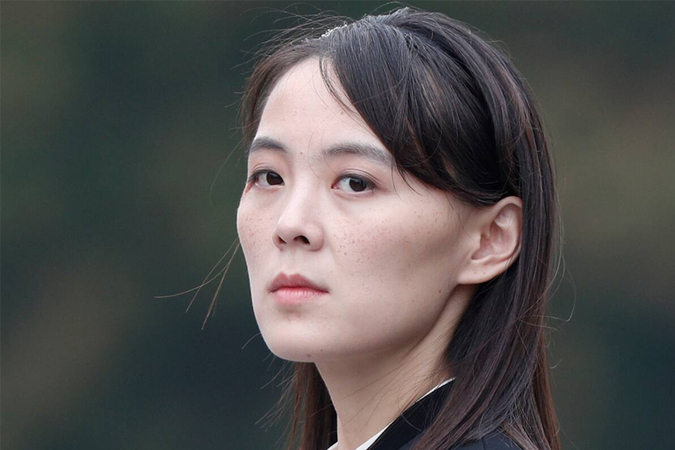
The complaint, issued by Kim Yo Jong, the sister of North Korean leader Kim Jong Un, comes as the United States’ top diplomat and its defense chief are in the region for talks with the Japanese and South Korean governments.
The annual joint military exercises between the United States and South Korea, which began March 8, are always a source of tension with Pyongyang. They have been scaled back for the past three years and mostly conducted by computer simulation, initially to allow space for dialogue with the North but now also because of the coronavirus pandemic.
The main target of Tuesday’s statement was South Korea, and Kim Yo Jong made it clear that even a scaled-back exercise, designed to target “fellow countrymen,” was unacceptable.
“War exercises and dialogue, hostility and cooperation can never exist together,” she said in a statement carried by state media.
She also criticized the Biden administration for giving off a “powder smell” in Korea.
“If it wants to sleep in peace for coming four years, it had better refrain from causing a stink at its first step.”
Leif-Eric Easley, a professor at Ewha University in Seoul, said Kim Yo Jong’s statement “reeks of hypocrisy” coming after North Korea had conducted its own winter military drills.
U.S. officials said Saturday that the Biden administration had tried to contact North Korea three times since mid-February but had not received a response.
The silence is hardly surprising: The Biden administration is undertaking an internal review of policy toward North Korea, and Pyongyang may want to see what comes out of that process before formulating its response, while the annual military exercises are always a tense moment.
Kim Yo Jong, who has become a vitriolic critic of the government in Seoul over the past year, said North Korea was considering pulling out of a military agreement with the South that was designed to lower tensions along their heavily fortified border.
She said the “spring days” of 2018 – when Kim Jong Un and South Korean President Moon Jae-in held their first meeting – “won’t come easily again.”
In Tokyo, Secretary of State Antony Blinken did not respond to a reporter’s request for comment on North Korea’s statement. He is accompanied by Defense Secretary Lloyd Austin, and the two will be holding talks with their Japanese counterparts Tuesday before heading to Seoul.
Some experts worry North Korean regime may try to get the attention of the Biden administration by conducting a missile test, while others say it may want to gauge the president’s approach first.
“The Kim regime’s rhetoric leaves more room for diplomacy than if it had welcomed Blinken and Austin with a long-range missile test,” said Easley. “But North Korea’s latest threats mean the allies have precious little time to coordinate their approaches on deterrence, sanctions and engagement.”
– – –
The Washington Post’s John Hudson contributed to this report.
EU begins legal action against U.K. over Brexit deal violation
InternationalMar 16. 2021A jogger passes graffiti that reads “The village say no to an Irish Sea border” in the Village area of Belfast, U.K., on Feb. 4, 2021. MUST CREDIT: Bloomberg photo by Paul Faith.
By Syndication Washington Post, Bloomberg · Ian Wishart
The European Union launched legal action against the U.K. in a major escalation of tensions between the two sides less than three months after Brexit was formally completed.
It follows Britain’s unilateral decision to delay implementing a key part of the Brexit deal relating to Northern Ireland. The move could ultimately lead to financial penalties or trade tariffs being imposed on the U.K.
The dispute is likely to worsen the already fraught relationship between the two sides that has led to disagreements over the export of Covid vaccines and the U.K. refusing to grant full rights to the bloc’s ambassador in London. The post-Brexit trade deal the two sides signed on Dec. 24 still hasn’t been formally ratified by the EU despite it taking effect on Jan. 1.
An EU official told reporters in Brussels on Monday that the bloc considered the U.K.’s actions an enormous problem and raised doubts about the government’s commitment to the Northern Ireland part of the Brexit agreement. The official said he hoped the government would hold talks with the commission to come up with joint solutions and draw a line under the legal action.
The commission is still deliberating whether to grant U.K. financial firms greater access to the bloc under a so-called regulatory equivalence decision. While there is no formal link between that decision and Monday’s legal action, there will be a joined-up response, said the official, who asked not to be identified because the process is private.
Under the Brexit deal, Northern Ireland effectively stayed in the EU’s customs union and single market. This avoided the need for border checks on the island of Ireland, but introduced them for the first time on goods coming into the province from Great Britain, leading to delays and disruption.
Prime Minister Boris Johnson has come under increasing pressure from members of his own party, as well as unionist politicians in Northern Ireland, to renegotiate the Brexit deal’s Northern Ireland Protocol.
Last month, the U.K. said it would temporarily waive rules set begin on April 1 that would have required firms sending food between Great Britain and Northern Ireland to provide additional customs paperwork — a move the commission warned violated the terms of the Protocol. Britain also plans similar delays in other areas, including checks on parcels.
The U.K. is committed to the Northern Ireland protocol, but wants to see areas of concern addressed, Johnson’s spokesman Jamie Davies told reporters on a call on Monday. The measures the government has taken are “temporary” and “operational” steps designed to “minimize disruption,” he added.
The commission launched infringement proceedings under EU law, the official said. That means it can ultimately ask for a ruling from the European Court of Justice, which could impose financial penalties. Despite the ECJ’s influence in the U.K. being a bone of contention in the campaign in the run-up to the 2016 Brexit referendum, the government accepted a role for the EU court in the treaty.
The commission is also taking action under the dispute resolution mechanism of the treaty itself, which could eventually see the establishment of an arbitration panel and — if the U.K. lost — could potentially see the suspension of part of its overall trade deal with the EU, or tariffs imposed.
Both options could take well over a year to reach a conclusion and officials on both sides have said they want to reach a settlement before getting as far as the imposition of penalties.
The commission previously initiated infringement proceedings against the U.K. after Johnson’s government announced plans in September to override part of the Protocol. These were dropped when the government backed down shortly before the trade deal was signed in December.
InternationalMar 16. 2021Cranes stand at a construction site for a residential development on the outskirts of Shanghai, China, on March 14, 2021. MUST CREDIT: Bloomberg photo by Qilai Shen.
By Syndication Washington Post, Bloomberg
China’s economic activity surged in the first two months of the year compared with a year ago, though the figures showed an uneven recovery with strong industrial output fueled by exports but lagging consumer spending.
The official data released Monday show unprecedented growth rates of more than 30% for key indicators, largely due to distortions when compared to last year’s shutdowns. Industrial production growth of 35.1% beat economist’s expectations of 32.2%, reflecting a shorter Lunar New Year holiday this year as the government encouraged workers to remain in factories rather than return to their hometowns.
Combined with strong export data for January and February, the statistics show that China has largely continued the pattern established last year of a recovery based on growth of industrial production for export and investment in sectors such as real estate, delaying Beijing’s efforts to re-balance the economy toward domestic consumer demand.
Retail sales reported by China’s statistics bureau climbed 33.8% in the period, beating a forecast of 32% in a Bloomberg poll of economists. On a two-year average basis, which corrects for the huge drop seen last year as China introduced pandemic restrictions, retail sales growth was 3.2%, a sharp contrast with 8.1% growth in industrial output over the same period.
Retail sales in February rose only 0.56% from the previous month, the data showed. This indicates that “the Lunar New Year may have had a weaker boost to national consumption than expected,” according to Bruce Pang, an economist at China Renaissance Securities.
The central bank kept market liquidity neutral earlier Monday, prompting money market rates to rise on persistent concerns about liquidity.
The central bank’s action “just offset maturity, indicating the People’s Bank of China’s tightening intention,” said Xing Zhaopeng, an economist at Australia & New Zealand Banking Group. “Since the start of this year, PBOC has net drained over 600 billion yuan in funds from the market in order to curb asset bubbles.”
The government imposed travel restrictions before the new year holidays, which fell in February this year, to curb sporadic virus cases in some parts of the country. That helped to boost industrial output, with factories able to remain open or resume production earlier than usual to meet soaring export demand. But it also suppressed spending on travel, restaurants and leisure activities.
Fixed-asset investment rose 35%, well below a projection of 40.9%. Since real estate has been the biggest driver of investment growth over the past year, that likely reflects Beijing tightening financing for property developers. Economists expect investment by manufacturers will strengthen in 2021 following a recovery in their profits. However, the lower-than-expected investment figures showed manufacturers are still cautious, Pang added.
“Domestically, the unbalanced recovery is still notable and the foundation for the economic recovery is not solid yet,” Liu Aihua, a spokeswoman for China’s statistics bureau said in a statement. The urban unemployment rate of 5.5% in February remained above pre-pandemic levels, with the rate among younger people particularly high.
“The retail sales and industrial consumption figures were widely above estimates and shows there is resilience in the economy,” said William Ping, managing director at Peaceful Investment in Shenzhen. “Currently the closest thing to a worry of mine is whether the nation will put enough emphasis on domestic consumption in the long run,” he added.
China is still the only major economy to have powered out of the pandemic after early control over the virus and then surging global demand for medical goods and work-from-home devices. The economy grew 2.3% in 2020 and is forecast by economists to expand 8.4% this year.
The government is targeting more modest growth of “above 6%” in 2021, allowing officials to focus on longer-term challenges such as technological upgrading and curbing risk in the financial system. Beijing has signaled it wants to scale back its pandemic stimulus, with analysts predicting a gradual reduction in monetary and fiscal support.
CEOs become vaccine activists as back-to-office push grows
InternationalMar 16. 2021Low-dead space syringes filled with the Pfizer-BioNTech covid-19 vaccine at a vaccination clinic in Vancouver, British Columbia, Canada, on Thursday, March 4, 2021. MUST CREDIT: Bloomberg photo by Jennifer Gauthier
By Syndication Washington Post, Bloomberg · Thomas Buckley
Some chief executive officers are so eager for their employees to get vaccinated against covid-19 that they’re granting workers time off or cash incentives to get shots.
In the U.S., retailer Lidl is giving its staff $200, while Aldi, Dollar General and Trader Joe’s are offering extra hours of pay. Online grocery delivery firm Instacart is providing a $25 stipend for workers and contractors. Yogurt makers Chobani and Danone are offering as much as six hours of paid leave, and the French company says it will cover the cost of inoculation in countries where vaccines aren’t free.
Other companies are taking a harder line. U.K. handyman empire Pimlico Plumbers has said it plans a “no jab, no job” policy for new members of its workforce. United Airlines wants to make shots mandatory, drawing concerns from unions.
Many CEOs see themselves as leaders of the fightback against a pandemic that’s killed more than 2.6 million people. They’re standing up against anti-vaccination sentiment that’s strong in countries like the U.S., France and Russia, and trying to keep their workers safe. For some, there’s also a more pragmatic motivation: Vaccination will facilitate a return to the office after a year of working from home that’s strained corporate cultures and spawned a new epidemic of Zoom fatigue.
“I think what we’d like to do is have carrots and sticks — we want people to take it; we think it’s a far better thing,” JPMorgan Chase & Co. CEO Jamie Dimon said in an interview with Bloomberg TV. The bank won’t make vaccination mandatory for the moment due to legal concerns but airlines and hotel companies may attempt to do so, he said.
– – –
The legality of companies requiring their clients and workers to get vaccinated varies from country to country. In many U.S. states, an employer can fire workers at will for any legal reason, which could include the refusal to comply with a vaccine mandate.
At the moment, less than 1% of companies in the U.S. require covid vaccination for all employees, and only 6% say they plan to once shots are readily available, according to a survey of 1,800 in-house lawyers, human-resources workers and executives by employment law firm Littler Mendelson.
In countries where employment protection is stronger, officials are tiptoeing around the issue. The U.K. government has said it’s up to businesses to determine immunization policies for their workforces but that those insisting on vaccination would be discriminatory.
In practice, it’s only legal for an employer to mandate inoculation if it’s considered a “reasonable instruction” related to the employee’s role, which is likely to be in sectors such as health care or hospitality, according to an employment law guide published by U.K. law firm Pinsent Masons. For companies that conduct home visits, such as Pimlico Plumbers, having employees vaccinated and posing less of a health threat to customers could also be a selling point.
So as not to be dragged into courtroom disputes, many CEOs are opting for persuasion over enforcement. The effectiveness of their advocacy will be critical to reopening the global economy, including offices where millions of workers toil away amid little direct contact with customers.
– – –
Unilever chief Alan Jope said he’s signing weekly letters to the company’s 150,000 employees urging them to get vaccinated when possible, and has invited the company’s doctor to promote inoculation on twice-monthly virtual town halls, which see about 14,000 workers dial in.
“We absolutely don’t want anti-vax or vaccine hesitancy to be part of the Unilever culture, and it’s so helpful for them to hear from someone they trust, who is a medical authority, and we will use that platform to answer people’s questions and to advocate for vaccines,” Jope said in an interview.
Budweiser, which is owned by Anheuser-Busch, decided not to run a commercial during the Super Bowl for the first time in 40 years and instead allocated that spending to the Ad Council’s pro-vaccination campaigns. Immunizations will “liberate people,” CEO Carlos Brito said in an interview.
Some CEOs are leading by example. Nestle’s Mark Schneider said that if a vaccine were immediately available to him, “I would get vaccinated in front of all our people to be a role model.”
“It’s the best possible way to protect yourself and to protect your colleagues, and we’ll be very clear on that, just like we were very clear early on on the masks,” he said in an interview. “One of the downsides last year was that very good, effective prevention measures such as masks were politicized.”
– – –
Osem Investments, a Nestle subsidiary in Israel, will bar employees who haven’t been vaccinated or recovered from covid-19 from the workplace unless they submit a negative virus test every three days. Businesses including Check Point Software Technologies and Intel’s Mobileye have also asked workers who are vaccine holdouts to stay home or provide a recent negative test.
Several airlines are taking an equally hard line: Scott Kirby, CEO of United Airlines, has said he wants to make vaccination a requirement for the company’s 60,000 workers. The initiative is dividing employees — the International Association of Machinists and Aerospace Workers District 141, a union representing fleet and passenger service staff at United, has said it’s received complaints from workers who don’t want to get shots as well as concerns from employees who don’t want to come into contact with unvaccinated colleagues.
Striking a persuasive tone on vaccination will become ever more important as executives hasten a return to the office. Employees at jeweler Tiffany & Co. in the U.S. have been instructed to work at least two days from the office from the beginning of March — whether they’re vaccinated or not.
Goldman Sachs CEO David Solomon said at a conference last month that more of the firm’s bankers would have been back in the office by now if vaccine distribution had been faster in the first quarter.
Working from home is an “aberration that we are going to correct as quickly as possible,” he said.
Marijuana and makeup are new growth areas for vertical farms
InternationalMar 16. 2021Visitors walk past a Metro Farm inside Sangdo metro station in Seoul, South Korea, on Feb. 23, 2021. MUST CREDIT: Bloomberg photo by Jean Chung.
By Syndication Washington Post, Bloomberg · Heesu Lee
Supercharged by the need to secure local supplies of fresh vegetables during the pandemic, some vertical farms are now branching out into other high-margin areas such as medical cannabis, health supplements and cosmetics.
South Korean startup Farm 8 is among a proliferation of indoor urban growers that saw sales jump during Covid-19. It’s looking to increase sales by almost 50% to 90 billion won ($79 million) this year, partly by boosting production of medical and cosmetic-based plants such as ginseng, centella asiatica and artemisia campestris, CEO Kang Dae Hyun said. In August, the company joined the country’s first regulation-free zone for medical cannabis, growing and processing hemp for cannabidiol (CBD).
“There’s massive demand for medical cannabis and the market’s growing rapidly,” Kang said in an interview. “Most of our production is dedicated to salad greens at the moment, but ultimately we’ll be ramping up production of cosmetic and medical-based plants to maximize profit.”
Other vertical farms are also using the technology to meet rising demand for stringent quality control in medical and cosmetic applications, such as Denmark’s International Cosmetics Science Centre, Poland’s Vertigo Farms and California-based MedMen Enterprises.
Farm 8 currently grows about 1.2 tons of salad greens per day on less than an acre (0.5 hectare) of land, spread across locations in three cities in South Korea, including in a busy subway station in South Korea’s capital. It’s one of the top local lettuce producers for fast-food chains including Subway, Burger King and KFC. Sales rose 30% last year.
That’s the traditional market for vertical farms — guaranteed delivery of quality controlled fresh produce that needs to reach the consumer quickly regardless of weather or season. Those advantages were underlined as pandemic supply disruptions and unreliable harvests pushed global food prices to a six-year high in February.
“You need the right amount of everything from water to light, and the weather has to be perfect, which is increasingly hard to predict,” said Kang. “We started as a traditional farming company 16 years ago, but we’ve learned to incorporate technology because we needed to protect ourselves from the changing climate.”
Farm 8 employees work inside an indoor vertical farm in Pyeongtaek, South Korea, on Feb. 23, 2021. MUST CREDIT: Bloomberg photo by Jean Chung.
Vertical farming uses as much as 90% less water and reduces emissions caused by plowing fields, weeding, harvesting and transportation, but uses much more energy than traditional methods, making it unsuitable for many crops like grains.
Farm 8’s greens grow in six-story hydroponic trays, lit by LED panels, allowing the company to produce plants twice as fast as a conventional farm. Light, water, temperature, humidity and carbon dioxide levels are controlled by robots that use artificial intelligence to assess data collected from the farms.
The company received 10 billion won from investors including Korea Development Bank in a private share sale in 2020 and plans to list on Kosdaq in the second half of next year. Backers include IMM Investment which invested about 20 billion won in 2014.
South Korea became the first country in East Asia to legalize cannabis for medical use in 2018, and in August 2020, the government set up a free trade zone for industrial hemp in the southeastern city of Andong to develop and extract cannabidiol for medical use with private companies. Marijuana remains illegal for recreational use in the country.
Besides growing and selling plants, Farm 8 wants to export its system, which can be fully automated from sowing to harvesting, to countries in the Middle East and Southeast Asia, Kang said. It’s hoping to ink a contract in Kuwait and recently sent a 40-foot container to South Korea’s research center in Antarctica. The polar farm will replace a smaller 10-year-old unit and provide 2 kilograms a day of chilies, zucchinis and cucumbers, all monitored remotely from Korea.
Cannabis has, of course, been grown illegally indoors on a small and large scale for decades, and the gradual legalization of the plant in some U.S. states has led to a plethora of vertical farms there. But the big advantage of new technology for industries such as cosmetics and medicine is the ability to meet stringent quality measures.
“The industry’s going through a major shift,” Kang said.
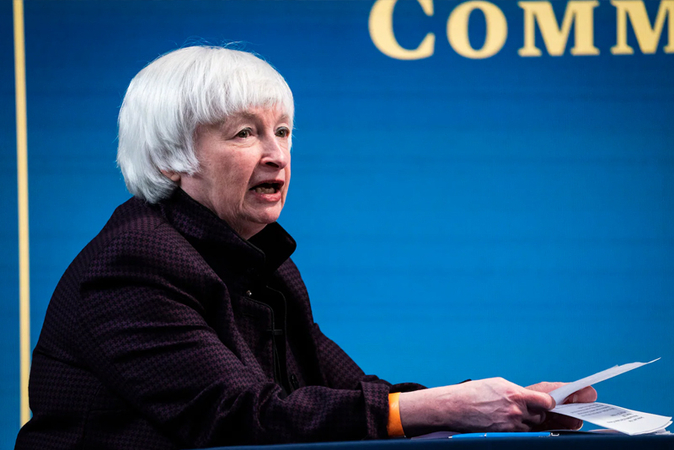
WASHINGTON – Treasury Secretary Janet Yellen is working with her counterparts worldwide to forge an agreement on a global minimum tax on multinational corporations, as the White House looks for revenue to help pay for President Joe Biden’s domestic agenda.
The effort, which would involve a fraught and challenging global negotiation of tax laws, could prove one of Yellen’s biggest policy legacies if it succeeds. It also could prove central to Biden’s presidency. The $1.9 trillion stimulus legislation signed into law last week was financed completely by additional federal borrowing. But the administration is expected to raise taxes at least partly to pay for its other big-ticket spending priorities, such as the massive infrastructure and jobs package being discussed by White House officials and congressional Democrats.
A key source of new revenue probably will be corporate taxes, which President Donald Trump sharply cut in 2017. Although he has not proposed entirely reversing Trump’s cut in the corporate tax rate from 35 percent to 21 percent, Biden has said he would aim to raise potentially hundreds of billions more in revenue from big businesses.
But some tax experts, business groups and Republican lawmakers say raising the rate could damage U.S. competitiveness. Countries worldwide have both recently and over the past several decades joined the United States in reducing tax rates to attract corporate investment, a trend some economists view as a destructive “race to the bottom.” The average tax rate among countries is 24 percent, according to the Tax Foundation, a right-leaning think tank. Just last year, nine countries, including France, lowered their corporate tax rates.
“It’s a little like the Paris climate accord of taxes. Every country thinks it can steal business from others by lowering taxes, and the only beneficiary of that race to the bottom has been the richest multinational corporations,” said Joseph Stiglitz, a Nobel Prize-winning economist at Columbia University and a mentor of Yellen’s.
Yellen is working to curb the practice through an effort at the Organization for Economic Cooperation and Development in which more than 140 countries are participating. The goal is for countries to agree in principle to a minimum corporate tax rate – although it would be nonbinding – that would make it harder for multinational corporations to play countries off one another by threatening to leave.
It remains highly unclear whether Yellen and the OECD can successfully negotiate a new agreement, particularly given the complexity involved of coordinating new tax rules across so many different countries.
“For decades, Europe was happy to cut taxes and take advantage of America having an uncompetitive corporate tax code,” said Brian Riedl, policy expert at the libertarian-leaning Manhattan Institute. “Now that America has modernized its policies, Europe is looking to gain the upper hand again – particularly by raiding silicon valley.”
Yellen in her first several weeks in office has spoken about the OECD tax negotiations with the finance ministers of Germany and France, among other nations, according to the Treasury Department. In late February, Yellen also told the Group of 20 nations that the United States has dropped demands to allow firms to opt out of new global digital taxes – a move applauded by other European nations that bolstered hopes for an agreement within months, possibly this summer.
“A global minimum tax could stop the destructive global race to the bottom on corporate taxation and help discourage harmful profit-shifting,” Yellen told U.S. senators during her confirmation process.
Yellen also said, “It’s necessary for U.S. companies to be globally competitive, and that’s why these OECD negotiations are so important.”
But Yellen’s efforts face myriad skeptics, who worry that the push could encourage further tax shifting to countries outside the OECD agreement, or lead the United States to make concessions that will hurt its competitiveness.
The U.S. Chamber of Commerce says it supports a “multilateral” approach to the problem but is “extremely concerned” that the proposed OECD rules would create additional complexity for multinational firms. Critics, including the Chamber, have expressed concern that the agreement would also lead firms to face “double taxation” on some profits,meaning two countries would levy taxes on the same stream of income.
Some opponents say the European countries are trying to claim a share of the financial success enjoyed by Silicon Valley firms developed by the United States, arguing that expanding taxation of tech firms risks shrinking the national “tax base” – the share of economic activity that falls under the United States’ purview to tax.
“It’s just a money grab from the Europeans, and we should not let them do it,” said Douglas Holtz-Eakin, president of the center-right American Action Forum and a former director of the Congressional Budget Office. “My big concern is that – as part of their desire to be on a ‘let’s be friends’ parade – the Biden administration will give away too much.”
Some critics on the left have warned that the OECD’s proposed solutions would primarily benefit countries that are already rich. The OECD framework would allocate the right to tax multinationals on the basis of the profits in a given country, rather than their number of employees – a metric some skeptics warn would privilege wealthier countries, given that they also have richer consumers.
Over the past four decades, industrialized nations worldwide have cut business taxes significantly.
Multinational corporations have increasingly stashed their profits in overseas tax havens, where little real economic activity occurs. At the same time, corporate tax rates have also fallen in industrialized countries not considered tax havens, in part because they are attempting to prevent capital from going to low-tax jurisdictions.
The average corporate tax rate globally in 1980 was about 40 percent, a number that has fallen to about 23 percent in 2020, according to the Tax Foundation. About 40 percent of profits earned by the world’s multinational firms – or more than $700 billion – was stashed in tax havens in 2017, the most recent year for which data are available, according to research by a team of economists including Gabriel Zucman, an economist at the University of California at Berkeley.
Developing countries depend more than advanced ones on corporate tax revenue for their budgets, meaning they have been particularly affected in their ability to raise funding for public spending projects by this race to the bottom, according to the International Monetary Fund. Still, the IMF and economists have said both poor countries and rich ones are hurt by the decline in corporate taxes.
The decline worldwide is startling. From 2000 to 2018, 76 countries cut their corporate tax rates, according to the OECD. Over that same period, 12 countries maintained their corporate tax level, and only six increased them.
In 2000, more than 55 countries had corporate tax rates above 30 percent. Now, fewer than 20 do.
“When one jurisdiction crafts a new tax loophole or secrecy facility that successfully attracts mobile money, others copy or outdo it in a race to the bottom,” the IMF said.
The impact of the falling international tax rate has hit the United States as well, constraining lawmakers’ ambitions to approve new domestic programs.
Before the 2017 GOP tax law, the official U.S. corporate tax rate remained at 35 percent for several decades. But that number masked a decline in what American corporations were actually paying. Because of expanded deductions and other subsidies, as well as the booking of profits in countries with much lower rates, U.S. corporations were already contributing far less to the federal budget. The effective U.S. federal tax rate had fallen from about 44 percent to closer to 29 percent before the tax law was passed, according to Goldman Sachs research.
The GOP tax cut lowered the official rate from 35 percent to 21 percent and pushed the effective rate lower. After the tax cut, the effective rate paid by the largest Fortune 500 companies fell from 21 percent to about 11.3 percent, with 91 of the world’s biggest corporations paying zero dollars in federal taxes. The tax cut has contributed to the staggering federal debt.
Biden campaigned for the presidency promising to enact new federal programs costing trillions of dollars, including expanding health care and rebuilding the nation’s infrastructure. He has promised to pay for those measures by partly repealing the GOP’s corporate tax cut and cracking down on business tax evasion.
But those plans have exposed the administration to Republican attacks that these tax increases will hurt U.S. competitiveness by encouraging multinational firms to relocate abroad. This is partly why administration officials, led by Yellen, keep pointing to the OECD negotiations as crucial to Biden’s broader agenda. At news briefings, White House press secretary Jen Psaki repeatedly has referred to tax increases on corporations as part of a global problem requiring a global solution.
“Is the objective of the U.S. to win a race to the bottom in global taxation, or is our objective to end the race to the bottom and level up corporate taxation so there could be lower burdens on working people here and everywhere else?” said Larry Summers, who served as treasury secretary and director of the White House National Economic Council under previous Democratic administrations. “I’m encouraged by Secretary Yellen’s early signals.”
Translating that ambition into reality through the OECD negotiations will prove much more difficult in practice.
The OECD negotiations put two related proposals on the table.
The first pertains primarily to the digital taxation of multinational corporations. Currently, taxes are mostly based on where companies are headquartered, as well as where they book their earnings. In the case of most tech firms, that is America. European countries, particularly France and Italy, have sought to claim a piece of the revenue earned by Silicon Valley giants from the e-commerce activity that occurs in their countries.
To address that issue, the OECD is proposing to grant countries taxing rights over a part of multinational firms’ profits where the consumers reside. Those would be assessed regardless of the companies’ physical presence. The tech firms’ digital profits would be allocated based on a formula, with about $100 billion in global tax revenue set to be distributed more evenly across countries. Under Trump, the United States pushed back strongly against solely approving a new digital tax, and the issue emerged as a major stumbling block to a broader deal.
But under Biden, the United States may be more open to that change. Yellen took the first big step in that direction in February, telling the G-20 that the United States would no longer insist on a “safe harbor” that would allow tech companies to escape from the new digital tax. That decision is viewed as a major concession and a sign of U.S. seriousness about reaching an agreement.
“Secretary Yellen making important step of dropping the request for a safe harbor. A new impetus and a real chance to make it!” German finance minister Olaf Scholz said on Twitter after Yellen’s announcement.
Yellen’s concession on digital taxation may help pave the way for an agreement on a separate major part of the OECD tax agreement that is mostly about enacting a floor on international corporate tax rates.
Under this part of the plan, the OECD would establish a global minimum tax rate – possibly around 12 percent of profits, although the final rate remains undecided. Low-tax countries would face pressure to increase their rates to adhere to this new minimum, because if they do not, other countries would be granted the authority to levy additional taxes on the overseas earnings of their firms.
For example, Hungary could maintain its existing 9 percent corporate tax rate even after the new 12 percent minimum is enacted. But under the OECD agreement, France could collect taxes on the income earned by French companies in Hungary amounting to the difference between Hungary’s corporate tax rate and the 12 percent global minimum – a measure known as a “top-up” tax. Hungary, seeing potential taxes siphoned off to France, could decide simply to raise its corporate rate to 12 percent. That would make Hungary a less attractive place for French firms to relocate but prevent France from taxing activity in Hungary.
“The OECD thinks there will be some gravitational pull toward that [new global] minimum,” said Daniel Bunn, an international tax expert at the Tax Foundation.
Some skeptics warn that such a move could come with a separate set of trade-offs and significant procedural and administrative hurdles. And other economists warn that it would not do nearly enough to stem the decline in corporate taxes.
“The OECD’s blueprints offer little more than a ‘tax haven lite’ model where tax havens can keep the majority of profit they siphon from around the world so long as they share some of those profit with the richest of countries,” Alex Cobham, chief executive at the Tax Justice Network, said in a statement last fall.
Any agreement reached by the Biden administration under the OECD about digital tax rules probably would have to be ratified by Congress. That could be difficult, depending on the details of the deal, as powerful tech giants may lobby to kill U.S. concessions on the digital service tax. Because it is nonbinding, it could take years for the OECD member countries to pass laws putting the agreement into effect – if they do so at all.
But proponents say the cost of inaction remains too steep.
The Trump administration approached global economic negotiations from a U.S.-centered perspective, often angering U.S. trading partners in the process. Yellen is vowing to restore a more collaborative U.S. attitude toward economic agreements across borders.
The OECD negotiations will be a major early test of that ambition.
“No one nation alone can declare victory over these crises. Indeed, our cooperation has never mattered more,” Yellen said in her letter to the G-20, citing the global impact of the coronavirus, among other crises. “We have come together to face great challenges in the past. We must do so again.”
By The Washington Post · Karla Adam, William Booth
LONDON – After widespread condemnations of how authorities broke up a weekend vigil for a murdered woman, Metropolitan Police took a more restrained approach to a follow-on demonstration outside Parliament Monday evening. But as the night wore on and crowds marched through central London, police ordered people to disperse and go home.
Prime Minister Boris Johnson earlier in the day had acknowledged the outrage over the killing, saying, “We’ve got to recognize that the tragedy and the horrific crime that we’ve seen in the case of Sarah Everard . . . has unleashed a wave of feeling from people, from women above all, who do worry about their safety at night.”
“Women,” Johnson said, “must be heard.” But he did not address how police should handle large demonstrations, which have been banned because of the coronavirus pandemic.
That left police once again in the position of having to determine whether to enforce covid restrictions or give space to the protesters.
On Saturday, police broke up a vigil-turned-protest in south London by people mourning Everard, 33, who was last seen walking home on March 3 and whose remains were found in a large bag last week.
A police constable, 48-year-old Wayne Couzens, was charged with kidnapping and murder. Couzens served in the Metropolitan Police Service’s division of parliamentary and diplomatic protection.
As images of women being pinned to the ground by officers and arrested during the Saturday vigil spread widely, there were calls for Metropolitan Police Commissioner Cressida Dick to resign over her force’s handling of the crowd.
Dick defended the officers’ actions, noting that the event – however heartfelt and well-intentioned – was “an unlawful gathering” that posed “a considerable risk to people’s health.”
She said, “If it had been lawful, I’d have been there. I’d have been at a vigil.”
Among the prominent people who did attend was Catherine, Duchess of Cambridge. The prime minister said he and his fiancee lit a candle at home.
Dick said police were confronted by “a really big crowd” that did not follow orders to disperse.
“This is fiendishly difficult policing,” she said.
Johnson’s government rallied behind the Dick, head of the largest police force in Britain, pointing to her career-long commitment to protecting women.
On Monday evening, hundreds gathered in Parliament Square and held aloft signs reading: “They came with flowers, you came with force,” “women matter” and “I am here so my daughters don’t have to be.” The police looked on.
At one point, the crowd chanted “kill the bill.”
This week, the House of Commons began debate on the Police, Crime, Sentencing and Courts Bill, which Johnson said would toughen sentences for rapists and block the early release of sexual offenders.
Keir Starmer, leader of the opposition Labour Party, said the legislation does not do enough for women and girls. Others say the bill will introduce new curbs on the right to peaceful protest.
Emma Kirkham, 49, a graphic designer who was at Monday’s demonstration, said protesting in the middle of a pandemic “was not a decision I took lightly.” But she said if the bill impacted her rights, “then we need to be out here.”
Britain is struggling through its third national lockdown. Although schools reopened last week and a vaccination campaign is speeding along, people have been ordered to stay at home except for essential work and travel. Shops, pubs and gyms are closed, and large gatherings – even for weddings and funerals – are prohibited.
The public, politicians and police are divided over how to balance fundamental human rights against the spread of a virus that is lethal for some.
The Saturday gathering began with silent mourners laying flowers and ended in scenes of chaos, as police dragged protesters away in handcuffs, while the crowd chanted, “Arrest your own” and “Shame on you.”
A snap poll by YouGov found Britons are split on whether police should have allowed the vigil to go ahead. In all, 40 percent thought the police should have allowed the vigil, 43 percent did not.
Marion Visagie, 49, a health-care professional who said she is a survivor of domestic abuse, said in a phone interview that she was “totally against” large demonstrations during the pandemic. “Covid rules are there for a reason,” she said.
“I didn’t not go to the vigil, because I don’t believe in the cause. I didn’t go because I respect the law and respect my fellow citizens to keep everyone safe,” she said, adding that she lit a candle for Everard in her front garden instead.
Kath Thomas, 36, a civil servant, stood in front of the makeshift memorial to Everard on Monday, wiping away tears as she took in the floral tributes.
“We think of Great Britain as so far ahead in this stuff, and you have something like this happen and you’re reminded really quickly that there is a huge way to go,” she said, speaking of Everard’s killing and women’s safety more generally.
Thomas said she is sympathetic to the difficulty of policing crowds during a pandemic.
“I completely see both sides,” she said. “The police can’t say, ‘No public gatherings, but we will allow this one.’ They were in an impossible situation.”
Megan Henson, 27, an actor who was wearing a mask and stayed apart from the larger crowd with her friends, said, “I just had enough, the violence on the streets, the everyday sexism, the way the vigil on Saturday was handled by the police, it spurred me to come out.”
“I respect it’s not great timing with the pandemic, but you can’t choose when these moments of history happen. George Floyd sparked a political movement that was necessary. Likewise, with Sarah Everard’s murder, we have to use this momentum, we have to make our voices heard.”
By The Washington Post · Loveday Morris, Luisa Beck, Rick Noack, Stefano Pitrelli
Germany became the world’s largest country to suspend the use of AstraZeneca’s coronavirus vaccine Monday, following reports of blood clots in people who were inoculated. Germany’s health ministry described the measure as “precautionary.”
The decision followed the detection of seven cases of blood clots in the brain, out of 1.6 million people who have received the vaccine in the country, Health Minister Jens Spahn said in a news conference.
France and Italy also announced Monday that they would suspend the use of the vaccine out of an abundance of caution while awaiting an analysis from the European Medicines Agency, which is expected to be finalized this week.
Drugmaker AstraZeneca said late Sunday that there is no scientific evidence of any link between its coronavirus vaccine and recent deaths in Europe from blood clots. The rate of blood clots in people who have been inoculated with the vaccine is “much lower than would be expected to occur naturally in a general population,” the company said in a statement.
“We are all aware of the far-reaching consequences of this decision,” Spahn said of the halt. German health authorities recommended that anyone who has not felt well for more than four days after receiving the jab to seek medical advice.
The vaccine, developed alongside Britain’s Oxford University, has yet to be approved in the United States and has struggled to build confidence around its product in Europe. Its trial data was criticized, while several European countries did not initially approve it for use among people over 65.
The World Health Organization and European regulators have continued to express confidence in its safety. Spahn said European regulators would now have to decide whether new information would impact the vaccine’s authorization.
The European Medicines Agency released a statement Monday to address the incidence of blood clots in patients who had recently received the Oxford-AstraZeneca vaccine. The safety committee reported that the frequency of clots after the vaccine is not higher than normal, but that its investigation will continue.
“Events involving blood clots, some with unusual features such as low numbers of platelets, have occurred in a very small number of people who received the vaccine,” the statement said. “Many thousands of people develop blood clots annually in the EU for different reasons. The number of thromboembolic events overall in vaccinated people seems not to be higher than that seen in the general population.”
The bottom line, the agency said, is that “the benefits of the AstraZeneca vaccine in preventing COVID-19, with its associated risk of hospitalisation and death, outweigh the risks of side effects.” The World Health Organization echoed that analysis Monday.
The EMA report is expected to be finalized this week.
Babies among hundreds in Hong Kong quarantine amid outbreak
InternationalMar 16. 2021Police officers stand guard in an area under lockdown on Pok Fu Lam Road in the Sai Ying Pun neighborhood of Hong Kong, China, on March 14, 2021. MUST CREDIT: Bloomberg photo by Justin Chin.
By Syndication Washington Post, Bloomberg · Jinshan Hong, Natalie Lung
Hong Kong sent hundreds of people, including a playgroup of infants, into quarantine and locked down residential areas as it tried to contain a coronavirus outbreak that began in a gym near the city center last week.
The number of confirmed cases linked to Ursus Fitness in Sai Ying Pun rose 13 on Monday to a total of 122, making it the city’s second-biggest cluster after one in November that was centered on dance halls. The Health Department said at a press conference that 860 close contacts of those infected have been sent to quarantine. Separately, the government said it would expand eligibility criteria so that more people could get vaccinated.
A group of eight 11- to 18-month-old babies and their caregivers were among those quarantined, according to parents. The measure was taken after the children attended a music playgroup last week, and a parent was later confirmed positive in connection to the gym cluster.
Dozens of offices are testing staff for the virus and several pricey international schools halted in-person classes. The outbreak also hit the U.S. consulate, which closed Monday for deep cleaning after two staff members tested positive, according to a statement. The consulate said it is speaking with the “highest levels” of the Hong Kong government about its approach to the outbreak, particularly the possible separation of children from parents.
Kylie Davies-Worley, a mother in quarantine with her husband and 15-month-old son, said conditions at the center may be bearable for adults, but “it’s just really not equipped for children.”
“The menu is definitely not baby appropriate — no designated baby food at all,” she said. “He literally will be living on snacks for the next 10 days.”
Hospital Authority Chief Manager Linda Yu said at a briefing Sunday she needed more information on the quarantined infants before commenting. Health Department official Albert Au also said more time was needed for observation given the disease’s incubation period of 14 days.
Davies-Worley said her room at Penny’s Bay on Lantau Island has two single beds, a foldable table and small bathroom. There is a television and one kettle, but no fridge and they had to bring their own cot for the baby, she said.
“We are still seeing examples of separation and the quarantine facilities are a one-size-fits-all,” said Nicholas Thomas, associate professor in health security at City University of Hong Kong. “This is understandable in the early phase of the outbreak, when there was a scramble to build facilities as fast as possible. Now that more time has elapsed, there is scope for more targeted facilities to be developed. It is a similar issue for the elderly.”
Among residential areas locked down Sunday for Covid testing were buildings near Ursus Fitness on Pok Fu Lam Road and Dynasty Court in Mid-Levels. Two preliminary positive cases were found at Dynasty Court as of midnight, and the lockdown of five blocks at the high-end residential development was lifted at 8:40 a.m. Monday.
As of 2 a.m. Monday, 680 residents in Pok Fu Lam Road buildings had been tested and no confirmed Covid-19 cases found, the government said in a statement. Another lockdown on Saturday night covered four buildings in Mid-Levels. That ended early Sunday with no positive cases.
The government also said Sunday that some students and staff at the Harbour School in Ap Lei Chau would be sent to government quarantine facilities after two confirmed cases and one preliminary case were found among school members. The students are between eight and 10 years old, the school said.
Hong Kong has one of the strictest quarantine regimes in the world, requiring all who’ve had close contact with infected people to enter mandatory isolation for as long as two weeks. The quarantining of children comes despite studies showing that younger people don’t tend to be the main drivers of transmission. Children under 10 also may be less susceptible to infection.
Offices housing UBS Group, Chanel Hong Kong, Cathay Pacific Airways and Standard Chartered are included on the list of buildings where people are subject to compulsory testing orders. Morgan Stanley’s office appeared on the list Monday.
Several banks last week advised staff not to come into offices. HSBC Holdings vacated a floor of its main building Thursday after an employee tested preliminary positive, according to a memo to staff. UBS told some staff to work from home after an employee tested positive, while Goldman Sachs Group reverted to a policy of 50% of staff working from home.
The outbreak also affected legal firms, with Allen & Overy and Herbert Smith Freehills both closing their offices after employees tested positive. Clifford Chance asked staff to work remotely out of an “abundance of caution.”
Hong Kong began its public vaccination campaign at the end of February, prioritizing people aged 60 and older, health-care staff and other essential workers. From Tuesday, residents aged 30 to 59 can also sign up for vaccines, as well as domestic helpers and students who are 16 or older if they are studying overseas. That means 5.5 million people will be able to sign up for vaccinations, more than 70% of the population.
“Now is a key time point,” Secretary for Food and Health Sophia Chan said Monday. “We need all citizens to actively participate in the vaccination program.”
Vaccination rates in Hong Kong have slowed amid concern over side effects from Sinovac Biotech’s shot, with reports of at least six deaths among the more than 150,000 people inoculated. None of the deaths have been linked to the Chinese company’s vaccine, but they’ve added to hesitancy and the growing no-show rate for appointments to get Sinovac immunizations.
“Until there is a high level of vaccine acceptance, the unpredictable potential for a super-spreader event is always going to be possible,” City University’s Thomas said. “Even after Hongkongers get vaccinated, the challenge is then going to be how and to what extent the economy should be re-opened to international arrivals who may be coming from less well vaccinated countries.”
InternationalMar 16. 2021The China Central Television Tower shrouded in Beijing on March 15, 2021. MUST CREDIT: Bloomberg photo by Yan Cong
By Syndication Washington Post, Bloomberg
A sandstorm sweeping across much of northern China left Beijing in an orange fog and helped push air quality levels in the capital to the worst since 2017.
Beijing’s government issued a yellow alert, the first sandstorm warning this year. The Air Quality Index surged to 500, well above health emergency levels, and a thick orange haze limited visibility to less than 3,280 feet (1,000 meters) Monday morning. Chinese social media was rife with pictures of the city’s iconic buildings enveloped by the dust, with many users saying it’s the worst sandstorm in years.
Levels of ultrafine particulates in the air in Beijing surged to as high as 680 micrograms per cubic meter, the highest concentration since May 2017, according to records kept by the U.S. Embassy there. Concentrations of slightly larger particles more commonly associated with sand surged to more than 2,000 per cubic meter at some monitoring stations.
Even before the storm, Beijing’s air quality had been worsening as the nation’s economy roared back from the pandemic, thanks to a heavy-industry led recovery that saw steel and cement production surge and a jump in fossil fuel consumption.
A residential building shrouded in haze in Beijing on March 15, 2021. MUST CREDIT: Bloomberg photo by Yan Cong
The storm, which will continue for a day in Beijing, originated in Mongolia and has also swept across the northern provinces of Shaanxi, Shanxi and Hebei. Inner Mongolia’s Baotou city canceled school classes because of the airborne dust. More than 400 flights were canceled at Beijing airports as of 9:30 a.m., Jiemian reported, citing the flight information app Flight Master.
Deforestation and drought are at least partly to blame for the sandstorms that often hit northern China. The government has launched massive tree-planting projects to try to curb the storms since the 1970s. The Three-North Shelter Forest Program, which protects regions affected by sandstorms sweeping out of the Gobi Desert, aims to grow new trees on 87 million acres (35 million hectares) by 2050.
The efforts seem to be having some success, with the annual number of sandy days in Beijing falling from 26 in the 1950s to around three after 2010, according to Xinhua.
Sandstorms typically occur in the spring and early summer, when the wind blows from the north. Last year, northern China experienced seven of them, with conditions lasting on average less than three days, according to the China Climate Bulletin released by the National Climate Center. That’s fewer storms for a shorter duration than usual, it said

 A jogger passes graffiti that reads “The village say no to an Irish Sea border” in the Village area of Belfast, U.K., on Feb. 4, 2021. MUST CREDIT: Bloomberg photo by Paul Faith.
 Cranes stand at a construction site for a residential development on the outskirts of Shanghai, China, on March 14, 2021. MUST CREDIT: Bloomberg photo by Qilai Shen.
 Low-dead space syringes filled with the Pfizer-BioNTech covid-19 vaccine at a vaccination clinic in Vancouver, British Columbia, Canada, on Thursday, March 4, 2021. MUST CREDIT: Bloomberg photo by Jennifer Gauthier
 Visitors walk past a Metro Farm inside Sangdo metro station in Seoul, South Korea, on Feb. 23, 2021. MUST CREDIT: Bloomberg photo by Jean Chung.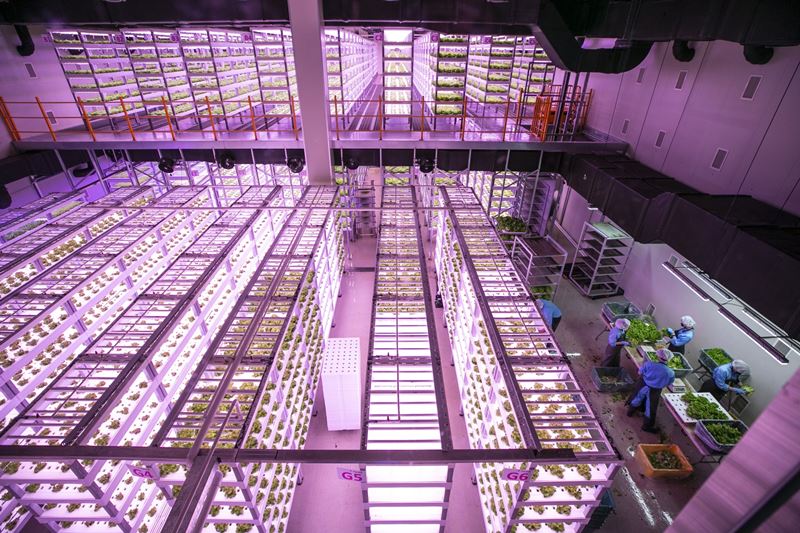



 Police officers stand guard in an area under lockdown on Pok Fu Lam Road in the Sai Ying Pun neighborhood of Hong Kong, China, on March 14, 2021. MUST CREDIT: Bloomberg photo by Justin Chin.
 The China Central Television Tower shrouded in Beijing on March 15, 2021. MUST CREDIT: Bloomberg photo by Yan Cong