
Farmer’s son becomes billionaire after early bet on wind power #SootinClaimon.Com

#SootinClaimon.Com : ขอบคุณแหล่งข้อมูล : หนังสือพิมพ์ The Nation.

Farmer’s son becomes billionaire after early bet on wind power

InternationalJan 28. 2021Wind turbines at a wind farm during sunset in Nauen Brandenburg, Germany, on Dec. 30, 2020. MUST CREDIT; Bloomberg photo by Liesa Johannssen-Koppitz.Wind turbines at a wind farm during sunset in Nauen Brandenburg, Germany, on Dec. 30, 2020. MUST CREDIT; Bloomberg photo by Liesa Johannssen-Koppitz.

By Syndication Washington Post, Bloomberg · Yoojung Lee

Gim Seong-gon was running a steel-manufacturing business in the late 1980s when he became fascinated by wind power. The South Korea native saw growth potential in the field and decided to get involved.

It was a good decision. With an early injection of capital from Goldman Sachs, his CS Wind Corp. has become the world’s biggest manufacturer of wind towers. The firm’s shares have rallied for the past four years, surging almost fivefold in 2020 alone, and expectations are running high for even more growth with the change of administrations in Washington.

Gim, 67, the son of a farmer, is now one of the wealthiest people in South Korea. The 51% stake in the company he owns with his family is valued at $1.4 billion, according to the Bloomberg Billionaires Index.

“Gim was quick to identify the growth potential globally,” said Han Byung-hwa, an analyst at Seoul-based Eugene Investment & Securities Co. “The industry has seen faster growth than other traditional businesses.”

Gim made the shift to renewable energy in 2003, setting up CS Wind’s first wind-tower factory in Vietnam to take advantage of lower labor costs. Five years later, his company received an investment of 47.2 billion won ($43 million) from Goldman Sachs, which helped it expand into seven countries.

CS Wind now operates plants in countries including Malaysia, China and the U.K., selling its wind towers to firms such as Siemens Gamesa Renewable Energy, General Electric and Vestas Wind Systems It also plans to build factories in the U.S., where newly elected President Joe Biden has pledged to prioritize suppliers based in the nation.

“Running a business is all about constantly finding new goals to challenge,” Gim said in an interview with a company magazine in 2014. “When a goal is achieved, you need to go for a new one. That’s how I’ve managed the business.”

CS Wind shares rose as much as 3% on Wednesday, rebounding after four days of losses. A company spokesman declined to comment on Gim’s fortune.

A shift to green energy has helped lift the fortunes of companies that make everything from electric vehicles to batteries to solar panels. Investments in low-carbon energy projects and technologies more than doubled in the past decade to $501.3 billion last year, and almost two-thirds of that came from renewables — mostly solar and wind, according to a BloombergNEF report this month.

With governments around the world pushing to go green, wind and solar are expected to meet 56% of the world’s electricity demand in 2050, a BNEF analysis found. In the U.S., Biden wants to make the nation’s electricity grid carbon-free by 2035, while China plans to go carbon-neutral by 2060 and European Union leaders agreed to cut greenhouse-gas emissions by at least 55% by 2030.

The rush to renewables has boosted the fortunes throughout the world. Claus Sauter, the chairman of German biofuel maker Verbio Vereinigte BioEnergie, and his family, as well as George Sakellaris of U.S. energy-solutions supplier Ameresco Inc. have become billionaires as shares of their firms have jumped more than threefold in the past year.

Through a company representative, Sauter said the gain “spurs us on to consistently continue on the path we have chosen,” while not commenting on his wealth. An Ameresco spokesperson didn’t respond to a request for comment.

CS Wind’s offshore manufacturing operations were what appealed to Goldman Sachs when it invested in 2008, according to a spokesman for the bank. The firm, which has since exited most of the bet, said it’s one of the biggest backers of the renewable-energy sector in the region.

“We were able to couple Chairman Gim’s passion and more than two decades of deep industry expertise with our global experience and network in the alternative- and clean-technology industry,” said Stephanie Hui, co-head of Goldman Sachs’s merchant banking division in Asia.

Revenue at CS Wind more than doubled in the two years to 2019 and climbed 16% to 695 billion won in the first nine months of 2020, with net income jumping 68% to 49.3 billion won. Still, more than 80% of CS Wind’s third-quarter sales were from three clients, making it vulnerable should one of them end the relationship.

For Gim, who paid his way through college by working at the post office and giving private tutoring lessons, the company has marked a big change in fortunes.

After graduating Seoul’s Chung-Ang University with a degree in trade, he worked at a property developer and moved to Saudi Arabia in a bid to make more money. That’s where he set up his first business venture, before returning to South Korea to start a business manufacturing steel structures including chimneys for thermal power plants in 1989.

“Life was tough back then,” Gim said in a 2014 interview with a local newspaper, adding that’s also what drove him to take on new challenges. “In retrospect, that time planted confidence in me.”

Germany’s recovery stumbles with forecast cut on extended curbs #SootinClaimon.Com

#SootinClaimon.Com : ขอบคุณแหล่งข้อมูล : หนังสือพิมพ์ The Nation.

Germany’s recovery stumbles with forecast cut on extended curbs

InternationalJan 28. 2021A social distancing sign stand near the checkout counters in a supermarket in Berlin on Jan. 19, 2021. MUST CREDIT: Bloomberg photo by Liesa Johannssen-KoppitzA social distancing sign stand near the checkout counters in a supermarket in Berlin on Jan. 19, 2021. MUST CREDIT: Bloomberg photo by Liesa Johannssen-Koppitz

By Syndication Washington Post, Bloomberg · Birgit Jennen

Germany’s recovery from the coronavirus pandemic will be slower than expected as extended restrictions hit activity.

Chancellor Angela Merkel’s government now expects gross domestic product to expand by 3% in 2021, according to its updated outlook. That’s down from a 4.4% prediction in October – before the most recent curbs on businesses and people were imposed.

“The recovery will continue in 2021, albeit with less momentum,” Economy Minister Peter Altmaier said Wednesday. “The situation is still serious, and the danger of virus variants hasn’t been overcome. We therefore can’t rashly put at risk what we’ve achieved.”

After a 5% contraction last year, Germany forecasts a return to pre-pandemic levels in mid-2022 – about six months later than the government’s previous projection. The prolonged recovery has sparked a debate about debt spending, a sensitive topic that will likely play a role in national elections in September.

Increased borrowing to prop up Europe’s largest economy probably will increase the government’s deficit to 7% of GDP this year, boosting the debt ratio to about 72.5% of national output, according to the government’s report. Debt levels are expected to shrink to less than 69% of GDP in 2024.

Helge Braun, Merkel’s chief of staff, roiled conservative allies Tuesday by proposing that constitutional debt limits be altered to allow more borrowing to help offset the impact of the pandemic. The plan, rejected by Merkel’s bloc, highlights the tension facing authorities as they plot their way out of the crisis.

Merkel and the leaders of Germany’s 16 states have gradually tightened restrictions since November. The curbs now include closing nonessential stores, limiting private gatherings and restricting movement in hard-hit areas. The current package of measures will run until at least Feb. 14.

Amid concerns about faster-spreading mutations, there are no signs that the lockdown will be eased soon. Merkel has repeatedly said that the contagion rate needs to fall to a manageable level, and while the number of infections per 100,000 people over seven days is coming down, it’s still double the government’s target.

The forecast downgrade reflects deteriorating prospects across the euro zone as the bloc heads for a double-dip recession. Germany has fared better than many of its neighbors, in part thanks to generous government support, but is struggling with business disruptions and concern over vaccine shortages.

The German economy showed divergent signs with manufacturing robust, Altmaier said, while services are being hit hard. He added that the government will continue to support companies affected by the pandemic and invest in future industries such as hydrogen energy and artificial intelligence.

Europe is starting to follow the familiar script of lagging its international peers when recovering from a crisis. That was the upshot of the International Monetary Fund’s forecasts on Tuesday, which downgraded the growth outlook for 2021 across Europe and underscored a generally poorer performance compared with China and the U.S.

Europe’s rebound largely hinges on vaccination programs, which have gotten off to a sluggish start. The tensions have sparked a spat between the European Union and drugmaker AstraZeneca, which has said production problems will hit deliveries to the bloc of a coronavirus vaccine that could be recommended this week.

Merkel waded into the dispute Tuesday, hinting at potential retaliation against the U.S. efforts to restrict vaccine trade after Health Minister Jens Spahn proposed export limits for shots produced in the European Union.

Jobless for longer: How the pandemic has hit Asian Americans #SootinClaimon.Com

#SootinClaimon.Com : ขอบคุณแหล่งข้อมูล : หนังสือพิมพ์ The Nation.

Jobless for longer: How the pandemic has hit Asian Americans

InternationalJan 28. 2021A worker pulls a cart outside a nail salon in Palo Alto, Calif., on July 28, 2020., MUST CREDIT: Bloomberg photo by David Paul Morris.A worker pulls a cart outside a nail salon in Palo Alto, Calif., on July 28, 2020., MUST CREDIT: Bloomberg photo by David Paul Morris.

By Syndication Washington Post, Bloomberg · Reade Pickert

Asian Americans who lost their jobs during the pandemic have found it harder than most to get them back.

The 5.9% unemployment rate among the roughly 10 million-strong Asian workforce in December was below the national rate. But in the final three months of 2020, almost half of jobless Asians had been out of work for at least 27 weeks — a bigger share than White, Black or Hispanic Americans.

The reasons are largely economic and geographic. Many work in industries particularly vulnerable to business closures, and almost one-third of Asian Americans live in California, one of the states hit hardest by pandemic restrictions.

Ivy Nguyen, a nail technician in Santa Ana, California, has been unemployed since the salon where she worked closed in mid-March. When it reopened, she wasn’t among those asked to return.

Nguyen, who moved to the U.S. from Vietnam in 1980 and is in her late 50s, has received just $2,184 in unemployment benefits. Speaking by phone through a translator, she said she has relied on financial support from her children and stimulus payments.

Almost one in four Asian-American workers is employed in hospitality and leisure, retail, or other services such as salons and dry cleaners, according to a July study of covid-19’s impact on Asian employment. Those sectors are among the hardest hit by the pandemic.

“Asian Americans were hard-hit initially,” said Don Mar, co-author of the study and a professor emeritus of economics at San Francisco State University. The researchers estimated that there was a disproportionate decline in the number of Asian-owned small businesses over the first two months of the pandemic, compared with those owned by non-Hispanic Whites.

Asian Americans are diverse. More than half are foreign-born, and no single country of origin dominates, according to a Pew Research Center report. On aggregate, the population has higher education and income levels than the U.S. as a whole. But it also includes many groups — such as refugees, or those with limited English-language skills — who are at greater risk of suffering lasting scars as a result of the pandemic slump.

In California, Asian-Americans made up 16% of the state’s labor force in February and filed 19% of initial unemployment claims in the first two-and-a-half months of the shutdown, according to Mar. In New York State they made up 9% of workers and 14% of claims by mid-April.

Many of the applicants needed help for linguistic reasons. Dung Nguyen (who’s not related to Ivy) at the California Healthy Nail Salon Collaborative estimates she’s helped as many as 300 people apply for government financial support during the pandemic. It involved hours of filling out forms or battling an overwhelmed and glitchy state computer system. One submission took 105 attempts.

“There’s a lot of confusion,” Nguyen said. “So folks just come to us.”

Asian immigrant workers often aren’t eligible for a lot of the social safety net, according to Howard Shih, director of research and policy at the Asian American Federation. He also says that aid programs generally weren’t designed with the Asian community in mind, citing the Paycheck Protection Program of loans for small companies as an example.Many Asian businesses “were unable to get assistance because the translations of the forms that they had to fill out and the instructions came out way too late,” Shih said.

Some firms won’t survive the pandemic, putting their employees and owners in jeopardy.Ivy Nguyen, who’s been a nail technician since 1986 and says she’s never really thought of doing anything else, is concerned about catching Covid if she goes back to work. But she’s also worried that opportunities will be hard to come by when the pandemic ends — because there’ll be so many unemployed nail-salon workers looking for a job.

The Constitution is murky on whether a former president can be subject to an impeachment trial #SootinClaimon.Com

#SootinClaimon.Com : ขอบคุณแหล่งข้อมูล : หนังสือพิมพ์ The Nation.

The Constitution is murky on whether a former president can be subject to an impeachment trial

InternationalJan 28. 2021House impeachment mangers walk through National Statuary Hall after leading a procession with the an article of impeachment against former president Donald Trump on Monday, Jan. 25, 2021. MUST CREDIT: Washington Post photo by Salwan GeorgesHouse impeachment mangers walk through National Statuary Hall after leading a procession with the an article of impeachment against former president Donald Trump on Monday, Jan. 25, 2021. MUST CREDIT: Washington Post photo by Salwan Georges

By The Washington Post · Ann E. Marimow, Robert Barnes

WASHINGTON – The question of whether former president Donald Trump can be convicted at an impeachment trial now that he has left office is likely to be settled by political muscle rather than the Constitution, which is murky on the matter and provides support for those on both sides of the issue, experts said Wednesday.

Although many legal scholars take the view that a president can be tried by the Senate even when he is no longer president, they acknowledge that there is enough ambiguity in the Constitution for Republicans to embrace as reason not to convict Trump at his trial set to begin Feb. 9.

Most who have studied the question say post-presidential impeachment, conviction and disqualification from holding future office is permitted, said Brian Kalt, a leading scholar on the subject. But it is far from unanimous because of ambiguous language in the Constitution.

“It’s a tough call because there is so much uncertainty,” said Kalt, a Michigan State University law professor.

In a 2001 law review article, Kalt concluded that there is a “solid basis” because of the history, text and past practice in Congress.

“The removal requirement was a way of protecting the office from bad presidents, not a way of protecting bad presidents from impeachment for things they do right at the end of their term,” said Kalt, who helped craft a recent letter signed by 150 constitutional scholars, including a founder of the conservative Federalist Society.

Republicans overwhelmingly signaled their support this week for the opposite argument, advanced by Sen. Rand Paul, R-Ky. – and backed by former federal judge Michael Luttig – that there is no constitutional basis for putting a former president on trial. All but five Republican senators backed Paul’s objections.

They also point to Chief Justice John Roberts’s absence as the presiding officer at the trial as supporting evidence that the impeachment is inappropriate. Roberts oversaw Trump’s first impeachment, but he has declined to comment on why he is not presiding over the coming trial.

Democrats and others say that has nothing to do with the bigger question of whether Trump must be held accountable for fomenting the violent Jan. 6 attack on the Capitol that resulted in the deaths of one police officer and four rioters.

The relevant section of the Constitution states that the “President, Vice President and all civil Officers of the United States, shall be removed from Office on Impeachment for, and Conviction of, Treason, Bribery, or other high Crimes and Misdemeanors.” Separately, it says, “Judgment in Cases of Impeachment shall not extend further than to removal from Office, and disqualification to hold and enjoy any Office of honor, Trust or Profit under the United States.”

Although it makes clear that the Senate’s punishment cannot go beyond removal or disqualification, the Constitution does not say anything about the timing of a trial.

Among those leading the arguments on both sides are legal heavyweights Laurence Tribe, a Harvard University law scholar, and Luttig, the former judge. The two frequently exchange emails on constitutional issues, most recently about this subject, and express great admiration for each other even when they disagree.

The Senate does not lose its power to hold an impeachment trial just because the official is no longer in office, Tribe said, in part because it has the authority to disqualify the person from holding future office. Although a powerful argument could be made that Congress cannot impeach a private citizen, he said, Trump was impeached by the House while still in office.

If an official could only be disqualified while still an office, that person could avoid accountability by resigning just before a final conviction vote in the Senate, he said.

Democrats have pointed to examples of the Senate holding impeachment trials for former officials, but those did not result in convictions. In 1876, Secretary of War William Belknap resigned shortly before the House voted to impeach him. The Senate affirmed its authority to hold a trial for the former executive branch official, but it did not get the two-thirds vote needed to convict him.

In response, Republicans have largely espoused Luttig’s view, first outlined in an opinion piece in The Washington Post before the House impeachment vote. Luttig says the Senate’s power to convict extends only to a sitting president. The purpose of the power, he wrote, is to remove a president before “he could further harm the nation from the office he then occupies.”

“The historical fact that the Congress has impeached former officers after they were no longer incumbent in their offices is evidence only that at times the Congress has assumed that it had the constitutional power to impeach former officers,” Luttig added in an interview Wednesday.

Only the Supreme Court, he said, can decide the legal question of whether Congress does in fact have that authority.

Two former solicitors general from Democratic and Republican administrations said courts probably would not settle the question of whether the impeachment trial is permissible.

The Supreme Court in a 1993 case involving the impeachment of a federal judge named Walter Nixon said the question of whether the Senate proceedings against Nixon were proper was a “political question,” meaning it was to be resolved by the Senate, not the judiciary.

Because of that precedent, “it’s pretty clear that the Supreme Court will not get involved in these issues,” said Paul Clement, solicitor general under President George W. Bush. “My strong sense is that the courts – starting with the first district court that addresses it up to the Supreme Court – will say, ‘No thank you – political question.’ “

The two also agreed that Roberts’s absence from the second trial does not signal the chief justice’s opinion about the legality of the proceedings. Under the Constitution, the chief justice presides over a trial of “the president,” not necessarily a former president.

“I don’t think the chief is foreshadowing a view of that separate question” of the legitimacy of a post-presidency trial, Clement said. “And if he thought he were, he’d have done something different, maybe explain it in writing.”

He added: “I think the chief has just made it clear he reads that clause to mean the current president of the United States.”

At a seminar at Georgetown University’s law center, Clement and Neal Katyal, solicitor general in the Obama administration, agreed. Katyal said that Roberts would have presided if the trial began before Jan. 20, and that the question then would have been whether to continue.

“I 100% think the chief is right in not presiding over this impeachment the way it was structured,” Katyal said.

Zuckerberg slams Apple in an earnings call, casting Facebook as a victim #SootinClaimon.Com

#SootinClaimon.Com : ขอบคุณแหล่งข้อมูล : หนังสือพิมพ์ The Nation.

Zuckerberg slams Apple in an earnings call, casting Facebook as a victim

InternationalJan 28. 2021Facebook CEO Mark ZuckerbergFacebook CEO Mark Zuckerberg

By The Washington Post · Elizabeth Dwoskin

On a fourth quarter earnings call Wednesday, Facebook CEO Mark Zuckerberg lashed out at Apple, calling Apple anti-competitive at a moment when the social network itself is facing major federal scrutiny over antitrust issues.

“We increasingly see Apple as one of our biggest competitors,” Zuckerberg said, noting that Apple’s iMessage software is preinstalled on iPhones – enabling it to become the most widely used messaging service in the U.S., unlike Facebook’s WhatsApp – and that Apple’s growing investment in services also enables it compete with Facebook and other apps that use its iOS software platform.

“Apple has every incentive to use their dominant platform position to interfere with how our apps and other apps work, which they regularly do,” he said. “They say they are doing this to help people, but the moves clearly track their competitive interests.”

Zuckerberg’s comments, at a moment when the social network is being accused of major antitrust violations by the U.S. Department of Justice, seemed intended to paint a picture of Facebook as a service that is not a monopoly because it faces significant competitive threats, and to point out that its rival tech giant is even more powerful than Facebook. Apple is the world’s wealthiest company by market capitalization; Facebook is the sixth.

Zuckerberg also accused Apple of providing false assurances on user privacy. He said that while Apple claims its iMessage software is encrypted and privacy-protecting, the company stores a backup of people’s messages. He compared that practice to WhatsApp, which does not.

He also reiterated messaging from Facebook that upcoming changes to Apple’s iPhone software would disproportionately harm both Facebook and small businesses that rely on personalized advertisements to reach customers and find new ones. Apple says that it made its policy change to limit data collection in order to protect user privacy.

D.C., Virginia change distribution as residents scramble to find doses #SootinClaimon.Com

#SootinClaimon.Com : ขอบคุณแหล่งข้อมูล : หนังสือพิมพ์ The Nation.

D.C., Virginia change distribution as residents scramble to find doses

InternationalJan 28. 2021Virginia Democratic Gov. Ralph Northam talks with Claire Brasler, 47, a school nurse from Henrico County helping to administer the coronavirus vaccine, at the Richmond Raceway on Jan. 21. MUST CREDIT: Washington Post photo by Gregory S. Schneider.Virginia Democratic Gov. Ralph Northam talks with Claire Brasler, 47, a school nurse from Henrico County helping to administer the coronavirus vaccine, at the Richmond Raceway on Jan. 21. MUST CREDIT: Washington Post photo by Gregory S. Schneider.
By The Washington Post · Jenna Portnoy, Julie Zauzmer, Erin Cox, Rachel Chason

WASHINGTON – Virginia Gov. Ralph Northam on Wednesday announced a flurry of coronavirus vaccine distribution and data reporting changes in the state, which has ranked among the worst-performing for getting doses out, while the District of Columbia streamlined its registration system for seniors trying to book appointments.

Responding to criticism that Virginia has not moved fast enough in identifying hundreds of thousands of seemingly unused doses, the Democratic governor urged hospitals not to hold on to second doses and advised health districts how to more fairly distribute the vaccine among eligible populations.

The state also launched a new vaccine reporting website, changed the time it reports its data to better line up with the Centers for Disease Control and Prevention, and will strengthen its efforts to have providers ask a person’s race and ethnicity at the time of vaccination.

“Vaccines are the light at the end of this long and dark tunnel, and they are a great reason for hope and optimism,” Northam said at a news conference. “I also want to acknowledge that everyone is out of time and patience.”

Northam and Maryland Gov. Larry Hogan, a Republican, said separately Wednesday they hoped recent announcements by the Biden administration to increase supply by 16% for the next three weeks and, later, by 50% would ease the imbalance between supply and demand.

The Virginia Department of Health soon will create a statewide system for residents to register for vaccine appointments, Northam said. Residents now must navigate a hodgepodge of local health district websites and phone numbers to secure a slot.

“I know this has been a source of great frustration for a lot of Virginians,” he said. “I take this seriously because I know that people just want answers. Even if the answer is they can’t get an appointment for a month or two, it’s important that everyone knows where to go and how to sign up.”

Northam said Virginia and other states expanded eligibility weeks ago based on a pledge by the Trump administration that more doses were on the way. When the doses never materialized, he said providers who worried about supply shortages held on to doses.

“That lead to a situation where there’s too much supply in some places and not enough in other places,” he said.

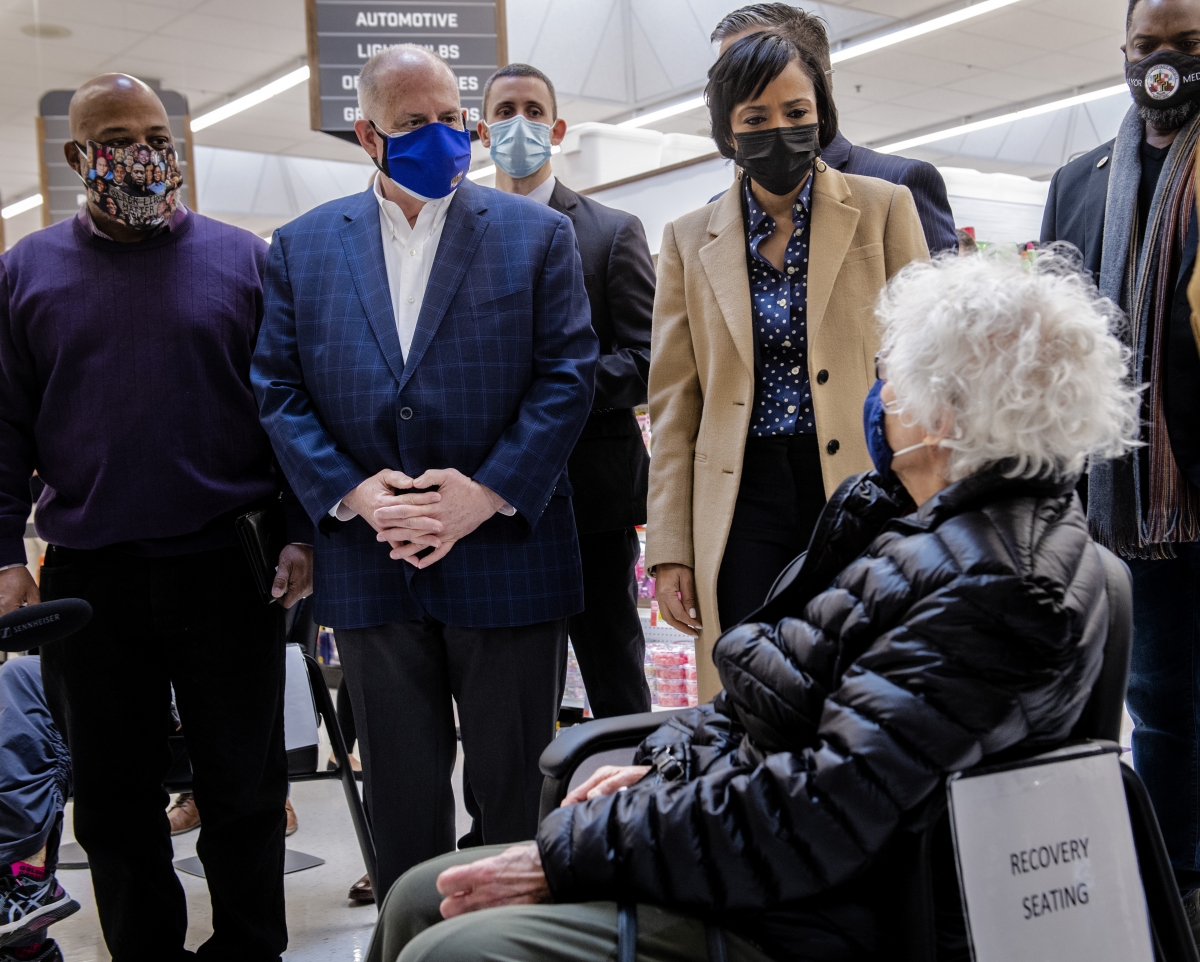
Maryland Gov. Larry Hogan, a Republican, left, Prince George's County Executive Angela Alsobrooks, a Democrat, and other officials talk with Louse Schmeltzer, who has just received her vaccine at a grocery store in Capitol Heights, Md., on Wednesday, Jan. 27, 2021. MUST CREDIT: Washington Post photo by Bill O'Leary

Maryland Gov. Larry Hogan, a Republican, left, Prince George’s County Executive Angela Alsobrooks, a Democrat, and other officials talk with Louse Schmeltzer, who has just received her vaccine at a grocery store in Capitol Heights, Md., on Wednesday, Jan. 27, 2021. MUST CREDIT: Washington Post photo by Bill O’Leary

Virginia officials expect the state’s weekly allotment to increase from 105,000 to 120,000.

According to CDC tracking, Virginia has ranked last or almost last recently for its vaccine administration as a proportion of total doses delivered, but Northam said the changes helped the state move up with an average of 26,000 daily shots. He has set a goal of administering 50,000 daily shots.

Northam on Wednesday also extended until Feb. 28 his restrictions on gatherings of more than 10 people and a ban on alcohol service after 10 p.m. Those were set to expire at the end of this month.

In D.C., officials on Wednesday also tweaked plans to vaccinate seniors, people with high-risk conditions, teachers and other essential workers as residents scramble to find scarce doses of the vaccine.

In response to complaints from frustrated seniors and D.C. lawmakers, the city announced technical changes to its online process for scheduling vaccine appointments. Health Director LaQuandra Nesbitt told the D.C. Council that more significant changes to the registration system are on the way.

The greater Washington region has reported 870,977 known cases of the coronavirus since the start of the pandemic, including 7,331 new coronavirus infections Wednesday, while 14,119 people have died of covid-19, the illness that can be caused by the virus.

As the pandemic’s economic harm continues, Maryland senators pitched adding $520 million in aid to Hogan’s proposed $1 billion state stimulus package.

The extra money would go to nearly three dozen groups or organizations, ranging from food banks and restaurants to people with disabilities, volunteer firefighters, the unemployed and people behind on utility bills.

Hogan has proposed sending checks of up to $750 to the state’s poorest families. The Maryland Senate could vote on the expanded proposal as soon as next week. Meanwhile, Maryland’s seven-day average case rate declined 37% over the past 15 days, from a pandemic high of 3,228 cases on Jan. 12 to 2,029 on Wednesday.

Hogan said Maryland has a six-day supply of vaccines because vaccinations are outpacing federal allocations.

“We’re caught up and about to run out of vaccine,” Hogan said outside a Giant pharmacy vaccination clinic in Prince George’s County.

Demand for the doses has overwhelmed appointment systems. The registration site for Giant pharmacies crashed within minutes of going online, said Samir Balile, manager of clinical programs for 153 Giant pharmacies in D.C., Maryland and Virginia.

Giant is distributing about 5,500 doses in the region each week, and appointments for them were gone “within minutes,” Balile said.

In Richmond, Mayor Levar Stoney, a Democrat, said Wednesday that he had tested positive for the coronavirus after the onset of mild symptoms two days earlier. He is working from home, and people he came into contact with are quarantining and taking necessary precautions, according to his office.

The mayor of Virginia’s capital city said more than 12,000 Richmonders have been infected by the virus.

“As my personal experience should tell you, while there is reason to be hopeful due to the distribution of the vaccine, this pandemic is still far from over and must be taken seriously,” Stoney said.

At least 912,000 first doses of the vaccine have been administered in D.C., Maryland and Virginia.

As of Wednesday, Maryland had administered 363,282 first doses while distributing 852,625 total doses. In Virginia as of Tuesday, 497,581 first doses had been administered of the 1.1 million the state has distributed.

As of Saturday, D.C. had administered 51,421 of the 68,750 doses it has received.

CVS and Walgreens, which have federal contracts to vaccinate residents and staffers at nursing homes, are nearly finished giving first doses at clinics in residential facilities in the region.

Advocates are pushing health officials in Maryland to come up with a vaccination plan for seniors in independent-living facilities, who were not included in the federal vaccination program.

“Independent living has fallen through the cracks,” said Joseph DeMattos, president of the Health Facilities Association of Maryland.

Management at Charles E. Smith Life Communities in Rockville, which includes the state’s largest nursing home, in addition to assisted living and independent-living facilities, has been pushing state and county officials for an on-site vaccination clinic for about 500 seniors in independent living.

Few of those seniors have been able to secure appointments, said Brenda Rice, vice president of operations at Charles E. Smith Life Communities. Meanwhile, 91% of those in its nursing home have received their second dose of the vaccine, and vaccinations in assisted living are beginning this week.

Hogan said the state is working with Giant pharmacies to inoculate seniors in independent-living communities, but details on the timing were still underway.

Elsewhere in Maryland, Anne Arundel County is lifting restrictions on restaurants, stores and churches, allowing them to operate at 50% capacity. Movie theaters, which had been closed, will open at 25%. The new policies take effect Friday.

Federal Reserve Chair Powell says ‘nothing more important’ to economy than vaccinating Americans #SootinClaimon.Com

#SootinClaimon.Com : ขอบคุณแหล่งข้อมูล : หนังสือพิมพ์ The Nation.

Federal Reserve Chair Powell says ‘nothing more important’ to economy than vaccinating Americans

InternationalJan 28. 2021Federal Reserve Chair Jerome PowellFederal Reserve Chair Jerome Powell

By The Washington Post · Rachel Siegel

Federal Reserve Chair Jerome Powell said Wednesday that getting Americans vaccinated is the most important thing to help the economy, comments that could boost President JoeBiden’s push to pass a massive new relief package that includes big spending on vaccines.

“There’s nothing more important to the economy right now than people getting vaccinated,” Powell said at a news conference following the Fed’s regular policy meeting.

“That is really the main thing about the economy, is getting the pandemic under control, getting everyone vaccinated, getting people wearing masks and all that,” Powell added. “That’s the single most important economic growth policy that we can have.”

Powell’s comments came on the same day Biden’s covid-19 response team held its first public briefing, with senior adviser Andy Slavitt emphasizing that they cannot reach their goal of vaccinating all Americans unless Congress acts to pass Biden’s $1.9 trillion relief package.

The package includes $160 billion for a national vaccination program, expanded testing, more public health jobs and other steps to curb the pandemic that has claimed more than 425,000 American lives and upended the economy.

Slavitt said that the administration can reach its initial goal of getting 100 million people vaccinated within 100 days without congressional action, “but that’s just the start.”

“In order to get all Americans vaccinated we need Congress to provide funds,” Slavitt said, including for expanding production and establishing more vaccination sites.

Congress has already devoted tens of billions of dollars to vaccine production and distribution, but as the pace of vaccinations lags what the Trump administration had promised and new variants of the coronavirus emerge, demand for vaccinations is far outpacing what Americans are demanding.

Powell and other Fed leaders have long emphasized that the economy will not fully heal until the pandemic is under control. But Wednesday marked the first time central bankers, in a statement released after their policy meeting, specified “progress on vaccinations” as core to the recovery.

“We haven’t won this yet,” Powell said. “We clearly can, but we’re going to have to say focused.”

The need for more money for vaccinations could prove a compelling argument in favor of passing Biden’s relief package, and a pressure point to try to win Republican support. Despite some discussion of breaking off vaccines and stimulus checks as a stand-alone bill, Biden said earlier this week he did not want to do that.

Overall, Biden’s relief package has gotten a frosty reception from many Republicans on Capitol Hill, including Senate Minority Leader Mitch McConnell, R-Ky., who dismissed it as an overly expensive and untargeted wish list of liberal priorities. In addition to vaccine funding, the package includes an extension of unemployment benefits that would otherwise expire in mid-March, a new round of $1,400 stimulus checks, an increased child tax credit, an increase in the federal minimum wage to $15 an hour, more than $130 billion for schools, and more.

But the need for spending on vaccines has emerged as an area of bipartisan consensus in meetings Biden administration officials have held with bipartisan groups of lawmakers in the Senate and the House.

Because of the widespread GOP opposition to the overall package, Democratic leaders in both chambers are making plans to try to advance the legislation under special rules that could allow it to pass with a simple majority vote in the Senate, meaning no Republican support would be required. Democrats say, however, that they still hold out hope for GOP support for the bill, and bipartisan discussions are continuing.

Overall, Powell said economic activity and employment had moderated in recent months. That pain has been most concentrated in service sectors – restaurants, bars, hotels – that have borne the brunt of the pandemic. December marked the first month of job losses since the recovery began in May.

For months, Powell has urged lawmakers to keep up the direct relief to struggling households and businesses, warning against the risks of withdrawing support too soon.

That’s especially the case, Powell said, for service-sector workers, including many women and people of color, whose jobs may only return once the health crisis ends. Still, Powell routinely stops short of outlining what should or should not go into another relief bill, leaving those discussions to the White House and Congress.

His overarching message is just to keep the aid flowing.

“Fiscal policy has been absolutely essential, and when we look back, we’ll see a strong and sustained fiscal policy response,” Powell said Wednesday. “As I mentioned, we’re a long way from a full recovery.”

Powell told reporters that he himself had received his first vaccine shot, and was awaiting the second.

Biden draws line on climate with oil-lease pause, subsidy review #SootinClaimon.Com

#SootinClaimon.Com : ขอบคุณแหล่งข้อมูล : หนังสือพิมพ์ The Nation.

Biden draws line on climate with oil-lease pause, subsidy review

InternationalJan 28. 2021President Biden with President Harris, left, in the State Dining Room of the White House in Washington on Jan. 21, 2021. MUST CREDIT: Bloomberg photo by Al Drago.President Biden with President Harris, left, in the State Dining Room of the White House in Washington on Jan. 21, 2021. MUST CREDIT: Bloomberg photo by Al Drago.

By Syndication Washington Post, Bloomberg · Jennifer A. Dlouhy, Ari Natter

President Joe Biden will take executive action on Wednesday to combat climate change, including temporarily blocking new leases for oil drilling on federal lands, ordering a review of fossil-fuel subsidies and other measures to overhaul the U.S. energy mix.

Biden will sign broad-ranging directives instructing federal agencies to consider climate change in everything from government purchases to national security. He will order U.S. intelligence authorities to estimate how climate change affects national security and tell agencies to do a better job assessing the threat.

“These executive orders follow through on President Biden’s promise to take aggressive action to tackle climate change and build on the executive actions that the president took on his first day in office,” the White House says in a fact sheet on the planned moves released Wednesday.

Much of the action has been telegraphed previously and builds on promises Biden made on the campaign as part of his bid to make the U.S economy carbon neutral by 2050. It’s not clear he’ll be able to do everything unilaterally.

For instance, Biden is directing federal agencies “to eliminate fossil fuel subsidies as consistent with applicable law,” and instead, seek “new opportunities to spur innovation, commercialization and deployment of clean energy technologies and infrastructure,” according to the White House.

However, while the Biden administration has some latitude to shift some funding for innovation at the Energy Department, abolishing tax incentives that support fossil fuel development, such as deductions for intangible drilling costs, would require action by Congress.

Still environmentalists were cheering the move as the boldest action by a president yet to confront the climate crisis and the fossil fuels that drive it.

“The era of putting polluters’ profits first is over,” said Josh Axelrod, senior advocate for the nature program at the Natural Resources Defense Council. “We can’t lock our children and grandchildren into decades more of the dirty fossil fuels of the past, and all the hazards and harms they bring to our public lands, oceans and coastal communities.”

Supporters of the fossil fuel industry said jobs would be lost. Wyoming Governor Mark Gordon, a Republican, said the president’s moves “will divide and alienate the very working-class American communities with whom the Biden administration has pledged to unite.”

“It is clear President Biden has caved in to a loud segment of the Democratic Party that is pushing to require all policies and decisions to meet a litmus test of climate change, regardless of consequence,” Gordon said in an emailed statement. “There are bipartisan solutions available that support the people working in oil and gas on federal lands as well as reduce carbon emissions.”

Biden’s order directs federal agencies to purchase zero-emission power and automobiles, such as electric vehicles, as a way to “leverage the federal government’s footprint and buying power to lead by example,” according to the White House fact sheet. The U.S. maintains fleet of 645,000 vehicles and operates nearly 10,000 buildings, according to the General Services Administration.

Biden is also inviting world leaders to a climate summit on April 22 — Earth Day — in a sign of the new president’s commitment to not just rejoin the Paris climate accord but strengthen it. The president’s efforts Wednesday kick off work to develop a new, stronger U.S. carbon-cutting commitments well as a climate finance plan, according to the White House.

The president’s announcements come as his administration has made climate change one of its top priorities — seeking to marshal the entire federal government to combat the crisis.

The work will be buttressed by new government commissions focused on climate, job creation and environmental justice. Biden will establish a climate-focused civilian conservation corps along the lines of the program created by President Franklin Delano Roosevelt during the Great Depression.

Biden is committing to conserve 30% of U.S. lands and waters by 2030 and revitalize communities that have borne the brunt of pollution. It is unclear what form those protections might take but conservation could involve designating areas as wilderness, refuges or national monuments — and walling off industrial development or even hiking and other recreational activity. And the goal could even encompass private land, as Biden directs the U.S. Department of Agriculture to consider ways to encourage climate-friendly agricultural practices that help store carbon.

The efforts will help restore forests, sequester carbon and revitalize wetlands, said Collin O’Mara, president of the National Wildlife Federation. Biden is “advancing solutions that will accelerate our economic recovery and revitalize frontline communities, while simultaneously confronting our nation’s biodiversity, climate and racial justice crises,” O’Mara said.

Biden’s temporary halt of the sale of new oil and gas rights on federal lands and coastal waters buys time for “a rigorous review” of the government’s leasing programs, according to the White House. About 22% of total U.S. crude supplies and 12% of U.S. natural gas came from federal lands and waters in 2019, according to the Energy Information Administration.

Under the order, Biden is directing the Interior Department to pause entering into new oil and natural gas leases “to the extent possible,” while looking for ways to double renewable energy production from offshore wind by 2030. The construction of just one new coastal wind farm could be enough to fulfill the pledge, with just two small projects currently operating near Rhode Island and Virginia. New installations are already planned up and down the U.S. coast, pending the agency’s approval.

The oil and gas leasing moratorium won’t affect ongoing operations under existing leases, the government’s sale of coal rights or energy activities on lands the U.S. holds in trust for tribes. Oil companies stockpiled leases and drilling permits in advance of Biden’s election, further blunting the effect.

Still, it could deliver a big economic blow to New Mexico, North Dakota and other states with substantial oil and gas reserves on federal land. The effects on the oil industry also will be uneven, with the impact falling heaviest on producers with significant federal acreage, such as Devon Energy and Cimarex Energy onshore and Murphy Oil offshore.

U.K.’s Johnson warns lockdown will last until at least March 8 #SootinClaimon.Com

#SootinClaimon.Com : ขอบคุณแหล่งข้อมูล : หนังสือพิมพ์ The Nation.

U.K.’s Johnson warns lockdown will last until at least March 8

InternationalJan 28. 2021A woman walks past a closed souvenir stall and government messaging on a telephone box on Oxford Street in London on Jan. 15, 2021. MUST CREDIT: Bloomberg photo by Chris J. Ratcliffe.A woman walks past a closed souvenir stall and government messaging on a telephone box on Oxford Street in London on Jan. 15, 2021. MUST CREDIT: Bloomberg photo by Chris J. Ratcliffe.

By Syndication Washington Post, Bloomberg · Tim Ross, Alex Morales, Emily Ashton

Prime Minister Boris Johnson put England on notice that the national virus lockdown will continue for at least another six weeks, with schools staying closed and new border quarantine rules coming into force.

A day after the British death toll passed 100,000, Johnson said the government will review the impact of pandemic measures and the effectiveness of the vaccine program in mid-February.

But the soonest restrictions could begin to be eased and schools fully reopened is March 8, he said, and some rules will be tightened.

In an attempt to stop dangerous mutant strains of the virus entering the U.K., new 10-day hotel quarantine measures will be imposed on all passengers arriving from hot spot regions such as South America, South Africa and Portugal.

“Everyone yearns to know how much longer we must endure these restrictions, with all their consequences for jobs, livelihoods and most tragically of all, the life chances of our children,” Johnson told members of Parliament on Wednesday. “We will not persist for a day longer than is necessary, but nor can we relax too soon.”

Johnson rejected a call from Tory colleague Steve Brine to consider opening some schools before March 8. “This is about as fast as we think we can prudently go,” the prime minister told Parliament. While the lockdown appears to have curbed the spread of infections, “we do not yet have enough data to know exactly how soon it will be safe to reopen our society and economy,” he said.

The U.K. is three weeks into its third national lockdown since the pandemic began almost a year ago, with tens of millions of workers ordered to stay home and retail and hospitality businesses shuttered. Since then, the government has committed almost 300 billion pounds to emergency support for the economy.

Despite the lockdowns and stimulus measures, the U.K. has suffered the fifth-highest death toll in the world and the heaviest economic hit of any Group of Seven country.

In recent weeks, Johnson’s administration has focused on driving ahead with a mass vaccination program that aims to provide shots to the 15 million most vulnerable people and carers by Feb. 15. Once that goal has been achieved, ministers will consider if and how restrictions can safely begin to be eased.

“We remain in a perilous situation,” Johnson said. The spread of a more contagious and potentially more deadly new strain of the virus, first found in southeast England, has set back the government’s ambitions for reopening the economy in the spring, he said.

Other strains have been identified in Brazil and South Africa and ministers have been debating border measures including quarantining all arrivals in hotels. In the end, Johnson announced a more limited policy aimed at arrivals from specific countries thought to be most at risk of carrying a new variant of the disease.

“In order to reduce the risk posed by U.K. nationals and residents returning home from these countries, I can announce that we will require all such arrivals who cannot be refused entry to isolate in government-provided accommodation such as hotels for 10 days, without exception,” the prime minister told the House of Commons. “They will be met at the airport and transported directly into quarantine.”

Extra police will also be stationed at ports and airports to stop Britons leaving the U.K. to go on holiday or for any other non-essential reason, Home Secretary Priti Patel said. “Anyone who does not have a valid reason for travel will be directed to return home,” she told Parliament.

Johnson, who has been criticized for being slow to take action throughout the pandemic, said the government will review the lockdown and vaccine roll-out in mid-February and aims to publish a plan for easing the restrictions in the week of Feb. 22.

“We have one of the highest death rates in the world,” said Keir Starmer, leader of the U.K.’s main opposition Labour Party. “The truth is this was not inevitable, it wasn’t just bad luck. It’s the result of a huge number of mistakes by the prime minister during the course of this pandemic.”

France holds off on new lockdown, worries about unrest risk #SootinClaimon.Com

#SootinClaimon.Com : ขอบคุณแหล่งข้อมูล : หนังสือพิมพ์ The Nation.

France holds off on new lockdown, worries about unrest risk

InternationalJan 28. 2021A morning commuter wearing a protective face mask passes the steps of the Grande Arche monument in Paris on Jan. 21, 2021. MUST CREDIT: Bloomberg photo by Benjamin Girette.A morning commuter wearing a protective face mask passes the steps of the Grande Arche monument in Paris on Jan. 21, 2021. MUST CREDIT: Bloomberg photo by Benjamin Girette.

By Syndication Washington Post, Bloomberg · Ania Nussbaum, Rudy Ruitenberg

The French government is delaying an agonizing decision to lock down the country once more, mulling options to slow new variants of covid-19 as the current curfew is considered insufficient.

President Emmanuel Macron “has asked for additional analysis” on the spread of the virus before deciding on any new restrictions, government spokesman Gabriel Attal said after a defense cabinet meeting Wednesday. Maintaining the status quo is “unlikely” as the 6 p.m. – 6 a.m. national curfew isn’t doing enough, and a strict lockdown is one option being considered, he said.

Macron is under pressure to shut down the economy for the third time in less than a year, as doctors and researchers raise the alarm about mutations of the coronavirus spreading through the country.

Yet with a presidential race coming up next year, the French leader also has to navigate criticism of his handling of the crisis, including a slow start to the vaccination campaign. And while surging U.K. cases and deaths demonstrate the perils of the new virus variants, riots in the Netherlands against a government curfew show the risks of tighter measures.

Christophe Castaner, head of Macron’s party at the National Assembly, told Le Parisien newspaper there was a risk of “civil disobedience” in France, too, should a new lockdown be imposed.

Voters have much less appetite for strict measures now than at the beginning of the pandemic, with 93% of adults approving of the first lockdown, compared to just 67% in favor of a third, according to a recent Elabe opinion poll.

“I know there is a fatigue,” Attal said during the press conference. A decision on whether to tighten measures will depend on health indicators, he said.

France’s second lockdown started late October and ended mid-December with a curfew that was expanded earlier this month. It brought only partial relief for the health system, with hospitalizations and intensive-care patients remaining more than five times higher than in August.

Restaurants, cafes, clubs, theaters, cinemas and sports venues have been closed since October and are being propped up by government aid, like many areas of the economy.

A third lockdown would cause an economic contraction by 10% to 18% compared to pre-crisis levels, according to a Ministry of Finance study cited by Parisien, depending on the severity of the measures. During the first — and strictest lockdown — in the spring of 2020, activity contracted by more than a third.

While the government is banking on a strong rebound of its economy in the second half of the year, another lockdown would threaten its growth forecasts.

Finance Minister Bruno Le Maire called a third lockdown a “last resort” on Wednesday. A recent survey by the French statistics agency showed rising concern in households in January, as consumers plan to save more cash for difficult times. Consumer sentiment is at its lowest since November.

“Let’s look at where we are,” Le Maire said. “There’s no haste.”

The more contagious U.K. variant of the virus represented 9.4% of cases in an analysis of positive tests in the Paris region between Jan. 11 and 21. Across France, hospitalizations have been climbing in the past two weeks to the highest level since early December, and the number of severely ill Covid patients in intensive care rose above 3,000 this week.

Macron could still make a final decision in the coming days — the defense cabinet, a small and close-knit group of ministers who gather around the president and prime minister, have met over weekends in the past.