
Trump administration bailed out prominent anti-vaccine groups with more than $800,000 in loans during pandemic #SootinClaimon.Com

#SootinClaimon.Com : ขอบคุณแหล่งข้อมูล : หนังสือพิมพ์ The Nation.

Trump administration bailed out prominent anti-vaccine groups with more than $800,000 in loans during pandemic

InternationalJan 18. 2021
By The Washington Post · Elizabeth Dwoskin, Aaron Gregg · NATIONAL, HEALTH, HEALTH-NEWS 

WASHINGTON – Five prominent anti-vaccine organizations that have been known to spread misleading information about the coronavirus received more than $850,000 in loans from the federal Paycheck Protection Program, raising questions about why the government is giving money to groups actively opposing its agenda and seeking to undermine public health during a critical period.

The groups that received the loans are The National Vaccine Information Center, Mercola Com Health Resources LLC, Informed Consent Action Network, Children’s Health Defense Co., and the Tenpenny Integrative Medical Center, according to the Center for Countering Digital Hate, a U.K.-based advocacy group that fights misinformation, which conducted the research using public documents. The group relied on data released in early December by the Small Business Administration in response to a lawsuit from The Washington Post and other news organizations.

Several of the Facebook pages of these organizations have by penalized by the social network, including being prohibited from buying advertising, for pushing misinformation about covid-19.

Vaccines are largely considered safe and effective, and clinical trials for both Moderna and Pfizer vaccines did not raise serious safety concerns. But many Americans hold skeptical attitudes about vaccination, attitudes public health experts have said are attributable in part to misinformation. Nearly 40% of Americans say they definitely or probably would not get the vaccine, according to a December survey by Pew Research Center. Certain groups, including Republicans and Black Americans, are even more skeptical, Pew found.

Public health officials, including WHO Director General Tedros Adhanom Ghebreyesus, have called vaccine misinformation “a major threat to global health that could reverse decades of progress made in tackling preventable diseases,” and last year the organization partnered with Facebook to help counter misinformation on its platform with content from authoritative sources.

The smallest loan of $72,000 went to the Tenpenny organization, which is run by Dr. Sherri Tenpenny, an osteopathic physician and social media figure who actively uses online forums to promote alternative health and argue against child and other forms of vaccination. A popular page run by Tenpenny was banned from Facebook in December for spreading misinformation, though she still has tens of thousands of followers on Instagram.

The largest loan of $335,000 went to Mercola, an organization affiliated with the well-known anti-vaccine activist and businessman Dr. Joseph Mercola. One of Mercola’s groups on Facebook was deemed by the left-leaning human rights group Avaaz to be one of the leading “superspreaders” of misinformation about the coronavirus. His Facebook pages in English and Spanish together have more than 2.7 million followers.

The Children’s Health Defense Co., founded by Robert Kennedy Jr., says it does not oppose vaccines, but is dedicated to raising questions about their safety. The group has questioned whether the coronavirus vaccines that have received emergency approval from the FDA are safe, along with questioning whether children should be vaccinated.

The group has posted on its social media channels about the “great reset” conspiracy theory, which holds that “global elites” such as Bill Gates will use the pandemic to advance their interests and push forward a globalist or Marxist plot to destroy American sovereignty and prosperity and control the population. In a CNBC interview last October, Gates said it was “unfortunate” that both he and director of the National Institute of Allergy and Infectious Disease Dr. Anthony Fauci had been targeted by conspiracy theorists, and worried that falsehoods and misleading information about the virus was undermining the country’s ability to respond to the pandemic.

Organizations tied to Kennedy were responsible for the majority of Facebook advertising critical of vaccinations, until Facebook restricted the group’s ability to advertise in 2019 on the grounds that it spread misinformation, according to a study in the journal Vaccine. Facebook has also removed the group from its recommendation algorithms so that it is not suggested to other users as a potential interest, and has demoted it in its news feed so that it shows up on people’s Facebook pages less frequently, and has blocked the ability of users to “like” the page.

In 2020, the group sued Facebook and its fact-checking partners for the ad ban and for debunking the group’s posts with fact-checking labels, costing the group 95% of its website traffic from Facebook, according to the lawsuit.

In an interview, Kennedy, an environmental lawyer and a nephew of former President John F. Kennedy, said his organization is “scrupulous about obeying the law” and questioned whether there is any law or regulation that would prevent his organization from receiving federal help.

“I’ve never heard anybody say that a loan is only available to people who don’t question the government,” Kennedy said.

The other four PPP recipients described in this story did not respond to requests for comment.

The anti-vaccine groups are ramping up their tactics and messaging at a moment when more and more Americans are searching for accurate information about the coronavirus vaccine. Encouraging the safe use of vaccines is considered a vital component of the government’s efforts to alleviate the public health crisis.

The Center for Countering Digital Hate previously exposed a conference in which anti-vaccination activists planned to seize upon people’s doubts and fears to undermine confidence in the coronavirus vaccine.

“Lending money to these organizations so they can prosper is a sickening use of taxpayer money. These groups are actively working to undermine the national covid vaccination drive, which will create long-term health problems that are felt most acutely in minority communities and low-income neighborhoods,” said Imran Ahmed, Chief Executive of Center for Countering Digital Hate.

While it’s unclear whether the anti-vaccine groups broke any rules, their receipt of public assistance is in many ways a consequence of the scattershot way in which the Paycheck Protection Program delivered hundreds of billions of dollars into the economy with few guardrails or preconditions.

The program was built around a controversial decision to allow businesses to self-certify their own eligibility for a taxpayer-backed loan. The SBA does not hand out the loans itself; rather, it empowers a network of approved lenders to quickly process them on its behalf.

Although the SBA reserves the right to audit specific PPP loans, the government performed almost no vetting of specific loan recipients beyond a basic check to determine whether the applicant had already received a loan.

The self-certification policy allowed the government to quickly pump money into a struggling business community during the chaotic months of April and May, by cutting much of the red tape typically associated with loan approvals.

But the broad eligibility criteria and lack of vetting meant numerous questionably-deserving organizations were among the millions of loan recipients. Massive restaurant and hotel chains such as Shake Shack and Sonic benefited handsomely from loans to their affiliates. Debt-collectors and high-interest lenders pocketed more than $500 million. A defense contractor with billions in sales received one.

In some cases the government has tried to claw back money after press coverage highlighted certain recipients. In April it asked publicly traded companies to return funds, and it later accused local Planned Parenthood affiliates of improperly accessing PPP loans.

It’s unclear whether the SBA will take issue with anti-vaccination groups receiving PPP funds.

SBA spokeswoman Carol Wilkerson declined to comment on whether the anti-vaccine organizations were legally eligible for the loans they received. She added that the agency is reviewing loan forgiveness applications to ensure compliance with the rules, and that the next round of PPP funding include more vetting on the front-end before an organization gets a loan.

She suggested that they probably did meet the requirements; the PPP program was open to a wide range of businesses and nonprofits.

“In general, if PPP applicants [or] borrowers met the requirements, they got a loan,” Wilkerson said.

The SBA has previously said in informational materials that a business appearing in its PPP loan database “doesn’t mean that SBA has made an affirmative declaration that a borrower is eligible.”

Misinformation about covid-19 spread widely across social media throughout the pandemic, shared by everyday people as well as anti-vaccine activists and supporters of the QAnon conspiracy theory. Now some of those groups have turned their attention to the vaccine, making baseless arguments, for example, that the U.S. government will force people to take it, that it contains microchips, and the people will be compelled to wear some biological marker to prove that they had the vaccine.

The social media pages of the anti-vaccine groups point to articles and research highlighting stories of adverse impacts from the coronavirus vaccine, or warning against forced vaccinations and passports, or the dangers of masks. Many of the posts are factual, but use fearmongering or present a distorted picture of the dangers of vaccines.

Facebook has banned misinformation about the coronavirus and the coronavirus vaccines, and has cracked down on large Facebook groups that oppose or question vaccination, including four of the five groups that received the PPP loans, said spokeswoman Dani Lever.

In recent months, the company also suspended two major groups, including the 100,000-plus-member Stop Mandatory Vaccination, as well as pages belonging to several of the movement’s leading figures. The National Vaccine Information Center is also prohibited from advertising, and the Informed Consent Action Network’s page has been labeled with a link to the World Health Organization and is not being recommended to users by the company’s algorithms, Lever said.

The company did not ban the groups for misinformation, but for what it said was abusive behavior, such as using paid troll farms in North Macedonia and the Philippines to spread messages.

Despite Facebook’s actions, major anti-vaccine accounts on social media platforms have gained more than 10 million new followers since 2019, including 4 million additional followers on Instagram and 1 million on Facebook, according to CCDH.

“These organizations have been sowing the seeds of doubt about vaccines and public health for years,” said Erica Dewald, advocacy director at a pro-vaccine nonprofit called Vaccinate Your Family.

“Now, in the middle of a pandemic, they are accepting funds for the chaos they’ve helped to create,” she said.
WHO chief warns of ‘catastrophic moral failure’ as rich countries dominate vaccine supplies #SootinClaimon.Com

#SootinClaimon.Com : ขอบคุณแหล่งข้อมูล : หนังสือพิมพ์ The Nation.

WHO chief warns of ‘catastrophic moral failure’ as rich countries dominate vaccine supplies

InternationalJan 18. 2021

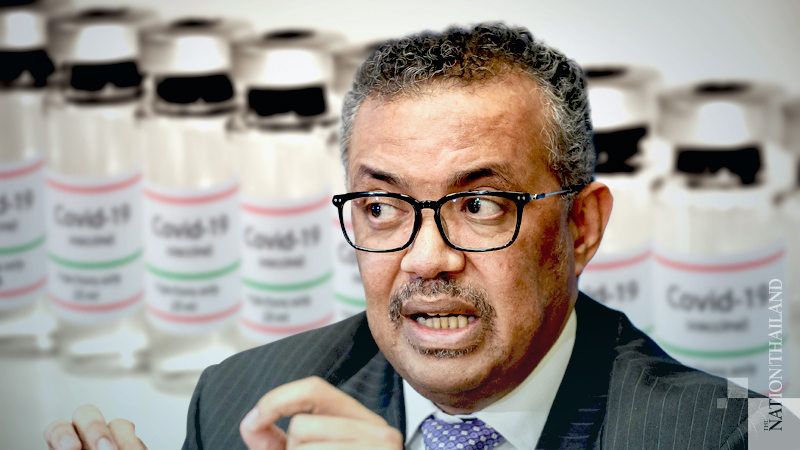
WHO Director General Tedros Adhanonom Ghebreysus

WHO Director General Tedros Adhanonom Ghebreysus

By The Washington Post · Paul Schemm, Jennifer Hassan · NATIONAL, WORLD, HEALTH, HEALTH-NEWS 

The head of the World Health Organization warned Monday that the world is on the brink of a “catastrophic moral failure” if wealthier nations don’t ensure the equitable distribution of vaccines to combat the coronavirus pandemic.

WHO Director General Tedros Adhanonom Ghebreysus, who repeatedly has warned richer countries against excluding poorer ones by cutting bilateral deals with vaccine suppliers, took his rhetoric up a notch in his opening remarks at an executive board session.

“I need to be blunt: The world is on the brink of a catastrophic moral failure – and the price of this failure will be paid with lives and livelihoods in the world’s poorest countries,” he said, noting that while 39 million doses have been administered in more than 40 higher-income countries, one poor country has so far just given out 25 doses.

While Tedros hailed the vaccine rollout as a great scientific achievement, he noted that there were lessons to be learned from past global pandemics when vaccines took a long time to reach developing countries. The current crisis was a chance to “rewrite history,” by ensuring that vaccines are distributed fairly between countries and to those who need them the most.

WHO has partnered with several vaccine makers to provide 2 billion doses to a consortium of low-income countries in an initiative dubbed Covax, but Tedros said there are concerns the vaccines won’t be delivered.

“Even as they speak the language of equitable access, some countries and companies continue to prioritize bilateral deals, going around Covax, driving up prices and attempting to jump to the front of the queue,” he said.

He called on wealthier countries to hold off on vaccinating their young and healthier adults so that older people and front-line health workers in developing countries could receive their doses of the vaccine.

His warning came as wealthier nations such as Britain scramble to vaccinate the vulnerable amid a fresh outbreak of the virus which experts say was triggered by a new and highly contagious variant that his since been identified in many other countries.

The British government has vowed to vaccinate its four priority groups – which include National Health Service workers and care home residents by Feb. 15.

England’s Department of Health and Social Care said Sunday that an estimated 45 percent of people over the age of 80 have now been vaccinated and that over 1 million people within the age group had been invited to book their vaccine appointments.

In Europe, several countries including Sweden and Finland have expressed concern and anger that shipments of the Pfizer vaccine have been delayed, calling the setback – which the U.S. firm called a temporary delay – “unacceptable.”

The president of the European Commission, Ursula von der Leyen, said last week that Pfizer had agreed to supply the EU with 600 million doses this year.

Those in Africa face a much longer wait for help, with the Africa Centers for Disease Control and Prevention estimating the a distribution program may not begin until April.

Ahmed Ogwell Ouma, deputy director of the Africa CDC, said last month that those in African nations were “often holding the short end of the stick.”

India, which has the second-highest coronavirus caseload in the world, is also beginning mass vaccination efforts and hopes to immunize around 300 million people by summer – despite concerns that one of the vaccines may not work.

FBI screens U.S. troops for possible insider threats ahead of inauguration #SootinClaimon.Com

#SootinClaimon.Com : ขอบคุณแหล่งข้อมูล : หนังสือพิมพ์ The Nation.

FBI screens U.S. troops for possible insider threats ahead of inauguration

InternationalJan 18. 2021National Guard troops march through the downtown area of Washington on Sunday, Jan. 17, 2021. MUST CREDIT: Photo for The Washington Post by Astrid Riecken
Photo by: Astrid Riecken — For The Washington PostNational Guard troops march through the downtown area of Washington on Sunday, Jan. 17, 2021. MUST CREDIT: Photo for The Washington Post by Astrid Riecken Photo by: Astrid Riecken — For The Washington Post

By The Washington Post · Paul Sonne, Dan Lamothe, Missy Ryan 

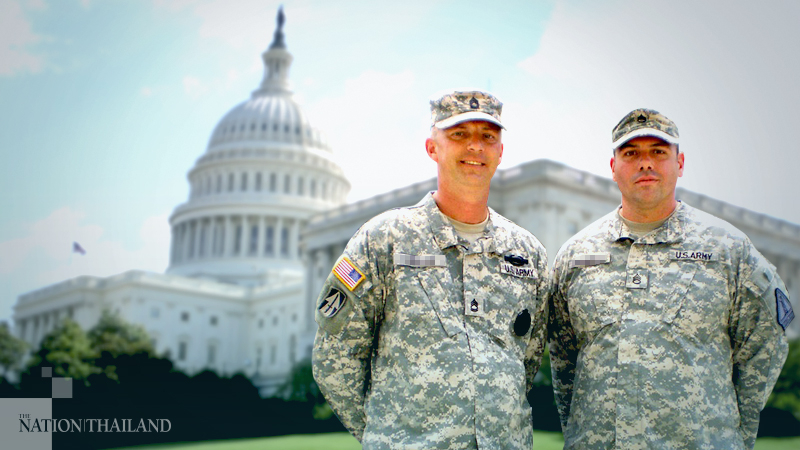
WASHINGTON – U.S. defense officials say the federal government is screening the 25,000 National Guard troops who have begun flowing into the nation’s capital to secure the inauguration because concerns about extremism in the ranks are intensifying.

The screening comes after a number of pro-Trump rioters involved in storming the U.S. Capitol on Jan. 6 were found to have military ties, raising questions about extremist sentiment within the armed forces. Dozens of people on a terrorist watch list were in Washington as the deadly riot unfolded.

A U.S. defense official, speaking on the condition of anonymity to discuss the sensitive preparations, said the Army is working with the FBI to vet all service members supporting the inauguration. The Army maintains awareness of threats but does not collect domestic intelligence itself, the official said. It was not immediately clear how extensive the FBI vetting of the military personnel would be.

The screening comes as thousands of troops in camouflage uniforms patrol the streets of the nation’s capital, which has turned into a fortress of security barriers and fences in the lead-up to the inauguration. Many of the guardsmen are armed, but they often do not have magazines loaded in their rifles.

Maj. Gen. William Walker, commanding general of the District of Columbia Guard, said in an interview with Defense One that the screening represented an “extra layer” of security for this deployment on top of the continuous monitoring that the U.S. military does of its service members.

“For this deployment everybody is screened additionally, but it’s more of a reassurance, because we do everything we can do (to) know our guardsmen, our soldiers and airmen,” Walker said.

Army Secretary Ryan McCarthy, who is overseeing the D.C. Guard and the military’s preparations for the inauguration, said in an interview with The Associated Press that the vetting process has not flagged any potential problems with the troops coming to help protect the inauguration.

“We’re continually going through the process, and taking second, third looks at every one of the individuals assigned to this operation,” McCarthy told the AP, which reported that the screening is being carried out by the FBI and is scheduled to be completed by Inauguration Day – Wednesday.

McCarthy told the AP that he has told commanders to keep an eye out for any problems within their units.

Because D.C. is not a state, its Guard answers to the president, but his authority is traditionally delegated to the defense secretary and the Army secretary, who assume operational control on the president’s behalf.

The extra screening of the forces flowing into the city from states demonstrates the high level of concern U.S. officials have heading into the week. President Donald Trump is set to be the first outgoing president since 1869 to skip his successor’s inauguration.

A second defense official said the Pentagon received 143 notifications of extremism-related probes last year from the FBI, 68 of which were related to suspected domestic extremism among current and former service members – a category that includes White nationalism, anti-fascist, antiabortion and anti-government beliefs. Most of the cases were related to veterans, the official said.

In a statement, the Army said it is working with the Secret Service to determine which service members supporting the inauguration require additional background screening.

All service members go through an annual program that requires them to report information regarding known or suspected extremist behavior in the ranks, the Army said. The Army also noted that the D.C. Guard is providing additional training as service members arrive in the city, instructing them to report anything they see or hear that seems inappropriate to the chain of command.

“There is no place for extremism in the military and we will investigate each report individually and take appropriate action,” the Army said in the statement. “The Army is committed to working closely with the FBI as they identify people who participated in the violent attack on the Capitol to determine if the individuals have any connection to the Army.”

To enter any branch of the U.S. military and receive a security clearance, all personnel undergo background checks, the Army added.

In a statement, Capt. Chelsi Johnson, a spokeswoman for the National Guard, said all members coming to Washington for the deployment “go through a credentialing process.”

“That information is shared with the requesting federal agencies and added to their database,” Johnson said. “We cannot speak for those agencies and how they use the information.”

Russian opposition leader Alexei Navalny detained on his return to Moscow #SootinClaimon.Com

#SootinClaimon.Com : ขอบคุณแหล่งข้อมูล : หนังสือพิมพ์ The Nation.

Russian opposition leader Alexei Navalny detained on his return to Moscow

InternationalJan 18. 2021Alexei Navalny returns to Mosocow after recovering in Germany from a near-fatal nerve agent poisoning. MUST CREDIT: Washington Post photo by Loveday MorrisAlexei Navalny returns to Mosocow after recovering in Germany from a near-fatal nerve agent poisoning. MUST CREDIT: Washington Post photo by Loveday Morris
By The Washington Post · Isabelle Khurshudyan, Loveday Morris

MOSCOW – In his return to Russia on Sunday, five months after he left in a coma from a near-fatal poisoning, Kremlin critic Alexei Navalny made it as far as border control.

Before Navalny’s passport could be stamped, police officers at Moscow’s Sheremetyevo Alexander S. Pushkin International Airport surrounded and detained him. He gave his wife a hug and a kiss goodbye before being led to a private room.

The 44-year-old opposition leader’s arrest was expected, but he chose to fly to Russia anyway. Before his arrival, Russian authorities said he was on a wanted list for allegedly violating the terms of his suspended sentence from a 2014 embezzlement conviction. Navalny and the European Court of Human Rights have called that case a political prosecution.

But the move to jail him could have far-reaching consequences for the government of President Vladimir Putin. Navalny says Putin ordered Russian state security agents to poison him with a nerve agent during a trip to Siberia in August. The Kremlin has denied the accusation.

Navalny’s team said Sunday that the chaos surrounding his return, including the diversion of his flight to Sheremetyevo after supporters gathered at the Moscow airport where he was scheduled to land, show how serious a threat Putin considers Navalny.

His arrest is expected to trigger protests by his supporters, and a response from Western governments, perhaps in the form of more sanctions, is also possible.

“Mr. Navalny should be immediately released, and the perpetrators of the outrageous attack on his life must be held accountable,” Jake Sullivan, President-elect Joe Biden’s choice for national security adviser, tweeted Sunday. “The Kremlin’s attacks on Mr. Navalny are not just a violation of human rights, but an affront to the Russian people who want their voices heard.”

Amnesty International declared Navalny a “prisoner of conscience” Sunday night.

Russia’s Federal Penitentiary Service said Navalny would be in police custody “until a court ruling.” It’s unclear when his case will be heard. Hours after his detention, his spokeswoman tweeted that his whereabouts were not known. His lawyer was not allowed to join him.

Navalny, standing before a backdrop of the Kremlin at the Sheremetyevo airport before he went to border control, said Sunday was his “best day in the past five months.”

“This is my home,” he said. “I came here, and everybody is asking, ‘Aren’t you afraid?’ No, I am not afraid.”

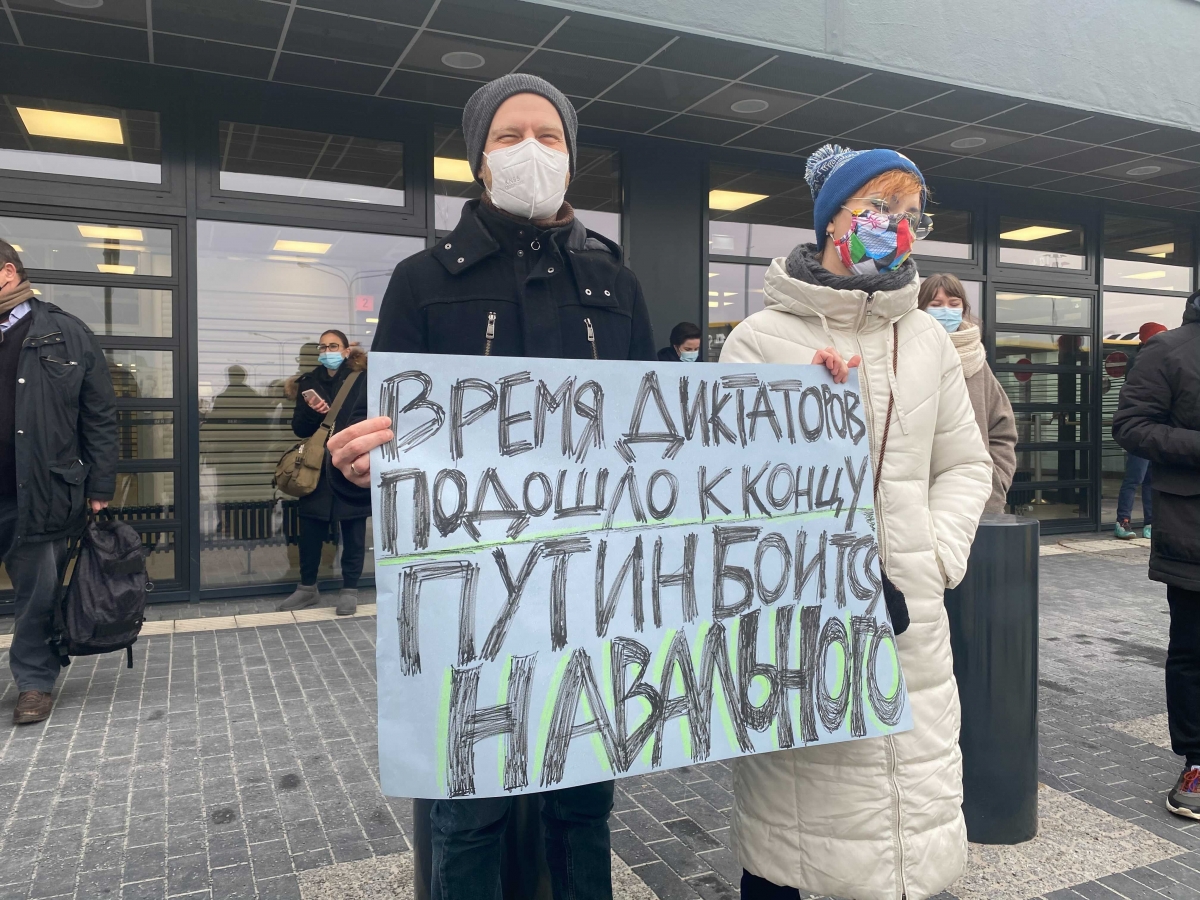
Ekaterina Raykova-Merz and Andreas Merz-Raykov wait outside Berlin airport Terminal 5 for Navalny to arrive. Their sign reads "The time of dictators has come to an end. Putin is afraid of Navalny." MUST CREDIT: Washington Post photo by Loveday Morris
Ekaterina Raykova-Merz and Andreas Merz-Raykov wait outside Berlin airport Terminal 5 for Navalny to arrive. Their sign reads “The time of dictators has come to an end. Putin is afraid of Navalny.” MUST CREDIT: Washington Post photo by Loveday Morris
Navalny had been staying in Berlin, where he was treated for his poisoning, including more than two weeks in a medically induced coma. He was escorted onto the flight by German security officials for his protection: Two black Audis with tinted windows surrounded by police cars could be seen on the tarmac. Airport officials warned journalists that they were not allowed to take pictures.

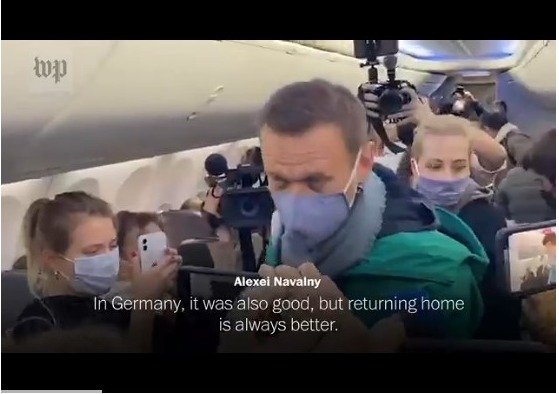
As Navalny made his way to his seat in the 13th row, reporters on the plane lobbed questions at him. He encouraged them to take their seats and fasten their seat belts so the flight could take off on time.

Asked what he expected in Moscow, Navalny replied with his signature humor: subzero temperatures, he said, and a warm welcome. He took a selfie with the flight attendants and watched the Cartoon Network series “Rick and Morty” during the flight.

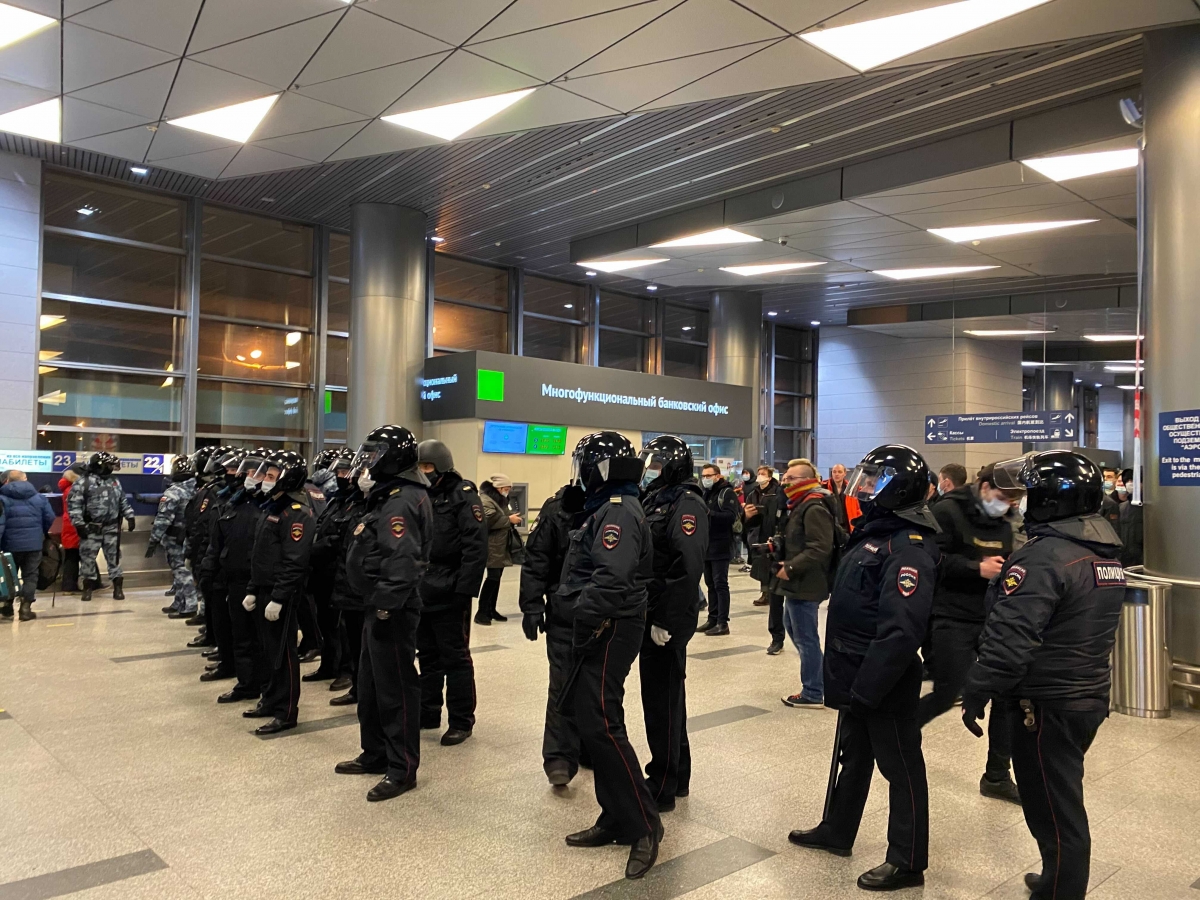
At Moscow’s Vnukovo International Airport, where Navalny was scheduled to arrive, riot police were deployed to disperse a gathering crowd. More than 50 people were detained, according to the monitoring group OVD-Info.

People gathered at the airport said they were waiting for pop star Olga Buzova. Navalny’s team called it a Kremlin-backed effort to compete with his supporters.

As Navalny’s flight neared Vnukovo, flight radar showed it turning away, and its arrival was pushed back. The arrivals board showed that the plane had been diverted to Sheremetyevo.

On the plane, the captain announced that “a technical issue” caused the change. Other flights were diverted, too, and Navalny later apologized to affected passengers.

“I didn’t believe it until the last minute,” Navalny said on the plane. “There are several planes in the air above Vnukovo Airport right now, and they’re keep passengers in the air because they are afraid.”

At the news, some of the crowd started to leave Vnukovo. “I think if we all head to Sheremetyevo now, they’ll turn the plane back around to Vnukovo,” said onlooker Danila Buzanov, 25.

Buzanov called Navalny a Nelson Mandela-like figure. He said his arrest would make things worse for the Kremlin. Navalny’s return, he said, “is such a brave thing to do, and it’s such a message for people of how to not be afraid and fight until the end.”

Tatiana Stanovaya, head of political analysis firm R. Politik, wrote on the Telegram messaging app that Navalny’s arrest would trigger protests that would test “how far [Russian security services] and the most repressive apparatus of the state can go.”

Despite the change in airport, Navalny’s supporters showed up at Sheremetyevo and chanted the name of Navalny’s wife, Yulia, as she exited the border control area.

In Berlin earlier Sunday, Ekaterina Raykova-Merz and Andreas Merz-Raykov waited to greet Navalny before his departure, holding up a sign that read, “The time of dictators has come to an end. Putin is afraid of Navalny.”

Riot police at Moscow's Vnukovo International Airport await Alexei Navalny's return. MUST CREDIT: Washington Post photo by Isabelle Khurshudyan

Riot police at Moscow’s Vnukovo International Airport await Alexei Navalny’s return. MUST CREDIT: Washington Post photo by Isabelle Khurshudyan

German doctors have said Navalny was poisoned with a nerve agent similar to the Soviet-era Novichok, which was used to poison former Russian double agent Sergei Skripal and his daughter in Salisbury, England, in 2018. Western intelligence blamed Russian agents for that poisoning.

The investigative website Bellingcat reported last month that telecommunications and travel data show that eight Russian state security agents were in the vicinity when Navalny was poisoned in Tomsk.

The Kremlin has denied any role in Navalny’s poisoning and has rebuffed Western calls for an investigation.

Putin, during a December news conference, seemed to confirm that Navalny was being watched, but he denied that Moscow was responsible for his poisoning. Without referring to Navalny by name, Putin laughed and asked: “Who needs him anyway? If we had really wanted, we’d have finished the job.”

Andrei Kolesnikov, chairman of the Russian Domestic Politics Program at the Carnegie Moscow Center, tweeted that “Navalny’s reception by the authorities at the airport is the best evidence of how afraid they are of him.”

“They themselves are inflating the importance of Navalny,” Kolesnikov said. “This disavows Putin’s ironic question: ‘Who needs him?’ “

But the government’s messaging on Navalny – alleging without evidence that he’s working with the CIA – has had some success in shaping Russian public opinion.

Forty-nine percent of Russians polled by the independent Levada Center in late December said the poisoning was either staged or “a provocation of Western special services.” Fifteen percent said it was an attempt by authorities to eliminate a political opponent.

Navalny’s return under threat of arrest could boost his popularity. Other prominent activists, such as businessman Mikhail Khodorkovsky and chess legend Garry Kasparov, continue to criticize the Kremlin, but from abroad.

Ruslan Karadanov, who went to the Berlin airport Sunday to show support, said Navalny was “very brave” to go back.

“If he wants to continue his political activity, he has no other choice,” he said. “Here in Germany, he’ll just be forgotten.”

In announcing his homecoming, Navalny said he “never considered the choice whether to go back or not.”

“I never left,” he said on Instagram. “I ended up in Germany, arriving there in an intensive care box, for one reason: they tried to kill me.”

U.S. pundits keep comparing Washington to a war zone, but people who know war disagree #SootinClaimon.Com

#SootinClaimon.Com : ขอบคุณแหล่งข้อมูล : หนังสือพิมพ์ The Nation.

U.S. pundits keep comparing Washington to a war zone, but people who know war disagree

InternationalJan 18. 2021

By The Washington Post · Miriam Berger

A massive security operation is underway in Washington, D.C., ahead of President-elect Joe Biden’s inauguration on Wednesday, two weeks after a pro-Trump mob stormed the Capitol.

As images of National Guard troops circulate online, some in the United States have compared the capital to a war zone. The commentary has drawn pushback from people who have lived or worked in areas actually beset by conflict, who say such remarks are misleading and trivialize the reality of war.

“It’s extremely degrading to people who have actually lived through war and foreign occupation and have actually seen tanks rolling down their streets and foreign soldiers occupying their land or their own soldiers deployed against them,” said Jasmine el-Gamal, a former Pentagon adviser who worked in Iraq as a translator following the U.S. invasion in 2003. “That’s a conflict situation. That’s a war zone.”

Resorting to these comparisons rather than putting events within U.S. historical context, she told The Washington Post, “does U.S. citizens a huge disservice and it does international viewers a disservice when they are trying to understand what’s happening to the United States and how we got here.”

On Friday, CNN anchor Wolf Blitzer tweeted a picture of members of the U.S. National Guards standing in a street with the caption: “I spotted these National Guard troops at a normal Washington street corner not even near the Capitol. So many streets have been closed. It reminds me of the war zones I saw in Baghdad or Mosul or Falluja. So sad.”

“HOW is the current situation in DC Baghdad??,” demanded a Twitter user named Soroya. “Are bombs dropping on everyone’s heads?? Have hundreds of thousands of people died?? Stop comparing like it’s even remotely the same.”

“Why, did your family get shot to pieces inside your car before you took this photo,” asked Patrick Osgood, an analyst who focuses on Iraq.

Others shared more caustic takes.

“The day of the storming of the Capitol, I was looking at my Twitter timeline and it was basically just full of people jumping to so many conclusions and comparisons and saying, ‘Oh my gosh this is what happens in the Third World or the Middle East,”” Gamal said.

“For people who live outside and looking at the U.S. and want to be heard and understood, these comparisons feel like a huge slap in the face,” Gamal said. “For Americans who don’t know these experiences, it makes them think they know what its like.”

Faysal Itani, an adjunct professor of Middle East politics at George Washington University, called conditions in Washington “qualitatively different” from conflicts in places like Lebanon, where he is from, and elsewhere in the Middle East.

But he was not surprised comparisons were being made.

“The Middle East has become the go-to aesthetic … the template for breakdown and violence” in the United States, he said.

Americans, Itani said, often view their country in one of two modes: “It’s either a pristine place … that somehow functions according to different rules” than the rest of the world, “or it turns out it’s imperfect and we’re back in Baghdad.”

The novelist Phil Klay, an Iraq War veteran, said he understood why people in the United States “are looking for the language to describe a circumstance that is truly bizarre and feels extremely unsettled.”

But he said he meets this kind of description with “an eye roll.”

“The situation is extremely serious in the context of American democracy,” he told The Post. “But I don’t think that comparing D.C. to a war zone leads you to consider how we got to this particular place and what we need to do to respond to it.”

Rasha Al Aqeedi, an Iraqi senior analyst at the Center for Global Policy in Washington, said that comparing any military activity to Iraqi cities such as Mosul and Baghdad has the effect of “normalizing that conflict and military war belong there. We tend to forget the human beings actually live there.”

She urged people to look instead for “analogies based on the human experience and not violence and the military.”

A year after Iran downed Ukrainian plane, victims’ families still hunt for justice #SootinClaimon.Com

#SootinClaimon.Com : ขอบคุณแหล่งข้อมูล : หนังสือพิมพ์ The Nation.

A year after Iran downed Ukrainian plane, victims’ families still hunt for justice

InternationalJan 18. 2021

By The Washington Post · Natalie Gryvnyak, Isabelle Khurshudyan, Erin Cunningham

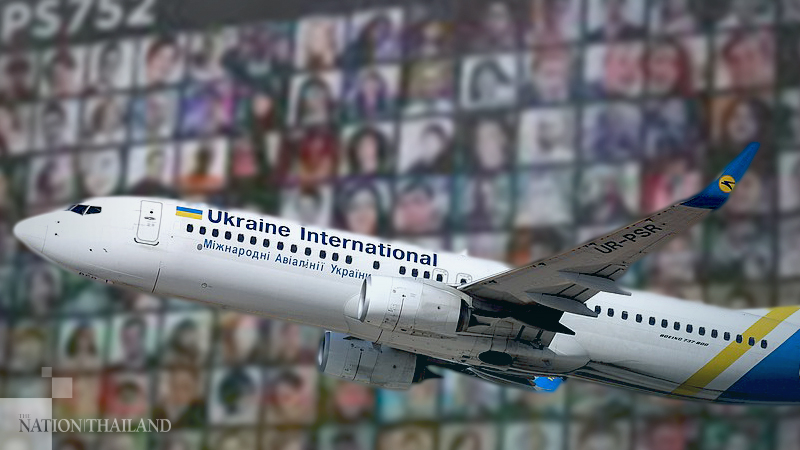
KYIV, Ukraine -In the year since their loved ones died in the downing of Ukraine International Airlines Flight 752 in Iran, they’ve learned the nuances of aviation law. They’ve scanned Iranian news sites daily for any clues on why the passenger plane was shot down just minutes after takeoff from Tehran.

They’ve consoled each other. They also shared their anger.

“It’s like we’re frozen in time. We’re stuck,” said Navaz Ebrahim, whose newlywed sister and brother-in-law were among the 176 killed Jan. 8, 2020, when missiles struck the plane bound for Kyiv.

The past year has turned into a waiting game for answers and closure. Iran, while admitting responsibility for the air disaster that killed all on board, has rebuffed calls for a more transparent investigation, blaming “human error” and denying any systemic flaws. While the government has said it has made arrests over the incident, names have not been released.

Tehran says it has offered the families of those killed $150,000 per victim, but several families said they want justice, not money, and have called on Ukraine or one of the other countries with citizens killed in the crash to bring a case against Iran to the International Court of Justice.

There were 82 Iranians, 63 Canadians, 11 Ukrainians and 10 Swedes on the plane, as well as Afghans, Germans and British nationals.

“What they’re offering to the families right now is blood money,” Ebrahim said. “They just want to close the case.”

Saghar Nourian and her sister, 26-year-old Ghazal, were visiting their family in Iran when a U.S. drone strike killed a top Iranian military commander, Maj. Gen. Qasem Soleimani, in Baghdad on Jan. 3, 2020.

Saghar and her husband flew home to the United States on Jan. 6, but Ghazal’s flight back to Canada wasn’t for two more days.

Just hours before Ghazal’s flight, Iran fired more than a dozen short-range ballistic missiles at military bases housing U.S. troops in Iraq. But the airspace remained open for Ukraine International Airlines Flight 752 to Kyiv.

“I talked to (Ghazal) 30 minutes before boarding, and she didn’t know about the high tension between Iran and the U.S. It was me telling her about it,” Saghar said. “She started crying. She was super worried, not for herself but for the family in Iran.”

Saghar fainted when she saw the news three days later that Iran admitted to shooting down the plane. Iranian President Hassan Rouhani called it a “disastrous mistake.” Iran claimed that the operators who fired missiles were unable to distinguish the passenger jet from potentially hostile aircraft and proceeded without contacting their superiors.

According to the military prosecutor in Tehran, Gholam Abbas Torki, six people were arrested for their role in the tragedy, five of whom have been released on bail. The trial is scheduled to start later this month, said Torki, who led the state’s investigation.

Victims’ families said that alone isn’t sufficient. They have demanded to know the names of those charged, their punishment and a detailed explanation as to what went wrong. But under International Civil Aviation Organization rules, Iran leads the investigation because the plane was downed in Iran.

Iran’s Civil Aviation Organization said this month that it had distributed a draft of the final accident report to the concerned countries, after which the findings will be made public.

Hamed Esmaeilion, who lost his wife and young daughter in the crash and is the spokesman for the Association of Families of Flight PS752 Victims, said the families want the case brought to the International Court of Justice regardless of what the final accident report says.

The families have lost confidence in Iran to investigate its own actions fairly, he said.

“In case Ukraine sees that our efforts don’t take us anywhere, we don’t exclude a possibility to refer this dispute to an international legal forum,” said Ukrainian Foreign Minister Dmytro Kuleba in a statement to The Washington Post.

Andriy Guck, a Ukrainian aviation lawyer representing the family of one of the victims, said he doesn’t expect Ukraine to take that action until after it is finished evaluating the final accident report from Iran, perhaps not until early spring.

Ironically, a precedent for International Court of Justice involvement is the Iran Air flight shot down by the U.S. military over the Persian Gulf in 1988, which killed all 290 people aboard. The two sides reached a settlement in 1996 at the International Court of Justice in which the United States did not admit liability but agreed to pay up to $300,000 to families of each of the passengers.

Separate from Iran’s investigation of the crash, Ukraine opened its own criminal case. But Kuleba expressed frustration with Tehran’s lack of cooperation and said it “significantly delays the process at every stage.”

“We have sent several requests for legal assistance to Iran. Some of them have never been responded to; the responses we did receive have so far been unsatisfactory,” he said. “Furthermore, during our talks Iran agreed to set up a joint investigation team, but no practical steps have been taken in this direction since.”

Iran, cash-strapped in part due to U.S. sanctions, said it would offer the families of the deceased $150,000 per victim, though none of the families are believed to have accepted or received that payment.

Iranian officials have accused Canadian and Ukrainian authorities of stalling negotiations and “politicizing” the tragedy, saying the two nations are not “ready” to discuss compensation. Kuleba said Ukraine hasn’t “received any official information on the matter from Iran.”

Peter Neenan, a partner at London law firm Stewarts, wrote in a commentary that an appropriate compensation would be $400,000 per victim, a calculation he based on the United States paying $300,000 to victims’ families in the 1988 tragedy.

Katerina Gaponenko, the widow of the flight’s captain, Volodymyr Gaponenko, said she doesn’t expect to receive reparations for at least three years.

She got some financial support from the Ukrainian government and her husband’s insurance through the airline, but with two young girls at home, she appealed to Kyiv Mayor Vitali Klitschko for help finding work. He placed her in a job at the Kyiv City State Administration that she started this week.

She’ll wait for compensation if it means getting answers.

“The key issue for me is to hear the real reason for the plane crash,” she said. “We cannot bring back to life the captain, the crew and the passengers. The matter of reparation is not the key one in this case.”

D.C. mayor takes national spotlight in preparing for inauguration, making case for statehood #SootinClaimon.Com

#SootinClaimon.Com : ขอบคุณแหล่งข้อมูล : หนังสือพิมพ์ The Nation.

D.C. mayor takes national spotlight in preparing for inauguration, making case for statehood

InternationalJan 18. 2021D.C. Mayor Muriel Bowser, a Democrat, holds a news conference on Friday, Jan. 15. MUST CREDIT: Washington Post photo by Bill O'LearyD.C. Mayor Muriel Bowser, a Democrat, holds a news conference on Friday, Jan. 15. MUST CREDIT: Washington Post photo by Bill O’Leary
By The Washington Post · Julie Zauzmer, Michael Brice-Saddler

WASHINGTON – Workers had just fenced off all of Capitol Hill – not just the congressional complex but Mayor Muriel Bowser’s Capitol Hill: the wide plaza that locals bike across on sunny days and the gentle hill where they take their children to sled in the snow.

Bowser looked at her city’s geographical and symbolic heart, transformed into a militarized zone. Then, she laced her hands together, pivoted toward a group of 50 National Guard troops in her high-heeled boots – and made a pitch, of all things, for their tourism.

“I know you probably won’t have a lot of time to enjoy our beautiful city,” she said to the volunteers from Virginia who had left their homes and families to protect the nation’s capital from insurrectionists, catching sleep on its cold marble floors. “When you come back, please be sure to do exactly that.”

Since the Jan. 6 storming of the Capitol, and throughout an unprecedented military clampdown to prevent further violence at President-elect Joe Biden’s inauguration, Bowser has popped up everywhere.

She held two news conferences in the hours during and after the riot, while federal authorities answered no questions from the reporters. In the following days, with near-silence from Trump administration about the attack, Bowser spoke authoritatively to a nation hungry for information and reassurance.

The 48-year-old Democrat has stayed on message, just as she did when addressing the National Guard troops – using the unfolding national crisis to make the case for the city of Washington, her native home.

Bowser, first elected in 2014,has been in the national spotlight before, most recently in late spring. She abandoned her years-long reluctance to speak strongly against President Donald Trump, whose cooperation she believed she needed, to criticize his response to the protests over the death of George Floyd.

The tangle quickly escalated far beyond the personal barbs they both fired on Twitter. Four days after federal law enforcement used tear gas to clear peaceful protesters from the street so Trump could pose for a photo, the city awoke to find that Bowser had ordered “Black Lives Matter” painted in enormous yellow letters yards from where the president had stood.

Photographs of Bowser’s taunting brainchild circulated around the world.

Now, the cameras are trained on Bowser again. From “Good Morning America” to “Face the Nation” to “The Situation Room,” she has been interviewed by almost every national network over the past two weeks. A few of her regular news conferences, ordinarily streamed only on the local government-access cable station, have gone live coast-to-coast.

“Certainly this time last year we didn’t expect to be in this situation. Even last week, we didn’t expect to be,” Bowser said at one of those briefings Wednesday, her third in three days.

Anthony Williams, who was mayor of Washington during the Sept. 11, 2001, terrorist attacks, said he has been glued to Bowser’s appearances. “She’s done a great job of stepping up and showing national leadership, notwithstanding the fact she isn’t given the respect as the governor of a state,” Williams said. “Yet she has state responsibilities. On top of that, she has national responsibilities.”

For most inaugurations, the public role of the District of Columbia mayor is to roll out the welcome mat for hundreds of thousands of tourists, then watch the parade from a reviewing stand outside the Wilson Building, D.C.’s city hall.

Not this year. When it became clear that the U.S. Secret Service would attempt to shut down a large swath of the city because of the seriousness of the threat of right-wing violence on Inauguration Day, it was Bowser – not Trump or Biden – who made the announcement.

It was Bowser who told Americans in stark terms not to travel to town for inaugural events. People across the 50 states heard her words and canceled their plane tickets.

“If you take the preparation we did in 2009 and preparations she has to do now in 2021, the degree of difficulty which she’s operating under is at least tenfold, maybe twentyfold,” said former mayor Adrian Fenty, an early political mentor of Bowser’s. He was mayor when Barack Obama’s first inauguration brought unprecedented crowds and threats to the incoming president’s safety.

D.C. Mayor Muriel Bowser, a Democrat, approaches Virginia National Guard troops guarding the Capitol on Tuesday, Jan. 12, 2021. MUST CREDIT: Executive Office of Mayor Muriel Bowser photo by Khalid Naji-Allah

D.C. Mayor Muriel Bowser, a Democrat, approaches Virginia National Guard troops guarding the Capitol on Tuesday, Jan. 12, 2021. MUST CREDIT: Executive Office of Mayor Muriel Bowser photo by Khalid Naji-Allah

Bowser’s chief of staff, John Falcicchio, said that the mayor has spoken with Biden and Vice President-elect Kamala Harris since Jan. 6, and that Bowser’s stay-home announcement was a message the Biden team wanted to send.

“Mayor Bowser has been solely focused on how to keep people away from D.C.,” Falcicchio said, noting that the circumstances have called for a complete reversal of Bowser’s ordinary demeanor. “She travels the world trying to get people to come to Washington, D.C., to see all the great things that we have.”

For support, Falcicchio said, Bowser has leaned on a network of Black Democratic mayors across the country, a group that includes San Francisco’s London Breed, Atlanta’s Keisha Lance Bottoms and Chicago’s Lori Lightfoot.

“Especially in the last year, African American women mayors have come to the forefront of the American political dialogue,” he said. “There’s a collection of women who have stepped forward and assumed that mantle.”

The shutdown of the monumental core was Bowser’s latest somber announcement in a year full of them as she has wielded her executive authority to close businesses to limit the spread of the novel coronavirus and impose curfews after sporadic rioting during Black Lives Matter demonstrations.

“We’ve seen this year, we’ve had to do some extraordinary things to keep people safe,” she said last week.

Bowser said she considers communicating with D.C. residents her “first responsibility,” but the invitations to speak to the rest of the country have allowed her to help shape the inaugural plan.

“I do feel a responsibility to also communicate directly with the American people,” she said. “I’m using my power as the mayor of the best city in the world to convene people.”

Starting hours after the attack on the Capitol, Bowser has steered almost every conversation to her pitch for D.C. statehood. Again and again, she noted that the building ultimately was secured by police officers from a city whose residents do not have voting representation in Congress.

While the images of chaos and military preparations being beamed around the world may not cast the nation’s capital in the most positive light, statehood advocates are hoping Bowser’s decision to fill what seemed like a national leadership void has educated millions about the cause.

“In times of great concern, you need leadership, and we’re not getting that at the federal level. The mayor is stepping up,” said Josh Burch, the founder of Neighbors United for D.C. Statehood. “And when she uses those moments to teach about our status and why statehood isn’t just important for us, but important for them, she’s doing a great of seizing the opportunity that’s given to her.”

Fenty said he is hearing from acquaintances across the country who have seen Bowser on television – and in at least one case, is suddenly interested in D.C. statehood.

He reflected on his own experience in the days leading up to Obama’s 2009 inauguration. The mayor and the incoming president met up 10 days before the swearing-in. They got into a car headed north, out of downtown and through some residential neighborhoods. Fenty did not know the destination.

Obama, it turned out, wanted to stop at Ben’s Chili Bowl, a famed neighborhood eatery. Falcicchio, who was an aide to Fenty at the time, remembers crowds cheering as if the Beatles had stopped by.

Bowser took her own car ride through Washington in the lead-up to this inauguration.

After midnight on the night of the attack on the Capitol, she and acting D.C. police chief Robert Contee circled the city to assess the state of affairs.

At the Capitol, they stopped to thank Inspector Robert Glover, the D.C. officer who had been the commander on the scene. Bowser told Glover that people would remember what he had done that day.

Then, they drove on and looked out at what the day had wrought, riding mostly in silence.

Extremists move to encrypted apps, complicating law enforcers’ tracking #SootinClaimon.Com

#SootinClaimon.Com : ขอบคุณแหล่งข้อมูล : หนังสือพิมพ์ The Nation.

Extremists move to encrypted apps, complicating law enforcers’ tracking

InternationalJan 18. 2021

By The Washington Post · Ellen Nakashima, Mark Berman, Matthew D. LaPlante

WASHINGTON – The dramatic move by big technology firms to evict tens of thousands of users from their social media accounts because of concerns over violence is posing a challenge for law enforcement, which has lost a valuable resource to monitor the growing threat.

In the days after a pro-Trump mob rioted at the U.S. Capitol, Twitter suspended more than 70,000 accounts, Facebook purged an undisclosed number, and Amazon Web Services booted Parler – one of the more popular platforms among far-right domestic extremists – entirely offline.

The FBI has warned about the potential for violence through Wednesday’s inauguration in capitols across the country, saying domestic violent extremists “pose the most likely threat . . . particularly those who believe the incoming administration is illegitimate.”

The targeted accounts and platforms have increasingly seethed with rage over perceived but unfounded grievances and conspiracy theories: criminal immigrants invading the country, an election stolen from President Donald Trump and Satan-worshipping Democrats trafficking in child sex. Communications on these platforms provided law enforcement with insights into disparate groups or movements – some paramilitary, some avowedly white supremacist – and which might be planning violent attacks.

But when the toxic online discourse coincided with an unprecedented assault on the Capitol that left five dead, U.S. tech firms shut accounts and kicked Parler off the Web, leading thousands of users to migrate to encrypted apps and less-moderated platforms such as Telegram, which is based overseas.

“It’s good news and bad news,” said John Miller, deputy commissioner of intelligence and counterterrorism for the New York Police Department, the largest metropolitan police force in the nation. “The good news is for a moment it interrupts the conversation to a mass audience that seems to be growing. The bad news is they’re going to have to find another platform. And you’re going to have to find that platform to follow them.”

The shift to fringe platforms also concentrates the users into smaller forums, where “they will be met by others just as angry and disaffected as they are without any moderating influence from a broader public” said Rita Katz, founder of the SITE Intelligence Group, which tracks online extremism.

The violent discourse is not entirely muzzled. One site, TheDonald.win, which was instrumental in mobilizing Trump supporters to participate in the Jan. 6 attack on the Capitol, is still up and running, still trafficking in violent ideas, said Katz.

On Jan. 10, for instance, a thread posted on TheDonald discussed arresting and executing House Speaker Nancy Pelosi, D-Calif., and other political leaders for “sedition and treason,” according to SITE.

At the end of day, said Katz, the advantage to the public safety outweighs the disadvantage to law enforcement of losing a surveillance window. “When these extremists are on mainstream media, they spread blatant disinformation,” she said. “Pushing them off is one of the most crucial steps in curbing far-right radicalization and conspiracy theories online.”

State and local law enforcers have used social media to anticipate the size of protests and whether they might turn violent. It “helps us track the flow of protest interest and track the interest of those who had, in the past, been known to be unlawful at a protest,” said Nick Street, a spokesman for the Utah Highway Patrol, which is charged with protecting the state Capitol. “It just means we can better do our job by knowing who is coming and the amount of people who are coming.”

The smartest and most ardent violent extremists have always used more secure, encrypted channels. And, Street noted, many protesters were aware that law enforcement agents might be watching public forums. “You’d see comments . . . like ‘Hey, stop talking about it here, the cops are watching,’ ” Street said. “Well, like, yeah we’re watching. No kidding. Why wouldn’t we be?”

Even if law enforcement is not monitoring all comments, said one former federal agent, there is no harm with extremists thinking so, if it subdues their activity. “Let ’em think everybody’s a fed,” said the former agent, speaking on the condition of anonymity to be candid.

Some agencies rely on the public and researchers to alert them to potential violent acts being discussed online rather than devote scarce resources to monitoring social media. And the recent crackdown has eliminated a tip channel.

Mass attackers, for instance, often have expressed desires to carry out violence in online postings or to acquaintances, a phenomenon that researchers call “leakage.”

“There are many things that are reported to us by the community that they see on Twitter and Facebook,” said Andrew Walsh, deputy chief of the Las Vegas Metropolitan Police Department. “The trade-off is these platforms are used by people to discuss the plotting and planning of violence, so [their] loss is problematic. But it’s also problematic that people have a forum to promote and advertise violence.”

Open-source social media is not an infallible tool for law enforcement. Even when content is accessible, it’s often not detailed enough to enable authorities to act swiftly. Robert Bowers, who is charged with killing 11 people at a Pittsburgh synagogue in 2018, made a series of anti-Semitic statements on a far-right site. “I can’t sit by and watch my people get slaughtered. Screw your optics, I’m going in,” he posted on Gab, officials said, less than two hours before entering the synagogue and opening fire. He did not say which synagogue he was attacking.

Most planning of violent criminal activity is done in closed chats and on encrypted platforms, officials said. Last fall the FBI said it thwarted an anti-government group’s plan to kidnap Michigan Gov. Gretchen Whitmer, a Democrat, by infiltrating discussions over several months that the plotters thought were shielded in a private Facebook group and encrypted chats.

But the bureau said a member worried about the group’s plans to kill police officers had agreed to become an informant. In October, state and federal officials announced charges against more than a dozen people it said were involved in plots, among them members of the Wolverine Watchmen, a self-described militia group, and their associates.

“The FBI with a warrant can spy on closed, nonencrypted chats, but having informants or undercover sources inside these closed virtual networks is important to understanding the nature of the threat,” said Javed Ali, a former senior FBI counterterrorism analyst who now teaches at the University of Michigan.

The crackdown on domestic violent extremists resembles in some ways Silicon Valley’s gradual push several years ago to remove foreign terrorism content – particularly related to the Islamic State – under pressure, at times, from the federal government, though some officials said content can be retained for intelligence purposes. But it differs in one important respect: Domestic voices have far more protection under federal law. And the tech firms, though they are not bound by the First and Fourth amendments, have been loath until recently to take down even clearly misleading and dangerous statements.

For social media companies, the decision to remove foreign terrorist content was easier, said Clint Watts, distinguished research fellow at the Foreign Policy Research Institute and a former FBI special agent. He noted that “it’s international. Everybody hates [the Islamic State]. They are not voters, and they are not donors,” he said.

But domestic far-right voices range the gamut from gun-toting, camouflage-clad paramilitaries to suburban moms. “They are voters and donors. They are American citizens,” Watts said. Also, foreign terrorist groups are illegal. The extremist ideology QAnon and far-right groups including the Proud Boys and the “boogaloo boys” are not.

Deciding when a violent extremist’s posts cross the line from aspirational to operational and merits taking action is also difficult, said Tom O’Connor, a former FBI special agent who worked on domestic terrorism cases for 23 years.

“When a horrendous event takes place like this at the Capitol, people want the FBI to start monitoring everything,” he said, “whereas just weeks ago, the same people would have criticized the FBI for reviewing the postings of U.S. citizens.”

Monitoring encrypted venues may be beyond the reach of most state and local law enforcement agencies. But that is less of a concern for organizations such as the FBI and the NYPD, and expert groups such as SITE.

“Wherever they end up,” said Miller, “we’ll find them.”

Man charged with smashing Capitol glass with Trump flagpole seconds before shooting #SootinClaimon.Com

#SootinClaimon.Com : ขอบคุณแหล่งข้อมูล : หนังสือพิมพ์ The Nation.

Man charged with smashing Capitol glass with Trump flagpole seconds before shooting

InternationalJan 18. 2021Tony Naples, left, and Gary Phaneuf salute at a memorial for Ashli Babbitt on Jan. 7, 2021, in Washington. Babbitt was shot and killed during the riot at the Capitol the day prior. MUST CREDIT: Washington Post photo by Matt McClainTony Naples, left, and Gary Phaneuf salute at a memorial for Ashli Babbitt on Jan. 7, 2021, in Washington. Babbitt was shot and killed during the riot at the Capitol the day prior. MUST CREDIT: Washington Post photo by Matt McClain
By The Washington Post · Spencer S. Hsu

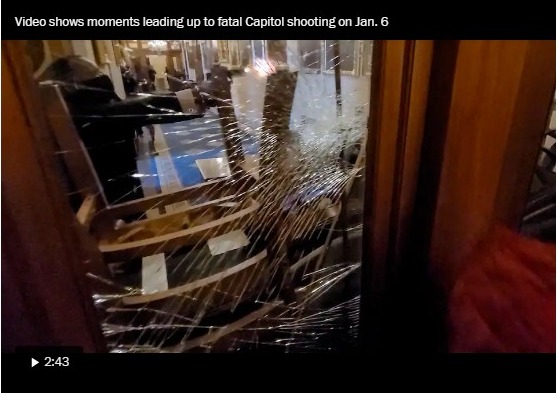
WASHINGTON – Federal prosecutors have arrested a Kentucky man who they say was part of a violent crowd that stormed the House Speaker’s Lobby during the breach of the U.S. Capitol, smashing a window with a flagpole moments before a woman was fatally shot, court filings show.

An FBI charging affidavit alleges that Chad Barrett Jones is the man shown in video at Ashli Babbitt’s left on Jan. 6, wearing a red-hooded jacket and gray skullcap and striking the lobby door’s glass panels as a mob chanted “Break it down!” and “Let’s f—–g go!”

Jones allegedly used a flagpole to break the glass, the affidavit says.

Seconds later, Babbitt, 35, an Air Force veteran from Southern California, was shot by a police officer as she tried to enter the lobby, an inner sanctum that leads to the House floor. Hers is one of five deaths linked to the riot, which was carried out by supporters of President Donald Trump who wanted to stop Congress from certifying President-elect Joe Biden’s election victory.

District of Columbia police and U.S. Capitol Police are investigating the shooting of Babbitt, and the officer involved has been placed on administrative leave. Acting U.S. attorney Michael Sherwin of Washington has said investigators are probing all aspects of the shooting of Babbitt, including whether the officer, whose name has not been released, used excessive force. They are also examining whether the shooting was foreseeable and occurred during felonies committed by others, in which case those individuals could face felony murder charges.

Dozens of people have been arrested for their roles in the Jan. 6 riot. On Sunday, Capitol Police arrested Couy Griffin, a county commissioner in Otero County, N.M., who heads a group called Cowboys for Trump and has spoken openly about his involvement in the storming of the Capitol.

Images from a Facebook video that Griffin posted shows that he was within the restricted area of the building, the FBI said in an affidavit. In the video, on the Cowboys for Trump Facebook page, Griffin said he had “climbed up on the top of the Capitol building and . . . had a first row seat.”

He also raised the specter of a future gun rights rally at the Capitol, saying there would be “blood running out of that building” and promising, “we will plant our flag on the desk of Nancy Pelosi and Chuck Schumer.”

Griffin said at a commission meeting last week that he planned to return to Washington to protest the inauguration and would bring guns with him, the affidavit said. He was arrested Sunday afternoon just north of the Capitol.

The affidavit said Griffin was interviewed by the FBI on Monday and told agents “that he hopes a change in leadership can be accomplished ‘without a single shot being fired’ but noted that there was ‘no option that’s off the table for the sake of freedom.’ “

Jones, of Mount Washington, Ky., was arrested Sunday. He is charged with assaulting a federal officer, civil disorder, obstruction of justice, destruction of property and trespassing. To support those charges, prosecutors submitted a statement by FBI Special Agent Javier Gonzalez narrating the three minutes before Babbitt was shot.

Citing video footage published by The Washington Post and on YouTube, the agent described apparent lawmakers and officials awaiting evacuation yards behind lobby door, which was barricaded with chairs and protected by officers.

One man splintered the glass door panels with punches as the crowd shouted at officers, including one person who cried out “F— the blue” multiple times, the statement by Gonzalez says.

Another voice warned the officers to leave, saying he did not want to see them get hurt. Three officers appeared to move to one side as colleagues in tactical gear arrived, the statement says.

But within seconds, a man identified as Jones allegedly struck the glass with a wooden flagpole at least 10 times, attempting to break in. A police officer, with gun raised, appeared to shoot Babbitt, with Jones still in view at the left, holding the pole, the FBI agent said.

The FBI interviewed a relative and a close friend of Jones who had identified him from footage of the shooting, the agent said. Court papers say the relative, identified as W-1, told the FBI that he spoke with Jones on the night of Jan. 6.

The relative allegedly described Jones’s clothing to FBI agents as a way of identifying him, and said Jones was “using a rolled up Trump flag to attempt to break the glass on an interior door,” the court papers say.

In three FBI interviews, the witness told agents that he contacted Jones after watching news of Babbitt’s death and told him that he needed to contact the FBI or an attorney. Jones allegedly responded by saying he wanted to explain to another close friend “why it all was happening and why it was a hoax.”

That friend, identified as W-2, also allegedly told FBI agents that he recognized Jones from video circulating on the Internet as the man wearing a red jacket and a gray cap, breaking a window inside the Capitol, and standing next to Babbitt.

The FBI said the friend told agents that Jones called him on Jan. 7, saying he was in trouble, admitted that he broke the glass and “called himself an idiot.” According to the affidavit, the friend said Jones told him that he was in the middle of the crowd and had been able to walk into the Capitol “without any problem.”

Jones attended a previous Trump rally in Washington, his relative allegedly told the FBI, adding that he saw on Facebook that Jones was going to the Capitol on Jan. 6. The “Stop the Steal” demonstration that day was inspired by Trump’s repeatedly debunked claims that he lost reelection because of fraud.

At least three others were arrested or charged in their home states over the weekend, the U.S. Justice Department said.

One was Brandon Fellows, 26, of Albany, N.Y., who told Bloomberg News that he had “no regrets” about entering the Capitol and that his Bumble dating profile was “blowing up” after he posted a picture of himself there.

Photos on social media sites show Fellows with his feet propped on a table in the private office of Sen. Jeff. Merkley, D-Ore., and sitting on a police motorcycle outside the Capitol, wearing costume hat, fake orange beard and a red, white and black jacket and “USA” in blue letters, the FBI said. He was charged with trespassing and disorderly conduct on Capitol grounds.

On Saturday, two cousins were arrested and charged with assaulting police, civil disorder, and other offenses during the riot. One allegedly told a witness that he would return to Washington, armed, for future pro-Trump demonstrations and not go home “unless he was in a body bag,” the FBI said.

An FBI affidavit said Cody Page Carter Connell of Louisiana allegedly described events in a conversation on social media, saying he and his cousin Daniel Page Adams of Texas stormed police and breached the Capitol after Adams “got clubbed and shot with rubber bullet.”

“But we pushed the cops against the wall, they dropped all their gear and left,” the FBI quoted Connell as allegedly saying.

“We will be back and it will be a lot worse than yesterday,” Connell allegedly wrote on Facebook, the FBI said.

Man arrested near Capitol for carrying gun, ammunition; woman arrested for allegedly impersonating police #SootinClaimon.Com

#SootinClaimon.Com : ขอบคุณแหล่งข้อมูล : หนังสือพิมพ์ The Nation.

Man arrested near Capitol for carrying gun, ammunition; woman arrested for allegedly impersonating police

InternationalJan 18. 2021

By The Washington Post · Laura Meckler

WASHINGTON – A 22-year-old Virginia man whose Facebook page features a photo from the Jan. 6 riot at the U.S. Capitol was arrested near the Capitol complex on Sunday, carrying three high-capacity magazines, 37 rounds of unregistered ammunition and a Glock 22 firearm.

The arrest of Guy Berry of Gordonsville, Va., was reported by District of Columbia police and confirmed by his aunt, who said she was his primary caregiver when he was a child and who spoke on the condition of anonymity to protect her privacy.

The aunt said she saw Berry on Jan. 6 and knows he was not was at the Capitol that day, when a mob of supporters of President Donald Trump forced their way into the building to try to stop the certification of his election defeat.

She said her nephew often voiced pro-Trump sentiments and “always carries his gun.” Asked why, she said, “Just because he can.”

“He’s one of those open-carry people,” the aunt said, adding that she and her nephew disagreed over politics and his decision to carry a firearm.

“I keep telling him Black men can’t walk around with guns on his hip, but he doesn’t believe me,” she said. She said that she received a voice mail from him early Sunday saying he had been arrested, but that she had not yet spoken with him.

Also this weekend, Capitol Police say they arrested a woman for impersonating a police officer, stopping her at a security checkpoint in place for Wednesday’s inauguration.

The areas around the Capitol and the White House, as well as much of downtown Washington, are under a massive lockdown following the breach of the Capitol, which resulted in the deaths of a Capitol Police officer and four others.

Law enforcement agencies have warned of the possibility of additional violent protests on Sunday and through Wednesday’s inauguration of President-elect Joe Biden in Washington and at state capitols.

But with a huge police and National Guard presence around key government buildings and Washington’s monumental core, no major protests or violence had materialized by 3 p.m. Sunday.

A valid security credential is needed to enter the sprawling and unprecedented security zone, with many checkpoints in place.

Police said Berry was walking in the Capitol area just after midnight Sunday, with a firearm “clearly visible” in a holster. He was stopped near a police checkpoint, and officers concluded he was not permitted to carry a handgun in the District of Columbia. They then discovered that he had the magazines and ammunition, so they arrested him, police said.

He was arrested for carrying a pistol without a license, possession of a large-capacity ammunition-feeding device and unregistered ammunition.

Berry is pictured on his Facebook page wearing a black cowboy hat, with his arms folded, looking down at the camera. His cover photo is a wide shot of the U.S. Capitol during the riot, with two large “Trump 2020” signs on display and smoke rising.

A post on Election Day shows video of Berry, again in his cowboy hat, saying he “did my part” and voted, exulting that he “put a shovel of coal in the Trump train–choo, choo!” Above this video, he wrote, “I see smoke in the district. . . trump better win #TrumpTrain.”

Berry’s Facebook page bio says, “A warriors mentality, with a poets soul.”

In 2017, Berry was arrested in Charlottesville, Va., for shooting a firearm within 1,000 feet of a school, a felony. The case was later dropped. Berry’s aunt said that the case did not involve an altercation with anyone and that her nephew had shot into the ground. Nonetheless, she said, the arrest derailed his plans to enlist in the military.

Since then, Berry has worked off and on, driving trucks, she said. She said he was supposed to start working Monday driving a truck for a gas company.

In a separate incident, the woman arrested on Saturday was stopped by Capitol Police about 8:45 a.m., at a checkpoint.

She presented what was identified as a military challenge coin, a pocket-size medallion that is typically given out by military commanders, Capitol Police said.

The woman, whose name was not released, said she was a law enforcement officer. But as she was being questioned, she drove off. She was stopped shortly thereafter and placed under arrest, police said.

Capitol Police said she was charged with false impersonation of a law enforcement officer, failure to obey an officer and fleeing a law enforcement officer.

The woman was taken for evaluation at the D.C. Comprehensive Psychiatric Emergency Program and later processed at Capitol Police headquarters and then transported to the D.C. Central Cell Block.

On Friday, a Virginia man who has been working as a private security guard in the D.C. area was arrested after law enforcement found at least one firearm and ammunition in his truck as he tried to enter an inauguration security checkpoint.

Wesley Allen Beeler, 31, of Front Royal drove his Ford F-150 up to a checkpoint near the Capitol, where he was met by Capitol Police officers, according to the court documents.

In an interview, he said he forgot that his firearm was in his truck when he left his home in Virginia, where he said he has a license to carry. A person with knowledge of Beeler’s actions, who spoke on the condition of anonymity because the case is pending, said Beeler has no extremist ties, cooperated fully with law enforcement and was cleared from further investigation, except for the charge of violating D.C. law by carrying a pistol without a license.