Google follows Apple in ending third-party ‘cookies’ in ad-tracking #ศาสตร์เกษตรดินปุ๋ย

#ศาสตร์เกษตรดินปุ๋ย : ขอบคุณแหล่งข้อมูล : หนังสือพิมพ์ The Nation

https://www.nationthailand.com/edandtech/30380566?utm_source=category&utm_medium=internal_referral

Google follows Apple in ending third-party ‘cookies’ in ad-tracking

Jan 15. 2020
By Syndication Washington Post, Bloomberg · Naomi Nix, Gerrit De Vynck 

Google is planning to “render obsolete” a key tool advertisers use to track people around the web, increasing user privacy but also disrupting the marketers and publishers who rely on the search giant’s ad products.

Over the next two years the Alphabet Inc. unit intends to stop supporting third-party cookies in its Chrome browser, Google said in a blog post Tuesday. Cookies are little bits of code that stick in peoples’ browsers and follow them around the web and are a core part of the online advertising landscape. They allow advertisers to target people with ads for websites they previously visited and make it easier to determine how effective certain ads were in getting internet surfers to buy something.

Apple Inc.’s Safari and Mozilla Corp.’s Firefox browsers already block third-party cookies, but Google has argued in the past those approaches are too heavy-handed and risk cutting into vital revenue for internet publishers. In the blog post, Chrome Engineering Director Justin Schuh said blocking third-party cookies could have “unintended consequences that can negatively impact both users and the web ecosystem.” The company is seeking input from advertisers, publishers and Chrome users as it works to find ways to help support advertising online while still preserving privacy.

“Users are demanding greater privacy — including transparency, choice and control over how their data is used — and it’s clear the web ecosystem needs to evolve to meet these increasing demands,” Schuh said.

Google has talked about this approach before. While Apple and Mozilla don’t derive much money from advertising, the vast majority of Google’s revenue comes from digital ads. It’s in the company’s interest to keep advertisers spending more money on its websites and ad products. Google’s empire was built on its ability to provide targeted advertising.

Google is navigating a thicket of threats to its business though, including a rising demand for greater privacy and government investigations into whether its business practices in the ad tech world are anti-competitive. If it shuts advertisers out from its system too much, they could increase their complaints that it’s being unfair. But if it ignores privacy advocates, some Chrome users could decamp for other browsers.

Virtual reality to get role in autonomous vehicle development #ศาสตร์เกษตรดินปุ๋ย

#ศาสตร์เกษตรดินปุ๋ย : ขอบคุณแหล่งข้อมูล : หนังสือพิมพ์ The Nation

https://www.nationthailand.com/edandtech/30380449?utm_source=category&utm_medium=internal_referral

Virtual reality to get role in autonomous vehicle development

Jan 12. 2020
The Yomiuri Shimbun

The Yomiuri Shimbun
By The Japan News/ANN

The Yomiuri Shimbun: The government plans to create a performance simulator in which the roads around the Odaiba district of Tokyo are replicated in virtual reality, part of its measures to support the development of autonomous vehicles in fiscal 2020.

By verifying the performance of sensors indispensable in autonomous driving through the use of virtual reality, the amount of road testing conducted with real vehicles can be drastically reduced with the aim of speeding up the development process for domestic manufacturers.

This is one initiative as part of the Cabinet Office’s Cross-ministerial Strategic Innovation Promotion Program which supports the development of autonomous driving.

The simulator would be made available to domestic manufacturers of cameras, millimeter-wave radar and other types of sensors, such as Sony Corp., Denso Corp. and Pioneer Corp. It could also be used by manufacturers of finished vehicles such as Toyota Motor Corp. and Nissan Motor Co.


In advanced autonomous driving, sensors recognize not only nearby vehicles and pedestrians, but lane lines, traffic signals and other objects as well. This data is processed by artificial intelligence to avoid accidents during driving.

Sensors play the role of the human eye, and their sophistication, in parallel to AI, is expected to determine the course of global competition over the practical applications of autonomous driving.

The simulator would replicate a network of about 54 kilometers of roads from the Daiba district of Minato Ward to the Toyosu district of Koto Ward in a virtual reality environment.

In addition to weather conditions, many fine points of the simulator’s environment can be freely adjusted, including the movements of oncoming vehicles and pedestrians, the fading of lane lines, and the location of signs.

Conducting tests using real vehicles in special driving conditions, such as intense rain, snow or a pedestrian suddenly running out into the street, require considerable time and money.

As such, “Testing in virtual reality can greatly reduce the number of tests using real vehicles and speed up development,” said Kanagawa Institute of Technology Prof. Hideo Inoue, who has been commissioned by the government to take part in creating the simulator.

If each company uses a simulator to collect data under the same conditions, it could also help standardize quality control.

ที่สุดบนโซเชียลเมืองไทยปี 2562 #ศาสตร์เกษตรดินปุ๋ย

#ศาสตร์เกษตรดินปุ๋ย : ขอบคุณแหล่งข้อมูล : หนังสือพิมพ์คมชัดลึก

https://www.komchadluek.net/news/lifestyle/408687?utm_source=category&utm_medium=internal_referral&utm_campaign=lifestyle

ที่สุดบนโซเชียลเมืองไทยปี 2562

6 มกราคม 2563 – 15:30 น.
ที่สุดบนโซเชียลเมืองไทยปี 2562,โซเชียล,กูเกิล
เปิดอ่าน 219 ครั้ง

ที่สุดบนโซเชียลเมืองไทยปี 2562 คอลัมน์…  อินโนสเปซ โดย…  บัซซี่บล็อก 

เรียกได้ว่าปี 2562 ที่เพิ่งผ่านพ้นไป เป็นอีกปีแห่งที่สุดของความคึกคักบนโลกโซเชียลเมืองไทย ที่สำคัญหลายๆ เรื่องราวที่เปิดเผยสู่การรับรู้ และสร้างผลกระทบทั้งเชิงบวกและลบให้แผ่ขยายวงอย่างรวดเร็วในพริบตา ก็เริ่มต้นจากเพียง 1 โพสต์ หรือ 1 แชร์บนเครือข่ายสังคมออนไลน์นี่เอง

และเป็นธรรมเนียมปฏิบัติที่แต่ละเครือข่ายโซเชียล จะมีการรวบรวมอันดับสถิติ “ที่สุด” ในของแต่ละรอบปีที่สิ้นสุดลงไป ซึ่งที่น่าสนใจของปีนี้คือ มีละครดังเข้ามาเบียดแทรกครองใจชาวโซเชียลไทยกันหลายเรื่องทีเดียว

มาเริ่มต้นกันที่ยูทูบ ซึ่งมีผู้ใช้ต่อเดือนไม่ต่ำกว่า 2 พันล้านคนทั่วโลก แต่ละวันที่จำนวนการเข้าไปดูคลิปวิดีโอผ่านแพลตฟอร์มนี้ร่วม 1 พันล้านชั่วโมง และทุก 1 นาทีมีการอัพโหลดคอนเทนท์วิดีโอความยาวรวมกัน 500 ชั่วโมง

ในส่วนของประเทศไทย ตัวเลขทางการจากการเปิดเผยของผู้บริหารกูเกิล ประจำประเทศไทย ซึ่งเป็นเจ้าของแพลตฟอร์มยูทูบ เคยระบุไว้เมื่อปี 2560 ว่า ประเทศไทยติดอันดับ Top 10 ที่มีผู้ใช้งานยูทูบสูงที่สุดของโลก เข้าถึงประชากรมากกว่า 40 ล้านคนทั่วประเทศ จากจำนวนผู้ใช้อินเทอร์เน็ตทั้งประเทศที่มีกว่า 46 ล้านคน นั่นหมายความถึงศักยภาพในการเป็นสื่อที่เข้าถึงกลุ่มคนต่างจังหวัดได้อย่างกว้างขวางอีกด้วย

ข้อมูลจาก Youtube Rewind 2019 สรุปวิดีโอยอดนิยมแห่งปี 10 อันดับแรกของไทย (จัดอันดับ ณ วันที่ 30 พ.ย. 62) ซึ่งมียอดการเข้าชมรวมกันมากกว่า 95 ล้านครั้ง และช่องที่เป็นเจ้าของวิดีโอเหล่านี้มีจำนวนผู้ติดตามรวมกันมากกว่า 90 ล้านคน ได้แก่

1.คลิปแกล้งแฟนหลอกผีที่โหดที่สุด!! (Kaykai&Sprite) ที่มียอดเข้าชมเกือบ 17 ล้านครั้งจากช่อง Kaykai Salaider (เก๋ไก๋สไลเดอร์) ซึ่งเป็นครีเอเตอร์ไทยรายแรกที่มีผู้ติดตามทะลุ 10 ล้านคน 2.การ์ตูนจากช่องมิกกี้เม้าส์ของค่ายดิสนีย์ที่มีชื่อตอนว่า “Our Floating Dreams” กับกระแสเพลงชิปกับเดล 3.คอมเมดี้ซิทคอม “เป็นต่อ” ตอน “นารีรำพึง” 4.เหมาของหมด 7-11 ครั้งแรกในชีวิต!!! เพื่อบริจาคเด็กบนดอย 5.โยนทุเรียนจากตึกสูง 35 ชั้น!!!! 6.มีแฟน VS ไม่มีแฟน ต่างกันอย่างไร ?

7.ถ้า Rapper สั่งอาหารตามสั่ง???(ภาค2) – Bie The Ska (บี้ เดอะสการ์) 8.พีช อีท แหลก vs ราชานักกินไต้หวัน Ep.53 ปี 2 | PEACH EAT LAEK 9. ASMR รังผึ้งแสนอร่อย กินบ่อยๆ เป็นเบาหวาน (โคตรหวาน!) และ 10.FIN | ไม่มีปัญญาทำเอง แล้วยังกล้ามาขี้ตู่ | ทองเอกหมอยาท่าโฉลง ช่อง 3

ทางด้านเว็บไซต์ Google Trends ก็ได้เปิดสถิติคำค้นหายอดฮิตในรอบปี 2562 ดังนี้
1.ชิมช้อปใช้ 2.กรงกรรม 3.เมียน้อย 4.ใบไม้ที่ปลิดปลิว 5.หัวใจศิลา ส่วนข่าวในประเทศ 5 อันดับแรกที่ได้รับความสนใจค้นหาผ่านกูเกิล ได้แก่ 1.ข่าวลันลาเบล

2.ข่าวออฟฟี่ แม็กซิม 3.ข่าวน้องโยโย่ 4.ข่าวป๊อบ ปองกูล และ 5.ข่าวปุ๊กกี้ ปริศนา และข่าวต่างประเทศ ได้แก่ 1.ข่าวพายุเข้าญี่ปุ่น 2.ข่าวพายุปาบึก 3.ข่าวดาวเคราะห์น้อยชนโลก 4.ข่าวซึงรี และ 5.ข่าวฮ่องกง / ร้านค้า

ท้ายสุดของสุดยอดละครครองใจชาวโซเชียล กูเกิลได้จัดให้ 5 อันดับแรก ตามนี้ 1.กรงกรรม 2.เมียน้อย 3.ใบไม้ที่ปิดปลิว 4.หัวใจศิลา และ 5.มธุรสโลกันตร์

ขณะที่ แพลตฟอร์มทวิตเตอร์ โซเชียลยอดฮิตของคนข่าวและวัยใส รวมถึงกำลังมาแรงในเหล่านักปั้นแบรนด์/เจ้าของแบรนด์ ด้วยยอดผู้ใช้ในไทยไม่ต่ำกว่า 20 ล้านคน มีการเปิดเผยสถิติส่งท้ายปีที่เพิ่งผ่านพ้นไปว่า 5 อันดับแฮชแท็กยอดนิยมแห่งปี 2562 ก็คือ #เป๊กผลิตโชค, #bambam, #lisa, #bnk48 #ออฟกัน และสำหรับแฮชแท็กเอ็นเตอร์เทนเมนต์ที่มีคนทวิตมากที่สุดในประเทศไทย น่าสนใจว่า 5 อันดับแรก เป็นศิลปินสัญชาติไทยทั้งหมด ไม่ว่าจะเป็น #เป๊กผลิตโชค, #bambam, #peckpalitchoke, #lisa, #bnk48 ส่วนแฮชแท็กดาราไทยที่มียอดรีทวิตสูงสุดแห่งปี ได้แก่ #ออฟกัน, #singtoprachaya และ #kristperawat

อีกทั้ง ทวิตเตอร์ ยังรวบรวมบทสนทนาที่ถูกพูดถึงตลอดทั้งปี 2562 โดยมองว่าปีนี้ในประเทศไทยนับได้ว่าเป็นปีที่ผู้ใช้งานคือผู้กำหนดบทสนทนาที่เกิดขึ้นอย่างแท้จริง ว่ามีเรื่องราวอะไรกำลังเกิดขึ้น หรือแฮชแท็ก #WhatsHappening อีกทั้งมีหลายช่วงเหตุการณ์ที่กลายเป็น “ทอล์กออฟเดอะทาวน์” บนทวิตเตอร์ ตั้งแต่ #พระราชพิธีบรมราชาภิเษก หรือพระราชพิธีบรมราชาภิเษก รัชกาลที่ 10 ซึ่งมีการเฉลิมฉลองเป็นเวลา 3 วัน #ThailandElection2019 การเลือกตั้งที่ประชาชนรอคอยมาอย่างยาวนาน หรือ #สงกรานต์ การฉลองปีใหม่ไทย และ #ASEANSummit ซึ่งจัดขึ้นที่กรุงเทพฯ และประสบความสำเร็จด้วยดี

ก่อนหน้านี้ ผู้บริหารของบริษัท มีเดียโดนัทส์ ผู้แทนอย่างเป็นทางการของทวิตเตอร์ในประเทศไทย เคยกล่างถึง “ความแรง” ของเทรนด์ #Happening ว่าเนื่องจากทวิตเตอร์ที่เป็นแพลตฟอร์มที่ “รวดเร็ว” คนมักเข้ามาพูดถึงข่าวสารบ้านเมือง หรือสิ่งที่กำลังเกิดขึ้น ณ ปัจจุบันนั้นๆ เช่น บีทีเอสเสีย บีทีเอสซ่อมแล้ว ไฟไหม้ที่นี่ มีระเบิดที่ไหน น้ำท่วม ฝนตกที่ไหน นอกจากนี้ บางประเด็นที่เป็นกระแสในวงกว้างก็ยังมีแบรนด์ใหญ่ๆ เข้ามาเกาะกระแส ต่อยอดไปสู่การทำกิจกรรมการตลาด หรือทำโปรโมชั่นใหม่ๆ อีกด้วย

และอีกแนวโน้มที่แรงได้อีกคือ ทวิตเตอร์กับละครทีวี ดูไป ทวิตไป โดยการรวบรวมข้อมูลช่วงเกือบ 10 เดือนแรกของปี 2562 พบว่า “กรงกรรม” ติดอันดับ 1 ในละครที่มีการพูดถึงมากที่สุดบนทวิตเตอร์ คือ 7 ล้านทวิต และมีคนเห็นทวิตเหล่านี้ 2.8 พันล้านครั้ง มีทั้งทวิตที่เม้าท์ตัวละครและบทละคร ขณะที่ในภาพรวมการคุยเรื่องบันเทิงบนทวิตเตอร์มีประมาณ 80 ล้านการสนทนา

AIS Fibre reinforces the leader in broadband technology #ศาสตร์เกษตรดินปุ๋ย

#ศาสตร์เกษตรดินปุ๋ย : ขอบคุณแหล่งข้อมูล : หนังสือพิมพ์ The Nation

https://www.nationthailand.com/recommended/819?utm_source=category&utm_medium=internal_referral

AIS Fibre reinforces the leader in broadband technology

Jan 09. 2020
by presenting the first and only SuperMESH WiFi innovation in Thailand

Deliver real speed up to 1 Gbps on WiFi

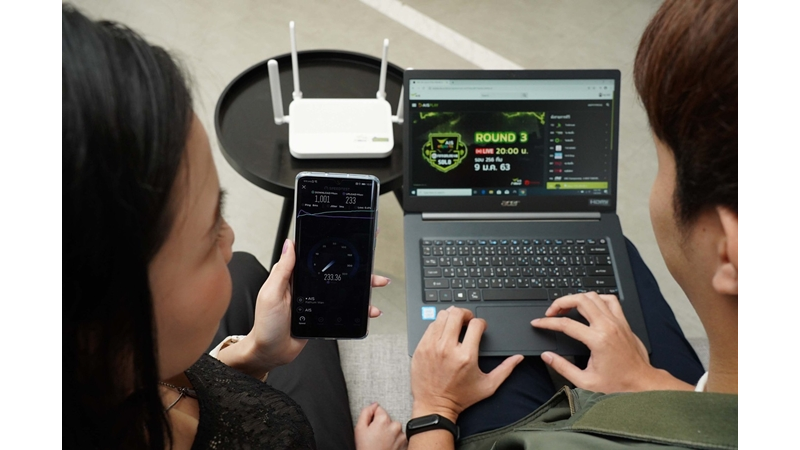
AIS Fibre continues to provide quality of home broadband internet experience No.1 for Thais with reinforcing the real innovation leader that is determined to innovate, develop different technology, and lead the trend before everyone else by bringing the best innovation “SuperMESH WiFi” to enhance the efficiency of home internet to be more powerful under the concept of “Forward, Better, Simple”, including the new standard routers and new service packages with the most beneficial value on the best networks to transform the home broadband internet standard to the next level. AIS Fibre is the first and only one provider that emphasizes on quality to ensure customers that the 1 Gbps package can really use at 1 Gbps! and customers will get the entire home with high speed since the first day of installation, able to support new consumer lifestyles and technological progress in 2020.

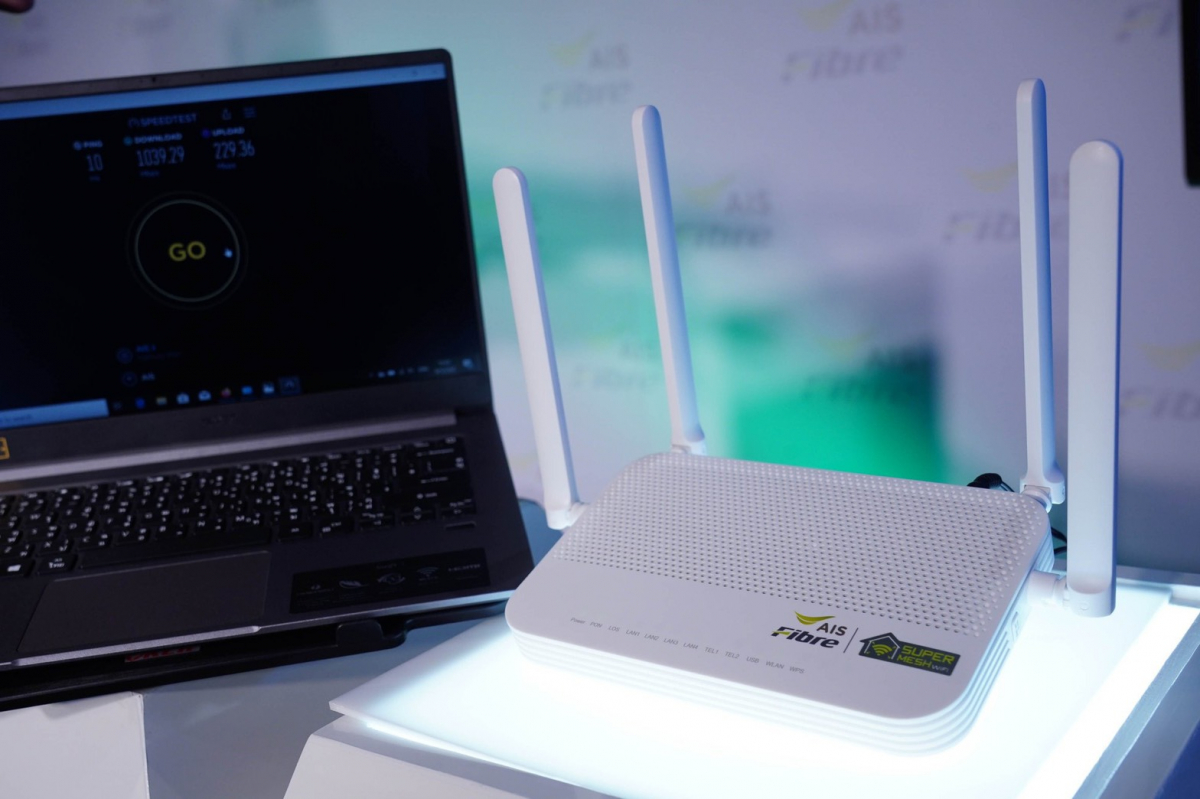
  • Fulfill customers life with “Better” speed with the AIS SuperMESH WiFi Router, the new standard of Thai routers with the capability of the innovation team of AIS Fibre in Designed and Customized the new Mesh WiFi technology to produce the best and most advanced router technology for Thais by helping to increase the speed of delivering at full speed, covering all rooms in the house, answering to customers who are large families and support the usage behavior of consumers in the digital era that demands high-speed internet anywhere and anytime, with the most beneficial value package, speed 1000/200 Mbps for only 999 baht per month and Get Free! 2 AIS Fibre SuperMESH WiFi Routers (with a value of 7,980 baht)
  • Outstanding with 4 best and most advanced features and no one has done before, which is considered to be “The Best and Most Advanced ISP Router” or the router of the best and most advanced internet service provider in the market today.

1) Internet signal distribution with fast and powerful at full speed 1 Gbps, reliable on WiFi.

2) Connect to a Mesh WiFi to distribute the signal faster, and cover equally in every corner of the house.

3) Connect up to 8 AIS SuperMESH WiFi Router devices, and support a large number of smart devices and IoT devices, which can transform customers home into a Smart Home that able to control everything with fingertips.

4) This is the only “Green Energy Router” in Thailand that assists in saving energy and reducing electricity usage by more than 30%, compared to the same router of other service providers.

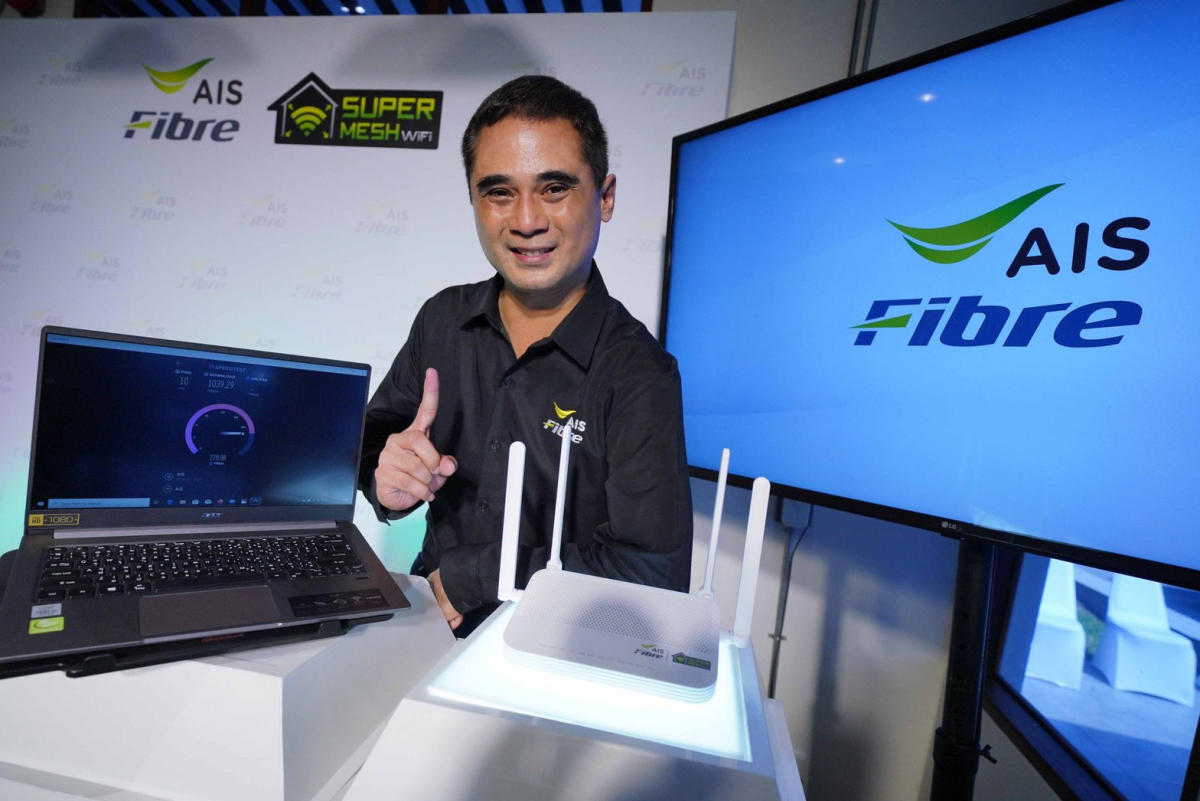
Mr. Saran Phaloprakarn, Head of Fixed Broadband Department, AIS said “According to a study of people’s internet usage habits today, it has been found that most consumers require the speed of the internet consistently also cover all areas of the house. Most of them live in a two-story house, but with a WiFi Router Only 1 router, including may not be able to place the router in the center of the house and appearing in the spread of WiFi signals that not covered the whole house. In the past, AIS Fibre has been committed to the development of technology and solutions to meet the needs of customers in all dimensions continuously; we are the first and only service provider in Thailand that has developed the SuperMESH WiFi innovation that can connect to a mesh WiFi signal covering all corners of the house without LAN wiring, empowering customers to use the internet at full efficiency from the first day of installation, which has collaborated with world-class partners to study, test, and develop in-depth Mesh WiFi technology continuously to be a new alternative for customers, until being more widely used of Mesh WiFi to enhance the home broadband internet experience to be the best for Thais.

“To support the changes in technology that will occur in the year 2020 and the future such as the growth of video streaming in 4K resolution, 5G technology and new applications, Virtual Reality (VR) technology that demands gigabit high-speed internet. Today, AIS Fibre is ready to take the SuperMESH WiFi innovation and standard router to the next level, this time, we have chosen to use the MESH WiFi Router from Huawei, the world-class network equipment manufacturer, together with the best technology developed by AIS Fibre and is the only one in Thailand and give us the best and most advanced technology router in the market that meet the needs of customers who require to use high-speed WiFi throughout the house by providing the efficiency of “Forward” signal distributed at full speed of 1 Gbps on WiFi is the first in the market that can be achieved and ready to connect as a Mesh WiFi to deliver the signal faster, equally throughout the house without LAN wiring and can connect up to 8 devices, there is no problem with blind spots, including “Speed Toggle” for customers to adjust the download/upload speed by themselves, also ready to deliver services at “Better” and “Simple” by sending AIS Fibre GURU, a team of expert technicians to facilitate installation to customers at home; therefore customers can be confident that the WiFi signal is excellent throughout the house since the first day of installation.

New and current customers can apply for the AIS FIbre SuperMESH WiFi package from 11 January 2020, with the most beneficial value package, 1000/200 Mbps speed at only 999 baht per month, and Get Free! AIS FIbre SuperMESH WiFi Router for 2 units, with a value of 7,980 baht. Also, customers can select to add an AIS PLAYBOX additional service for just 100 baht per month, which comes with world-class content from famous channels, with the PLAY FAMILY package for 12 months, HOOQ for 6 months, and NETFLIX for 3 months for free! Total content value of 3,192 baht. However, if the customer wants to add a router to the house, customers can notify the technician immediately on the installation date, and receive a special 50% discount to just 1,990 baht per point (from the regular price at 3,990 baht).

“All of this reinforces the concept of ‘Forward, Better, Simple’ in moving forward to provide the No. 1 home broadband internet experience that is superior to AIS Fibre’s customers, and also being an extension of the success of the new Thai internet standard that guaranteed by the number of the fastest-growing broadband customers in the market, which currently has a total of over 1 million customers.

From now on, AIS Fibre will continue to focus on service quality and expanding service areas to cover 77 provinces by 2020 as the goal of “The Most Admired Internet Service Provider in Thailand”, which we are confident that AIS Fibre will become the Top of Mind Brand of customers nationwide as we have set a goal for sure.” Saran concluded

After mishap with Boeing spacecraft, NASA faces a dilemma #ศาสตร์เกษตรดินปุ๋ย

#ศาสตร์เกษตรดินปุ๋ย : ขอบคุณแหล่งข้อมูล : หนังสือพิมพ์ The Nation

https://www.nationthailand.com/edandtech/30380352?utm_source=category&utm_medium=internal_referral

After mishap with Boeing spacecraft, NASA faces a dilemma

Jan 10. 2020
Chris Ferguson, Boeing director of Starliner Crew and Mission Systems and a former NASA astronaut, fist bumps NASA commercial crew astronaut Suni Williams as Nicole Mann and Bob Behnken prepare for emergency egress system training at Kennedy Space Center. MUST CREDIT: Photo for The Washington Post by Jonathan Newton

Chris Ferguson, Boeing director of Starliner Crew and Mission Systems and a former NASA astronaut, fist bumps NASA commercial crew astronaut Suni Williams as Nicole Mann and Bob Behnken prepare for emergency egress system training at Kennedy Space Center. MUST CREDIT: Photo for The Washington Post by Jonathan Newton
By The Washington Post · Christian Davenport

As it probes why Boeing’s Starliner spacecraft suffered a serious setback during a flight test last month that forced the cancellation of its planned docking with the International Space Station, NASA faces a high-stakes dilemma: Should the space agency require the company to repeat the uncrewed test flight, or allow the next flight to proceed, as originally planned, with astronauts on board?

The answer could have significant ramifications for the agency, and put astronauts’ lives on the line, at a time when NASA is struggling to restore human spaceflight from the United States since the Space Shuttle fleet was retired in 2011.

Forcing Boeing to redo the test flight without anyone on board would be costly, possibly requiring the embattled company, already struggling from the consequences of two deadly crashes of its 737 Max airplane, to spend tens of millions of dollars to demonstrate that its new spacecraft is capable of meeting the space station in orbit.

But if NASA moves ahead with the crewed flight, and something goes wrong that puts the astronauts in danger, the agency would come under withering criticism that could plague it for years to come.

For now, NASA is moving cautiously. It has formed an independent team with Boeing to examine what went wrong with the Starliner during last month’s test flight. NASA also is reviewing data to help it determine if the capsule achieved enough objectives during its truncated flight to assure NASA that its astronauts will be safe.

On Dec. 20, an Atlas V rocket lifted off from Cape Canaveral, delivering the Starliner into space. But soon after it was on its own, the Starliner suffered a software problem – its onboard clock was 11 hours off. As a result, the engines that would have put it on a trajectory to the space station failed to fire, even while other thrusters, designed to keep the capsule stable, did fire, expending precious fuel.

Boeing officials regained control of the spacecraft and were able to complete a series of objectives, including maneuvering the capsule, having it communicate with the space station and deploying the docking system to see if it would work in a real scenario. But the spacecraft had consumed too much fuel to make it to the space station, and officials cancelled that part of the mission.

Two days after it launched, Starliner landed safely in the New Mexico desert, days ahead of schedule, and officials from NASA and Boeing went out of their way to highlight the things that went well during the mission.

“We’re all very excited that a whole lot of things did go right – went very, very well as a matter of fact,” Bridenstine said after the landing. “In fact, you could argue that some of the hardest parts of this mission have now been proven to be very capable.”

But he said the teams would have to figure out what went wrong before allowing crews on board. Docking with the space station is a delicate endeavor and a key part of the program, which is designed to give NASA a way to get its astronauts there and back safely.

“I’m not saying we’re going to do it. But I’m not ruling it out either,” Bridenstine said of proceeding with a crewed flight. “Remember, when we had Space Shuttles, every single one of those missions was crewed from day one. The very first time we launched space shuttle it had people on board. . . . These are not things that are new to NASA. But I want to make sure we understand what the challenges were and get those fixed and make sure there’s not some larger, systemic problem.”

Getting NASA’s astronauts flying from American soil again is a huge priority for the agency – and the White House. Bridenstine said that in the 48 hours after the mishap, he spoke three times with Vice President Mike Pence, who heads the National Space Council.

In a blog post, Bridenstine said the investigation into what caused the timing malfunction could take about two months, and that a separate determination on whether Boeing would have to refly the test mission should be competed in several weeks.

Some industry officials said they believed Boeing already has a clear sense of what happened and would be able to fix it without much difficulty.

“Actually what happened and how to fix it is pretty straightforward, and already almost done,” said Wayne Hale, the former manager of NASA’s space shuttle program who now serves as a consultant to many aerospace companies, including Boeing. “The question is – is there anything else out there?”

Another industry official, not authorized to speak publicly said, “I don’t think this will be a show-stopper.”

If NASA does force Boeing to perform another test flight, it’s not clear who would have to pay the tens of millions of dollars such a mission would cost.

NASA’s contract with Boeing is what’s known as a “fixed-price contract,” meaning the payments to Boeing are contingent on hitting certain milestones and the amount of those payments should not change. Boeing’s contract with NASA specifically says it “shall include an uncrewed orbital test flight to the ISS” that demonstrates “automated rendezvous and proximity operations and docking with the ISS, assuming ISS approval.”

But NASA has said that Boeing proposed the uncrewed test flight, as a “way to meet NASA’s mission and safety requirements.” As a result, the docking became part of the contract, NASA said. But in the blog post Bridenstine said that it was possible that requirement could be waived. “Although docking was planned, it may not have to be accomplished prior to the crew demonstration,” he wrote. “Boeing would need NASA’s approval to proceed with a flight test with astronauts on board.”

It did not say who would be required to pay if NASA ordered the additional uncrewed test flight, an issue that remains unsettled. “Any contractual implications would be informed by the in-depth review and analysis of the data obtained from the company’s uncrewed Orbital Flight Test,” NASA spokesman Joshua Finch said in an email. “NASA and Boeing would determine what additional data is required and the optimal approach for obtaining it. We expect this process to take several weeks.”

NASA officials have said that if astronauts had been on board Boeing’s spacecraft last month, they could have taken manual control of the spacecraft and flown it safely to the space station. “You could almost say that it might have been better if there had been a crew on board,” Hale said.

For the first flight with crews, NASA has chosen a pair of former military test pilots, astronauts Nicole Mann and Mike Fincke. Joining them would be former NASA astronaut Chris Ferguson, who now works for Boeing. Between them, Fincke and Ferguson have been to space six times and as a trio they have years of experience flying all sorts of military aircraft.

“You couldn’t have a better crew for the mission,” Scott Kelly, the former NASA astronaut, who spent nearly a year in space, said in an interview. “Their capability to fly this flight is not in question. . . . It wouldn’t surprise me at all if they flew the next flight with people on it.”

Last year, SpaceX, the other company contracted by NASA to fly astronauts to the space station, successfully docked its crew Dragon spacecraft with the station. The company’s cargo spacecraft also has visited the space station some 20 times since 2012, delivering experiments and supplies. SpaceX is scheduled to test crew Dragon’s emergency abort system later this month, and hopes to fly astronauts within a few months of that.

NASA knows how difficult and dangerous human spaceflight is. In 1986, it lost the crew of Space Shuttle Challenger, and another seven were killed in 2003 when Columbia came apart. Calculating the risks is particularly difficult on a new spacecraft such as the Starliner.

Before the first shuttle flight, for example, NASA estimated that the chance of death was between one in 500 and one in 5,000. Later, after the agency had compiled sufficient data from ensuing flights, it went back and recalculated the number for the first flight and found the chance of death was actually one in 12.

Wrapping up CES 2020: Anxiety, fear and cats #ศาสตร์เกษตรดินปุ๋ย

#ศาสตร์เกษตรดินปุ๋ย : ขอบคุณแหล่งข้อมูล : หนังสือพิมพ์ The Nation

https://www.nationthailand.com/edandtech/30380306?utm_source=category&utm_medium=internal_referral

Wrapping up CES 2020: Anxiety, fear and cats

Jan 09. 2020

The Nreal AR smart glasses look like regular sunglasses. Well, almost. MUST CREDIT: Washington Post photo by Geoffrey Fowler

The Nreal AR smart glasses look like regular sunglasses. Well, almost. MUST CREDIT: Washington Post photo by Geoffrey Fowler
By The Washington Post · Geoffrey A. Fowler, Heather Kelly 
LAS VEGAS – Wandering through the miles of CES exhibitors this year was the usual mix of inspiring, confusing and hilarious.

The Homhompet is a dryer for small wet pets who are okay being confined in small places for five minutes. MUST CREDIT: Washington Post photo by Heather Kelly

The Homhompet is a dryer for small wet pets who are okay being confined in small places for five minutes. MUST CREDIT: Washington Post photo by Heather Kelly

The consumer tech industry’s biggest annual showcase combined lofty visions of the future, including electric self-driving cars and exoskeletons for baggage handlers, with smaller and much weirder ideas, like an exercise machine for cats.

CES is huge – 2.9 million square feet, to be exact – but it’s no longer where the most influential tech products launch. Tech giants like Apple, Google and Amazon save the real stuff for their own events in the spring and fall. Still, we walk miles at CES each year to hunt for emerging ideas, practical new gadgets, adorable robots and you-gotta-see-it-to-believe-it tech. (We’re looking at you, people-moving egg.)

https://www.washingtonpost.com/video/c/embed/3d7ee859-6f4e-4dd5-b63c-e2a804fd88e8

https://www.washingtonpost.com/video/c/embed/3d7ee859-6f4e-4dd5-b63c-e2a804fd88e8

This year, even the politicians flocked to CES, including White House adviser Ivanka Trump, who was a keynote speaker Tuesday.

A few trends got us excited. Laptops are getting interesting again, thanks to new “foldable” technology that lets OLED screens bend and hinge. TVs are getting the ability to fix their own darned picture settings, finally. Fake meat is branching out in new directions. So are “artificial humans,” virtual avatars with whom we’re supposed to interact as if they were the real thing.

CES is also useful for tracking progress on long-promised but still nascent technologies, including self-driving cars, artificial intelligence and augmented-reality glasses. The TV industry, the single largest exhibitor at the show, is pushing ahead into its latest reason to get you to upgrade: 8K TVs, which have four times as many pixels as ultra-HD 4K TVs.

There are also trends we hope go away, such as companies using fear to sell dubious security and health gadgets, and casually integrating surveillance into everyday things. We’re also not a fan of “privacy-washing” – when tech companies market privacy features but continue gobbling up our data like a hungry, hungry hippo.

Our CES favorites are usually the products that make you go “hmmmm.” Seeing what problems we’re trying to solve with tech reveals as much about us as it does the state of the art.


https://www.washingtonpost.com/video/c/embed/aedf1206-405e-473f-8e03-522f6158637c

As this year’s event winds down, here are our finds for the best, most noteworthy and weirdest products of CES 2020.

– Surveillance takes off: Sunflower home-security drone

This year’s CES was littered with “smart” home-surveillance cameras. Companies from around the world showed up to shill internet-connected cameras for outside houses, on doorbells, inside living rooms and kitchens, above sleeping babies and on the ground to watch pets. For the person with an entire estate to protect, there’s Sunflower, a home-security system that can fly a drone around the property and capture intruders on camera. The system starts at $10,000 and uses outdoor lamps outfitted with motion sensors to detect people, animals or cars around a home. It sends a smartphone alert to the homeowner, who can then tap a button on their phone to launch Bee, the autonomous outdoor drone that will go to the trouble area and live-stream any action. The drone will not film the neighbors and does not offer any offensive measures, like weapons or loud noises. The chief executive of Sunflower Labs, the company that makes the device, says Bee can also double as a party photographer for outdoor bashes.

$10,000 and up, available for preorder now and shipping this summer.

– Pet ownership gets weird: Homhompet dry room

Saying something “smells like a wet dog” is a common insult. The solution for real wet dog smell is, obviously, drying said dog. Sure, you can use a towel or a hair dryer, or you could shove your damp pet into a circular drying and sterilization chamber and shut the clear door for five minutes while he or she stares at you in horror. The Homhompet dry room is designed to be minimally stressful – it’s quiet, doesn’t blow air too hard and includes soothing colorful lights inside. The version shown at CES is only big enough for one of those small dogs that fit in a tote bag, or an extremely docile and trusting cat. It was not the only odd pet tech at CES. There was the Little Cat giant golden hamster wheel for cats, designed to get overweight kitties into shape. The Inupathy dog vest collects information about your pet’s heart rate and then tells you if he or she is feeling relaxed, happy, stressed or excited.

Homhompet will cost $1,400 and be available later this year.

– AI to fix everything: Delta’s problem-solving software

Delta is an airline, not a technology company. That didn’t stop it from having a huge presence at CES this year, where it announced a number of tech-related products and experiments. It’s testing exoskeletons to help baggage handlers lift heavy bags and beefing up its in-flight entertainment with recommendations based on what passengers watched previously. But a brand isn’t truly in tech until it dabbles in artificial intelligence, so Delta announced a machine-learning platform that it will use to help make decisions when things go wrong. Instead of human employees trying to reroute planes or change schedules in bad weather, the system will suggest the best solutions based on years of data Delta has accumulated from past delays and disruptive events, like volcano eruptions. Tons of other companies at the show touted adding AI to their products, too. The Lioness smart vibrator claims to track and quantify orgasms over time using AI, Oral-B says its new internet-connected iO toothbrush uses AI to improve brushing, and makers of the YogiFi yoga mat say it uses AI as part of its tracking and training.

Delta will launch its AI tool this spring.

– More realistic bots: NEON avatars

Before you get too excited, no, we have not yet mastered sentient artificial intelligence in humanoid robot bodies. Samsung’s independent Star Labs division claims it has built an “artificial human” called NEON, which is one of the bigger marketing stretches at CES. NEON appears to be a computer-generated animation that looks like a person in the same way video-game characters look like people. It includes Alexa-like conversational skills, and the company says NEON avatars will be able to “sympathize” as a real person does. The technology could be used by companies who want to do things like replace their customer service representatives with computerized versions. The group says NEON avatars can also be used as virtual health-care providers, concierges and, eventually, television anchors or movie stars.

No price yet, available in the “near future.”

– A self-balancing people mover: Segway S-Pod

We took a ride in the people mover of the future and crashed only once. The “WALL-E” comparisons for Segway’s new people-moving S-Pod are unavoidable, but the company says it was inspired by the pods in “Jurassic World.” A cross between a comfortable recliner, a scooter and a giant egg, the new mobility device is designed to move people around non-road locations like malls, airports and (dinosaur-free) theme parks. The self-balancing pod, which goes up to 24 mph, is controlled by a small knob on the armrest or a panel that can be removed from the pod for remote steering. When we put a helmet on and tested the S-Pod prototype on the CES show floor Monday, its speed limit had been limited to 7 mph, and there was no seat belt. It felt fast and a little dangerous, more like a La-Z-Boy go kart than futuristic wheelchair. The pod was just one of many mobility options announced by transportation companies at CES, which is packed with remote-controlled scooters, electric dirt bikes and real cars inching closer to full self-driving status.

No price yet, available in late 2020.

– Translation stations are coming: Google Translate

Last year, Google launched a real-time interpreter mode by sticking it on one of its smart displays and placing it in a hotel near CES. This year, the feature is all grown up and about to start showing up for real lost-in-translation situations via the company’s Google Nest Hub devices. Google is selling it as a service to businesses, like hotels and banks. It’s starting with information desks in the international terminal at John F. Kennedy International Airport, sports stadiums in Qatar, major hotel chains and Mercy Corps, a nongovernmental organization that works with refugees. Google is not the only translation game in town. Companies like Pocketalk and Waverly Labs also have translation technology at CES. The boom is in part the result of improvements in AI, including natural language processing.

Available now in lobbies near you.

– Smarter smart glasses: Nreal

We’ve been hearing the future is face computers for nearly a decade. That hasn’t happened, but the technology to bring AR to our glasses is improving. The Nreal looks almost like a normal pair of sunglasses – except for a slight protrusion from your head and a long cord slithering down to a smartphone that does the processing. But this Beijing-based start-up has managed to squeeze an awful lot into a comfortable, lightweight 3.1-ounce form, including front-facing cameras that help it locate virtual objects in a room, and an operating system that overlays nearly any Android app on top of the world around you. It even supports snap-in prescription lenses. The augmented field of view is limited to about 52 degrees, but the images were bright when we gave it a test watching videos and fending off virtual zombies in a game.

$500, available early 2020.

– The other other white meat: Impossible Pork

For the first time, the makers of the Impossible Burger are branching out to mimic the taste of a new animal. The company announced two new fake-pork products on Monday, Impossible Sausage breakfast patties, which will be available in some Burger King restaurants, and the ground Impossible Pork. The announcement comes at a tumultuous time for the global pork industry, which spent the last year and a half struggling with an epidemic of African swine fever that has killed a quarter of the world’s pig population. Supplies are limited, and pork prices in China are up 84 percent. Impossible Foods didn’t announce details on where or when it would release the new product, but, if priced right, it could find a lucrative market in Asia.

No prices yet. Impossible Sausage will be at 139 U.S. Burger King locations in late January. The Impossible Pork rollout has not been announced.

– Privacy dashboard, sort of: Ring’s Control Center

Amazon’s Ring is finally starting to hear our concerns about the security and privacy of its products. It announced a new software dashboard that lets you manage the devices and services with access to your connected doorbell and other cameras, as well as let you opt out of letting police request access to your video feed. We just wish Ring made more substantial changes, such as turning on two-factor account verification by default – or drawing clear lines about not sharing video with police. Instead, Ring continues to put the responsibility for security and privacy onto its users. (Amazon CEO Jeff Bezos owns The Washington Post, but we review all tech with the same critical eye.)

Available as a free update in the Ring mobile app later this month.

– Emotional support robot: Bocco Emo

From most talking tech, you expect clear answers to your queries. From this one, you mostly get nonsense. And that’s entirely the point: Bocco Emo is an emotional support robot. It listens to what you’re saying, and responds with an emotionally appropriate coo, chirp or gurgle. Its mechanical head also bobs up and down with empathy. Say what? Its Tokyo-based maker Yukai Engineering, also known for a headless robot cat with mechanical wagging tail called Qoobo, thinks robots can play important roles in human emotional lives as we face isolation, especially in aging societies. Bocco Emo can also do a few other more practical tasks, like turn on and off smart lights.

Price to be determined, shipping in May 2020.

– Simpler wireless charging: Aira FreePower

We were supposed to be living wire-free by now. But wireless charging hasn’t worked nearly as well as we were promised. It requires lining up your gadgets in the exact right spot. And you can only charge one thing at a time – Apple canceled plans for a multi-device product called AirPower that it was supposed to deliver in 2018. Now a start-up called Aira says it’s got the solution. Its FreePower tech allows you to charge multiple devices at once without worrying about where they sit on the pad. (It worked when we tried it with three.) The company says it redesigned the wireless power coil matrix to better line up the magnetic fields required for charging. Aira, which had a successful run on the “Shark Tank” TV show, is selling its tech to other companies, starting with a charging pad from a brand called Nomad Goods.

Nomad Base Station Pro with FreePower, no price or shipping date yet.

– ‘Foldable’ laptop: Lenovo ThinkPad X1 Fold

The folding-screen design trend we first saw in phones is spreading to laptops. After teasing the idea in 2019, Lenovo is ready to start shipping a 13-inch laptop with a seamless screen that closes up like a book. Lay it flat like a tablet, or prop it up at a right angle like an adorably tiny laptop. You type on a detachable wireless keyboard that stows away inside when it’s closed up. Lenovo says the X1 Fold will appeal to people who need the full power of a Windows 10 Pro computer but hate lugging around a proper laptop. In our hands, the 2.2-pound X1 Fold felt a little chunkier than your standard writing folio or notebook, but we like where the idea is headed.

Cost is $2,499, available in mid-2020.

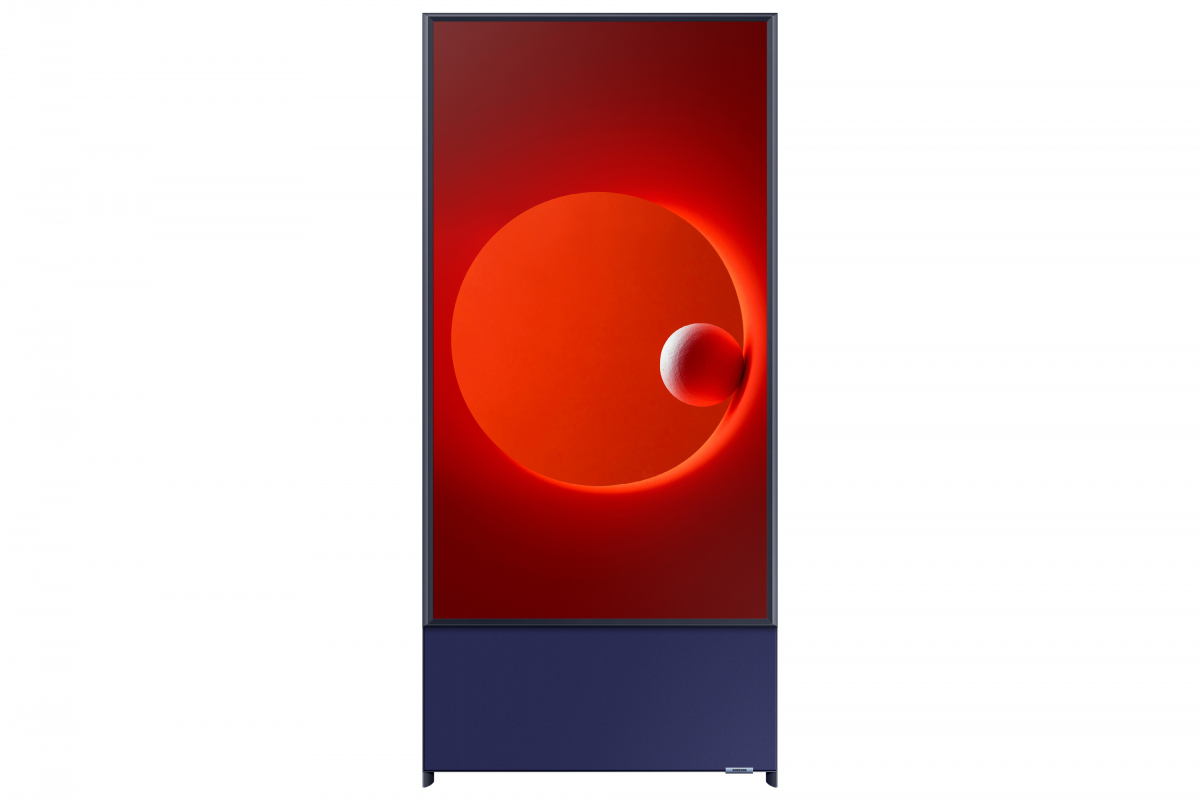
– Vertical TV: Samsung Sero

People keep shooting video while holding their phones vertically. That works fine when you’re watching Instagram or TikTok on your phone, but it looks terrible on a horizontally oriented TV. No longer: Samsung’s latest TV rotates to switch between horizontal and vertical orientations. You sync the Sero TV to a Samsung Galaxy phone, and it automatically switches orientation to match what you’re watching.

No price yet, available in the United States in early 2020.

– Smartwatch that detects sleep apnea: Withings ScanWatch

Add one more to the list of health concerns that smartwatches can detect: sleep apnea. Withings, a pioneer wearable maker, added to its new ScanWatch an SpO2 sensor that measures oxygen saturation levels and identifies when they’re too low – an indicator of the common sleep condition. (It does this by emitting and absorbing a light wave passing through blood vessels.) The ScanWatch tracks sleep length, depth and quality and provides a nightly sleep score. It also does other now-common smartwatch things, including tracking activity, monitoring heart rates and detecting arrhythmia (atrial fibrillation). Even better, its battery lasts 30 days.

Cost is $250, available in spring 2020 (pending clearance from the Food and Drug Administration).

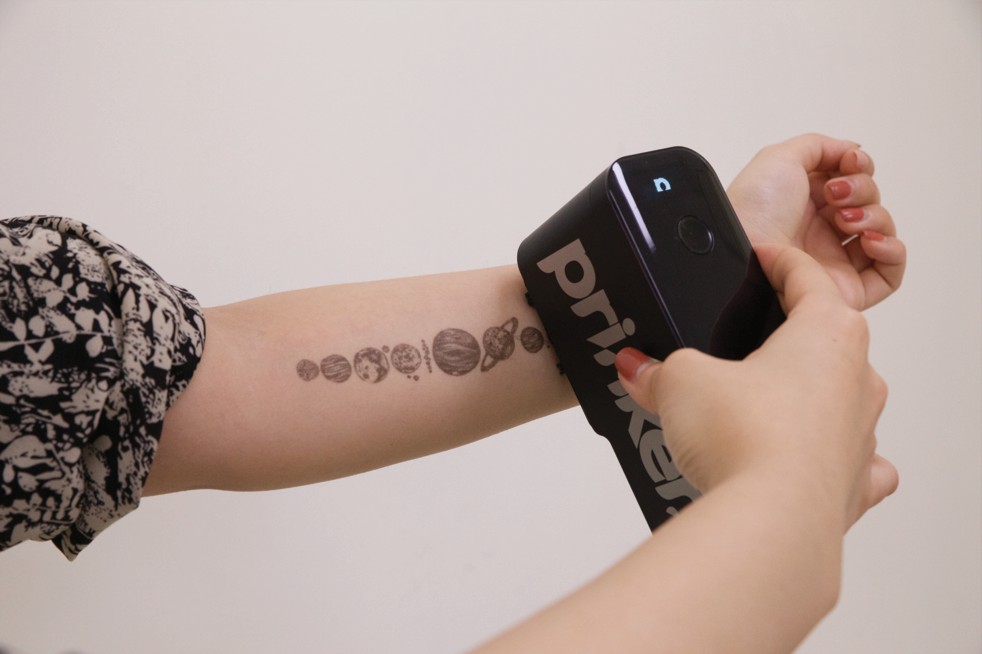
– Temporary tattoo printer: Prinker

Temporary tattoo technology hasn’t changed much in recent years. You can buy them, order custom designs online or print your own on special paper at home. But a new device called the Prinker makes temporary tattoos mobile for spontaneous people who don’t want to commit to forever ink. The handheld printer can apply cosmetic-grade ink to the skin in black or color just by quickly passing it once over the chosen body part. Images are selected from a companion app, or you can add your own. It can only print graphics up to an inch wide, so a full tattoo sleeve would take a while, but the only limit on the length of a tattoo is the length of your body. While the final product doesn’t smudge or fade much, it does wash off easily with soap and water.

Cost is $269, available in mid-2020.

– Sex toys go high-tech: Lora DiCarlo’s Osé

It was the sex toy that launched a thousand articles when its CES innovation award was revoked last year. After a little introspection and a lot of outside pressure, CES is allowing sex-tech products in the show. The Osé is back, a uniquely shaped robotic massager that doesn’t vibrate, along with two other similar products. The drama opened the door for more sex-tech players, around a dozen by our count, that include products such as internet-connected vibrators and fertility devices.

Cost is $290, available now.

– 8K is coming: LG Signature OLED 8K TV

What do you sell people who already have the latest 4K high-definition TV? If TV makers have their way, the answer will be an 8K TV. LG is releasing a lineup of 8K TVs later this year and says its target audience is people putting larger screens in smaller spaces – one of the few situations when a viewer might notice the difference. There’s not much 8K content at this point but, like Samsung, LG will use deep-learning algorithms to upscale 4K movies and TV shows to 8K. It’s still working on its other big TV innovation: the rollable TV. After a delay, LG says this is the year the device will finally get a price tag and go on sale to the public. It’s a 65-inch 4K OLED screen that pops out of a large but classy-looking box when you want to watch TV. Turn it off and it lowers itself back into the box, rolling up inside like a giant high-resolution taquito.

No price yet, available later this year.

– ‘Filmmaker mode’ for TVs

Many modern televisions have settings that automatically boost colors and smooth out motion in ways that can make movies and shows look fake. Filmmakers including Paul Thomas Anderson, Ryan Coogler, Patty Jenkins, Martin Scorsese and Christopher Nolan decided they had had enough, so they got an industry coalition called the UHD Alliance to back a new “filmmaker mode” for TVs. The idea is that content will have the ability to push out a special signal indicating the TV should disable all post-processing – such as the motion-smoothing setting that makes films look like reality shows – and the TV will adjust its own settings accordingly. A number of big TV-makers have signed on so far, including Vizio, Panasonic, Samsung and LG.

Available on select 2020 model TVs.

– A sleep trainer: Hatch Restore

This combined bedside lamp and white-noise machine promises to help you fall asleep and wake up with more ease. The Restore changes color and brightness to match your sleep routine – yellow for wind-down reading time, bright white for waking up – and pairs each stage with calming sounds or even recorded meditation routines. You find and set the right nightly sleep routine for yourself through its companion app. The gadget’s creators, who were also behind the children’s sound machine and night light called Rest, say the Restore’s sounds and colors are based in cognitive behavioral science that finds routines lead to better sleep.

No price yet, available in early 2020.

– Home privacy helper: Winston

We’re finally getting some help in protecting our privacy. This box that you install between your WiFi router and modem takes evasive maneuvers to reduce the data footprint of all the devices in your house. More than just a virtual privacy network (or VPN), Winston scans the traffic coming and going from your house to block ads, filter tracking cookies, fight website “fingerprinting” and cloak your internet address. Even better, Winston claims it’ll speed up your internet because it stops so many online trackers and ads from loading. There’s an $8.25 monthly service fee, with the first year included with purchase.

Cost is $249, available now.

Sonos sues Google for allegedly swiping speaker tech #ศาสตร์เกษตรดินปุ๋ย

#ศาสตร์เกษตรดินปุ๋ย : ขอบคุณแหล่งข้อมูล : หนังสือพิมพ์ The Nation

https://www.nationthailand.com/edandtech/30380258?utm_source=category&utm_medium=internal_referral

Sonos sues Google for allegedly swiping speaker tech

Jan 08. 2020
By The Washington Post · Greg Bensinger 

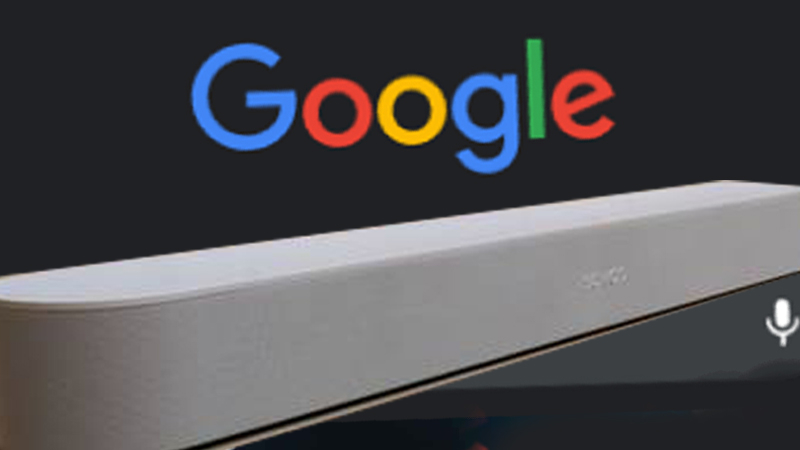
Sonos alleged in two federal lawsuits Tuesday that Google swiped technology used in its speakers to create its own, seeking a halt on further sales of the devices as well as financial penalties.

In the suits, filed with U.S. District Court in Los Angeles and the U.S. International Trade Commission, Sonos claims Google co-opted patented technology that allows for its speakers to work in multiple rooms and put it to use in its own speakers, including the Google Home and Pixel devices and the discontinued Chromecast Audio. Google gained access to Sonos’s technology through a partnership begun in 2013 allowing Sonos’s speakers to work with Google Play Music, according to the suits.

“Google has not merely copied Sonos’s patented technology, it has also subsidized the prices of its patent infringing products, including at the entry level, and flooded the market,” according to one of the suits. “These actions have caused significant damage to Sonos.”

Google denied the allegations and said it would “vigorously” defend itself in court. “Over the years, we have had numerous ongoing conversations with Sonos about both companies’ IP rights and we are disappointed that Sonos brought these lawsuits instead of continuing negotiations in good faith,” said a spokesman, Jose Castaneda.

The lawsuits were reported earlier by The New York Times.

The suits speak to the increasingly symbiotic relationship of technology firms. While fiercely competitive, they are often compelled to work closely with one another to promote or sell their goods, something unthinkable in older industries such as autos.

Sonos’s actions add to an increasingly challenging slate for new Google-parent CEO Sundar Pichai, who was promoted late last year. The company is facing antitrust probes from U.S. federal and state regulators, as well as scrutiny over its planned acquisition of fitness tracker Fitbit.

Amazon and Google dominate the U.S. smart speaker market, accounting for 61% and 24% of devices sold, respectively, according to data from Voicebot. Sonos is included in a category along with Apple and others that make up 15% of the market collectively.

(Amazon founder and CEO Jeff Bezos owns The Washington Post.)

The speaker maker claims in the suits that Google infringed on five of its patents, and it is seeking unspecified damages. It asked the courts to halt sales of devices such as Google Home speakers, Pixel phones, tablets and laptops.

Google purportedly pilfered elements of Sonos’s software that makes it easy for users to set up multiple devices on a single local network and simultaneously adjust the volume and synchronize the audio on them, according to the suit. Sonos devices were once the gold standard for wireless audio, eliminating the need for unsightly cords strung room to room.

The company said that it raised its concerns with Google starting in 2016 but that the tech giant continued copying its proprietary software in multiple devices. That gave Google a leg up to roll out more inexpensive devices more quickly, as it didn’t have to spend as much time or money developing the underlying technology, Sonos claims.

Sonos said “Google’s business strategy to use its multiroom audio products to vacuum up invaluable consumer data from users and, thus, further entrench the Google platform among its users and ultimately fuel its dominant advertising and search platforms,” according to the suit.

Sonos grew in popularity due to its wireless speakers that could be easily controlled to play in multiple rooms at once from a single digital player. But it was soon challenged by a host of lower-priced rivals, including from Google.

Tuesday’s suits mark the second time in recent months that Sonos has sued over alleged patent infringement. In June, it filed a lawsuit against speaker maker Lenbrook, which makes speakers and other audio products, claiming it stole technology while working as a distributor for Sonos.

That case is still pending.

CES 2020 preview: Surveillance, sex toys and futuristic gadgets #ศาสตร์เกษตรดินปุ๋ย

#ศาสตร์เกษตรดินปุ๋ย : ขอบคุณแหล่งข้อมูล : หนังสือพิมพ์ The Nation

https://www.nationthailand.com/edandtech/30380225?utm_source=category&utm_medium=internal_referral

CES 2020 preview: Surveillance, sex toys and futuristic gadgets

Jan 07. 2020
The Segway-Ninebot S-Pod is a new self-balancing people mover for malls and airports. MUST CREDIT: Segway-Ninebot handout photo.

The Segway-Ninebot S-Pod is a new self-balancing people mover for malls and airports. MUST CREDIT: Segway-Ninebot handout photo.
By The Washington Post · Geoffrey A. Fowler, Heather Kelly

LAS VEGAS – For one week a year, thousands of people gather here to ponder some of life’s big questions. Can robots make us feel less lonely? Have we invented enough devices to replace walking yet? Does an internet-connected vibrator count as technology? Why is Ivanka Trump here?

Thousands of people are headed to Las Vegas for CES, a massive marketing event where technology companies show off their newest innovations. What does CES stand for? The more than 50-year-old event was the Consumer Electronics Show until 2012, when organizers declared it was going by International CES, then simply CES in 2016. The change was to accommodate all the new categories of non-consumer products at the show.

Prinker mobile temporary tattoo printer can instantly print graphics on your skin. MUST CREDIT: Prinker handout photo.

Prinker mobile temporary tattoo printer can instantly print graphics on your skin. MUST CREDIT: Prinker handout photo.

+++The Sero TV from Samsung, swivels between horizontal and vertical orientations, depending on the video you're watching. MUST CREDIT: Samsung handout photo.

The Sero TV from Samsung, swivels between horizontal and vertical orientations, depending on the video you’re watching. MUST CREDIT: Samsung handout photo.

Now it’s a parade of product announcements of all types, including health tech, self-driving cars,very sharp TVs and weird gadgets, many of which will never be released. The show floor doesn’t open until Tuesday, but events begin Sunday, and there are already some hints of what the biggest stories will be out of the event.

That includes newly sanctioned sex tech and facial recognition to track attendees – plus stealth marketing outside the official CES venue. Trump is also scheduled to give a keynote talk on Tuesday about the future of work, a decision proving controversial among some attendees.

– Sex toys are allowed. Cannabis is not.

CES organizes its thousands of exhibitors into categories like smart home, augmented reality, transportation – and the fast-growing health and wellness segment. And for the first time in its 52 years, the conference will allow sex-toy companies to exhibit on the show floor as part of that group, including a multitasking bed for sex and a number of “smart” and internet-connected vibrators.

CES changed its policy after some drama at last year’s show. Sex-toy company Lora DiCarlo won a CES innovation award, but it was later taken away for being against CES policies prohibiting “immoral, obscene, indecent, profane” products.

The award was later reinstated, and Lora DiCarlo received far more press coverage than it would have for an award alone. After that, CES updated its policies to allow “sex tech” exhibitors in the health and wellness group.

Not all vices are getting an invite. Cannabis and tobacco technology, such as vaporizers, is still forbidden at the show. But if past years are any indication, crafty cannabis-adjacent companies will find a way around the rule with clever marketing and euphemisms. There are indoor-hydroponics systems and machines that blend essential oils (including, say, THC). Expect more of the same this year, including a secure, odor-concealing box called Trova for “objects that aren’t for all audiences.”

– Facial identification works on a consumer-friendly rebrand

When attendees register at CES this year, there will be a new option to confirm they are who they say they are: facial recognition. Certain CES check-in locations will have a camera set up that will snap a person’s photo and automatically match it to the photo they used to register. It’s opt-in and an example of how the conference and its exhibitors are trying to give the technology a more consumer-friendly image.

Facial-detection technology has caused a lot of controversy and concerns over privacy and bias. It’s already in use at airports and by law enforcement and included in other surveillance systems. Now the same companies making those systems want it to be embraced as a fun, user-friendly technology that makes tasks easier.

CES is organized by the CTA, an industry group that represents technology companies – many of whom would like to give facial detection a friendlier consumer image. Companies like Australian retail ad firm Mikara want to sell facial recognition to stores so they can serve targeted advertisements, while Black and Decker’s Pria home-care robot uses it to identify users.

Balancing ethical uses of facial detection with the industry’s desire for profit could be complicated for the show. Two previous CES award winners listed as exhibitors at this year’s show – security camera company Ezviz, which is owned by Hikvision, and voice recognition company iFlytek – are no longer attending, CNET reported. The U.S. Commerce Department added the companies to a blacklist in October over their alleged use in human rights violations by China against Muslims. The CTA said it does not comment on individual companies.

– Lots of bathroom technology, for some reason

Smart-home technology, like web-connected thermostats and security cameras, has been a hit in nearly every part of the house. One room that technology companies seem set on infiltrating this year is the bathroom.

At CES, a number of companies are planning to show toilet-related tech and other gimmicky products that even they admit will never go on sale. They might, however, draw some attention to normally overlooked faucet and toilet paper companies.

Toilets are getting sensors to help determine how much water each flush requires, voice assistants are standing by to flush your toilet, and wearables monitor your stomach and send you a smartphone notification when it’s time to use the bathroom. Toilet paper maker Charmin is even showing off demos of something mysterious called a “roll bot.” And multiple companies promise to revolutionize teeth with high-tech toothbrushes.

The head of the CTA’s research team, Steve Koenig, sees toilet tech as the next logical step for connected home technology.

“We’re getting to the point where we’re fulfilling the original promise of the smart home, which is creating intelligent living spaces that take care of us instead of the other way around,” he told The Washington Post.

– Billboards: Where the real CES drama happens

Inside the Las Vegas Convention Center, companies like Sony and Samsung still jockey for the biggest floor spaces and flashiest displays at CES. But not every tech company participates in the event itself. Apple, Facebook and Twitter have been notable holdouts in recent years.

Companies that don’t participate in the event itself have found a way break through the noise, sometimes without paying a cent to the conference itself.

For the past two years, Google has gone from a minimal CES presence to plastering every available surface in the city with “Hey, Google” ads for its voice assistant, including the coveted front entrance to CES. It is competing with Amazon’s Alexa, and to a lesser degree Apple’s Siri, for partners to include the assistant in their upcoming products. (Amazon CEO Jeff Bezos owns The Washington Post.) Last year, in addition to monorail trains and billboards, it built an elaborate working ride – like Disney’s It’s a Small World but for Google products – in front of the convention center. This year, there is already a giant Google structure with slides in front of the convention center and more monorail ads.

Last year, Apple spent a fraction of the cost of actually attending the event on a single, snarky ad that generated far more attention. The giant billboard pasted on the side of a Marriott near the convention center read, “What happens on your iPhone, stays on your iPhone.” It was widely interpreted as a dig at Google and a promotion for Apple’s marketing push as the “privacy” company.

We’ll find out whether Apple started a new sub-tweeting-via-outdoor-advertisements trend in a few days. The company will also have a speaker at CES for the first time in 28 years via an appearance from its senior director of privacy, Jane Horvath, on a privacy roundtable.

CES 2020 preview: Surveillance, sex toys and futuristic gadgets #ศาสตร์เกษตรดินปุ๋ย

#ศาสตร์เกษตรดินปุ๋ย : ขอบคุณแหล่งข้อมูล : หนังสือพิมพ์ The Nation

https://www.nationthailand.com/edandtech/30380178?utm_source=category&utm_medium=internal_referral

CES 2020 preview: Surveillance, sex toys and futuristic gadgets

Jan 06. 2020
Have we invented enough devices to replace walking yet? Does an internet-connected vibrator count as technology? Why is Ivanka Trump here? File Photo : Ivanka Trump /Getty Images

Have we invented enough devices to replace walking yet? Does an internet-connected vibrator count as technology? Why is Ivanka Trump here? File Photo : Ivanka Trump /Getty Images
By The Washington Post · Heather Kelly

LAS VEGAS – For one week a year, thousands of people gather here to ponder some of life’s big questions. Can robots make us feel less lonely? Have we invented enough devices to replace walking yet? Does an internet-connected vibrator count as technology? Why is Ivanka Trump here?

Thousand of people are headed to Las Vegas for CES, formerly known as the Consumer Electronics Show, a massive marketing event where technology companies show off their newest innovations. It’s a parade of product announcements, very sharp TVs and weird gadgets, many of which will never be released. The show floor doesn’t open until Tuesday, but events begin Sunday, and there are already some hints of what the biggest stories will be out of the event.

That includes newly sanctioned sex tech and facial recognition to track attendees – plus stealth marketing outside the official CES venue. Trump is also scheduled to give a keynote talk on Tuesday about the future of work, a decision proving controversial among some attendees.

– Sex toys are allowed. Cannibis is not.

CES organizes its thousands of exhibitors into categories like smart home, augmented reality, transportation – and the fast-growing health and wellness segment. And for the first time in its 52 years, the conference will allow sex-toy companies to exhibit on the show floor as part of that group, including a multitasking bed for sex and a number of “smart” and internet-connected vibrators.

CES changed its policy after some drama at last year’s show. Sex-toy company Lora DiCarlo won a CES innovation award, but it was later taken away for being against CES policies prohibiting “immoral, obscene, indecent, profane” products.

The award was later reinstated, and Lora DiCarlo received far more press coverage than it would have for an award alone. After that, CES updated its policies to allow “sex tech” exhibitors in the health and wellness group.

Not all vices are getting an invite. Cannabis and tobacco technology, such as vaporizers, is still forbidden at the show. But if past years are any indication, crafty cannabis-adjacent companies will find a way around the rule with clever marketing and euphemisms. There are indoor-hydroponics systems and machines that blend essential oils (including, say, THC). Expect more of the same this year, including a secure, odor-concealing box called Trova for “objects that aren’t for all audiences.”

– Facial identification works on a consumer-friendly rebrand

When attendees register at CES this year, there will be a new option to confirm they are who they say they are: facial recognition. Certain CES check-in locations will have a camera set up that will snap a person’s photo and automatically match it to the photo they used to register. It’s opt-in and an example of how the conference and its exhibitors are trying to give the technology a more consumer-friendly image.

Facial-detection technology has caused a lot of controversy and concerns over privacy and bias. It’s already in use at airports and by law enforcement and included in other surveillance systems. Now the same companies making those systems want it to be embraced as a fun, user-friendly technology that makes tasks easier.

CES is organized by the CTA, an industry group that represents technology companies – many of whom would like to give facial detection a friendlier consumer image. Companies like Australian retail ad firm Mikara want to sell facial recognition to stores so they can serve targeted advertisements, while Black and Decker’s Pria home-care robot uses it to identify users.

Balancing ethical uses of facial detection with the industry’s desire for profit could be complicated for the show. Two previous CES award winners listed as exhibitors at this year’s show – security camera company Ezviz, which is owned by Hikvision, and voice recognition company iFlytek – are no longer attending, CNET reported. The U.S. Commerce Department added the companies to a blacklist in October over their alleged use in human rights violations by China against Muslims. The CTA said it does not comment on individual companies.

– Lots of bathroom technology, for some reason

Smart-home technology, like web-connected thermostats and security cameras, has been in a hit in nearly every part of the house. One room that technology companies seem set on infiltrating this year is the bathroom.

At CES, a number of companies are planning to show toilet-related tech and other gimmicky products that even they admit will never go on sale. They might, however, draw some attention to normally overlooked faucet and toilet paper companies.

Toilets are getting sensors to help determine how much water each flush requires, voice assistants are standing by to flush your toilet, and wearables monitor your stomach and send you a smartphone notification when it’s time to use the bathroom. Toilet paper maker Charmin is even showing off demos of something mysterious called a “roll bot.” And multiple companies promise to revolutionize teeth with high-tech toothbrushes.

The head of the CTA’s research team, Steve Koenig, sees toilet tech as the next logical step for connected home technology.

“We’re getting to the point where we’re fulfilling the original promise of the smart home, which is creating intelligent living spaces that take care of us instead of the other way around,” he told The Washington Post.

– Billboards: Where the real CES drama happens

Inside the Las Vegas Convention Center, companies like Sony and Samsung still jockey for the biggest floor spaces and flashiest displays at CES. But not every tech company participates in the event itself. Apple, Facebook and Twitter have been notable holdouts in recent years.

Companies that don’t participate in the event itself have found a way break through the noise, sometimes without paying a cent to the conference itself.

For the past two years, Google has gone from a minimal CES presence to plastering every available surface in the city with “Hey, Google” ads for its voice assistant, including the coveted front entrance to CES. It is competing with Amazon’s Alexa, and to a lesser degree Apple’s Siri, for partners to include the assistant in their upcoming products. (Amazon CEO Jeff Bezos owns The Washington Post.) Last year, in addition to monorail trains and billboards, it built an elaborate working ride – like Disney’s It’s a Small World but for Google products – in front of the convention center. This year, there is already a giant Google structure with slides in front of the convention center and more monorail ads.

Last year, Apple spent a fraction of the cost of actually attending the event on a single, snarky ad that generated far more attention. The giant billboard pasted on the side of a Marriott near the convention center read, “What happens on your iPhone, stays on your iPhone.” It was widely interpreted as a dig at Google and a promotion for Apple’s marketing push as the “privacy” company.

We’ll find out whether Apple started a new sub-tweeting-via-outdoor-advertisements trend in a few days. The company will also have a speaker at CES for the first time in 28 years via an appearance from its senior director of privacy, Jane Horvath, on a privacy roundtable.

‘A cyber attack should be expected’: U.S. strike on Iranian leader sparks fears of major digital dis #ศาสตร์เกษตรดินปุ๋ย

#ศาสตร์เกษตรดินปุ๋ย : ขอบคุณแหล่งข้อมูล : หนังสือพิมพ์ The Nation

https://www.nationthailand.com/edandtech/30380130?utm_source=category&utm_medium=internal_referral

‘A cyber attack should be expected’: U.S. strike on Iranian leader sparks fears of major digital dis

Jan 04. 2020
Protesters Decry Killing Of Iranian General Qasem Souleimani

TEHRAN, IRAN - JANUARY 03: Protesters hold up photographs as people demonstrate after the U.S. airstrike in Iraq that killed Iranian Revolutionary Guard Gen. Qasem Soleimani on January 3, 2020 in Tehran, Iran. Iran has vowed 'harsh retaliation' for the U.S. airstrike near Baghdad's airport that killed Tehran's top general as tensions soared in the wake of the targeted killing. (Photo by Majid Saeedi/Getty Images)

Protesters Decry Killing Of Iranian General Qasem Souleimani TEHRAN, IRAN – JANUARY 03: Protesters hold up photographs as people demonstrate after the U.S. airstrike in Iraq that killed Iranian Revolutionary Guard Gen. Qasem Soleimani on January 3, 2020 in Tehran, Iran. Iran has vowed ‘harsh retaliation’ for the U.S. airstrike near Baghdad’s airport that killed Tehran’s top general as tensions soared in the wake of the targeted killing. (Photo by Majid Saeedi/Getty Images)
By The Washington Post · Tony Romm, Isaac Stanley-Becker, Craig Timberg 

Iran’s cyber troops long have been among the world’s most capable and aggressive – disrupting banking, hacking oil companies, even trying to take control of a dam from afar – while typically stopping short of the most crippling possible actions, say experts on the country’s capabilities.

But Friday’s American airstrike that killed one of Iran’s top generals, Quds Force Commander Maj. Gen. Qasem Soleimani, now threatens to unleash a fully unshackled Iranian response,analysts and former U.S. officials warned.They said a variety of potential cyber-attacks, possibly in conjunction with more traditional forms of lethal action, would be well within the digital arsenal of a nation that has vowed “severe revenge.”

“At this point, a cyber-attack should be expected,” said Jon Bateman, a former Defense Intelligence Agency analyst on Iran’s cyber capabilities and now a cybersecurity fellow for the Carnegie Endowment for International Peace.

The range of possible tactics is long: The Iranians can overwhelm computerized systems to snarl business operations, as they did to U.S. banks from 2011 to 2013. They can also use malicious software to wipe out data, as they reportedly did in 2014 to the Las Vegas Sands casino, whose staunchly pro-Israel owner Sheldon Adelson had suggested the United States drop nuclear bombs on Iran.

Arch-rival Saudi Arabia’s oil giant Aramco suffered a similar fate in 2012, when a cyber-attack reportedly emanating from Iran wiped out the memories of tens of thousands of computers, crimping oil production. The company’s frantic efforts to recover reportedly drove up the price of hard drives worldwide.

Hackers with ties to Tehran can potentially hijack crucial machinery over the Internet, a tactic they experimented with at a New York state dam, whose control systems they penetrated in 2013. Or they could target sensitive political or diplomatic targets while mounting sophisticated information operations over Facebook, Twitter and other social media platforms. Last October, Microsoft accused a group tied to the country’s government of attempting to identify, attack and breach personal email accounts associated with a U.S. presidential campaign, government officials and journalists.

And while the most appealing targets are likely to be in the U.S. homeland given Iran’s history of staging visible, politically potent attacks linked thematically to their grievances, it may be easier to strike U.S. military or diplomatic targets abroad, or similar targets in allied nations.

Cyber-security expert James Lewis recently compiled a list of suspected Iranian hacks, cyber-attacks and online spying incidents and was surprised to find 14 reported last year alone. The list included hacks aimed at the Trump campaign, telecommunications systems in Iraq, Pakistan, and Tajikistan, and intrusions into employee accounts of companies making and operating industrial control systems. Iranians also reportedly used LinkedIn to target users affiliated with Middle Eastern governments and workers within the financial and energy industries.

“They have enough capability that they don’t need to ask, ‘Can we do this?’ ” said Lewis, a senior vice president for the Center for Strategic & International Studies. “It’s, ‘Do you want to do this?'”

Experts tracking online disinformation said Friday they had already seen suspicious, early signs of accounts pivoting to push messages sympathetic to the Iranian government. Some potentially suspect accounts on Instagram, for example, started tagging the White House in images featuring flag-draped coffins, according to the Atlantic Council’s Digital Forensic Research Lab. Meanwhile, apparently bogus claims of an airstrike at the Ain Al-Asad airbase, which hosts U.S. forces in western Iraq, were spreading in hardline Iranian media outlets, as well as on services including Twitter and Telegram, according to researchers.

“This is a new era,” said Ali Soufan, a former FBI agent who chaired the countering foreign influence subcommittee of the Department of Homeland Security’s advisory council. “We always had controlled escalation policies with Iranians. Now these rules don’t exist, and the Iranians are going to usher in an era of unrestrained responses – an era that’s going to be filled with even more chaos.”

Those responses, Soufan added, are likely to include cyber activities, as well as disinformation, which already saturates political and military conflict in the Middle East. “They have so many tools to make our existence in the Middle East and our interests and the interest of our allies really under threat.”

Almost a year to the day before President Donald Trump ordered the attack on Soleimani, federal officials issued a sober assessment of Iran’s cyber prowess: A January 2019 intelligence report highlighted the country as an “espionage and attack threat,” with the ability to target U.S. officials, steal intelligence and disrupt “a large company’s corporate network for days to weeks.”

Iran’s cyber capabilities rank below those of Russia and China. But they have advanced significantly since 2010, the time of the discovery that a joint Israeli-U.S. operation had installed malicious software known as Stuxnet that destroyed centrifuges crucial to Iran’s nuclear ambitions.

Since then, U.S. officials blame Iran for cyber attacks on “dozens of Saudi governmental and private-sector networks in late 2016 and early 2017,” and warn that targets in the United States similarly could be at risk.

An Iran bent on a visible, painful form of revenge could attempt several retaliatory actions in cyber-space, possibly as part of a broader campaign to drive American forces out of Iraq and enlist proxies and allies in wounding U.S. interests here and abroad.

“The focus will be critical infrastructure – oil and gas in the Middle East, maybe elsewhere,” said John Hultquist, director of intelligence analysis for the cybersecurity company FireEye, adding that past operations have targeted the American financial sector. “Anywhere where they can cause serious, almost psychological effects, noticeable disruption. The purpose is to prove to the public that they can reach out and touch Americans.”

At the Department of Homeland Security, a top official said Friday that businesses and others should “brush up” on Iranian cyber tactics. Christopher Krebs, who leads DHS’s cybersecurity work, pointed to the agency’s past warnings that Iran is “looking to do much more than just steal data and money.” DHS did not respond to further request for comment. Neither did the White House.

“We know that Iranian cyber operations are currently scoping and preparing to attack our networks – in all sectors of society – to see where they can hit us,” said Virginia Sen. Mark Warner, the top Democrat on the Senate Intelligence Committee.

In recent years, malicious actors tied to Iran, or to the country’s leaders, also have intensified their operations on Facebook, Twitter and other social media sites. Through fake accounts – some of which masqueraded as journalists and even U.S. political figures – they pushed messages sympathetic to Tehran’s interests, at times opposing Trump.

“Any time you get geopolitical tensions, you get an uptick in disinformation operations,” said Ben Nimmo, director of investigations at Graphika, a social media analysis firm.

Over the past two years, Facebook has announced six major Iran-related takedowns – involving more than 1,800 accounts, pages, and groups on its site and on Instagram, reaching 5 million users globally, according to an analysis of the company’s public statements. Twitter, meanwhile, has taken down thousands of accounts linked to Iran that had violated its rules.

Iran’s efforts differ from those of Russia, which sought to stoke social and political unrest in the United States during the 2016 election. Russia “intends to engage in, and infiltrate, communities online,” and is politically agnostic, targeting users and causes across the spectrum, said Graham Brookie, the leader of the Atlantic Council’s DFRLab. Iran, by contrast, “presents a very specific worldview and has tended to try to persuade others to their side,” he said, particularly with anti-Israel, anti-U.S. and anti-Saudi messages.

Brookie said DFRLab already has seen “social media accounts that were previously used for economic purposes, like selling sneakers, immediately repurposed for coordinated messaging that aligns directly with the Iranian government.

“This is another large and effective proxy front we should expect escalation on,” he added.

On messaging apps, dueling narratives were already taking shape, according to Mahsa Alimardani, a researcher at the Oxford Internet Institute who was monitoring about 100,000 Persian-language channels on Telegram. Using regime-supporting channels, such as “Young soldiers of the soft war,” users were circulating images of Soleimani’s body and portraying the U.S. as an “evil force that just committed an act of terrorism.”

The government has a handful of options in addressing the elevated threat, experts said. These include aiming to track and intercept cyber operations as they’re developing, akin to efforts to predict and blunt maneuvering on the battlefield. Another imperative, they said, is sharing information with private businesses, which could end up bearing the brunt of the risk.

The experts said it was difficult to predict what an Iranian offensive in cyberspace would look like, given how quickly capabilities are evolving.

But they pointed to certain precedents, including the 2017 cyberattacks targeting government ministries, banks and companies in Ukraine. The operation, blamed on Russia by Western officials, had global ramifications and was described by the White House as “the most destructive and costly cyber-attack in history.”

While the U.S. has more extensive defenses, those remain untested against aggressive Iranian tactics.

“Iran has used their cyber-capabilities in a somewhat restrained way,” said Robert Knake, a former cybersecurity director at the National Security Council, now at the Council on Foreign Relations. “Whether that holds after this [U.S.] attack, is difficult to say.”