แพทย์เฉพาะทางด้านกระดูกและข้อ กระดูกสันหลัง เผยความไม่สบายและความเจ็บป่วยที่กระดูกและข้อที่เกิดจากการ Work from Home มีอะไรได้บ้าง และเราจะป้องกันได้อย่างไร
ในห้วงเวลาที่ประเทศไทยกำลังเผชิญกับโรค Covid-19 ที่กำลังระบาดในขณะนี้ มีหลายคนต้องปรับตารางการทำงาน เพื่อรองรับกับสถานการณ์การระบาด และจำเป็นต้องทำงานจากที่บ้าน หรือที่เรียกกันว่า Work from Home ซึ่งการที่ต้องเปลี่ยนสถานที่จากที่ทำงานมาเป็นที่บ้านก็มีบางปัจจัยที่อาจทำให้เกิดความไม่สบาย หรือเกิดความเจ็บป่วยของโรคทางกระดูกและข้อได้
Covid-19 ยังไม่จบง่าย ๆ พวกเรายังจำเป็นต้องทำงานจากที่บ้านกันไปอีกสักพัก ดังนั้น เรามาทำให้การ Work from Home เป็นการทำงานที่ดีต่อสุขภาพกันดีกว่า เพียงปฏิบัติตัวให้ถูกต้อง ปรับสภาพแวดล้อมให้เหมาะสม ก็จะทำให้ลดความเครียดจากการทำงาน และมีความสุขมากขึ้น
Many people have been wondering about what they can or cannot consume before they get their Covid-19 shot.
Here’s some advice from the Health Department:
What you CAN take before the shot:
• Prescribed medication for chronic diseases like respiratory disorder, heart and blood vessels, kidney disease, stroke, cancer, diabetes and weight-loss drugs.
• Blood thinners
• Paracetamol (can only be taken after the vaccine for pain)
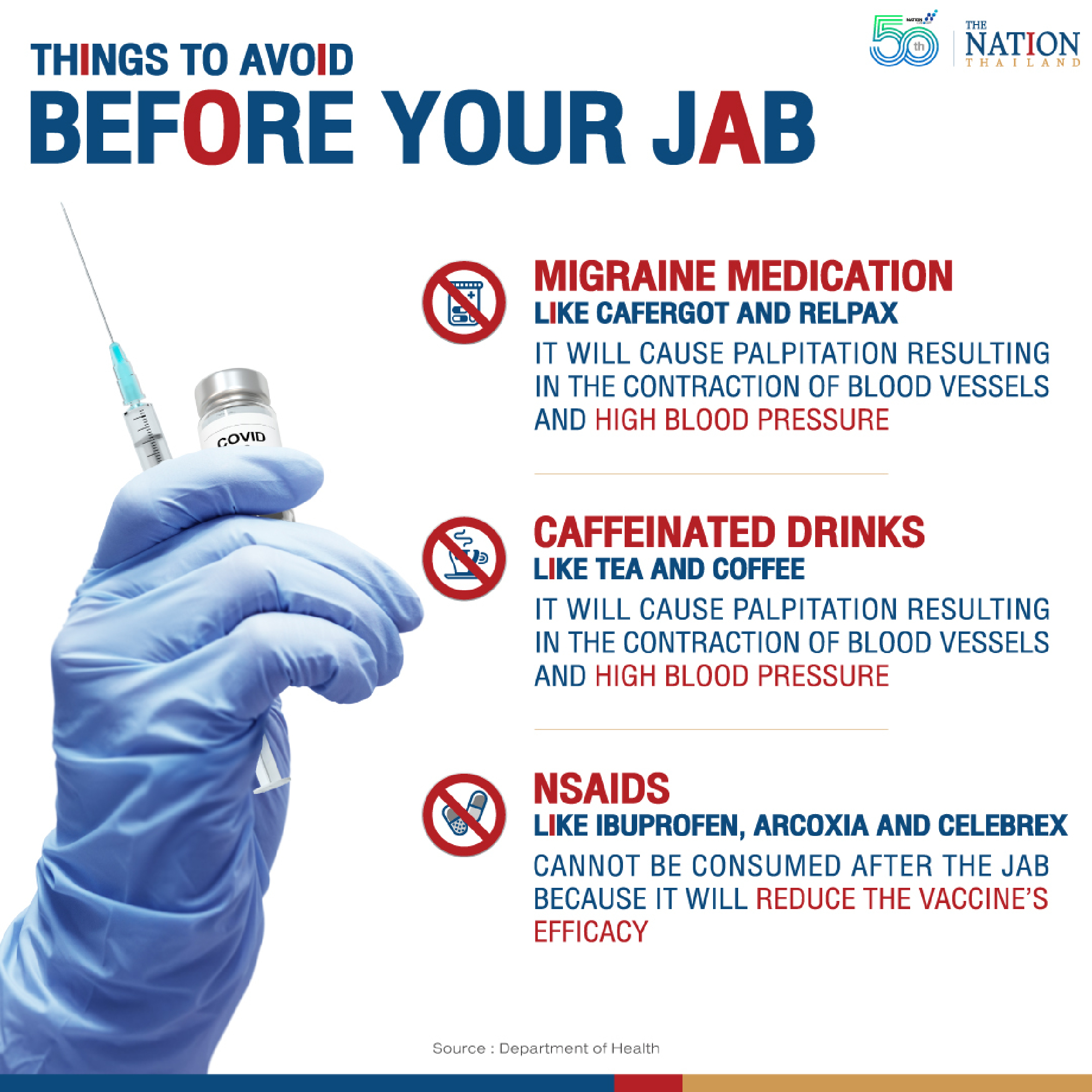
What you CANNOT take before the shot:
• Cafergot or Relpax for migraine: It will make the heart palpitate, resulting in the contraction of blood vessels and a rise in blood pressure.
• Caffeinated drinks such as tea and coffee: Caffeine will cause the same symptoms as above.
• Non-steroidal anti-inflammatory drugs (NSAIDs) such as Ibuprofen, Arcoxia and Celebrex: Taking these drugs after the jab will reduce the efficacy of the vaccine.
Precautions
• Inform the medic if you have a fever before you get your jab
• The second jab should be taken at least a month later
• People with immune system disorders should consult a doctor before getting a jab
• Do not refrain from eating or drinking fluids before the jab
G20 leaders pledge support for Access to Covid-19 Tools Accelerator as crisis grows
World leaders on Saturday met at the Global Health Summit, co-hosted by the European Commission and Italy as part of its G20 presidency, to adopt an agenda to overcome the Covid-19 pandemic, and develop and endorse a Rome Declaration of principles.
The meeting came at a time when the virus is surging and spreading uncontrollably in many parts of the world.
With nine people losing their lives to Covid-19 every minute on average, and as the risk of even more transmissible and dangerous variants increases, the Global Health Summit comes at a critical juncture. The future of the pandemic is in the hands of the G20 leaders.
The Access to Covid-19 Tools Accelerator (ACT-Accelerator) was launched just over a year ago in response to the G20’s call for a global mechanism to accelerate the development of tests, treatments and vaccines and to ensure their equitable distribution.
Hosted by the World Health Organization, the ACT-Accelerator offers the only end-to-end multilateral solution to speeding up an end to the acute phase of the Covid-19 pandemic.
The ACT-Accelerator welcomes the commitments made at the Global Health Summit and will work with countries to operationalise rapidly these pledges, both financial and – crucially – for over 100 million doses of scarce vaccine, the WHO said.
Current financial commitments are reflected in the ACT-Accelerator interactive funding tracker. However, a significant funding gap remains.
Speeding up an end to the pandemic through the ACT-Accelerator would cost less than 1 per cent of what governments are spending on stimulus packages to treat the consequences of the pandemic.
As the economic and social costs of the pandemic continue to escalate, the case for global solidarity grows even stronger.
The Rome Declaration, released at the end of the summit, reaffirmed leaders’ support for the ACT-Accelerator and underlined the necessity to share the financial burden and close the funding gap, in order for the ACT-Accelerator to fulfil its mandate for the equitable allocation and delivery of tests, treatments and vaccines to defeat the pandemic.
The group also emphasised its support for global sharing of vaccine doses approved for emergency use by the WHO and through Covax.
Carl Bildt, special envoy for the ACT-Accelerator and former prime minister of Sweden, said: “Today’s commitments are welcome – but more action is needed now, not in weeks or months, to change the course of the pandemic. While some countries have moved beyond just words, by donating vaccines and pledging to fully finance the ACT-Accelerator, further action is needed from G20 and G7 leaders if we are to stop this virus from spreading and mutating further. We all have substantial work ahead of us.”
People across the world are hoping the vaccines will help reduce fatalities and finally bring the Covid-19 crisis to an end.
Like other countries, Thailand has also been working on inoculating 70 per cent of its population to achieve herd immunity. To get a jab in Thailand, people can either register through the “Mor Phrom” (Doctors Ready) application or at medical facilities nationwide. However, people are still concerned about which brand of vaccine they will get.
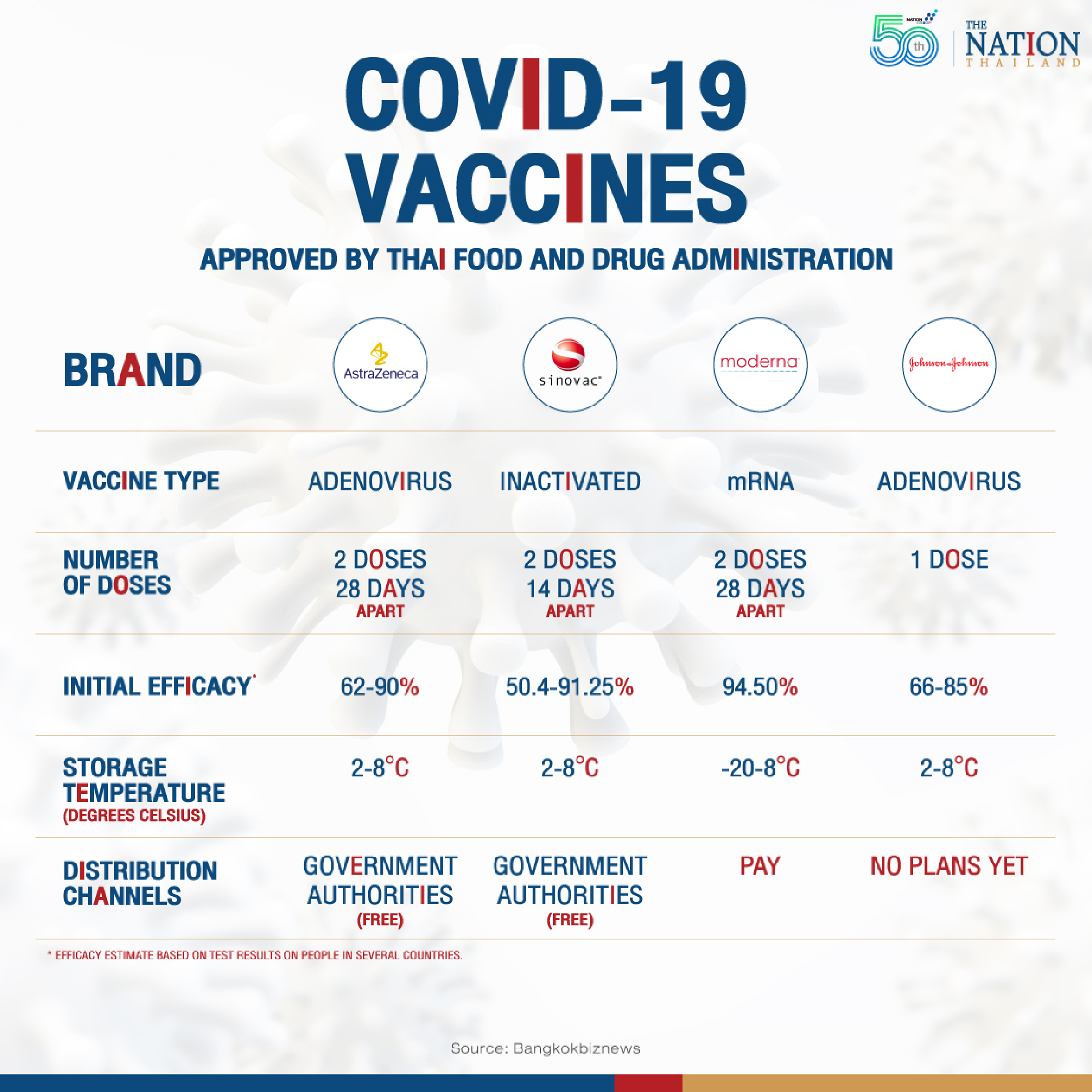
As of May 14, the Thai Food and Drug Administration (FDA) had approved four vaccines:
Sinovac
The inactivated vaccine, manufactured by a private Chinese company, was approved by the Thai FDA on February 22.
According to the World Health Organisation, this vaccine effectively protects people below the age of 60.
Dr Nakhon Premsri, director of the National Vaccine Institute, said the vaccine offers 50.7 per cent protection against infection and cuts down the chance of developing moderate symptoms by 83.7 per cent and severe symptoms by 100 per cent. This is a two-dose vaccine.
AstraZeneca
This adenovirus type vaccine, developed jointly by the Swedish firm AstraZeneca and UK’s Oxford University, was approved in Thailand in late January.
This vaccine has been found to offer 54.1 per cent protection against infection and cuts down the chance of developing moderate symptoms by 70.4 per cent and 100 per cent against severe symptoms.
Recent studies show that the vaccine is more effective if the second dose is delivered within an eight to 12-week interval.
Johnson & Johnson
This adenovirus type vaccine was approved by the Thai FDA on March 25.
It offers 66.9 to 85.4 per cent protection against moderate and severe infection through just one dose of the vaccine.
Moderna
This mRNA type vaccine was approved on May 13 and has been categorised as an alternative vaccine that can be procured by the private sector.
Dr Norraphat Pisirikarn, acting director at the Government Pharmaceutical Organisation, said this vaccine can stimulate immunity against Covid-19 3.4 times higher than plasma therapy.
“Fourteen days after the second jab, the vaccine offers 94.1 per cent protection to people below 65 and 86.4 per cent to those older than 65,” Norraphat said. “It reduces the severity of infections and mortality by 100 per cent.”
Recent tests show that it is effective against the UK B117 and South African B1351 mutations, he said.

 เวนติซี เดลิเวอรี่ โรงแรมเซ็นทาราแกรนด์ฯ เซ็นทรัลเวิลด์ พร้อมเสิร์ฟโปรพิซซ่าโฮมเมดแป้งบางหน้าแน่นๆ เครื่องเน้นๆ สไตล์อิตาเลียนขนานแท้ ส่งตรงถึงบ้านคุณให้คุณอิ่มเอมแบบไม่จำเจ


 ตื่นสายก็ได้ฟิน “อร่อยดี” ส่งเมนู เอ้ก อี้ เอ้ก เอ้ก… เริ่มต้นยามเช้ากับด้วย “เมนูไก่โห่” คัดสรรเมนูเด็ดจาก 3 ร้านดัง #อร่อยดี #เจ๊เกียงหมูทอดข้าวเหนียวนุ่ม #เจ๊เกียงโจ๊กกองปราบ


 ฮ่องกง ฟิชเชอร์แมน แนะนำ 8 เมนูซุปบำรุงสุขภาพสไตล์ฮ่องกง พร้อมให้บริการเดลิเวอรี่


 แพทย์เฉพาะทางด้านกระดูกและข้อ กระดูกสันหลัง เผยความไม่สบายและความเจ็บป่วยที่กระดูกและข้อที่เกิดจากการ Work from Home มีอะไรได้บ้าง และเราจะป้องกันได้อย่างไร
 เมื่อต้องอยู่ด้วยกันมากขึ้นช่วง Covid-19 ณ จุดนี้ … Quality Time หรือมะเร็งที่ลุกลามความสัมพันธ์
 เปลี่ยนจากผู้เล่นมาเป็นผู้สังเกตการณ์ ฟังสัญญาณเตือนเมื่อร่างกายติดสมาร์ทโฟน เช็กลิสต์เบื้องต้นนั่งหลังค่อมไหล่ห่อ คอยื่น ปวดเมื่อยบ่า ก้านคอ สะบัก นิ้วล็อกมือชา มือไม่มีแรง แม้แต่อาการมึนๆ ตึงๆ ปวดศีรษะ ปวดกระบอกตา ตาพล่ามัว หาวนอนบ่อยๆ หายใจไม่อิ่ม ฯลฯ
 ไทยรู้สู้โควิด เผยข้อแนะนำการเตรียมตัวก่อนไปฉีดวัคซีนป้องกันโควิด-19
 Preparing for your Covid-19 jab

 Covid vaccines approved in Thailand explained
