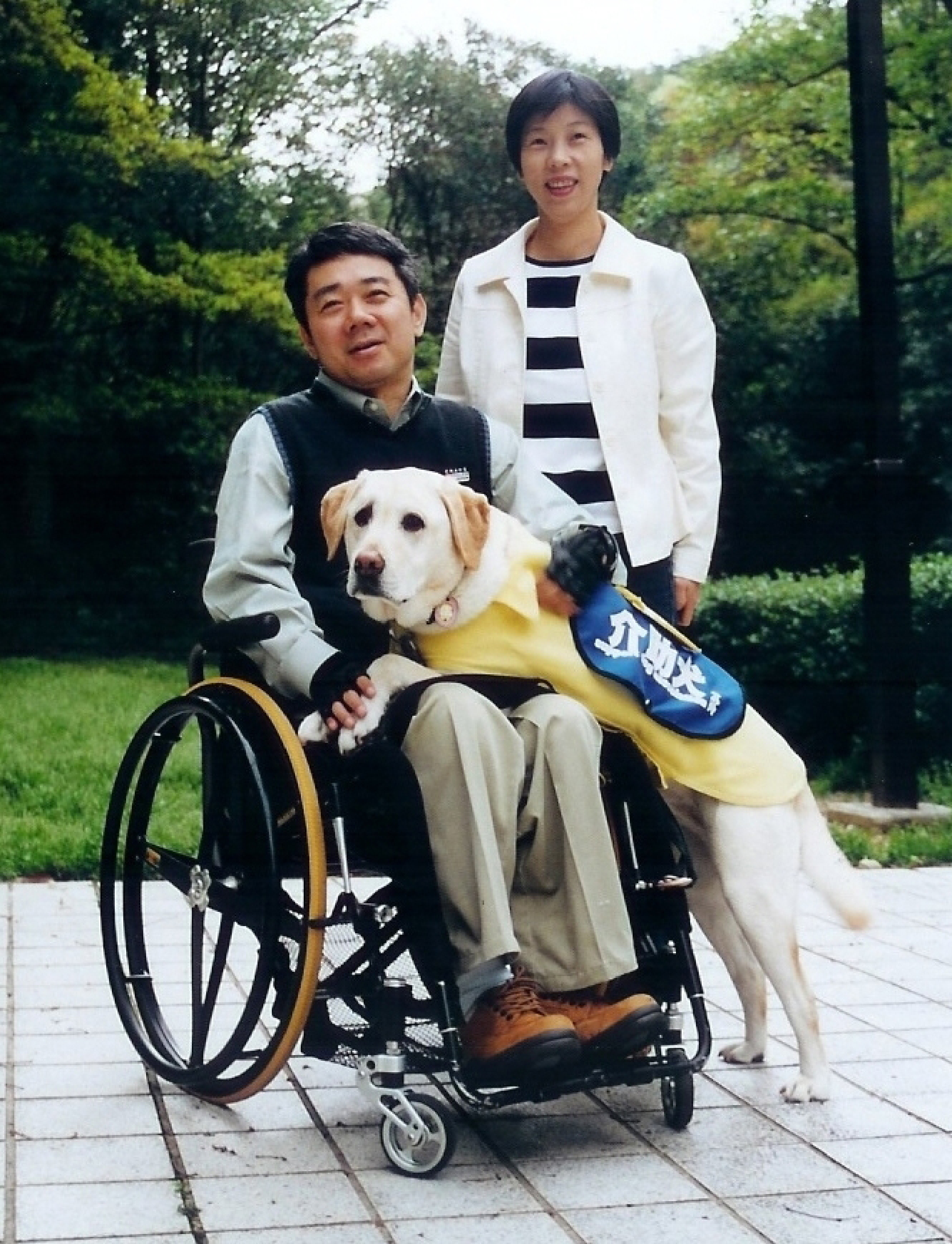
In Japan, disability advocates hope the Paralympics will showcase the pawsomeness of service dogs
TOKYO – On a winter day many years ago, Yoshitomo Kimura fell out of his wheelchair when he was trying to get into his car. He yelled for help, but no one was around – except Cynthia, his Labrador retriever service dog. Thanks to Cynthia, who fetched his cellphone, Kimura was able to call his neighbor.
“No one was coming, so I thought that I was going to freeze outside,” recalled Kimura, 61, who lives in Osaka. “She really saved my life and I am eternally grateful for that.”
Every day, Kimura relies on his service dog for opening doors, pushing his wheelchair up a sloped street, and a lot more. Yet life with a furry aide does not come seamlessly for hundreds of thousands of Japanese people who would qualify for canine assistance, because of barriers that have hindered service dogs’ widespread use and acceptance, said Kimura and other disability advocates.
Service dogs made headlines in Japan last month when they strutted alongside visually impaired athletes on the Israeli team, tails wagging, during the Tokyo Paralympics Opening Ceremonies. The images and videos were a hit on social media, where Japanese users gushed over the pups with surprise and admiration.
In Japan, disability advocates hope the Paralympics will showcase the pawsomeness of service dogs
For Japan’s disability advocates, the Tokyo Paralympics provides a global platform to raise awareness about the social stigma, barriers and discrimination they face, similar to how the 1964 Tokyo Paralympics – the first in Asia – helped the Japanese public understand the needs of people with disabilities.
Those who rely on four-legged partners say they hope the Games will lead to greater acceptance of service dogs and other forms of assistance that empower them to live independently and stay healthy.
“People don’t see service dogs accompanying disabled people as a necessity for them to actively participate in society, but more just as a well-trained dog … which is why people often face rejection,” said Tomoko Hashizume, head of the nonprofit Japan Service Dog Resource Center. “I hope people’s perceptions of disabled people change [from] watching the Paralympics, from people that can’t do anything by themselves that need help, to these people that are doing extraordinary things in all sorts of creative ways.”
Nearly two decades ago, the Japanese government passed the Assistance Dogs for Persons with Physical Disabilities Act of 2002 to certify service dogs and allow them to enter public facilities and transportation.
But the use of service dogs remains rare in Japan – unlike in the United States, where they are so common that some people try to pass off their pets as service dogs to gain entry to more places, or bring alligators, peacocks and ducks as emotional support animals on airplanes.
In general, dogs aren’t tolerated in public settings in Japan. It can be hard for dog owners to rent apartments in Tokyo, and few restaurants allow people to bring their dogs. Many owners carry cleaning spray bottles to wipe down the sidewalk of their dogs’ feces. At the same time, many people push small dogs around in strollers and pamper them with designer-brand clothing and accessories.
Uyanga Erdenebold, 38, lost her eyesight after being diagnosed with a congenital eye condition as a child. Her Labrador, Dunaway, helps her navigate life as she drops her son off at his school bus stop and goes to the grocery store or the gym.
She recalled waiting in line to enter a beer garden in Tokyo, where dogs on strollers were being let in. When she tried to enter with Dunaway, she was turned away.
“I’m blind. My guide dog is not a fashion statement. It’s a necessity,” she said. “Calling Dunaway my mobility aid is like calling my husband ‘the person I live with.’ They do so much more, and they mean so much more to us.”
About half of the people in Japan who use service dogs have had similar experiences being denied access to places such as hospitals, restaurants and other buildings, according to a 2019 survey by the National Federation of All Japan Guide Dog Training Institutions.
It wasn’t until Japan won the bid for the Paralympics in 2013 that many of the infrastructure and regulatory changes were made to make the country more accessible.
Still, those updates haven’t led to meaningful progress in cultural understanding, said Mark Bookman, an advocate for people with disabilities and a postdoctoral fellow at Tokyo College, who studies the history of disability policy and activism.
The cost of installing barrier-free features in existing buildings, for instance, has led developers to place them in hard-to-reach areas that make access more difficult for people with disabilities, Bookman said, such as elevators installed in areas where maintenance staff have to unlock entry.
Service dog users have also experienced those limitations. In 2019, a Tokyo subway line introduced its first bathroom for service dogs. Yet the facility requires extensive human mobility: The person needs to lay down a pee pad on a shower area, and place the dog to go to the bathroom there, before washing down the area with a shower head.
“It was great that lots of guidelines around service dogs were made in light of the Paralympic Games, but the problem in Japan is the operation,” said Yoshiko Park, director of the Japan Service Dog Association. “Because the number of service dogs is so little, it’s really difficult for attitudes to change to properly implement the guidelines.”
There are just under 1,000 active assistance dogs for people with disabilities, with a waiting list of about 3,000 people and a total of about 310,000 registered legally blind people in Japan, according to the National Committee of Welfare for the Blind in Japan. That does not include the elderly and others who would benefit from a service dog, such as those with hearing impairment, neurological diseases, and other disabilities or conditions.
These barriers have made it difficult to recruit and train more dogs to become service animals, which can be costly and labor intensive, experts say.
As the Paralympic Games come to a close this weekend, disability advocates are looking to the future: Where do we go from here? How can we make sure that the cosmetic accessibility upgrades and the global spotlight create lasting, cultural upgrades that make Japan more inclusive? How can we show that Japan, with a rapidly aging population, should prioritize those who need additional assistance?
Hashizume, of the Japan Service Dog Resource Center, said she hopes that the spotlight on people with disabilities will help break down barriers.
“I think in Japan, people’s understanding of disabilities is still very behind because people with disabilities weren’t able to actively participate in society historically. Therefore, many people in the government that are having discussions for disabled people, have never communicated or interacted with people with disabilities,” Hashizume said. “So I think the Paralympics has been a real learning opportunity for them.”
LONDON – Arnold Pease isnt as nimble as some of the other climate protesters who have flooded the streets of Britains capital. At 93, he walks with the support of a stick and carries a foldable stool for when he needs to sit down. But hes just as determined.
“It’s desperately important to take serious action against climate change,” said the great-grandfather and retired engineer. Last week, he was arrested after refusing to budge from a road where fellow activists had glued themselves to a bamboo structure.
The climate activist movement tends to be associated with younger people. It was Greta Thunberg, a Swedish teenager, who prompted hundreds of thousands of students to skip school to demand action.
But there are indications that an increasing number of older people are getting exercised about what is happening to the planet. During protests in London over the past two weeks, there have been quite a few gray heads in the crowd – the “gray greens,” as one BBC presenter called them.
And many of those people said they were willing to go to jail for their beliefs.
Gray greens joining climate fight in London
Pease was among the nearly 500 people who were detained and subsequently released over the course of the demonstrations, which were organized by the environmental group Extinction Rebellion.
The older protesters who spoke with The Washington Post said they felt a sense of collective responsibility: It was their generation that drove gas guzzlers, thought nothing of flying abroad for a beach vacation in Spain, paid scant attention to deforestation in the Amazon. It was on their watch that carbon emissions climbed.
That sentiment is not exclusive to Europe. American climate activist Bill McKibben announced this past week that he is starting a new group called Third Act aimed at getting older people involved in climate activism.
“We’re going to try and organize ‘experienced Americans’ – i.e., people over 60 like me – around issues of climate justice, racial justice, economic justice,” he tweeted. “Our generations have done their share of damage; we’re on the verge of leaving the world a worse place than we found it.”
Gray greens joining climate fight in London
Many of the seniors protesting in London, calling on governments to divest from fossil fuels, said they were concerned for their grandchildren. Those that led a march on Thursday, snaking from the Tate Modern museum over the Millennium Bridge to the financial district, held aloft signs that read “I would be arrested for my grandchildren’s future” and “Grandparents against climate change.”
“I’d do anything to protect my grandchildren,” said Charmian Kenner, 67, a retired academic. “I won’t live long enough to know whether it worked or not for them, but I’m here, doing this.”
She said sometimes the older protesters get looks that say: “What are you doing here? You should be at home knitting.”
But she said older generations “should have acted earlier, so we need to be here, because in some way, whether we meant it or not, we are responsible for what happened.”
John Lynes, 93, a great-grandfather and retired engineer, said, “Full stop, we are responsible – no doubt about it.”
“Nowadays, increasingly, it’s older people taking part. That’s true of my experience,” he said. “If you have a job to lose, need to ask someone for a mortgage or are looking after children, it’s not that easy for you to be arrested. For me, what does it matter if I’m arrested?”
Sue Williamson, 68, a retired social worker and grandmother, was among the hundreds blocking traffic outside the Bank of England on Thursday. She said she was willing to be arrested by one of the dozens of officers looking on at the scene. “You got to make the most of the years you got left,” she said of her activism.
Those attending protests are a small subset of society. But a new poll this past week by Ipsos MORI suggests that the climate is becoming an important concern for older people in Britain more broadly. Given an open-ended prompt about major issues facing the country, 42% of those age 55 to 64 and 35% of those over 65 mentioned climate, compared with 24% of 18-to-34-year-olds.
The poll found that, while concern about the climate shot up between July and August – alongside the publication of a gloomy review by the United Nations’ Intergovernmental Panel on Climate Change and reports of fires and flooding around the world, including in London – the jump was especially pronounced among the elderly.
Stephen Fisher, a public opinion researcher at the University of Oxford, said the new survey stood in contrast with findings that younger people have tended to be more alarmed about climate change than their elders, which has been “pretty consistent in surveys internationally for decades.” (He added that, at the same time, older people tend to report higher levels of energy-saving behavior, “perhaps for cost reasons, rather than climate reasons.”)
Fisher helped with the biggest ever climate poll, published in January for the U.N. Development Program. It found an age divide in every one of the 50 countries surveyed, with young people more climate-conscious than seniors. That survey also found that public belief in a “global emergency” was highest in Britain, which Fisher said may have been influenced by the high-profile status of Extinction Rebellion.
The group, founded in the United Kingdom, isn’t everyone’s cup of tea. A YouGov poll released Friday showed Britons tended to have a negative view of Extinction Rebellion.
London Mayor Sadiq Khan said that he “passionately believes we face a climate emergency” and that the November U.N. climate summit in Glasgow, Scotland, is “the last chance.” But he said some of tactics used by Extinction Rebellion may be “inadvertently driving people away” from the cause. Speaking to LBC radio, he urged protesters to “think carefully about your tactics.”
Over the course of the latest protests, which conclude Saturday, the group erected a 13-foot pink table in Central London, blocked London Bridge and Tower Bridge, and shut down streets in Central London and the financial district.
This was Extinction Rebellion’s fourth extended protest in London. Authorities have said that policing their previous protests, in April and October 2019 and September 2020, cost more than 50 million pounds, or $69 million.
Lissa Roy, 58, a grandmother who used to work in logistics for a tech company, said she had tried other tactics before joining Extinction Rebellion “and nothing worked.”
“I went on marches, signed petitions, wrote to my MP – it all gets ignored,” she said. “So I got to the point I had to do something.”
“It saddens me,” she said, “to see young people here, having to do this, risk arrest, knowing the impact that could have on their lives, because we didn’t do a good-enough job early on.”
She said her family appreciated her activism.
“My eldest grandson, he’s 11. He’s very proud, and climate-conscious. It amuses me when he tells his teacher, ‘My nana got arrested.’ I tell him, ‘I hope you explained to her why.’ “
China hedge funds pay $300,000 to beat Wall Street to best graduates
When computing major Garen Zhou deferred his studies in the U.S. because of the pandemic, he applied for internships at Chinas biggest internet companies.
In the end, the Peking University graduate chose Ubiquant, a local hedge fund managing $8 billion of assets which is offering top college leavers like Ph.D.s annual salaries of as much as $300,000. After a year, Zhou became a permanent employee, giving up his enrollment at Johns Hopkins University.
“The benefits of staying in this job far outweigh those of studying in the U.S. both in terms of knowledge and financial return,” said 23-year-old Zhou.
For elite students in artificial intelligence and computer science, companies like Ubiquant offer triple the $100,000 sticker price for freshly minted college graduates on Wall Street, illustrating a shift in global financial hiring driven by the pandemic and rising emerging market wealth. Rather than aspire to an education in the U.S. that often leads to opportunities at global companies or even staying in America, some of the nation’s best and brightest are choosing to stay home.
Graduates are in particular demand at funds which use computer models to trade, which have been lifted by inflows from rich individuals in the world’s second-biggest economy. Assets at such funds in China have jumped tenfold compared with four years ago to exceed 1 trillion yuan ($155 billion), according to Citic Securities Co. estimates.
But quant funds are also competing for hires with internet titans from TikTok owner ByteDance to Alibaba Group Holding, and global hedge funds including Bridgewater Associates and Citadel. The battle for talent even transcends business as China and the U.S. make technological superiority important national objectives, channeling increasing amount of support toward research and innovation, as well as data security.
“It’s very important for us to identify talent early on, because once they go abroad to study, they’ll have more options and we’ll have to compete with global companies,” said Wang Chen, 39, founder of Beijing-based Ubiquant. “Their willingness to join has increased quite a lot compared with a few years ago.”
Seeking an elite education abroad is a well trodden path, and the number of Chinese students pursuing computer science degrees in the U.S. has steadily risen in the past decade. Now with more students deferring their studies as the global pandemic restricts travel, companies like Ubiquant have adjusted their hiring strategy by offering one-year internships.
So far that tactic is working. Ubiquant has seen an influx of talent, partly due to Covid-19 and also because a humbled tech industry in China is grappling with regulatory change. Applications have jumped six times this year to more than 300 compared with when the company was founded.
Zhejiang High-Flyer Asset Management is also capitalizing on the changing priorities of graduates. The country’s largest quant fund managing more than $10 billion hired about 10 researchers over the past year, many of whom gave up overseas studies amid the pandemic, according to Chief Executive Officer Simon Lu. Shanghai Minghong Investment Co., which manages $8.5 billion in China, hired more than 10 experts in artificial intelligence and natural language processing in recent years, according to founder Qiu Huiming.
And Lingjun Investment, which manages about $7.7 billion, plans to expand its investment and research team by as much as a third to 140 people by the end of the year, the firm said. It plans to boost spending in the area, including salaries, to about 1 billion yuan in the 15 months through March next year, up from an annual average of between 200 million yuan and 300 million yuan in the past three years.
China’s private quant funds have been facing a persistent shortage of new talent since 2018 amid the industry’s expansion, pushing up salaries, according to Eric Zhu, Shanghai-based head of financial services at recruiter Morgan McKinley.
The higher wages are in line with a broader global trend that goes beyond hedge funds, as business at financial firms is booming. In the span of a few months, entry-level salaries at top investment banks have quickly shot up into six figures, even before bonuses, as executives responded to a rebellion against the demands of Wall Street life sparked by a damning presentation from a group of first-year analysts at Goldman Sachs.
And while President Xi Jinping has stepped up rhetoric about “common prosperity” as the Communist Party takes aim at wealth extremes, higher salaries are helping China to hold on to graduates in priority areas like artificial intelligence.
High-Flyer’s investment and research team now numbers almost 160, Lu said. It already includes Olympiad gold medalists, experts from internet giants and senior researchers from global rivals. He expects the mix of young scientists and top talent from Wall Street to inspire each other.
Stationed near China’s prestigious Tsinghua University, Ubiquant tests people on everything from coding to statistics and examines their academic research papers, hiring about 10 fresh graduates last year.
Wang says he has offered more experienced hires salaries of $1 million a year. The company also gives extra incentives to top staff like one-time bonuses of 10 million yuan or profit sharing from breakout trading strategies, as he gets more comfortable poaching talent from global corporations.
“If we think someone is worth hiring, we will try to hire them, sparing no efforts,” said Wang.
Back at Ubiquant’s headquarters, Zhou and his colleague Nathan Lin, who both joined last year, focused on studying natural language processing and the firm’s existing research for the first four months of their internships.
“I like the fact that your code and work speaks for itself,” instead of having to socialize and meet clients, said 22-year-old Lin, adding that this combined with the better salary offer from Ubiquant was the reason he joined the company instead of ByteDance or a job in banking.
The work pace also appeals. Starting at 10 a.m. every day, they work for an hour and a half before heading for a lunch break and getting a quick nap at their desks. They resume at 1 p.m., writing codes and brainstorming strategies till about 7 p.m. or 9 p.m. before hitting the gym. Often they’ll play ping pong in the office with other colleagues.
“Working here matches the spirit of being a self-branded geek,” said Zhou. “As long I’m still learning, I’ll be staying on.”
Weighing Fed nominees, Biden administration faces delicate political test
WASHINGTON – A major decision for President Biden when it comes to the economy is whether to reappoint Jerome Powell to a second term as chair of the Federal Reserve Board. But that choice is increasingly fanning political flames and could depend on who else the White House assembles to round out the Fed roster.
Powell, a Republican, joined the Fed board under President Barack Obama. He was nominated by President Donald Trump to be chair in 2017, although Trump often lashed out against him for not doing enough to stimulate the economy. Powell’s term expires in February.
Going forward, Powell will perhaps be best known for steering the Federal Reserve through the coronavirus crisis as the central bank deployed an unprecedented effort to keep the economy afloat.
The White House must now decide whether to reappoint him to another term. And it’s a politically fraught decision.
Earlier this week, Reps. Alexandria Ocasio-Cortez, D-N.Y,, Rashida Tlaib, D-Mich., and Ayanna Pressley, D-Mass., all of whom sit on the House Financial Services Committee, called for Biden to appoint a new Fed chair. In a statement, which was first reported by Politico, the lawmakers said that under Powell, the Fed “has taken very little action to mitigate the risk climate change poses to our financial system.” They also said the Fed “has substantially weakened many of the reforms enacted in the wake of the Great Recession,” including those regulating the largest banks.
Meanwhile, some left-leaning economists and Fed watchers hope Biden keeps Powell, in large part because of Powell’s push for full employment and the benefits of a tight labor market. On Thursday, Rep. John Yarmuth, D-Ky., chair of the House Budget Committee, said in a statement that Powell has had a “steady hand through a time of severe crisis” and that “a consistent and focused Federal Reserve is critical.”
The White House also faces a tricky political test when it comes a slew of other Fed decisions. In addition to chair, the administration can fill slots for the Fed’s vice chair, vice chair for supervision (essentially the Fed’s top banking cop) and a separate seat on the board of governors that’s already open.
In one scenario often discussed by economists, as well as those close to the Fed and Capitol Hill, Biden could reappoint Powell at the same time that he fills other openings on the Fed board with a slate of more liberal nominees. The idea behind a “package deal” would be to please as many factions within the Democratic Party as possible.
But that strategy has increasingly met pushback from some left-leaning groups that say they aren’t sold on that kind of trade-off. Their concern is whether Fed policies meaningfully shift – especially on banking regulation – if Powell stays in place.
“There was a sense among some in the administration that keeping Powell at the top and having the other vacancies [go to left-leaning candidates] gave them a relatively easy path to accomplish a broad range of things, from keeping markets from reacting in a negative way, to keeping both moderates and progressives happy,” said Eswar Prasad, an economist at Cornell University and the Brookings Institution. “And I think that is where things have become complicated.”
Jeff Hauser, executive director of the Revolving Door Project at the left-leaning Center for Economic and Policy Research, said it makes sense for the administration to evaluate a group of nominees at once. But he said “that doesn’t mean starting with retaining Trump’s Fed chair.”
“The notion that we can balance out Powell, I think, runs into some very basic facts about the structure of the Federal Reserve,” Hauser said, adding that “there are limits to what a dream team can do.”
People close to the administration and the Hill emphasized that there has not been a groundswell of opposition to Powell, and that discussions over who should run the Fed are still fluid.
In a statement, the White House said, “The President will appoint the candidates who he thinks will be the most effective in implementing monetary policy.” Last month, Bloomberg News reported that Treasury Secretary Janet Yellen told senior White House advisers that she supports reappointing Powell as chair.
The Fed stakes much of its authority and reputation on a separation from politics. Yet it can never truly unplug from Washington’s churn, especially when it comes to nominees. Biden’s decisions for the Fed have drawn attention given the politics – and the economic backdrop.
As inflation rises, Powell and the White House share the view that the price increases on a range of items, from groceries to rental cars, are a temporary problem for the economic recovery. As supply chains have time to clear their backlogs, and consumer demand settles down, they say inflation will ease back down, too. But only time will tell if they are right.
Republicans are likely to back Powell, despite their criticisms that he’s been too lax on rising inflation. Many Democrats, meanwhile, have embraced Powell’s views on full employment and the labor market and give Powell enormous credit for his leadership during the pandemic.
If Powell is not chosen as chair, the widespread expectation is that Biden would nominate Lael Brainard, the lone Democrat on the Fed board. Brainard has consistently voted against the Fed’s moves to soften banking regulation and warned of the dangers of less Wall Street oversight, even when the economy is healthy.
Brainard has also exerted her influence in other ways. Last year, Powell brought Brainard into the Fed’s close inner circle – a group traditionally confined to the Fed chair, vice chair and New York Fed president – that shapes the monetary policy agenda.
In gaming out Biden’s options, some people close to the Fed and the Hill think Biden could nominate Brainard to be the Fed’s vice chair, or vice chair for supervision, given her strong views on banking regulation.
But it’s unclear whether those would be attractive offers for Brainard. Plus, that hypothetical scenario has drawn little enthusiasm from Democrats who say stronger regulatory policies should also come from the top.
In an interview with Bloomberg TV last month, Sen. Elizabeth Warren, D-Mass., praised Brainard’s “strong and powerful dissents,” adding that Brainard “makes a good case for why it is the job of the Federal Reserve to be that cop on that beat.” Warren said that Powell “has weakened a regulation here, he has led the Fed to ease up there.”
When asked during the interview whether it would work to have a chair who was “very strong” on monetary policy work alongside a top Fed official who was “stronger” on regulation, Warren sounded unconvinced.
“The problem is that it’s the chair of the Federal Reserve where the power is concentrated,” she said. “It is the chair who decides what policies go forward. It is the chair who decides when to call a vote.”
But not everyone believes Powell would dictate the Fed’s agenda if he got another term as chair.
Powell is known to value consensus. People close to the Fed also noted that the vice chair for supervision role was a job specifically created by Congress after the Great Recession to oversee the financial system. They said Powell respects the authority that comes with that job, and doesn’t see it as one that can or should be co-opted by the chair.
And a look back at his record shows Powell sided with Randal K. Quarles, the vice chair for supervision, about as much as he did with Daniel Tarullo, a Democrat who led the Fed’s moves to tighten Wall Street oversight when Yellen was chair.
“The notion of Powell overriding that person seems very out of step with how he has conducted himself as a Fed chair and Fed governor,” said Skanda Amarnath, executive director at Employ America, a left-leaning think tank that advocates for the Fed to let the economy run hot. “I think you get the picture of someone who is not putting his thumb aggressively on the scale.”
Asean figures improve as Vietnam sees sharp decrease in new Covid cases
Southeast Asia saw a decrease in new Covid-19 cases and related deaths on Saturday, collated data showed.
Asean countries reported 76,029 infections and 1,781 deaths on Saturday, lower than 81,459 and 1,809 respectively on Friday.
Vietnam saw a sharp reduction in new cases, by 37 per cent, to 9,521 on Saturday from 14,922 on Friday. Deaths were also lower at 317 from 338 the previous day.
Philippine Airlines (PAL) is currently filing for bankruptcy in a US court to cut debt and restructure the company as the aviation industry has been severely affected by the Covid-19 crisis, it was reported.
The bankruptcy filing will enable the company to cut debt by at least US$2 billion (THB64.96 billion) and receive $655 million (THB21.27 billion) as capital.
PAL will reduce the fleet size by 25 per cent and commence negotiations to reduce rental fees.
Meanwhile, a cargo flight carrying 2.5 million doses of Sinovac Covid-19 vaccine from China will land at Phnom Penh International Airport in Cambodia on Sunday morning.
Cambodia’s Ministry of Health said of the total doses, 500,000 were donated by Sinovac Biotech.
Cambodia plans to vaccinate 12 million people, or 75 per cent of the total population, by the end of this year.
U.S. Navy says five dead after helicopter crash off California coast
The five missing crew members of a helicopter were comfirmed dead, one was rescued following the crash. Five sailors aboard aircraft carrier USS Abraham Lincoln were also injured during the incident.
The five missing crew members of an MH-60S helicopter which crashed off the coast of California on Tuesday, have been declared dead, U.S. Navy said Saturday.
U.S. Navy said in a press release that the 3rd Fleet has shifted from search and rescue efforts to recovery operations.
“The transition from search and rescue efforts to recovery operations comes after more than 72 hours of coordinated rescue efforts encompassing 34 search and rescue flights, over 170 hours of flight time, with 5 search helicopters and constant surface vessel search,” said the Navy.
Assigned to Helicopter Sea Combat Squadron 8, the helicopter was conducting routine flight operations from aircraft carrier USS Abraham Lincoln when it crashed into the sea approximately 60 nautical miles off the coast of San Diego Tuesday afternoon, according to the Navy.
New York sets up service centers to help residents recover from flash flooding
The service centers will provide those affected with in-person support and information on resources and services available, said a release by NYC Emergency Management.
The emergency management and social service departments in New York City (NYC) on Saturday announced the establishment of five service centers across the city in a bid to support individuals and families affected by flash floods brought by the remnants of hurricane Ida.
The service centers will provide those affected with in-person support and information on resources and services available, said a release by NYC Emergency Management.
“New York City government agencies, nonprofit organizations, and community-based organizations will be on-site to help connect families and individuals to critical services, including enrollment in public benefits and health insurance, housing, food assistance, and mental health counseling,” said the release.
It was noted that visitors to these sites will not be asked about their immigration status.
The American Red Cross in Greater New York will assist in disaster relief management including referrals, distribution of emergency supplies, and applying for assistance as well as mental health counseling, according to NYC Emergency Management.
Meanwhile, NYC’s Department of Sanitation said it would continue to pick up storm debris at curb over the weekend including the Labor Day holiday next Monday.
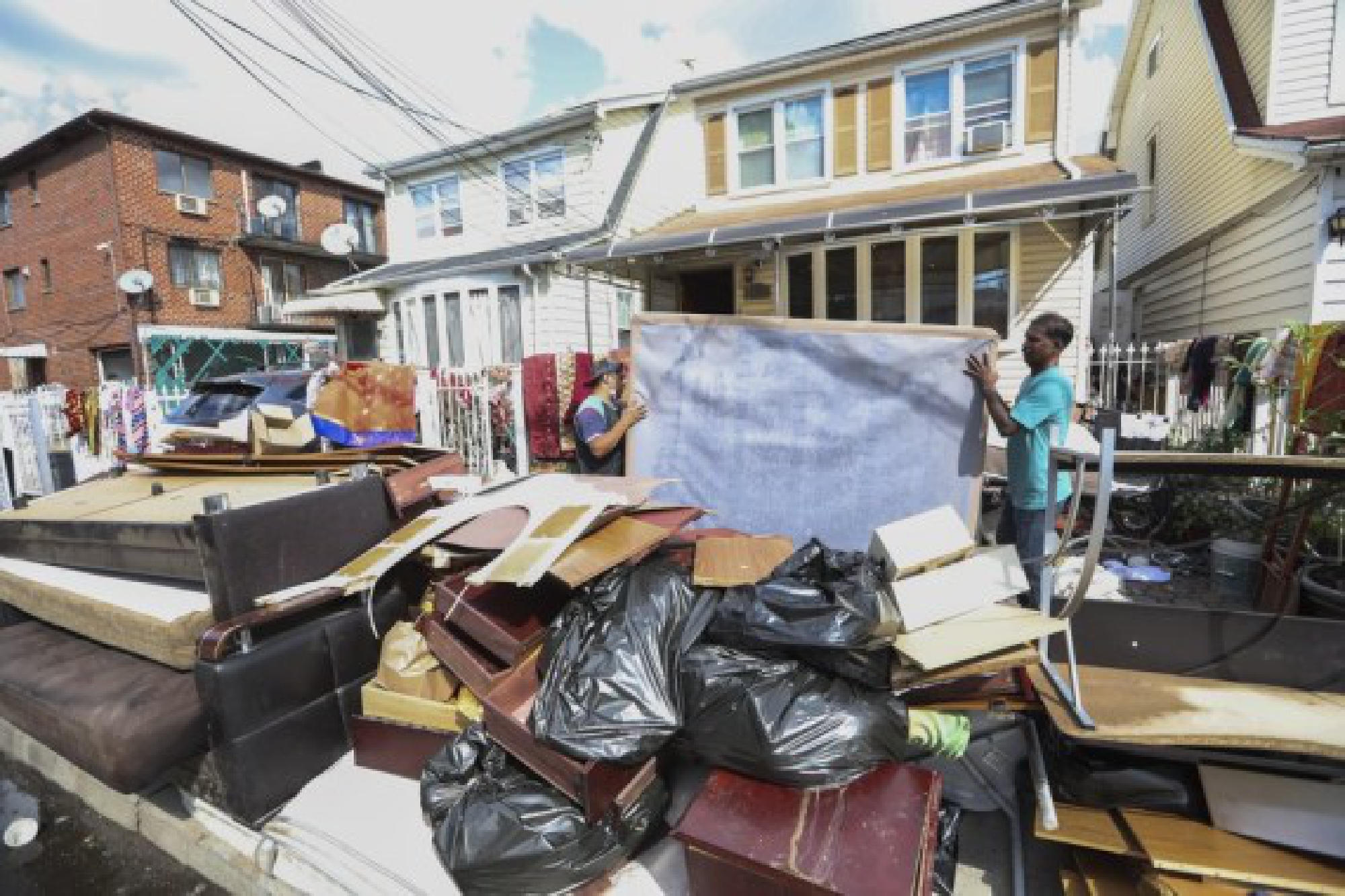
People move waterlogged belongings outside a house, in the Flushing neighborhood of the Queens borough of New York, the United States, Sept. 3, 2021.
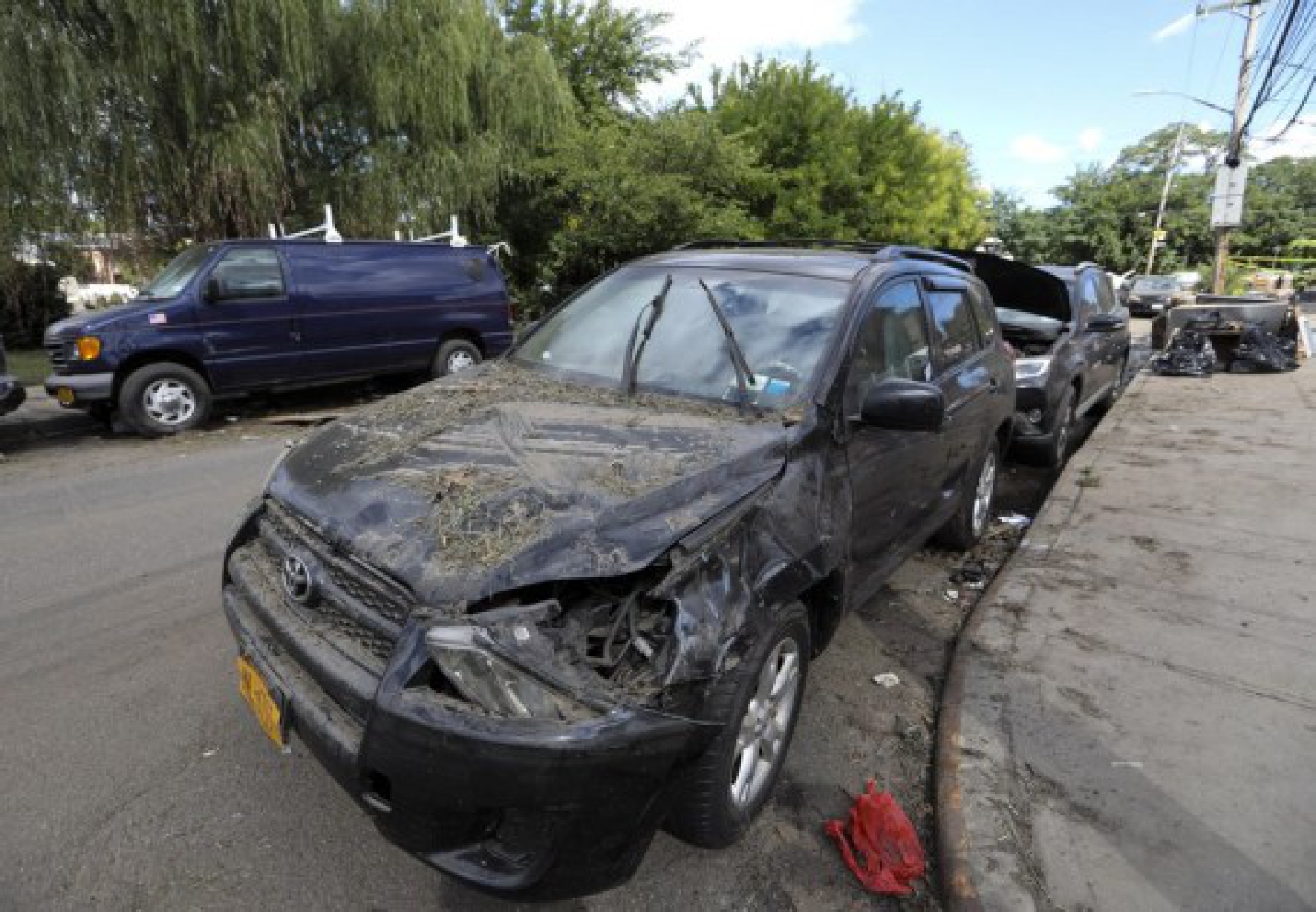
New York City and surrounding areas in the northeast of the United States suffered from tornadoes and flash floods and lost the lives of near 50 people in total as the remnants of hurricane Ida hit the area on Wednesday.
The federal government has approved an emergency disaster declaration in 14 counties of New York State including New York City and is expected to provide up to 5 million U.S. dollars in immediate federal funding to support response operations in the early stage, according to a statement by the New York State government on Friday.
The Federal Emergency Management Agency began damage assessment on Friday and would expedite the process with the support of local governments, said New York Governor Kathy Hochul.
Power supply to over 8,200 customers affected by Tropical Storm Ida has been restored as of Thursday and planned to restore 95 percent of service interruptions by midnight on Friday, according to Consolidated Edison, Inc., which provides power in NYC and Westchester County.
New York City Mayor Bill de Blasio on Friday announced a climate-driven rain response plan involving more severe warnings, basement apartment evacuations and a 30-day extreme weather response task force to devise solutions quickly and expedite implementation.
Waterlogged vehicles are seen in the Flushing neighborhood of the Queens borough of New York, the United States, Sept. 3, 2021.

 อีกหนึ่งคำสั่งสำคัญ จีนจัดระเบียบ ‘วงการบันเทิง’ เพื่อการเติบโตที่ดีของคนรุ่นใหม่
 สำนักข่าวซินหัวรายงาน จีนกระตุ้น ‘นักเขียน’ ยึดมั่นจรรยาบรรณ รับผิดชอบสังคม
 การปราฏตัวของ “มิว” กำลังทำให้โลกหวั่นใจ มันกำลังค่อยๆ ระบาดในสหรัฐจนเกือบทั่วแล้ว
 In Japan, disability advocates hope the Paralympics will showcase the pawsomeness of service dogs
 Gray greens joining climate fight in London
 Gray greens joining climate fight in London



 People move waterlogged belongings outside a house, in the Flushing neighborhood of the Queens borough of New York, the United States, Sept. 3, 2021.
 Waterlogged vehicles are seen in the Flushing neighborhood of the Queens borough of New York, the United States, Sept. 3, 2021.
