‘Save Australia’ concert Sunday in Bangkok #ศาสตร์เกษตรดินปุ๋ย

#ศาสตร์เกษตรดินปุ๋ย : ขอบคุณแหล่งข้อมูล : หนังสือพิมพ์ The Nation

https://www.nationthailand.com/lifestyle/30380714?utm_source=category&utm_medium=internal_referral

‘Save Australia’ concert Sunday in Bangkok

Jan 17. 2020
By The Nation

Bangkok music fans will on Sunday (January 19) be rocking to help victims of the bushfires ravaging all of Australia.

Hot local bands Season Five, Playground, Ae Jirakorn and Zeal are among the acts lined up for the Thai Red Cross Society fund-raiser organised by the Emporium and EmQuartier and Muzik Move Records.

The show is free, but donations to the relief fund are encouraged.

The music starts at 4pm in Quartier Park at ground level at the EmQuartier.

Disney to remove ‘Fox’ from 20th Century film studio name #ศาสตร์เกษตรดินปุ๋ย

#ศาสตร์เกษตรดินปุ๋ย : ขอบคุณแหล่งข้อมูล : หนังสือพิมพ์ The Nation

https://www.nationthailand.com/lifestyle/30380747?utm_source=category&utm_medium=internal_referral

Disney to remove ‘Fox’ from 20th Century film studio name

Jan 18. 2020
By The Washington Post · Steven Zeitchik 

Disney is removing “Fox” from the name of its 20 Century Fox film division, continuing a process of subsuming the company it bought last year for $71 billion.

The unit has been renamed 20th Century Studios, while the iconic 20th Century Fox logo will no longer contain the word “Fox.”

Meanwhile, Fox Searchlight, the prestige unit behind films such as 2020 Oscar best picture nominee “Jojo Rabbit” and past winners “Slumdog Millionaire” and “12 Years a Slave,” is being re-branded as Searchlight Pictures.

The two Fox-branded TV studios that Disney bought in last year’s deal, 20th Century Fox Television and Fox 21 Television Studios, will retain their Fox names, at least for now.

The news was first reported by Variety.

The move further separates, at least in the public eye, Disney and Rupert Murdoch’s new Fox Corporation, which counts the Fox Broadcasting Network and Fox News among its core assets.

Disney and Fox spokespeople did not immediately comment.

The move was not unexpected. While Disney has in the past maintained much of the branding of acquired companies such as Marvel and Pixar, Fox has long been in a different category. The other companies’ staffs remained largely intact, but Disney began letting go of hundreds of Fox film employees last year.

Disney at the time also unexpectedly fired Elizabeth Gabler, who had been running the Fox 2000 label; many had expected the division to continue under Disney.

20th Century Fox is one of Hollywood’s most historic names and brands. The studio, itself formed by a merger in the 1930′s, released some of the biggest classics in movie history, including “The Sound of Music,” “The French Connection” and “Avatar.” The sight of its logo along with its memorable theme music provided the rare studio brand that carried weight with ordinary consumers.

With the decision, Disney has signaled its attention to dissociate itself from Fox as Fox News remains a polarizing force. Disney has sought to stay above the culture-wars fray and appeal to families across the ideological spectrum, not always successfully.

The disassociation from Fox also helps to disentangle Disney from Murdoch – at least publicly. Murdoch still holds as much as $10 billion in Disney shares.

Branding is only part of the issue for Disney and its Fox acquisition. The entertainment giant has struggled with movies it bought from 20th Century Fox, with “Dark Phoenix,” “Stuber” and several others underperforming in the past year. Only “Ford v Ferrari” has been an exception. The Matt Damon-Christian Bale auto-racing movie has grossed more than $200 million worldwide and been nominated for a best picture Oscar.

Disney chief executive Bob Iger last summer blamed Fox movies for the company’s poor quarterly results. At the time he also was seeking a “new direction” and an attempt to “turn around” the unit under Disney studio chiefs Alan Horn and Alan Bergman.

The box-office trend has continued into 2020, with the deep-sea horror movie “Underwater” opening to just $7 million last weekend.

Famed Buddhist nun Pema Chodron resigns from Shambhala – cites community’s lack of ‘accountability’ to alleged abuse victims #ศาสตร์เกษตรดินปุ๋ย

#ศาสตร์เกษตรดินปุ๋ย : ขอบคุณแหล่งข้อมูล : หนังสือพิมพ์ The Nation

https://www.nationthailand.com/lifestyle/30380751?utm_source=category&utm_medium=internal_referral

Famed Buddhist nun Pema Chodron resigns from Shambhala – cites community’s lack of ‘accountability’ to alleged abuse victims

Jan 18. 2020

Pema Chodron

Pema Chodron
By The Washington Post · Michelle Boorstein 
Sexual misconduct charges against its leader continued to roil the Shambhala Buddhist community this week, with famed nun and best-selling author Pema Chodron stepping down as a Shambhala teacher, saying adherents are “yearning for accountability.”

The 83-year-old American nun has written multiple best-selling books, including “When Things Fall Apart” in 1996, and is one of the best-known faces of American Buddhism. She announced her retirement as a teacher in the Halifax, Nova Scotia-based global community in a Tuesday letter to the Shambhala board.

Chodron pointed to recent news that Sakyong Mipham Rinpoche, whose father founded the Shambhala movement and who has been the group’s longtime spiritual leader, had been approved by the group’s board to lead an initiation ceremony in Europe in June, as reported in the Buddhist news magazine Tricycle. “I was dumbfounded,” Chodron wrote.

The sakyong, whose birth name is Osel Rangdrol Mukpo, had “stepped away” from teaching and administrative duties in 2018 after allegations of sexual abuse and misconduct were made against Shambhala teachers and leaders, including him, Tricycle reported Friday.

The community’s board of directors resigned in 2018. A new, interim board hired an outside law firm to investigate. A report was released in February that found that Mukpo had in two cases probably forced himself on two women, Tricycle reported. The report, by the firm Wickwire Holm, also “painted a picture” that Mukpo in the 1990s and early 2000s frequently had sexual contact with women who were his students.

In a statement to The Washington Post on Friday, the Shambhala board did not comment on the sakyong’s upcoming public role. It emphasized that Pema remains a part of the Shambhala community and that the board is in dialogue with her about trying to find a “path forward” together, the board statement said.

A spokesperson for Mukpo said he is on retreat and unavailable.

In two letters he wrote in 2018 addressed to the Shambhala community, the sakyong apologized to anyone he hurt and said he accepts responsibility for the pain he had caused. Citing the stress of taking over leadership of the community at a young age after his father’s passing, and of an alcohol addiction, he said he is “like all of you, human and on the path,” he wrote in June of 2018.

A few weeks later, in a second letter, he said he was in a “state of complete heartbreak, I write to you, humble, embarrassed, and thoroughly apologetic for disappointing you.”

A message to Chodron’s spokesperson was not immediately returned Friday.

Chodron appeared on Oprah Winfrey’s “Super Soul Sunday” this past fall and has written several best-selling books. In her retirement letter, she acknowledged she had not been teaching in her Nova Scotia-based community for a while but felt that the reemergence of Mukpo, without what Chodron sees as a public accounting, made this seem like the right time.

“The seemingly very clear message that we are returning to business as usual distresses me deeply,” Chodron wrote. “How can we return to business as usual when there is no path forward for the vast majority of the community who are devoted to the vision of Shambhala and are yearning for accountability, a fresh start, and some guidance on how to proceed? I find it discouraging that the bravery of those who had the courage to speak out does not seem to be effecting more significant change in the path forward.”

Issues of sexual misconduct have been pushed to the forefront by Buddhist Project Sunshine, a group that investigates and hosts discussion about complaints related to alleged sexual misconduct and violence in Shambhala.

In 2018, Chodron publicly apologized for dismissing a woman who accused a different Shambhala director of rape. Chodron, the woman said, told her “I don’t believe you,” and, “If it’s true I suspect that you were into it.” The unnamed woman’s allegation is in a 2018 Project Sunshine report that did not specify when the alleged conversation happened.

In a 2018 statement, reported on by the Buddhist news site Lion’s Roar, Chodron said she apologized: “I was able to tell her that I feel very differently now; I believe what she told me and, going forward, I hope to be a better listener and not again say such insensitive and hurtful remarks to those who come to me for help.”

The battle for Notre Dame: As the cathedral rises from the ashes, a tug-of-war is waged over its transformation #ศาสตร์เกษตรดินปุ๋ย

#ศาสตร์เกษตรดินปุ๋ย : ขอบคุณแหล่งข้อมูล : หนังสือพิมพ์ The Nation

https://www.nationthailand.com/lifestyle/30380734?utm_source=category&utm_medium=internal_referral

The battle for Notre Dame: As the cathedral rises from the ashes, a tug-of-war is waged over its transformation

Jan 18. 2020
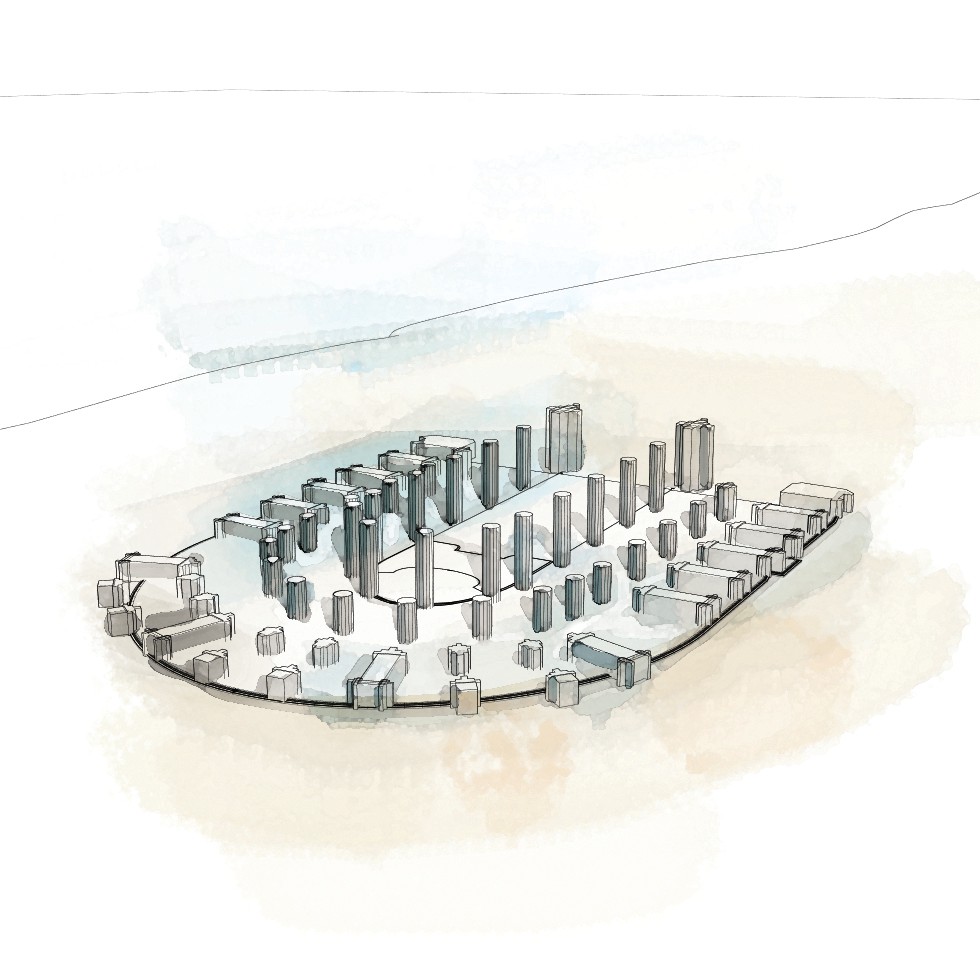
On an island in the Seine, in the heart of the ancient city of Paris, the land where Notre Dame would be built had been devoted to religious worship for centuries. In 1160, Maurice de Sully, a brilliant administrator, was elected bishop of Paris and almost immediately began plans for a large cathedral, dedicated to the Virgin Mary. To clear space for Notre Dame, other structures, including the cathedral of Saint-Étienne, were gradually dismantled. MUST CREDIT: Washington Post illustration by Aaron Steckelberg

On an island in the Seine, in the heart of the ancient city of Paris, the land where Notre Dame would be built had been devoted to religious worship for centuries. In 1160, Maurice de Sully, a brilliant administrator, was elected bishop of Paris and almost immediately began plans for a large cathedral, dedicated to the Virgin Mary. To clear space for Notre Dame, other structures, including the cathedral of Saint-Étienne, were gradually dismantled. MUST CREDIT: Washington Post illustration by Aaron Steckelberg
By The Washington Post · Philip Kennicott · FEATURES

The battle for Notre Dame: As the cathedral rises from the ashes, a tug-of-war is waged over its transformation. PARIS – Earlier this month, the French general tasked with overseeing the restoration of Notre Dame confirmed some terrible news: Even now, nine months after a catastrophic fire in April destroyed the cathedral’s spire, roof and some of its vaults, its fate remains uncertain. “The cathedral is still in a state of peril,” Jean-Louis Georgelin told the French broadcaster CNews.

There has been renewed anguish in France. The holidays passed without a Christmas Mass in the beloved national icon or a Christmas tree on the public square outside its richly decorated west facade. When I visited in October, I passed by only once, and it was painful to see the great church off-limits. The writer Hilaire Belloc once described Notre Dame as a matriarch whose authority is familiar, tacit and silent. But she now seems not just reticent, but mute.
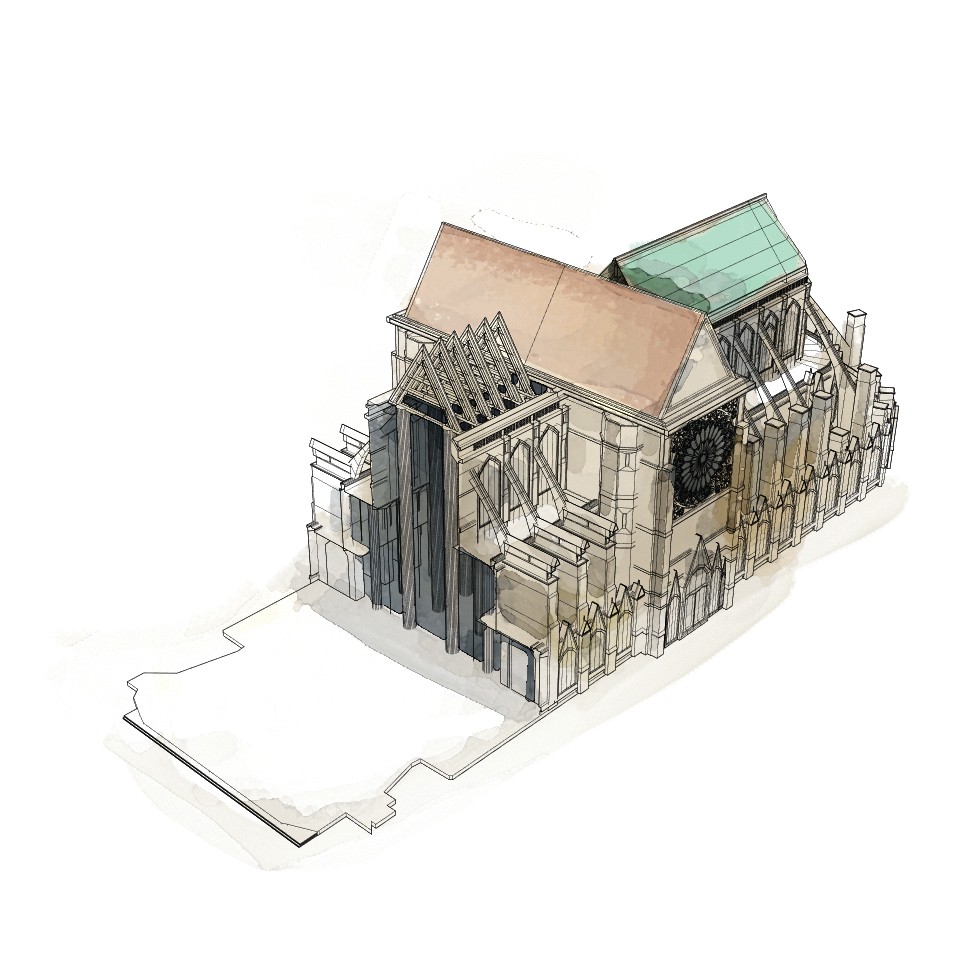
With King Louis VII and Pope Alexander III in attendance, the first major phase of construction began with the laying of the cornerstone in 1163. MUST CREDIT: Washington Post illustration by Aaron Steckelberg

With King Louis VII and Pope Alexander III in attendance, the first major phase of construction began with the laying of the cornerstone in 1163. MUST CREDIT: Washington Post illustration by Aaron Steckelberg

As the public commission headed by Georgelin met for the first time in December, it was clear that the country was still far from any consensus on how the cathedral will be restored. Weeks earlier, Philippe Villeneuve, chief architect of the country’s historic monuments service, said in a broadcast interview that he would resign rather than allow a modern spire – as proposed by French President Emmanuel Macron – to be built atop the cathedral’s roof. In response, Georgelin told the architect to “shut his gob.”

By 1182, much of the cathedral's choir - the liturgical core of the building, then reserved for the clergy - with its iconic flying buttresses supporting its tall walls and roof, had been completed. MUST CREDIT: Washington Post illustration by Aaron Steckelberg

By 1182, much of the cathedral’s choir – the liturgical core of the building, then reserved for the clergy – with its iconic flying buttresses supporting its tall walls and roof, had been completed. MUST CREDIT: Washington Post illustration by Aaron Steckelberg

That comment made international news, although in France it wasn’t out of character for public discussion of architecture and preservation.
Over the next decades, work on the nave pushed the cathedral's spine to the west. MUST CREDIT: Washington Post illustration by Aaron Steckelberg

Over the next decades, work on the nave pushed the cathedral’s spine to the west. MUST CREDIT: Washington Post illustration by Aaron Steckelberg

“This debate is classic,” Philippe Barbat, director general of heritage at the French Ministry of Culture, said in interview last fall. “Do we restore it as close as possible to what we understand by analyzing the historical context of the building, or do we try to make something more creative?” Barbat cites the glass pyramid at the Louvre, designed by I.M. Pei as a modernist intervention at the heart of one of the city’s sacred cultural spaces, as an example of the latter.
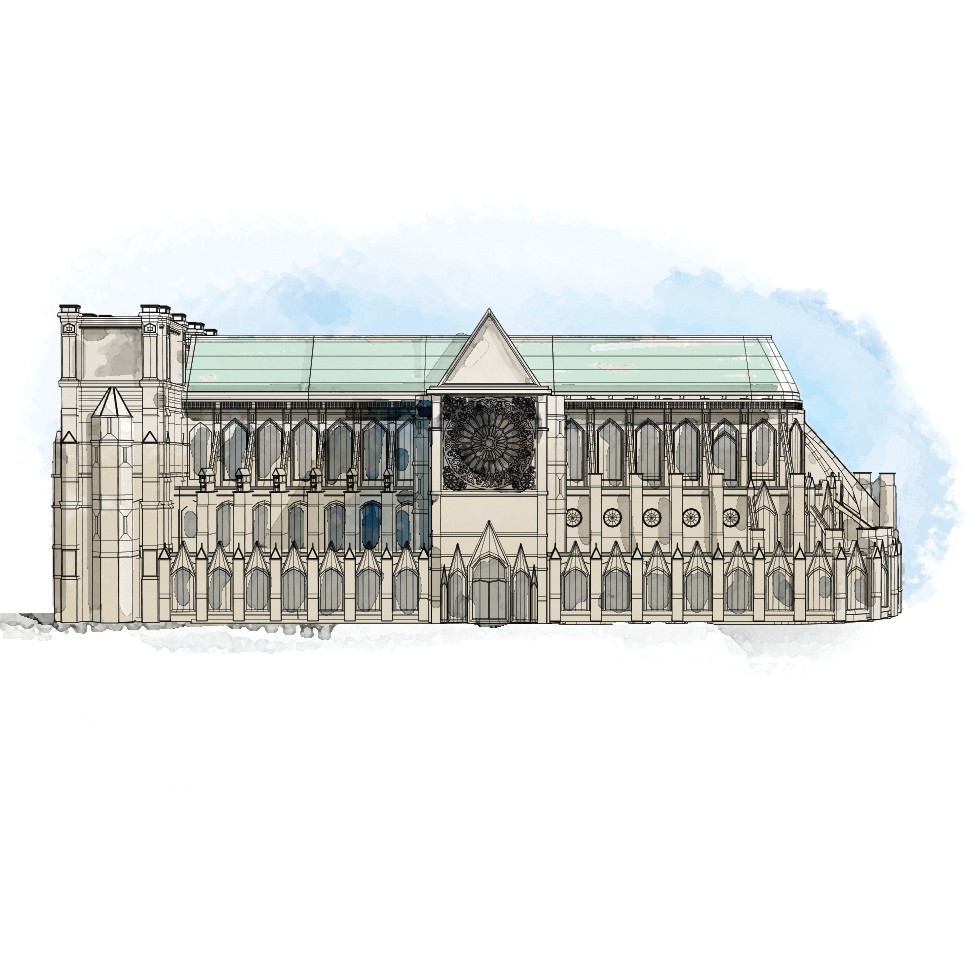
By 1220, the basic form of the early cathedral was essentially finished. MUST CREDIT: Washington Post illustration by Aaron Steckelberg

By 1220, the basic form of the early cathedral was essentially finished. MUST CREDIT: Washington Post illustration by Aaron Steckelberg

And change is classic, too. Although there have been centuries during which the architecture of Notre Dame stayed mostly the same, especially after the major construction work was finished in the middle of the 13th century, it has undergone major transformations throughout its history. As France, and much of the rest of the world, contemplates what will become of the grand cathedral, it’s clear that the final result will be an amalgam: of history and fantasy, the 12th century and the 21st, the imaginary building seen in art and described in literature, and a pile of stones that has been made and remade for almost nine centuries.

Beginning in the mid-1220s, much of Notre Dame was remade to be more in line with contemporary architectural tastes. The two western towers were finished and a spire was added to the crossing of the nave and transept. The last major phase of the original construction ended in the mid-14th century, more than 150 years after it had begun. By the late 18th century, the original spire was removed before it could collapse from decay. The cathedral remained without a spire until 1859, when one designed by Eugène Emmanuel Viollet-le-Duc was added as part of an extensive 20-year renovation. Over the next 160 years, alterations and repairs continued to be made. MUST CREDIT: Washington Post illustration by Aaron Steckelberg

Beginning in the mid-1220s, much of Notre Dame was remade to be more in line with contemporary architectural tastes. The two western towers were finished and a spire was added to the crossing of the nave and transept. The last major phase of the original construction ended in the mid-14th century, more than 150 years after it had begun. By the late 18th century, the original spire was removed before it could collapse from decay. The cathedral remained without a spire until 1859, when one designed by Eugène Emmanuel Viollet-le-Duc was added as part of an extensive 20-year renovation. Over the next 160 years, alterations and repairs continued to be made. MUST CREDIT: Washington Post illustration by Aaron Steckelberg

As Notre Dame has been rebuilt and repaired over the centuries, there have been many cries of sacrilege. Shortly before the French Revolution, it was whitewashed, leading one prominent critic to grumble that the edifice had “lost its venerable color and its imposing darkness that had commended fervent respect.” And beginning in the 1840s, after decades of little maintenance, sporadic use and sometimes misguided efforts at repair, it was “restored” so thoroughly that many historians came to think of it as a 19th-century church, not a medieval one.

In the spring of 2019, the most recent renovations to the cathedral were underway. Scaffolding was erected around the spire to make repairs, and days before the fire, 16 statues at the base of the spire were removed. MUST CREDIT: Washington Post illustration by Aaron Steckelberg

In the spring of 2019, the most recent renovations to the cathedral were underway. Scaffolding was erected around the spire to make repairs, and days before the fire, 16 statues at the base of the spire were removed. MUST CREDIT: Washington Post illustration by Aaron Steckelberg

One of the most significant transformations was probably precipitated by a fire in the 13th century, perhaps similar to the one in 2019, in the roof space above the vaults. Whether the damage forced the cathedral’s stewards to rebuild, or was simply a good pretext to update the building, isn’t clear. But the change was extensive.
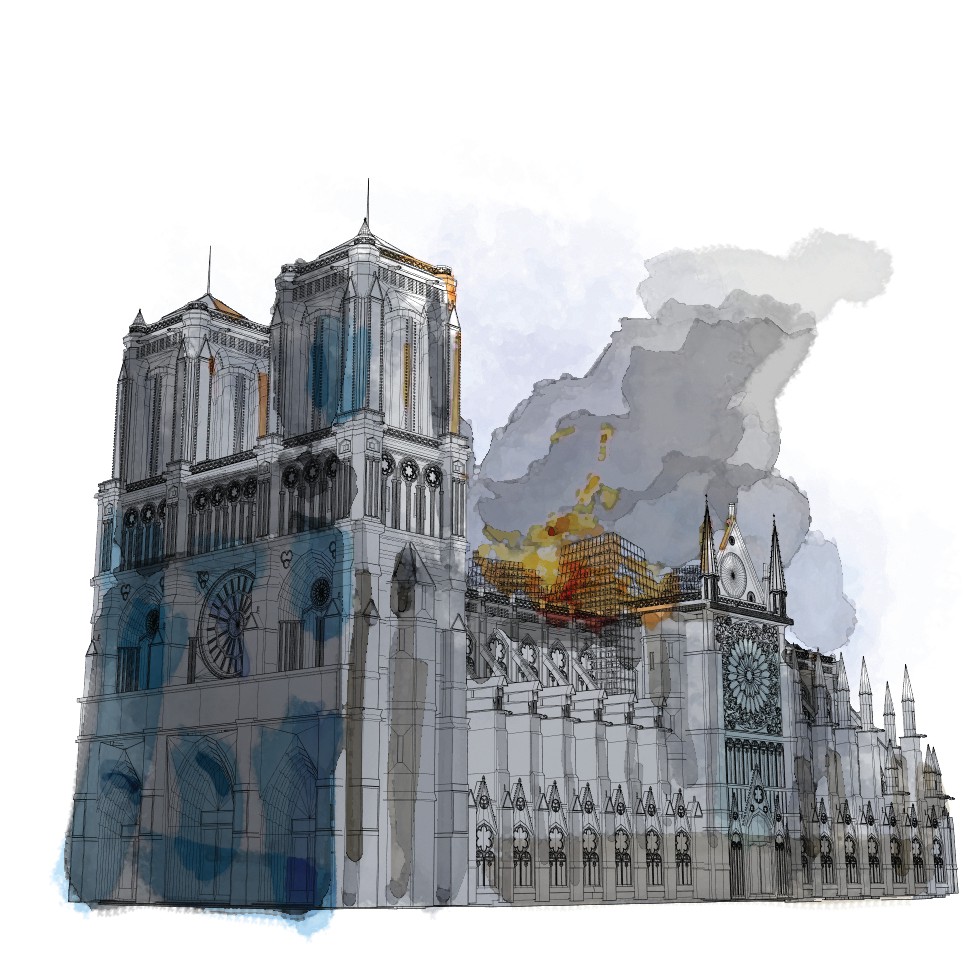
On April 15, a massive fire broke out. Over several hours, flames raged and eventually destroyed Notre Dame's spire, roof and timbers within. An official cause has still not been determined, although early speculation centered on an electrical source, or a discarded cigarette. MUST CREDIT: Washington Post illustration by Aaron Steckelberg

On April 15, a massive fire broke out. Over several hours, flames raged and eventually destroyed Notre Dame’s spire, roof and timbers within. An official cause has still not been determined, although early speculation centered on an electrical source, or a discarded cigarette. MUST CREDIT: Washington Post illustration by Aaron Steckelberg

“Having been around for a mere sixty years, Notre Dame had already been eclipsed,” Dany Sandron of the Sorbonne and the late Andrew Tallon of Vassar write in a forthcoming book about the cathedral, based in part on their comprehensive laser measurement of Notre Dame before the 2019 fire. Elsewhere, in 13th-century France, new cathedrals were being built, and old ones disassembled and reconstructed, to make them taller, lighter and more vertical, and to introduce more light, as if they were made from taut curtains of glass, not heavy columns of stone. And so Notre Dame’s clerestory windows were enlarged, the roofs changed and the flying buttresses reconstructed, although the cathedral remained relatively dark despite its fashionable update.
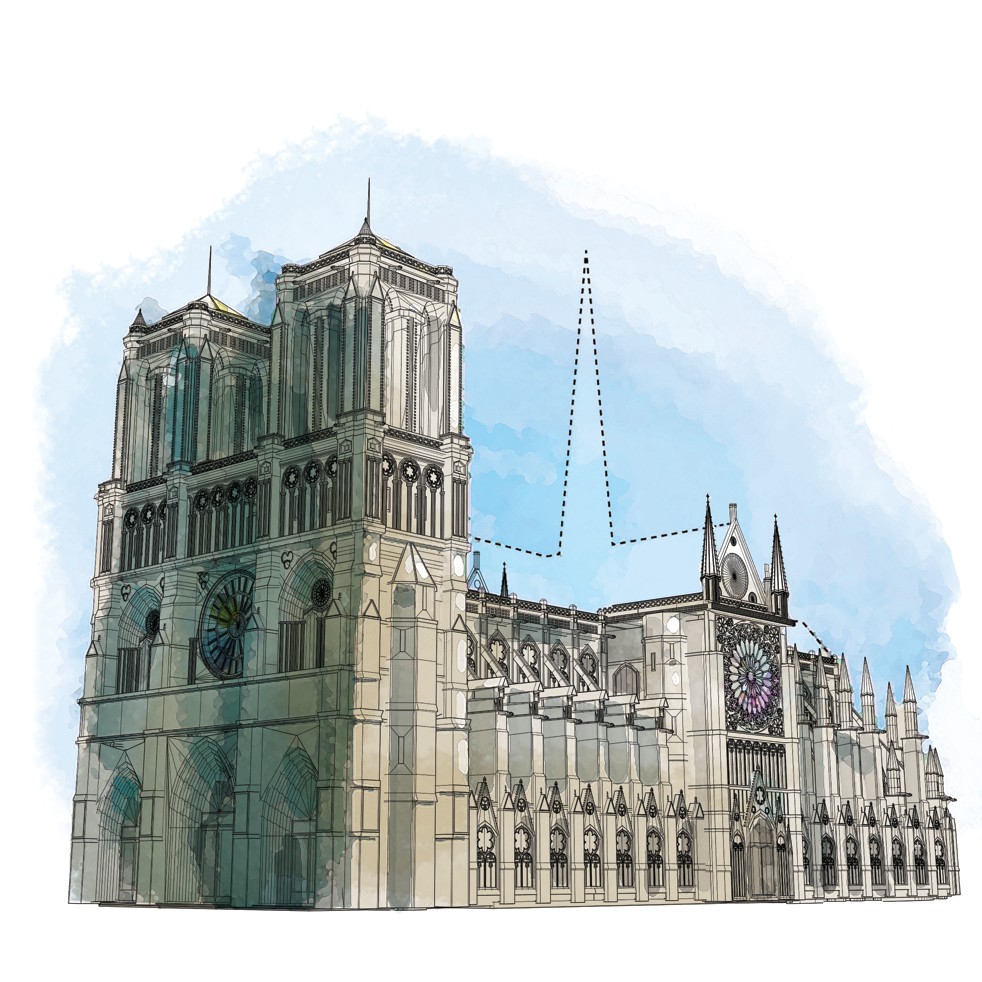
After the fire, debate began almost immediately about the cathedral's restoration. Should it be returned to its exact pre-fire configuration? Should the 19th-century spire be rebuilt? Or should it be updated for the 21st century and beyond? MUST CREDIT: Washington Post illustration by Aaron Steckelberg

After the fire, debate began almost immediately about the cathedral’s restoration. Should it be returned to its exact pre-fire configuration? Should the 19th-century spire be rebuilt? Or should it be updated for the 21st century and beyond? MUST CREDIT: Washington Post illustration by Aaron Steckelberg

The second radical transformation dates, in part, to 1831, when Victor Hugo published the novel known in English as “The Hunchback of Notre Dame.” The book, set in the 15th century, was a phenomenal success, and the church itself was a major character in its drama of love, lust and betrayal. Hugo intended the novel to ignite interest in France’s legacy of gothic and medieval architecture, and he succeeded. Notre Dame, then in a state of grave disrepair, was rediscovered, and various government committees and commissions were established to help the country address what we now call cultural heritage and historic preservation.

Repairing Notre Dame was one of the most urgent projects, and Eugène Emmanuel Viollet-le-Duc, one of two architects put in charge of restoration, began to undertake extensive and controversial changes. Perhaps no one in the history of the cathedral understood it better – its quirks, structural oddities and weak spots – and no one was more passionately hostile to earlier renovations that had altered its gothic design. But Viollet-le-Duc’s definition of restoration was more like that of a contemporary theater director approaching an old script than a preservationist working with scientific and historical rigor: “To restore a building,” he wrote, “is not to maintain, repair, or redo it, but to reestablish it in a finished state that may never have existed at a given time.”

Viollet-le-Duc changed the windows, added decorative elements to the base of the flying buttresses, remade statues, and created wholesale many of the grotesques, chimeras and gargoyles that visitors often assume are the essence of the cathedral’s gothic character. He also built a new spire, out of wood and lead, to replace the one that had been removed in the mid-18th century because it was no longer sound.

Those changes rapidly became embedded in the public memory of the building. I recall receiving a postcard from Paris that showed a classic image: the Eiffel Tower, with one of Viollet-le-Duc’s gargoyle figures in the foreground. But it didn’t contrast old and new, simply two visions of the 19th-century remake of the city.

One of the most famous images of 19th-century France was an 1853 etching by Charles Meryon called “Le Stryge,” or “The Vampire,” which shows another of Viollet-le-Duc’s grotesque Notre Dame figures, its tongue sticking out contemptuously as it watches over a fantasy of old Paris. It helped to define the curiously Parisian sense that the city’s essence is woven of both beauty and squalor, that it teems with contradictions and harsh contrasts, as in a famous poem by Charles Baudelaire: “Brothels and hospitals, prison, purgatory, hell/Monstrosities flowering like a flower …”

After the fire, the Cité de l’Architecture et du Patrimoine, a Paris museum that includes Viollet-le-Duc’s invaluable collection of full-scale architectural casts of historic French facades and medieval sculptural elements, displayed models, sculpture and other objects related to Notre Dame. The museum embodies the complicated legacy of Viollet-le-Duc, who was for much of the 20th century considered a fantasist, a Walt Disney-like figure who invented his own version of historic architecture. But he also was a meticulous observer, and the documentation he left behind may be essential to restoring Notre Dame.

“We know we can construct it exactly like it was,” says Francis Rambert, director of the museum’s architectural design department. He is standing in front of Viollet-le-Duc’s model for the wooden spire, a small-scale sculptural marvel in itself. “But the question is, do we need to sacrifice all those trees?”

The spire and the wood have become intertwined flash points that seem to divide French opinion not into clearly opposed ideological camps, but into myriad fragmentary alignments of opinion, as complex as one of the cathedral’s rose windows. There are environmental issues, aesthetic issues, cultural issues, patrimony issues and financial issues.

Is wood necessary? Would lighter materials be better, or do the vaults need the heavy weight of wood to make them secure? Is satisfactory wood available? At one point last year, a Ghanaian company even offered to dredge up giant trees preserved and strengthened by submersion when land was flooded for a dam in Africa in 1965.

The current debates and controversies have uncovered a deeper admiration for Viollet-le-Duc and his architectural changes than might have been apparent a quarter century ago. “Was he some kind of genius or someone who was a megalomaniac?” asks Barbat, the government heritage director, who adds that opinion about Viollet-le-Duc has changed markedly since the 1990s, with growing acknowledgment that his changes have become part of the cathedral’s history. Indeed, when a damaged part of the church’s Porte Rouge was repaired recently, one of Viollet-le-Duc’s elements was meticulously reproduced, a sign that preservation now includes older, 19th-century restoration efforts.

In the end, it will probably be Macron who determines the new form of Notre Dame, although it’s unclear how much he will defer to experts, traditionalist voices, the Catholic Church and the concerns of preservationists. French presidents generally want to put their stamp on Paris, such as Georges Pompidou’s support for a modern cultural center, which eventually became the Centre Pompidou, a bristling postmodern architectural masterpiece, or Francois Mitterand’s championing of I.M. Pei’s Louvre pyramid project. Macron, young, arrogant and determined to chart a new middle course through the fault lines of French political life, has his perfect signature project: the restoration of an ancient building with a modern twist.

“As for the decision itself, I would say that only the president can answer this,” Barbat says. “He was really involved since the night of the fire when he was present at the cathedral. Most likely he will speak about it with the head of the (commission), General Georgelin, but also the minister of culture. Afterward, I cannot answer precisely what he will decide alone in the loneliness of the presidency.”


Henderson, Inbee atop Diamond Resorts Tournament of Champions #ศาสตร์เกษตรดินปุ๋ย

#ศาสตร์เกษตรดินปุ๋ย : ขอบคุณแหล่งข้อมูล : หนังสือพิมพ์ The Nation

https://www.nationthailand.com/sport/30380738?utm_source=category&utm_medium=internal_referral

Henderson, Inbee atop Diamond Resorts Tournament of Champions

Jan 18. 2020
Inbee Park of South Korea reacts after a birdie on the 14th green during the first round of the Diamond Resorts Tournament of Champions at Tranquilo Golf Course at Four Seasons Golf and Sports Club Orlando on January 16, 2020 in Lake Buena Vista, Florida. (Photo by Michael Reaves/Getty Images)

Inbee Park of South Korea reacts after a birdie on the 14th green during the first round of the Diamond Resorts Tournament of Champions at Tranquilo Golf Course at Four Seasons Golf and Sports Club Orlando on January 16, 2020 in Lake Buena Vista, Florida. (Photo by Michael Reaves/Getty Images)
By THE NATION

A pair of major winners lead the field at -9 heading into the weekend at the 2020 Diamond Resorts Tournament of Champions presented by Insurance Office of America.

Brooke Henderson, a nine-time LPGA Tour winner with one major title, shot Friday’s round of the day with a 5-under 66 and vaulted up the leaderboard after starting the day in solo 10th. Inbee Park, the 19-time LPGA Tour winner with seven majors to her credit, is bogey-free through 36 holes, following Thursday’s 65 with a 3-under 68 on Friday.

“It’s a really nice way to start the year. I haven’t made many mistakes on the golf course, and that’s what I really look to do all year,” said Park. “Hopefully, I can keep that going for the next two days. Today was definitely a little bit tougher conditions with the wind. I hit a lot longer clubs and missed a few greens, but I was able to make some great up and downs.”

Gaby Lopez sits in solo third at -8 after a second-round 69, with Celine BoutierSei Young Kim and Nasa Hataoka tied for fourth at -7. First-round co-leader Danielle Kang was 2-under on her round after nine holes but closed with four bogeys on her back nine to fall to -6 and heads into the weekend in seventh.

After opening with a 3-over 74, defending champion Eun-Hee Ji rebounded with a 4-under 67 on Friday and heads into the weekend tied for 17th.

The celebrity portion of the competition has a three-way tie for the lead with defending champion John SmoltzChad Pfeifer and Mardy Fish all at +74. First-round leader Mark Mulder is fourth at +69, with Eric Gagne rounding out the top five at +67.

“I’m very confident. I’ve just got to see more putts go into the hole,” said Smoltz. “They’re touching the hole. Every one of them is close, but if I keep putting like this, it’s going to be really good.”

CLOSING EXCITEMENT FOR BROOKE HENDERSON

It was a colorful closing stretch for Brooke Henderson. After making a birdie at No. 16, the Canadian superstar nearly holed out for double eagle at the par-5 17th, hitting her 3-wood from 230 yards out. For a few moments, it looked like her ball would hit the cup at the Aon Risk Reward Challenge hole, but she instead settled for a 4-inch tap-in eagle.

“It was pretty downwind. I was kind of contemplating between 7 wood and 3 wood,” said Henderson, who was third on the LPGA Tour in eagles in 2019 with 16. “At the last second, it sort of switched to maybe a little bit more crosswinds, so we pulled the 3 wood, and I’m really glad I did. I hit it, and I thought I hit it pretty well. (Caddie and sister) Brit (Henderson) was telling it to sit down, so I’m not sure where it hit on the green there, but it was nice to walk up and have that short putt for eagle.”

A bogey at 18 for the second straight day put a slight damper on her round, but Henderson still sits atop the leaderboard heading into the weekend, tied with fellow major champion Inbee Park. Henderson comes into 2020 on a streak of four consecutive years with at last two victories, dating to 2016.

GABY LOPEZ MASTERS WINDS TO JUMP INTO THIRD

When Gaby Lopez started her second round in the Diamond Resorts Tournament of Champions, the winds were just beginning to make their presence known. As the day progressed, sustained winds of 10-20 mph gave way to gusts up to 28 mph.

“Today was really windy at the beginning, so I couldn’t play aggressive,” said Lopez, who carded a 1-over 35 on the front nine that included two bogeys. “I had to pick my target, and if I was in a fairway bunker, I had to just hit to the middle of the green. That’s some of the things I didn’t do. The conditions are going to determine how I play but going to be aggressive when I can.”

Sitting third at the halfway point, Lopez added that she “probably didn’t have the amount of weeks that I wanted to practice” before the season opener. Even so, the 2018 Blue Bay LPGA champion is drawing on positive memories from the 2019 TOTO Japan Classic, where she finished tied for sixth.

“I played very well in Japan last year, the second to last event,” Lopez said. “I’m kind of bringing those memories back to how I mentally play the game. That for sure has been helping me. Also, taking it easy. I know it is a long season and the more patient I stay, the better I play.”

SEI YOUNG KIM CONTINUES IMPRESSIVE STREAK

Today’s round of 2-under 69 marked the 17th consecutive under-par round for 10-time LPGA Tour winner Sei Young Kim. The last time Kim recorded a round over par came on Oct. 17, 2019, when she shot a 1-over 73 in the first round of the Buick LPGA Shanghai.

“I’m very happy with that,” said Kim, who closed the 2019 season with a win at the CME Group Tour Championship. “Normally my play style is not consistent, very aggressive.”

Kim particularly enjoyed today’s walk around the course at Four Seasons Golf and Sports Club Orlando thanks to a fun grouping with Roger Clemens and Grant Hill. Kim is a third-degree black belt in taekwondo and she chatted with Hill about his daughter’s jiujitsu training. “He said his daughter keeps trying to fight somebody,” she said with a laugh.

CELINE BOUTIER RECORDS FIRST ACE OF 2020 LPGA TOUR SEASON

Celine Boutier made the first hole-in-one of the 2020 LPGA Tour season, acing the 178-yard fifth hole with a 4-iron.

“Super happy, excited,” said Boutier, who became a Rolex First-Time Winner at the 2019 ISPS Handa Vic Open. “It’s my second one, but my first one was like eight years ago, so it was definitely time for another one.”

For that ace, CME Group will donate $20,000 to St. Jude Children’s Research Hospital, which is leading the way the world understands, treats and defeats childhood cancer and other life-threatening diseases. The 2019 LPGA Tour season saw 32 aces from 31 different players, which more than covers the average cost of $425,000 needed to treat a pediatric cancer patient.

Jazz moves one clear #ศาสตร์เกษตรดินปุ๋ย

#ศาสตร์เกษตรดินปุ๋ย : ขอบคุณแหล่งข้อมูล : หนังสือพิมพ์ The Nation

https://www.nationthailand.com/sport/30380735?utm_source=category&utm_medium=internal_referral

Jazz moves one clear

Jan 18. 2020
Jazz Janewattananond

Jazz Janewattananond
By THE NATION

Defending champion Jazz Janewattananond of Thailand made a spirited charge up the leaderboard by carding a second round six-under-par 65 to head into the weekend in pole position at the SMBC Singapore Open on Friday.


Jazz, who started his round two shots off the pace, did not get off to the best of starts as he bogeyed the second hole. But he quickly found his rhythm with three birdies on holes four, eight and nine.

The 2019 Asian Tour Order of Merit champion then raced towards the summit with another four birdies in his back-nine for a two-day total of 10-under-par 132 at the Serapong course, Sentosa Golf Club.

“It makes me really happy to be back here to play in the course that I won in a year ago,” said the in-form Thai.

“There are still two more days and anything can happen. There are a lot of good players here. Kuchar and Rose are still within reach and I will just stick to my plan and hopefully will take a win for the weekend,” he added.

Philippines’ Miguel Tabuena matched Jazz’s efforts when he also returned with a 65 to share second place with Korean teen sensation Joohyung Kim, who signed for a 66 at the US$1 million event which is sanctioned by the Asian Tour and Japan Golf Tour Organisation (JGTO).

American Matt Kuchar and former world number one Justin Rose of England also underlined their star credentials when they posted a 68 and 66 respectively to share fourth place.

Canada’s Richard T. Lee, a two-time Asian Tour winner, slipped to sixth place (69), having started the round in tied for second while Thailand’s Gunn Charoenkul returned with a 70 to stay four shots back of Jazz together with Japan’s Tomoharu Otsuki and India’s Rashid Khan in a share of seventh place.

66 players made the weekend cut which was set at one-over-par.

Toyota pumps another $700 million into American SUV expansion #ศาสตร์เกษตรดินปุ๋ย

#ศาสตร์เกษตรดินปุ๋ย : ขอบคุณแหล่งข้อมูล : หนังสือพิมพ์ The Nation

https://www.nationthailand.com/auto/30380746?utm_source=category&utm_medium=internal_referral

Toyota pumps another $700 million into American SUV expansion

Jan 18. 2020
By Syndication Washington Post, Bloomberg · Chester Dawson 

Toyota Motor Corp. has poured more money into yet another North American plant to boost production of the SUVs and trucks U.S. customers increasingly seek instead of sedans.

The Japanese automaker said Friday it has spent $700 million and hired 150 new workers at its plant in Princeton, Indiana, mostly to increase production of its Highlander sport utility vehicle.

The outlay is part of a $1.3 billion injection into the factory and a broader pledge by Toyota to invest $13 billion at its U.S. facilities through next year, about half of which the company will detail into next year. The spending – which has helped Toyota fend off tariff threats made by President Donald Trump – is designed to align production with demand for more SUVs and trucks.

As sales of once-dominant sedans including the Corolla and Camry have dropped, Toyota has had a hard time maintaining enough stock of its best-selling RAV4 crossover and growing range of hybrids. The shift in demand has already prompted the company to revamp factories in Kentucky, Texas and Ontario in just the last year and shift more SUV assembly to the U.S. market.

“Part of Toyota’s tremendous success in North America is building vehicles where we sell them,” Christopher Reynolds, Toyota’s chief administration officer in North America, said in a statement.

The investment in Princeton boosts the plant’s annual capacity by almost 10% to 420,000 vehicles and focuses production on the conventional mid-size Highlander and a gas-electric hybrid version. Toyota said it will shift output of the full-size Sequoia SUV from Indiana to a truck factory in Texas in 2022.

That should allow the company to improve productivity in Princeton, which made about 362,000 vehicles last year but was capable of manufacturing 383,000. The Highlander accounted for 73% of the total, trailed by Sienna’s 24% and Sequoia’s 2.5%.

To make room for the Sequoia alongside the full-size Tundra truck at its San Antonio plant, Toyota will stop producing the mid-size Tacoma there next year and move all manufacturing of that popular pickup to two factories in Mexico that already assemble the model.

Capacity in San Antonio will remain at 208,000 vehicles a year and no jobs will be cut, the company said.

It’s not clear what will make up for the slack left by the Tacoma. About 40% of the more than 275,000 Tacomas produced last year were built in San Antonio, where Toyota said it is spending $391 million on “multi-vehicle production capabilities” for unspecified models.

Tesla faces federal review of complaints its cars accelerate without warning #ศาสตร์เกษตรดินปุ๋ย

#ศาสตร์เกษตรดินปุ๋ย : ขอบคุณแหล่งข้อมูล : หนังสือพิมพ์ The Nation

https://www.nationthailand.com/auto/30380742?utm_source=category&utm_medium=internal_referral

Tesla faces federal review of complaints its cars accelerate without warning

Jan 18. 2020
File Photo of Tesla cars

File Photo of Tesla cars
By The Washington Post · Ian Duncan, Faiz Siddiqui

WASHINGTON – The federal auto safety regulator said Friday that it has begun a review of complaints that Tesla cars have suddenly accelerated, crashing into a palm tree in one instance, and walls, a fire hydrant, and parked cars in others.

A photo included in the agency’s complaint records shows a Tesla Model S that smashed through a wall in a person’s home after they tried to park in their garage.

The National Highway Traffic Safety Administration has received 127 similar complaints about sudden acceleration resulting in 52 injuries. Their inquiry into the incidents could involve as many as half a million vehicles, according to the agency’s summary of the review.

While many of the complaints involve allegations that the driver was parking when their car suddenly sped away, a few of the complaints involve high-speed incidents recorded by law enforcement.

A witness to a 10-vehicle crash on a Oregon highway in August told police that it appeared a speeding Tesla Model 3 that careened through traffic “was not controllable and that it seemed like she was watching a movie.”

NHTSA said it launched the review after receiving what’s known as a defect petition, a type of complaint that members of the public can use to compel the agency to act. The review involves Model S and 3 sedans and Model X SUVs in model years 2012 through 2019.

“As is the agency’s standard practice in such matters, NHTSA will carefully review the petition and relevant data,” the agency said in a statement.

Tesla, which makes electric vehicles only, did not respond to a request for comment.

The review is the second that NHTSA has launched involving Tesla in recent months: In November, it said it would review complaints about battery defects.

Automakers have faced complaints about their vehicles suddenly accelerating before, but it has proved difficult to determine whether a defective design or the driver was at fault. Jason Levine, the director of the Center for Auto Safety, said the amount of data Tesla collects on its vehicles could lead to greater clarity, and he hoped NHTSA would force them to turn over the information.

A McLean, Virginia, woman’s husband filed a complaint with the agency after her Model 3 crashed in her parking garage at work last April. The woman said she was trying to roll forward into a parking space when, “I felt like someone had taken control from me.”

The car smashed into a pole and was totaled, said the woman, who asked that her name not be used to protect her privacy. Her husband said Tesla investigated and told them the accelerator was pushed all the way down, a conclusion they reject.

The woman’s experience was typical, according to a review of the Tesla complaints in NHTSA’s records. People reported vehicles approaching parking spaces or garage doors – or otherwise traveling at a low speed – when they violently lurched forward despite an apparent lack of accelerator input from the driver.

In some of the complaints, people reported that Tesla refused to turn over computer reports on the force of the pedal or the incident logs from the episodes and blamed driver error.

Details of the Oregon crash were submitted to NHTSA by police, who told the federal agency that witness accounts “appear to verify” the driver and passenger’s account that the car experienced unintended acceleration.

The complainants themselves insisted they hadn’t depressed the accelerator pedal. One couple, a 42-year-old pilot and 37-year-old physician, said they both experienced instances of sudden unintended acceleration in the span of about two weeks.

Several of the drivers suspected Tesla’s advanced driver-assistance suite, Autopilot, was a potential culprit. In one instance, a driver in Olympia, Washington, said they were attempting to park their Tesla Model S at a Costco when “the car bolted.”

“It felt like it was in Autopilot mode without me engaging it manually,” the complaint said. “I can still drive the car and feel fairly safe as I believe the computer accidentally engaged the Autopilot and now the Autopilot isn’t operational. However, I no longer trust this car.”

Justice Department official sees ‘fertile ground’ for encryption legislation in wake of Pensacola shooting #ศาสตร์เกษตรดินปุ๋ย

#ศาสตร์เกษตรดินปุ๋ย : ขอบคุณแหล่งข้อมูล : หนังสือพิมพ์ The Nation

https://www.nationthailand.com/edandtech/30380743?utm_source=category&utm_medium=internal_referral

Justice Department official sees ‘fertile ground’ for encryption legislation in wake of Pensacola shooting

Jan 18. 2020
By The Washington Post · Ellen Nakashima 

WASHINGTON – A senior Justice Department official on Friday said he saw an increasing willingness on Capitol Hill to pass legislation requiring tech companies to make their encrypted devices accessible to law enforcement, saying “the ground is as fertile as ever” for such action.

Assistant Attorney General John Demers declined to disclose “how far along we are on a decision to seek legislation” but leaned forward on the issue.

“I’ve never seen the atmosphere here in D.C. to be so conducive to passing some kind of encryption legislation or lawful access legislation as it is today,” Demers said during a discussion at the Wilson Center.

His remarks come in the wake of last month’s shooting at a naval base in Pensacola, Florida, that killed three people and led the FBI earlier this month to ask Apple for help opening two iPhones that belonged to the Saudi shooter. This week, U.S. Attorney General William P. Barr raised the issue again, accusing Apple of failing to provide “substantial assistance” and calling on the firm “to help us find a solution” to locked devices.

President Trump on Tuesday also weighed in with a harsh tweet: “We are helping Apple all of the time on TRADE and so many other issues, and yet they refuse to unlock phones used by killers, drug dealers and other violent criminal elements,” he said. “They will have to step up to the plate and help our great Country, NOW!”

Demers referred to a Senate hearing in December in which Senate Judiciary Committee Chairman Lindsey Graham, R-S.C., warned tech firms to find a way to build access into their phones or Congress would act. “My advice to you is to get on with it,” he said, “because this time next year, if we haven’t found a way that you can live with, we will impose our will on you.”

Any legislation would still have to pass a Democratic-controlled House, where a bipartisan alliance of privacy hawks and libertarians could block those efforts. Such legislation has been an uphill climb in Congress for years. A bipartisan draft law was circulated after the FBI in early 2016 was unable to get into the iPhone of a terrorist who carried out a mass shooting in San Bernardino, California, but it faced such criticism that it was never introduced.

In a statement, Apple rejected the assertion that it has not provided substantial help in the Pensacola case. Within six hours of the FBI’s first request on Dec. 6 and in the days after, it provided data, including iCloud backups and account information for multiple accounts, the firm said. One account belonged to the shooter.

The FBI notified Apple only on Jan. 6 – a month after the shooting – that it needed additional help, revealing that the gunman had a second phone. But, as the firm argued in 2016 when the FBI wanted help unlocking the phone in the San Bernardino case, it could not break into the device without hacking it. The FBI eventually paid a private contractor $900,000 to crack the passcode after disabling a security feature.

“There’s a good reason why Congress has failed to legislate up to now,” said Jennifer Daskal, a law professor at American University. “Once you get past the talking points, the range of security, privacy and economic risks become apparent.”

Facebook ordered to hand over data about thousands of apps that may have violated user privacy #ศาสตร์เกษตรดินปุ๋ย

#ศาสตร์เกษตรดินปุ๋ย : ขอบคุณแหล่งข้อมูล : หนังสือพิมพ์ The Nation

https://www.nationthailand.com/edandtech/30380741?utm_source=category&utm_medium=internal_referral

Facebook ordered to hand over data about thousands of apps that may have violated user privacy

Jan 18. 2020
By The Washington Post · Tony Romm 

A Massachusetts judge has ordered Facebook to turn over data about thousands of apps that may have mishandled its users’ personal information, rejecting the tech giant’s earlier attempts to withhold the key details from state investigators.

The decision amounted to a significant early victory for Maura Healey, the Democratic attorney general of Massachusetts, who said in a statement Friday that Facebook users – and local watchdogs – “have a right to know” whether the company broke the law and violated people’s privacy.

Facebook, however, signaled the fight may not be over, marking its latest effort to battle back state regulators who have intensified their scrutiny of the tech giant.

“We are disappointed that the Massachusetts Attorney General and the Court didn’t fully consider our arguments on well-established law,” spokesman Andy Stone said in a statement, adding: “We are reviewing our options, including appeal.”

Massachusetts revealed it was probing Facebook over its data-collection practices in September, an investigation that stemmed from the company’s entanglement with Cambridge Analytica. That privacy scandal already has resulted in a record-breaking, $5 billion federal fine for Facebook.

The court dispute centered on Facebook’s admission last year that it had suspended “tens of thousands” of apps for possible privacy violations. Facebook discovered the app issues as a result of an internal audit of its third-party developers, but it declined to share – with the public or with Massachusetts officials – exactly who it had suspended or many details about their potential wrongdoings.

Healey and her aides argued the data was critical, potentially showing that thousands of apps, some with large numbers of users, presented an elevated risk of privacy violations or behaved in a way that “may suggest data misuse,” her office said at the time. Facebook, however, fought to keep the evidence to itself, arguing it should be shielded from investigators.

After months of wrangling, the attorney general’s office took the issue before a Suffolk Superior Court judge, who ruled Friday that Facebook must surrender the information. Facebook now has 90 days to comply with the state’s request.

“We are pleased that the Court ordered Facebook to tell our office which other app developers may have engaged in conduct like Cambridge Analytica,” Healey said in a statement.

Facebook, for its part, has fought aggressively against states that have probed its privacy practices in the months after the Federal Trade Commission settled with the company. In California, for example, Facebook’s refusal to turn over key documents prompted Attorney General Xavier Becerra, a Democrat, to take the company to court in November.