China’s bottled water king is now richer than Warren Buffett
InternationalJan 07. 2021Warren Buffett, chairman and chief executive officer of Berkshire Hathaway Inc., center left, ahead of the company’s annual meeting in Omaha, Neb., on May 4, 2019. MUST CREDIT: Bloomberg photo by Houston Cofield.
By Syndication Washington Post, Bloomberg · Venus Feng, Pei Yi Mak
Zhong Shanshan is setting new wealth records.
The chairman of Nongfu Spring Co., a bottled-water company that’s ubiquitous in China, is now richer than Warren Buffett as his fortune surged $13.5 billion since the start of the year to $91.7 billion on Tuesday, according to the Bloomberg Billionaires Index.
Zhong, 66, is now the sixth-wealthiest person on the planet. Nongfu shares jumped 18% in the first two trading days of 2021, taking the advance since their September listing to more than 200%. They gained 0.7% on Wednesday.
It’s only the second time a Chinese national has broken into the world’s Top 10 — property tycoon Wang Jianlin hit No. 8 in 2015 — and no one from the mainland has ever ranked this high on Bloomberg’s wealth index since it launched in 2012.
Nicknamed locally as the “Lone Wolf” for avoiding involvement in clubby business groups or politics, Zhong also took vaccine maker Beijing Wantai Biological Pharmacy Enterprise Co. public in April. The stock has soared more than 2,800%.
Zhong dethroned India’s Mukesh Ambani as Asia’s wealthiest person last week and is close to entering the rarefied realm of individuals worth more than $100 billion. Buffett is outside that group with an $86.2 billion fortune, but the Berkshire Hathaway Inc. founder has given away more than $37 billion of stock since 2006.
Investors are snapping up Chinese consumer shares as the country demonstrates it’s recovering from covid-19, while analysts have grown increasingly bullish on Nongfu.
Zhong has also helped four relatives become billionaires. His younger sister, Zhong Xiaoxiao, and three of his wife’s siblings each hold a 1.4% stake in Nongfu worth $1.3 billion, based on the ownership listed in the company’s prospectus from last year. The firm has produced dozens of millionaires, including more of Zhong’s relatives and employees.
While covid-19 upended much of the global economy in 2020, it was a good year for the world’s ultra-rich. The 500 wealthiest people added $1.8 trillion to their fortunes and were worth a combined $7.6 trillion by year-end. Zhong, the biggest winner from Asia, amassed more than $71 billion, the most after Tesla Inc.’s Elon Musk and Amazon.com’s Jeff Bezos.
One notable exception is Jack Ma, until recently Asia’s richest person. He’s not been seen in public since Chinese regulators torpedoed Ant Group Co.’s $35 billion initial public offering. His net worth has dropped about $10 billion since October and he’s now the world’s 25th-richest person.
Hollywood losing ground to Chinese movies in biggest market
InternationalJan 07. 2021A man walks through the foyer of the Grand Theater at the Dalian Wanda Group Co. Oriental Movie Metropolis film production hub in Qingdao, China, on April 17, 2018. MUST CREDIT: Bloomberg photo by Qilai Shen.
By Syndication Washington Post, Bloomberg · Shirley Zhao
Box office collections by foreign films in China more than halved in 2020, posing a tough challenge for Hollywood in one of the few major markets to be recovering from the pandemic.
In the year China took the crown from the U.S. as the world’s No. 1 movie market with a revenue of 20.4 billion yuan ($3.2 billion), overseas films accounted for only 16% of the ticket receipts. That compares with 36% in 2019, according to data from local ticketing platform Maoyan Entertainment.
After China aggressively contained the virus within months, movie theaters on the mainland reopened as early as mid-July, offering a bevy of local fare including the world’s top-grossing movie last year, “The Eight Hundred,” a historical war drama. In contrast, the U.S. and Europe are still struggling to contain the pandemic. Lockdowns are back in many countries as infections and deaths surge, keeping cinema halls shuttered and delaying Hollywood productions and releases.
“China is the fastest to walk out of the pandemic impact and Chinese people are very willing to go out and watch movies in cinemas,” said Wilson Chow, global technology, media and telecommunications industry leader at PwC China. “Hollywood released fewer blockbusters last year, so its level of appeal to Chinese viewers has become lower.”
The pandemic also “half-paralyzed Hollywood’s studios,” Chow said. Fewer big releases in China meant a smaller share in the their box office revenue. Films like “Minions: The Rise of Gru” and “Black Widow,” for instance, were pushed to this year.
Foreign films are also at a disadvantage in China as authorities keep a tight control over the number of imported movies. A World Trade Organization memorandum in 2012 expanded the annual target for foreign titles imported into China to 34 from 20. There are also blackout periods for overseas films during peak seasons.
Movie theaters in Asia are generally thriving, according to Imax Corp.’s Chief Executive Officer Rich Gelfond. In Japan, a record number of people watched films in Imax cinemas over the weekend, while December ticket sales in China at the company’s big-screen theaters jumped 28% from a year earlier, Gelfond said on Bloomberg Television.
Local movies accounted for 84% of China’s box office revenue in 2020, bulking up from 64% in 2019. Chinese studios produced four of the 10 biggest titles, including “The Eight Hundred,” according to industry data tracker Box Office Mojo. On the other hand, several of Hollywood’s highly anticipated, big-budget films flopped in China or spent time fire-fighting some public relations fiasco.
Walt Disney Co.’s fantasy-action drama “Mulan” stirred up controversy for its portrayal of Chinese culture and came under fire for filming in China’s Xinjiang region, where Beijing is accused of oppressing Muslim-minority Uighurs.
“Monster Hunter,” directed by Paul W.S. Anderson and backed by Sony Corp., was pulled from some cinemas in China after some viewers criticized a scene for being racist. Its co-producer apologized and edited out the controversial line that, according to some viewers, was similar to a playground taunt against people of Asian descent for supposedly being dirty.
The recovery of the industry in China has also spurred a rally in some of the local film stocks. Wanda Film Holding Co. has advanced 28% since July while Beijing Enlight Media Co. and Huayi Brothers Media Corp. gained 6% and 11%. Each of these three companies saw their shares plunge in the first six months of 2020.
China’s most famous billionaire has suffered months of mounting trouble, with regulators turning the screws on his tech empire. And now social media is abuzz with the darkest speculation yet: Is Jack Ma missing?
The charismatic founder of the e-commerce giant Alibaba, known for his frequent Davos appearances and Michael Jackson dance moves, hasn’t been seen in public since late October, when he criticized Chinese regulators in a speech.
His absence, combined with regulatory troubles including a recent antitrust probe, have fueled wild speculation on social media about his whereabouts, with some fearing he is under house arrest. In China, it’s not unusual for powerful figures to disappear with little public explanation when they fall afoul of authorities – such as in 2018, when the country’s most prominent movie star, Fan Bingbing, fell off the map for months before reemerging to confess to tax evasion.
A CNBC reporter who has interviewed Ma in the past tamped down some of the wilder speculation Tuesday, reporting that Ma was not missing but merely “being less visible, purposefully.”
Still, the saga has drawn attention to the increasingly uneasy position of China’s tech giants, which may be growing too big and powerful for the ruling Communist Party’s liking.
The increased scrutiny they are receiving has many Chinese characteristics, but it mirrors some of the anti-tech regulation happening in the United States and Europe, where worries have also mounted about the economic and political power of the world’s biggest companies.
“I think it’s relatively similar dynamics at play in all these places. There are lots of winner-take-all network dynamics, which raises some worries about competition and about the societal impacts,” said Martin Chorzempa, a research fellow at the Peterson Institute for International Economics, a Washington think tank. “In China, the societal concerns include worries about private entrepreneurs being able to challenge the party-state. In the U.S., it is more about misinformation and alleged political bias.”
In some respects, China’s internet giants are even more powerful than their Western counterparts, with the market more concentrated around a couple of top players.
Ma, a former English teacher from Hangzhou, founded the e-commerce company Alibaba in 1999 and built it into China’s version of Amazon, with annual revenue of $50 billion. Ant Group was spun off from Alibaba in 2014, after a decade as Alibaba’s in-house payment processing arm.
The companies were part of a group of tech start-ups, including Tencent and Baidu, that eventually grew into multinational behemoths, outside the more traditional system of state-owned enterprises. Ma became a business celebrity in China, widely admired for his success and colorful public appearances, including his rock-and-roll performances at annual employee galas.
Under President Xi Jinping, who has tried to reassert state control over the economy, the market might of the tech giants has at times caused tension.
Ant Group, a $16 billion-a-year business, has been chipping away at powerful state banks’ market share and unnerving regulators with investment and lending products that have become so popular that Ant sometimes acts as a lender to government banks – not the other way around.
In October, Ma offended the authorities by telling a technology conference that Chinese financial regulators stifle innovation and that big state banks are like “pawnshops.”
Soon after, regulators summoned Ma to Beijing for urgent meetings, and then quashed Ant Group’s plans to raise more than $34 billion by listing its stock on the Shanghai and Hong Kong exchanges.
And late last month, Chinese regulators said they were launching an antitrust investigation into Alibaba, and would question Ant Group executives about the financial platform’s competitive and consumer-protection practices.
Ma, meanwhile, skipped a planned appearance in November on a television show he created, “Africa’s Business Heroes,” the Financial Times reported.
Representatives of Alibaba, Ant Group and the Jack Ma Foundation didn’t respond to requests for comment.
Orville Schell, a longtime China watcher and Ma friend at the Asia Society in New York, said he doesn’t think this is a “fully scheduled voluntary retreat for him.”
“He is keeping his head down at the very least, and I don’t think he is going to rise again in the same dimension we were used to before,” Schell said.
Ma came of age in the 1990s, under then-Communist Party leader Jiang Zemin, when “civil society was strong and everybody was setting up environmental organizations and NGOs,” Schell said.
“That’s when he was in Davos. All these new, young entrepreneurs were infiltrating into global society and business,” Schell said. “That was just fine until Xi Jinping did not imagine Chinese society continuing to evolve in a more open and dispersed way.”
Large companies like Alibaba have gone from being “part of a quest for national greatness to being a potential threat to the preeminence of the party,” Schell said.
Aaron Friedberg, a China expert and politics professor at Princeton University, said Xi’s desire to rein in large, independent companies runs counter to his other big goal – boosting China’s technological might.
“The most dynamic companies in China since the beginning of reform and opening up have been nominally private, not state-owned, enterprises,” he said. “And if they really want to become innovative, certainly the view of most Western economists is they are going to have to let the private sector have more space.”
There is a view among China’s leadership, however, that heavy state investment and goal-setting also have boosted China’s technological rise and that the Communist Party can have its cake and eat it, too, Friedberg added.
The theory goes, “We’re going to have a bigger role in driving and directing innovation because it’s so urgent for strategic reasons. And, yes, we’re going to have private companies, but we’re going to keep them under control,” Friedberg said.
By The Washington Post · Simon Denyer, Min Joo Kim · NATIONAL, WORLD, POLITICS, NATIONAL-SECURITY, ASIA-PACIFIC
TOKYO – North Korean leader Kim Jong Un opened a rare ruling-party Congress this week with a frank admission that his country’s economy had “immensely underachieved” in the past five years, and said he had learned “painful lessons” from the experience, state media reported Wednesday.
Since taking power in 2012, Kim has made a habit of admitting failures even as he celebrates the successes of his regime. In October, he made a tearful apology to the North Korean people for failing to always live up to their expectations, under the twin pressures of sanctions and the coronavirus pandemic and after one of the toughest years for the economy in decades.
Kim did not flag any fundamental change in direction, however, nor suggest in the Tuesday remarks that he would approach the West cap-in-hand for sanctions relief. The “quickest and surest solution” to the problems North Korea is facing is the “reinforcement of our very own self-reliant power by all possible means,” he said.
He also celebrated the regime’s “miraculous victories” over the past five years and the “remarkable” achievement of being able to hold the Eighth Congress of the ruling Workers’ Party of Korea during a pandemic, as he addressed about 7,000 delegates who were not wearing masks.
But he stressed the “heavy responsibility of leading Korea to a stronger and richer path in this world full of harsh challenges and instability,” and finding a “shortcut to bring happiness to the people of our nation.”
It was only the second party Congress to take place in the past four decades, with previous gatherings in 2016 and 1980, as Kim appears to move toward a Chinese model of five-yearly meetings to review and chart economic plans.
Kim made no mention of the United States in what was a domestically focused speech, although he said that “reactionary forces” who are hostile toward North Korea “suffered severe damage.”
But unlike in 2016, he also made no mention of nuclear weapons, and his language left the door open to possible engagement with the President-elect Biden, experts said.
“He’s leaving room to deal with the Biden administration,” said John Delury, a professor at Yonsei University in Seoul. “It’s very hard not to see that as deliberate.”
Some experts have expressed concern that Kim might greet the incoming Biden administration with a missile test, as a way of getting Washington’s attention and raising itself up the diplomatic agenda. So far, at least, there is no sign of that, and Delury said the two sides are “looking to size one another up.”
Lim Eul-chul, an expert on the North Korean economy at South Korea’s Kyungnam University, said he saw hints of possible economic reforms in the next five-year plan that should be announced this week as the Congress continues.
“Kim himself is painfully aware of the problems inside the North Korean society,” he said.
In his speech, Kim said officials had been dispatched to different parts of the country “to sincerely listen to voices of party members, farmers and workers on the ground.”
Lim said that signals Kim’s willingness to “understand public sentiment at the grass-roots level and develop a more realistic and effective solution.”
After closing its borders soon after the coronavirus pandemic emerged in neighboring China, North Korea says it has not recorded any cases of the virus, although experts and South Korea’s government say this is hard to believe.
Control of the U.S. Senate goes down to the wire in Georgia runoff races
InternationalJan 06. 2021Democratic Senate hopeful Rev. Raphael Warnock speaks to canvassers in Georgia on Tuesday, Jan. 5, 2021. MUST CREDIT: Photo by Kevin D. Liles for The Washington Post
By The Washington Post · Reis Thebault, Michael Scherer, Cleve R. Wootson Jr. · NATIONAL, POLITICS, CONGRESS
ATLANTA – Control of the U.S. Senate hung in the balance Tuesday night as Georgia election officials counted the results of two closely contested runoff races that will determine whether Democrats can enact a sweeping legislative agenda during the first years of Joe Biden’s presidency.
After swapping leads over the course of the night, Democrats Raphael Warnock and Jon Ossoff benefited from late counts in Democratic areas of the state, which gave Warnock a narrow lead over Republican Sen. Kelly Loeffler with nearly all precincts reporting. Ossoff was essentially tied with David Perdue, a Republican, whose Senate term lapsed Sunday.
A win by either Democrat would represent a historic upset in a longtime Republican bastion, signaling a clear shift in the political makeup of the state that Biden won nine weeks ago. Warnock would be the first African American Democratic senator from a former Confederate state, and Ossoff, 33, would be the youngest newly elected Democratic senator since Biden in 1973.
At stake was the governing coalition Biden will enjoy in his first years in office. If both Democrats win, they would flip control of the Senate, with the tie-breaking vote of Vice President-elect Kamala Harris, opening the door for potential passage of legislation Democrats campaigned on over the past two years, including an expansion of federal health-care subsidies, a tax increase on the wealthy and a comprehensive immigration overhaul.
President Donald Trump had supported both Republicans in the race, most recently on Monday, calling Loeffler and Perdue close allies who were essential to holding back Democratic priorities.
But his efforts were complicated by his simultaneous decision to attack Republican officials in the state, his proposal to increase stimulus payments to $2,000, which was opposed by GOP Senate leadership and embraced by Democrats, and his false allegations that the 2020 elections in the state were rigged.
Loeffler and Perdue closed out the campaign warning that unified Democratic control of the House, Senate and presidency would be catastrophic for the nation. Because of possible exposure to the coronavirus, Perdue had to finish the campaign with remote appearances.
“We have to STOP socialism. We have to PROTECT the American Dream,” Loeffler tweeted after polling places opened. “We have to SAVE our country!”
Ossoff and Warnock, who reject the “socialist” label, closed the campaign promising dramatic changes in Washington, including a $1,400 increase to the $600 stimulus checks Congress approved last month, a surge in vaccine distribution, new civil rights legislation and an ambitious jobs and infrastructure bill. The Republican Senate had tabled the larger stimulus checks, holding to the lower level despite pressure from Democrats and President Trump.
“This is history unfolding in Georgia right now,” Ossoff said in a Tuesday morning appearance at a polling site in Atlanta. “Georgia voters have never had more power than you have today. That is the reason the whole world is watching us.”
Republicans have a historical advantage in the traditionally lower-turnout runoffs in the state, and the Democratic Senate candidates ran behind both the victorious Biden and the combined votes of their Republican opponents in the first round of voting in November. They were given another chance because multicandidate fields prevented anyone from breaching the 50% threshold.
Both parties immediately repurposed their presidential campaign ground operations and flooded resources to the state, embracing the all-or-nothing stakes of the final two contests of the election season. The four candidates and their supportive outside groups spent nearly $500 million on television and radio advertising on the runoff races, with the Republicans attacking their opponents as radical liberals with untested biographies and the Democrats labeling the incumbents as representatives of the status quo who profited from private stock trades after receiving official briefings about covid-19.
To win their race, Democratic strategists said, they needed to repeat the strong November turnout among Black, Asian and Hispanic voters in the state while maintaining the anti-Trump margins they had received in college-educated suburban Atlanta communities. Republicans were counting on winning back some of the White, college-educated vote, with Trump off the ballot, while maintaining the high turnout that Trump had attracted in more rural parts of the state.
That effort has been complicated by the president, who offered passionate endorsements for both Republicans in the runoffs, while pursuing his own sometimes contradictory agenda to overturn the results of the 2020 election in Georgia and elsewhere, prompting concerns among Republican strategists that he would dissuade their voters from casting ballots. He also told Republican Secretary of State Brad Raffensperger in a call Saturday that if Biden’s win in the state was not overturned, Republicans might stay home from the polls this week.
Trump’s focus on the last election was an animating force for Republicans who traveled to campaign events in the closing weeks, with voters frequently repeating disproved conspiracy theories of a rigged November contest. Concerned that the misinformation would reduce turnout, Raffensperger’s office staged a news conference Monday to plead with Georgians to disregard Trump’s false arguments and vote in the runoff elections.
In a final Georgia rally Monday night, Trump showed no sign of giving up on his crusade against state Republicans, whom he blamed for not overturning Biden’s win.
“I’m going to be here in a year and a half, and I’m going to be campaigning against your governor and your crazy secretary of state,” Trump said in Dalton, where he endorsed Loeffler and Perdue as the “last line of defense” against Democratic control.
Trump’s efforts to overturn the last election also became a rallying cry for Democrats, who hoped the president’s continued involvement would drive their own turnout higher. When Biden traveled to the state Monday to campaign for the Democrats, he argued that Trump’s effort to reverse the election result was a reason for voters to go to the polls.
“Politicians cannot assert, seize or take power,” Biden said. “Power is granted by the American people, and we cannot give that up.”
Preliminary exit polls found roughly 7 in 10 Georgia voters were confident that votes in Tuesday’s runoff elections would be accurately counted. But there were sharp partisan differences, with about 3 in 4 Republican voters saying the presidential election in the state was not conducted fairly, compared with more than 9 in 10 Democrats who said the election was fair.
The Republican skepticism of the vote count marked a shift since Biden narrowly won the state in November. Then, network exit polling found that 92% of Republicans believed votes would be counted accurately, slightly higher than 79% of Democrats.
Before election sites opened Tuesday, Democrats had racked up a significant lead among absentee votes that gave hope to party strategists that they could win the state if GOP Election Day turnout disappointed. Polls in the state since the last election have consistently shown a tight race in both contests.
If Warnock and Ossoff are victorious, it will be just the second time in nearly three decades that two Democrats represent Georgia in the Senate.
Strategists and experts have attributed part of the escalating success of Georgia Democrats to a foundation of political organization powered by Stacey Abrams, who narrowly lost the 2018 gubernatorial race to now-Gov. Brian Kemp, a Republican, and the legion of activists who have since joined her cause. In 2016, Trump won Georgia by five points. Two years later, Kemp beat Abrams by about a point and a half.
Biden won the state in November by fewer than 12,000 votes, or about 0.2 percentage points, becoming the first Democrat since Bill Clinton in 1992 to carry Georgia.
In the case of a close contest, extended litigation could also delay a final result. Republicans filed a lawsuit this week requesting greater transparency in the counting of absentee ballots in Fulton County, a Democratic bastion that includes much of the Atlanta metropolitan area.
A victory for the Republicans would cement the third consecutive cycle, with Donald Trump leading the party, when Democrats have been unable to take back control of the upper legislative chamber despite high initial hopes. It would also underscore the challenges that Democrats had in state legislative and U.S. House races, in which they struggled to overcome Republican attacks about socialism and defunding the police, positions that most in the party do not support.
The result will also give an early clue about the staying power of Trump, who has indicated that he will attempt to continue to be a major force in American politics after his long-shot bid to overturn November’s presidential election results is over.
“The one thing I know, if they win, I’ll get no credit, and if they lose, they’re going to blame Trump,” he said Monday about his role in the race.
Long lines formed early at polling places across the state Tuesday but dwindled throughout the day, and the secretary of state’s office reported average wait times of just a couple of minutes by the afternoon. Officials said it was unclear whether short wait times reflected low turnout or an efficient process.
Bobby Caro, a 25-year-old first-time voter in Kennesaw, an Atlanta suburb, cast his ballot for Warnock and Ossoff on Tuesday morning. He described himself as “very new to politics” and said the drumbeat of advertisements about the runoffs convinced him he needed to register – that and the razor-thin margin in November.
“In the presidential election, I didn’t vote; it got close, and I said, ‘I almost didn’t get what I want,’ so I decided to do something now,” Caro said.
This time around, he saw more enthusiasm from young people like him, and he voted for Democrats because he felt they had a more positive outlook on the country and its future.
At the same precinct, Jim Earwood, a 67-year-old retiree, said he appreciated Trump’s ceaseless commentary on the Georgia election, from his early and uncorroborated claims of fraud to his weekend call to the secretary of state.
“I’m glad he’s involved,” Earwood said. “Everybody says he’s not presidential, and that’s what I like about him.”
As he left the Christian church that served as a polling place, Earwood said he voted all Republican.
“I wouldn’t vote for a Dem here lately unless they let Jesus on the ticket,” he said.
Republican concerns about turnout were evident up to the final hours of voting, with Perdue and Loeffler releasing a joint statement Tuesday afternoon asking people to keep going to the polls, saying the election “could come down to the difference of just a few votes in a few precincts across the state.”
Actress Tanya Roberts died Monday night due to complications from a urinary tract infection, according to her publicist, Mike Pingel. She was 65. Roberts had been hospitalized at Cedars-Sinai Medical Center in Los Angeles since late December, leading to the false news of her death on Sunday. Pingel clarified earlier Monday that she had not died over the weekend.
In a statement issued Tuesday, Pingel stated that Roberts’s longtime partner, Lance O’Brien, had received a call from the hospital confirming her death late the previous night. The infection had spread to Roberts’s kidney, gallbladder, liver and bloodstream.
Widespread confusion over the status of Roberts’s health stemmed from Pingel confirming her death to members of the media on Sunday. He told The Washington Post on Monday – before her actual passing – that he had mistakenly announced it because of a “miscommunication” involving hospital staff and Roberts’s longtime partner, Lance O’Brien.
“He was called to go because she was passing away, they thought, and so he went and saw her – that is how it happened,” Pingel said Monday. “The phone rang at 10 a.m. (Monday) morning, and it was the hospital saying that, yes, she was still alive and in the ICU, and she had not passed away.”
Pingel added that O’Brien – Roberts’s partner of 18 years who had been “very distraught” – was the one who originally informed the publicist of her supposed death. The Associated Press wrote an obituary based on the information relayed by Pingel, who said Roberts had been admitted to Cedars-Sinai after collapsing in her home. Earlier Monday, The Washington Post published that same story online, supplemented with additional biographical detail.
Roberts, the daughter of a fountain-pen salesman, was born Victoria Leigh Blum in the Bronx on Oct. 15, 1955. She modeled and landed minor stage roles in New York before making it to Hollywood in the late 1970s. She replaced Shelley Hack in the final season of the “Charlie’s Angels” television series and went on to appear in several fantasy adventure films.
Among Roberts’s most high-profile roles was geologist Stacey Sutton, love interest to Roger Moore’s James Bond in the 1985 film “A View to a Kill.” Starting in the late 1990s, she appeared on “That ’70s Show” as Midge Pinciotti, the mother of Laura Prepon’s character, Donna.
“That ’70s Show” actor Ashton Kutcher informed several co-stars before Roberts’s confirmed death on Monday that, despite initial reports, she was still alive: “yo bro she’s not dead,” he tweeted to Topher Grace, who, in mourning Roberts, remembered her as “delightful.”
“I had never acted before and, to be honest, a little nervous around her,” Grace had written. “But she couldn’t have been kinder. We’ll miss you Midge.”
By Syndication Washington Post, Bloomberg · Christopher Jasper, Charlotte Ryan, Richard Weiss
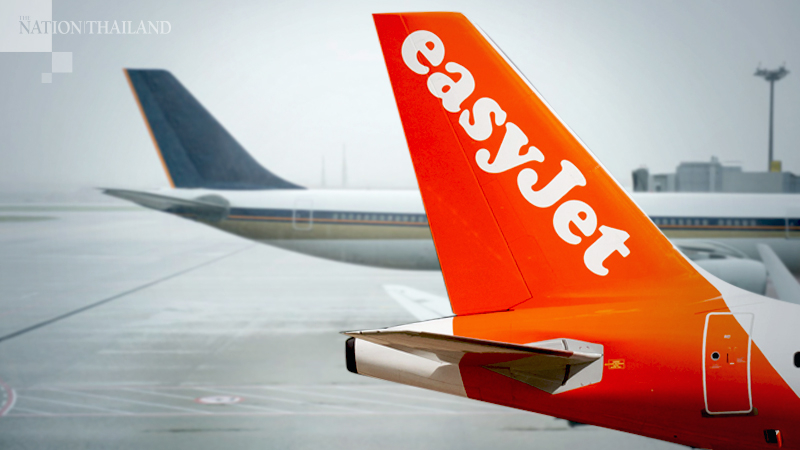
Airlines kicked off 2021 by shrinking their already meager U.K. schedules, prompted by a new coronavirus lockdown and the prospect of further restrictions on travel abroad.
easyJet PLC, Britain’s biggest discount carrier, pared back its flying program to prioritize essential connections between key U.K. cities and “a small number of international routes.” British Airways said it’ll keep crucial links open, while TUI AG on Tuesday halted all package holiday tours from the U.K. through mid-February, when the new lockdown is set to end.
A spokeswoman for Wizz Air Holdings Plc, which has been adding U.K. bases in an effort to emerge stronger from the pandemic, said it will review capacity to ensure that it remains appropriate to demand.
The fast-spreading virus strain that’s driven up U.K. case counts has also dashed airline-industry hopes of relief from 2020’s unrelenting downturn. Prime Minister Boris Johnson late Monday announced a new coronavirus lockdown that will keep most people at home until mid-February, when vaccines being rolled out are able to stem the worst infection rates since the start of the outbreak.
EasyJet had already reduced its schedule for next week by one-third and Ryanair Holdings Plc, Europe’s biggest discounter, by two-thirds, said John Grant, senior analyst at travel data provider OAG.
“Last night’s news will see those numbers go down further,” Grant said in an email. “Whilst the news is no surprise and most airlines and airports had been expecting this to happen, it is nevertheless another setback to the recovery.”
IAG SA-owned British Airways is reviewing its plans, a spokesman said.
TUI, the German tour operator with a large base of British customers, had already culled most of its U.K. program, with only some destinations including St. Lucia, Cuba and Aruba served. These trips have now been canceled.
Further restrictions on international travel are in the works, including talks with authorities in Scotland, Wales and Northern Ireland on coordinated curbs, U.K. Cabinet Office Minister Michael Gove said on LBC Radio.
The plans include requiring arriving passengers to present a negative coronavirus test, the Times newspaper reported, citing an unnamed former Downing Street official.
Johnson said late Monday that people should stay home as Britain wrestles with the fast-spreading strain. The government forbid all leisure travel and advised U.K. residents to check with carriers on arrangements for returning.
Some European Union countries are considering revising restrictions placed last month when the U.K. mutation began to receive attention.
Hungary lifted its flight ban with the U.K., while Swiss aviation authorities said that a Dec. 23 decision to bar incoming travel from Britain except for returning residents will be reviewed Wednesday.
A $6.2 billion (4.6 billion-pound) aid package for businesses announced on Tuesday is geared toward smaller concerns and airlines won’t be eligible. Industry group Airlines UK called on the government for further support.
Disruption to carriers is unlikely to be as great as that suffered last spring, when fleets were grounded across the world. Luton, England-based easyJet, which has operations across Europe, said the impact might be similar to a month-long lockdown in November, though schools remained open then.
Ryanair, with its large presence at London Stansted airport, said Tuesday that passenger traffic tumbled 66% during 2020. Even in December, the Dublin-based company was operating only 22% of its usual schedule. Wizz separately posted a 58% decline in annual traffic.
While airlines were braced for near-term disruption, the effects of the new lockdown would be magnified if it were to cause the industry to miss a second high season after last summer’s collapse, said HSBC analyst Andrew Lobbenberg.
“The next six weeks won’t be a make or break for any of the major airlines but several would be challenged if the summer recovery doesn’t happen,” Lobbenberg said. “At some stage in March and April they are going to want to see those inflows for summer bookings.”
By Syndication Washington Post, Bloomberg · Arne Delfs
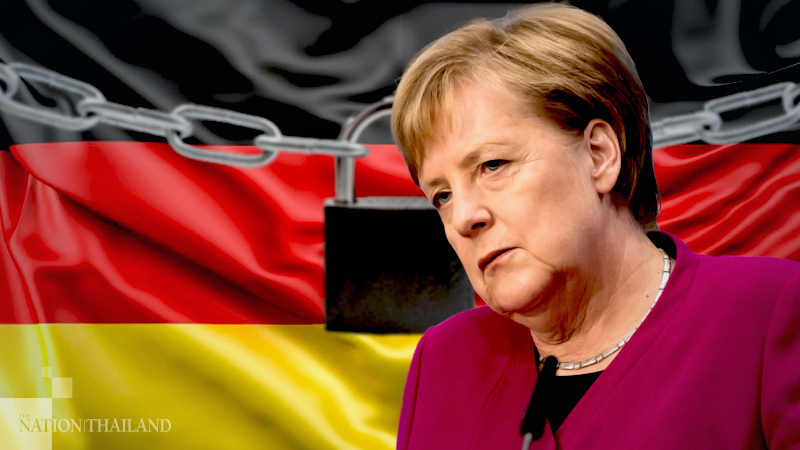
Germany extended its lockdown and tightened restrictions as pressure mounts on Chancellor Angela Merkel’s government to contain the coronavirus spread and speed up vaccinations.
Merkel and state leaders agreed on Tuesday to limit nonessential travel to 9.3 miles (15 kilometers) for people living in areas with more than 200 cases per 100,000 people, according to a person familiar with the discussions.
The restrictions will affect many of Germany’s major cities, particularly in the hard-hit states of Bavaria and Saxony. Nuremberg, Dresden, Potsdam and dozens of others have incidence rates above the 200 threshold. Berlin, Frankfurt and Munich are below that level, according to the RKI public health institute.
Private gatherings will be limited to one person from another household, with children no longer exempt from the rules. Nonessential stores and leisure facilities will remain shuttered in Europe’s largest economy until at least Jan. 31, according to the person.
Weeks into a hard shutdown, contagion rates are still more than double the level the government has determined to be manageable, and there was broad consensus that action was needed. Merkel is set to announce the new rules after a video conference with the heads of the 16 federal states. Officials are still debating what to do with schools and day-care facilities.
With hundreds dying each day, political tensions threaten to escalate further amid a rising tide of criticism over the government’s strategy to distribute a coronavirus vaccine. A national election is due in September and top officials from the Social Democrats — the junior partner in the ruling coalition — attacked Health Minister Jens Spahn, a leading figure in Merkel’s Christian Democrats, over apparent delays.
Finance Minister Olaf Scholz — the SPD’s chancellor candidate — on Monday presented Spahn with a lengthy list of questions about why vaccinations are not happening faster, Bild newspaper reported. The crisis is set to be discussed at a cabinet meeting on Wednesday.
Merkel has been drawn into the controversy after Bild published a June letter from Spahn that indicated the German leader was behind the strategy to hand off vaccine procurement to the European Commission.
Europe has become an epicenter of the pandemic since cases began ticking up again in October, with more than 400,000 coronavirus-related deaths and 17.3 million infections. Growing concern around Europe over diminishing hospital capacity and rapidly rising death rates has already prompted sharper measures in several countries in the region.
Italian Prime Minister Giuseppe Conte extended a ban on people moving around the country through mid-January, while British Prime Minister Boris Johnson shut England’s schools and ordered people across the country to stay at home. In France, the government is seeking to speed up its vaccination rollout after a slow start.
Merkel is coming under increasing scrutiny over her decision in the summer to task the European Union with negotiating with drug companies, a move critics say slowed down the process and reduced the quantity of jabs available.
Officials in Merkel’s administration have said they are seeking to accelerate the production and distribution of vaccines. In addition to the shot jointly developed by Germany’s BioNTech SE, the approval of others by European health authorities should help accelerate the rollout.
According to the latest data from the RKI public health institute, about 317,000 people had been immunized in Germany through midday Tuesday, just under 0.4% of the population. That compares with around 1.4% in the U.S. and Britain, which both began vaccinating several weeks earlier, and about 0.2% in Italy and Spain.
After initially supporting an alliance with France, Italy and the Netherlands, Spahn has defended Germany’s decision to buy and distribute vaccines simultaneously among EU members. He said it was fairer for the smaller countries that wouldn’t have been able to negotiate on equal terms with manufacturers.
Spahn told ARD television Tuesday that there wouldn’t be any magical solutions overnight. “We have to be realistic,” he said. “This won’t be done quicker than around the summertime in many countries in the world.”
Trump supporters protesting election results begin demonstrating in D.C.
InternationalJan 06. 2021Supporters of President Donald Trump gather at Freedom Plaza on Tuesday. MUST CREDIT: Washington Post photo by Matt McClain.
By The Washington Post · Marissa J. Lang, Emily Davies, Peter Hermann, Jessica Contrera
WASHINGTON – One day before Congress votes to certify that Joe Biden won the presidential election, Trump supporters who refuse to accept the reality of his defeat were demonstrating in Washington again. The city is bracing for potentially violent protests promoted by President Donald Trump himself.
All Tuesday afternoon, people bundled against the cold but many free of masks arrived in downtown Washington for what they see as a last stand for Trump, who has continued to falsely assert that the election was stolen from him.
Although many Republican lawmakers, all 10 living former defense secretaries and election officials across the country have said Trump should stop attempting to overturn the results of the election, his refusal to do so has energized his followers. One Wednesday demonstration has a National Park Service permit for up to 30,000 people. Trump said on Twitter that he will speak at 11 a.m. Wednesday, and he praised those who were echoing his inaccurate version of events in the streets.
“They won’t stand for a landslide election victory to be stolen,” he said Tuesday evening.
For hours, speakers turned election conspiracy theories into winding speeches, closed their eyes to pray and shared discount codes for MyPillow, a company owned by a Trump ally.
They ranted against the need for masks, vaccines, and precautions against a virus that has killed more than 355,000 Americans.
“I’m going to give everyone three action steps . . . turn to the person next to you and give them a hug,” one speaker exhorted the crowd. “Someone you don’t know . . . it’s a mass-spreader event! It’s a mass-spreader event!”
A supporter of President Donald Trump waves his flag while joining fellow supporters at Freedom Plaza to protest the results of the election. MUST CREDIT: Photo by Astrid Riecken for The Washington Post.
D.C. Police are not enforcing the District of Columbia’s mask mandate, despite the growing coronavirus surge. The city is averaging 233 new coronavirus cases daily, and hospitalizations are up 12% compared with last week. The Washington region set a daily record for new coronavirus infections Friday.
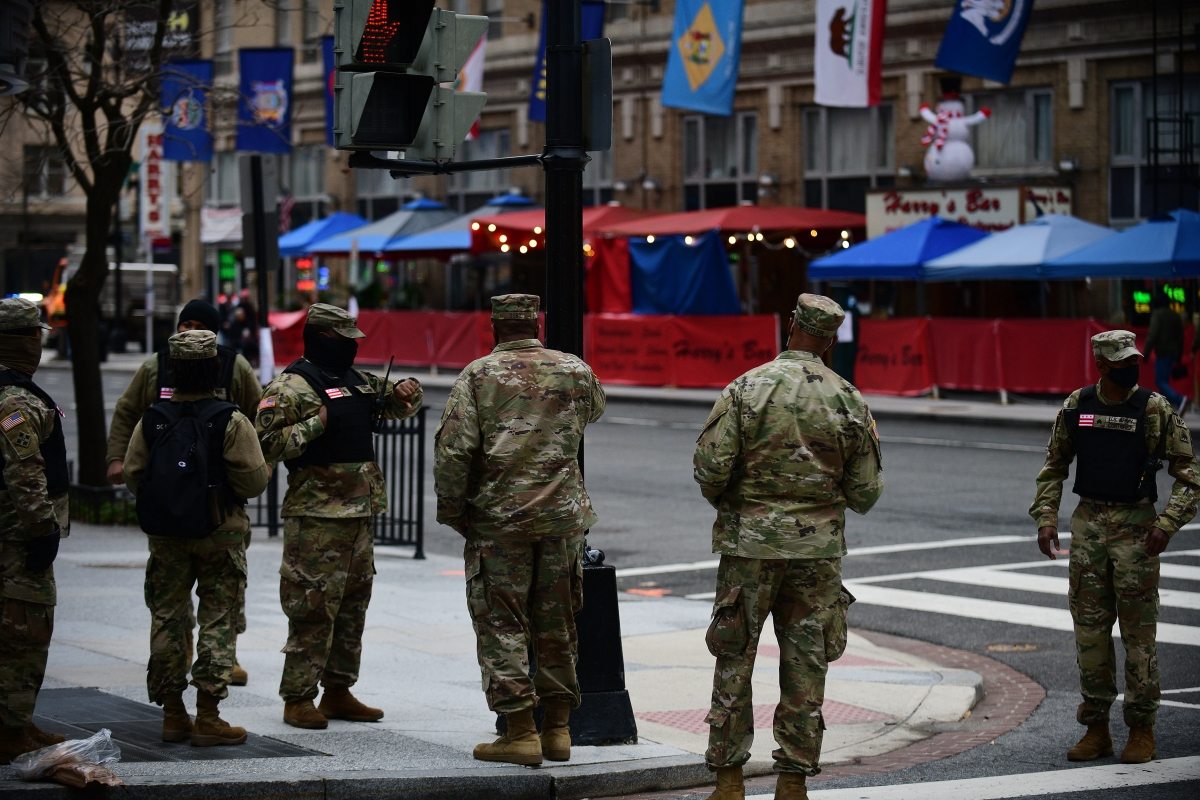
Local law enforcement will instead focus on arresting anyone who is unlawfully armed, while the National Guard works to manage crowds and block streets. D.C. police said that shortly before 2 p.m. Tuesday, officers pulled over a North Carolina bus for a traffic violation. Police said one person inside, who has not yet been identified, possessed two firearms – a rifle and a semiautomatic handgun, along with a large magazine.
In recent weeks, right-wing groups have used the conservative social media site Parler and the encrypted messaging app Telegram to discuss how to sneak guns into the city, where there are laws banning openly carrying firearms and prohibiting such weapons on federal lands and near protests.
Recent pro-Trump protests ended in violent skirmishes. In December, members of the Proud Boys, a male-chauvinist organization with ties to white nationalism, spent hours attempting to reach activists in Black Lives Matter Plaza, being repeatedly blocked by police. Later in the evening, four people were stabbed amid a crowd of Proud Boys and Trump supporters outside Harry’s Bar, which has become a Proud Boys gathering spot.
When the leader of the Proud Boys, Enrique Tarrio, returned to D.C. for this week’s events, he was arrested. D.C. police took him into custody Monday afternoon on a warrant charging him with burning a Black Lives Matter banner taken from a historically Black church during the December demonstration.
He faces a misdemeanor charge of destruction of property and two felony counts of possessing large gun magazines at the time of his arrest.
On Tuesday afternoon, Tarrio appeared in D.C. Superior Court, where he pleaded not guilty. A judge released him but barred him from the city, pointing to his social media posts in which he threatens to set fire to more signs. Tarrio could be arrested if he is seen in D.C.
Later, the crowds in Freedom Plaza would turn his name into a chant: “En-ri-que!”
They cheered for a Michigan lawmaker, a pastor who told them it was “time for war,” and a man wearing a patch representing the far-right armed group Three Percenters, who told them to “fight, fight, fight.”
D.C. National Guard arrives at 12th Street near Hotel Harrington, a popular hangout for Pro-Trump supporters and Proud Boys. MUST CREDIT: Photo by Astrid Riecken for The Washington Post.
Arielle Early, 17, flew from Northern California after she saw Trump’s tweets calling for demonstrators to come to the nation’s capital.
“What I love about Trump is that he rallies people to come here and fight,” she said.
Early said she dropped out of school in 2017 after being bullied for supporting Trump. On Instagram, she found a community of like-minded young Trump die-hards. She plans to meet with those virtual friends this week in Washington.
Diane Marney, a real estate agent who lives in Wyoming, said she sees this week’s demonstrations as the single most important event in her lifetime. She worries about what a Biden administration will mean for her son, who works in a coal mine. She compared her decision to come to D.C. to her grandson’s decision to serve in the military.
“I want to do the same as him,” she said. “Just not with a gun.”
An afternoon rainstorm sent some demonstrators scurrying toward their hotels, but hundreds remained as streetlights flicked on over a sea of Trump flags, yellow “Don’t Tread on Me” banners and signs that read “Mask Free Zone.”
One man held a wood carving that resembled a can of Twisted Tea. Chris Bouland, 43, said it represented the viral video of a Black man at a gas station who hit a White man in the face with a can after the man would not stop calling him the n-word. The beverage then exploded, sending tea flying. The video has been shared countless times, set to music and remixed.
Bouland, who traveled from Arkansas, said the video reminded him of his fellow Trump supporters.
“You know, if you mess with us, you don’t want to open that can of a– whooping,” he said.
He and his wife, Jo, are planning to wake up early Wednesday to be there for Trump’s expected 11 a.m. speech at the Ellipse.
“We’re not backing down,” she said as Chris Bouland nodded.
Behind them, the crowd of hundreds at Freedom Plaza began to recite the Pledge of Allegiance.
“This is not about Democrats versus republicans, or Trump versus Biden,” Jo Bouland said. “This is about good versus evil. This is about saving our country.”
WASHINGTON – President-elect Joe Biden plans to name several former Obama administration officials to senior jobs at the State Department and National Security Council in the coming days, adding more experienced and well-connected Democratic staffers to the country’s sprawling national security bureaucracy.
For deputy secretary of state, Biden will nominate Wendy Sherman, the chief U.S. negotiator of the Iran nuclear deal under the Obama administration and the former No. 3 official at the State Department, according to three people familiar with the decision.
The nomination for the No. 3 job at the State Department, undersecretary for political affairs, is expected to go to Victoria Nuland, who served as spokesperson for the department under Secretary of State Hillary Clinton and was the top U.S. diplomat for Europe under Secretary of State John Kerry, two people familiar with the decision said.
At the National Security Council, Biden is expected to give the job of deputy national security adviser to Jon Finer, a former Washington Post reporter who worked in a number of jobs in the Obama administration that culminated in his role as director of policy planning at the State Department. After leaving the administration, he worked at the Council on Foreign Relations and joined a private equity firm co-founded by the father of Antony Blinken, Biden’s nominee for secretary of state.
Biden also plans to name Amanda Sloat as senior director for Europe on the NSC. The former Brookings Institution fellow served as a deputy assistant secretary of state for Southern Europe and Eastern Mediterranean affairs at the State Department.
Biden’s picks were first reported by Politico. A Biden transition spokesman declined to comment. The people familiar with the decisions spoke about them on the condition of anonymity because they were not authorized to speak to the news media.
Sherman, a professor at Harvard’s John F. Kennedy School of Government and a senior counselor at Albright Stonebridge Group, played a prominent role in defending the Iran nuclear deal to a skeptical Congress.
Republicans are expected to grill Sherman on her involvement in the deal, which they uniformly opposed, while Democrats underscore that the agreement kept a lid on Tehran’s nuclear program – restrictions that fell apart only after the Trump administration withdrew from the deal.
She also has experience negotiating with North Korea, which has continued to advance its nuclear weapons program despite the Trump administration’s efforts to broker a denuclearization agreement.
Nuland, a prominent Russia hawk, advocated for sending lethal aid to Ukraine during her time in the Obama administration. During the George W. Bush administration, she served as deputy national security adviser to Vice President Richard B. Cheney.

 Warren Buffett, chairman and chief executive officer of Berkshire Hathaway Inc., center left, ahead of the company’s annual meeting in Omaha, Neb., on May 4, 2019. MUST CREDIT: Bloomberg photo by Houston Cofield.
 A man walks through the foyer of the Grand Theater at the Dalian Wanda Group Co. Oriental Movie Metropolis film production hub in Qingdao, China, on April 17, 2018. MUST CREDIT: Bloomberg photo by Qilai Shen.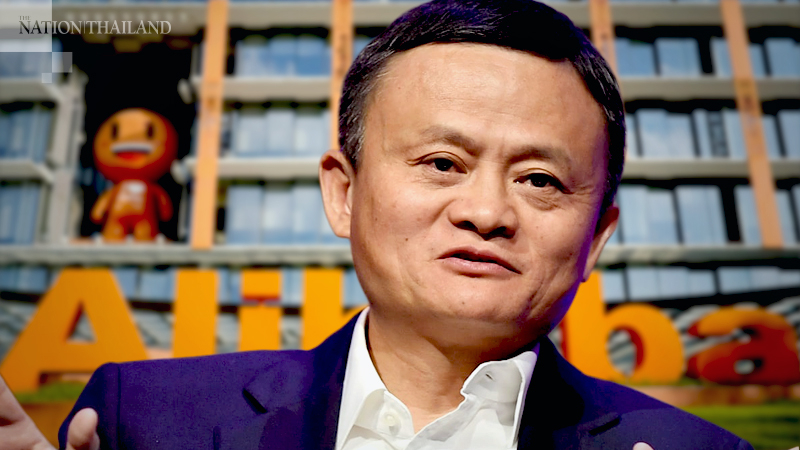
 Kim Jong Un
 Democratic Senate hopeful Rev. Raphael Warnock speaks to canvassers in Georgia on Tuesday, Jan. 5, 2021. MUST CREDIT: Photo by Kevin D. Liles for The Washington Post
 Supporters of President Donald Trump gather at Freedom Plaza on Tuesday. MUST CREDIT: Washington Post photo by Matt McClain.
 Joe Biden
 SootinClaimon.Com