Pak Nam Pho Chinese New Year festival roars to life on banks of Chao Phraya
TUESDAY, JANUARY 17, 2023
The ancient and spectacular Pak Nam Pho Chinese New Year festival kicked off in Nakhon Sawan on Monday night under the theme “The dragon flies skywards and the flowers bloom”.
The province 250km north of Bangkok is home to a large Chinese-Thai population who celebrate the lunar New Year on the Chao Phraya riverbank with fireworks, dragon and lion dancing and pole-climbing.
The New Year celebrations run every night in the city until January 26.
Monday’s crowd was treated to dazzling pyrotechnics and Chinese-Thai cultural performances.
Now a magnet for tourists, the event also features exhibitions of arts and culture, vendors selling local specialities, and a range of performances and activities.
The festivities culminate on the night of January 24 with the Chao Pho-Chao Mae Pak Nam Pho procession, which is expected to draw over 100,000 visitors.
A daytime procession of dancing dragons, lions and other traditional Chinese-Thai performances will flow through the streets on January 25, bringing the festival to an end.
Thailand a beacon of hope for investors in emerging Asian markets: seminar
TUESDAY, JANUARY 17, 2023
Nongluck Ajanapanya
Thailand remains a safe haven for investors looking to capitalise on some profitable opportunities among Asia’s emerging markets this year amid global economic uncertainty, a group of Abrdn experts said.
The United Kingdom-based global investment company hosted a seminar titled “2023 Global Outlook: Embrace the Perfect Storm” in Bangkok on Tuesday.
Darunrat Piyayodilokchai, Abrdn’s head of equities Thailand, explained the Thai equity market’s upbeat outlook to three key positive factors: strong economic recovery momentum; supportive foreign information fund, especially from the tourism industry; and a short-term catalyst, such as the general election in May.
“This year, tourism will be critical to Thailand’s growth. Tourist arrivals in 2023 have been revised from 20-22 million to 25-28 million. Every million people contributes 0.3% to the country’s gross domestic product (GDP). So, tourism will contribute approximately 1-1.75% to GDP this year, helping to offset the export sector, which tends to slow with global recession,” she stated.
Despite the global recession, export slowdown, high costs, earnings decline, political tensions, foreign exchange volatility, and the impending implementation of a local financial transaction tax in May, Darunrat believes Thailand would be able to manage the risk.
Thailand will be one of two Asian countries with higher growth in 2023 than in 2022, according to Abrdn. The country’s growth rate is expected to increase to 3.6% this year, up from 3.3% last year.
Pongtharin Sapayanon, Abrdn’s head of fixed income and asset allocation Thailand, suggested that of all asset investments (equities, fixed income, bonds, real estate, commodities, and foreign exchange), Asia’s emerging market is preferable due to the region’s positive growth and China’s reopening.
However, investors must be selective and conservative. This means they must carefully consider the fundamentals of each asset, such as corporate profitability, investment grade bonds and credits, commodity demand and supply balance, and a long history of consistent dividends, he explained.
(From left) MC, Jeremy Lawson, Pongtharin Sapayanon, Darunrat Piyayodilokchai and Nicholas Yeo
Aside from Thailand, Abrdn recommends that Thai investors look for opportunities to grow their portfolio in China.
According to Nicholas Yeo, Abrdn’s director and head of equities, the property sector and Covid-19 may be two factors holding China back, but the easing of its policy after its post-Covid reopening, rapid development of its own innovation, and significant revenue growth reliant on the domestic market make Asia’s largest economy promising.
He emphasised that China is investible, but it takes time and expertise.
China is one of the few major economies that does not experience inflation. Flexible government policies can be implemented, he noted.
Meanwhile, there is an opportunity for equity in China because 62% of the country’s household pension allocation is heavily invested in real estate, which is a risky investment. Hence, China is encouraging its people to shift from real estate to the capital markets (equities and fixed income).
Jeremy Lawson, Abrdn’s chief economist and head of research institute, said the global economy is still facing multiple and reinforcing headwinds this year, particularly recession, inflation, and geopolitical tensions.
According to him, inflation will be the most worrying and troubling factor when it becomes more persistent as a result of labour market tightness, wage growth, and higher expectations.
This scenario will force major central banks, particularly the US Federal Reserve, to keep raising interest rates in order to halt inflation and contain it at the 2% target. The continued hike in interest rates may result in a slowing of business activity and, eventually, cause a recession.
Although the inflation peak has already passed, Lawson warned that core inflation (excluding food and energy prices) is likely to be stickier, forcing central banks to continue to tighten policy in 2023, making the next 12 months globally occupied with recession.
However, there are some opportunities for investors during this global downturn. Lawson suggested gradually increasing exposure to high-paying companies, then take advantage of alternatives that are truly uncorrelated to traditional equity and fixed income markets, and to not overlook China.
Thailand’s Horizon Plus in talks to make EVs for Chinese, European brands
TUESDAY, JANUARY 17, 2023
Horizon Plus, a joint venture between PTT subsidiary Arun Plus and Taiwan-based Hon Hai (Foxconn), has announced plans to manufacture electric vehicles (EVs) in Thailand for Chinese and European brands.
Horizon Plus’s Chonburi plant aims to open in 2024 with production capacity of 50,000 EVs per year to drive Thailand’s ambition to become an Asian hub of EV manufacturing. Capacity will rise to 150,000 EVs by 2030 to meet growing demand from Asean consumers, the company says.
On Monday, Arun Plus managing director Ekachai Yimsakul revealed Horizon Plus is currently negotiating to produce EVs for several partner brands from Europe and China.
“Deals with two partners are expected to be completed by the first quarter of this year,” he said.
China’s Hozon Auto, which makes the Neta V model, is reportedly among the EV brands planning to produce cars at the Horizon Plus plant in Rojana Nong Yai Industrial Estate, Chonburi.
Meanwhile, Horizon Plus has invested US$1 billion (36.1 billion baht) to build a full EV manufacturing cycle in Thailand, promote domestically manufactured EVs, and recruit more than 2,000 skilled workers, Ekachai said.
Developing an EV ecosystem is part of PTT’s mission to create energy sustainability in Thailand, he explained.
PTT president and CEO Auttapol Rerkpiboon said the joint venture with Foxconn will push Thailand towards becoming a low-carbon society.
“This move is also seen as an important strategy to help PTT achieve its goal of net-zero greenhouse gas emissions by 2050,” he added.
Nearly three-quarters (73%) of CEOs believe global economic growth will decline over the next 12 months, according to PwC’s 26th Annual Global CEO Survey, which polled 4,410 CEOs in 105 countries and territories in October and November 2022.
The bleak CEO outlook is the most pessimistic CEOs have been regarding global economic growth since we began asking this question 12 years ago and is a significant departure from the optimistic outlooks of 2021 and 2022, when more than three-quarters (76% and 77%, respectively) thought economic growth would improve.
Nearly 40% of CEOs think their organisations will not be economically viable in a decade
In addition to a challenging environment, nearly 40% of CEOs think their organisations will not be economically viable in a decade if they continue on their current path. The pattern is consistent across a range of sectors, including telecommunications (46%), manufacturing (43%), healthcare (42%) and technology (41%). CEO confidence in their own company’s growth prospects also declined dramatically since last year (-26%), the biggest drop since the 2008-2009 financial crisis when a 58% decline was recorded.
Globally, business confidence around economic growth varies starkly, with G7 economies, including France (70% v 63%), Germany (94% v 82%) and the United Kingdom (84% v 71%) – all weighed down by an ongoing energy crisis – more pessimistic about their domestic growth prospects than they are about global growth.
CEOs are also seeing multiple direct challenges to profitability within their own industries over the next 10 years. More than half (56%) believe changing customer demand/preferences will impact profitability, followed by changes in regulation (53%), labour/skills shortages (52%), and technology disruptions (49%).
Inflation, macroeconomic volatility and geopolitical conflict are top CEOs’ concerns
While cyber and health risks were the top concerns a year ago, the impact of the economic downturn is top-of-mind for CEOs this year, with inflation (40%) and macroeconomic volatility (31%) leading the risks weighing on CEOs in the short-term – the next 12 months – and over the next five years. Close behind, 25% of CEOs also feel financially exposed to geopolitical conflict risks, whereas cyber risks (20%) and climate change (14%) have fallen in relative terms.
The war in Ukraine and growing concern about geopolitical flashpoints in other parts of the world have caused CEOs to rethink aspects of their business models, with almost half of the respondents that are exposed to geopolitical conflict integrating a wider range of disruptions into scenario planning and corporate operating models either by increasing investments in cybersecurity or data privacy (48%), adjusting supply chains (46%), re-evaluating market presence or expanding into new markets (46%), or diversifying their product/service offering (41%).
CEOs are cutting costs but not headcount or compensation
In response to the current economic climate, CEOs are looking to cut costs and spur revenue growth. 52% of CEOs report reducing operating costs, while 51% report raising prices and 48% diversify product and service offerings. However, more than half – 60% – say they do not plan to reduce the size of their workforce in the next 12 months. A vast majority – 80% – indicate they do not plan to reduce staff remuneration in order to retain talent and mitigate workforce attrition rates.
Bob Moritz, Global Chairman, PwC, said: “A volatile economy, decades-high inflation, and geopolitical conflict have contributed to a level of CEO pessimism not seen in over a decade. CEOs globally are consequently re-evaluating their operating models and cutting costs, yet despite these pressures, they are continuing to put their people front and centre as they look to retain talent in the wake of the ‘Great Resignation.’ The world continues to change at a relentless pace, and the risks facing organisations, people – and the planet – will only continue to rise. If organisations are not only to thrive – but survive the next few years – they must carefully balance the dual imperative of mitigating short-term risks and operational demands with long-term outcomes – as businesses that don’t transform, won’t be viable.”
Managing climate risk is a growing priority for businesses
While climate risk did not feature as prominently as a short-term risk over the next 12 months relative to other global risks, CEOs still see climate risk impacting their cost profiles (50%), supply chains (42%) and physical assets (24%) from a moderate to a very large extent. CEOs in China feel particularly exposed, with 65% seeing the potential for impacting their cost profiles, 71% to supply chains, and 56% to physical assets. Recognising the impact climate change will have on business and society over the long-term, a majority of CEOs have already implemented – or are in the process of implementing – initiatives to reduce their companies’ emissions (65%), in addition to innovating new, climate-friendly products and processes (61%), or developing a data-driven, enterprise-level strategy for reducing emissions and mitigating climate risks (58%).
Despite an increasing number of countries now having some form of carbon pricing, a majority of respondents (54%) still do not plan to apply an internal price on carbon in decision-making, and over a third (36%) don’t plan to implement initiatives to protect their company’s physical assets and/or workforce from the impact of climate risk.
The continued importance of trust and transformation in generating long-term value
CEOs noted the need to collaborate with a wide range of stakeholders to build trust and deliver sustained outcomes if they are to generate long-term societal value. The survey found that when organisations partner with non-business entities, it is to address sustainable development (54%), diversity, equity, and inclusion (49%), and education (49%).
If organisations are to remain viable in the near and long-term, they must also invest in their people and technological transformation agendas to empower their workforces. Technologically, nearly three-quarters (76%) of organisations say they are investing in automating processes and systems, implementing systems to upskill workforces in priority areas (72%), and deploying technology such as the cloud, AI and other advanced technology (69%).
However, many CEOs question whether critical preconditions for organisational empowerment and entrepreneurship – such as alignment to company values and leaders’ encouragement of dissent and debate – are present in their companies to tackle the increasingly complex risks organisations face. For example, only 23% of CEOs say leaders in their company often/usually make strategic decisions for their function without consulting the CEO. Further, only 46% of CEOs say leaders in their company tolerate small-scale failures often/usually. However, more optimistically, nearly 9 in 10 (85%) respondents say the behaviours of employees are often or usually aligned with their companies’ values and direction.
Torn between the demands of short-termism and long-term transformation, CEOs say they are primarily consumed with driving current operating performance (53%), rather than evolving the business and its strategy to meet future demands (47%). If they could redesign their schedules, CEOs say they would spend more time on the latter (57%).
Bob Moritz, Global Chairman, PwC, concludes: “The risks facing organisations and society today cannot be addressed alone and in isolation. CEOs must therefore continue to collaborate with a wide range of public and private sector stakeholders to effectively mitigate those risks, build trust and generate long-term value – for their businesses, society and the planet.”
About the data: PwC surveyed 4,410 CEOs in October and November of 2022. The global and regional figures in the report are weighted proportionally to the country or regional nominal GDP to ensure that CEOs’ views are representative across all major regions. The industry and country-level figures are based on unweighted data from the full sample of 4,410 CEOs. Interviews were conducted with CEOs from three global regions (North America, Western Europe and Asia-Pacific).
Future shines bright for Thai jewellery sector through new MoU with Shenzhen
MONDAY, JANUARY 16, 2023
Chanapat Komlongharn
After a long hiatus due to the pandemic, Thailand’s jewellery makers can now return to China and make the most of the opportunities offered by a new memorandum of understanding (MoU).
The Asean Gems and Jewellery Association (AGJA) signed an MoU with the Jewellery Museum of Shenzhen on Thursday at the “China-Thailand Modern Fashion (Gold and Jewellery Cooperation” meeting in Bangkok.
Present at the event were top executives from leading organisations of both countries, including Yang Qing, first secretary at the Chinese embassy; Zuo Jinping, executive deputy head of Shenzhen’s Luohu district; Sitthichai Parinyanusorn, deputy director of the Gem and Jewellery Institute of Thailand (GIT); and Boonlert Siripatvanich, advisory chairman of the Thai Goldsmith Association.
The pact aims to drive the gems and jewellery industries in both countries, as well as foster cooperation, tighten ties and boost trade, a Facebook post from AGJA said.
Suttipong Damrongsakul, president of the Thai Gem and Jewellery Traders Association, said he strongly believes all sides will benefit from this collaboration as most economies are in recovery mode.
Meanwhile, Zuo Jinping said Thailand has been trading with Luohu – a major diamond producer – for a while now, and with this link, both countries can work more effectively together.
“The era of rejuvenation has arrived and the door for Thais to invest in China has opened,” he added.
Suttipong Damrongsakul (Left) and Wang Zhen (The Curator of Jewellery Museum of Shenzhen) (Right)were signing MoU.
According to Luohu’s Bureau of Industry and Information Technology, Shenzhen has developed 10 projects to stimulate growth in the sector.
The projects are:
• Industrial chain replenishment and extension
• Gold finance innovation
• Design creativity promotion
• Intelligent manufacturing
• Brand promotion
• Consumption expansion
• Talent cultivation
• Intellectual property rights protection and standardisation
• Internationalisation
• Environmental enhancement
Liw Chen, an official from Luohu’s Bureau of Industry and Information Technology, also believes the collaboration will be successful.
“We are working together to help Thailand break into the Chinese gems market,” he added.
Meanwhile, Sitthichai said Thailand’s gems and jewellery industry earns more than US$3 billion per year from export and local consumption.
This accounts for about 2% of the country’s gross domestic product (GDP). He pointed out that the industry has also created more than 750,000 jobs in Thailand.
Meanwhile, Shenzhen’s Luohu district is considered China’s jewellery hub, packed with local and international brands, many of whom plan to expand their investment this year.
Several foreigners dressed in traditional Thai attire were spotted posing for photographs on the grounds of Wat Arun (Temple of Dawn) on Sunday.
Thailand’s tourism industry has started picking up after many countries began lifting their travel restrictions, with as many as 11.81 million arriving last year.
Here we find out why foreigners find Thailand’s traditional dress so attractive.
Singapore firm offers social media platform for kids where parents retain control
TUESDAY, JANUARY 17, 2023
Children are getting their hands on mobile devices at a younger age, but some parents hesitate to grant them access to social media apps, for fear of cyberbullying, exposure to advertisements and online harm. With these concerns in mind, home-grown tech company myFirst has created a social media platform for children aged 4-12.
Unveiled at the Consumer Electronics Show (CES) 2023 in Las Vegas that was held from Jan 5 to 8, the myFirst Social Circle app allows parents to limit who can interact with their children online via a list of approved contacts, said founder and chief executive Yong G-Jay, 40.
The company is known for its line of colourful smartwatches for children. It has sold about 70,000 worldwide, including 20,000 in Singapore, said Yong, who started the company in 2017.
Online safety for youngsters has been a concern for the authorities, including in Singapore, which is set to roll out its Online Safety Bill in 2023 to crack down on how social media firms operate. It will be mandatory for social media platforms to give tools for parents to manage the content that a young user can encounter online and limit any unwanted interactions.
myFirst’s approach to social media essentially gives parents complete control over who gets to interact with their children and takes action to remove posts if they find that their child has posted something inappropriate online.
Addressing concerns about social media today, Mr Yong said it is a matter of time before children go online. “We can train them early so that when they join the main channels, they are prepared and know how to use it safely.”
The app’s measures are one up on current parental controls on most platforms for users under 18.
MyFirst chief executive Yong G-Jay with a smartwatch and the app on his smartphone. Mr Yong was inspired to create the app when his daughter lost touch with many friends while cooped up at home due to Covid-19 restrictions. ST PHOTO: CHONG JUN LIANG
On Instagram, for instance, parents can opt to oversee their teen’s activities online under the “supervision” setting, allowing them to determine how much time a teenager spends online and get notified about who follows their teen. But the teens still own their accounts, said Instagram, and parents cannot see the teens’ search history and cannot see what they post unless they follow them or have a public account.
Mr Yong said the idea for the social media platform for children came to him during the pandemic, when his only child, seven-year-old Ru Faye, lost touch with many friends while cooped up at home due to Covid-19 restrictions.
“She lost touch with a lot of friends and would always come to my wife to ask her to help ring some of them,” Yong said.
“Some parents do give kids a phone, but most don’t want them to use Facebook, Instagram or other apps,” he said, adding that most of these platforms are restricted to users 13 years old and above.
“These apps can be scary for children. I’ve read about incidents where children meet strangers online or read about fake news, or come across content about suicide.”
In spite of these risks, Mr Yong said there is still a place for children on social media as a means of connecting with friends from school and discovering new interests.
Using the myFirst Social Circle app, children can keep in touch with family, friends from school and relatives.
These contacts will first have to be approved by parents or guardians before the child can make any interaction, such as commenting on or reacting to another child’s posts, or having his posts seen by the other child. The restrictions do not apply to users aged above 13.
Once a friend request is accepted, parents will be prompted to tag the contact to one of four groups of relationships, comprising family, besties, friends and acquaintances.
Parents can then check on any posts uploaded by their child, such as a selfie with friends at school, and decide who gets to see it.
Young users can also form chat groups with their approved friends and family members and send voice messages or videos.
To set up an account, young users will have to scan a QR code available on their parent’s version of the Social Circles app.
For privacy reasons, parents will not be able to see their children’s private messages with other contacts, Mr Yong added.
The app will also do away with “likes”, as they can cause young users to crave attention online, he said.
This was a key finding during the app’s pilot among about 20 children when some began to compare the number of likes that their posts racked up.
Yong said the app will be enhanced later this year to detect profanities and alert parents when their children use foul language.
Safe tech for young children was an area of the market that was often overlooked, said Chris Corse, a British distributor scouring the CES show floor for potential tech products to sell.
Mr Corse, who has two children, five and eight years old, said myFirst’s app would likely appeal to young families. “There’s not much protection for children online at the moment. Like myself, parents don’t want their children to be exposed to bad content, so that is a key part of promoting this app to parents.”
He added: “But it’s impossible to keep kids away – my kids are looking at my phone on my social media, and occasionally watch videos on their own.”
Another distributor, Karin Caligari from Malta who was in the market for tech products for children, said the app will give parents peace of mind even as children go online at an increasingly earlier age.
The app is available for download for free on the App Store and Google Play Store and will be pushed out to earlier models of myFirst smartwatches in an update.
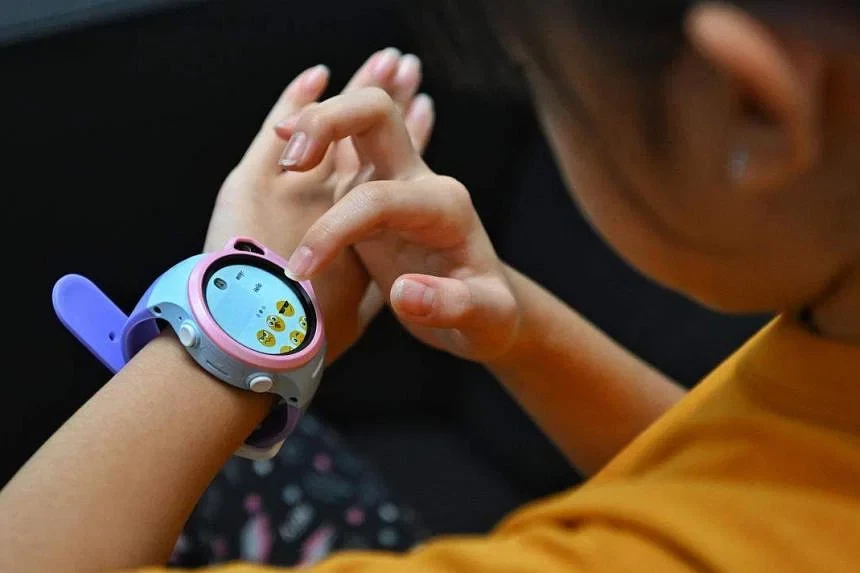
MyFirst’s smartwatches come with apps, like a GPS tracker to inform parents where their children are. ST PHOTO: CHONG JUN LIANG
The brand also launched a new camera-equipped smartwatch – the myFirst Fone S3 – at CES that will come with the Social Circle app pre-installed.
Designed for children, the watches come with apps, such as a GPS tracker to inform parents where their children are, and a geofence feature that alerts parents when a child is not where he is supposed to be.
A child’s access to the watch’s features can be limited when he is in school by setting a timer via the parents’ app.
myFirst also launched new earphones, myFirst CareBuds, with a lower volume output to prevent children from harming their ears.
The device’s sound transparency mode will automatically kick in when it detects a user is walking, to ensure he can hear his surroundings and travel safely.
Russian bombing puts Kyiv’s utilities under critical strain – Klitschko
TUESDAY, JANUARY 17, 2023
Kyiv’s infrastructure could collapse at any second as Russia’s sporadic missile attacks along with freezing winter temperatures put local authorities under increasing strain, the Ukrainian capital’s mayor said on Monday.
Kyiv’s mayor Vitali Klitschko and his brother Wladimir told Reuters that Ukraine’s Western allies had to speed up deliveries of air defence systems capable of downing Russian missiles.
Kyiv has accused Moscow of indiscriminately targeting civilians as well as key infrastructure, threatening the winter supply of electricity, running water and central heating.
“We don’t talk about the collapse, but it can happen … at any second (because) Russian rockets can destroy our critical infrastructure in Kyiv,” Vitali Klitschko said, adding that there was currently a 30% deficit in energy in the capital.
“It’s pretty cold in Ukraine right now so living without electricity and heating is almost impossible. The situation is critical. We are fighting to survive,” he said on the sidelines of the World Economic Forum (WEF) annual meeting in Davos.
Former world heavyweight boxing champions Vitali and Wladimir are part of a broader high-level business and political Ukrainian delegation attending the WEF summit.
“It is important not to hesitate to give us weapons that we so need, but to deliver them the sooner the better otherwise we will continue to lose our infrastructure and most importantly our best men,” Wladimir Klitschko said, adding that they expected an escalation in the north of Ukraine from Belarus.
Part of the focus of Ukraine’s delegation in Davos will be to lay the foundations for future reconstruction and assess the appetite for investment in the country’s recovery.
“Today, we are talking about the war and ending this senseless war, but we need to think about the day after tomorrow,” Vitali Klitschko added.
Legendary Muay Thai boxer Buakaw Banchamek was left stunned when ex-volleyball player Onuma Sittirak proved that her smash was stronger than his punch.



 (From left) MC, Jeremy Lawson, Pongtharin Sapayanon, Darunrat Piyayodilokchai and Nicholas Yeo


 Suttipong Damrongsakul (Left) and Wang Zhen (The Curator of Jewellery Museum of Shenzhen) (Right)were signing MoU.
 Sitthichai Parinyanusorn
 MyFirst chief executive Yong G-Jay with a smartwatch and the app on his smartphone. Mr Yong was inspired to create the app when his daughter lost touch with many friends while cooped up at home due to Covid-19 restrictions. ST PHOTO: CHONG JUN LIANG
 MyFirst’s smartwatches come with apps, like a GPS tracker to inform parents where their children are. ST PHOTO: CHONG JUN LIANG


