Carbon credit trading opens on FTIX platform tomorrow
SUNDAY, JANUARY 15, 2023
The Federation of Thai Industries will allow registration for trading carbon credits on its FTIX platform on Monday, a senior federation official said on Sunday.
Suwit Torraninphanit, chief of the federation’s climate change committee, said the FTIX had been developed through cooperation between the federation and the Climate Action Leading Organization (CALO). It will be operated by the federation’s Climate Change Institute.
The institute will on Monday start allowing companies to register for trading carbon credits from the Thailand Voluntary Emission Reduction Program (T-VER).
Suwit said the FTIX would help Thai exporters reduce pressure from importing countries to comply with carbon emission reduction standards by allowing them to buy carbon credits.
He said the FTIX platform would make it more convenient for Thai businesses to shop for T-VER carbon credits. Currently, they are restricted to over-the-counter trade.
The FTIX platform will be supervised by a committee and managed by a joint committee of members from the federation and CALO.
This will ensure transparent trading as well as creating an effective alternative for businesses to reduce carbon commissions to increase their competitiveness, Suwit explained.
The FTIX will be connected to the online system of CALO for trading T-VER carbon credits and will also trade 100% renewable energy (RE100 energy).
Suwit said the FTIX would register about 12,000 companies from 45 sectors.
CALO announced that 319 projects had been registered under the T-VER programme from the beginning of fiscal 2014 to the first quarter of fiscal 2023.
However, only 141 of the registered projects have been certified to trade 13.97 million tonnes of carbon dioxide equivalent (CO2e) and only 2.019 million tonnes of CO2e credits have been traded for a total of 152.95 million baht, according to CALO. In the first quarter of fiscal 2023 (from October to December 2022), nine projects were registered and eight of them have been certified to trade 460,600 tonnes of CO2e carbon credits, it said.
Rashford the hero again as Man United come back to beat Man City in dramatic derby
SATURDAY, JANUARY 14, 2023
Reuters
In-form Marcus Rashford scored a late winner as Manchester United came from behind to beat rivals Manchester City 2-1 on Saturday, a victory that moves them to within a point of the champions in the Premier League standings.
The hosts had the best chances of a tense first half at Old Trafford, with in-form England forward Rashford seeing a tame effort blocked on the line by Manuel Akanji, while City struggled to get going.
City were much improved after the break, and the pressure told as Jack Grealish stepped off the bench to head his side into the lead in the 61st minute, on the end of a superb cross from the ever-reliable assist-maker Kevin De Bruyne.
However, with United looking second best, they produced a remarkable turnaround, out of nowhere, to turn the match on its head.
There was an element of controversy about United’s equaliser in the 78th minute, with Rashford initially flagged offside as Bruno Fernandes swept the ball home, with the goal given following a VAR review.
Southeast Asian countries have always had vibrant gastronomic scenes. This is evident in the never-ending stream of tourists who visit Southeast Asian countries, particularly for the food.
In 2023, gastronomy tourism is said to be one of the big trends in travel. Let’s check out what’s in store for tourists who come to Malaysia, as well as some of our neighbouring countries, to feast on our delicious fare.
Like the country’s diverse culture, Malaysian cuisine is also just as varied. And while Malaysian flavours may be distinct to locals, to international tourists the combination of spices, ingredients and traditional cooking styles from different cultures is truly unique.
Top favourites for both tourists and locals include nasi lemak, nasi kerabu, chicken rice, char kuay teow, laksa (almost every state has its own version, too!), Nyonya kueh, roti canai and pisang goreng. Travellers get an even wider variety of offerings in Sabah and Sarawak, like linopot, sinalau, umai, kampua mee, kuih cincin and manuk pansuh.
On top of that, the street food and cafe scenes in Malaysia are also worth checking out. In fact, one of the country’s most humble street foods, the Ramly burger, has been featured in many international food and travel videos on YouTube and other social media platforms.
Perhaps our biggest rival in Southeast Asia when it comes to gastronomy tourism is Thailand. Thai food has been a top destination choice for foodies for many years now. There’s a wide variety of cheap, fresh and delicious food available throughout the country – you can never go hungry in Thailand! The vibrant and dynamic street markets offer curious foodies a chance to feast on many delicacies, including deep-fried insects (if you’re into these kinds of things, that is).
If you’re ever in Bangkok, head to Sampeng Market, Srinagarindra Train Night Market, Jodd Fairs, Hua Mum Night Market, Khao San Road, Patpong Market, Chang Hui, Asiatique The Riverfront and Chatuchak Weekend Market, and send your taste buds on a scrumptious adventure. There’s also lots of shopping to be had in these markets so remember to bring your reusable shopping bags along.
Some of the iconic must-try dishes are pad thai, moo ping (Thai satay), pad kra pao, pad see ew and khao pad; try the Thai iced tea too.
Thailand also has plenty of top-notch fine dining restaurants, Michelin-selected eateries and award-winning bars, as well as innovative cafes. These are mostly found in bigger cities like Bangkok and Chiang Mai.
While the Philippines and Cambodia are not usually considered gastronomy tourism destinations, the cuisine in both these countries has their own distinct flavours.
When you take a voyage through the dynamic food scene in the Philippines, you’re in for an enticing dining experience. Pinoy cuisine promises a refreshing taste that will lead you to a sensory explosion.
One of the many popular dishes, sizzling sisig, maybe something of an acquired taste but it’s worth trying, if only for the experience. This dish is made up of pork (particularly meat from a pig’s head) and chicken liver and seasoned with vinegar or calamansi juice.
Another popular and truly unique Filipino delicacy is balut. This is a fertilised duck egg with a developing embryo, normally consumed fresh out of the shell. This famous snack is not for the faint-hearted, though.
In Cambodia, there’s fish amok (amok trei), a Cambodian steamed curried fish dish that has a 2,000-year-old history. Fish amok was once only served to the Khmer royals, but today you can get this in many restaurants, though not all will serve you the “authentic” version. Locals say that if the dish is not steamed in banana leaves – some restaurants and stalls steam them in bowls or ramekins, for example – then it is not amok (the word “amok” actually means “to steam in banana leaves” in the local dialect).
For comparison, fish amok is similar to the Malaysian otak-otak, only with different spices, and sometimes different types of fish, used.
This year, be sure to go on a gastronomy holiday anywhere in Southeast Asia, or plan some trips to a few states in Malaysia to try delicacies you’ve never had before.
Vietnamese artist welcomes New Year with 2,023 feline statuettes
SUNDAY, JANUARY 15, 2023
Sculptor Nguyen Tan Phat’s collection includes 2,023 feline statuettes, meticulously crafted from jackfruit wood and covered with lacquer, or from laterite, the indigenous materials of the artist’s hometown.
The witty and playful cat, the Oriental zodiac animal of the upcoming Lunar New Year, the Year of the Cat, a festival in Vietnamese culture, has become the inspiration for a new collection of lacquer works by sculptor Nguyen Tan Phat from Duong Lam Ancient Village on the outskirts of Hanoi.
The collection includes 2,023 feline statuettes, meticulously crafted from jackfruit wood and covered with lacquer, or from laterite, the indigenous materials of the artist’s hometown.
This is Phat’s third unique collection of artworks inspired by symbolic animals of the lunar calendar. Before the cat collection, he made 1,010 buffalo statues on the occasion of the 1,010th anniversary of Hanoi in 2021, and 2,022 small tigers to welcome 2022, the Year of the Tiger.
The special feature of the collections is uniqueness – no item looks alike. In his latest collection, the cats are depicted in various positions that showcase their cuteness and playfulness, chasing each other, teasing a mouse, sunbathing on house roofs or climbing trees.
“Through this lacquer statue collection, I wish to promote the values of Vietnamese traditional lacquer craft and culture by welcoming 2023 or the Year of the Cat,” Phat told Viet Nam News.
“The feline statues are inspired by the image of cats in Vietnamese folk art, and the number of the artworks corresponds to the year 2023, which is expected to leave a lasting impression on the viewers.”
Sculptor Nguyen Tan Phat wishes to promote the values of Vietnamese traditional lacquer craft and culture. — VNS Photo Minh Phuong
Interestingly, the cat artworks could have different functions. Besides being decorative items, they can be used as a box, a flower vase, or a tea tray, making images of the animal dearer to art lovers.
To complete a one-of-a-kind artwork, the 40-year-old artist has to work on various steps, from visualising the ideas to chiselling and shaping the wood block and then covering it with layers of paint.
After it is dried, the item will be polished, inlaid with eggshells or mother-of-pearl and added hand-drawn features like eyes or whiskers. Each artwork takes many days to finish. To save time, he works alternately on several items a day and has one or two people to assist with simple work steps such as painting, sanding and lacquering.
He revealed that the phases of shaping and painting the statues are the most important.
The special feature of the feline statue collection is uniqueness – no item looks alike. — Photo courtesy of the artisan
“As an old Vietnamese saying goes: nhat dang nhi da (first shape, second skin), and the statues first and foremost must have a beautiful shape. Then comes its skin or the paint. The more elaborately and meticulously they are painted, the more complete and beautiful they become,” Phat said.
Not only different in shape, but the statues are also diverse in styles of sculpture. While some are crafted in the realism style, others are depicted in abstraction or expressionism.
“To differentiate them from tiger statues, I have carefully studied the cat figures. The cat’s face is always triangular, with big ears, pointed chin, and its tail is long and straight-up,” he added.
According to Phat, the image of a cat has inspired him as it is a domesticated animal closely associated with Vietnamese life and loved by everyone, from children to the elderly.
“I have come up with many unique cat figures and positions, but I have been most impressed with the image of cats playing in the sun. That explains why I have created many decorative items depicting cats playing around.”
Phat
The most impressive and sophisticated work in Phát’s feline collection is a set of chairs with different colours and a fish-shaped table, which he has named Bua Tiec Ngay Xuan (A Spring Feast). Patterns inspired by Vietnamese folk art and tales like Dam Cuoi Chuot (Mice’s Wedding) or Chu Be Om Meo (Boy Hugs Cat) are used to decorate the chairs.
“The set showcases the meal of a cat family celebrating a new year. It aims to deliver my wish of a joyful party for every Vietnamese family in 2023, just like these witty and lively cats,” he said.
Unlike the previous collections that were mainly exhibited in Hanoi, the artist has taken his feline artworks further, having them displayed in HCM City last December. Through the eight-day solo exhibition, he introduced the traditional craft to more people in the southern city.
Phat is pictured with the feline statue that won third prize in the Vietnam Handicraft Design contest 2022. — Photo courtesy of the artist
Dedication to the ancient craft
Phat was born in the Hanoi suburb’s Son Tay Town. As the only lacquer artisan in the town, he has contributed to passing down the craft to the next generation and inspiring young artists in his homeland, as well as creating jobs for dozens of locals.
His greatest desire is not only to preserve and promote traditional lacquer fine art but also to bring this traditional beauty of Vietnam to the world. His original artisanal artworks have made a great impression on Vietnamese and international art lovers in recent years.
Phat said his passion for art was inherited from his father and grandfather. During his childhood, he followed them to restore heritage buildings in his hometown, like communal houses, temples, and shrines, which exposed him to his first understanding of lacquer art.
His childhood passion inspired him to study lacquer painting at the Hanoi University of Industrial Fine Arts. After graduating, Phat embarked on his own artistic path. He started a private business specialising in lacquer paintings, lacquerwares, and inlaid and lacquered jewellery in his hometown.
Since then, his artistic career began to flourish, and he has won many awards, such as first prizes in the Hanoi handicraft design competitions in 2014 and 2019, and the top prize in the Vietnam Handicraft Design Contest 2020 with the “1010 Lacquered Buffalo Statues” project.
Most recently, his feline statue named Meo Xu Doai (Cat of Doai Land) won third prize in the Vietnam Handicraft Design contest 2022.
In 2017, he was among the youngest artists honoured as a typical “Hanoi Artisan” by the municipal People’s Committee.
With great passion and capacity to grasp market trends, Phat has created unique products of his own mark with high value, different from other lacquer products on the market.
He has opened a free vocational workshop at home to spread his passion for lacquer art.
“My free vocational workshop aims to find ‘heirs’ who can join me in building and transforming Doung Lam into a traditional lacquer village,” he said.
His creativity space – Phat Studio – has become a must-visit for any tourists to Duong Lâm Village. There they can contemplate his feline statue collection and other unique lacquer artworks or observe the artist at each stage, from sculpting to lacquering.
They can also join in creating artwork, thereby gaining a deeper understanding of Vietnamese traditional art.
Thai condo developers hope return of Chinese tourists will help clear outstanding stocks
SUNDAY, JANUARY 15, 2023
Major condo developers are delighted that Chinese tourists are finally returning to Thailand after nearly three years, and are hoping they will clear the outstanding stock.
Thansettakij spoke to several developers and learned that they are all happy that Chinese tourists are returning now that China has lifted travel restrictions.
Apa Ataboonwong, president of Richy Place 2002, said Chinese tourists returning boded well for developers, especially when it came to unsold units and projects that are close to completion.
She also believes that the return of Chinese travellers will also bring the property market back to its feet and benefit the country’s economy.
Richy Place has five projects with 50 units in the heart of Bangkok and is hoping they will get snapped up by Chinese buyers.
The developer also has a 32-storey condo project with 800 units on the Thonburi side of Bangkok near the Wutthakat BTS station that Chinese buyers may also find attractive, Apa said.
She said her company expects to sell at least 300 to 400 units to Chinese investors.
Meanwhile, Pruksa Real Estate’s CEO Piya Prayong said his company has completed 10 condominiums with a total of 3,000 units just in time for the return of Chinese tourists.
He reckons the projects will be attractive to Chinese buyers because they are either in the heart of the capital, near public transport or along the Chao Phraya River.
Wongsakorn Prasitvipat, chief business development officer at Property Perfect Plc, however, said his company does not develop property in the heart of Bangkok, so it is not relying on Chinese investors.
Thai Real Estate Association president Meesak Chunharakchot said he believes the lifting of restrictions in China will help revive Thailand’s property market.
Wichai Wiratkaphan, acting director of Government Housing Bank’s Real Estate Information Centre, said the pandemic did not appear to have much of an effect on Chinese investors’ interest in Thailand. He said this was reflected by the high number of property transfers.
The first half of last year saw 4,433 condo units being transferred to both Thai and foreign buyers, marking a 1.4% increase from the same period in 2021. Of the 4,433 units, 1,124 or 48% were transferred to Chinese buyers.
Wichai said the value of the condo units transferred in the first half of 2022 stood at 22.33 billion baht, 9.1% higher than the same period in 2021.
Nepal plane crash with 72 onboard leaves at least 40 dead
SUNDAY, JANUARY 15, 2023
At least 40 people were killed on Sunday when an aircraft of domestic carrier Yeti Airlines crashed in Pokhara in Nepal, a Nepal aviation authority official said.
Video footage from the crash site showed rescue workers searching for survivors amid the smouldering wreckage as crowds of people looked on.
There were 72 people on the twin-engine ATR 72 aircraft operated by Nepal’s Yeti Airlines, including two infants, four crew members and 10 foreign nationals, said airline spokesman Sudarshan Bartaula. Officials said they expected to recover more bodies and that the weather was clear at the time of the crash.
Air accidents are not uncommon in Nepal, home to eight of the world’s 14 highest mountains, including Everest, as the weather can change suddenly and make for hazardous conditions.
A woman is arrested in South Korea for living with dead mother’s body for 2 years
SUNDAY, JANUARY 15, 2023
An arrest warrant was issued for a 47-year-old woman in Incheon on Friday for failing to register her mother’s death for over two years, keeping her body in the house where they had lived together to collect her social security benefits.
Police are seeking charges of concealing and possessing a corpse, a crime in South Korea that can be punished by imprisonment of up to seven years. The warrant was issued by the Incheon District Court on Friday.
This comes as the welfare authorities grew suspicious “because the mother had no medical records over the past two years” while receiving pension benefits, a spokesperson of the National Pension Service said Sunday.
The authorities will also “work to get back the wrong pension payment possibly through asset seizures, depending on the police probe results,” the spokesperson added.
The woman is accused of keeping the skeletal remains of her mother covered with a blanket at her house in a low-rise apartment building in Incheon.
The mother is believed to have been dead for more than two years, based on the woman’s note indicating her mother died at the age of 76 in August 2020.
The daughter has since allegedly received up to 17 million won ($13,700) combined in the past two years and four months — about 600,000 won a month — from her mother’s pension.
The woman, who is unemployed, reportedly used the money to make ends meet, and failed to register her mother’s death for fear of falling into poverty.
She was discovered with her mother’s body after police forced their way into the house Wednesday.
The woman comes from a family of six siblings. The other siblings had broken off contact with their mother after their father died in 1995. The discovery came after the welfare authorities were unable to contact the dead mother for two years.
The welfare officials asked one of the siblings of the accused to check her mother’s eligibility as a recipient, and the sibling called the police in the middle of the process, according to the NPS.
The mother was one of some 67,000 people suspicious of wrongfully receiving pension payments, according to welfare officials.
An autopsy report ruled out foul play but added that it could not determine the cause of death of the mother.
China reports 59,938 Covid-19 related deaths at hospitals from Dec 8 to Jan 12
SUNDAY, JANUARY 15, 2023
Chinese mainland reported 59,938 Covid-19-related deaths at hospitals from Dec 8 to Thursday, a health official said on Saturday.
Jiao Yahui, head of the National Health Commission’s medical administration bureau, said that 5,503 fatalities were caused by respiratory failure induced by the infection, and the other 54,435 cases had died with preexisting illnesses.
The average age of deaths during said period is 80.3, and over 90 % of them had suffered from chronic illnesses, she said.
“Winter is also the peak season for respiratory and cardiovascular diseases among the elderly. With the spread of the Covid-19 disease, the number of elderly deaths is relatively large and we are attaching greater significance to protecting elderly patients and saving their lives,” she said.
Jiao said that China has established a reporting platform aimed at collecting and analyzing Covid-19 related deaths in a scientific and fact-based manner. The platform was put into use on Dec 31.
In addition, medical institutions across the country were asked to gather and report information on deaths recorded between Dec 8 to 29.
She said it took some time for experts to analyze the massive amount of data so as to present a science-based and objective account of the Covid-19 death toll in the country.
China has been counting deaths with a positive Covid-19 nucleic acid test as Covid-19 related fatalities since the initial phase of the epidemic, Jiao said. The criteria, she said, are in alignment with standards adopted by the World Health Organization and most countries.
Japan Firm Uses Vending Machines to Promote Uptake of Whale Meat
SUNDAY, JANUARY 15, 2023
Japan’s public and private sectors are promoting increased consumption of whale meat through such initiatives as vending machine “stores.”
Kyodo Senpaku Co., a Tokyo-based major whaling company, will open four unmanned vending machine stores selling whale meat and processed whale meat products in Tokyo and other locations by mid-February.
This year marks the fifth year since Japan withdrew from the International Whaling Commission, and the concerned entities aim to increase the uptake of whale-related foods as the first step in protecting the nation’s whaling culture.
For its part, the Fisheries Agency aims to expand the nation’s whale-catch quotas in around two years’ time.
Test-marketing
Four vending machines sit on the first floor of a building near Keikyu Kojiya Station in Ota Ward, Tokyo. Next to the vending machines, a sign reads “Kujira (whale) Store”.
The vending machines have been selling whale meat and related processed goods since late December. The products include frozen items such as red whale meat, which can be used for sashimi and rare steaks; skin; bacon; and sets of canned, cooked whale, including Yamatoni simmered meat.
“My father ate a dish of Tatsuta-age [a kind of fried whale meat] with a nostalgic look on his face, and my eldest son in high school is a fan of shoyu-flavoured whale steak,” said Miki Yamanaka, a 43-year-old Ota Ward housewife who visited the store on Jan. 6. “I’m back again today to buy more.”
Though the prices may strike some as high — ranging from ¥1,000 to ¥3,000 for single items — the store has seen a steady stream of customers. “We’ve been surprised by the brisk sales, which have outstripped our expectations,” said 38-year-old Kozue Mihira, chief of Kyodo Senpaku’s sales section. “We want to support people who say, ‘I want to eat [whale meat], but I don’t know where to find it.’”
The company plans to launch two additional unmanned stores in Tokyo and Yokohama’s Motomachi district by the end of January and one in Osaka’s Umeda district by the middle of February.
It also plans to sell “onomi” sashimi — a highly prized fat-rich section taken from near the tail fin.
The firm will monitor sales with an eye on increasing the number of stores to about 100 nationwide over the next five years.
IWC secession
Whale meat is deemed nutritious as it contains large amounts of protein and iron. Whale meat played an important role in Japanese households following the end of World War II, when many people struggled with food shortages.
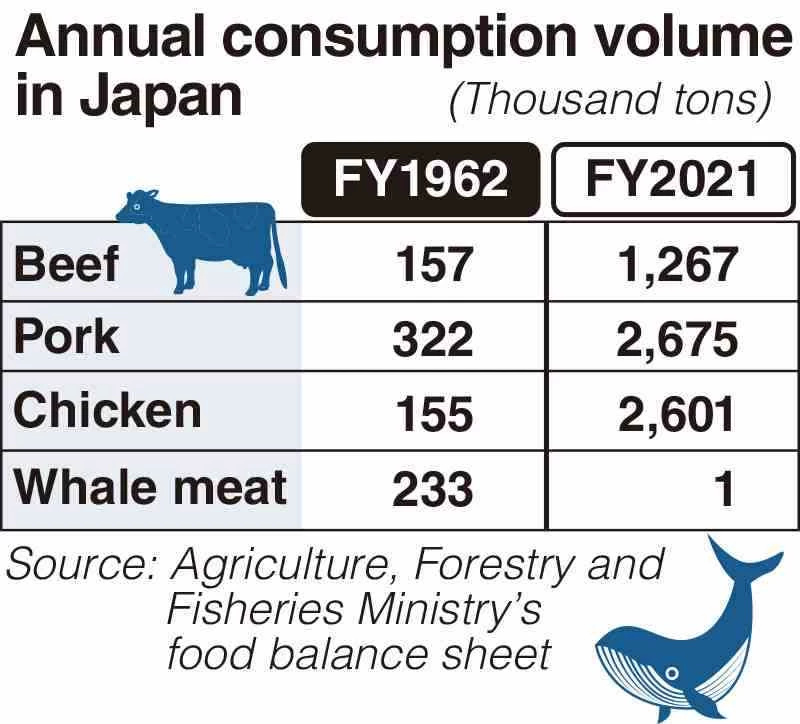
According to Agriculture, Forestry and Fisheries Ministry statistics, Japan consumed 233,000 tons of whale meat in fiscal 1962, eclipsing the figures for beef (157,000) and chicken (155,000).
However, the whale population began to decline drastically due to overhunting. In the 1980s, the IWC, which controls whale stocks as a marine resource, declared a moratorium on commercial whaling.
Japanese dietary habits subsequently changed, and the eating of whale meat quickly faded.
In the 2000s, anti-whaling organizations carried out fierce protests and took obstructive action against whaling ships. “Even now, some retailers remain hesitant about selling whale meat over fears of possible trouble,” a whaling industry official said.
In 2019, Japan withdrew from the IWC and resumed commercial whaling inside Japanese territorial waters and exclusive economic zone (EEZ). However, the government specifies catch quotas to prevent adverse effects on stocks.
This year, for example, the quota is set at a total of 379 whales across three species, including Bryde’s whale. Catches are thus lower than those seen from 1987 to 2019, when the nation conducted whaling for scientific research mainly in the Antarctic Sea. Since Japan withdrew from the IWC, domestic whale meat consumption has been relatively low at 1,000 tons to 2,000 tons per year.
A Kyodo Senpaku official expressed a growing sense of urgency, saying, “Unless domestic consumption increases, the traditional whaling industry won’t survive and [elements of] Japan’s unique dietary culture will be lost.”
Icelandic imports
Despite the drop in whale meat consumption in Japanese homes, public and private entities have continued efforts to advance its uptake. For example, they have introduced whale meat into school lunches, promoted whale meat recipes and launched a website to showcase eateries that serve whale foods.
The unmanned stores are aimed at increasing opportunities for consumers to purchase whale meat, while the longer-term goal is to increase sales at supermarket stores and other outlets, too.
Kyodo Senpaku conducts sales campaigns primarily featuring raw whale meat for sashimi. Starting in February, the company plans to annually import nearly 3,000 tons of fin whale meat from Iceland in northern Europe.
Last October, the Japanese government attended the IWC’s general meeting held in Slovenia as an observer. A senior official of the Agriculture, Forestry and Fisheries Ministry said, “There was no sign of compromise between countries opposing whaling and those who support it.” In light of this, the government will not be rejoining the IWC for the time being.
As commercial whaling is likely to continue in the nation’s territorial waters and EEZ, the Fisheries Agency plans to set new catch quotas. From 2024, it will expand its list of three legally catchable species to include larger whale types and is presently conducting research to that end.
Thousands of Israelis rally against Netanyahu legal reforms
SUNDAY, JANUARY 15, 2023
Tens of thousands of Israelis demonstrated in three major cities on Saturday against Prime Minister Benjamin Netanyahu’s judicial reform plans, with organisers accusing him of undermining democratic rule weeks after his reelection.
Bestriding a religious-nationalist coalition with a solid parliamentary majority, Netanyahu, now in his sixth term, wants to rein in the Supreme Court in what he has described as a restoration of the balance of the three branches of government.
Critics say the proposed reforms would cripple judicial independence, foster corruption, set back minority rights and deprive Israel’s court system of credibility that helps fend off war crimes allegations abroad. Among those opposed are the Supreme Court chief justice and the country’s attorney-general.
After President Isaac Herzog appealed to polarised politicians to “lower the temperatures” of the debates, organizers of the demonstrations – held under chilly winter rain – sought to strike a note of national unity.
Israeli media put the number in attendance at some 80,000, with thousands more at protests in Jerusalem and Haifa.
Footage showed a small number of Palestinian flags on display, in defiance of Netanyahu’s far-right allies. One of these, National Security Ministry Itamar Ben-Gvir, told Kan TV he wanted such flags removed but was awaiting the opinion of the attorney-general before ordering any crackdown by police.
The 73-year-old Netanyahu on Friday (January 13) signalled flexibility on the reform plan, saying it would be implemented “with careful consideration while hearing all of the positions”.
Polls have diverged on public views of the reforms. Channel 13 TV last week found 53% of Israelis were opposed to changing the court appointments’ structure while 35% were in support. But Channel 14 TV on Thursday found 61% in favour and 35% opposed.
Critics of the Supreme Court say it is overreaching and unrepresentative of the electorate. Its proponents call the court a means of bringing equilibrium to a fractious society.


 The FTIX will be connected to the online system of CALO for trading T-VER carbon credits and will also trade 100% renewable energy (RE100 energy).


 Sculptor Nguyen Tan Phat wishes to promote the values of Vietnamese traditional lacquer craft and culture. — VNS Photo Minh Phuong
 The special feature of the feline statue collection is uniqueness – no item looks alike. — Photo courtesy of the artisan
 Phat is pictured with the feline statue that won third prize in the Vietnam Handicraft Design contest 2022. — Photo courtesy of the artist