Biden set for G-7 boost in bid for all nations to impose minimum global corporate tax #SootinClaimon.Com

#SootinClaimon.Com : ขอบคุณแหล่งข้อมูล : หนังสือพิมพ์ The Nation.

https://www.nationthailand.com/business/40001525

Biden set for G-7 boost in bid for all nations to impose minimum global corporate tax


WASHINGTON – Finance ministers from Group of Seven nations meeting in London on Friday are expected to back President Joe Bidens call for a global minimum tax on corporate profits, giving him an early win in a grueling diplomatic campaign that is just beginning.
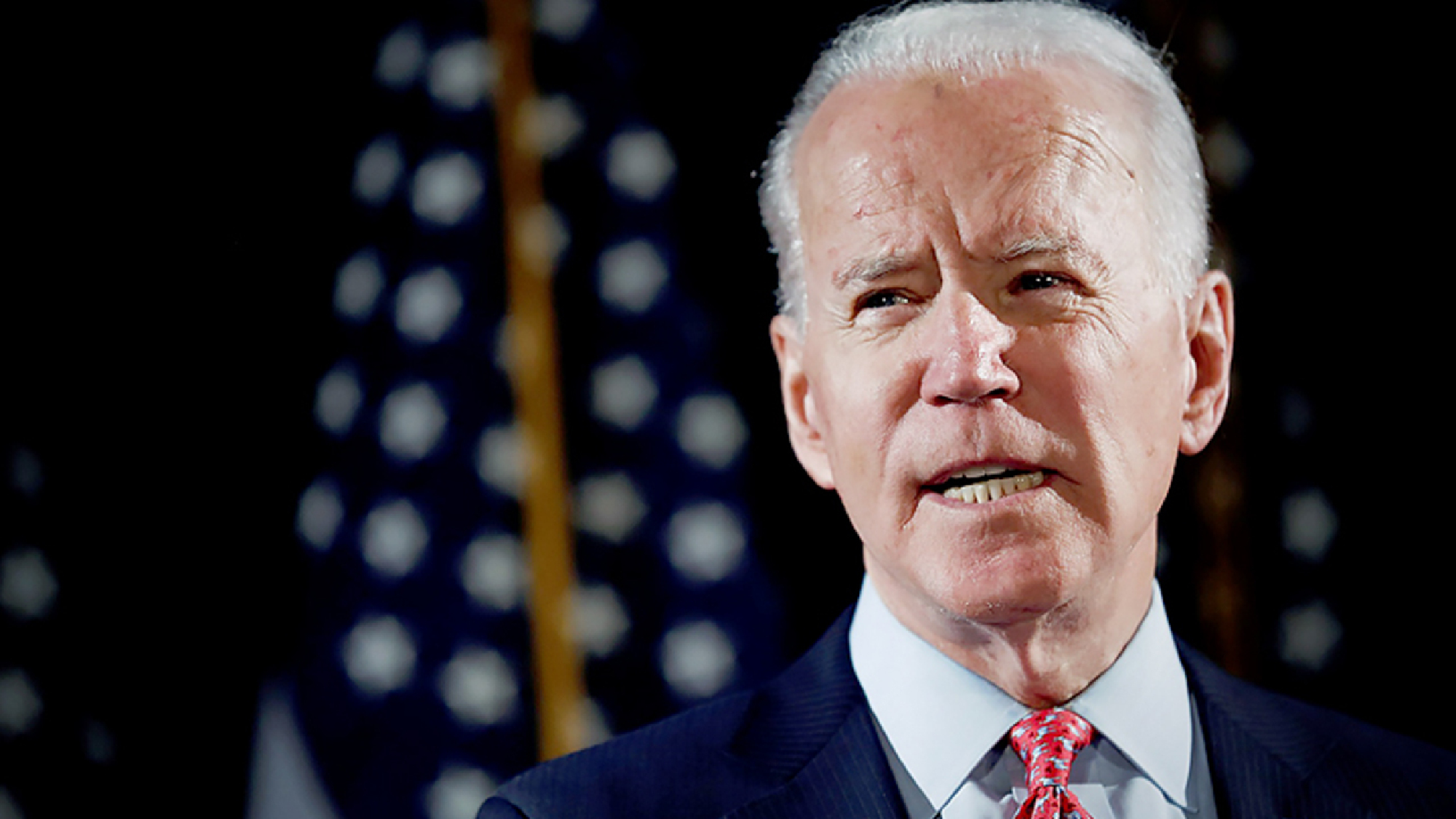
Biden set for G-7 boost in bid for all nations to impose minimum global corporate tax

The new minimum tax, one half of a two-pronged global reform effort, is designed to halt a cycle of corporate tax-cutting that has sapped government revenue around the globe. As part of a package deal, negotiators are also wrestling with European demands to tax American technology giants such as Google and Facebook, which earn substantial revenue in countries where they have little physical presence.

Biden catalyzed the global tax debate this month by lowering to 15% from 21% his proposed worldwide minimum. If he can secure agreement from the world’s leading democracies – en route to a broader global consensus later this year – it could eventually produce the most significant global tax shift in decades.

Putting a floor beneath multinationals’ tax bills in other countries would help the president raise the corporate rate at home to 28% by reducing the incentive for corporations to continue shifting hundreds of billions of dollars in profits to low-tax venues.

Along with opposition from corporate lobbyists, additional obstacles loom, including objections from low-tax countries such as Ireland as well as likely noncompliance from China and Russia. After more than three decades of factory offshoring, any global minimum levy also might only minimally reshape the map of global production and investment.

“Fundamentally, the goal for all of us is to make sure companies that are multinationals are paying their fair share of taxes,” Deputy Treasury Secretary Wally Adeyemo said in an interview. “Anything we can do to close the gap is going to be a boon to the American economy and business.”

Biden confronts a complex chore, which blends rewriting the tax code’s eye-glazing arcana with the diplomatic puzzle of satisfying the interests of both advanced and developing nations. The varying domestic and global political calendars mean administration officials may end up asking Congress to change U.S. tax law before other nations have acted.

Negotiators are simultaneously wrestling with both the global minimum levy and the challenge of taxing digital companies. Several global bodies such as the G-7 and the G-20 are involved. The U.K., which hosts Friday’s finance minister session and a leaders’ summit in June, insists that the digital and minimum tax issues be resolved in a single bargain. Securing E.U. agreement, meanwhile, requires unanimity among its 27 nations. And the international talks are occurring as the United States gears up to rewrite its domestic tax laws.

Amid all these moving parts, the expected G-7 endorsement “is good news in terms of the possibility of a global agreement,” said Michael Mundaca, U.S. national tax department leader for Ernst & Young. “But it’s still very early.”

Biden’s time-consuming multilateral strategy signals a departure from President Donald Trump’s preference for unilateral tariffs.

The Democrat’s determination to use a tax code overhaul to reset the terms of global commerce is reflected in the addition to his Treasury Department team of several prominent academic tax specialists, including Kimberly Clausing of Reed College, Rebecca Kysar of Fordham Law School and Itai Grinberg of Georgetown University.

The president’s aim is to shrink the role that tax calculations play in corporate investment decisions, boosting economic efficiency and income. But even some supporters caution that the immediate gains may prove modest.

“We will get some revenue by shrinking the use of tax havens, especially for intangibles, and we will get the benefit of multinationals locating any start-ups in the U.S.,” said Steven Rosenthal, a senior fellow at the Urban Institute. “But I don’t think we’ll see the end of factories and jobs leaving America. To the extent that’s done now, it’s more because of other factors such as technology and wages. It’s not done for tax rules.”

Under the auspices of the Organization for Economic Co-operation and Development (OECD) in Paris, 137 nations have been wrestling since 2013 with the question of how to tax corporations in a globalized, digital economy.

The pandemic’s budgetary impact, coupled with an American president determined to narrow the gap between rich and poor, have given momentum to the idea of a global minimum corporate tax, U.S. officials and tax specialists said.

Governments around the world spent an estimated $16 trillion battling the novel coronavirus over the past year, according to Vitor Gaspar, director of the International Monetary Fund’s fiscal affairs department. All those bills for health care and economic support drove the average country’s public debt to 99% of gross domestic product this year, up from 83.7% in 2019.

That has left governments thirsty for revenue. Changing the way corporate taxes are collected could harvest between $100 billion and $600 billion annually, according to published estimates.

“The benefits are tremendous. Once we have it, the race to the bottom that is depriving emerging markets and developing countries from revenue is going to stop,” Kristalina Georgieva, managing director of the International Monetary Fund, said recently. “I get a strong sense of confidence that this is going to be done and we would all breathe a sigh of relief when it is done.”

Even without action by other nations, the Biden administration expects to reap more than $533 billion over the next decade by reducing incentives for U.S. corporations to shift assets and incomes abroad, according to the president’s budget proposal released Friday.

The global debate over raising government revenue caps a generation of collapsing corporate tax rates. Since 1980, the global average rate set in national laws, weighted according to economic output, has fallen from more than 46% to 26%, according to the nonprofit Tax Foundation.

In 2017, the Trump administration lowered the U.S. corporate rate to 21%. But what corporations actually pay – the effective rate – is less than 8%, according to the congressional Joint Committee on Taxation.

Annual revenue from corporate taxes relative to the size of the economy is now less than one-quarter as large as in 1967, according to the Congressional Budget Office. The Biden administration sees raising the corporate share as an essential way to pay for its “Build Back Better” agenda of infrastructure and social spending.

“We can keep giving every break in the world to corporations and CEOs, or we can raise the corporate tax rate back to 28% . . . which is still lower than it was at any point between World War I and 2017, and they’re making trillions of dollars,” the president said Thursday in Cleveland.

Determining how – and how much – to tax corporate earnings has become tougher as companies expanded their cross-border operations and drew greater profits from intangible goods such as software and intellectual property.

Corporate accountants easily shift income on paper to low-tax jurisdictions such as Ireland, the Cayman Islands or Bermuda: 40%of the profits multinationals earn outside their home country are “artificially shifted to tax havens,” according to a 2018 study by Gabriel Zucman, an economics professor at the University of California at Berkeley, and Ludvig S. Wier and Thomas R. Tørsløv, both of the University of Copenhagen.

Corporate leaders oppose Biden’s plans. Even as the proposal for a global minimum tax appears to be gaining steam at the G-7, business leaders say that differences in the structure of European and U.S. tax codes – such as which expenses can be deducted from taxable income – make it difficult to imagine implementing a uniform corporate tax.

“All we know is they’re talking about a rate. We don’t know what it applies to. We don’t know how it applies,” said Catherine Schultz, vice president for tax and fiscal policy at the Business Roundtable.

Speaking at a recent Washington Post roundtable, the IMF’s Georgieva said she expected negotiators to continue haggling over the rate for the global minimum as well as potential implementation timetables.

U.S. officials still hope to eventually get a global minimum rate above 15%. But the current negotiations represent a balancing act: They need a rate low enough to win wide support but high enough to shrink the incentive for U.S.-based multinationals to engage in profit shifting.

After Friday’s scheduled gathering of finance ministers from the G-7 – the United Kingdom, France, Germany, Canada, Italy, Japan and the United States – the administration’s strategy winds through additional global meetings. Negotiators hope to secure an agreement in principle some time this summer, with a final accord sealed at a Group of 20 leaders summit in Rome at the end of October.

Yet even if a diplomatic agreement is reached, each nation will need to rewrite its tax code through legislation. So Congress will probably vote on the administration’s tax plan before that work is completed.

“They want to push for a tax change domestically at a time when all they’ll have will be political commitments from the OECD countries. Those political commitments are just that. They’re political commitments. They’re not changes in law,” said Brent McIntosh, who was Treasury’s top international official in the Trump administration.

Published : June 01, 2021

By : The Washington Post · David J. Lynch
OPEC+ sees tight oil market as ministers set for supply talks #SootinClaimon.Com

#SootinClaimon.Com : ขอบคุณแหล่งข้อมูล : หนังสือพิมพ์ The Nation.

https://www.nationthailand.com/business/40001524

OPEC+ sees tight oil market as ministers set for supply talks


A year after shuttering unprecedented volumes of crude, the OPEC+ alliance is expecting world oil markets to get acutely tight.

OPEC+ sees tight oil market as ministers set for supply talks

The coalition led by Saudi Arabia and Russia believes that the glut created during the pandemic has nearly gone, and that oil stockpiles will diminish rapidly in the second half of the year as lockdowns ease and travel gathers pace.

That leaves the Organization of Petroleum Exporting Countries and its partners with a decision they will start pondering as soon as Tuesday: whether to pour more oil into the market in the second half when the outlook is still so mired in uncertainty.

Holding output steady would support the market against the twin risks of renewed virus outbreaks and a potential export flood from fellow OPEC member Iran. But with Brent futures near $70 a barrel, it could also jeopardize the global economy and feed into the inflationary pressures fixating Wall Street.

“There are many moving parts when it comes to factors affecting the global oil market, such as the pace of change during the pandemic,” OPEC Secretary-General Mohammad Barkindo said after preliminary consultations on Monday.

At their meeting on Tuesday, ministers are expected to press ahead with a gradual increase already penciled in for July, completing the return of 2 million barrels since May. In theory, according to a historic deal struck in the depths of the oil crisis last year, the group has committed to hold at that level until early 2022. But a tight market may call for the agreement to be revised.

Delegates said initial discussions would begin on Tuesday about the alliance’s moves after July. No decision will be made, they said. But any hints the ministers give will be closely scrutinized — by inflation forecasters as much as oil traders.

OPEC’s Joint Technical Committee estimated on Monday that by the end of July stockpiles in developed nations will be below the average levels seen during 2015 to 2019 — a key benchmark for the group. Between September and December, inventories will be depleted at a brisk clip of more than 2 million barrels a day.

That encourages many observers to believe that OPEC+ will need to open the taps in the second half of the year.

“The market is now facing the exact opposite dilemma of April 2020,” said Louise Dickson, an analyst at consultants Rystad Energy.

“Producers now have just as delicate of a task to bring back enough supply to match the swiftly rising oil demand,” said Dickson. “If markets over-tighten, a flare-up in prices could jeopardize the global economic recovery.”

But the demand outlook remains beset with uncertainties. Indian energy demand is taking a big hit as Covid-19 rages through the country. Japan and Malaysia, key consumers of OPEC’s crude, have recently announced tougher measures to deal with the latest infections.

“The resurgence of COVID-19 cases in some Asian and Latin American countries remains a source of concern, and could still dampen economic activities and an oil demand rebound,” the JTC said in its report.

A critical factor in the group’s decision-making will be Iran.

Tehran is in talks with world powers to revive a 2015 nuclear accord that limited its atomic activities in return for U.S. sanctions relief. Iran is keen to reach an agreement before it holds presidential elections on June 18. If that happens, and Washington lifts sanctions, Iran may be able to ramp up exports quickly.

Iran’s oil minister said on Monday the country can increase its crude production rapidly, and analysts estimate output could rise to about 4 million barrels a day.

OPEC’s Barkindo signaled at the JTC meeting that Iran’s comeback “will occur in an orderly and transparent fashion,” causing no upset to the stability that other OPEC+ nations have toiled to achieve.

As ministers weigh the risks of bringing more oil back onto the market, the debate may well re-open old fault-lines in the leadership of the coalition.

Riyadh and Moscow have often diverged on how quickly to bolster output, with the kingdom typically advocating restraint and Russia more impatient to expand sales volumes. The United Arab Emirates, another key player, has also shown eagerness to resume exports.

“It remains a delicate balancing act,” said Bill Farren-Price, a director at research firm Enverus and veteran observer of the cartel.

Published : June 01, 2021

By : Syndication Washington Post, Bloomberg · Grant Smith, Salma El Wardany, Javier Blas

Thai stocks up ahead of jab rollout #SootinClaimon.Com

#SootinClaimon.Com : ขอบคุณแหล่งข้อมูล : หนังสือพิมพ์ The Nation.

https://www.nationthailand.com/business/40001515

Thai stocks up ahead of jab rollout


The Stock Exchange of Thailand (SET) Index closed at 1,593.59 on Monday, up 11.61 points or 0.73 per cent. Transactions totalled THB79.81 billion with an index high of 1,594.65 and a low of 1,578.09.

Thai stocks up ahead of jab rollout

In the morning session, Krungsri Securities expected the index on Monday to fluctuate between 1,575 and 1,595 points, citing hopes of global economic recovery plus the start of mass vaccination in Thailand on June 7.

The US Federal Reserve, meanwhile, is likely to maintain its low interest rate and quantitative easing.

However, Krungsri Securities said the SET would come under pressure from uncertainty over rising US inflation, after personal consumption in April increased by 0.6 per cent, plus the outflow of foreign funds.

The 10 stocks with the highest trade value today were SIRI, KBANK, RCL, STGT, CPF, DELTA, KCE, CPALL, HANA and PTT.

Other Asian indices were on the rise with one exception:

Japan’s Nikkei Index closed at 28,860.08, down 289.33 points or 0.99 per cent.

China’s Shanghai SE Composite Index closed at 3,615.48, up 14.69 points or 0.41 per cent, while the Shenzhen SE Component Index closed at 14,996.38, up 143.50 points or 0.97 per cent.

Hong Kong’s Hang Seng Index closed at 29,151.80, up 27.39 points or 0.094 per cent.

South Korea’s KOSPI closed at 3,203.92, up 15.19 points or 0.48 per cent.

Taiwan’s TAIEX closed at 17,068.43, up 197.57 points or 1.17 per cent.

Published : May 31, 2021

By : The Nation

Thailand’s manufacturing index rises on back of improving global economy #SootinClaimon.Com

#SootinClaimon.Com : ขอบคุณแหล่งข้อมูล : หนังสือพิมพ์ The Nation.

https://www.nationthailand.com/business/40001508

Thailand’s manufacturing index rises on back of improving global economy


Thailand’s manufacturing production index (MPI) jumped to 91.88 in April, rising 18.46 per cent compared to the same period last year, Industry Minister Suriya Juangroongruangkit said on Monday.

Thailand’s manufacturing index rises on back of improving global economy

“April’s MPI jumped due to an increase in exports owing to the improving global economy. The government’s economic stimulus campaigns have also helped create demands for the manufacturing sector,” he added.

“The third wave of Covid-19 [which kicked off in late March] has had no significant impact on the country’s industrial manufacturing sector and supply chain.”

Thongchai Chawalitphichet, director-general of the Office of Industrial Economics (OIE), added that the automotive industry has contributed the most to the expansion of MPI in April, expanding by 288.06 per cent year on year.

“This jump is due to the fact that last year, many manufacturers had to halt their production due to lockdown measures, especially in the production of pick-up trucks, small passenger cars and diesel-run vehicles,” he added.

“The production of beer also rose 515.18 per cent year on year because no lockdown measures were announced during this year’s Songkran festival.”

Manufacturing of air conditioners and components also recorded a 57.38 per cent rise year on year because many countries have eased their lockdown measures and are facilitating the export of products from Thailand.

Thongchai added that Thailand netted US$16.17 billion from the export of industrial products, expanding 45.69 per cent year on year and 13.09 per cent from March.

“This makes industrial exports in April the highest in the past 36 months, while products that saw a significant increase include cars, electrical appliances, electronic components, rubber products and chemicals,” he added.

Published : May 31, 2021

By : THE NATION

วันที่ 31 พ.ค. 2564 ข่าวเศรษฐกิจ-ธุรกิจ #SootinClaimon.Com

#SootinClaimon.Com : ขอบคุณแหล่งข้อมูล : หนังสือพิมพ์โพสต์ทูเดย์

https://www.posttoday.com/economy

เวียตเจ็ท เปิดรับสมัครงานหลายตำแหน่งตั้งแต่ นักบิน ลูกเรือ ฝ่ายบริการภาคพื้นดิน ซ้อมปลุกธุรกิจการบินฟื้น

เวียตเจ็ท เปิดรับสมัครงานหลายตำแหน่งตั้งแต่ นักบิน ลูกเรือ ฝ่ายบริการภาคพื้นดิน ซ้อมปลุกธุรกิจการบินฟื้น

เวียตเจ็ท จัดงานใหญ่ประจำปี “ Sky Career Festival 2021” ผ่านไลฟ์เฟซบุ๊ก เปิดโอกาสผู้ร่วมงานเรียนรู้ข้อมูลตำแหน่งงานในสายการบินตรง พร้อมเปิดรับสมัคงานหลายตำแหน่งแบบออนไลน์วันที่ 31 พ.ค. 2564 เวลา 20:02 น. | ข่าวเศรษฐกิจ-ธุรกิจ

ซีพี ชี้ 'วัคซีนทางเลือก' คือคำตอบฝ่าวิกฤต พร้อมหนุนเอกชนจัดหาใช้เองในองค์กร

ซีพี ชี้ ‘วัคซีนทางเลือก’ คือคำตอบฝ่าวิกฤต พร้อมหนุนเอกชนจัดหาใช้เองในองค์กร

ซีพี ย้ำจุดยืนสนับสนุนเอกชนซื้อวัคซีนทางเลือก ซิโนฟาร์ม ไฟเซอร์ โมเดอร์นา และอื่นๆ เพื่อจัดฉีดให้กับพนักงานและครอบครัว แบ่งเบาภาระภาครัฐวัคซีนทางเลือก ซิโนฟาร์ม ไฟเซอร์ โมเดอร์นา และอื่นๆ เพื่อจัดฉีดให้กับพนักงานและครอบครัว แบ่งเบาภาระภาครัฐวันที่ 31 พ.ค. 2564 เวลา 18:24 น. | ข่าวเศรษฐกิจ-ธุรกิจ

ปตท.จับมือ ฟ็อกซ์คอนน์ ลงทุนรถอีวี ดันไทยฮับในอาเซียน

ปตท.จับมือ ฟ็อกซ์คอนน์ ลงทุนรถอีวี ดันไทยฮับในอาเซียน

ปตท.ลุยตลาดยานยนต์ไฟฟ้า ตอบโจทย์เทรนด์โลก ลงนามเอ็มโอยู ฟ็อกซ์คอนน์ จากไต้หวัน ลงทุน 1-2 พันล้านเหรียญสหรัฐ สร้างแพลตฟอร์มผลิตรถอีวี ครบวงจรในไทยวันที่ 31 พ.ค. 2564 เวลา 18:10 น. | ข่าวเศรษฐกิจ-ธุรกิจ

เปิดรับซื้อไฟฟ้าโซลาร์รูฟ ร.ร.-รพ. 50 เมกะวัตต์ ราคาหน่วยละ 1 บาท

เปิดรับซื้อไฟฟ้าโซลาร์รูฟ ร.ร.-รพ. 50 เมกะวัตต์ ราคาหน่วยละ 1 บาท

กกพ.เดินหน้ารับซื้อไฟฟ้าโซลาร์เซลล์บนหลังคา กลุ่มโรงเรียน โรงพยาบาล และสูบน้ำเกษตร นำร่อง 50 เมกะวัตต์ ระยะเวลา 10 ปี เปิดให้ยื่นโครงการ 1 มิ.ย. นี้ กำหนดจ่ายไฟฟ้าเข้าระบบภายในปี 2564วันที่ 31 พ.ค. 2564 เวลา 15:15 น. | ข่าวเศรษฐกิจ-ธุรกิจ

NT ขับเคลื่อน Digital Transformation ด้วย AWS Outposts

NT ขับเคลื่อน Digital Transformation ด้วย AWS Outposts

บริษัท โทรคมนาคมแห่งชาติ ขับเคลื่อน Digital Transformation ด้วย AWS Outpostsวันที่ 31 พ.ค. 2564 เวลา 14:01 น. | ข่าวเศรษฐกิจ-ธุรกิจ

ดัชนี MPI โตต่อเนื่อง ยอดผลิตเบียร์พุ่ง 500% ช่วงโควิด

ดัชนี MPI โตต่อเนื่อง ยอดผลิตเบียร์พุ่ง 500% ช่วงโควิด

ดัชนีผลผลิตฯเดือนเม.ย.ขยายตัวเป็นเดือนที่ 2 แม้เกิดโควิดระลอกใหม่ ชี้เศรษฐกิจของโลกแนวโน้มดี ส่งผลภาคการผลิตคึกคัก รถยนต์-เครื่องใช้ไฟฟ้า-เครื่องดื่ม-อาหาร รองรับ Work From Homeวันที่ 31 พ.ค. 2564 เวลา 12:50 น. | ข่าวเศรษฐกิจ-ธุรกิจ

Asap ปรับกลยุทธ์ธุรกิจรถเช่าครบวงจร เจาะลูกค้าค้นหาบริการผ่านแพล็ตฟอร์มออนไลน์

Asap ปรับกลยุทธ์ธุรกิจรถเช่าครบวงจร เจาะลูกค้าค้นหาบริการผ่านแพล็ตฟอร์มออนไลน์

Asap ขยายธุรกิจให้ครอบคลุมลูกค้ารายย่อยยุคนิวนอร์มอล เปิดบริการจองรถเช่าผ่านแอปพลิเคชัน ลุยตลาดประกันภัย-ขายรถมือสองแบบ Peer-to-Peer พร้อมสร้างชุมชนซื้อขายรถมือสองผ่านชุมชนออนไลน์วันที่ 31 พ.ค. 2564 เวลา 12:38 น. | ข่าวเศรษฐกิจ-ธุรกิจ

โควิดรอบ 3 ฉุดคนไทยใช้น้ำมันลดลง  4 เดือนแรกวูบ 3.5%

โควิดรอบ 3 ฉุดคนไทยใช้น้ำมันลดลง 4 เดือนแรกวูบ 3.5%

ยอดการใช้เบนซิน-โซฮอล์-ดีเซล 4 เดือนแรกลดลงจากปัจจัยโควิดระลอกใหม่ ชี้น้ำมันเครื่องบินลดลงหนักสุด 64.8% ส่งผลนำเข้าน้ำมันลดลง 8%วันที่ 31 พ.ค. 2564 เวลา 11:40 น. | ข่าวเศรษฐกิจ-ธุรกิจ

วันที่ 30 พ.ค. 2564 ข่าวเศรษฐกิจ-ธุรกิจ #SootinClaimon.Com

#SootinClaimon.Com : ขอบคุณแหล่งข้อมูล : หนังสือพิมพ์โพสต์ทูเดย์

https://www.posttoday.com/economy

วิเคราะห์ตลาดที่อยู่อาศัยภาคตะวันออก 3 จังหวัด EEC

วิเคราะห์ตลาดที่อยู่อาศัยภาคตะวันออก 3 จังหวัด EEC

วิเคราะห์ตลาดที่อยู่อาศัยภาคตะวันออก 3 จังหวัด EECตลาดชะลอ หน่วยเหลือขายกว่า 6.4 หมื่นหน่วยวันที่ 30 พ.ค. 2564 เวลา 19:52 น. | ข่าวเศรษฐกิจ-ธุรกิจ

ตลาดรถยนต์เมษายนเติบโตทะลุ 90%

ตลาดรถยนต์เมษายนเติบโตทะลุ 90%

ตลาดรถยนต์เมษายนเติบโตทะลุ 90% ยอดขายรวม 58,132 คัน เพิ่มขึ้น 93.1%วันที่ 30 พ.ค. 2564 เวลา 10:36 น. | ข่าวเศรษฐกิจ-ธุรกิจ

ฟอร์ดร่วมมือโพลีเน็ตส่งมอบแว่นตานิรภัยเพิ่มอีก10,000 ชิ้น

ฟอร์ดร่วมมือโพลีเน็ตส่งมอบแว่นตานิรภัยเพิ่มอีก10,000 ชิ้น

ฟอร์ดร่วมมือโพลีเน็ตส่งมอบแว่นตานิรภัยเพิ่มอีก10,000 ชิ้น เพื่อสนับสนุนบุคลากรทางการแพทย์รับมือกับโควิด-19วันที่ 30 พ.ค. 2564 เวลา 09:26 น. | ข่าวเศรษฐกิจ-ธุรกิจ

SET slides despite some positive factors #SootinClaimon.Com

#SootinClaimon.Com : ขอบคุณแหล่งข้อมูล : หนังสือพิมพ์ The Nation.

https://www.nationthailand.com/business/40001496

SET slides despite some positive factors


The Stock Exchange of Thailand (SET) Index fell by 2.57 points, or 0.16 per cent, to 1,579.41 on Monday morning. The volume of total transactions was THB10.93 billion with an index high of 1,585.41 and a low of 1,578.61.

SET slides despite some positive factors

Krungsri Securities predicted the index would fluctuate between 1,575 and 1,595 points despite hopes of a global economic recovery as well as the Thai Public Health Ministry announcing mass vaccinations from June 7.

The US Federal Reserve, meanwhile, is likely to maintain interest rate at a low level and continue using quantitative easing.

However, uncertainty over rising inflation after US personal consumption expenditure in April increased by 0.6 per cent, plus the outflow of foreign funds, would pressure the index, Krungsri Securities said.

It recommended that investors buy:

▪︎ BDMS, BCH, CHG, MINT, CENTEL, AOT, CPALL, HMPRO, CPN and CRC, which have gained positive sentiment from the mass vaccination plan.

▪︎ PTT, PTTEP, PTTGC and IVL, which benefit from the rising oil price.

The SET Index closed at 1,581.98 on Friday, down 0.98 points or 0.06 per cent. Transactions amounted to THB99.50 billion with an index high of 1,595.45 and a low of 1,579.53.

Published : May 31, 2021

By : The Nation

Limited downside for baht even if dollar strengthens #SootinClaimon.Com

#SootinClaimon.Com : ขอบคุณแหล่งข้อมูล : หนังสือพิมพ์ The Nation.

https://www.nationthailand.com/business/40001495

Limited downside for baht even if dollar strengthens


The baht opened at 31.26 to the US dollar on Monday, unchanged from Friday’s close.

Limited downside for baht even if dollar strengthens

The Thai currency is likely to move between 31.20 and 31.30 during the day and between 31.15 and 31.45 within this week, Krungthai Bank market strategist Poon Panichpibool said.

The baht would tend to move sideways in line with the dollar and funds flow of foreign investors, he said, adding that the Thai currency was still pressured by the Fed’s statement on quantitative easing.

The market strategist added that the baht would not weaken sharply even if the dollar strengthened, as exporters aimed to sell the US currency. Gold trade was another factor to support the baht, he said.

Negative factors hampering investments in Thailand were the Covid-19 crisis and vaccine procurement.

Published : May 31, 2021

By : The Nation

Gold price up as inflation fears push up demand for precious metal #SootinClaimon.Com

#SootinClaimon.Com : ขอบคุณแหล่งข้อมูล : หนังสือพิมพ์ The Nation.

https://www.nationthailand.com/business/40001492

Gold price up as inflation fears push up demand for precious metal


The price of gold in Thailand rose by THB100 per baht weight in morning trade on Monday, buoyed by mass buy-ups of the precious metal to prevent risks from inflation after US personal consumption expenditure in April increased by 0.6 per cent.

Gold price up as inflation fears push up demand for precious metal

The Gold Traders Association report at 9.30am showed tye buying price of a gold bar at THB28,100 per baht weight and selling price at THB28,200, while gold ornaments were priced at THB27,591.20 and THB28,700, respectively.

At close on Saturday, the buying price of a gold bar was THB28,000 per baht weight and selling price at THB28,100, while gold ornaments were priced at THB27,500.24 and THB28,600, respectively.

The price of gold in Thailand had risen by THB200 per baht weight last week.

Spot gold price on Monday was US$1,908 (THB59,610) per ounce compared to Friday when it rose by $6.8 to $1,905.3 per ounce.

Hong Kong gold price on Monday rose by HK$110 to $17,620 (THB70,926) per tael, the Chinese Gold and Silver Exchange Society reported.

Published : May 31, 2021

By : The Nation

Workers return to weirder offices with moveable walls and touchless elevators #SootinClaimon.Com

#SootinClaimon.Com : ขอบคุณแหล่งข้อมูล : หนังสือพิมพ์ The Nation.

https://www.nationthailand.com/business/40001483

Workers return to weirder offices with moveable walls and touchless elevators


Masked, desk-bound and unable to recognize their colleagues in an elevator, people are starting to return to offices in cities around the world where the pandemic is receding. Many will find their offices transformed, too.

Workers return to weirder offices with moveable walls and touchless elevators

In the challenge to make offices both Covid-safe and attractive places to work, firms have been experimenting with working arrangements and space while employees toiled at home. Some gave up floor space to adjust to less rigid schedules, others introduced movable walls to create flexible areas. Many installed safety innovations such as touchless lifts and worked to improve air quality.

Lockdowns have provided a “fantastic opportunity to create and recreate a new world for each of us, which may, for each company, be slightly different,” said Neil McLocklin, a Knight Frank partner.

Employees of Arcadis, a design and engineering consultancy, will be able to choose one of 20 different types of workspace via an app when they move into new offices in the City of London next month. The company’s Building Intelligence app, developed during the pandemic, provides options for meeting spaces, focused work and collaboration, as well as social and wellbeing areas such as a winter garden.

The app will help monitor the number of people using different spaces, ensuring capacity limits designed to prevent the spread of infection are never exceeded. The limit will initially be set to about one-third of the company’s 1,200 London office users, as it shifts to more work from home. That also means less space is needed: its London office is about 30% smaller than before.

“The app is the critical enabler,” Arcadis’ U.K. Chief Executive Officer Mark Cowlard said. “It helps us understand when people are using meeting spaces so they can be cleaned afterward.”

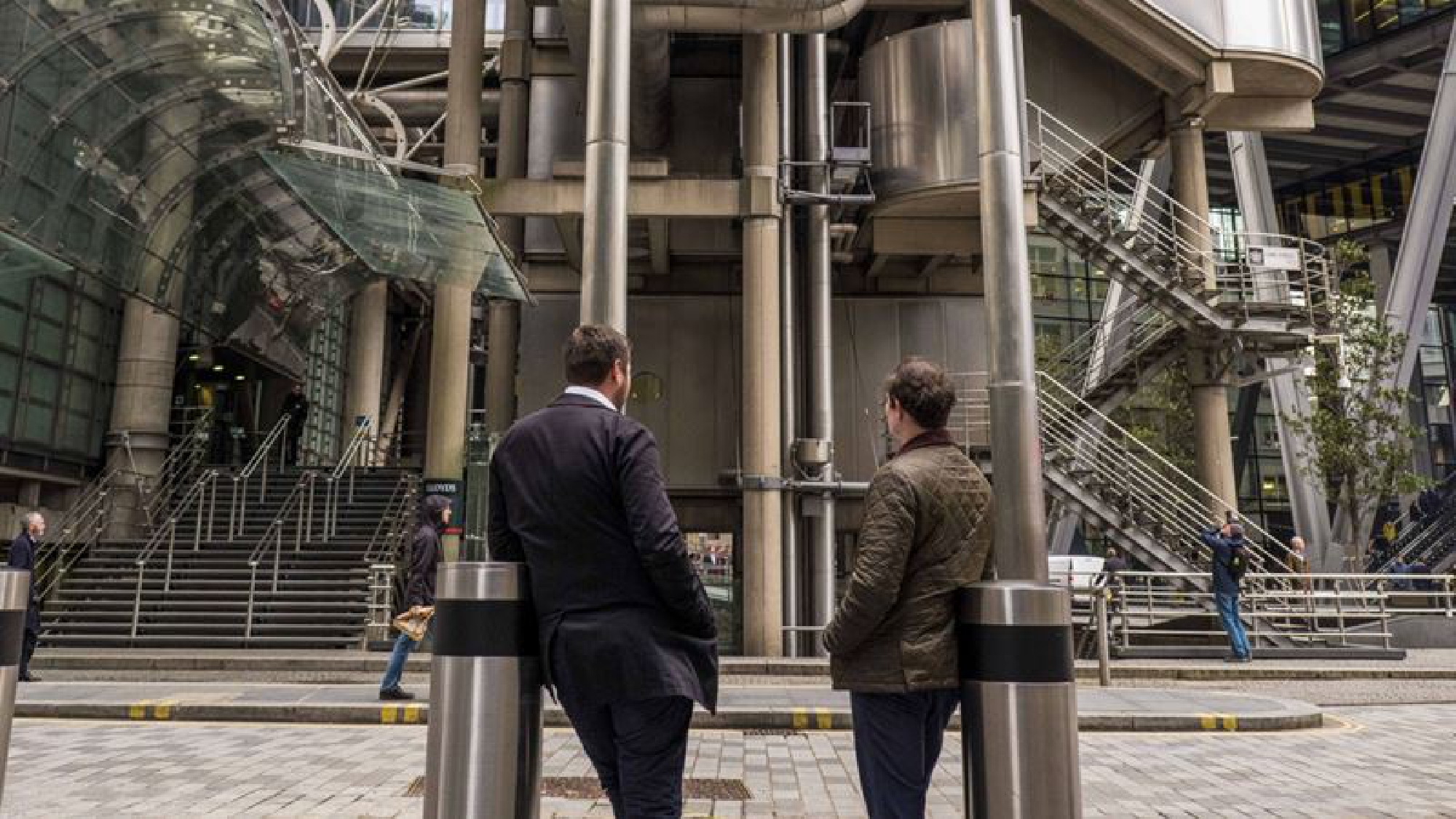
At the Lloyd’s Building, the iconic home of the 300-year-old insurance market, the externally-clad ventilation ducts inject fresh air from the ground-up and ejects it after it’s risen through the floors.

“That way of keeping the air fresh in the space is the best,” said Ivan Harbour, senior design partner at Rogers Stirk Harbour + Partners, who cut his teeth on the Lloyd’s building project as a young architect in the 1980s. “Our projects since Covid have really brought that home.”

But ventilation isn’t enough on its own. As the building reopens, face coverings are now a requirement in most of it, underwriters sit at desks bordered by perspex screens and use an app to order their lunch to-go.

The importance of making the space accessible and interesting to be in isn’t lost on HR departments. Bringing staff back to the office is already a retention issue: almost 30% of people said they’d look for another job if they need to come back to the office five days a week, according to a global McKinsey & Co. survey.

“It’s like a Rubik’s Cube. You are solving for so many different things at the same time,” said Andrea Alexander, associate partner at McKinsey in Houston, who advises some clients to take a team-based approach so employees are only expected to come in when their close colleagues are too. “It requires you to really think through what are those moments that matter that should be in person.”

Broker CBRE Group Inc. is advising its Fortune 500 clients on a range of issues, from short-term concerns around keeping people safe to longer-term considerations on what the office of the future needs to look like, according to Kate Smith, head of workplace for the U.K.

It’s advising companies on how to “magnetize” their spaces to lure staff back, adding perks like live music that have been among the things people missed most during lockdowns, Smith said.

That’s assuming you can actually fit people in your office. HSBC Holdings Plc has scrapped its London headquarters executive floor as it reduces office space by 40% globally and gives employees more choice to work from home. But in the skyscraper, elevators are the biggest hurdle. Just two people are allowed in a lift at a time, in line with government social-distancing guidelines, keeping office capacity at about 3%, according to a company spokesperson.

The co-working industry — not long ago thought to be on the verge of collapsing — is cashing in on the demand for flexibility. Deloitte LLP has moved its entire Manchester office in the U.K. to 35,000 square feet (3,250 square meters) in a WeWork building in the city center.

WeWork is also trying to make Zooming a little less two-dimensional, signing a deal with ARHT Media Inc. to integrate hologram technology in 16 of its offices around the world.

And bit by bit, the silver-lining amenities are coming back at London’s quirkier offices. At London’s White Collar Factory, as many as 30 employees, policed by a traffic light system, can use the rooftop running track. At WeWork’s U.K. sites, beer taps are reopening after running dry for months to follow government hospitality guidelines.

The experiments should keep going, CBRE’s Kate Smith said.

“It is too early for most organizations to see what it means,” she said. “They are in test-and-learn mode.”

Published : May 31, 2021

By : Syndication Washington Post, Bloomberg · Todd Gillespie, Jack Sidders