Minister plans energy incentives for customers over New Year

#ศาสตร์เกษตรดินปุ๋ย : ขอบคุณแหล่งข้อมูล : หนังสือพิมพ์ The Nation

https://www.nationthailand.com/business/30379405?utm_source=category&utm_medium=internal_referral

Minister plans energy incentives for customers over New Year

Dec 13. 2019
Energy Minister Sontirat Sontijirawong

Energy Minister Sontirat Sontijirawong
By THE NATION

733 Viewed

Energy Minister Sontirat Sontijirawong will soon propose a number of measures as New Year gift to consumers for the Cabinet’s consideration.

He said today (December 13) that one of the proposals would be to lower the retail price of B10 diesel and E20 gasohol by Bt1 per litre for 15 days from December 25 to January 10 to encourage motorists to use B10 diesel.

B10 will be available at all petrol stations countrywide from March next year.

The Energy Regulatory Commission will also cap the fuel tariff of electricity at minus 11.60 satang per unit and the average electricity price people pay at Bt3.64 per unit for four months during next January to April.

He added that PTT will also launch a promotional campaign during New Year.

He will also propose to the National Energy Policy Council on December 16 the plan to set up a national electric vehicle committee to steer the EV sector’s development.

SET and Asia stocks rally, boosted by US-China trade deal

#ศาสตร์เกษตรดินปุ๋ย : ขอบคุณแหล่งข้อมูล : หนังสือพิมพ์ The Nation

https://www.nationthailand.com/business/30379395?utm_source=category&utm_medium=internal_referral

SET and Asia stocks rally, boosted by US-China trade deal

Dec 13. 2019
By The Nation

1,331 Viewed

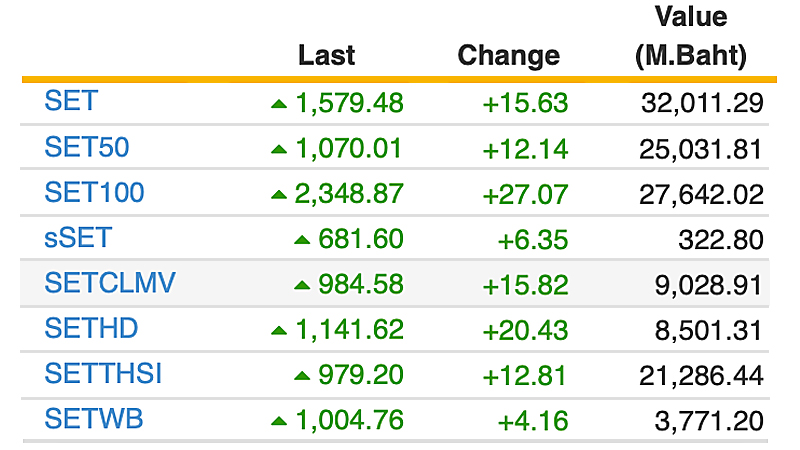
The Stock Exchange of Thailand Index edged up about 1 per cent in morning trade, rising to 1,578.43, or up 0.93 per cent at 10.54am Bangkok time.

Tisco’s market insight suggested it could be the right time for short-term traders to enter the market . The index has high chance to rise further next week provided it maintains its position at 1,570-1,575, said Tisco Financial Group, adding that SET 100 shares prices including AMATA, BJC, Intuch, Centel, Planb, PTG, Ratch and WHA, which have been down since late last month, may also have a chance to recover. SCC, Kbank, PTT and PTTEP shares, earlier the target of short sales, could also rise according to Tisco.

Shares in major market across Asia also rose sharply following the jump of US stocks. Japan’s Nikkei 225 jumped more than 2 per cent, South Korea’s Kospi rose about 1.3 per cent and China’s Shanghai composite index was up 1.2 per cent.

White House, Chinese negotiators reach trade deal in principle

Global stock markets have been boosted by news reports suggesting that US and China have reached a trade deal and the UK election, where exit polls put the Conservatives firmly in the lead.

SEC grants ThaiBMA right to test blockchain tech for trading bonds

#ศาสตร์เกษตรดินปุ๋ย : ขอบคุณแหล่งข้อมูล : หนังสือพิมพ์ The Nation

https://www.nationthailand.com/business/30379393?utm_source=category&utm_medium=internal_referral

SEC grants ThaiBMA right to test blockchain tech for trading bonds

Dec 13. 2019
By The Nation

1,004 Viewed

At its monthly meeting on Wednesday (December 11), the SEC Board passed a resolution to grant a securities depository centre regulatory sandbox license to the Thai Bond Market Association (ThaiBMA) to test the use of distributed ledger technology (DLT) in facilitating faster issuance of bonds and increase efficiency of the bond market, according to press statement from the SEC.

The adoption of technology will shorten the issuance of bonds process and increase efficiency of overall market. Under the sandbox regime, ThaiBMA has set up a DLT-based bondholder data storage system, which will allow entities related to issuance and offering of bonds – i.e., investors, issuers, underwriters, registrars, depositories and regulators – to examine bond information more conveniently and rapidly while benefiting from less redundancy and a shorter timeframe for book closing process.

ThaiBMA’s participation in this regulatory sandbox is expected to solve issues in corporate bond market. These includes the time-consuming process for verification of bondholders’ ownership and the lack of an interconnected data centre due to unconnected data systems of individual bond registrars. Such issues have caused delays and inefficiency in the bond issuance process. The real-time, live testing under the regulatory sandbox can be a protocol for further bond market development and other work processes in the capital market in the future.

This regulatory sandbox is a major step forward and an important part of the implementation of DLT to support the Thai Capital Market Digital Infrastructure initiative . The initiative, spearheaded by the SEC, was officially launched on September 3 to increase efficiency, reduce costs, enhance transparency and strengthen competitiveness of business operators. In addition, investors and issuers will benefit from cost reduction and convenient access to capital market, says the statement.

Thanathorn invites supporters to a rally on Saturday

#ศาสตร์เกษตรดินปุ๋ย : ขอบคุณแหล่งข้อมูล : หนังสือพิมพ์ The Nation

https://www.nationthailand.com/news/30379407?utm_source=category&utm_medium=internal_referral

Thanathorn invites supporters to a rally on Saturday

Dec 13. 2019
By THE NATION

3,207 Viewed

Future Forward Party (FFP) leader Thanathorn Juangroongruangkit on Friday (December 13) invited his supporters to join him at a rally on Saturday (December 14).

In a live video broadcast via his Facebook page, he invited people to a gathering at 5pm at the Pathumwan intersection skywalk on Rama I Road.

“I am fed up with the current state of Thai society and want to start a change,” he said. “Tomorrow we will stand together and shout out our voices to the ones in power that we want fairness, justice and equality in the society.”

Earlier this week, the Election Commission petitioned the Constitutional Court to dissolve Future Forward Party over Thanathorn’s Bt191-million loan, which it alleged was illegal for a political party. On November 20, the Constitutional Court unseated Thanathorn as a member of Parliament. The court ruled that he had registered to run in the March election while still holding shares in a media company, in violation of the law.

5 states refuse to implement Citizenship Act, Centre says ‘they have no power’

#ศาสตร์เกษตรดินปุ๋ย : ขอบคุณแหล่งข้อมูล : หนังสือพิมพ์ The Nation

https://www.nationthailand.com/news/30379427?utm_source=category&utm_medium=internal_referral

5 states refuse to implement Citizenship Act, Centre says ‘they have no power’

Dec 14. 2019
By The Statesman/Asia News Network59 Viewed

State governments have no powers to reject the implementation of the Citizenship (Amendment) Act, 2019 as the legislation was enacted under the Union List of the 7th Schedule of the Constitution, a top official said on Friday.

The statement came after chief ministers of five states — West Bengal, Punjab, Kerala, Madhya Pradesh and Chhattisgarh — refused to implement the law while terming it as “unconstitutional”.

“The states have no powers to deny implementation of a central law which is in the Union List,” the top home ministry official was quoted as saying by PTI.

Amid protests over the Citizenship Act in the northeast, West Bengal Chief Minister Mamata Banerjee on Friday said she would not allow its implementation in the state “under any circumstances”.

Lashing out at the BJP-led central government over the amended Citizenship Act, Banerjee, who is also TMC chief, said the saffron party can’t bulldoze the states to implement the law.

“We will never allow the NRC exercise and Citizenship Act in Bengal. We will not implement the amended Act, even though it has been passed in Parliament. The BJP can’t just bulldoze the states to implement it,” Banerjee said.

“The Citizenship Act will divide India. As long as we are in power, not a single person in the state will have to leave the country,” the chief minister added.

Meanwhile, the Trinamool Congress has announced a mega rally against the law on December 16 in Kolkata. CM Mamata Banerjee will participate in the rally which is said to begin near the statue of Dr BR Ambedkar and end at Jorasanko in the state’s capital.

Terming the Citizenship Act as a “direct assault on India’s secular character”, Punjab Chief Minister Captain Amarinder Singh on Friday said his government would not allow the legislation to be implemented in his state.

Kerala Chief Minister Pinarayi Vijayan said his state will not accept the law while terming it as “unconstitutional”.

The Kerala government further accused the Centre of trying to “divide India on religious lines” and claimed that it is “a move to sabotage equality and secularism”.

Madhya Pradesh and Chhattisgarh governments have also indicated that they would not implement the law, but officially they said they would back the position taken by the Congress high command.

President Ram Nath Kovind, in a late Thursday night order, gave his assent to The Citizenship (Amendment) Bill, 2019, letting it become an Act allowing Indian citizenship to six non-Muslim minority migrants facing religious persecution in Pakistan, Bangladesh and Afghanistan.

According to the Act, members of Hindu, Sikh, Buddhist, Jain, Parsi and Christian communities, who have come from Pakistan, Bangladesh and Afghanistan, till December 31, 2014, facing religious persecution there, will not be treated as illegal immigrants but given Indian citizenship.

The passing of the Citizenship Bill in the Parliament has plunged the northeast, especially the states of Assam, Tripura and Meghalaya into deep chaos with locals and students hitting the streets in thousands in protest.

The indigenous people of the northeastern states are worried that the entry of these people will endanger their identity and livelihood.

Phase-one Sino-US trade deal reached

#ศาสตร์เกษตรดินปุ๋ย : ขอบคุณแหล่งข้อมูล : หนังสือพิมพ์ The Nation

https://www.nationthailand.com/news/30379426?utm_source=category&utm_medium=internal_referral

Phase-one Sino-US trade deal reached

Dec 14. 2019
By Xin Zhiming and Jing Shuiyu in Beijing and Zhao Huanxin in Washington
China Daily/Asia News Network
51 Viewed

China and the United States have reached agreement on the text of their phase-one trade deal on the basis of equality and mutual respect, according to Chinese officials on Friday.

China agreed to increase imports of US agricultural products and the latter will gradually eliminate its tariffs on Chinese goods, said Wang Shouwen, vice-minister of commerce and a deputy international trade representative.

The US will implement its promise to eliminate tariffs on Chinese goods “phase by phase”, Wang said at a news conference in Beijing. “The US tariffs will undergo a change from going up to going down.”

The deal will cover intellectual property rights, technology transfers, food and agricultural products, financial services, exchange rates and transparency, he said.

The two nations agreed to complete their respective legal approval processes as soon as possible and hold talks to make concrete arrangements regarding the formal signing of the deal, Wang said.

“The two countries should abide by the agreements and make efforts to implement the phase-one deal well,” he urged.

The two nations reaching the agreement will serve the fundamental interests of both countries and the world as a whole, Wang said, adding that it will have a “positive effect” on global trade and the world economy as well as financial markets.

Major stock markets around the world reacted positively on Thursday and Friday in anticipation to such a deal being reached.

“The deal will be conducive to the two countries’ strengthening cooperation in trade and effectively controlling and managing their disputes in that field,” Wang said.

China’s increasing imports from the US will better satisfy Beijing’s domestic market demand and serve China’s pursuit of high-quality development, said Ning Jizhe, vice-minister of the National Development and Reform Commission.

The elimination of tariffs on Chinese products is the “core concern” of China and Beijing hopes the US can keep its word, said Liao Min, vice-minister of finance and deputy director of the General Office of the Central Financial and Economic Affairs Commission.

Analysts said it is in the interest of the US to sign such a deal.

“The next round of tariffs would have been an unmistakable ‘own goal’, hurting American companies and consumers more than China,” said Douglas H. Paal, distinguished fellow of the Asia Program at the Carnegie Endowment for International Peace, who used a term that refers to a soccer team kicking the ball into its own net.

“Even Trump saw its downsides, so it makes every sense to avoid the new round,” Paal told China Daily.

Gary Hufbauer, a senior fellow and trade expert at the Peterson Institute for International Economics, another think tank in Washington, said it will be a “big relief” not to have a new round of tariffs.

A deal “will be good news for Christmas shopping and for business confidence”, he said in an email before the Chinese conference. “The stock market is very happy,” he said, adding that the phase-one agreement will “tamp down the trade wars for a while”.

Speaking at a news conference on Friday, Foreign Ministry spokeswoman Hua Chunying said China insisted on resolving existing differences with the US through constructive consultations, which should be based on the principle of equality and mutual respect. The agreement must be mutually beneficial, she said.

Bian Quanshui, a macroeconomic researcher with Sinolink Securities, said Sino-US friction is a deeply rooted and long-term issue. “There is still a long way to go in the future,” Bian said.

“But we feel hopeful that China and the US will eventually be able to resolve their trade disputes, because they share common interests, so that the cost of their conflicts is enormous,” Bian added.

Bank of Russia delivers fifth rate cut, signals more easing

#ศาสตร์เกษตรดินปุ๋ย : ขอบคุณแหล่งข้อมูล : หนังสือพิมพ์ The Nation

https://www.nationthailand.com/news/30379423?utm_source=category&utm_medium=internal_referral

Bank of Russia delivers fifth rate cut, signals more easing

Dec 14. 2019
File Photo: Russian President Vladimir Putin visits the Kalashnikov Academy in Izvevsk

IZVEVSK, RUSSIA - SEPTEMBER 19 (RUSSIA OUT) Russian Central Bank Chairman Elvira Nabiullina seen while visiting the Kalashnikov Academy on September 19, 2019 in Izhevsk, Russia. Putin is having a one-day visit to Izhevsk, 967 km. east of Moscow to hold the Military-Industrial Commission Meeting. (Photo by Mikhail Svetlov/Getty Images)

File Photo: Russian President Vladimir Putin visits the Kalashnikov Academy in Izvevsk IZVEVSK, RUSSIA – SEPTEMBER 19 (RUSSIA OUT) Russian Central Bank Chairman Elvira Nabiullina seen while visiting the Kalashnikov Academy on September 19, 2019 in Izhevsk, Russia. Putin is having a one-day visit to Izhevsk, 967 km. east of Moscow to hold the Military-Industrial Commission Meeting. (Photo by Mikhail Svetlov/Getty Images)
By Syndication Washington Post, Bloomberg · Natasha Doff, Anya Andrianova 

427 Viewed

The Bank of Russia delivered a fifth consecutive bout of monetary easing and said it would consider more cuts in the first half of next year as inflation continues to fall below target.

The bank lowered its benchmark interest rate by 25 basis points to 6.25%, according to a statement published on Friday, taking the total reduction this year to 150 basis points. The move was forecast by 26 out of 33 economists in a Bloomberg survey. Four had predicted a hold and three expected a deeper move.

“If the situation develops in line with the baseline forecast, the Bank of Russia will consider the necessity of further key rate reduction in the first half of 2020,” the bank said in the statement. “Disinflationary risks still exceed pro-inflationary risks over the short-term horizon.”

At past meetings the central bank said it would consider further cuts “at one of the next meetings.”

Governor Elvira Nabiullina will hold a news conference at 3 p.m. Moscow time.

The rate cuts have so far failed to stoke inflation, which fell well below the bank’s 4% goal last month, while economic growth has also lagged behind the government’s goals. Russian government bonds have attracted inflows of about $16 billion this year due to faster-than-expected easing.

What Our Economists Say:

“A subtle change in the guidance leaves the door open for further easing but signals a greater chance of a pause before the next move. We still think another cut will come early next year, but that’s going to be data dependent,” said Scott Johnson of Bloomberg Economics.

Russia is following central banks in Turkey and Ukraine in reducing borrowing costs this week after the Federal Reserve signaled it is in no rush to reverse its three recent rate cuts. Optimism about a trade deal between the U.S. and China is helping to create a rosier backdrop for emerging-market central bankers.

The ruble extended a rally after the rate decision, trading about 1% higher in line with most emerging-market currencies. Yields on 10-year government bonds declined 2 basis points to 6.4%.

Key insights:

– Annual inflation slowed to 3.4% as of Dec. 9, the central bank said. The Economy Ministry forecasts a further drop to 2.5%-2.7% as soon as January.

– Spending on a six-year government infrastructure program was meant to get underway this half, but bureaucrats have been cautious about releasing funds.

– Analysts at Goldman Sachs warned earlier this month that the central bank is underestimating the potential for price growth to slow dramatically and will come under pressure to revise down its 4% target.

Forget the log cabin. Wood buildings are climbing skyward – with pluses for the planet.

#ศาสตร์เกษตรดินปุ๋ย : ขอบคุณแหล่งข้อมูล : หนังสือพิมพ์ The Nation

https://www.nationthailand.com/news/30379400?utm_source=category&utm_medium=internal_referral

Forget the log cabin. Wood buildings are climbing skyward – with pluses for the planet.

Dec 14. 2019
The design building's structural frame consists of glulam posts and beams and cross-laminated timber plates. MUST CREDIT: UMASS photo by Alex Schreyer

The design building’s structural frame consists of glulam posts and beams and cross-laminated timber plates. MUST CREDIT: UMASS photo by Alex Schreyer
By Special To The Washington Post · Doug Struck · NATIONAL, SCIENCE-ENVIRONMENT

485 Viewed

AMHERST, Mass. – Research assistant Conrado Araujo punches a key, mighty electromechanical motors surge, and a giant steel arm begins to bear down on a long wooden beam with thousands of pounds of pressure. In this airy lab on the ground floor of a four-story building made of similar beams, the crucial question is when the wood will break.

When completed in 2017, the design building was the country's largest academic structure made of mass timber. MUST CREDIT: UMASS photo by Alex Schreyer

When completed in 2017, the design building was the country’s largest academic structure made of mass timber. MUST CREDIT: UMASS photo by Alex Schreyer

+++

The John W. Olver Design Building at the University of Massachusetts at Amherst required about 70,000 cubic feet of wood. MUST CREDIT: UMASS photo by Alex Schreyer

The John W. Olver Design Building at the University of Massachusetts at Amherst required about 70,000 cubic feet of wood. MUST CREDIT: UMASS photo by Alex Schreyer

Araujo’s computer traces the load with a line that climbs along with the suspense. Sixteen thousand pounds. . . . Eighteen thousand pounds. . . . Twenty-one thousand pounds. . . . Finally, under the weight of nearly six cars, the wood surrenders with a sharp crack.

“Impressive,” Araujo says.

This is no ordinary block being tested at the University of Massachusetts, Amherst. It is “engineered wood,” composed of about 20 boards of eastern hemlock glued together in perpendicular layers to make a thick, extraordinarily strong slab 12 inches wide and 6 1/2 inches high. The potential of such cross-laminated timber – also called “mass timber,” for massive – is exciting builders, city planners, architects and environmentalists around the world.

Builders see it as a way to construct midrise structures faster and cheaper. City planners see a fast track that could help reduce housing shortages. Architects love its light weight and look. And some environmentalists tout its ability to lock up carbon to combat climate change.

“We call it a win, win, win, win,” explains Robert Perschel of the New England Forestry Foundation.

Advocates envision a radical shift in construction, with wood buildings of seven to 18 stories sprouting wholesale in cities, drastically reducing the cement and steel that generate tons of greenhouse gases.

The perceived environmental benefit is key to their enthusiasm, moving discussion of mass timber out of builders’ trade shows and into academic and governmental offices. By utilizing wood, proponents argue, the carbon stored in it during tree growth is retained within floors and walls.

“It’s kind of amazing,” said Nicole St. Clair Knobloch, a climate policy expert who has a U.S. Forest Service grant to promote mass timber in Massachusetts. “That carbon, you put it in a building, it’s going to stay in the building. It’s not going to be released to the atmosphere.”

Not all environmentalists are on board, though. The Sierra Club contends that nearly two-thirds of trees’ carbon is lost to the atmosphere when forests are cut and milled, and replanting young trees does not always offset that loss.

“The carbon benefit of such substitution is exaggerated,” the Sierra Club, Natural Resources Defense Council, Greenpeace and 45 other environmental groups and companies wrote last year in an open letter aimed at countering a move by the state of California to encourage mass timber construction.

“It’s a drastic simplification to say that wood stores CO2 and thus it’s a perfect material,” concurred mechanical engineer Jeremy Gregory, a scientist at the Massachusetts Institute of Technology who runs a research group supported by the concrete industry.

Single-family homes and small buildings in the United States have long used “stick” construction – framing with studs and joists made of boards. Very high-rise buildings still require steel skeletons.

But vast numbers of midrise buildings are made of concrete. Producing the cement in concrete typically requires high temperatures, cooking limestone in a process that billows greenhouse gases. Workers who then mix the product must wait for it to dry, which can add months to construction site schedules.

By contrast, mass timber can be prefabricated – designed and produced at a factory, trucked to a location and quickly fitted together with special fasteners as if it were an Ikea bookshelf. There’s no sawing, cutting or pouring. Less time is needed, as well as fewer workers.

The John W. Olver Design Building at UMass Amherst, a soaring classroom and office space that houses three departments and the wood-testing lab, was made in just that way. When faculty member Peggi Clouston saw plans for a project of steel and concrete, she and her colleagues balked. With the help of a $3 million state grant, they persuaded the university to change course.

The result in 2017 was the largest U.S. academic structure made of mass timber. (A five-story wood dormitory at the University of Arkansas in Fayetteville is now larger.) It has an airy atrium, a staircase that seems to float upward, skylights, cabled trusses in the ceiling that hint at a sailing ship’s use of countervailing forces and warm wooden beams that support a cozy rooftop.

“There’s an experiential aspect of wood,” said Andrea Leers, whose Boston architectural firm did the design. “It feels like a connection to nature. Everyone yearns for it.”

Yet beyond the visual and sensory aesthetics, the structure’s 70,000 cubic feet of wood hold the carbon from 2,000 tons of CO2 removed from the atmosphere as trees matured. That’s akin to removing 500 cars from the road for a year, according to the university’s Department of Environmental Conservation.

Clouston, a professor of wood mechanics and timber engineering, is passionate in her promotion of mass timber for more than the climate change advantages. She sees a thriving mass timber market as helping rural forestry communities, as well as spurring intensive replanting and nurturing of forests – one of the most important carbon sinks on Earth.

“We need our forests to clean the air,” she said as strolled about the Design Building, eagerly explaining structural angles and assembly connectors used in the sleek space.

Felling forests to lessen climate change can seem like a counterintuitive argument, she acknowledged.

“Cutting down a tree is something we learned at a very young age is bad,” she said. “But think of the future population and how are we going to house them? If we continue building in concrete and steel, spewing pollution, we won’t have a planet to put people.”

A new report by the nonprofit Urban Land Institute labels cross-laminated timber a “good replacement” for traditional steel. The report predicts that governments will eventually move to regulate carbon, propelling a search for construction materials that emit less pollutants. “Once a carbon tax is passed, developers will have a strong financial incentive to take action,” it says.

Building with wood is hardly new. Some of mankind’s oldest structures are wood – a wooden temple near Nara, Japan, dates to 1,300 years ago – and log cabins are an icon of the American West. But the massive, solid beams used in barns and big factories are mostly gone.

Wood material came along next, thin layers pressed into plywood or boards bundled together called glulam. About 25 years ago, European builders found they could crisscross the boards in layers and use glue and pressure to bind them into a product as strong as steel.

Regulators here have been wary. The International Code Council, which sets standards closely followed in the United States, Canada and other countries, limited wooden buildings to five or six stories until it decided last year to raise the allowable height to 18 stories after seeing some structures built by exception. An 18-story student residence hall at the University of British Columbia in Vancouver is the tallest in North America; a Norwegian apartment building 105 feet higher claims to be tallest in the world.

Dozens of others are flying off architects’ drawing boards – including a 23-story project in Milwaukee – and most states in this country are expected to eventually follow the international code. Such corporate giants as Walmart and Microsoft are embracing mass timber for new campuses, with the latter saying its project in Silicon Valley will be the “largest mass wood structure built to date in the U.S.” when completed next summer.

Proponents maintain they have answered skeptics’ objections. They say mass timber’s thick, dense beams and panels pass all fire code tests; both char on the outside, which prevents them from bursting into flames. Water can harm wood, so architects design exposed surfaces with a protective veneer of metal or glazing. Insect damage is possible, so maintenance is necessary, just as maintenance of all structures is needed. The timber structures, proponents believe, will be as long-lived and energy-efficient as those made of steel or concrete.

The concrete industry hotly contests these assurances. The website of the Build with Strength coalition, created by the industry, features dire warnings and colorful drawings of wood high-rises aflame.

“I wouldn’t want to live in a building that chars,” scoffed coalition spokesman Kevin Lawler, whose group contrasts photos of concrete withstanding blowtorch heat with a fire that destroyed an unfinished University of Nottingham laboratory in 2014. “It is inherently wood and less safe than concrete by any standard. We are specifically saying these are a fire hazard and have structural integrity issues.”

Mass timber advocates were embarrassed in March 2018 when a 1,000-pound ceiling section of the signature building of Oregon State’s Forestry School came apart and crashed during construction. Inspectors found dozens of faulty cross-laminated timber panels. The manufacturer admitted to fabrication defects of the panels.

“It wasn’t a good thing,” said Stephen Shaler, who heads a building materials research center at the University of Maine in Orono. “But talk to architects. The energy is out there for people to use this material. They are still gung-ho.”

Money is beginning to follow. Both Massachusetts and Maine have offered funds to explore mass timber, and Massachusetts Republican Gov. Charlie Baker has embraced the higher building codes for mass timber. Boston officials are interested in the product to provide much-needed housing more quickly.

Lawyer Jeffrey Hutchins, a former executive director of the Massachusetts Forest Alliance, started a Boston company last year to promote construction. “We see the biggest potential in multifamily housing,” said Hutchins, who named the company Travirke, which means timber in Swedish. He predicts a boom of mass timber apartment projects of up to 12 stories throughout the Boston area. “We’re talking probably about 15 to 20 buildings per year.”

Nationwide, the possibilities depend in part on the availability of the engineered wood. New plants have opened in Washington state’s Spokane Valley to use lumber from the Pacific Northwest and in Alabama to access the vast softwood forests across the Southeast.

But plans announced by two companies to open mass timber manufacturing in Maine, the most forested state per acre, have yet to move forward nearly two years later.

“The timing of our financing did not work out,” said Casey Malmquist, the founder of SmartLam, which owns cross-laminated timber plants in Montana and Alabama. “We are very intent on building a plant in the Northeast. We are just taking a broader view of where.”

At the end of a gravel road in secluded woods northwest of Boston, New England Forestry Foundation officials say they hope demand will persuade landowners to allow trees to grow taller and thicker. The resulting timber would have more sequestered carbon and represent a more valuable harvest – for strong building material instead of paper towels and toilet paper.

“You can get the wood products and store the carbon at the same time, but you’ve got to manage it,” stressed Perschel, the foundation’s executive director.

Even the staunchest proponents of mass timber don’t claim it will solve climate change, but they believe it can make a difference.

“There’s not a silver bullet out there,” Shaler said from Maine. “But mass timber is one of the silver BBs in the shotgun shell. It’s important.”

Sekiro: Shadows Die Twice bags top honours in gaming world awards

#ศาสตร์เกษตรดินปุ๋ย : ขอบคุณแหล่งข้อมูล : หนังสือพิมพ์ The Nation

https://www.nationthailand.com/news/30379417?utm_source=category&utm_medium=internal_referral

Sekiro: Shadows Die Twice bags top honours in gaming world awards

Dec 13. 2019
Photo Credit: The Game Awards' website

Photo Credit: The Game Awards’ website
By The Nation

550 Viewed

The winner of the best game of the year and the best action/adventure game went to Sekiro: Shadows Die Twice in The Game Awards, the largest live-streamed event on the Internet.

Hailed as “the Oscars for the gaming world” by the New York Times, it announced the winners on Wednesday (December 11).

The event brings together game industry creators, e-sports champions, digital influencers and Hollywood names for a night of awards, exclusive game-world premieres, new game announcements and musical performances.

The programme airs live and free across more than 45 digital video networks including Twitch, YouTube, Twitter, Facebook, all the major video game platforms, and globally on more than 30 networks in countries such as China and India.

The award was divided into 29 categories. Death Stranding won three awards: best score/music, best performance, and best game direction, as well as Disco Elysium in fresh indie game, best role-playing game, and best independent game categories.

The winners in other categories are as follows:

Best Community Support: Destiny 2

Best Fighting Game: Super Smash Bros. Ultimate

Best Audio Design: Call of Duty: Modern Warfare

Best Strategy Game: Fire Emblem: Three Houses

Content Creator of the Year: Michael “Shroud” Grzesiek

Best Art Direction: Control

Best Action Game: Devil May Cry 5

Games for Impact: Gri

Best Family Game: Luigi’s Mansion 3

Best Sports/Racing Game: Crash Team Racing Nitro-Fueled

Best Mobile Game: Call of Duty: Mobile

Best Multiplayer Game: Apex Legends

Best Ongoing Game: Fortnite

Best VR/AR Game: Beat Saber

Best e-sports Game of the year: League of Legends

Best e-sports Coach: Danny “Zonic” Sørensen (Astralis, Counter-Strike: Global Offensive)

Best e-sports Event: 2019 League of Legends World Championship

Best e-sports Host: Eefje “Sjokz” Depoortere

Best e-sports Team: G2 Esports (League of Legends)

Best e-sports Player: Kyle “Bugha” Giersdorf

Lawyer’s Association disagrees with EC move for Future Forward dissolution

#ศาสตร์เกษตรดินปุ๋ย : ขอบคุณแหล่งข้อมูล : หนังสือพิมพ์ The Nation

https://www.nationthailand.com/news/30379415?utm_source=category&utm_medium=internal_referral

Law Council disagrees with EC move for Future Forward dissolution

Dec 13. 2019

Narinpong Chinapak

Narinpong Chinapak
By The Nation1,713 Viewed

The chief of the Law Council of Thailand has expressed his disagreement with the Election Commission’s petition to the Constitution Court, seeking dissolution of Future Forward Party overs its leader Thanathorn Juangroongruangkit allegedly illegally granting loans to the party.

President of the council, Narinpong Chinapak, said the EC petition cites Article 72 of the organic law on political parties, which prohibits holders of political positions from receiving money, properties or any profit from illegal sources both knowingly and unknowingly.

However, Narinpong said that Thanathorn’s loans are not an illegal source of money as he has made contracts according to the law.

He added that the EC petition did not seem to be completely transparent and tried to illogically link the loan case with Article 72.