Chocky soars to the top in China’s ‘Double 11’ shopping fest

#ศาสตร์เกษตรดินปุ๋ย : ขอบคุณแหล่งข้อมูล : หนังสือพิมพ์ The Nation

https://www.nationthailand.com/business/30379307?utm_source=category&utm_medium=internal_referral

Chocky soars to the top in China’s ‘Double 11’ shopping fest

Dec 11. 2019
By The Nation

943 Viewed

Thai brand Chocky was the top-seller in the wafer category during China’s “Double 11” shopping festival, which ended recently.

Apart from the usual fierce competition from local businesses, the festival found growing consumer interest in high-quality imported foods. Thai brand Chocky, which has partnered with Beijing Tian Fu Ying International Trade Company, emerged the No 1 seller in the wafer category of Tmall from October 21 to November 11.

According to Frost & Sullivan, the sales volume of China’s snack food industry reached Bt4.4 billion in 2018.

According to the General Administration of Customs China, the sales volume of imported foods in China grew at a compounded annual growth rate of 17.7 per cent from 2009 to 2018, and reached Bt2.15 billion last year.

With the continuous growth of Thailand’s tourism market, Thai snacks have become the dark horse in 2019 “China Double 11”. There are three reasons why Thai food represented by Chocky is widely loved by Chinese consumers. Firstly, Thai enterprises focus on food quality in export. Secondly, many enterprises are Chinese descendants, so they know how to customise their products based on Chinese taste while retaining Thai food’s distinguished features. Thirdly, Chocky has partnered with Tian Fu Ying International Trade Co, who has been deeply engaged in the food market for over 10 years, and continuously promoted Chocky online and offline during the past two years — this is a key factor in this old Thailand snack brand becoming popular in China.

The rapid growth of Chocky in China reflects the growing demand for quality imported food. According to Supra, director of the Guangzhou office of the international trade promotion office of the Ministry of Commerce of Thailand, the Chinese snack market has great potential and Thai enterprises should fully seize the opportunity. With the Belt and Road Initiative and strong online e-commerce channels in China, China-Thailand trade will be further strengthened in the future.

ADB trims growth forecasts as Asia’s biggest economies slow

#ศาสตร์เกษตรดินปุ๋ย : ขอบคุณแหล่งข้อมูล : หนังสือพิมพ์ The Nation

https://www.nationthailand.com/business/30379300?utm_source=category&utm_medium=internal_referral

ADB trims growth forecasts as Asia’s biggest economies slow

Dec 11. 2019
By THE NATION

1,494 Viewed

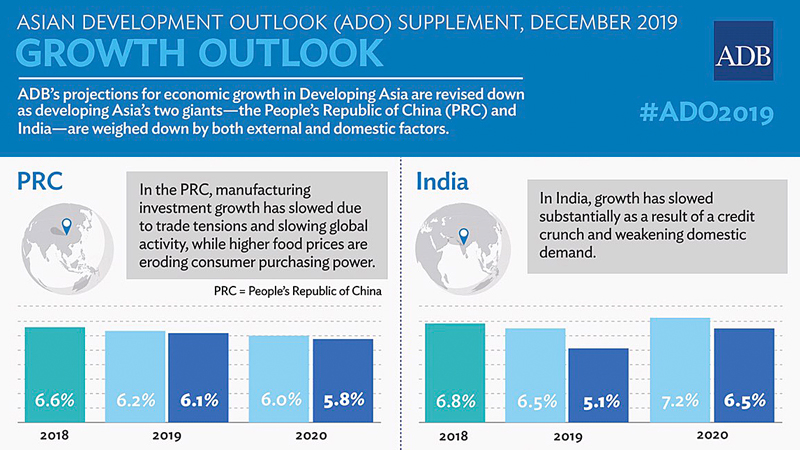
The Asian Development Bank (ADB) has trimmed its forecasts for economic growth in developing Asia this year and next year as growth in the People’s Republic of China (PRC) and India remains weighed down by both external and domestic factors.

In a supplement to its Asian Development Outlook 2019 Update released in September, ADB now expects gross domestic product (GDP) in the region to expand 5.2 per cent in both 2019 and 2020, down from the September forecast of 5.4 per cent growth this year and 5.5 per cent next year.

+++

“While growth rates are still solid in developing Asia, persistent trade tensions have taken a toll on the region and are still the biggest risk to the longer-term economic outlook. Domestic investment is also weakening in many countries, as business sentiment has declined,” said ADB chief economist Yasuyuki Sawada. “Inflation, on the other hand, is ticking up on the back of higher food prices, as African swine fever has raised pork prices significantly.”

The supplement forecasts inflation of 2.8 per cent in 2019 and 3.1per cent in 2020, up from the September prediction that prices would rise 2.7 per cent this year and next.

In East Asia, growth in the PRC is now expected at 6.1 per cent this year and 5.8 per cent next year due to trade tensions and a slowdown in global activity coupled with weaker domestic demand, with family wallets being hit by pork prices that have doubled relative to a year ago. Growth could accelerate, however, should the US and the PRC come to an agreement on trade, the report says. In September, ADB forecast GDP growth of 6.2 per cent in 2019 and 6.0 per cent in 2020.

Hong Kong, China, already in technical recession, will see severe downward pressures persist possibly into 2020. The economy is now expected to contract 1.2 per cent this year and grow 0.3 per cent next year.

In South Asia, India’s growth is now seen at a slower 5.1 per cent in fiscal year 2019 as the foundering of a major non-banking financial company in 2018 led to a rise in risk aversion in the financial sector and a credit crunch. Also, consumption was affected by slow job growth and rural distress aggravated by a poor harvest. Growth should pick up to 6.5 per cent in fiscal year 2020 with supportive policies. In September, ADB forecast India’s GDP to grow 6.5 per cent in 2019 and 7.2 per cent in 2020.

In Southeast Asia, many countries are seeing continued export declines and weaker investment, and growth forecasts have been downgraded for Singapore and Thailand. GDP growth is expected to slow in the Pacific with activity in Fiji, the sub-region’s second largest economy after Papua New Guinea, expected to be more subdued than previously anticipated.

Central Asia is the only sub-region where prospects look a little brighter now than in September, largely thanks to increased public spending in Kazakhstan, the region’s largest economy. Central Asia is now forecast to grow 4.6 per cent in 2019, up from the previous prediction for expansion of 4.4 per cent . The forecast for 2020 is for growth of 4.5 per cent . Kazakhstan’s economy is seen expanding by 4.1 per cent this year and 3.8 per cent next year.

ADB is committed to achieving a prosperous, inclusive, resilient, and sustainable Asia and the Pacific, while sustaining its efforts to eradicate extreme poverty. In 2018, it made commitments of new loans and grants amounting to $21.6 billion.

EC ‘petitions charter court’ to dissolve Future Forward over Thanathorn loan

#ศาสตร์เกษตรดินปุ๋ย : ขอบคุณแหล่งข้อมูล : หนังสือพิมพ์ The Nation

https://www.nationthailand.com/news/30379301?utm_source=category&utm_medium=internal_referral

EC ‘petitions charter court’ to dissolve Future Forward over Thanathorn loan

Dec 11. 2019
Thanathorn Juangroongruangkit

Thanathorn Juangroongruangkit
By THE NATION

2,144 Viewed

The Election Commission (EC) has petitioned the Constitutional Court to dissolve Future Forward Party (FFP) over its leader Thanathorn Juangroongruangkit’s Bt191-million loan.

On Wednesday (December 11), a source from the Office of the Election Commission of Thailand revealed that the EC has filed a petition with the Constitutional Court to consider dissolving FFP over its leader Thanathorn lending the party Bt191 million, which may be a violation of the election and political party law according to Article 72 of the Political Party Act BE 2560.

Article 72 prohibits political parties from receiving donation of money or assets from any sources which it knows are unlawful or have reasonable doubts of it being unlawful. Article 92(3) of the same act allows the Constitutional Court to consider dissolving any political party that violates Article 72.

Thanathorn had loaned Bt161.2 million to his own party in January at 7.5 per cent interest and another Bt30 million in April at 2 per cent interest. The borrower listed in both contracts is Nitipat Taempairot, acting FFP leader at that time.

Earlier on November 20, the Constitutional Court had ruled that Thanathorn lost his status as a member of Parliament on May 23, having registered to run in the March election while still holding shares in V Luck Media, in violation of the law.

Time picks Greta Thunberg as youngest-ever Person of the Year

#ศาสตร์เกษตรดินปุ๋ย : ขอบคุณแหล่งข้อมูล : หนังสือพิมพ์ The Nation

https://www.nationthailand.com/news/30379327?utm_source=category&utm_medium=internal_referral

Time picks Greta Thunberg as youngest-ever Person of the Year

Dec 12. 2019
Swedish climate activist Greta Thunberg speaks during the New York City Climate Strike rally in New York on Sept. 20, 2019. MUST CREDIT: Bloomberg photo by Demetrius Freeman.

Swedish climate activist Greta Thunberg speaks during the New York City Climate Strike rally in New York on Sept. 20, 2019. MUST CREDIT: Bloomberg photo by Demetrius Freeman.
By Syndication Washington Post, Bloomberg · Jeremy Hodges

585 Viewed

Greta Thunberg, the teenage activist behind a global wave of student strikes, was named Time magazine’s youngest-ever Person of the Year.

“Her message is one the Boomers would have recognized in the 1960s: Our elders have sold us out,” the magazine said in its article announcing the choice. The previous youngest Person of the Year was the first, aviator Charles Lindbergh, then 25, in 1927.

Thunberg spoke on Wednesday at a United Nations conference in Madrid, telling delegates that rich nations aren’t doing enough to solve the climate crisis. Below are excerpts from her speech.

– “Rich countries need to do their fair share and get down to real zero emissions much faster and then help poorer countries do the same so people in less fortunate parts of the world can help raise their living standards.”

– “Tell me how do you react to these numbers without feeling at least some level of panic. How do you respond to the fact that basically nothing is being done about this without feeling the slightest bit of anger and how do you communicate this without sounding alarmist. I would really like to know.”

– “We indeed have some work to do but some more than others.”

– “Recently a handful of rich countries pledged to reduce the emissions in their countries by so-and-so many percent by this or that date or to become climate neutral or net zero in so-and-so many years. This may sound impressive at first glance but even though the intentions may be good this is not leadership. This is not leading, this is misleading. Because most of these pledges do not include aviation, shipping, imported and exported goods and consumption; they do however give the possibilities of the countries to offset their emissions elsewhere.”

– “Without seeing the full picture we will not solve this crisis. Finding holistic solutions is what the COP should be all about. But instead it has turned into some kind of opportunity for countries to negotiate loopholes and to avoid raising their ambition. Countries are finding clever ways around having to take action.”

– “The biggest danger is not inaction. The real danger is when politicians and CEOs are making it look like real action is happening when in fact almost nothing is being done apart from clever accounting and creative PR.”

Fossil fuel-free air travel gets closer with a short electric flight

#ศาสตร์เกษตรดินปุ๋ย : ขอบคุณแหล่งข้อมูล : หนังสือพิมพ์ The Nation

https://www.nationthailand.com/news/30379324?utm_source=category&utm_medium=internal_referral

Fossil fuel-free air travel gets closer with a short electric flight

Dec 12. 2019
Greg McDougall, founder and CEO of Harbour Air, pilots the world's first all-electric commercial aircraft on its first test flight at Vancouver International Airport, in Richmond, British Columbia, on Dec. 10, 2019. MUST CREDIT: Bloomberg photo by Darryl Dyck.

Greg McDougall, founder and CEO of Harbour Air, pilots the world’s first all-electric commercial aircraft on its first test flight at Vancouver International Airport, in Richmond, British Columbia, on Dec. 10, 2019. MUST CREDIT: Bloomberg photo by Darryl Dyck.
By Syndication Washington Post, Bloomberg · Josh Petri 

517 Viewed

Vancouver-based Harbour Air just flew an all-electric commercial aircraft-for five minutes.

The neon green and indigo blue seaplane took off from the Fraser River in Richmond, British Columbia, early Tuesday morning as a small crowd cheered from the dock. The propeller aircraft, a six-passenger de Havilland DHC-2 Beaver prototype, was powered by a magniX magni500 electric motor and piloted by Harbour Air Chief Executive Officer Greg McDougall.

It was a small but significant step in the broader quest to replace fossil fuel-powered aircraft, a mode of transportation increasingly viewed through the prism of global warming.

The test was “far more than the laboratory exercises we’ve seen in the past,” said Robert Mann, the New York-based head of aviation consultancy R.W. Mann & Co. “It’s a real serious, practical test.”

Harbour said it plans to spend the next two years getting its new plane approved for commercial flight. The carrier, which flies to a dozen destinations on the West Coast, has 53 planes and 450 employees spread between British Columbia and Seattle.

There are about 170 different electrically-propelled aircraft programs in development worldwide, up 50% since April 2018, according to consulting firm Roland Berger. Much of that development is in the urban air taxi category and general aviation segments. Current electric technology favors these aircraft, which have lower power needs than large commercial aircraft.

Harbour’s electric Beaver can fly about 60 minutes on one charge. But regulators require aircraft operating under visual flight rules (of the smaller, noncommercial variety) to have the ability to fly 30 additional minutes, which gives Harbour’s new plane a mere 30 minutes of flight time. The relatively short timeline isn’t a problem for the airline, however, said magniX CEO Roei Ganzarski.

“The majority of Harbour Air’s flights are less than 25 minutes in length,” he said, adding that once the plane is certified, the companies will focus on extending the flight envelope.

Those singing the gospel of electric vehicles often point to decreased operating costs. A fossil-fuel powered Beaver burns anywhere between $300 and $400 worth of fuel during a 100-mile flight, said Ganzarski. That same trip in the electric Beaver will cost anywhere from $4 to $10 in electricity, depending on the source, he said.

The electric Beaver is theoretically cheaper to maintain than its combustion engine predecessor, too. Electric motors are sealed units, with a minimum of moving parts. Of course, since there has yet to be a commercial electric aircraft maintenance program, there may be unforeseen expenses.

“The cost of being a pioneer is a relevant problem,” said Mann. “We don’t know the actual costs of operating electric airplanes.”

The near-term is likely to see a generation of hybrid aircraft, pairing electric and conventional power systems along with smaller all-electric craft. Larger, fully-electric aircraft are still about a decade off.

Joby Aviation Inc. is targeting the air-taxi market with a plane that would carry four passengers and travel 150 miles. Uber Technologies Inc. plans to start an electric flying-taxi service, with pilot programs in Dallas, Los Angeles and Melbourne as soon as next year. Israel-based Eviation plans test flights next summer of its all-electric Alice, a nine-passenger plane powered by a smaller version of the magniX motor in Harbour’s Beaver.

“Eviation is excited to congratulate our partner, magniX on its successful test flight of the magni500 propulsion system,” Eviation CEO Omer Bar-Yohay said Tuesday in a statement. “This is a great milestone for electric aviation.”

Siemens, Airbus and Rolls-Royce Holdings are working on a hybrid system, the E-Fan X, that would power a relatively large aircraft. Airbus said it’s targeting an initial flight of its demonstration aircraft in 2021 and expects to eventually phase in new electric technologies by about 2030.

“Airbus has been flying electric for a couple of years,” Mann said. “But they’ve all been laboratory exercises as opposed to practical.”

Consulting firm Roland Berger expects the first flight of such commercial aircraft to occur by 2032. Easyjet Plc has partnered with U.S.-based Wright Electric to develop a full-sized battery-powered airliner within a decade for flights of less than two hours.

While manufacturers and airlines alike plan for an electric future, they’re still dealing with the politics of the present. Europe’s top airlines on Tuesday attacked European Union plans for a planned kerosene tax, part of the bloc’s sweeping new environmental strategy. Airlines called the duty both unnecessary and unfair, arguing that an investment in sustainable fuels and electric planes would ultimately be more effective in reducing carbon emissions.

For its part, Harbour Air is likely to run into some infrastructure issues in the near term, Mann said, since most major airports lack fast-charging capabilities. Ganzarski said they will rely on existing infrastructure for now, but may attempt to build their own renewable infrastructure in the future. The company reported revenue of CAD $69.9 million ($52.8 million) in 2019. McDougall didn’t return a request for comment.

But there are other challenges. Seaplanes, as the name implies, operate from bodies of water rather than land. Unlike meticulously paved and maintained runways, open water is a high-friction surface which requires a far greater amount of energy for a plane to gain enough momentum to take flight.

Salt water is another issue. It’s naturally corrosive, eating away at a plane’s surfaces and parts. Finally, the Pacific Northwest isn’t exactly pleasant in December: Cold temperatures have a negative effect on power density and power conversion in batteries.

“If you were thinking of the toughest case for electric flight, it would probably be a seaplane in salt water,” said Mann.

ASEAN to take immediate steps to combat drought in SE Asia

#ศาสตร์เกษตรดินปุ๋ย : ขอบคุณแหล่งข้อมูล : หนังสือพิมพ์ The Nation

https://www.nationthailand.com/news/30379298?utm_source=category&utm_medium=internal_referral

ASEAN to take immediate steps to combat drought in SE Asia

Dec 11. 2019
Speakers at the Building Resilience Drought Southeast Asia dialogue held yesterday in Cần Thơ. VNS Photo Bồ Xuân Hiệp

Speakers at the Building Resilience Drought Southeast Asia dialogue held yesterday in Cần Thơ. VNS Photo Bồ Xuân Hiệp
By Viet Nam News

491 Viewed

CAN THO — ASEAN-member countries have vowed to take immediate action to resolve problems caused by worsening drought in Southeast Asia, especially in Vietnam’s Mekong Delta region, which is especially susceptible to global warming.

Speaking at a meeting on Tuesday in Can Tho, Intani Nur Kusuma, senior officer at the Disaster Management and Humanitarian Assistance Division of the ASEAN Secretariat, said that a declaration on drought would be adopted by leaders at the ASEAN Summit to be held in Vietnam in November next year.

ASEAN has worked closely with relevant sectors to help the ASEAN Committee on Disaster Management draft the declaration, she said, adding that drought-related activities need to be integrated into the future action plan of ASEAN.

To mitigate the impact, drought risk assessment and early-warning services should be improved through the sharing of data from space-based technologies.

Risk-financing instruments as well as improvement of people’s awareness of the effects of drought are also needed.

Tiziana Bonapace, director of the Information and Communications Technology and Disaster Risk Reduction Division of the Economic and Social Commission for Asia and the Pacific (ESACP), told Vietnam News: “Climate change has already happened. Now is the time to adapt instead of fighting it.”

“Southeast Asia is faced with intensification and a changing geography of drought, and of disaster risk in general, as climate change converges with social, environmental and economic stresses.

“Regional co-operation, especially among nations benefiting from the Mekong River, is needed to support national efforts to manage drought through data, technology, innovations, policy and financing options,” Bonapace said.

“The best solution is no single solution but a multi-approach solution,” she added. “Negotiations and dialogue are also needed among all the countries involved based on science and technology and evidence.”

“Our new analysis shows disasters in the region are having more impact than previously thought. Much of the increase is due to the quantification of agricultural drought losses, which was not reported before,” she noted.

Nguyen Truong Sơn, deputy head of the Vietnam Disaster Management Authority, said the Mekong Delta and Central Highlands regions were facing abnormal weather that could be attributed to climate change.

The Mekong River levels in June and July significantly fell compared to previous years, raising concern of exacerbated drought and saline intrusion for the entire Mekong Delta in the 2019-20 dry season.

In the Central Highlands, rainfall in the dry season has dropped considerably compared to previous years, while temperatures have been 0.5-1 degrees Celsius higher than average, sparking serious droughts that have threatened vast tracts of natural forests as well as crops.

Economic losses

No Southeast Asian country can afford to ignore drought when trying to mitigate the economic impact of natural disasters, according to experts.

Bonapace said the significance of economic losses due to agricultural drought was consistent across all countries for which data is available.

“The agricultural losses are highest in Indonesia. In Vietnam, we estimate it to be around US$6.5 billion or 3 per cent of GDP,” she said.

Disasters continue to erode economic gains. Ultimately this means that disasters will limit the ability of economic growth to eradicate poverty.

“According to our study, the economic models show that without disasters, Vietnam is expected to completely eradicate extreme poverty by 2030,” Bonapace said.

According to the Asia-Pacific Disaster Report 2019, annual economic losses in Asia Pacific more than quadruple when slow-onset disasters, most notably drought, are added to the region’s disaster risk landscape.

The average annual loss for the region is $675 billion, of which $405 billion, or 60 per cent, is drought-related agricultural losses.

In Southeast Asia, the average annual loss is higher than the Asia-Pacific regional average, reaching $86.5 billion or 3 per cent of the regional GDP.

The average annual loss is highest in Cambodia, Myanmar, Laos, Vietnam, and the Philippines.

According to the 2019 Report Ready for the Dry Years report, though starting slowly, drought can have a devastating cumulative impact, striking hardest at the poor and heightening inequality and degrading land, all of which increases the prospects of conflict.

According to the report, there will be many more dry years ahead, and the area affected by drought is likely to shift and expand.

The report was jointly produced by ESCAP and ASEAN as part of their disaster-risk reduction efforts.

Dying river

Experts have recently expressed concern about a number of dams impeding the Mekong Delta’s flow, drying up many parts of the once fast-flowing river and leaving the region facing serious drought.

Le Cong Thanh, deputy minister of the Ministry of Natural Resources and Environment, said an increasing number of dam constructions in the Mekong River were “posing a great burden on the 4,700-kilometre Mekong River basin, especially on the Mekong Delta”.

As a result, millions of people who depend on the river for their livelihoods in Vietnam, China, Laos, Myanmar and Thailand will be seriously affected.

The Mekong River Commission, a regional intergovernmental agency that manages the river’s water resources, said that all the “dams in the upstream Mekong River countries contribute to worsening drought in the region”.

The river’s water levels last month recorded their lowest level in 60 years. Other estimates suggest that water levels have dropped to their lowest level in a century, the commission said.

Lower freshwater river levels mean that saltwater levels in the delta could rise, threatening rice-growing and agriculture in general, while agriculture irrigated by the river could suffer if nutrient-rich sediment is blocked from flowing downriver by dams.

The Mekong River, which originates in China and snakes through five Southeast Asian countries, is emerging as a new security flashpoint, experts have warned.

The river begins in the Tibetan Plateau, stretches through much of mainland Southeast Asia, and ends in the Mekong Delta.

The one-day Building Resilience Drought Southeast Asia dialogue was co-organised by the Vietnam Disaster Management Authority, ESCAP, and the ASEAN Secretariat. — VNS

Intani Nur Kusuma, senior officer at the Disaster Management and Humanitarian Assistance Division, speaks at the Building Resilience Drought Southeast Asia dialogue held yesterday in Cần Thơ. VNS Photo Bồ Xuân Hiệp


Intani Nur Kusuma, senior officer at the Disaster Management and Humanitarian Assistance Division, speaks at the Building Resilience Drought Southeast Asia dialogue held yesterday in Cần Thơ. VNS Photo Bồ Xuân Hiệp
AOT must remove barriers at entrance to Central Village

#ศาสตร์เกษตรดินปุ๋ย : ขอบคุณแหล่งข้อมูล : หนังสือพิมพ์ The Nation

https://www.nationthailand.com/news/30379334?utm_source=category&utm_medium=internal_referral

AOT must remove barriers at entrance to Central Village

Dec 12. 2019
By The Nation

128 Viewed

The Supreme Administrative Court yesterday (December 11) upheld the ruling of a lower court ordering the Airports of Thailand (AOT) to remove all barriers set up at the entrance to Central Village and immediately cease all activities that disrupt its business operation.

Central Village is CPN’s latest luxury retail outlet, located next to the Suvarnabhumi Airport.

The dispute between Airports of Thailand (AOT) and Central Pattana (CPN) escalated after AOT blocked the entrance to Central Village with boards, a week before the opening of the outlet in August, saying it “trespasses the airport’s flying zone”.

In a final verdict, the Administrative Court ruled that opening national highway no 370 for access to the CPN outlet would not interfere with AOT’s operation.

The court said AOT’s claim that opening the linkage would increase traffic in front of the outlet, affecting the travel of air passengers to the airport, service standards, and the airport’s development plan was only a presumption.

It has yet to decide whether highway no 370 is a immovable state property, under the supervision of AOT.

Phuket Tram project temporarily halted, more study needed

#ศาสตร์เกษตรดินปุ๋ย : ขอบคุณแหล่งข้อมูล : หนังสือพิมพ์ The Nation

https://www.nationthailand.com/news/30379333?utm_source=category&utm_medium=internal_referral

Phuket Tram project temporarily halted, more study needed

Dec 12. 2019
By THE NATION

184 Viewed

Speaking in his capacity as president of the Mass Rapid Transit Authority of Thailand (MRTA)’s board, Department of Highways director-general Sarawut Songsiriwilai announced on Wednesday (December 11) that the board had agreed to temporarily halt the development of the Phuket Tram project and ordered MRTA to conduct a further study of the impacts across all dimensions.

“One of the key aspects that needs reconsideration is the estimated number of passengers, which is thought to be inaccurate,” he said. “The project also needs further study on the travel behaviour of local residents and an estimate of the numbers of foreign tourists visiting Phuket in the future.”

“The board still believes that the project is feasible, and that the thorough study of impacts in all dimensions will help improve investors’ confidence in the project,” he added. “This project will have a combined distance of 42 kilometres, 30.2 km at the ground level, while 2.7 km. will be elevated and 9.1 km. will be constructed underground.”

Meanwhile, MRTA governor Pakapong Sirikantaramas said that the Phuket Tram project is currently undergoing the Environmental Impact Assessment (EIA) process as well as selecting investment models. “The board’s order to perform further studies should not impact the bidding process, which is still slated for before the end of 2020. MRTA will begin the study as soon as possible and will present preliminary results to the next board meeting,” he said.

Pakapong added that the Phuket Tram will be a Public Private Partnership (PPP) project with an estimated total budget of Bt34.5 billion, comprising Bt26 billion for construction, Bt1.5 billion for land reclamation and a Bt7-billion operational budget. The tram will start at Phuket International Airport and terminate at the Chalong Intersection, with a total of 21 stations.

Bangkok kicks off ‘City Lab Silom’ campaign

#ศาสตร์เกษตรดินปุ๋ย : ขอบคุณแหล่งข้อมูล : หนังสือพิมพ์ The Nation

https://www.nationthailand.com/news/30379332?utm_source=category&utm_medium=internal_referral

Bangkok kicks off ‘City Lab Silom’ campaign

Dec 12. 2019
By THE NATION

414 Viewed

Bangkok Governor Assawin Kwanmuang launched the ‘City Lab Silom’ campaign on Wednesday (December 11) in the grand opening ceremony for the landscape improvement project on Silom Road that it is implementing in partnership with the Thai Health Promotion Foundation (ThaiHealth), the Faculty of Architecture of Chulalongkorn University and the private sector.

“One of the main missions of Bangkok Metropolitan Administration (BMA) is to make sure that the city has international standard of cleanliness, tidiness, safety and modern facilities just like other major cities in the world,” said the Governor. “This ‘City Lab Silom’ campaign aims to establish a temporary laboratory on sidewalks for one month to serve as a public space that promote health, safety and other recreational activities for pedestrians.”

Assawin further explained that after the trial period of one month BMA and ThaiHealth will gather feedback from the public and use it in the design of future landscape improvement projects for Silom Road and other areas in Bangkok.

“This project will be 100% funded by ThaiHealth and will start in 6 areas on Silom Road: the pavements in front of Bangkok Bank Headquarters, United Center Building, C.P. Tower, Bangkok Christian Hospital, Southeast Insurance Building, and BTS Saladaeng,” he added.

According to the Governor, the campaign will essentially improve the standard of sidewalks by installing more lights for nighttime safety, repainting the zebra crossings, installing smart billboards displaying bus schedule information, as well as installing ramps for wheelchair users. “We are also aiming to install ‘Smart Poles’ capable of inspecting the PM2.5 level, CCTV and providing free WIFI,” he added.

“The success of this project will help promote tourism and improve the quality of life of people in the area, and will be used as the prototype ‘Silom Model’ for other areas in Bangkok in the future.”

Kratom leaves to be left out of new narcotics list

#ศาสตร์เกษตรดินปุ๋ย : ขอบคุณแหล่งข้อมูล : หนังสือพิมพ์ The Nation

https://www.nationthailand.com/news/30379317?utm_source=category&utm_medium=internal_referral

Kratom leaves to be left out of new narcotics list

Dec 11. 2019
By THE NATION

1,101 Viewed

Justice Minister, Somsak Thapsutin said on Wednesday (December 11) that his ministry would propose new laws related to narcotics in terms of type and legal penalty, and aimed to exclude kratom leaves from the drug lists.

“To consider plants or chemicals as narcotics, the government referred to World Health Organization (WHO)’s drug regulatory framework, which defined narcotics as having four characteristics,” he explained.

First, narcotics must cause effects on the users’ body like anxiety or severe dysentery, when they stop using them. Second, narcotics have no medical advantage or have them slightly, and, third, those who consume it suffer from health problems, such as emaciation, weakness, and being nervous, and cannot control themselves. Lastly, narcotics can cause an impact on society.

“Kratom leaves do not match those characteristics,” said the minister. “Those who use them can stop using it easily, and the leaves can be used as herb to relieve pain, fever, dysentery, or diarrhea. Also, it is better than morphine thirteen times in killing pain, and has a few disadvantages.”

Previously, Thai researchers had studied kratom leaves with Japanese researchers, and copyrighted two copies in Japan and two copies of America.