Energy Regulatory Commission to look at price for charging EVs

#ศาสตร์เกษตรดินปุ๋ย : ขอบคุณแหล่งข้อมูล : หนังสือพิมพ์ The Nation

https://www.nationthailand.com/business/30379169?utm_source=category&utm_medium=internal_referral

Energy Regulatory Commission to look at price for charging EVs

Dec 07. 2019
By THE NATION

1,326 Viewed

The Office of the Energy Regulatory Commission (ERC) will conduct a study on the appropriate fee for an electric car charging service at charging stations.

This is in response to an order issued by the Energy Policy Administration Committee on December 4.

ERC deputy secretary-general Khomgrich Tantravanich explained that charging station operators were keen for the government to set new and higher fee rates to make their business more commercially viable as currently only a small number of electric vehicles (EV) are using the service.

The operators have proposed that the government determine the higher rate to make it worthwhile for them to continue business expansion, he added.

The current rate is based on a time of use (TOU) basis, which sees the charging fee varying according to the peak time from 9am to 10pm on weekdays to the off-peak time after 10pm on weekdays and during weekends.

The charging fee at peak time and off peak is Bt4.10 per unit and Bt2.60 per unit, respectively.

The administration committee has also approved the ERC’s proposal to solve the problem of 14 renewable power plants which failed to start operation on the commercial dates due to uncontrolled factors.

The ERC proposed that the administration committee put off the dates of the commercial operations for these plants on a case-by case-basis. This proposal will also need approval from the National Energy Policy Committee.

These renewable power plants have a total capacity of 300 megawatts. Construction is almost complete on most of them but several will not probably not be finished until 2021. One reason for the delay has been cited as the time needed to reach an understanding with communities where the plants will be located.

If they fail to start operation on time, their licences will be terminated.

Pheu Thai to investigate ‘cobras’ for voting with govt

#ศาสตร์เกษตรดินปุ๋ย : ขอบคุณแหล่งข้อมูล : หนังสือพิมพ์ The Nation

https://www.nationthailand.com/news/30379173?utm_source=category&utm_medium=internal_referral

Pheu Thai to investigate ‘cobras’ for voting with govt

Dec 07. 2019
By THE NATION

1,107 Viewed

Pheu Thai Party declared yesterday (December 6) that it will appoint a committee to investigate its House of Representatives, who voted on Wednesday (December 4) to support the government’s voting down of a commission setting up to study the impacts of National Council for Peace and Order’s actions and its use of power under section 44 of the Constitution.

Those ‘cobras’ a term used for politicians who defy their party’s orders, are Khachit Chainikom, Pornpimon Tummasarn, and Phonphum Wiphatphumiprathet and represent Udon Thani, Pathum Thani, and Bangkok respectively.

The committee will start with an investigation into their actions before calling on the three to provide further information then present conclusions for consideration by party leader Sompong Amornvivat.

The whole investigation will take around 7 to 10 days. “If the three members are found guilty, they will be dismissed and prohibited from registering in the next election” said the party’s leader. “If they were found to have taken bribes, the party will forward their case for legal action.”

Khachit said that his vote was accidental. “I did not want to votedown the government’s motion or go against the party’s opinion” added he. “My voting ticket was stuck to the voting point. Staffs collected it and counted it as a supporting voice,” he said.

Meanwhile, Justice Minister, Somsak Thapsutin said that those who supported the government’s motion should not be called cobras, adding they may have chosen to vote that way because it was advantageous to the government.”

In addition to the three members of Pheu Thai Party, seven other opposition representatives voted in favour of the government, namely including two members of Future Forward Party (FWP), four of New Economics Party, and one fromf Prachachart Party.

Secretary-general of the FWP Piyabutr Saengkanokkul said that the cobras in his party should resign because FWP will not allow them to register in a next election. Moreover, the party’s executive committee will hold a meeting to consider this matter.

Investigation broadens in shooting at Naval Air Station in Pensacola

#ศาสตร์เกษตรดินปุ๋ย : ขอบคุณแหล่งข้อมูล : หนังสือพิมพ์ The Nation

https://www.nationthailand.com/news/30379197?utm_source=category&utm_medium=internal_referral

Investigation broadens in shooting at Naval Air Station in Pensacola

Dec 08. 2019
Shooting On Naval Air Station Pensacola Leaves Multiple Dead And Injured

PENSACOLA, FLORIDA - DECEMBER 06: A general view of the atmosphere at Baptist Hospital following a shooting at the Naval Air Station on December 06, 2019 in Pensacola, Florida. The second shooting on a U.S. Naval Base in a week has left three dead plus the suspect and seven people wounded. (Photo by Josh Brasted/Getty Images)

Shooting On Naval Air Station Pensacola Leaves Multiple Dead And Injured PENSACOLA, FLORIDA – DECEMBER 06: A general view of the atmosphere at Baptist Hospital following a shooting at the Naval Air Station on December 06, 2019 in Pensacola, Florida. The second shooting on a U.S. Naval Base in a week has left three dead plus the suspect and seven people wounded. (Photo by Josh Brasted/Getty Images)
By The Washington Post · T.S. Strickland, Ellen Nakashima, Joby Warrick, Hannah Knowles

85 Viewed

PENSACOLA, Fla. – FBI officials broadened their probe Saturday into the deadly shooting rampage at a Navy flight school here amid reports that several of the gunman’s Saudi compatriots took video footage as the attack was underway.

The shooting at Naval Air Station Pensacola was labeled an act of terrorism by congressional officials, even as investigators continued to explore why a Saudi military student blasted his way through a classroom building early Friday, killing three people and wounding eight. The gunman, identified as Ahmed Mohammed al-Shamrani, was shot dead by a sheriff’s deputy.

Law enforcement officials combed through the shooter’s belongings and social media accounts on Saturday while questioning six other Saudi nationals, at least some of them fellow students in the same Navy flight training program. Three of the Saudis were said to have taken cellphone video at the scene, according to a U.S. official familiar with investigation. The official spoke on the condition of anonymity to discuss an ongoing probe.

The FBI declined to offer a motive for the attack, and it was unclear Saturday whether any of the Saudis questioned knew of the gunman’s plans. Officials said they were investigating claims, first reported by the Associated Press, that Shamrani showed videos of previous mass shootings at a dinner party he hosted in the days before the attack.

There also was no official confirmation of a possible link between Shamrani and a Twitter account that surfaced Friday bearing the same name and containing a note in English criticizing U.S. support for Israel and accusing Washington of “funding crimes against Muslims.”

The user of the account, which Twitter suspended Friday, did not express an allegiance to any particular extremist group. Law enforcement officials were investigating the possibility that Shamrani was self-radicalized.

Several members of Congress said the attack was terrorism and demanded stricter screening of the hundreds of foreign nationals who travel to the United States every year for military training.

“This was a planned terrorist attack, and the shooter wasn’t alone,” Rep. Matt Gaetz, R-Fla., whose district includes Pensacola, said on Twitter. Gaetz said he received a call of condolence from the Saudi ambassador to the United States, Reema bint Bandar al-Saud, and had “expressed in the strongest possible terms that we expect to conduct our investigation w full cooperation and no interference from the Kingdom.”

The incident – with its eerie echoes of Sept. 11, 2001, when a mostly Saudi team of al-Qaida operatives received flight training in the United States and then crashed planes into the World Trade Center and Pentagon – threatened to further erode U.S. relations with Saudi Arabia, which have been under exceptional strain since the killing of Saudi national and Washington Post columnist Jamal Khashoggi in Istanbul last year. But White House and Defense Department officials stressed Saturday that they did not think the attack would harm ties between Riyadh and Washington. In remarks to reporters on Saturday, President Donald Trump described Saudi leaders as “devastated” by the killings in Florida.

The FBI has taken the lead in the case as authorities look into Shamrani’s past and possible motives. The bureau’s Jacksonville branch said the inquiry remains “active and still very fluid.” A formal determination of whether to classify the attack as terrorism was being reviewed, said a U.S. official, who spoke on the condition of anonymity to discuss an ongoing investigation.

An initial survey found no apparent connection to a foreign terrorist group, though the official cautioned that the investigation is in its early stages. There also were no firm indications so far of a conspiracy, the official said, adding that the shooter may have been self-radicalized.

As the probe progressed, family members and local officials provided initial accounts of the dead and wounded, as well as details of how the gunman was confronted and killed.

The Pensacola News Journal, citing family members, identified one of the three killed as Joshua Kaleb Watson, 23, a recent graduate of the U.S. Naval Academy. Watson’s brother, Adam Watson, wrote that Joshua Watson suffered multiple gunshot wounds but managed to flee the building to seek help.

“Joshua Kaleb Watson saved countless lives today with his own,” his brother wrote. “After being shot multiple times he made it outside and told the first response team where the shooter was and those details were invaluable. He died a hero and we are beyond proud.”

Among the wounded were two of the sheriff’s deputies who charged into the classroom building within minutes of when the shooting began. One was released from a hospital, while another is recovering after undergoing surgery, Escambia County Sheriff’s Office spokesman Major Andrew Hobbs said Saturday. Deputies arrived on the scene within three to four minutes, fatally shooting the gunman, he said.

Details of the conditions of the six other wounded were not available.

Investigators spent part of Saturday trying to piece together Shamrani’s movements in the United States. Pentagon officials said that his training with the U.S. military began in August 2017 and that he was to finish in August 2020. According to a U.S. official familiar with the case, Shamrani attended language school at Lackland Air Force Base in San Antonio for six months and was assigned to the training program in Pensacola only in the past week, although he had been staying in the area for some time. His coursework at the Navy school was to include basic aviation and initial aviation training, officials said.

Three of the Saudis questioned by FBI officials had flown to the United States with Shamrani and then went to different training locations in Louisiana and Oklahoma, the officials said.

The FBI declined to answer questions about how the gunman obtained his weapon, described as a handgun. “Non-immigrant aliens” admitted to the United States for a specific period of time are generally banned from transporting or possessing firearms, but there are exceptions, including for law enforcement from “a friendly foreign government entering the United States on official law enforcement business,” according to the Bureau of Alcohol, Tobacco, Firearms and Explosives.

Gun use is tightly restricted on military bases, and officials said only members of “security forces” are able to bring a weapon on to the Pensacola installation. It was not immediately clear how the shooter was able to take a gun into the classroom.

The Defense Department operates a robust effort to train foreign military officers, with more than 5,000 such foreign students from 153 countries in the United States, officials said. Those foreign nationals are vetted in a process that includes searching databases for evidence of drug trafficking, support for terrorist activity, corruption and criminal conduct, officials said.

Several members of Congress called Saturday for canceling or suspending training programs until better screening procedures could be adopted. But current and former defense and counterterrorism officials described the programs as vital for U.S. national security, saying they promote good relations between U.S. and foreign militaries and are crucial in fostering seamless deployments with U.S. troops fighting and training overseas. Violent incidents among participants are extremely rare, the officials said.

“We’ve been having individuals from Arab militaries studying and working here for decades – not just from Saudi Arabia but from across the Arab world,” said Nicholas Rasmussen, a former intelligence official who directed the National Counterterrorism Center. “When something like this happens you have to go back and look at whatever vetting procedures you have and check carefully to make sure that you are doing everything you can to get a full picture of those entering the United States for this purpose. But it doesn’t invalidate the utility of the actual programs.”

Trump’s response to the shooting has been conspicuously restrained in comparison with his reactions to other violence by people from predominantly Muslim countries. After speaking by phone with Saudi King Salman, he tweeted that the monarch and his people are “greatly angered by the barbaric actions of the shooter, and that this person in no way shape or form represents the feelings of the Saudi people who love the American people.”

Secretary of State Mike Pompeo’s response echoed the president’s.

“I just spoke with Foreign Minister Al-Saud of Saudi Arabia who expressed his condolences and sadness at the loss of life in the horrific attack in Pensacola, Florida yesterday,” Pompeo said in a Twitter posting.

Trump: Giuliani will report to Justice Department, Congress on his investigations in Ukraine

#ศาสตร์เกษตรดินปุ๋ย : ขอบคุณแหล่งข้อมูล : หนังสือพิมพ์ The Nation

https://www.nationthailand.com/news/30379196?utm_source=category&utm_medium=internal_referral

Trump: Giuliani will report to Justice Department, Congress on his investigations in Ukraine

Dec 08. 2019
File Photo: Celebrities Visit SiriusXM - November 1, 2019

NEW YORK, NEW YORK - NOVEMBER 01: (EXCLUSIVE COVERAGE) Rudy Giuliani visits the SiriusXM Studios on November 01, 2019 in New York City. (Photo by Noam Galai/Getty Images)

File Photo: Celebrities Visit SiriusXM – November 1, 2019 NEW YORK, NEW YORK – NOVEMBER 01: (EXCLUSIVE COVERAGE) Rudy Giuliani visits the SiriusXM Studios on November 01, 2019 in New York City. (Photo by Noam Galai/Getty Images)
By The Washington Post · Colby Itkowitz

100 Viewed

WASHINGTON – President Donald Trump said his personal attorney Rudy Giuliani planned to issue a report to the Justice Department and Congress detailing what he’d learned from his investigations in Ukraine.

Trump claimed not to know what Giuliani was doing in Ukraine this week or what he found out while there, but he asserted that Giuliani says “he has a lot of good information.”

“He’s going to make a report, I think to the attorney general and to Congress,” Trump told reporters Saturday outside the White House. “He says he has a lot of good information. I have not spoken to him about that information yet.”

“I hear he has found plenty,” Trump added.

During Giuliani’s trip to Ukraine, the country at the center of the impeachment inquiry against Trump, the former New York mayor met with Ukrainians who have peddled unsubstantiated allegations of misdeeds by former vice president Joe Biden in Ukraine and claims that Ukraine, not Russia, interfered in the 2016 election.

While in Kyiv, Giuliani tweeted that he had “compelling evidence of criminal conduct” by Biden. He also suggested that until a corruption probe in Ukraine is resolved, “it will be a major obstacle to the U.S. assisting Ukraine with its anti-corruption reforms.”

The crux of the impeachment probe is whether Trump withheld military assistance to Ukraine to pressure the government to launch a public investigation into a possible political foe. Career State Department officials have testified that Giuliani was operating a shadow foreign policy in Ukraine to dig up dirt on Biden, his son Hunter and the Ukrainian natural gas company Burisma, where Hunter Biden held a seat on the board.

The House Judiciary Committee is beginning to draft articles of impeachment against Trump and hoping to hold a vote before Christmas. On Saturday, the Democrats released a report detailing the constitutional justifications for impeaching Trump.

Trump told reporters Saturday that “nothing came out of the conversation” he had on July 25 with Ukrainian President Volodymyr Zelensky, during which he asked the foreign leader to look into the Bidens and again dismissed the Democrats’ probe.

“Nothing came out of the conversation, except for the relationship with Ukraine,” Trump said. “And the people see that it’s just a continuation of this three-year witch hunt.”

Coming to aid of sea turtles in troubled waters

#ศาสตร์เกษตรดินปุ๋ย : ขอบคุณแหล่งข้อมูล : หนังสือพิมพ์ The Nation

https://www.nationthailand.com/news/30379195?utm_source=category&utm_medium=internal_referral

Coming to aid of sea turtles in troubled waters

Dec 08. 2019
ntern Natashja Molina holds a rescued sea turtle as Katherine McKenna, seasonal staff biologist, examines the reptile at New England Aquarium's Animal Care Center in Quincy, Mass. Experts call the facility a bona fide sea turtle hospital. MUST CREDIT: Photo by Margaret Hetherman for The Washington Post

ntern Natashja Molina holds a rescued sea turtle as Katherine McKenna, seasonal staff biologist, examines the reptile at New England Aquarium’s Animal Care Center in Quincy, Mass. Experts call the facility a bona fide sea turtle hospital. MUST CREDIT: Photo by Margaret Hetherman for The Washington Post
By The Washington Post · Margaret Hetherman

118 Viewed

Sea turtles, which have roamed our oceans for 110 million years, have come under assault from poaching, oil spills, entanglement in fishing gear and a steady diet of plastic. Lately, the climate has been turning against them.

Endangered Kemp’s ridleys, greens and loggerheads are drawn to the warming waters of the Gulf of Maine, which stretches from Nova Scotia to Cape Cod and is heating up faster than 99 percent of the world’s oceans.

The turtles, most of them juveniles, summer in Cape Cod Bay, feasting on jellyfish and crabs, but when the weather turns in October and November, they miss cues to head back south. An ever-growing number are getting trapped by the hook-shaped projection of Cape Cod, unable to find their way back to open ocean.

When the temperature plummets below 55 degrees, they become “cold-stunned” – hypothermic, unable to eat or move, and drift passively until tides carry them ashore.

There they would die – if not for the intrepid volunteers from Mass Audubon’s Wellfleet Bay Wildlife Sanctuary who patrol the beaches, searching miles of sand for desperate turtles, willing to brave a nor’easter to find them, provide first aid and send them to a hospital in Quincy, south of Boston.

The nonprofit sanctuary has rescued more than 5,700 turtles since director emeritus Bob Prescott started tracking them in 1979, says Jennette Kerr, marketing and communications coordinator. In 2014, a record year, more than 1,200 turtles were found.

One morning in mid-November, local resident Erin Connelly is walking on Mayflower Beach in Dennis, Massachusetts, when her golden retriever, Finley, unearths a sea turtle. Its eyes are crusted with hardened sand, its flippers moving feebly. Connelly knows whom to call.

Armed with an empty banana box, Wellfleet Bay volunteer Triscia Hennessey is dispatched to retrieve the juvenile Kemp’s ridley. The critically endangered species accounts for 85 percent of the cold-stuns and must be transported in an unheated car, so as not to shock it.

Hennessey heads to the processing room at the sanctuary, set in woodlands and salt marsh, where research technician Jamien Meservey measures and weighs the turtle at 7.71 pounds. It would take laparoscopic surgery to learn its sex at this age, but we know that warming in the nest environment in Texas or Mexico is producing more females.

The turtle – probably a female – rests in a cool room, until the next vehicle leaves for the 90-mile drive to New England Aquarium’s Animal Care Center in Quincy. It is a bona fide sea turtle hospital, where she is admitted as Turtle 94.

Connie Merigo, director of the Aquarium’s Rescue Rehab program, describes the operation as “the equivalent of a trauma center.” Housed in a nondescript warehouse on a shipyard, the interior is a vision of aquamarine, from the giant tanks to scrubs-clad staff tending reptilian patients.

Turtles are evaluated for the immediate dangers of hypothermia, and related problems such as low blood sugar, pneumonia or decreased heart rate and respirations.

“Sometimes we are seeing a heartbeat of one beat per minute,” Merigo says. “But that animal is still alive and, with emergency care, can go on to survive and be released.”

The center sees a lot of eye damage, fractures, boat strikes, hooks in the mouth and more. Turtles may need fluids, cardiac stimulants or other medications depending on their bloodwork.

Fortunately, Turtle 94’s blood tests look good. Within a day, she starts physical therapy, stimulating blood flow. The turtle pool is a frigid 55 degrees, but over time, she will graduate to warmer waters. Recovery is on the horizon.

The Aquarium made a literal splash this year when it released a 330-pound loggerhead. The massive turtle was found near death in November 2018 by Wellfleet Bay volunteers who initially mistook the turtle for a huge rock in the surf.

“Munchkin” spent nine months in rehab. Then on July 2, she was taken to West Dennis Beach by truck. A dozen people had to lift her, and hundreds cheered her to the sea. A satellite tracker on her shell showed she was recently off the coast of the Carolinas.

Each release must begin with a rescue, and it’s all hands on deck at Wellfleet Bay with stranding season underway. Last year, Kerr says that over 800 turtles were found. So far this season, there have been 255. Most cold-stuns have occurred in the past decade, and the problem promises to get worse.

The sea turtle rescue operation works with 250 volunteers, plus a staff that includes marine biologists, research technicians and rescue coordinators. The team diligently studies tide charts and variables such as wind direction, intensity and duration to target specific beaches. Prescott deploys volunteers in pairs to align with the high tides, be it at noon, or midnight by headlamp in frost and howling winds.

Artists Anne Boucher, 66, of Cotuit, and Heather Pilchard, 55, of Eastham are assigned to walk Cold Storage Beach in East Dennis at first light. Pilchard climbs swaths of rocks at the water’s edge, scouring for dinner plate-sized ridleys that could be wedged within. Boucher follows a trail of eelgrass and other oceanic debris left on the sand at the tide line. They know to use this seaweed or “wrack” to cover cold-stuns, protecting them from the elements and predators, until transportation comes.

Like many veteran volunteers on patrol, they are intimately familiar with “their beach” and its potential perils. They know that the difference between 10-foot and 12-foot tides can mean suddenly there is no beach on which to walk; but they welcome the powerful winds, preferably sustained for days, that carry stunned turtles to shore and potential salvation.

“It’s like your emotional cup is overrun,” Pilchard beams. Sometimes, she says, finding a turtle is so moving it makes her cry.

The two share a special release memory. In December 2017, they found a 50-pound loggerhead. The following July, they were invited to the send-off, and were surprised to hear their names called. “We got to release our turtle!” Pilchard says.

“We didn’t even have time to cry,” Boucher laughs, recalling trying to lift the testudine that had grown to 77 pounds. “Watching it go into the water and just disappear . . . ,” Pilchard says, her voice trailing off as she reflects on the memory.

As for Turtle 94, she continues a journey probably begun as a hatchling in Rancho Nuevo in Tamaulipas, Mexico, Bob Prescott says. There, binational conservation efforts helped ensure that her mother made it to shore to lay eggs. From the Gulf of Mexico, swept into the Florida currents, she may have visited the seaweed community of the Sargasso Sea before riding the jet stream toward New England.

When an attending vet signs off in Quincy, she will join other shelled-passengers on a flight to a collaborative organization or aquarium farther south along the East Coast for more convalescence, courtesy of Turtles Fly Too, brainchild of Leslie Weinstein who manages a roster of volunteer pilots for the charity.

Then on the biggest day of her rare and precious life, she will inhale the scent of salty air, as did her innumerable ancestors going back to the time of the dinosaurs. With the goodwill of many humans (and one golden retriever) behind her, she will put one flipper in front of the other, and move toward the ocean that is home.

Fires, floods and free parking: California’s unending fight against climate change

#ศาสตร์เกษตรดินปุ๋ย : ขอบคุณแหล่งข้อมูล : หนังสือพิมพ์ The Nation

https://www.nationthailand.com/news/30379194?utm_source=category&utm_medium=internal_referral

Fires, floods and free parking: California’s unending fight against climate change

Dec 08. 2019
Some of the cliffs overlooking the Santa Barbara Channel have been reinforced with netting and cement columns. MUST CREDIT: Washington Post photo by Michael Robinson Chavez

Some of the cliffs overlooking the Santa Barbara Channel have been reinforced with netting and cement columns. MUST CREDIT: Washington Post photo by Michael Robinson Chavez
By The Washington Post · Scott Wilson

161 Viewed

SANTA BARBARA, Calif. – When the fire came this time, blowing in fast and ashy from the dry hills around her camping resort, manager Terri Bowman was ready.The past few years had prepared her for what had once been unthinkable. First, the Sherpa Fire scorched the hills around the camp in June 2016. Then, unusually heavy rains sent a wall of mud through El Capitan Canyon in January 2017, washing two camp buildings and a car into the Pacific Ocean.

The resort closed for four months.

The Thomas Fire in December 2017 was the first sign that Santa Barbara's climate had changed and that wildfires had become more severe. It burned 281,000 acres and heavy rains a month later killed 23 people. MUST CREDIT: Photo for The Washington Post by Stuart Palley

The Thomas Fire in December 2017 was the first sign that Santa Barbara’s climate had changed and that wildfires had become more severe. It burned 281,000 acres and heavy rains a month later killed 23 people. MUST CREDIT: Photo for The Washington Post by Stuart Palley

+++
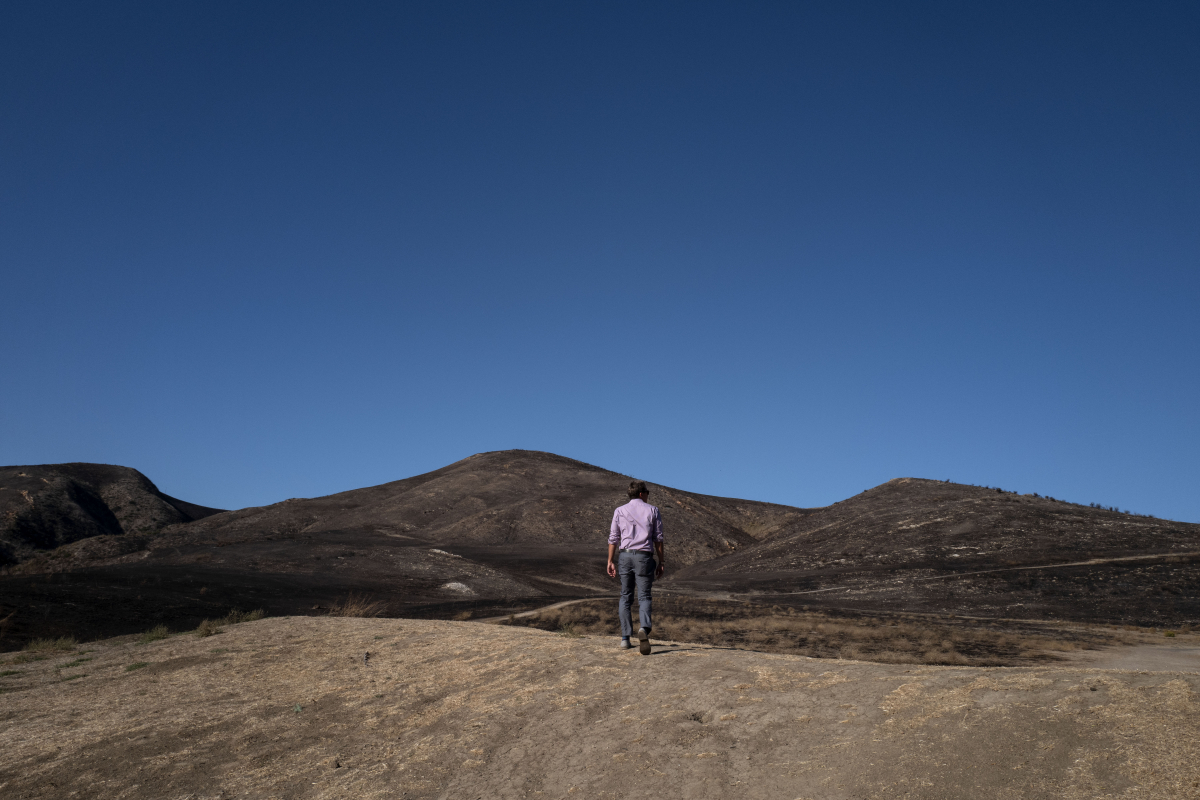
A man walks across a dried and burned out landscape, a result of the Real Fire, in Goleta, Calif. The Real Fire scorched more than 400 acres in mid-October but was quickly contained due to heightened awareness and readiness by local fire departments. MUST CREDIT: Washington Post photo by Michael Robinson Chavez

A man walks across a dried and burned out landscape, a result of the Real Fire, in Goleta, Calif. The Real Fire scorched more than 400 acres in mid-October but was quickly contained due to heightened awareness and readiness by local fire departments. MUST CREDIT: Washington Post photo by Michael Robinson Chavez

Bowman spent $250,000 shoring up the steep, loose hillsides of the canyon, which gives the resort its name. She also bought generators that she put to use in September, when Southern California Edison cut off power for a day to reduce the risk of fire.
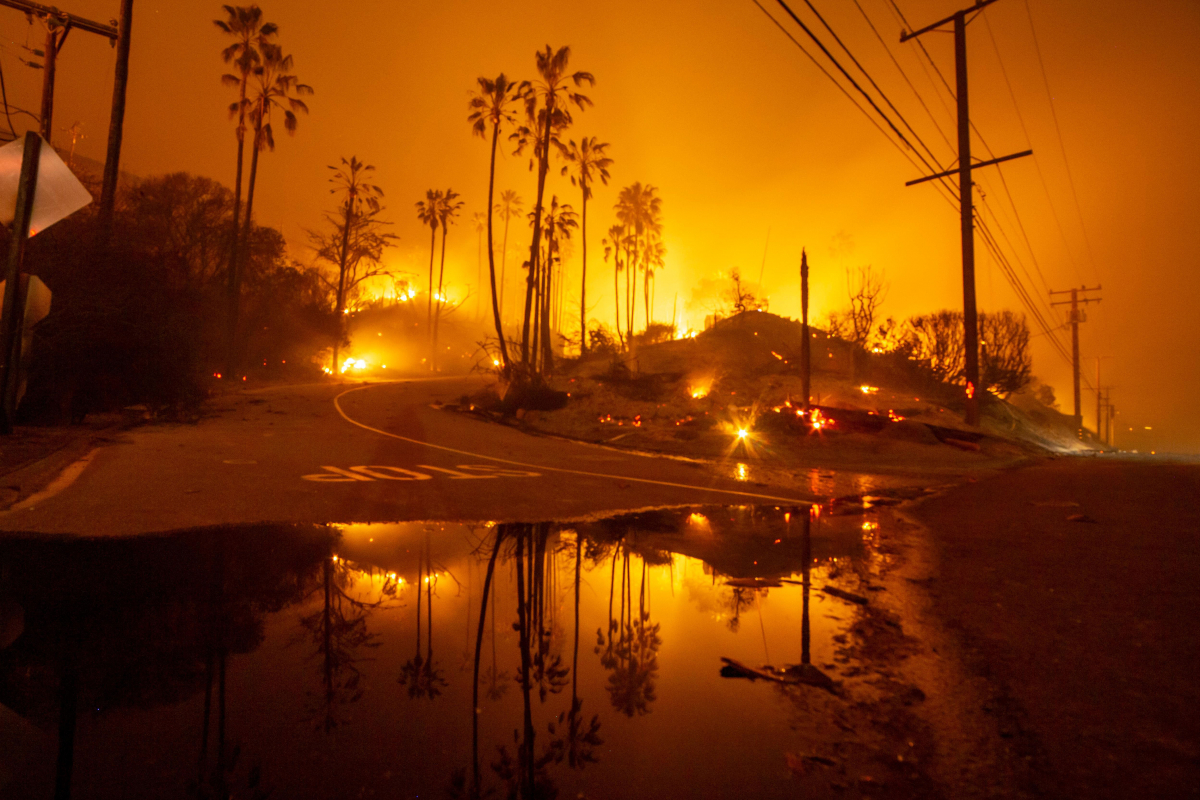
Rapid warming and extreme weather have affected the coastal sweep from Santa Barbara to San Diego counties. The 2018 Woolsey Fire in Malibu killed three people and torched over 1,600 buildings. MUST CREDIT: Photo for The Washington Post by Kyle Grillot

Rapid warming and extreme weather have affected the coastal sweep from Santa Barbara to San Diego counties. The 2018 Woolsey Fire in Malibu killed three people and torched over 1,600 buildings. MUST CREDIT: Photo for The Washington Post by Kyle Grillot

Then, in late October, plumes of smoke from the Real Fire appeared above the canyon walls. Bowman and her staff hurried from cabin to yurt to cabin, telling guests to leave. They dialed cellphone numbers collected as part of an emergency evacuation plan at check-in. They guided cars and buses along a one-lane road toward the highway, including a class of first-graders forced to cancel a weekend retreat.

The only casualty was her bottom line.

“We just kind of shifted into action, we were so used to it,” said Bowman, resigned to the new realities in the canyon where she has done business for nearly two decades. “Relatively nothing happened here until 2016. Since then, it has been an annual event.”

Life in southern California, once as mild and predictable as the weather, is being transformed as the climate grows hotter, drier and in some regions windier, fueling more intense wildfires, deadly mudslides and prolonged extreme drought.

The changing natural world is in turn forcing a fundamental social reckoning, altering the choice of crops on some of the nation’s most bountiful farms, erasing the certainty of electrical power in some of its wealthiest homes and exposing the limits of environmental activism among some of its most liberal voters.

The cradle of the Earth Day movement is confronting the consequences of a warming Earth.

The coastal curve that bends south from Santa Barbara through the Los Angeles metroplex to the arroyos along the Mexican border is warming at double the rate of the continental United States, according to a Washington Post analysis of more than a century of temperature data. And during the past five years, the pace has accelerated.

Since 1895, the average temperature in Santa Barbara County has warmed by 2.3 degrees Celsius, according to The Post’s analysis. Neighboring Ventura County has heated up even more rapidly. With an average temperature increase of 2.6 degrees Celsius since preindustrial times, Ventura ranks as the fastest-warming county in the Lower 48 states.

Warming here already has exceeded the threshold set in the 2015 Paris climate accords, which President Barack Obama joined and the Trump administration has promised to leave. The agreement concluded that average warming worldwide should be held “well below” 2 degrees Celsius to avoid potentially catastrophic consequences – but it already has warmed by more than 1 degree Celsius.

Across California, the growing heat and loss of moisture threatens the iconic coastal redwood forests and the Joshua trees of the southern desert. Bird populations have been ravaged by drought, with several once-prominent desert habitats losing 43% of their species in the past century, according to a study published last year in the Proceedings of the National Academy of Sciences.

Offshore, the warming ocean has depleted once-expansive kelp forests around the Channel Islands and has thrown oyster, crab and urchin harvests into disarray.

Thirteen whales washed ashore dead this year in the San Francisco Bay area, and when marine biologists went searching for answers, they found that many of them had empty stomachs.

In Santa Barbara County, the dangers of this grave new world came into focus with the Thomas Fire in 2017. The blaze started in early December, late by traditional standards and a sign that the fire season is now effectively year-round. It was the largest in state history at the time, burning more than 281,000 acres.

Residents were forced to evacuate at the height of the holiday season in the wealthy, woodsy suburb of Montecito. Many were just getting back home when a severe storm forecast prompted a second evacuation order. Tired of living in hotels or crashing with friends, many people ignored it.

Stripped by fire, soaked by rain, the steep hillsides above town collapsed in the predawn hours of Jan. 9, 2018. The torrent of earth killed 23 people, carrying some out of their houses and all the way to the sea.

The twin disasters caused more than $2 billion in damage and focused attention on the shifting climate.

“Before the fire and flood, people here thought of climate change in similar ways as they thought of the refugee crisis in other parts of the world – something important but remote,” said Santa Barbara County Supervisor Das Williams, whose district was hit hard by the fire and its aftermath. “Now, I’m confronted with the fact we had a mass casualty event that was climate enhanced.”

The possible remedies are improvisational – and, so far, largely ineffective.

Despite Santa Barbara’s heritage as the birthplace of the modern environmental movement, the county is falling far short of its own anti-pollution goals, which are meant to serve as a model for others to follow. The failure has activists here wondering: If a place with Santa Barbara’s predominantly green electorate and political class is unwilling or unable to change, who will?

This is a tourist town, a weekend resort for the Los Angeles wealthy, a place that has become shorthand for getaway glamour thanks to a once-popular daytime soap opera named for it. Several years ago, the county adopted goals consistent with California’s overall target to cut the greenhouse gas emissions that cause global warming to zero over the next 25 years.

But the government here has bumped up against local business interests, from downtown retailers and restaurants to the oil industry, that oppose more environmental regulation and even such seemingly minor changes to civic life as a reduction in downtown parking. Those interests are often decisive in determining local elections.

The results, so far, have been dismal. In 2015, the county pledged to reduce greenhouse gas emissions by 15% compared with 2007 levels. Two years later, a progress report found that, rather than reducing those emissions, Santa Barbara was actually exceeding its 2007 levels by 14%.

“The city’s legacy tells a story about how progressive it is on environmental matters,” said Leah Stokes, a political science professor at the University of California at Santa Barbara, who specializes in energy and environmental politics. “But in our own backyard, we are not nearly as progressive as we think.”

– – –
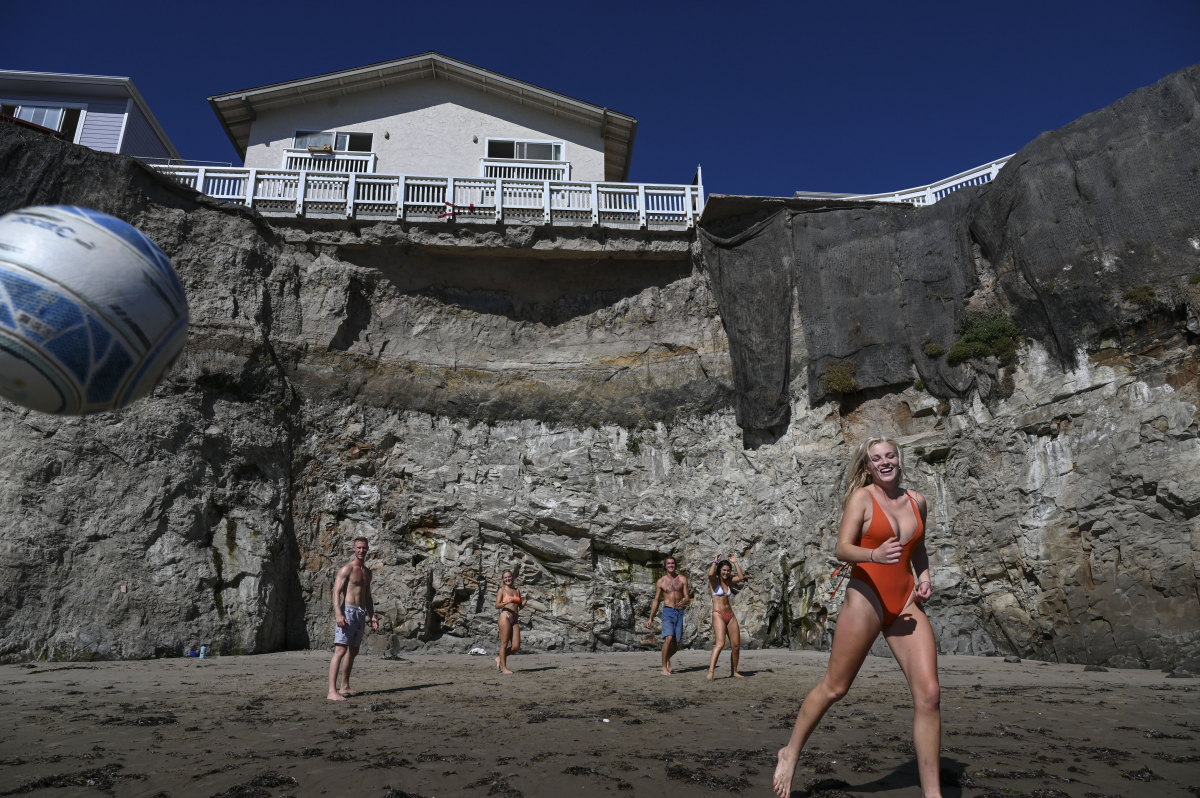
Amber Stevens, right, a student at UCSB, plays with friends in Isla Vista. The cliffs below the apartments used as student housing are disappearing as a rising ocean slowly erodes them. MUST CREDIT: Washington Post photo by Michael Robinson Chavez

Amber Stevens, right, a student at UCSB, plays with friends in Isla Vista. The cliffs below the apartments used as student housing are disappearing as a rising ocean slowly erodes them. MUST CREDIT: Washington Post photo by Michael Robinson Chavez

Along Santa Barbara’s Del Playa Drive, the cliffs above the Pacific Ocean are disappearing with the rising sea.

One apartment building, popular with UCSB students, was condemned three years ago after the cliffs beneath it crumbled into the water. Last fall, the city’s planning department said in a report that, unless conditions change, erosion could claim up to 78% of the city’s bluffside beaches by 2060.

Reilly Ehrlich, a senior psychology major, waited several years for a spot in her apartment at the edge of a precipice, now so eroded it is being braced by netting. By the hammock and barbecue out back is a sign attached to the fence. It shows a stick figure falling backward off a cartoon cliff, warning people to keep their distance.

“It’s crazy waking up to this view,” Ehrlich said, the blue Santa Barbara Channel sparkling behind her. “But we always talk about how this house will not be here in 20 years.”

Scientists have no clear answer for why this region is heating up so fast. But they say a century of urbanization in Los Angeles and Orange counties probably plays a role, bringing more traffic up and down the region’s single north-south coastal highway.

Temperature inversions – the appearance of a layer of warm air in the upper atmosphere – are commonplace regionwide but today hold in the larger amounts of smog and heat. Scientists here say the warming waters offshore are beginning to resemble tropical oceans that, according to local fishermen and farmers, are intensifying the dry winds that cascade down the steep coastal range and deepen the effects of drought.

A shift in weather patterns has affected the morning cloud cover known as the marine layer, pushing the foggy early-summer “June gloom” into a late-summer “Fog-gust.” The marine layer also has thinned out, declining by as much as 50% since 1970, according to Park Williams, a research professor at Columbia University’s Lamont-Doherty Earth Observatory.

That results in less coastal moisture, and more risk of fire.

A quarter of California’s 40 million residents now live in high-risk fire zones.

For the past three autumns, tens of thousands of people have packed up family photos, home deeds and marriage licenses to evacuate in fearful, fire-driven migrations, from the Sierra Nevada to San Diego. More than 6,000 residents were forced from their homes here Nov. 25, when the Cave Fire flared up in the Santa Ynez Mountains, burning thousands of acres of chaparral-covered hillside.

Wildfires have long been a fact of life here, but today’s fires are simply more intense. The three most severe in state history – measured by acreage burned, homes destroyed and lives lost – have happened in the past two years. In the coastal counties running from Santa Barbara to San Diego, four of the five worst fire seasons of the past half century have burned in the last two decades.
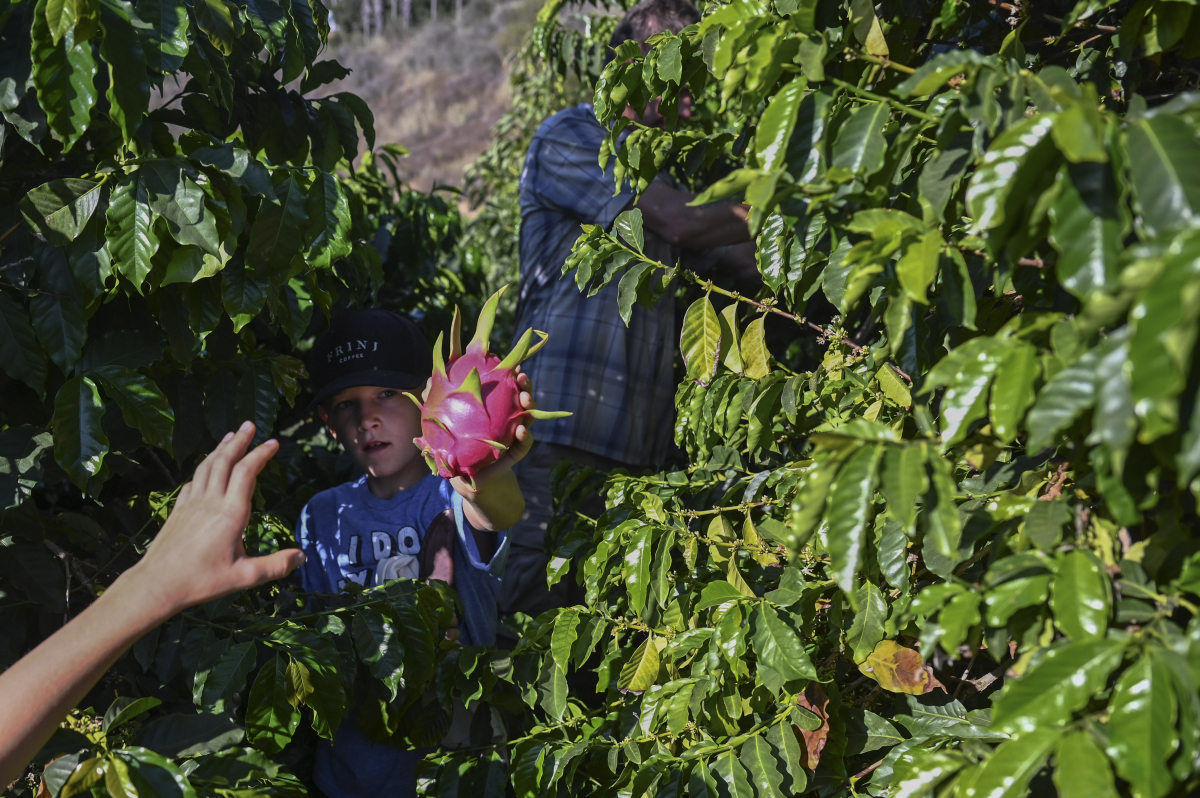
Jay Ruskey has winnowed his avocado orchard and turned to planting more exotic fruits on his farm, including the dragon fruit shown here. MUST CREDIT: Washington Post photo by Michael Robinson Chavez

Jay Ruskey has winnowed his avocado orchard and turned to planting more exotic fruits on his farm, including the dragon fruit shown here. MUST CREDIT: Washington Post photo by Michael Robinson Chavez

State Sen. Henry Stern, D-Canoga Park, whose home burned in the 2018 Woolsey Fire in Malibu, doesn’t know anymore what to tell his constituents north of Los Angeles, who have experienced several fires and electricity outages this fall.

“I feel like I am failing them,” he said.

Seeking to reduce fire risk and financial liability, utilities have begun intentionally cutting off power. This year alone, nearly 3 million Californians were left in the dark for days. State officials say generator sales have soared 1,400%.

“What we have seen is a complete lack of preparedness,” said Trent Robbins, chief executive of Santa Barbara-based Global Power Supply, where customer calls for generator sales and rentals quadrupled in October. “This is like climate change writ small – you know it’s coming, but you are not preparing.”
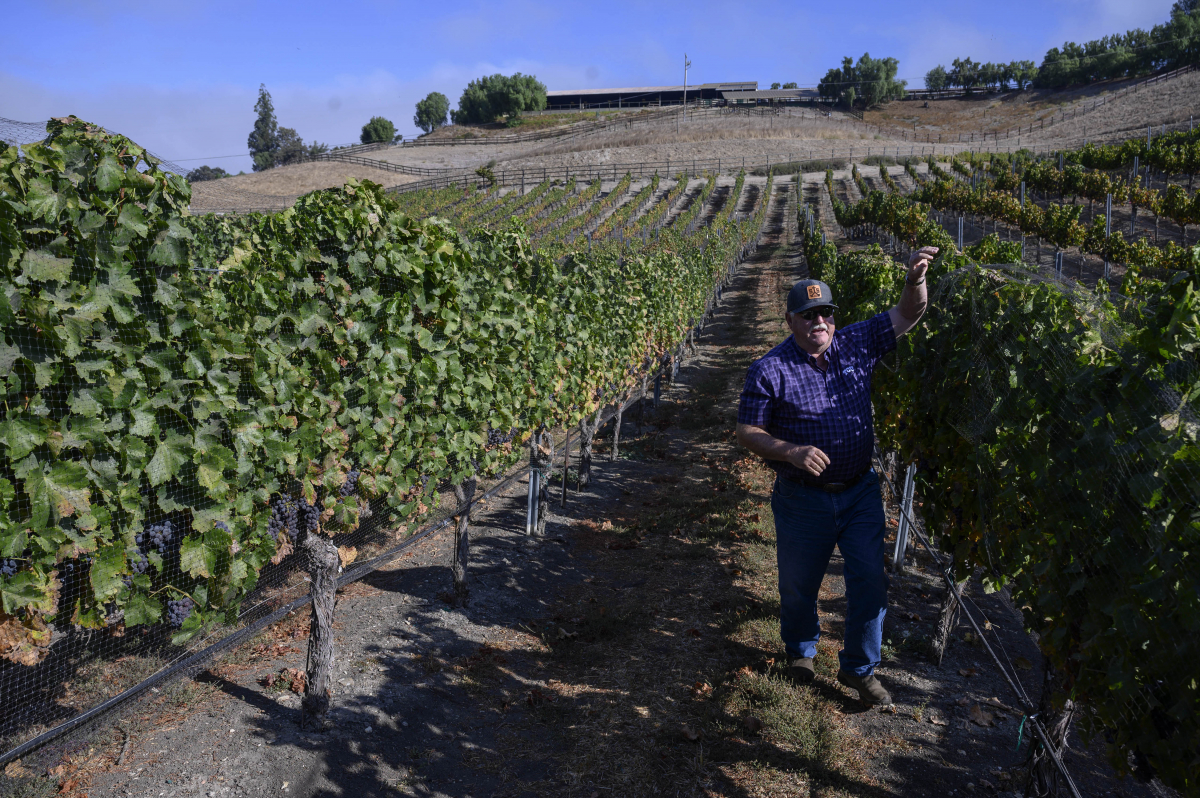
Larry Saarloos, owner of Saarloos and Sons winery, spent hundreds of thousands of dollars on fire-prevention measures around his vineyard, only to find after a power outage that it didn't work. MUST CREDIT: Washington Post photo by Michael Robinson Chavez

Larry Saarloos, owner of Saarloos and Sons winery, spent hundreds of thousands of dollars on fire-prevention measures around his vineyard, only to find after a power outage that it didn’t work. MUST CREDIT: Washington Post photo by Michael Robinson Chavez

What has surprised those who live, work and study the climate in Santa Barbara is how precipitously the warming is happening. A recent study of the Santa Barbara-area climate projected that “the number of extremely hot days will likely double by 2050.”

“It’s been hard to connect the dots,” said Santa Barbara County Supervisor Joan Hartmann, whose district includes parts of the Santa Ynez Valley, where she has had a home for two decades. Hartmann said she had never been forced to evacuate by fire until last year. She has since had to leave home twice.

Now she and her neighbors meet regularly, often in living rooms over a glass of the valley’s famous pinot noir, to discuss the confounding climate.

“We’re asking each other, ‘Who has the horses if something happens? Who is frail and needs extra help?’ ” she said. “This is also about social resilience now, about neighborhoods looking for ways to protect themselves.”

– – –
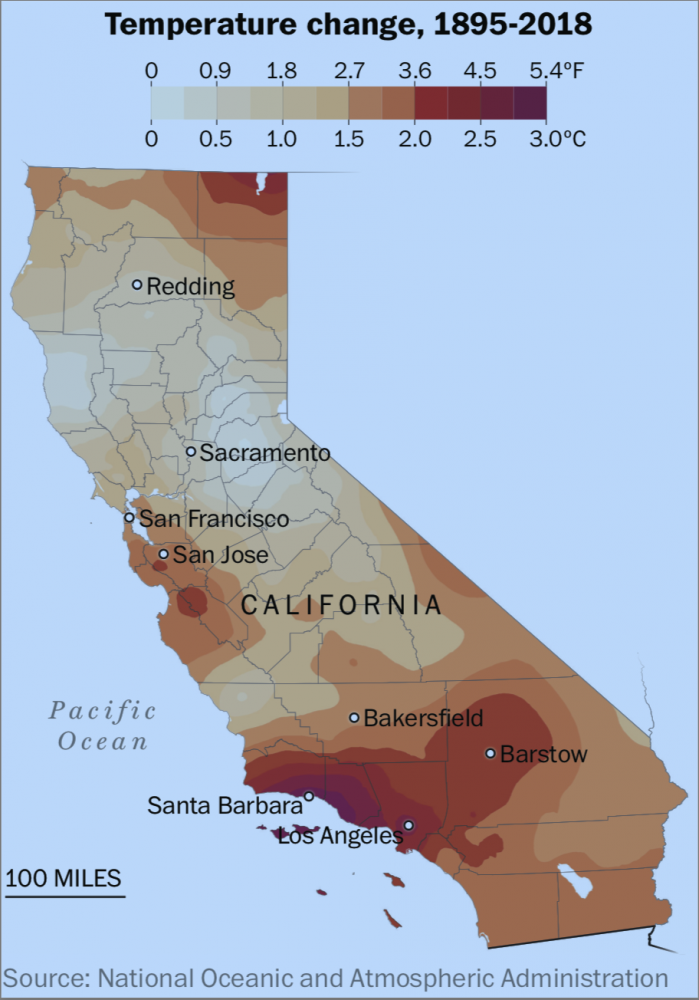
Temperature change, 1895-2018 Photo by: The Washington Post

Temperature change, 1895-2018 Photo by: The Washington Post

On July 6, 2018, a huge high-pressure system over Colorado helped spin a mass of hot air into Southern California.

By 11 a.m., temperatures reached 90 degrees Fahrenheit, so Guner Tautrim, whose family has farmed Orella Ranch for seven generations, worked with his father to spray down their pigs, chickens and horses with water before taking refuge inside.

“The crazy thing happened around 3 p.m., when the temperature just started going up and up,” Tautrim said.

It spiked to 115 degrees Fahrenheit, then, nearly as abruptly, cooled down after sunset. Such an hours-long super spike had happened only once before in Santa Barbara – 149 years ago.

“I call what’s happening here ‘global weirding,’ ” said Tautrim, whose farm was deeded through a Spanish land grant more than two centuries ago.

The damage was severe: Dozens of Tautrim’s animals died in the heat, and his neighbors saw entire avocado harvests fail. Some scorched orchards have yet to recover, and the hills behind his redwood house are parched to the color of desert sand.

Those losses add up.

Last year, Santa Barbara farmers and ranchers took in $1.5 billion in revenue, a nearly 5% decline from the previous year, according to an annual report that began with an introduction titled: “2018 – A year of extreme weather and events.”

The unpredictability has prompted experimentation along the windblown Gaviota Coast, a 76-mile comma of beach and orchards that make up the largest stretch of undeveloped land in southern California.

Set between the mountains and the sea, Eric Hvolboll’s La Paloma Ranch once filled with water during the rainy season, forming fishing ponds used by the Chumash tribes hundreds of years ago.

Now it is dry.

The ranch’s 746 acres of slope and ravine, cropland and pasture have shifted thanks to a combination of drought and technology. The primary crop since 1969 has been avocado, profitable but water intensive in a place with very little water left. It was the first crop on the farm to need irrigation.

Now crawling up the hillside are neat rows of agave, the spiky plant that in Mexico produces tequila. It is among the least thirsty of crops and, in some ways, takes La Paloma Ranch back to the pre-irrigation days of Hvolboll’s grandparents, who relied on the rain alone to grow garbanzo beans, walnuts and lima beans.

“The question I had to ask was, ‘Is there a way we can make money and not use water?’ ” said Hvolboll, a lawyer by training. “We still don’t know if we can make money doing this.”

A small Ventura distillery turns the agave into craft tequila – though it can’t be labeled tequila because it isn’t from that region of Mexico. It is selling in small batches, and Hvolboll said he hopes to switch out some of his avocados for the durable plants.

“Our working assumption is that we are going to have less and less water,” said Hvolboll, 64. “Maybe not tomorrow, maybe not in my life. But we have to look at all options around that assumption.”

Four years ago, in the midst of the state’s historic drought, Jay Ruskey winnowed his avocado orchard. At the time, the reservoir in the valley where much of Santa Barbara’s water originates was at just 6% of capacity.

“I don’t think people had any idea how close we came to simply running out of water,” Ruskey said.

He too, is turning to more tropical crops: finger limes native to Australia, dragon fruit, passion fruit, and now, coffee, which he sells under the brand Frinj. The coffee trees run downhill between his avocado trees, benefiting from the shade.

“These last 10 years have been very different from the first 20 years,” said Ruskey, 47, who has owned his farm since 1990. “I could step aside, and someone would replace me. Or I can change.”

– – –

If there is a God-given civic right in which Santa Barbarans believe, it is bountiful and convenient free public parking.

Studies have found that there is no greater predictor of the number of cars on the road than the availability of free parking. And in Santa Barbara County, the biggest contributor to air pollution and greenhouse gas emissions is the car.

Environmentalists are lobbying to put an end to it and to even replace parking lots on prime downtown real estate with housing. But that campaign has so far failed to budge the city council on an issue the business community says is key to profitability.

“Parking is the third rail of Santa Barbara politics,” said Michael Chiacos, a native of the city who works with the nonprofit Community Environmental Council.

Sacrifices in service of environmental goals have been tough to come by in Santa Barbara, local environmentalists say – evidence, perhaps, of the county’s conflicted history.

Huge oil deposits make the region one of California’s primary producers and shape its politics, despite a seminal environmental disaster in January 1969. Then, a Unocal rig blowout cracked the sea floor, spilling 3 million barrels of oil, the third-largest spill in U.S. history. To this day, beachgoers find tar on their feet from the still-seeping oil.

The disaster gave rise to Earth Day, and much of the environmental expertise and activism that grew up around the movement is still based here. But Santa Barbara is often accused of caring more about how it looks than how it lives.

Several government-sanctioned architectural review boards make sure the city’s breezy, Mediterranean aesthetic remains intact, supported by many staff members. But until recently, only one person was directly responsible for moving the city toward renewable energy sources.

The county conducts a full inventory of its greenhouse gas emissions only once every three years. And its Climate Action Plan imposes no mandatory regulations on businesses or individuals.

“There are no teeth in these plans. The rules are just words on paper,” said Tomás Morales Rebecchi, the senior Central Coast organizer for the nonprofit Food & Water Watch. “No one is there to enforce it.”

Williams, the county supervisor, once used the term “environmental poseurs” to describe the gap between Santa Barbara’s talk on the environment and its actions.

“We’re always willing to make changes that cost nothing, but never willing to take steps that really change things and that will cost something,” said Edward France, the former executive director of the Santa Barbara Bicycle Coalition.

There has been some progress. The city council recently voted to create a program that allows utility customers to select the source of their electricity. Residents will automatically receive 100% renewable power from desert solar panels, which can be more expensive, unless they choose not to participate.

But the oil industry still has clout. In 2014, it spent big to defeat a county referendum that would have banned “high-intensive” drilling operations such as fracking and steam injection. And county officials are actively considering a proposal to allow a major drilling expansion in the north, a move environmentalists say would directly contradict their climate goals.

“We’ve got this wave of new oil projects being proposed, but we also have a climate action plan,” said Linda Krop, chief counsel of the Environmental Defense Center, a local organization that emerged after the 1969 oil spill. “You can’t responsibly approve one, and claim to be serious about the other.”

– – –

On a warm late-September evening, several dozen farmers and ranchers gathered inside the stuffy gymnasium of Los Olivos Elementary School to learn about one of the more peculiar aspects of living in a place that is warming faster than most anywhere in the country.

Eric Daniels, regional policy and external affairs director for Pacific Gas and Electric, the state’s largest utility, had been invited to explain a decision to begin cutting power to their homes in the hope of preventing wildfires caused by downed lines.

“My office has been inundated with questions about this,” Hartmann, the county supervisor, told the audience. “What is frustrating right now is that we need to protect our residents, but we do not have a say over these shutdowns.”

Daniels said PG&E would act only in times of extreme risk and would try to give people two-days’ notice before turning off electricity to their water pumps, refrigerated warehouses and homes.

“This will give you and your loved ones time to get your emergency kits ready,” he said.

In the audience sat Larry Saarloos, a stout vintner who has spent more than $100,000 building his own Maginot Line against wildfire. Over the past three years, Saarloos installed two fire hydrants, new alarms and an advanced system of sprinklers and cisterns on his 100-acre ranch, a mix of horses, cattle and grapes that his family turns into well-regarded syrah and cabernet sauvignon.

The price seemed a small one to pay as fall approached. One dry, breezy day in early September, two fires sparked nearby, their pillars of smoke bracketing his home. He turned to his wife, Linda, and assured her that all would be fine when he turned on the sprinklers to wet the place down.

But when he flipped the switch, nothing happened. The power had been cut by an equipment failure.

Mark Mesesan, a PG&E spokesman, said smoke and airborne debris had caused an electrical fault. “This is an area where we’re working to improve,” he said via email.

To Saarloos, the experience was an unpleasant introduction to a confusing new world.

“Everything I just told you I did, the steps I took, meant absolutely nothing to the protection of my home when the fire came,” he said. “I might as well not have spent any money at all.”

Those who followed had questions, unanswerable now. Would PG&E, now bankrupt with billions of dollars in fire-related liability costs, reimburse them for lost produce? Would the state offer tax breaks for generator purchases? Or would they simply be left in the dark when the fires came?

“We’ve got a lot of folks working on those things right now,” said Matthew Pontes, the assistant county executive officer of Santa Barbara. “I hope we have some better answers for you soon.”

Pensacola, Florida shooting: Gunman who killed three was a military pilot from Saudi Arabia training

#ศาสตร์เกษตรดินปุ๋ย : ขอบคุณแหล่งข้อมูล : หนังสือพิมพ์ The Nation

https://www.nationthailand.com/news/30379184?utm_source=category&utm_medium=internal_referral

Pensacola, Florida shooting: Gunman who killed three was a military pilot from Saudi Arabia training

Dec 07. 2019
By The Washington Post · T.S. Strickland, Brittany Shammas, Kim Bellware, Devlin Barrett

782 Viewed

PENSACOLA, Fla. – A Saudi Arabian military student opened fire with a handgun Friday at Naval Air Station Pensacola, leaving three people dead and several others wounded before sheriff’s deputies shot and killed him, officials said.

The harrowing shootout at the home of the Navy’s fabled Blue Angels aerial demonstration team was the second instance of deadly gunfire at a U.S. naval base in three days. On Wednesday, a sailor opened fire at Joint Base Pearl Harbor-Hickam in Hawaii, killing two and injuring a third, before killing himself.

The Pensacola shooting began just as the sun was rising in the Florida Panhandle, and by the afternoon, the FBI had taken command as the lead investigative agency, seeking to determine whether the gunman’s history or any social media posts pointed to terrorism or some other motive, officials said.

“We have not at this hour determined one way or the other whether it is terrorism or not,” FBI spokeswoman Amanda Videll said.

U.S. and Saudi government officials identified the gunman as Ahmed Mohammed al-Shamrani, who had been receiving aviation training at the base. Officials said investigators are also working to determine what, if anything, Shamrani’s fellow students knew about his intentions.

The deadly violence at the hands of a Saudi military student on an American base threatens to further complicate relations between the two countries, but President Donald Trump struck a measured tone on Twitter, saying that Saudi King Salman had called him “to express his sincere condolences and give his sympathies.”

“The King said that the Saudi people are greatly angered by the barbaric actions of the shooter, and that this person in no way shape or form represents the feelings of the Saudi people who love the American people,” Trump tweeted.

Saudi Arabia’s Ministry of Foreign Affairs issued a statement declaring its “deep distress” over the incident and pledging to “provide full support to the U.S. authorities to investigate the circumstances of this crime.”

Trump’s restraint stood in contrast to some of his past reactions to violence by people from predominantly Muslim countries.

Hours after eight people were killed in a 2017 alleged terrorist attack in New York City, Trump demanded officials “step up our already extreme vetting program. Being politically correct is fine, but not for this!” As a presidential candidate, the president once declared that “Islam hates us.”

Late Friday, several independent organizations published postings from a Twitter account said to belong to Shamrani. The postings, under the handle @M7MD_SHAMRANI, included a photo image of a letter in English apparently written a few hours before the shooting rampage. The Washington Post has not confirmed that the account belonged to the shooter.

Twitter suspended the account Friday afternoon.

Excerpts of the Twitter postings were published by SITE Intelligence Group and the Middle East Media Research Institute, two U.S. organizations that track extremist groups’ online propaganda.

In the letter, the writer blasts the United States for “funding crimes against Muslims” and supporting Israel. “You will not be safe until we live it as reality in [Palestine], and American troops get out of our land,” he writes.

The letter does not contain an explicit pledge of support for any group, but the contents echo views expressed by al-Qaida as well as extremist clerics in the Persian Gulf, analysts said. The account profile lists the U.S. Chief of Naval Operations as among the accounts followed.

The posting, if authenticated, “suggests terrorist motive” and “echos Bin Laden,” SITE Director Rita Katz said in a Twitter posting.

“The style doesn’t necessarily resemble one group over another,” Katz said. “However, given that ISIS has very little to lose at this point, it wouldn’t be surprising if it claimed the attack, regardless of the attacker’s potential allegiances.”

After Friday’s shooting in Florida, state officials called for closer scrutiny of the training program that brought the gunman to the United States and said the Saudi government should pay compensation to his victims.

“This is a dark day for a very great place,” said Florida Gov. Ron DeSantis, a Republican. “I think there’s obviously going to be a lot of questions about this individual being a foreign national, being a part of the Saudi air force and then to be here training on our soil, to do this.”

Saudi Arabia “needs to make things better for these victims, and I think they’re going to owe a debt here,” DeSantis added.

Sen. Rick Scott, R-Fla., said he was “extremely concerned” by the issues raised by the shooting and called for a review of all programs that place foreign nationals with U.S. military personnel.

“Whether this individual was motivated by radical Islam or was simply mentally unstable, this was an act of terrorism,” Scott said. “It’s clear that we need to take steps to ensure that any and all foreign nationals are scrutinized and vetted extensively before being embedded with our American men and women in uniform.”

The Department of Defense operates a robust effort to train foreign military officers, with more than 5,000 such foreign students from 153 countries in the United States, officials said.

Those foreign nationals are vetted through a screening process that includes searching databases for evidence of drug trafficking, support for terrorist activity, corruption and criminal conduct, officials said.

Pentagon officials said Shamrani’s training with the U.S. military began in August 2016, and was scheduled to finish in August 2020. His coursework included English, basic aviation and initial aviation training, officials said.

It was not immediately clear whether the three deceased victims were service members or civilians. Multiple people were taken to area hospitals. Among them were two Escambia County sheriff’s deputies who are expected to survive.

Baptist Health Care said it had admitted eight patients from the shooting but could not yet report on their conditions. “Our teams are treating patients and we are working with Navy personnel to communicate with family members,” the hospital said in a statement.

The first reports of a shooting inside an air station classroom came in at 6:51 a.m., when law enforcement officers began rushing toward the incident while Navy officials placed the base on lockdown. After about an hour, authorities said the gunman was dead.

“There was some real heroism today,” said the base’s commanding officer, Capt. Timothy F. Kinsella. “I am devastated, we are in shock, this is surreal, but I couldn’t be prouder to wear the uniform that I wear because of my brothers and sisters in uniform, civilian or otherwise, that did what they did today to save lives.”

The FBI investigation is being aided by military investigators, the Bureau of Alcohol, Tobacco, Firearms and Explosives, and local police.

Escambia County Sheriff David Morgan warned that because of the nature of an attack on a military base by a foreign national, investigators would not be able to reveal everything they learn about the case.

“Do not expect quick answers,” the sheriff said. “There’s going to be some parts of this investigation … that you may never have access to, just because of … who we’re dealing with. That will be extremely frustrating for you.”

The sheriff noted that in two weeks’ time, most people will not remember the names of anyone killed or wounded in the attack, but their families will be marked by the tragedy for the rest of their lives.

“You’re going to have to trust us. We’re going to tell you what you need to know to keep our communities and our state and our nation safe,” he said. “You will hear the truth from us, as best we can tell you.”

Civilian and military investigators spent Friday afternoon poring over the gunman’s military history and other records, including social media, for clues about what might have motivated him.

Friday’s incident shook a community whose identity is deeply entwined with the base, with many residents either employed there or tied to related businesses that sprawl alongside Pensacola Bay.

Jana Lormer, who is renovating her grandmother’s home directly across the bayou from the base, comes from a long line of service members – like many in the neighborhood. She said the area’s usual sense of quiet had been shattered.

“I woke up and opened my texts to all of these messages and then looked across the water to see all the ambulances on the bridge,” she said. “It was too close for comfort.”

The facility hosts 16,000 military personnel and more than 7,000 civilians.

“For 200 years, they have been a part of the city of Pensacola,” Mayor Grover C. Robinson IV said during a news conference. “We’re a military town.”

The shooting could put additional strain on the U.S.-Saudi relationship, which has been tested recently by legal and diplomatic troubles.

Last month, the Justice Department charged two former Twitter employees with spying for Saudi Arabia by accessing information about Saudi dissidents who used the social media platform, marking the first time federal prosecutors have publicly accused the kingdom of running agents in the United States.

One of those implicated in the scheme, according to court papers, is an associate of Saudi Crown Prince Mohammed bin Salman, who the CIA has concluded likely ordered the killing of the journalist Jamal Khashoggi in Istanbul last year. Khashoggi was a Washington Post contributing columnist who advocated for free expression in the Arab world.

In September, the U.S. Justice Department decided to provide families of the victims of the 9/11 attacks some information that the FBI learned about Saudi government activity related to those attacks; 15 of the 19 plane hijackers were Saudis.

Friday’s shooting in Florida came just two days after a gunman opened fire at Joint Base Pearl Harbor-Hickam near Honolulu.

The shooter in that incident was identified as an active-duty U.S. Navy sailor and his three victims as civilian Defense Department employees working at the base’s shipyard, but officials do not suspect terrorism was the motive in that case.

The gunman, Gabriel Romero, was assigned to the USS Columbia, a submarine undergoing maintenance at Dry Dock 2, where the shooting occurred, officials said.

After that incident, military officials said Romero had been receiving counseling and was unhappy with his commanders. He was also involved in a low-level administrative process for minor misconduct, officials said.

Thai beauty takes Miss Supranational crown

#ศาสตร์เกษตรดินปุ๋ย : ขอบคุณแหล่งข้อมูล : หนังสือพิมพ์ The Nation

https://www.nationthailand.com/news/30379178?utm_source=category&utm_medium=internal_referral

Thai beauty takes Miss Supranational crown

Dec 07. 2019
Anntonia Porsild

Anntonia Porsild
By THE NATION

1,735 Viewed

Anntonia Porsild was crowned Miss Supranational 2019 today (December 7) beating contestants from 77 countries and becoming the first Thai to be awarded the honour,

Yana Haenisch from Namibia, Jesica Fitriana from Indonesia, Janick Maceta del Castillo from Peru, and Gabriela De La Cruz from Venezuela were named 1st 2nd 3rd and 4th runners-up respectively.

Anntonia, who is half Danish and half Thai, was a contestant on the first season of “The Face Thailand” television show in 2014/15. She is currently studying advertising and public relations at Stamford International University.

Miss Supranational is one of five international beauty contests at the grand slam level. The first competition was held in 2009 in the Polish city of Płock.

Other Thai contestants who have done well in the contest are Nanthawan Wannachutha and Parapadsorn Vorrasirinda, named 1st runners-up in 2012 and 2014.

The victory of Anntonia was the second one this year following Sireethorn Leearamwat taking home the Miss International 2019 crown late last month. Thais expect Paweensuda Drouin to win the Miss Universe 2019 contest, which is being held on December 9.

Tony Fernandes wants the world to hear Asean music; launches music label

#ศาสตร์เกษตรดินปุ๋ย : ขอบคุณแหล่งข้อมูล : หนังสือพิมพ์ The Nation

https://www.nationthailand.com/news/30379174?utm_source=category&utm_medium=internal_referral

Tony Fernandes wants the world to hear Asean music; launches music label

Dec 07. 2019
AirAsia Group chief executive officer Tan Sri Tony Fernandes announced the launch of RedRecords, a music label aimed at showcasing Asean music.

AirAsia Group chief executive officer Tan Sri Tony Fernandes announced the launch of RedRecords, a music label aimed at showcasing Asean music.
By Kenneth Chaw
The Star Online/Asia News Network

391 Viewed

AirAsia has launched a new route. Its destination? Music land.

The low-cost airline has teamed up with Universal Music Group (UMG) to start RedRecords, a music label devoted to discovering and grooming new talents in South-East Asia.

“The idea is to use the marketing power of AirAsia to find talents in South-East Asia, make great music and help them break through in the global market,” said AirAsia Group chief executive officer Tan Sri Tony Fernandes during its launch on Friday in Kuala Lumpur.

“It’s a lofty dream. But if you never do it, you never know.”

In a bid to foster a global appreciation for Asean music, Fernandes shared the music of RedRecords will showcase the different native languages spoken in ASEAN countries as well as traditional instruments like the gamelan.


Thai-German singer Janine Weigel (centre) is RedRecords' first signed artiste.

Thai-German singer Janine Weigel (centre) is RedRecords’ first signed artiste.

Chairman and chief executive officer of UMG Sir Lucian Grainge said in video message: “Music today in the streaming age has no barriers. We’ve seen that with the music from Latin America, Europe and with K-pop.

“We think this partnership between AirAsia and Universal Music will be a phenomenal opportunity to introduce the best music from the (Asean) market.”

RedRecords’ first signed artiste is 19-year-old Thai-German singer Jannine Weigel.

Prior to joining the airline industry in 2001, Fernandes was a music executive at Warner Music.

“This day has been 18 years in the making. It’s a really special day for me to be back in the music business,” said Fernandes.

Strong winds and cold weather in most parts of Thailand

#ศาสตร์เกษตรดินปุ๋ย : ขอบคุณแหล่งข้อมูล : หนังสือพิมพ์ The Nation

https://www.nationthailand.com/news/30379198?utm_source=category&utm_medium=internal_referral

Strong winds and cold weather in most parts of Thailand

Dec 08. 2019
By The Nation

57 Viewed

The strong high-pressure trough over Thailand continues to bring cool to cold weather with strong winds over the upper part of the country with further drops in temperatures of 1-3°C. It will be cold to very cold in the North and Northeast with minimums ranging from 6-14°C.

It will be particularly cold on the mountaintops with morning frost and temperatures from 1-8°C. The Central region including Bangkok and its vicinity, and the East region, will also experience cold weather with minimum temperatures ranging from 12-19 degrees Celsius.

Meanwhile, the stronger northeast monsoon will continue to whip up waves in the southern Gulf, reaching 2-3 metres high from Chumphon northward and 2-4 metres from Surat Thani southward.

Tidal surges along the eastern coast of South Thailand are likely. Ships should proceed with caution, and small boats should stay ashore.

Bangkok and the vicinity will experience Northeasterly winds of 15-35 km/hr