Japan govt OKs new stimulus package worth ¥73.6 trillion
Dec 10. 2020Prime Minister Yoshihide Suga attends a meeting of the government’s Council on Economic and Fiscal Policy at the Prime Minister’s Office on Tuesday. Economic Revitalization Minister Yasutoshi Nishimura is seated next to him. (The Yomiuri Shimbun)
By The Japan News/ANN
The government on Tuesday approved an additional economic package worth ¥73.6 trillion, including ¥51.7 trillion for projects aimed at re-configuring the nation’s economy and bringing it back to pre-pandemic levels. It also contains measures aimed at accelerating the introduction of digital technology and the reduction of carbon emissions.
The package was adopted at an extraordinary Cabinet meeting on the day. Part of the funding for its various measures will consist of ¥40 trillion in fiscal spending — including money to be paid by local governments — in a third supplementary budget for fiscal 2020 through next March and the initial budget for fiscal 2021, jointly deemed “the 15-month budget.”
At a meeting of the government’s Council on Economic and Fiscal Policy held at the Prime Minister’s Office on Tuesday, Prime Minister Yoshihide Suga said, “In addition to financial support for medical institutions and helping companies raise funds, measures aimed at new growth have also been incorporated [in the package].”
The latest package follows two extra budgets for the current fiscal year that were earmarked to fight the novel coronavirus. It will bring the value of stimulus measures so far to a total of more than ¥307 trillion, equivalent to 60 percent of Japan’s gross domestic product. The government estimates that the stimulus measures will boost the nation’s GDP by 3.6 percent.
The latest package mainly comprises 1) measures to prevent the spread of novel coronavirus infections (¥6 trillion); 2) spending to re-configure the nation’s economy and bring it back to pre-pandemic levels (¥51.7 trillion); and 3) measures to prevent or mitigate damage from and enhance resilience against natural disasters (¥5.9 trillion).
As it is difficult to predict future events, the government will secure a reserve fund of ¥5 trillion in the initial budget for fiscal 2021.
Of the ¥40 trillion in fiscal spending, ¥30.6 trillion will be provided by the central government and ¥1.7 trillion by local governments, while the remaining ¥7.7 trillion will come from the Fiscal Investment and Loan Program, under which the government secures funds and extends low-interest loans to companies.
With such funding as loans from financial institutions added to the fiscal spending, the latest package will be worth a total of ¥73.6 trillion.
As budgetary measures accompanying the additional economic package, the government plans to include ¥19.2 trillion in the general account and ¥1 trillion in the special account of the third supplementary budget, which will be compiled next week.
The government will reinforce medical service systems to prevent the spread of infections, through such measures as securing more hospital beds. It will increase emergency comprehensive support grants to medical institutions, which are provided through prefectural governments, while promoting increased production of testing kits and greater readiness to administer vaccinations.
As part of efforts to re-configure the nation’s economy, the government will establish a ¥2 trillion fund for companies developing green technologies and work to reduce greenhouse gas emissions to effectively zero by 2050.
The government will also extend through end of next June its Go To Travel campaign to promote domestic travel and its Go To Eat program for dining out, in a bid to balance measures to combat the coronavirus and to keep economic activities going.
The government will extend through next February the employment adjustment subsidy, a special measure to subsidize companies that have had to pay allowances to employees taking time off work. It will also expand the scale of its projects aimed at reinforcing the nation’s resilience against natural disasters.
S. Korea on alert over spreading bird flu, more highly pathogenic cases likely in store
Dec 10. 2020Quarantine officials prepare to cull ducks at a farm in Naju, 355 kilometers south of Seoul, on Wednesday. (Yonhap)
By The Korea Herald/ANN
South Korea reported yet another suspected highly pathogenic avian influenza case from a poultry farm Thursday, raising concerns that the bird flu outbreak is spreading nationwide despite enhanced measures.
Authorities are investigating the suspected case in Naju, 355 kilometers south of Seoul, according to the Ministry of Agriculture, Food and Rural Affairs. The samples were gathered from a slaughter house.
The farm had killed all of its 22,000 ducks to be sold at market, but they were discarded after the suspected case.
Another duck farm from the same town confirmed a highly pathogenic bird flu case the previous day. If found to be seriously contagious in a test, it will become the third such case from South Jeolla Province alone.
So far, South Korea has reported seven highly pathogenic avian influenza cases from poultry farms across the country, including two from Gyeonggi Province that surrounds the capital city.
There were also infection cases from North Chungcheong, North Gyeongsang and North Jeolla provinces.
South Korea completed the culling of more than 4 million poultry from affected farms late Wednesday, covering 2.42 million chickens, 1.01 million quails and 572,000 ducks.
Authorities cull poultry within a 3-km radius of infected farms. Birds at farms with suspected cases are also destroyed.
Highly pathogenic avian influenza is contagious and can cause severe illness and even death in poultry.
The country reported its first highly pathogenic case in 32 months in late October in Cheonan, 92 kilometers south of Seoul, from wild birds.
Since then, a total of 22 cases have been found from wild bird habitats across the country, according to the latest data provided by the ministry. Health authorities are investigating more than 10 suspected cases among wild birds. (Yonhap)
Chevron (Thailand) will roll out more Caltex petrol stations in Thailand to meet its target of 500 next year, up from over 400 at present, said Alice Potter, country chair and general manager.
Chevron said it will also upgrade existing stations with smart designs at a rate of 50 per year to cater to new-generation lifestyles.
Meanwhile the company is joining with partners to open food and coffee shops in the stations to strengthen its non-oil business.
She added that the company has continued to invest in Thailand given its growth potential in terms of oil consumption and the economy.
By Syndication Washington Post, Bloomberg · Rita Nazareth, Claire Ballentine
A sell-off in some of the world’s biggest technology companies weighed heavily on the equity market, dragging down stocks amid dimming prospects for fresh stimulus.
The S&P 500 slid from a record, while the Nasdaq 100 had its biggest slump in a month. Facebook Inc. sank after being sued by U.S. antitrust officials, while Tesla Inc. tumbled as JPMorgan Chase & Co. called it “dramatically” overvalued. Zoom Video Communications Inc., one of the biggest stay-at-home winners, plunged after an analyst downgrade. The Russell 2000 index of smaller companies was down half as much as the tech-heavy gauge. DoorDash Inc. defied the market weakness — almost doubling in its debut — before Airbnb Inc.’s initial public offering.
Stocks took a nosedive Wednesday as it became clear that a stimulus deal remains elusive amid the most-intense negotiations over a covid-19 package since Election Day. The Democratic and Republican lawmakers working on a relief plan delivered a more-detailed summary of their proposal, but haven’t yet resolved the deadlock over a business liability shield as well as aid to state and local governments.
“To the extent they can’t come to an agreement on stimulus given the heightened urgency, given the recent outbreak, that’s a bad message,” said Mark Heppenstall, chief investment officer for Penn Mutual Asset Management. “I do think stimulus is coming and I think the market was more prepared for it to be this year than next year.
These are some of the main moves in markets:
Stocks
– The S&P 500 declined 0.8% as of 4 p.m. EST.
– The Stoxx Europe 600 Index advanced 0.3%.
– The MSCI Asia Pacific Index climbed 0.5%.
Currencies
– The Bloomberg Dollar Spot Index increased 0.1%.
– The euro dipped 0.2% to $1.2082.
– The British pound gained 0.3% to $1.3401.
– The Japanese yen was little changed at 104.21 per dollar.
Bonds
– The yield on 10-year Treasurys increased two basis points to 0.93%.
– Germany’s 10-year yield rose less than one basis point to -0.61%.
– Britain’s 10-year yield climbed less than one basis point to 0.261%.
Commodities
– West Texas Intermediate crude was little changed at $45.57 a barrel.
By Syndication Washington Post, Bloomberg · Ranjeetha Pakiam, Eddie Spence
Gold declined from a two-week high as investors weighed vaccine roll-outs against surging covid-19 cases and fresh hopes for a U.S. stimulus deal.
U.S. regulators gave early indications they may grant emergency-use authorization to Pfizer Inc.’s shot, calling it highly effective with no safety concerns, although the U.K. said those with a significant history of allergies shouldn’t take it. Trial results found that the vaccine developed by the University of Oxford and AstraZeneca Plc is safe and effective, though more analysis will be required to see how well it works in people over 55.
On the stimulus front, Treasury Secretary Steven Mnuchin presented a $916 billion coronavirus relief proposal to House Speaker Nancy Pelosi, opening up a potential new path to a year-end deal. The offer crucially has the support of Senate Majority Leader Mitch McConnell, though its omission of supplementary jobless benefits remains a sticking point with Democrat leaders.
While vaccine developments have curbed haven demand, bullion is still heading for the biggest annual gain in a decade amid unprecedented amounts of stimulus to prop up economies. Top central banks are embarking on fresh waves of bond-buying, with the European Central Bank expected to increase its purchase plans when it meets on Thursday.
“The gold price is likely to close 2020 with a notable plus, despite the sizable losses in autumn,” Carsten Fritsch, an analyst at Commerzbank AG, wrote in a note. “We do not expect a change in the ultra-expansionary monetary and fiscal policy despite the upcoming vaccinations.”
Spot gold declined 0.7% to $1,857.10 an ounce by 12:43 p.m. in London, after touching the highest since Nov. 23 on Tuesday. Silver dropped 1.5%, platinum fell 1.1% and palladium was little changed. The Bloomberg Dollar Spot Index fell 0.2%.
Thailand’s rubber glove industry is aiming to expand its slice of the global market from 15 per cent to 20 per cent in the next five years.
To meet that target, the Thai Rubber Glove Manufacturers Association (TRGMA) is pushing for increased investment and improved overall competitiveness in the industry.
Association president Veerasith Sinchareonkul said the long-term aim was to grab a 40-per-cent share of the world market.
The move follows a 20-per-cent jump in global demand for rubber gloves to 3.6 million amid the Covid-19 pandemic. Demand is expected to rise by another 10 per cent next year.
Veerasith urged the government to provide more financial support to help manufacturers expand investment. It should also streamline regulations to ease the launch of new factories, he added.
Thailand is the world’s second largest exporter of rubber gloves, driven by 19 manufacturers with combined production capacity of 46 billion per year. Of that total, 90 per cent is exported. Medical rubber gloves account for 88 per cent of total production.
“We want to see Thailand become the world’s production hub of natural-rubber gloves,” he said.
China and Malaysia, the world’s major rubber glove makers, have already expanded their production capacity, he added.
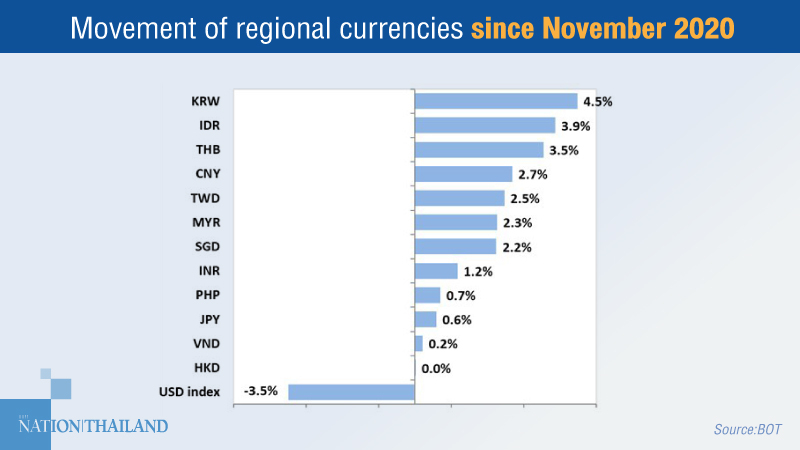
The weakening dollar has seen regional currencies appreciate quickly, with China’s yuan its highest for two and half years, the Korean won and Singaporean dollar strongest in three years, and the new Taiwan dollar at a 23-year high.
Availability of Covid-19 vaccine coupled with signs of global economic recovery in November have caused the US dollar to weaken rapidly, Bank of Thailand (BOT) assistant governor Vachira Arromdee said on Wednesday. The dollar fell to a two-year low against the baht of Bt30.023 on Wednesday, according to BOT figures.Since November, the baht has risen 3.5 per cent, the won 4.5 per cent and Indonesia’s rupiah 3.9 per cent.
Year-to-date, the baht had actually weakened slightly, Vachira noted.
The central bank was closely monitoring currency rates and it would prevent the baht’s value from impacting the economic recovery, she added.
The central bank has introduced a slew of measures to encourage capital outflow in order to balance increasing capital inflows that are driving the baht up.
Thai exporters are complaining that the strong baht makes their products more expensive and less competitive in the global market.
Prime Minister General Prayut Chan-o-cha should follow the example of former PM General Suchinda Kraprayoon who resigned after the deadly Black May crackdown on protesters in 1992, prominent social critic Sulak Sivaraksa said on Wednesday.
He made the remark after attending a ceremony to unveil a monument commemorating the heroic Black May protesters in Bangkok’s Santiporn Park.
He warned that Prayut would suffer the same fate as Suchinda if he did not resign.
“The country can only move forward if the old generation listens to the new generation’s demands. So we ask the government to solve the dispute without violence,” said Sulak.
He accused the government of using the lese majeste law for its own benefit and said it should be scrapped.
More than a dozen pro-democracy protest leaders are currently facing lese majeste (Section 112) charges after calling for Prayut’s removal, a new Constitution and reform of the monarchy.
“We hope that the new generation of military officials will pay the same attention to the nation and democracy as military officials did in 1932,” added Sulak, referring to the Siamese Revolution that abolished absolute monarchy and ushered in constitutional rule.
Meanwhile, the chairman of the Relatives Committee of the May 1992 Heroes said the current political situation was worse than during Black May 1992.
“Relatives of May 1992 heroes are praying for Prayut to resign soon, because no one can remain in their position forever,” said Adul Khiewboriboon.
WASHINGTON – The U.S. government and 48 attorneys general filed landmark antitrust lawsuits against Facebook on Wednesday, seeking to break up the social-networking giant over charges it engaged in illegal, anti-competitive tactics to buy, bully or kill its rivals.
The twin lawsuits filed in federal district court allege that Facebook and its chief executive, Mark Zuckerberg, had behaved as an unlawful monopoly for years – one that repeatedly had weaponized its vast stores of data, seemingly limitless wealth and savvy corporate muscle to ascend into one of the most widely used services around the world.
The state and federal complaints chiefly challenge Facebook’s past acquisition of two companies: Instagram, a photo-sharing tool, and WhatsApp, a messaging service. Investigators said the purchases ultimately helped Facebook remove potential potent rivals from the digital marketplace, allowing the tech giant to enrich itself on advertising dollars at the cost of users, who had fewer social-networking options at their disposal.
The lawsuits together represent the most significant political and legal threats to Facebook in its roughly 17-year history, setting up a high-profile clash between U.S. regulators and one of Silicon Valley’s most profitable firms that could take years to resolve. Antitrust regulators explicitly asked a court to consider forcing Facebook to sell off Instagram and WhatsApp to remedy their competition concerns, seeking a punishment that could severely constrain Facebook’s ambitions.
The Federal Trade Commission, led by Republican Chairman Joe Simons, brought its lawsuit in a D.C. district court. Ian Conner, the director of the agency’s Bureau of Competition, said in a statement the FTC seeks to “provide a foundation for future competitors to grow and innovate without the threat of being crushed by Facebook.”
Letitia James, the Democratic attorney general of New York, led her Democratic and Republican counterparts from dozens of states and territories in filing their complaint in the same venue. Appearing at a news conference, James sharply rebuked Facebook for having put “profits ahead of consumers’ welfare and privacy.”
“Today, we are sending a clear and strong message to Facebook and every other company that any efforts to stifle competition, hurt small business, reduce innovation and creativity, [and] cut privacy protections, will be met with the full force of our offices,” James said.
State, federal antitrust charges against Facebook could come as soon as November, sources say
The lawsuits drew rebuke from Facebook, which pledged to “vigorously defend” its business practices in a sign of conflict to come.
“People and small businesses don’t choose to use Facebook’s free services and advertising because they have to, they use them because our apps and services deliver the most value,” Jennifer Newstead, the company’s vice president and general counsel, said in a statement.
Zuckerberg, appearing frequently on Capitol Hill in recent years similarly has argued that the Web remains sufficiently competitive, bolstered by new companies including TikTok that did not exist years ago. Privately, he has told employees he would “go to the mat” to defend against an antitrust lawsuit he saw as an “existential” threat to the company, according to audio unearthed last year.
The lawsuit reflects the vast dissatisfaction with Silicon Valley that has come to pervade all levels of government in the United States. For years, state and federal regulators had maintained a hands-off approach to the tech industry, even as watchdogs in Europe and around the world began to probe and penalize Facebook and its digital peers for their practices. But a series of high-profile scandals and missteps have brought Democrats and Republicans into rare accord as they seek anew to challenge Silicon Valley over its ever-expanding footprint – and the consequences it poses to corporate rivals and consumers alike.
Last month, the Justice Department filed a similarly sweeping antitrust lawsuit against Google, saying the company struck special deals and engaged in other wrongful tactics to expand the reach of its search and advertising empires. Antitrust watchdogs similarly have set their eyes on Apple and Amazon, raising the potential for additional antitrust action to come. (Amazon CEO Jeff Bezos owns the Washington Post.)
U.S. investigators initiated antitrust probes targeting Facebook last year. Dozens of attorneys general led by James in New York promised a broad review of Facebook’s business, aiming to explore the nexus between its digital dominance and ever-growing efforts to siphon users’ data. The FTC, meanwhile, took aim at Facebook almost immediately after concluding an investigation into the company over its entanglement with Cambridge Analytica, a political consultancy, that forced the tech giant to pay a $5 billion penalty.
Facebook will have to pay a record-breaking fine for violating users’ privacy. But the FTC wanted more.
Immediately, regulators turned their attention to Facebook’s purchase of Instagram for $1 billion in 2012 and WhatsApp for $19 billion in 2014, two deals that the government could have blocked at the time but did not. For Facebook, the two transactions reflected its aggressive attempts at the time to pivot to smartphone devices as millions of users began to spend more time on iPhone and Android apps than desktop computers and traditional websites.
State and federal investigators, however, found that the two acquisitions reflected a troubling strategy at Facebook dating back more than a decade – an aggressive ploy to buy or kill competitive threats, large or small, before they could sap away the social-networking giant’s popularity.
The government lawsuits at times point to correspondence from Zuckerberg himself, who acknowledged in 2012 – before purchasing Instagram – that Facebook had fallen “very behind” in photo sharing and needed to make the critical acquisition to catch up, according to the FTC complaint. In making its move, Facebook sought to wield its “power as a sword,” the state attorneys general said, threatening negative repercussions if Instagram did not agree to a sale.
State and federal investigators detailed a similar troubling pattern with WhatsApp, highlighting additional emails from Zuckerberg, who saw the company and other messaging services at the time as “the next biggest consumer risk” for his social-networking empire. In 2013, a year before the acquisition, the once-independent WhatsApp even had outpaced Facebook’s own messenger product globally as measured by the number of messages sent daily.
In acquiring the company, Facebook initially promised users that it would preserve WhatsApp’s independence and strong privacy protections, state investigators said. But Facebook reversed course years later, frustrating regulators, who said the bait-and-switch had the effect of eliminating a privacy-protective competitor from the digital marketplace.
Facebook on Wednesday sought to rebut the charges: Newstead, the company’s general counsel, stressed that WhatsApp and Instagram became successful precisely because of the tech giant’s massive investments in them.
“This is revisionist history. Antitrust laws exist to protect consumers and promote innovation, not to punish successful businesses,” she said, arguing that federal regulators could have stopped the Instagram and WhatsApp deals but ultimately did not at the time.
“The government now wants a do-over, sending a chilling warning to American business that no sale is ever final,” she said.
The argument has hardly dissuaded the company’s critics, including those in Congress, who found reason for suspicion after concluding their own antitrust investigation this year. The review unearthed a trove of emails from Zuckerberg and his lieutenants apparently plotting against competitors in a series of discussions in which they referenced making a “land grab” for rival apps. Legal experts also said that the government was well within its rights to challenge those transactions on grounds that it ultimately enabled Facebook to act anti-competitively.
Investigators on Wednesday also faulted Facebook for the way in which the company manages its vast trove of user data and the policies that govern when and how third-party app developers and other companies can access it. Such tactics allowed Facebook to stamp out potential rivals before they could become too popular, investigators found.
In 2013, for example, Facebook sought to stop the rise of Vine, a short-video service launched by Twitter, the FTC complaint says. Facebook that January cut Vine off from accessing Facebook’s features, such as users’ friend lists, restricting its growth, according to the federal agency.
“Facebook has hindered, suppressed, and deterred the emergence and growth of rival personal social networking providers, and unlawfully maintained its monopoly in the U.S. personal social networking market, other than through merits competition,” the FTC said.
Johnson fails to get Brexit deal at Supper Summit in Brussels
InternationalDec 10. 2020Prime Minister Boris Johnson/File photo
By The Washington Post · Karla Adam, Michael Birnbaum, William Booth
LONDON – It was another of those make-or-break moments for a Brexit deal that ended in a fizzle. British Prime Minister Boris Johnson traveled to Brussels on Wednesday night for a dinner meeting with European Commission President Ursula von der Leyen, a tête-à-tête the British media dubbed Johnson’s “date with destiny.” The two talked, but no breakthrough was made.
Some feared that the dinner date could be a “last supper” before all hope of a post-Brexit trade and security deal crumbles. But the two sides agreed to send their representatives back to the negotiating table. Britain leaves the European Union in 22 days.
“We had a lively and interesting discussion on the state of play across the list of outstanding issues,” von der Leyen said after the dinner. “We gained a clear understanding of each other’s positions. They remain far apart.”
The European Commission president said in a statement that the two leaders agreed that their negotiating teams “should immediately reconvene to try to resolve these essential issues.”
Johnson left without speaking with reporters. “Very large gaps remain between the two sides and it is still unclear whether these can be bridged,” Downing Street said in a statement, adding that the prime minister “does not want to leave any route to a possible deal untested.”
Johnson and von der Leyen agreed that by Sunday a firm decision should be made about the future of the talks.
And so the British prime minister and the European Commission president did not forge a future relationship based on a bilateral pact. But they had a nice meal. Fish was on the menu – scallops and turbot – and fishing rights at the top of the talks.
Before Johnson left for Brussels, there was much huffing and puffing in London and Brussels over the last-ditch mission, just three weeks before Britain’s 11-month transition period expires at the end of the month.
The dinner between the two leaders was designed to reset the dynamics and unlock further discussions. Others suspected that it could help either side get an edge on the inevitable blame game that will ensue if Britain ends up crashing out without a deal after four decades in the world’s richest trading club.
Tim Bale, a politics professor at Queen Mary, University of London, said, “If they are going to get a deal, it’s best for both sides if it looks as if it was tough negotiating but they pulled off a miracle at the last minute.”
Bale cautioned, “By all accounts, they were quite a long way apart, even on most basic issues, even a few days ago.” He handicapped the possibility for an eventual deal at 50/50.
Both sides insist that an abrupt – and possibly chaotic – departure remains a possibility.
The meeting pitted Johnson against a frugal and precise former German defense minister who started as head of the European Union’s executive branch a year ago.
The two leaders share some basic traits. Like Johnson, von der Leyen spent some of her formative years in Brussels as the child of a senior E.U. official. They went to the same Brussels high school for the children of European bureaucrats, though their tenures did not overlap. Like Johnson, she is the parent of a large family: seven children in her case, six or more – the precise number is uncertain – in his.
But Johnson likes to bluster his way past the facts, and von der Leyen likes to muster them. He likes to live large – big Italian red wines and weekends at Chequers, the prime minister’s official countryside estate. She arranged for a tiny apartment to be constructed at the sprawling European Commission headquarters so she could skip the commute to work.
“You run a tight ship,” Johnson told von der Leyen on Wednesday as they entered their meeting, after he sought to take off his mask without keeping a pandemic-friendly distance from her. She politely corrected him, allowed masks off for a moment for the photographers, then told him to put it back on again as they drew close.
The dinner menu was rich with symbolism: French and British fishermen have clashed in the English Channel over scallops, with access to British fishing waters a major subject of contention in the talks.
Earlier in the day, when Johnson was still in London, he complained to Parliament about the European Union’s demands.
“If they pass a new law in the future with which we in this country don’t comply . . . they want the automatic right to punish us and to retaliate,” he said. “And secondly, they are saying that the U.K. should be the only country in the world not to have sovereign control over its fishing waters.”
These were not terms that “any prime minister of this country should accept,” he said.
Britain wants to be able to “take back control” of its sovereignty – for many Brexiteers, that was the whole point of leaving the bloc.
But Europe appears in little mood for compromise.
The disagreements have touched on areas that have been sore points for years – in some cases centuries.
Belgium’s Flemish fishermen have declared that they have eternal fishing rights in British waters because of a 1666 charter granted by King Charles II to the citizens of Bruges.
“We believe the privilege to still be valid today,” said Flemish Economy Minister Hilde Crevits.
The European Union also does not want Britain undercutting it on issues such as state aid and environmental regulations to gain a competitive advantage. It wants to make sure that British rules stay closely aligned with E.U. ones as a prerequisite for Britain to get relatively unfettered access to the European market.
If a deal is not struck, Britain’s exit could be messy and costly. Its trading relationship with its biggest trading partner would default to World Trade Organization rules, meaning overnight tariffs and quotas that would hit both sides, clogging ports and supply chains.
Time is in short supply. A stripped-down trade deal could be approved by leaders and the European Parliament alone, easing passage by Dec. 31. But if there is a more complicated bargain, some national parliaments would also have to ratify it, increasing the possibility of a misstep that leads to Britain dropping out of the European market on Dec. 31 without a safety net.

 Prime Minister Yoshihide Suga attends a meeting of the government’s Council on Economic and Fiscal Policy at the Prime Minister’s Office on Tuesday. Economic Revitalization Minister Yasutoshi Nishimura is seated next to him. (The Yomiuri Shimbun)
  Quarantine officials prepare to cull ducks at a farm in Naju, 355 kilometers south of Seoul, on Wednesday. (Yonhap)





 Sulak Sivaraksa



 Prime Minister Boris Johnson/File photo
  SootinClaimon.Com