Credit rating firm gives Thailand A- based on govt policies #SootinClaimon.Com

#SootinClaimon.Com : ขอบคุณแหล่งข้อมูล : หนังสือพิมพ์ The Nation.

https://www.nationthailand.com/business/30403585

Credit rating firm gives Thailand A- based on govt policies

EconMar 11. 2021Patricia Mongkhonvanit, director-general of the Public Debt Management Office (PDMO)Patricia Mongkhonvanit, director-general of the Public Debt Management Office (PDMO)

By The Nation

Japan-based Rating and Investment Information, Inc (R&I) maintained Thailand’s sovereign credit rating at A- with a stable outlook, signifying confidence in the government’s policies and the positive direction of the country’s economy.

Patricia Mongkhonvanit, director-general of the Public Debt Management Office (PDMO), said the rating remains stable because the government has taken proactive measures in the development of high value-added industries and the Eastern Economic Corridor (EEC).

Infrastructure investment projects have been continuously implemented to stimulate the economy and attract foreign investment, giving the country better potential for long-term growth and escape from the middle-income trap.

R&I will be closely following Thailand’s political uncertainty and changes in the population structure that affect the implementation of national economic and growth measures.

69% of Thais prefer using digital channels for banking communication during hardship: FICO survey #SootinClaimon.Com

#SootinClaimon.Com : ขอบคุณแหล่งข้อมูล : หนังสือพิมพ์ The Nation.

https://www.nationthailand.com/business/30403574

69% of Thais prefer using digital channels for banking communication during hardship: FICO survey

EconMar 11. 2021

By The Nation

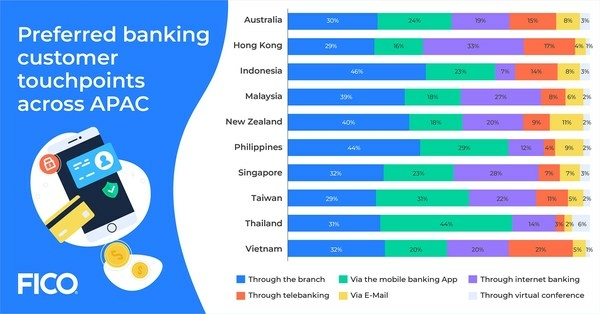
A recent survey by global analytics software firm FICO has shown that 69 per cent of Thais prefer to use digital channels to engage with their banks during a time of financial hardship.

The poll, conducted in December 2020 during the height of the global Covid-19 pandemic, demonstrates the willingness of consumers to embrace digital banking and the opportunities that exist for banks to develop their offerings.

The high level of smartphone penetration in Thailand means that 44 per cent of Thais preferred to communicate via their mobile banking apps; 14 per cent used Internet banking; 6 per cent wanted to use virtual conference technology; 3 per cent preferred telebanking and only 2 per cent communicated via email.

“The risk of infection and social distancing requirements made branch visits less appealing last year, accelerating a shift to digital banking channels globally,” said Aashish Sharma, risk lifecycle and decision management lead for FICO in the Asia Pacific.

“Being able to deliver and manage numerous channels in line with customer preference and deliver a seamless and engaging experience is a challenge that is here to stay. Investment in customer management and communication tools that span these channels and product silos and can deliver personalisation and improved decision making is key to making digital banking a success,” he said.

Customer attitudes to new technology from banks such as debt collection automation can yield some interesting preferences and behaviour.

“It is worth noting that during periods of hardship, some customers prefer to deal with the issue using intelligent, automated online services, such as our FICO Customer Communication Services, so as to avoid the embarrassment of talking to an agent about outstanding loans. If customers prefer digital channels during times of hardship, their most difficult time, it seems to me we can expect branch banking to continue its decline,” Sharma explained.

Importance of maintaining banking relationships

Banks still have a data and relationship advantage when compared to fintech challengers.

The survey revealed that across the Asia Pacific, one in three consumers preferred to have all their banking needs serviced by one bank. In Thailand this was higher, at 35 percent, with a further 40 per cent saying they “somewhat agreed” they would like to deal with just one primary bank.

“Managing multiple bank accounts or finance products with different lenders can often be a complex, time-consuming and costly process for the average banking customer,” said Sharma. “Digital banking users today are looking for greater control and visibility of their financial position.”

When asked about their willingness to try a fintech or challenger bank, 38 per cent of Thais said they were inclined to consider a competitor, and a further 40 per cent were open to the idea.

Most appealing reasons to switch banks

When asked about the reasons they would make the switch to a competitor, 50 per cent of Thais said their number one reason would be to secure improved personalisation and controls in their digital banking services. The poll defined this as the ability to view transaction history, update personal details, reset passwords and other such functions. Interestingly, personalisation and control was also the top reason by 31 per cent for switching across the Asia Pacific.

Other top switching drivers across the Asia Pacific were the ability to control a payment card (set transaction limits, lock/unlock); the ability to set up recurring payments; and improved security features such as biometrics and two-factor authentication.

FICO’s Advancing New Experiences in Digital Banking survey was conducted in December 2020 using an online quantitative poll of 5,000 consumers across ten countries carried out by an independent research company. The countries surveyed were Australia, Hong Kong, Indonesia, Malaysia, New Zealand, Philippines, Singapore, Taiwan, Thailand and Vietnam.

SET expected to get a boost from planned reopening of country, US stimulus approval #SootinClaimon.Com

#SootinClaimon.Com : ขอบคุณแหล่งข้อมูล : หนังสือพิมพ์ The Nation.

https://www.nationthailand.com/business/30403572

SET expected to get a boost from planned reopening of country, US stimulus approval

EconMar 11. 2021

By The Nation

The Stock Exchange of Thailand (SET) Index rose by 10.51 points or 0.67 per cent to 1,583.56 in the morning session on Thursday.

A Krungsri Securities analyst expected the SET to rise to between 1,580 and 1,590 points after US Congress approval of a $1.9-trillion (Bt58.3 trillion) economic stimulus package, plus the decline in the US bond yield as the country’s February consumer price index rose slightly.

Also, the SET gained positive sentiment from the Thai government’s measures to stimulate the economy and news that the country aimed to fully reopen to visitors.

He recommended investors buy:

▪︎ AOT, Mint, Centel, CPN, CRC and Major, which benefit from positive news of a Covid-19 vaccine in Thailand.

▪︎ Hana, KCE, TU and CPF, which benefit from the weakening baht.

▪︎ CBG, ICHI, SAPPE, RBF, DOD, PTG, and TACC, which benefit from positive news on hemp production and its general use.

▪︎ PSL, TTA and RCL, which would benefit from a rise in the freight rate.

The SET Index closed at 1,573.05 on Wednesday, up 22.46 points or 1.45 per cent. Total transactions amounted to Bt107.92 billion, with an index high of 1,573.55 points and a low of 1,550.45.

Related stories:

Baht expected to strengthen

Gold price up for second consecutive day

Baht expected to strengthen #SootinClaimon.Com

#SootinClaimon.Com : ขอบคุณแหล่งข้อมูล : หนังสือพิมพ์ The Nation.

https://www.nationthailand.com/business/30403571

Baht expected to strengthen

EconMar 11. 2021

By The Nation

The baht opened at 30.72 to the US dollar on Thursday, unchanged from Wednesday’s close.

The Thai currency is likely to move between 30.65 and 30.75, Krungthai Bank market strategist Poon Panichpibool said.

He expected the baht to strengthen from the decline in the US 10-year bond yield and inflow of foreign funds.

“However, the Thai currency won’t strengthen much due to mass buy-ups of the dollar, while the baht may weaken to between 30.75 and 30.90 if the dollar strengthens due to currency market volatility,” he said.

He advised exporters to avoid foreign-exchange risks when the baht weakens as the weakening dollar and inflow of foreign funds would boost the Thai currency.

“Exporters may consider using alternative tools, such as the currency option, to deal with risks as the currency market faces high volatility,” he added.

Meanwhile, Jitipol Puksamatanan, the head of the Easy Invest team at SCB Securities, advised investors to keep an eye on the capital market as the baht would be under pressure due to the change in economic direction.

Related stories:

SET expected to get a boost from planned reopening of country, US stimulus approval

Gold price up for second consecutive day

Gold price up for second consecutive day #SootinClaimon.Com

#SootinClaimon.Com : ขอบคุณแหล่งข้อมูล : หนังสือพิมพ์ The Nation.

https://www.nationthailand.com/business/30403569

Gold price up for second consecutive day

EconMar 11. 2021

By The Nation

The price of gold rose by Bt150 per baht weight in morning trade on Thursday, the Gold Traders Association reported. The precious metal has seen gains for two successive days.

As of 9.27am, the buying price of a gold bar was Bt25,000 per baht weight and selling price Bt25,100 while gold ornaments cost Bt24,544.04 and Bt25,600, respectively.

At close on Wednesday, the buying price of a gold bar was Bt24,850 per baht weight and selling price Bt24,950 while gold ornaments cost Bt24,407.60 and Bt25,450, respectively.

The spot gold price moved to US$1,730 (Bt52,966) per ounce after rising by $4.90 to $1,721.80 on Wednesday, thanks to the weakening dollar and the decline in the US bond yield after the US February consumer price index rose slightly.

The Hong Kong gold price rose by HK$120 to $15,970 (Bt63,001) per tael, the Chinese Gold and Silver Exchange Society reported.

Related stories:

Baht expected to strengthen

SET expected to get a boost from planned reopening of country, US stimulus approval

What’s in Congress’ $1.9 trillion covid bill: Checks, unemployment insurance and more #SootinClaimon.Com

#SootinClaimon.Com : ขอบคุณแหล่งข้อมูล : หนังสือพิมพ์ The Nation.

https://www.nationthailand.com/business/30403561

What’s in Congress’ $1.9 trillion covid bill: Checks, unemployment insurance and more

EconMar 11. 2021President Joe BidenPresident Joe Biden

By The Washington Post · Rachel Siegel

The House is poised to pass President Joe Biden’s $1.9 trillion stimulus plan Wednesday afternoon, marking a major Democratic legislative victory aimed at boosting the economy and ending the pandemic.

The vast relief package, known as the American Rescue Plan,would send $1,400 checks to most Americans, extend unemployment insurance and allocate billions of dollars for coronavirus testing.

Democrats have aimed to enact the law before mid-March, when unemployment benefits covered by the last relief bill expire for millions of Americans. Biden could sign the legislation as soon as this week.

Here’s a rundown of the American Rescue Plan:

– – –

Major buckets

– Unemployment benefits:

The package extends the existing $300 weekly unemployment benefit through Sept. 6, as well as provide a tax break on $10,000 in unemployment benefits.

Earlier proposals would have increased the weekly benefit from $300 to $400 per week. But that amount was lowered to $300 after a lengthy standoff in the Senate.

The $900 billion stimulus package passed in December provided the unemployed an extra $300 per week in benefits. That program expires in mid-March.

– Stimulus checks:

The bill would send $1,400 stimulus checks on top of the $600 payments issued through the stimulus bill passed in December. Roughly $400 billion of the package would go toward another round of checks.

Biden agreed to narrow eligibility for a new round of $1,400 payments to appease more moderate Democrats. Under the new structure, the checks would phase out faster for those at higher income levels compared with the formula in Biden’s initial proposal and the House bill.

Individuals earning $75,000 per year and couples earning $150,000 would still receive the full $1,400-per-person benefit. However, the benefit would disappear for individuals earning more than $80,000 annually and couples earning more than $160,000.

For example, that means singles making between $80,000 and $100,000 and couples earning between $160,000 and $200,000 would be newly excluded from seeing any benefit under the revised structure.

– Child tax credit:

Under the legislation, most Americans would receive $3,000 a year for each child ages 6 to 17, and $3,600 for each child under age 6.

The provision in the bill would last one year and be sent via direct deposit on a “periodic” basis. It is a major expansion of the existing child tax credit, which currently provides $2,000 a year for children from birth through age 16.

The more regular payments are intended to help offset costs families face day-to-day, instead of sending families one annual payment.

– Aid to state and local governments:

The package designates $350 billion for states, cities, tribal governments and U.S. territories.

Local government funding emerged as one of the top flash points in stimulus negotiations. Moderate Senate Democrats have pushed to redirect some of those funds to invest in infrastructure and to expand the broadband network. Others on the left have grown concerned that some states would use federal aid to cut local taxes instead of spending money on covid relief.

Facing deep budget shortfalls, state and local governments have shed 1.3 million jobs since the pandemic began last year – a loss of more than 1 in 20 government jobs, according to a Washington Post analysis of government data. While tax revenue grew in some states last year, the majority – at least 26 states – were hit with declines.

– Pandemic response

Tens of billions of dollars will fund coronavirus testing and contact tracing; increasing the size of the public health workforce and funding vaccine distribution and supply chains.

This week, Biden said there will be enough coronavirus vaccine doses for “every adult in America” by the end of May – a two-month acceleration of his previous projection of July.

– New provisions

The bill provides $510 million for the FEMA Emergency Food and Shelter Program. That money would support homeless services providers for overnight shelter, meals, one month’s rent and mortgage assistance and one month’s utility payments.

It expands the Employee Retention Tax Credit for start-up companies and other businesses hit by the pandemic

The bill also increases the value of the federal COBRA health insurance program from 85 percent to 100 percent

The bill adds a $10 billion infrastructure program to help local governments continue crucial capital projects.

The bill makes all coronavirus-related student loan relief tax-free.

The bill increases the total amount of Amtrak relief funding by $200 million.

For education funding, the bill sets aside $1.25 billion for summer enrichment; $1.25 billion for after-school programs and $3 billion for education technology

The Senate bill also adds $8.5 billion in funds for the Provider Relief Program to assist rural health care providers.

– – –

Not in the bill

– Minimum wage:

An amendment offered by Sen. Bernie Sanders, I-Vt., to increase the minimum wage to $15 did not win over enough Democratic support.

In a statement Friday, Sanders said: “If any Senator believes this is the last time they will cast a vote on whether or not to give a raise to 32 million Americans, they are sorely mistaken. We’re going to keep bringing it up, and we’re going to get it done because it is what the American people demand and need.”

Last month, the Senate parliamentarian ruled that the minimum wage hike was not permissible within the rules of budget reconciliation, the procedure Democrats are using to pass the relief bill with a simple majority instead of the 60 votes normally required. The House bill included the minimum raise increase from $7.25 to $15.

U.S. stocks rise as tech lags #SootinClaimon.Com

#SootinClaimon.Com : ขอบคุณแหล่งข้อมูล : หนังสือพิมพ์ The Nation.

https://www.nationthailand.com/business/30403555

U.S. stocks rise as tech lags

EconMar 11. 2021

By Syndication Washington Post, Bloomberg · Andreea Papuc, Emily Barrett

U.S. equities advanced as the rotation into value stocks resumed following a weak inflation report. Treasury yields turned lower after a 10-year note auction. The dollar weakened.

The S&P 500 notched its best two-day advance since early February, led by financial firms and producers of raw materials. A lower-than-expected inflation reading eased concern that prices will spike higher if growth picks up as many economists now predict. Tech shares whose valuations look stretched in an era of higher yields slipped after Tuesday’s rebound from weeks of selling.

The yield on the 10-year Treasury note fell toward 1.50%, with bonds rising after a government auction. The dollar retreated. The threat of higher prices as the economy revs and the Biden administration signs a $1.9 trillion spending package drove the rotation from growth stocks that led all of 2020 and into companies with businesses more closely tied to the economic cycle.

The dollar weakened versus major peers, sending the euro and pound higher. The Stoxx Europe 600 Index advanced. Crude topped $64 a barrel in New York, while gold futures edged higher. Bitcoin briefly topped $57,000.

The rising trend in bond yields is consistent with economic growth expectations, said Lauren Goodwin, portfolio strategist at New York Life Investments. That backdrop still favors cyclicals over defensive assets and “supports equities over bonds, and a weaker U.S. dollar,” she said.

These are the main moves in markets:

Stocks

– The S&P 500 Index rose 0.6% as of 4 p.m. EST.

– The Nasdaq 100 fell 0.3%

– The Stoxx Europe 600 Index climbed 0.4%.

– The MSCI Asia Pacific Index gained 0.4%.

– The MSCI Emerging Market Index rose 0.8%.

Currencies

– The Bloomberg Dollar Spot Index slumped 0.3%.

– The euro was little rose 0.2% to $1.1925.

– The British pound added 0.3% to $1.3931.

– The onshore yuan was little changed at 6.508 per dollar.

– The Japanese yen rose 0.1% to 108.40 per dollar.

Bonds

– The yield on 10-year Treasurys fell one basis point to 1.52%.

– The yield on two-year Treasurys dropped one basis point to 0.15%.

– Germany’s 10-year yield declined one basis point to -0.31%.

– Britain’s 10-year yield fell one basis point to 0.714%.

– Japan’s 10-year yield climbed less than one basis point to 0.128%.

Commodities

– West Texas Intermediate crude gained 1.2% to $64.78 a barrel.

– Brent crude increased 1% to $68.22 a barrel.

– Gold futures rose 0.4% to $1,723.50 an ounce.

SET up 1.45% as US poised to inject $1.9tn into economy #SootinClaimon.Com

#SootinClaimon.Com : ขอบคุณแหล่งข้อมูล : หนังสือพิมพ์ The Nation.

https://www.nationthailand.com/business/30403545

SET up 1.45% as US poised to inject $1.9tn into economy

EconMar 10. 2021

By The Nation

The Stock Exchange of Thailand (SET) Index closed at 1,573.05 on Wednesday, up 22.46 points or 1.45 per cent. Total transactions amounted to Bt107.92 billion with an index high of 1,573.55 and a low of 1,550.45.

In the morning session, a Krungsri Securities analyst expected the day’s index to fluctuate between 1,540 and 1,560 points amid US progress to pass a $1.9-trillion relief package, plus a decline in the US bond yield.

He also predicted that a falling oil price and volatility in foreign fund inflows could pressure the index.

The 10 stocks with the highest trade value today were CPALL, OR, PTT, KBANK, AOT, SCGP, BBL, ADVANC, IVL and EA.

As of 4.30pm, the oil price rose by $0.21 or 0.33 per cent to $64.22 per barrel, while the gold price dropped by $4.50 or 0.26 per cent to $1,712.40.

Other Asian indices were mixed:

Japan’s Nikkei Index closed at 29,036.56, up 8.62 points or 0.03 per cent.

China’s Shang Hai SE Composite Index closed at 3,357.74, down 1.55 points or 0.046 per cent, while the Shenzhen SE Component Index closed at 13,563.34, up 87.62 points or 0.65 per cent.

Hong Kong’s Hang Seng Index closed at 28,907.52, up 134.29 points or 0.47 per cent.

South Korea’s KOSPI closed at 2,958.12, down 18.00 points or 0.60 per cent.

Taiwan’s TAIEX closed at 15,911.67, up 58.58 points or 0.37 per cent.

The Aspen Tree teams up with Muang Thai Life Assurance to offer ‘Elite Health’ programme #SootinClaimon.Com

#SootinClaimon.Com : ขอบคุณแหล่งข้อมูล : หนังสือพิมพ์ The Nation.

https://www.nationthailand.com/biz-moves/30403520

The Aspen Tree teams up with Muang Thai Life Assurance to offer ‘Elite Health’ programme

Mar 10. 2021

By THE NATION

The Aspen Tree, a residential community with lifetime care by Magnolia Quality Development Corporation Limited (MQDC), has joined forces with Muang Thai Life Assurance to offer “Elite Health” coverage for serious illnesses, common and infectious diseases, and accidents, the company said in a press release.

Residents will be able to enjoy instant coverage of up to Bt20 million per year after signing the contract during construction of the project, rising to Bt40 million/year once the project is completed and leasehold transferred. Coverage lasts up to 99 years of age to ensure “quality living at Thailand’s first holistic lifetime care and full-service community for older adults”, the statement said.

MQDC chief executice Visit Malaisirirat said The Aspen Tree is the country’s first and Asean’s “finest healthy living community with holistic lifetime care”. It’s a community for residents with long-term plans to ensure a healthy, fulfilling life ahead, complete with residences, facilities and service for residents 50 years and over, he said, adding that the project is part of The Forestias, a forested neighbourhood spanning 398 rai in Bang Na.

The Aspen Tree offers a full spectrum of services and preventive care combined with a health & wellness programme suitable for older adults that help promote physical, mental and brain health, the company said.

“In keeping with the focus on elderly, The Aspen Tree has collaborated with its world-class partner Baycrest Global Solutions, a global leader in residential living, healthcare, research, innovation and education, that has cared for older adults in Toronto, Canada, for over 100 years. Certified healthcare specialists ensure a high standard of care and services for older adults,” it said.

“Security is another key focus of The Aspen Tree. A high-tech security system covers all areas of the project to assure residents of their safety. The car-free community also dedicates 60 per cent of its common areas to beautiful green spaces. Residents can safely enjoy these lush gardens in a walkable district that reduces the risk of car accidents,” the statement said, adding that under The Aspen Tree’s “Ageing-in-Place” concept, residents can freely and safely enjoy their homes and surroundings, connected with nature and the community and with access to comprehensive healthcare.

“The Aspen Tree started construction in January 2020 and is set to be completed in the third quarter of 2023. The project focuses on lifetime care for residents to live happily and free from worry. To achieve this goal, The Aspen Tree is extremely proud to partner with Muang Thai Life Assurance as a leading Thai life and health insurance company,” Malaisirirat said.

Muang Thai President and CEO Sara Lamsam said the company is “delighted to partner with the project to deliver a unique experience for The Aspen Tree customers, with the Elite Health insurance plan offering superior coverage guaranteed by the Product of the Year Awards 2020”.

“It provides coverage for critical illnesses, general diseases and epidemics including accidents. It covers OPD benefits, including cancer treatment, MRI or CT scans. It also provides coverage for hospitalisation in an ICU room for up to 365 days according to the actual amount, and the coverage area is only in Thailand,” Sara said.

Apart from receiving the Elite Health insurance plan, The Aspen Tree customers are also entitled to “MTL Smile Service, Beyond Normal Coverage”, services that are designed to meet the needs of all lifestyles through service innovation and technologies including the MTL Click Application and MTL Health Buddy, the press statement said. Customers can also apply for Muang Thai Smile Club membership to receive privileges and participate in exclusive activities and campaigns, it added.

Unlock trapped millions in your organisation #SootinClaimon.Com

#SootinClaimon.Com : ขอบคุณแหล่งข้อมูล : หนังสือพิมพ์ The Nation.

https://www.nationthailand.com/business/30403530

Unlock trapped millions in your organisation

Biz insightsMar 10. 2021Noratip DhanasarnsilpNoratip Dhanasarnsilp

By Noratip Dhanasarnsilp
Special to The Nation

Businesses across the country are hitting a snag in their push for digital transformation under enterprise resource planning (ERP).

“We have already implemented ERP and we have data, but we don’t know how to use it.” This is the message being heard over and over in Deloitte’s consulting sessions with clients.

In 2021, businesses in Thailand are fully aware they need to transform digitally. Around 40 per cent have completed their transformation to some degree, 50 per cent are in progress and 10 per cent are planning their transformation. One benefit of digital transformation is the wealth of data being collected, categorised and stored. Information such as customer profiles, customer interaction with the business’s services, internal processes and suppliers can be very useful for gaining competitive advantage, improving our processes and reducing operating costs. However, data are useless if they are not properly analysed – a problem that could be trapping value worth millions within transaction systems.

Businesses might be surprised to learn that the ability to unlock these trapped millions lies within your risk management and internal audit teams. Although both of these departments may have a good understanding of business processes and what can go wrong, their potential is often limited by a lack of digital data and/or tools to handle that data. Deloitte’s Risk Advisory team has heard this complaint many times over the past two years and our response is: “Empower your second and third line of defence.” The approach to empowerment consists of the following two stages:

1. Automate to reduce time spent on routine work

Research shows that we spend 67 per cent of working hours with computers but only 26 per cent applying our expertise. Risk management and internal audit teams (RM & IA) spend significant amounts of time requesting, collecting and preparing data, leaving them with only a small window to do their work. We suggest organisations adopt Robotic Process Automation (RPA) to help automate manual, recurring and resource-intensive tasks that RM & IA teams are doing. A client who adopted RPA for internal controls has reduced time spent on routine tasks from 900 working days to 15 working days. The tasks are done 60,000 per cent faster, ensuring compliance while also boosting the morale of staff since they can now focus on challenging tasks and can also leave work on time. With the cost of RPA technology decreasing each year, its affordability now means businesses can recoup the investment within months.

2. Increase data processing capability with analytics

Current good practice for data sampling is to randomly select 10 per cent of the target population – a method that has not changed for decades. However, the 10 per cent practice in the digital age poses two major challenges to risk assurance. The first is the low possibility of detecting risk and abnormal transactions. The second is inability to handle 10 per cent of transactions, especially for businesses that operate digitally such as e-commerce. For example, in 2020 food delivery applications saw an estimated 68 million transactions – which is impossible for RM & IA teams to effectively monitor. With this scenario, we need tools to increase analytic capability. Deloitte foresaw this problem and has for some time been advising clients to use data analytic and visualisation.

A fast-rising technology in this field is Process Mining, which helps users take in all data generated throughout a given business process. At this point, you may be asking how Process Mining differs from other Business Intelligence (BI) tools. The significant advantage of Process Mining is its ability to create maps of your processes based on three key data fields – transaction ID, activity and activity’s time-stamp. With this tool, the risk management and internal audit teams can see how business processes operate from end to end, covering 100 per cent of transactions with limited resources.

This full oversight of business processes allows RM & IA teams to see exactly which part of the operation is causing delays, identifying bottlenecks and where processes deviate from established standards. Using the resulting experience in business processes, good practice and data, teams can provide insights into business operations, pinpointing risks and suggesting improvements that unlock business opportunities worth millions trapped within your organisation.

In conclusion, as businesses undergo digital transformation and collect large pools of data, they must focus on maximising analysis and use of digital data. This applies to every business unit, including supporting functions such as risk management and internal auditing. RM & IA teams must adopt these digital assets and become internal consultants for the business – providing insights, improvements and assurance to the organisation. Doing so will give RM & IA a seat at the decision-making table, freeing millions in trapped revenue and contributing to the next wave of business growth.

Noratip Dhanasarnsilp is senior manager for Risk Advisory Services at Deloitte Thailand.