How the Italian mafia is targeting Europe’s crisis recovery fund #SootinClaimon.Com

#SootinClaimon.Com : ขอบคุณแหล่งข้อมูล : หนังสือพิมพ์ The Nation.

https://www.nationthailand.com/news/30403388

How the Italian mafia is targeting Europe’s crisis recovery fund

InternationalMar 07. 2021Maurizio Vallone in Rome, on March 2, 2021. MUST CREDIT: Bloomberg photo by John Follain.Maurizio Vallone in Rome, on March 2, 2021. MUST CREDIT: Bloomberg photo by John Follain.

By Syndication Washington Post, Bloomberg · John Follain, Alessandra Migliaccio

Criminal enterprises — like their legitimate counterparts — have suffered during the pandemic-induced economic crisis. But the Italian mafia has already laid the foundation for a massive payday.

Last year, when countries were seized by lockdowns, the mafia started infiltrating cash-starved companies in a bid to siphon money from the European Union’s recovery fund and the 1.8 trillion euros ($2.2 trillion) that will, in part, start flowing to struggling firms later this year, according to Maurizio Vallone, Italy’s top investigator on organized crime.

Criminal groups including the N’drangheta in the southern Calabria region and Cosa Nostra in Sicily have sought to gain footholds in lawful businesses that will be first in line to get EU aid, such as those in environmental and digital sectors, said Vallone of the Antimafia Investigative Directorate, which groups investigators from the main police forces.

“The mafia has been choosing the companies that are best-placed to take part in recovery fund tenders, especially in the health and infrastructure sectors where a great deal of money will be spent,” Vallone told Bloomberg at his Rome office on Tuesday. “It will try to take everything. We have to make sure they don’t get even one euro.”

And Italy is a prime target for criminals since it’s poised to be the largest recipient of EU grant money.

The new government of Prime Minister Mario Draghi is drafting a spending plan for its 209 billion-euro share of the EU funds as it struggles to shake off the worst recession since World War II. Italian firms are particularly vulnerable since a scheme for state-guaranteed bank loans has been too complex and limited to be effective, said Vallone.

As a result, companies that have shaky credit-worthiness have benefited little from state help, he said.

Mafia gangs have seized on the opportunity, with regional and national lockdowns, to reach out to small and medium-sized companies desperate for liquidity in an economy that contracted 8.9% last year.

Mafiosi typically seek to muscle in on a firm’s share capital, fund struggling businesses through usury, or exploit them through a hidden partner, Vallone said. The number of suspicious financial operations reported by the Bank of Italy increased by 7% last year to 113,000. “That makes us strongly suspect that there is organized crime interest,” he said.

The Italian national flag flies outside a shop in Rome on Jan. 26, 2021. MUST CREDIT: Bloomberg photo by Alessia Pierdomenico.

The Italian national flag flies outside a shop in Rome on Jan. 26, 2021. MUST CREDIT: Bloomberg photo by Alessia Pierdomenico.

The European Anti-Fraud Office, called OLAF, will screen spending plans by member states to ensure they meet control and anti-fraud requirements, and will in the future carry out investigations of its own, according to a spokeswoman. The organization will also team up with national authorities and partners including Europol.

Vallone wants tighter anti-mafia checks on public works. Under the current system, police forces assess the winner of a tender before a project begins. Under a proposal Vallone said he will send to the interior ministry later this month, anti-mafia investigators would automatically monitor money transfers as well as sub-contractors and suppliers for the duration of the project.

“The recovery fund is the priority, but this procedure should apply to all public works contracts,” Vallone said.

Stricter rules are needed also because of pressure from Brussels. “The European Commission doesn’t wait for the biblical time-spans of traditional public tenders, it wants to give the money and see the results within a reasonable period,” said Vallone.

There may well be a downside to more anti-mafia checks however. Italy, plagued by red tape, already fails to spend much of the structural funds it receives from the EU. The country had used only 30.7% of allocated funds at the end of 2019, according to an EU report, compared to 66.2% for leader Finland, and an average for the bloc of 39.6%. More controls could risk stalling recovery money too.

In the Sicilian capital Palermo, many are facing a stark choice, according to Patrizia Di Dio, head of the local, 13,000-strong branch of the Confcommercio business lobby.

“When a businessman cannot any longer support even his own family, he’ll find organized crime ready for him with its doors wide open,” Di Dio said. “If the state wants to protect the legal economy, it should make loans more accessible, and it should suspend taxes. It’s crazy and hypocritical not to help you, and to threaten you with taxes at the same time.”

Pressure grows on Biden to end filibuster #SootinClaimon.Com

#SootinClaimon.Com : ขอบคุณแหล่งข้อมูล : หนังสือพิมพ์ The Nation.

https://www.nationthailand.com/news/30403382

Pressure grows on Biden to end filibuster

InternationalMar 06. 2021President Joe Biden is shown at the White House in Washington on Feb. 10, 2021. Washington Post photo by Bill O'LearyPresident Joe Biden is shown at the White House in Washington on Feb. 10, 2021. Washington Post photo by Bill O’Leary

By Annie Linskey, Sean Sullivan, Maria Sacchetti
The Washington Post

WASHINGTON – Pressure is building on President Joe Biden, a longtime backer of traditional Washington rules, to do away with the filibuster and other procedures as Democrats press him to seize what could be a fleeting moment of power to enact his agenda.

Liberals have long pushed for sweeping changes such as expanding the Supreme Court, ending the electoral college and banning gerrymandering. But as Biden faces a critical stretch of his presidency, even moderate Democrats are urging more-immediate changes – particularly rewriting the filibuster so that at the very least fewer bills need 60 votes to pass the Senate.

Democrats increasingly worry that popular pieces of Biden’s agenda will hit a wall in the Senate, including his plans for climate change, immigration, gun control, voting rights and LGBT protections. Failing to enact them, they fear, could be a political disaster for Democrats.

Sen. Amy Klobuchar, D-Minn., a centrist, said Wednesday she wants to “get rid of the filibuster,” her toughest comments to date on the matter. By Thursday, Sen. Tina Smith, D-Minn., announced via social media that she, too, now wants to abolish the filibuster, because “the more I thought about it, the more I realized that the filibuster has long been the enemy of progress.”

Sen. Jon Tester, D-Mont., also a moderate, told The Washington Post he could envision the Senate changing the filibuster if bills are floundering. “We’ve got to figure out whether leadership on both sides wants to have obstruction or if they want to come together and try to get some things done,” Tester said.

For the moment, Democrats do not have the votes to fully abolish the filibuster, which allows a senator to block a bill by refusing to yield the floor unless at least 60 senators overrule the speaker. Some Democrats, such as Sen. Joe Manchin III (D-W.Va.), oppose repeal. (“Never!” he shouted recently at a journalist who asked.) So advocates are looking for ways to limit the filibuster instead of ending it – and hoping Biden weighs in.

Sen. Jeff Merkley, D-Ore., warned that if Democrats fail to pass a popular agenda because of arcane Senate rules, the party will suffer in the midterm elections. “It will be a Democratic Party Armageddon in 2022 if we sit here on our butts and say, ‘Oh, we’re sorry, we’re not as determined to get our agenda passed as Republicans were,’ ” said Merkley, who is spearheading an overhaul effort.

Republicans say such changes would create a free-for-all in the Senate and contend Democrats are threatening to toss the rules to gain an unearned political advantage.

“The same party that wants to change Senate rules when they lose a vote, pack the Supreme Court when they lose a case and throw out the electoral college every time they lose the White House now wants to forcibly rewrite 50 states’ election laws from Washington,” Senate Minority Leader Mitch McConnell, R-Ky., said recently on the Senate floor, speaking in opposition to a Democratic election bill.

He added, “Millions of American voters elected 50 Republican senators and a whole lot of House Republicans to make sure that Democrats play by the rules, not rewrite the rules.”

As the presidential campaign unfolded and the depth of many Democrats’ dissatisfaction became clear, Biden softened his vociferous opposition to changing Washington’s rules. In July, he conceded that his approach to the filibuster would “depend on how obstreperous [Republicans] become.” After resisting proposals to expand the Supreme Court, he promised a commission to look into changes of the court’s structure.

Now that Biden is president, such middle positions could be harder to sustain. Biden faces a choice, some activists say, between ruling mostly via executive fiat – which permits modest accomplishments at best – and pulling down the structural obstacles.

For now, the White House is keeping its options on the table.

“One thing that is nonnegotiable is him delivering for the American people,” said Emmy Ruiz, the White House political director. “The number-one priority here is to get this agenda, this bold agenda, passed through Congress.”

A White House official, not authorized the discuss the administration’s legislative approach and speaking on the condition of anonymity, said the “strategy is adjusting every single day,” reiterating Biden’s position that the filibuster is not sacrosanct, while the agenda is.

But with Democrats potentially losing their narrow House or Senate majorities in 2022 – a president’s party usually fares poorly in midterms – the Democrats’ window for change may be short-lived.

The vulnerability of Biden’s agenda became clear last week when a proposed minimum-wage increase ran into a procedural hurdle and was removed from his coronavirus relief package. Some Democrats, and many activists, saw that as a warning sign for the rest of Biden’s agenda.

And while Biden hopes to soon pass a $1.9 trillion coronavirus relief package, the second-largest stimulus bill ever to go through Congress, he may struggle to repeat that feat with measures that do not fit as easily into “reconciliation,” a maneuver allowing a bill to pass the Senate with a simple majority instead of 60 votes.

Biden will have just two more opportunities to use reconciliation before the midterms, and only budget-related bills qualify. It is the Senate parliamentarian who decides whether a bill fits under reconciliation, and while her advice can be ignored, Democrats have chosen to abide by her rulings.

“It’s not an ideal procedure to get things done, but politically this is the only palatable path right now to progress on key issues,” said Ben LaBolt, an aide in the Obama administration.

Some liberals in Congress sent a letter this week to Biden and Vice President Kamala Harris urging them to sidestep the parliamentarian’s decision on the minium wage, a move that has historical precedent.

“There is an institutional deference that maybe would have been fine in times past, but a defense of the status quo is inadequate to the challenges of our time,” said Rep. Ro Khanna, D-Calif. “We have to follow the rule of law, but we don’t have to defer to traditions and norms.”

Without such changes, Senate rules force advocates into a tortuous process of making sometimes circuitous arguments for why their bills fit reconciliation.

Kerri Talbot, deputy director of the Immigration Hub, a pro-immigrant organization, said reconciliation may be the best hope for passing a citizenship measure for at least some of the 11 million undocumented immigrants in the United States. “We think we can qualify, due to the economic impact of providing a path to citizenship,” Talbot said. “Ultimately it’s a big boon for the economy, but in the short run there are some costs involved as well.”

Advocates and 100 lawmakers have asked Biden to consider legalizing at least 5 million undocumented immigrants via budget reconciliation. Three people with detailed understanding of Senate rules, however, said it is unlikely that a broad immigration plan would pass the parliamentarian’s muster.

Immigration activists are preparing for that eventuality. “We have to understand that the ruling of the Senate parliamentarian is not the end of the story,” said Carlos Rojas Rodriguez, who was among 150 supporters and ex-staffers of Sen. Bernie Sanders, I-Vt., who wrote Sanders last week urging him to use reconciliation.

If the Senate parliamentarian disagrees, Rojas Rodriguez said, Democrats should overrule her.

Merkley said he is seeing steadily more receptiveness from his colleagues for ending the filibuster. In 2009 when he first joined the Senate, the push for change was “a very lonely journey,” he said, but now “there’s been a massive shift.”

Proponents are casting about for proposals that could win over the last few votes for change. For example, a current Democratic bill to overhaul elections is expected to attract no Republican support, prompting some Democrats to suggest an exception to the filibuster for civil rights and voting matters.

Biden’s climate agenda, a top priority for the party’s liberal wing and many young voters, also would probably struggle to attract 60 Senate votes, nor would it easily qualify for reconciliation. One lobbyist familiar with Biden’s plan said “the whole thing, basically,” would be unlikely to meet the reconciliation test without being “substantially redrafted.”

Some lawmakers believe that if a stack of popular bills passes the House but cannot get through the Senate, it would put critical pressure on Senate Democrats to consider revamping their system.

“The longer the Senate doesn’t function as it used to, pressure will keep building for changes that would allow overwhelmingly popular policies to move forward,” said Phil Schiliro, who headed legislative affairs in the Obama White House.

Senate Majority Leader Charles Schumer, D-N.Y., has sidestepped questions about how Biden’s agenda could make it through the currently configured Senate.

“The bottom line is we’re going to come together as a caucus and figure out a way to get the bold action that the American people demand,” Schumer said recently. “We will put bills on the floor. We’re not going to be the legislative graveyard.”

Biden is uniquely situated to push for a major change to the Senate proceedings, some Democrats say, because of his credibility as a Senate institutionalist. He served in the chamber for more than three decades and frequently speaks of it with affection.

In his previous stint in the executive branch, Biden showed flexibility. As vice president he supported the Obama administration’s push to end the filibuster on most judicial nominations, lobbying his former colleagues to make the change, said Ed Pagano, a legislative-affairs aide in the White House at the time.

But Biden is also on the record defending Senate traditions such as the parliamentarian’s rulings, saying in a 2005 floor speech that heeding them had “been the practice for 218 years.”

As for killing the filibuster – that, he warned at the time, would be “a fundamental power grab by the majority party.”

– – –

The Washington Post’s Erica Werner, Alice Crites and Juliet Eilperin contributed to this report.

Biden’s FDA takes baby steps toward limiting toxic heavy metals in commercial baby foods #SootinClaimon.Com

#SootinClaimon.Com : ขอบคุณแหล่งข้อมูล : หนังสือพิมพ์ The Nation.

https://www.nationthailand.com/news/30403381

Biden’s FDA takes baby steps toward limiting toxic heavy metals in commercial baby foods

InternationalMar 06. 2021

By Laura Reiley
The Washington Post

WASHINGTON – In the wake of a congressional report last month that found the presence of toxic metals at high levels in many baby foods, the Biden administration Friday announced the first steps aimed at reducing arsenic, lead and other toxins in baby and toddler products.

The Food and Drug Administration said in a statement that it will identify maximum safe limits of contaminants in commercial food for babies and toddlers, finalize guidance on reducing inorganic arsenic in apple juice and publish draft guidance on setting maximum lead levels in juices.

The FDA statement also said the agency will increase inspections and testing of baby and toddler foods for heavy metals and make public the results. It will support research that identifies “additional steps that industry can take to further reduce levels,” the agency said in a statement.

The guidance marks a first step toward expanding FDA oversight over commercial baby food.

As of now, the agency has only set legal limits on inorganic arsenic in infant rice cereal.

Members of Congress and advocacy groups said they were concerned the announcement didn’t go far enough and was vague about the measures the FDA would be taking around inspections and establishing legal limits for toxins in baby food.

“I’m glad the FDA was responsive to our report and cited it as prompting their action. However, I have a couple of concerns,” Rep. Raja Krishnamoorthi (D-Ill.), chairman of the subcommittee on economic and consumer policy that released last month’s report, told The Washington Post.

Krishnamoorthi, along with Sen. Amy Klobuchar, D-Minn., Sen. Tammy Duckworth, D-Ill., and Rep. Tony Cárdenas, D-Calif., has drafted the Baby Food Safety Act, which urges the FDA to use its existing authority to regulate toxic heavy metal content in baby food to protect infant health and safety.

“One is that there’s no timeline and there’s no clear commitment to removing toxic heavy metals from baby food,” Krishnamoorthi said. “And frankly, I’m concerned about their tone. I don’t see a sense of urgency. Perhaps they aren’t understanding the level of outrage among parents.”

Peter Lurie, the president of Center for Science in the Public Interest, said Friday’s announcement was “a more forward-looking response that we would have gotten three months ago.”

“There’s an opportunity here to take real action on a public health problem,” he said. “Pronouncements are fine. But at the end of the day the agency has to be evaluated by the final actions it takes.”

The FDA said it will ramp up the availability of consumer information and resources that underscore the importance of a varied diet: A single baby food with high levels of a metal like lead would pose less of a threat to a baby who eats a broad array of foods.

Many nutrition experts caution parents about eschewing commercial baby food entirely to make food from fruits and vegetables at home.

The FDA said toxic elements are present in the air, water and soil, and therefore unavoidable in the general food supply.

Krishnamoorthi said this is only partially true.

“[The FDA] says these heavy metals are naturally occurring in soils, but that is disingenuous. There are several other man-made sources like vitamin additives or fertilizers in soil. You can’t say baby food has to be this way,” he said.

Korean War hero priest’s remains identified, Pentagon says #SootinClaimon.Com

#SootinClaimon.Com : ขอบคุณแหล่งข้อมูล : หนังสือพิมพ์ The Nation.

https://www.nationthailand.com/news/30403380

Korean War hero priest’s remains identified, Pentagon says

InternationalMar 06. 2021

By Michael E. Ruane
The Washington Post

The remains of Father Emil Kapaun, the Catholic priest and Korean War POW who was given the Medal of Honor posthumously in 2013, have been identified, the Pentagon said Friday.

The almost complete set of Kapaun’s remains had been exhumed from a cemetery in Hawaii where they had been buried as unknown after the 1950-1953 war, his nephew, Ray Kapaun, said Friday.

The identification was made using dental records and DNA, he said.

He said he was not sure when the exhumation took place.

But in 2019 the Defense POW/MIA Accounting Agency began disinterring 652 sets of unknown Korean War remains at Honolulu’s National Memorial Cemetery of the Pacific to attempt identifications.

Father Kapaun, who is also a candidate for sainthood in the Catholic Church, was beloved for ministering to American soldiers during the war’s fierce fighting, rescuing them under fire, and caring for them when they became POWS.

He died of illness and maltreatment on May 23, 1951, and his place of burial was lost. He was 35.

“I never envisioned we would have this day,” said Ray Kapaun, who accepted the Medal of Honor from President Barack Obama in 2013. “That’s pretty incredible.”

He said he had been told the news Friday in a telephone call from an army official at Fort Knox.

“At first it was too hard to believe,” he said in a telephone interview. “It couldn’t be real . . . All of a sudden out of the blue to have it happen, it’s still kind of hard to wrap our arms around it.”

“I was way beyond flabbergasted,” he said.

Others were too, he said.

“Talking to the POWs who were in the camp with him that are still alive, and hearing their reaction at the news,” he said. “Those guys loved him dearly . . .[They] are in their late 80s, early 90s, and for them to be able to . . . witness this in their lifetime, I think that’s a miracle in itself.”

He said he is not yet sure of funeral arrangements, especially in light of the pandemic.

The family will seek “everybody’s input as to what and where, and time frame-wise,” he said. “We realize that there’s going to be a lot of people that are going to want to be involved in bringing his remains back and having the services.”

Ray Kapaun said the Army believes his uncle’s body may have been buried in the Hawaii cemetery around 1956: “He was an unknown soldier because they had no way of identifying him.”

“His remains are pretty much intact, from what they have informed us so far,” he said. “They’re about 95 percent intact.”

He said he was not sure where his uncle had been originally buried in Korea, or exactly how the body had been recovered and returned. The Defense POW/MIA Accounting Agency, which made the identification, plans to brief the family in more detail, a spokesman said.

Father Kapaun was “an American soldier who didn’t fire a gun, but who [carried] the mightiest weapon of all: the love for his brothers so powerful that he was willing to die so that they might live,” President Obama said in bestowing the nation’s highest medal for gallantry.

The son of a Czech immigrant, he had been raised on a farm near Pilsen, Kansas. He became a priest and a military chaplain and served in the closing months of World War II. He served again in Korea with the 3rd Battalion of the First Cavalry Division’s 8th Cavalry Regiment.

During a ferocious battle with Chinese forces in November, 1950, “Chaplain Kapaun calmly walked through withering enemy fire in order to provide comfort and medical aid to his comrades and rescue . . . wounded from no-man’s land,” his medal citation reads.

Surrounded by the enemy at a place called Unsan, now in North Korea, “the able-bodied men were ordered to evacuate,” the citation reads. “However, Chaplain Kapaun, fully aware of his certain capture, elected to stay behind with the wounded.”

After being captured, Father Kapaun, whose name is pronounced Ka-PAWN, knocked aside the rifle of a Chinese soldier who was about to execute Staff Sergeant Herbert Miller.

“He pushed that man’s rifle aside and he picked me up,” Miller said in 2013. And for a time Father Kapaun carried him on his back.

The American prisoners were marched 80 miles in frigid weather to a POW camp. Temperatures were often below freezing. The prisoners were put on a starvation diet and perished in droves.

But the priest worked to care for them. He stole food from the Chinese to feed them. He traded his watch for a blanket, and cut up the blanket to make socks for his comrades’ frozen feet.

But then his health began to fail. He reportedly developed pneumonia. The prison guards ordered him to go to a “hospital,” his buddies recalled in 2013. The Americans termed it the dying room, and protested. But the guards insisted.

“They wanted volunteers to carry him up there,” fellow prisoner Robert Wood remembered. “I was one of those who carried him up there.”

Ray Kapaun said: “I really do see this as a miracle. Just for this to happen. And at a time now when something good really needs to happen. It’s pretty special to say the least.”

– – –

The Washington Post’s Magda Jean-Louis contributed to this story.

Disneyland, other California theme parks get OK to reopen as soon as April 1 #SootinClaimon.Com

#SootinClaimon.Com : ขอบคุณแหล่งข้อมูล : หนังสือพิมพ์ The Nation.

https://www.nationthailand.com/news/30403379

Disneyland, other California theme parks get OK to reopen as soon as April 1

InternationalMar 06. 2021

By Hannah Sampson
The Washington Post

Disneyland and other theme parks in California will be able to reopen for the first time in more than a year – at reduced capacity, and with mandatory masking – as early as April 1, under new guidelines released Friday by the California Department of Public Health.

In a news release, the department said the capacity allowed at amusement parks will be determined based on what tier they’re in, which is based on a series of health metrics. Those in the red tier will only be able to open at 15% capacity; that will increase to 25% in the orange tier and 35% in yellow.

Previously, counties had to be in the least-restrictive yellow tier for theme parks to reopen, according to the L.A. Times. Both Orange county and Los Angeles county, where Disneyland and University Studios Hollywood are located, are now in the most-restrictive purple tier. But according to news reports, both are close to moving up to red.

The new guidelines also let outdoor sports and live performances start with limited numbers of people on April 1. Capacity will also be tied to which tier the county is in, according to the state’s announcement.

Only residents of California will be allowed to visit the amusement parks.

Both Disneyland and Universal have opened some shops and restaurants in their retail areas to visitors, and both have announced ticketed food festival-type events this month. But those did not include rides or other typical theme park attractions.

Disneyland did not immediately announce a reopening date Friday, but acknowledged the state’s announcement. Both it and Walt Disney World in Florida closed in March of 2020; Disney World reopened in July.

“We are encouraged that theme parks now have a path toward reopening this spring, getting thousands of people back to work and greatly helping neighboring businesses and our entire community,” Ken Potrock, president of Disneyland Resort, said in a statement. “With responsible Disney safety protocols already implemented around the world, we can’t wait to welcome our guests back and look forward to sharing an opening date soon.”

Women’s groups propose rules for sexual harassment investigation of New York Gov. Andrew Cuomo #SootinClaimon.Com

#SootinClaimon.Com : ขอบคุณแหล่งข้อมูล : หนังสือพิมพ์ The Nation.

https://www.nationthailand.com/news/30403378

Women’s groups propose rules for sexual harassment investigation of New York Gov. Andrew Cuomo

InternationalMar 06. 2021

By Michael Scherer
The Washington Post

A coalition of women’s rights and sexual abuse survivor advocates asked the New York attorney general on Friday to adopt rules to protect accusers and avoid political interference in the investigation into whether Gov. Andrew Cuomo, a Democrat, sexually harassed his subordinates, while demanding his resignation if the claims against him are upheld.

The letter was intended both as a message to the state’s chief legal officer, Letitia James, who is leading the investigation, and the broader public about how a fair and transparent investigation of workplace misconduct should be handled.

The groups asked for James to adopt a civil law standard for determining Cuomo’s potential wrongdoing, as opposed to the criminal standard of “beyond a reasonable doubt.” They asked for “the full collection of relevant evidence” from contemporaneous sources and witnesses, and for the accusers not to be discounted because of questions of their sexual history, mental health struggles or record of championing “women’s causes.”

“Transparency is critical with respect to the survivor’s right to seek justice. If there is a credible finding that sexual harassment or assault occurred, there must be consequences; in this case, Gov. Cuomo’s resignation,” the coalition wrote in the letter.

“There is not a broad public understanding of what fair and thorough investigations look like,” said Shaunna Thomas, the co-founder of UltraViolet, a feminist group focused on ending sexism, who helped draft the letter. “This is a potentially crucial and paradigm-shifting moment for survivor justice.”

The letter was signed by 14 organizations, including Time’s Up, the National Alliance to End Sexual Violence, the National Women’s Law Center, Survivors Know and Women’s March. Other signatories include the ‘me too’ Movement, a group founded by Tarana Burke; Tewa Women United, a Native American group in New Mexico; Girls for Gender Equity; and PB Work Solutions, a workplace training consultancy headed by Paula Brantner.

Cuomo, 63, has maintained that he had never touched any woman “inappropriately” but has admitted and apologized for behavior that had caused harm in ways he said he did not recognize at the time. He has refused calls to resign and asked the public to await the conclusion of James’s investigation before passing judgment on him.

He initially worked to limit James’s independent authority over the inquiry, proposing that a retired federal judge lead the probe and then that James work with the chief judge of New York, Janet DiFiore, to pick someone to lead the investigation. James refused those terms, after which Cuomo agreed to refer the matter to her for an independent investigation with subpoena power.

The letter writers said they do not doubt James’s intent to conduct a fair investigation of the Cuomo accusations, but nonetheless said a “comprehensive list of characteristics” for such an investigation needs to be publicly declared. A spokesperson for James announced Friday that she had asked Cuomo’s office to retain all documents that could be germane to the investigation.

“It is really important that no matter where you sit in this situation, if you are working with someone who is really powerful and famous, or powerful and famous only to you, that we normalize the idea that there are fair and appropriate approaches to these allegations,” said Fatima Goss Graves, president of the National Women’s Law Center.

They emphasize that the news reporting on allegations is not a substitute for an independent investigation.

“Frequently, the media gives equal weight to the survivor and perpetrator without taking into account the difference in positions of power,” the letter read. “Negative press coverage has very different ramifications for a governor who comes from a politically connected family, rather than a young woman with little or no political influence.”

The question of what legal standard to use in a harassment investigation has been a point of contention in recent years. The Obama administration instructed schools that receive federal funds to use the lower “preponderance of evidence” standard in sexual misconduct cases.

That decision was rescinded by the Trump administration, which said schools could use either the Obama standard or a “clear and convincing” standard, which sets a higher bar for finding wrongdoing.

Cuomo’s office did not reply to a request for comment Friday morning. A spokesperson for the attorney general, who has not yet announced who will be hired to conduct the probe, said Friday that the letter was under review.

Cuomo recently has been accused by three women of inappropriate behavior in separate incidents. Charlotte Bennett, 25, a former executive assistant, told the New York Times that the governor asked her about her sex life, including a past sexual assault. She said he told her in a private meeting that he was lonely and open to dating much younger women. She said she understood that he was trying to sleep with her.

Bennett expanded on her claims in a CBS News interview broadcast Friday morning, when she said that the day after that conversation he met with her again privately. She said he asked her for help with his phone and asked her “if I have found him a girlfriend yet.” She responded by saying she was working on it.

“I was terrified. I was shaking,” she said. “I thought at any moment something could happen, and I have no power here.”

Bennett also said a senior attorney for Cuomo, Judith Mogul, told her in a subsequent meeting about her allegations that the interaction did not need to be investigated, a prospect that Bennett hoped to avoid at that time.

“She said you came to us before anything serious happened. It was just grooming, and it was not yet considered sexual harassment, so for that we do not need to investigate,” Bennett told CBS.

An attorney for Bennett, Debra Katz, has argued that this was a violation of state regulations that require “any complaint” to be referred to the Governor’s Office of Employee Relations for investigation. A spokesman for Cuomo did not respond late Friday to a request for comment on this new allegation.

A former New York state economic development official, Lindsey Boylan, 36, told the Times earlier that Cuomo suggested a game of strip poker and kissed her on the mouth without consent in a different set of interactions.

In the third instance, Anna Ruch, 33, who was not a government employee, said the governor touched her back at a 2019 wedding that he attended. When she removed his hand, he clasped her face, kissed her and called her aggressive, she said. She also made public a photo of Cuomo’s hands on her face.

A Quinnipiac University poll this week found 55% of the state’s voters say Cuomo should not resign, but the poll also found that 59% of voters did not want him to seek a fourth term as governor in 2022. By a margin of roughly 2 to 1, New Yorkers said they were not satisfied with Cuomo’s explanation and apology for the sexual harassment allegations against him.

Cuomo is facing a separate investigation by federal prosecutors into his administration’s decision last year to not release the full number of nursing-home patients who died of covid-19, the disease caused by the coronavirus. Reports by the New York Times and the Wall Street Journal on Thursday said state documents showed the governor’s decision to hold back the accurate numbers led to internal fights with state health officials.

Cuomo advisers, the newspapers reported, rewrote a report to remove the full count of nursing-home deaths. Cuomo advisers have since said they were concerned that the data could be used as a political weapon by Cuomo’s critics, including those in the Trump administration.

Nicola Pagett, British stage and screen actress in ‘Upstairs, Downstairs,’ dies at 75 #SootinClaimon.Com

#SootinClaimon.Com : ขอบคุณแหล่งข้อมูล : หนังสือพิมพ์ The Nation.

https://www.nationthailand.com/news/30403377

Nicola Pagett, British stage and screen actress in ‘Upstairs, Downstairs,’ dies at 75

InternationalMar 06. 2021

By Harrison Smith
The Washington Post

Nicola Pagett, a British stage and screen actress who dazzled millions of television viewers as Elizabeth Bellamy, a headstrong daughter of Edwardian aristocrats who grows up to become a militant suffragette in the acclaimed period drama “Upstairs, Downstairs,” died March 3 at a hospice center in Esher, a London suburb. She was 75.

The cause was brain cancer, said her daughter, Eve Swannell. Pagett had been diagnosed with the disease less than three weeks earlier.

Pagett performed in plays by Harold Pinter, Shakespeare and Molière – “great minds,” she once said, “that rub off into your everyday life” – and had already shared the stage with Vivien Leigh and Alec Guinness by the time she turned 30. But she was perhaps best known for playing strong-willed aristocrats in television shows that made her famous on both sides of the Atlantic.

As Elizabeth Bellamy, Pagett played a central role in early seasons of “Upstairs, Downstairs” (1971-75), which chronicled the decline of the British aristocracy by focusing on the Bellamy family and their servants. While Elizabeth’s father Richard Bellamy (David Langton) rules “upstairs” at 165 Eaton Place, a lavish London townhouse, “downstairs” is the domain of staffers such as Hudson (Gordon Jackson), the authoritarian butler.

The show began in the Edwardian era and spanned nearly three decades, with characters fighting in World War I, drowning on the Titanic and losing their fortunes in the 1929 stock market crash. For her part, Pagett’s character becomes involved with a group of socialist poets – marrying one of them – and joins the women’s suffrage movement.

Airing on ITV in Britain and on public television’s “Masterpiece Theatre” in the United States, “Upstairs, Downstairs,” attracted some 11 million American viewers a week, earned seven Emmy Awards and influenced period dramas such as Robert Altman’s “Gosford Park” and the television series “Downton Abbey.”

Pagett reveled in the show’s success – “There’s nothing more gratifying than busting into people’s homes,” she later joked – but left after two seasons, fearing she would be typecast by the role. The writers dispatched her character to New York.

She later appeared in the television movie “Frankenstein: The True Story” (1973), opposite Leonard Whiting and James Mason, and starred in the BBC’s 10-episode adaptation of “Anna Karenina” (1977), taking a role that had previously been played on-screen by Leigh and Greta Garbo.

Praising Pagett’s performance, a Time magazine reviewer called her “a breathtaking star” with “a face of strange beauty” that seemed perfectly suited to Tolstoy’s character. As Pagett put it in an interview with the New York Times, distinguishing herself from earlier Annas: “There’s nothing remotely ethereal or delicate about me. I’m sort of peasant stock. Words won’t blow me off my feet. I’m not fragile – not that sort of lady.”

Pagett was certainly not “fragile,” a term that was often used to stigmatize people with mental health issues. Two decades later, at a time when few celebrities or politicians spoke openly about mental health, she published a frank, lyrical memoir detailing her battle with manic depression, now known as bipolar disorder.

As Pagett told it, she was working on a National Theatre production of Joe Orton’s “What the Butler Saw” in 1995 when she had “a crack-up, breakdown, burnout – call it what you will.” She became infatuated with a public figure, whom she nicknamed “The Stranger” (he was later identified as Alastair Campbell, spokesman for Labour leader Tony Blair), and began writing him rambling letters. One included a check for six billion pounds, signed “Moi.”

In the grip of psychosis, Pagett accused her husband of incest and feeding their daughter heroin. She went to a psychiatric hospital three times, she said, before beginning to manage her condition with help from lithium, a prescription medication.

“Sometimes when I think about where I went, my breath gets caught,” she wrote in her memoir, “Diamonds Behind My Eyes” (1997). “But now, when I look at people, and I can tell they’ve been there and back, I feel quite proud. I’ve got a tale too, I want to whisper.”

Pagett noted that she risked losing future parts by discussing bipolar disorder, and soon stopped acting altogether. But she said she believed she needed to tell her story, as few celebrities seemed interested in addressing mental health concerns, and was happy with what she had accomplished in getting treatment.

“I’ve never respected myself until now,” she told the Guardian, shortly before her book came out. “If I can deal with this, it’s like shaking hands with myself.”

Nicola Mary Paget Scott was born in Cairo, where her father worked as a Shell oil executive, on June 15, 1945. (After graduating high school she changed her last name to Pagett – with two Ts, although only one was on her birth certificate.) Her father’s job led the family to move to Cyprus, Hong Kong and eventually Japan, where Pagett attended a Yokohama convent school and began acting at age 8, playing Snow White.

She later studied at an English boarding school in Bexhill-on-Sea before successfully auditioning for the Royal Academy of Dramatic Art in London. By age 19, she was performing in a West Sussex repertory company, acting in a different play each week, with two days to learn a part.

Pagett seemed on the verge of a professional breakthrough when she joined a 1965 touring production of “La Contessa,” a Paul Osborn play that starred Leigh but never made it to the West End. She later said she developed an eating disorder – another taboo subject for the times – while working on the play, which persisted until the birth of her daughter.

“There was a general consensus that I was a bit chubby and had to lose weight,” she told the Daily Mail in 1995. “I was only a size 10, but it was the Sixties and Twiggy reigned supreme. . . . I thought I would be worth more if I was thinner. Even when I appeared in ‘Anna Karenina’ on TV I thought I was too large. You wake up feeling fat although you’re not.”

Pagett made her London stage debut in “A Boston Story” (1968), adapted by Ronald Gow from a novel by Henry James, and launched her film career with movies such as “Anne of the Thousand Days” (1969), a period drama, and “There’s a Girl in My Soup” (1970), a romantic comedy with Peter Sellers and Goldie Hawn.

She later appeared in the 1985 miniseries “A Woman of Substance,” about the makings of a business empire, and starred as the sexually promiscuous Liz Rodenhurst in the 1989 series “A Bit of a Do.” Her other screen credits include the marital sitcom “Ain’t Misbehavin’ ” (1994-95) and the coming-of-age film “An Awfully Big Adventure” (1995), starring Hugh Grant and Alan Rickman.

Pagett also continued acting onstage, notably starring in a 1985 revival of Pinter’s love-triangle play “Old Times” alongside Liv Ullmann and the playwright himself. Pinter played Pagett’s possessive husband, two years after directing her when she played Helen of Troy in a National Theatre production of “The Trojan War Will Not Take Place.”

In 1975 she married Graham Swannell, an actor turned playwright. They divorced in the late 1990s. In addition to her daughter, of Twickenham, England, survivors include a sister.

Pagett once said she began to gain confidence as an actress after performing at the Citizens Theatre in Glasgow, where she appeared in major works by Shakespeare and Racine. At the time, her dream was to perform on the West End.

“I wanted to go to London and act there – and I have, and I love it. But I don’t love it for the reasons I thought I would,” she told the Independent in 1992. “It doesn’t make me feel important, it doesn’t make me feel successful. I adore being in the paper and I love people knowing who I am, especially if they’re nice to me in the supermarket but, more than anything, I like looking into the eyes of someone whose work I respect and seeing them look back as if to say ‘I think you can do it, too.’ If anything means anything, that does.”

Unemployed workers are hit with another shock: Many owe the government money for health insurance #SootinClaimon.Com

#SootinClaimon.Com : ขอบคุณแหล่งข้อมูล : หนังสือพิมพ์ The Nation.

https://www.nationthailand.com/news/30403376

Unemployed workers are hit with another shock: Many owe the government money for health insurance

InternationalMar 06. 2021

By Heather Long
The Washington Post

Preschool teacher Michele Ryan was nearly in tears when she filled out her 2020 taxes and learned that she owes the government more than $3,100 despite being unemployed for a significant portion of last year. She owes about $1,000 in taxes on unemployment income, but the bulk of her bill – $2,100 – is to repay some of the subsidy she received to buy health insurance last year.

According to the federal government, Ryan earned too much money on unemployment. It was more money than she would have made working as a preschool teacher, and it bumped her into a different income bracket that reduced her Affordable Care Act insurance subsidy. She’s desperate to keep health insurance in the middle of the pandemic and is trying to figure out how to pay the hefty bill.

“Where do I come up with all of this money to pay them back during the pandemic?” said Ryan, 50, who lives in Bergen County, N.J. “What did they expect us to do? Drop Obamacare during the pandemic?”

Ryan is among the millions of Americans encountering surprisingly large tax bills in the midst of a global health crisis. She was finally able to go back to work at a day-care center, but she says she doesn’t have $3,100. She used what savings she had to move from Pennsylvania to New Jersey when a job opened up in her field.

“We’re just trying to get back on our feet, and we’re now slammed with all these bills we owe,” said Ryan, who lives with her boyfriend.

Congress is trying to fix this problem so that low-income Americans don’t drop their health insurance because they can’t afford it. The $1.9 trillion stimulus package that is expected to pass by mid-March would forgive these tax bills. (Under a deal reached late Friday, households earning under $150,000 would also be spared taxes on the first $10,200 in unemployment income.)

Politicians and health experts say the United States needs to keep as many people on health insurance as possible during the deadly pandemic. But this subsidy issue that Ryan and millions of others are now facing is making that difficult.

Low-income workers and the self-employed typically turn to Affordable Care Act marketplaces to buy health insurance. If workers earn between roughly $18,000 and $51,000, they are eligible for a government subsidy to make plans more affordable. But the catch comes if they signed up for health insurance in November or December 2019 – before the pandemic became a national emergency.

People like Ryan estimated their earnings for 2020 and ended up being way off, largely because of the extra $600 a week that Congress gave unemployed people from April through July. Workers like preschool teachers, teacher’s aides, waiters and the self-employed often ended up making more on unemployment last spring than at their regular jobs. Now they owe the government money to repay some of their health subsidy.

This happens every year to some low-income Americans, but experts say it is particularly widespread now since so many people’s livelihoods were disrupted dramatically.

About 3.2 million low-income Americans owed the government money on their health subsidy in 2018, according to Internal Revenue Service data. That number is expected to be above 5 million for 2020, according to estimates from the Joint Committee on Taxation and the Kaiser Family Foundation.

“This just goes to show how complicated it is to subsidize people’s health care through the tax system,” said Larry Levitt, executive vice president for health policy at the Kaiser Family Foundation. “In the midst of tremendous uncertainty for people, it would certainly be helpful if they didn’t have to pay back subsidies because they misstated their income.”

For 2021, the stimulus bill says anyone who is on unemployment would automatically qualify for the full health insurance subsidy. If the legislation is enacted, these Americans will not get a shock tax bill next year, and they should be able to afford health coverage now.

The Biden administration has also reopened sign-ups for health insurance. Americans can enroll in the Affordable Care Act marketplace from Feb. 15 through May 15.

Advocates for the poor welcomed these latest initiatives by Congress and the White House, but they lamented that it has taken a year for lawmakers to figure out how to help.

“We’ve been in a pandemic since March, and Congress hasn’t done anything until this point to give more people access to health insurance,” said Tara Straw, a senior health policy analyst at the left-leaning Center on Budget and Policy Priorities.

And while there is a fix on the way, some Americans like Shawn McCreary of Doylestown, Pa., have already paid their taxes – and the health insurance credit penalty.

“This year I owed $3,565 in federal taxes, apparently $1,300 of which is from the health-care exchange ‘overpayment’ because my unemployment was more than my projected income in November of 2019,” said McCreary. “This was a complete surprise to me.”

McCreary, 36, is a special-education teacher. He was working as a substitute when the pandemic caused most schools to shut down last March. Since he was a substitute teacher, he was not on the school district’s insurance plan. He had purchased insurance through the health exchange and says he even tried to overestimate his 2020 income to avoid paying a penalty later on, but he ended up being unemployed for most of the year.

As an asthmatic, McCreary already has large health bills. He’s also been cautious about returning to the classroom until he has been vaccinated. His grandmother died of covid-19 in July.

“The pandemic has really completely reshaped my life from top to bottom,” McCreary said. “I don’t have $3,500 I can just hand back to the government. I almost wish they had just paid me less to begin with.”

McCreary filed his taxes last month and started a payment plan with the IRS. He will probably have to file an amended return if Congress passes the stimulus bill, which would waive the money he owes on the health subsidy.

For the unemployed, this is one more twist in a harsh year. Health experts say they just hope the stimulus passes soon and people will realize they can refile.

Senate Democrats announce deal on unemployment insurance, allowing Biden bill to move forward #SootinClaimon.Com

#SootinClaimon.Com : ขอบคุณแหล่งข้อมูล : หนังสือพิมพ์ The Nation.

https://www.nationthailand.com/news/30403375

Senate Democrats announce deal on unemployment insurance, allowing Biden bill to move forward

InternationalMar 06. 2021Senate Majority Leader Chuck Schumer, D-N.Y., appears at a news conference on Capitol Hill last month. Washington Post photo by Salwan Georges.Senate Majority Leader Chuck Schumer, D-N.Y., appears at a news conference on Capitol Hill last month. Washington Post photo by Salwan Georges.


By Erica Werner, Jeff Stein, Tony Romm
The Washington Post

WASHINGTON – Senate Democratic leaders reached an agreement over unemployment benefits with moderate Democratic Sen. Joe Manchin III of West Virginia, late Friday, ending a nine-hour standoff that threatened to derail action on President Joe Biden’s $1.9 trillion coronavirus relief bill.

The agreement would extend the existing $300 weekly unemployment benefit through Sept. 6, as well as provide tax relief on up to $10,200 in unemployment benefits for households making under $150,000.

“We have reached a compromise that enables the economy to rebound quickly while also protecting those receiving unemployment benefits from being hit with [an] unexpected tax bill next year,” Manchin said in a statement.

The deal revived action on Biden’s relief bill, his first major legislative initiative, which had stood in limbo in the Senate over hours of uncertainty after an earlier attempted compromise on unemployment insurance unraveled – raising questions about Democrats’ ability to govern with a 50-50 Senate.

With Manchin on board, Democrats are now within reach of passing the sweeping legislation that would send out a new round of $1,400 stimulus checks, $350 billion to cities and states, $130 billion to schools, billions for a national vaccine program and more – although they’ll first have to plow through dozens of other amendments in a chaotic process known as a “vote-a-rama” certain to last into the early morning hours Saturday.

“The president supports the compromise agreement, and is grateful to all the senators who worked so hard to reach this outcome,” said White House press secretary Jen Psaki. “It extends supplemental unemployment benefit into September, and helps the vast majority of unemployment insurance recipients avoid unanticipated tax bills. Most importantly, this agreement allows us to move forward on the urgently needed American Rescue Plan.”

The legislation would still have to go back to the House for final passage before getting sent to Biden to sign, something that’s expected to happen early next week. House Speaker Nancy Pelosi, D-Calif., has guaranteed the House will pass the Senate’s version of the bill, though House liberals were voicing growing discomfort over changes pushed by Senate moderates they said watered down the bill.

The announcement of the final deal with Manchin capped a confounding day that began with Senate Majority Leader Charles Schumer, D-N.Y., vowing passage of Biden’s relief bill – only to watch the process go off the rails as it became clear Manchin was not on board with an earlier version of the unemployment insurance agreement.

As originally passed by the House, the relief legislation would have increased the existing $300 weekly benefit to $400 and extended it through August. The benefits are now set to expire March 14, which Democrats and the Biden administration are eyeing as the deadline for passing the wide-ranging relief bill into law.

But Manchin had voiced persistent concerns about increasing the unemployment benefit over $300 per week, suggesting that doing so could keep workers from rejoining the workforce just as the economy tries to get back on its feet. So Friday morning Democratic aides announced that an agreement had been reached on a compromise amendment, to be offered by Sen. Thomas Carper, D-Del., that would keep unemployment benefits at $300 a week and extend them through September, while also making the first $10,200 in benefits nontaxable to avoid tax shock hitting some Americans who’ve received the benefits.

Instead of clearing the way for action on the legislation, however, the supposed deal brought the Senate floor to a standstill for hours as Manchin huddled with Republicans who were offering competing amendments – and multiple other senators and aides milled about with little clear idea of what was happening.

In its final form, the deal extends the $300 weekly benefit to Sept. 6, instead of through the end of September as proposed Friday morning, and makes tax relief available only to those with household incomes below $150,000.

Despite Democrats’ ultimate success in breaking the logjam, the baffling developments underscored the challenges Biden faces in getting his agenda through Congress given the exceedingly narrow Democratic majorities in both chambers. After disavowing bipartisan negotiations to pass a sweeping relief bill opposed by the GOP, Biden confronted a scenario where a single balky moderate Democrat had the ability to upset his plans.

As the day wore on Friday , Sen. John Thune, R-S.D., and others jokingly expressed concern for Manchin, who single-handedly had the ability to throw Biden’s first major legislative effort off-track.

“I hope the Geneva Conventions applies to him,” Thune said.

“Save Joe Manchin!” said Sen. Lindsey Graham, R-S.C.

Even after the deal was announced around 8 p.m. Friday evening, floor action was delayed as senators worked on setting up an amendment schedule for the night. In the process the Senate broke a record for longest roll-call vote ever, since a vote that opened at 11:03 a.m. Friday morning on an motion by Bernie Sanders, I-Vt., aimed at restoring the $15 minimum wage was never officially gaveled shut even though it was headed for defeat. The previous record of 10 hours and 8 minutes for a roll-call vote was set in 2019 on a defense measure.

Senate Finance Chairman Ron Wyden, D-Ore., said in an interview that he had spent the day in several conversations with Manchin and Schumer about the unemployment provisions in the bill. While disappointed the weekly benefit amount would not grow, Wyden praised the extension of benefits through the first week of September, expressing concern about the implications had they been set to expire in August with Congress out of session.

“We felt very strongly about avoiding this August cliff … having a cliff in August is a prescription for chaos. Our priority was avoiding that; we have been able to do that,” Wyden said. He added: “These are not my first choices. Not by a long shot.”

The extended unemployment benefits are just one piece of a much larger bill that Biden insisted anew on Friday was critical to shoring up the economy and helping to stabilize the health-care system.

“The rescue plan is absolutely essential to turning this around, getting kids back to school safely, giving a lifeline to small businesses and getting the upper hand on covid-19,” Biden said at an event at the White House.

Republicans, however, attacked the legislation as a liberal wish-list and said the chaotic events of Friday demonstrated the dangers of attempting to govern on a partisan basis in a narrowly divided Congress.

“That’s why reconciliation is a bad idea. They should have worked with us,” said Sen. Rob Portman, R-Ohio, referring to the “budget reconciliation” process Democrats are using to push the legislation through the Senate on a simple majority vote, instead of with the 60 normally required.

Portman had authored an alternate unemployment insurance amendment that would have extended the $300 weekly benefit into mid-July, and had spoken with Manchin throughout the day Friday to try to bring him on board, ultimately unsuccessfully.

The uncertainty around the unemployment insurance provisions arose as the Senate was about to plunge into a grueling “vote-a-rama,” which involves votes on dozens of amendments, one after another, hour after hour until senators exhaust themselves and stop.

The first to be offered was by Sanders on the minimum wage. The complicated rules governing reconciliation bills prohibit certain items without a particular budgetary impact, and the Senate parliamentarian ruled last month that the minimum wage increase, a top priority for many liberals, did not pass that test.

The Senate was poised to defeat Sanders’s move, with Republicans united against it along with eight Democrats – but the vote was held open for hours to accommodate the drawn-out behind-the-scenes drama over jobless benefits.

Schumer vowed to stay in session until Democrats passed the underlying bill.

“We need to get this done. It would be so much better if we could in a bipartisan way, but we need to get it done,” Schumer said. “We’re not going to make the same mistake we made after the last economic downturn, when Congress did too little to help the nation rebound. . . . We’re not going to be timid in the face of big challenges.”

Minority Leader Mitch McConnell, R-Ky., lambasted Democrats for using a partisan procedure to rush through the giant legislation after Biden campaigned on promises to unify the nation – but conceded there was little Republicans could do to stop it.

“In this supposed new era of healing leadership we’re about to watch one party ram through a partisan package on the thinnest of margins,” McConnell said. “Go figure.”

Friday’s debate kicked off after Sen. Ron Johnson, R-Wis., forced Senate clerks to read the entire 628-page bill aloud, a process that took almost 11 hours and concluded around 2:05 a.m. Friday. That came after the Senate voted 51 to 50 on party lines Thursday afternoon to open debate, with Vice President Harris breaking the tie. The partisan vote to start debate was a likely sign of the final outcome, although Sen. Lisa Murkowski, R-Alaska, said she was still examining the bill after Democrats made some last-minute changes that could help her state and others.

The last-minute wheeling-and-dealing was a sign of Democratic leaders’ determination to hold together to pass Biden’s first major piece of legislation. It would be one of the largest bills ever enacted in congressional history, and its passage would stand as an early success for the new president.

Even before the late change on unemployment benefits, Biden and Democratic leaders already had agreed to some other changes aimed at addressing concerns raised by moderate Democrats, including narrowing eligibility for stimulus payments and earmarking some of the state and local funding for capital projects.

Congress passed a series of bills last year totaling some $4 trillion to fight the pandemic, including $900 billion in December, and Republicans said that was more than enough.

The debate came as the U.S. economy saw encouraging news on Friday in a jobs report showing 379,000 jobs had been added in February. Still, the unemployment rate remained dramatically elevated above pre-coronavirus levels with more than 9 million Americans remaining jobless.

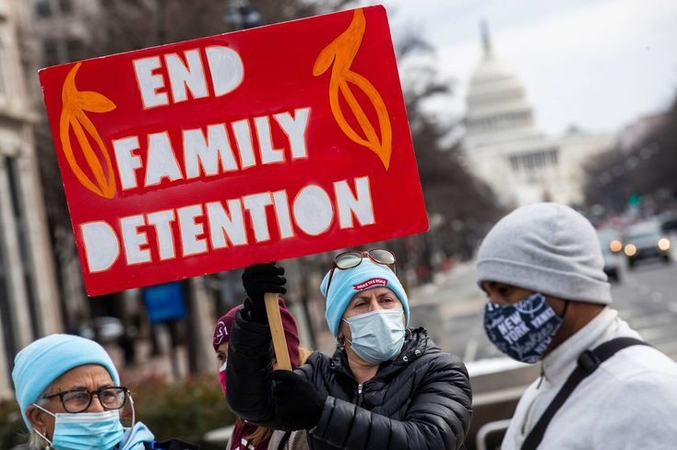
Texas family detention centers expected to transform into rapid-processing hubs #SootinClaimon.Com

#SootinClaimon.Com : ขอบคุณแหล่งข้อมูล : หนังสือพิมพ์ The Nation.

https://www.nationthailand.com/news/30403347

Texas family detention centers expected to transform into rapid-processing hubs

InternationalMar 05. 2021

By Maria Sacchetti, Nick Miroff, Silvia Foster-Frau
The Washington Post

WASHINGTON – The Biden administration is preparing to convert its immigrant family detention centers in South Texas into Ellis Island-style rapid-processing hubs that will screen migrant parents and children with a goal of releasing them into the United States within 72 hours, according to Department of Homeland Security draft plans obtained by The Washington Post.

The plans show the Biden administration is racing to absorb a growing number of migrants crossing the U.S.-Mexico border amid shortages of bed space and personnel. Republicans and some Democrats fear that relaxing detention policies will exacerbate a surge that is already straining the Biden administration.

Russell Hott, a senior official with Immigration and Customs Enforcement, notified staff of the rapid-processing plan in an email Thursday that said arrivals by unaccompanied minors and families this year “are expected to be the highest numbers observed in over 20 years.”

If U.S. border officials continue to take in more than 500 family members per day, the change in use to the family detention centers “may not be sufficient to keep pace with apprehensions,” Hott warned in his email, which was reviewed by The Post.

Individuals who cannot be housed in one of the rapid-processing centers may need to be placed in hotels, Hott wrote. MVM, an ICE contractor, will help transport the families to hotels if there is no longer capacity at the rapid-processing centers, he said, adding that the company plans to use hotels in McAllen and El Paso, Texas, and Phoenix.

“We welcome the change, because the detention of families – we never thought that was a good system or a good policy at all,” said Edna Yang, co-executive director of American Gateways, an immigration legal aid organization in Texas. “They shouldn’t be detained, and they should be given the opportunity to go before the immigration judge and be released in the community and not held like prisoners.”

The plans come as Republicans are criticizing President Joe Biden for relaxing immigration policies, saying he could encourage more migrants to travel to the border.

“There is no question there’s a crisis at the border,” Rep. James Comer, R-Ky., said Thursday on Fox News. “It’s Joe Biden’s fault. Joe Biden has signaled to the world that he’s not going to take border security seriously.”

Transforming family detention amounts to a wholesale repudiation of not only Donald Trump’s policies but also Barack Obama’s and presents a significantly different vision of how to handle the fast-changing character of mass migration at the southern border.

For decades, single adults – particularly men – dominated the flows northward into the United States, but the number of families and minors traveling without their parents has increased substantially in recent years. Before the coronavirus pandemic, migrant families and unaccompanied minors were a majority of those taken into custody at the southwest border, a trend that more closely resembles refugee streams worldwide.

During the Obama and Trump administrations, most families were quickly released or deported. But some were held in dormitory-style facilities for weeks or months, if not longer, for immigration proceedings. Advocates for these families have long said they are fleeing violence and poverty and shouldn’t be detained at all – a sentiment Biden echoed on the campaign trail last year.

“Children should be released from ICE detention with their parents immediately,” Biden wrote on Twitter in June. “This is pretty simple, and I can’t believe I have to say it: Families belong together.”

Six weeks into Biden’s presidency, advocates are frustrated that his administration has continued to detain families and expel them from the border under a public-health order. The number of detained family members more than doubled, from 228 adults and children before Biden took office to 476 last week, federal records show.

Although the tally is a fraction of the combined capacity of 3,300 people at three family residential centers, the uptick baffled child-welfare advocates who hoped that the detention centers would finally close. They noted that Biden and Alejandro Mayorkas, now the homeland security secretary, helped to expand use of these detention centers during the Obama administration.

“There needs to be open expression of what they’re going to do with these facilities,” said Bridget Cambria, a lawyer representing migrant families in Pennsylvania. “They shouldn’t detain families or children even for one second.”

ICE oversees three family residential centers for immigrants facing deportation: the 96-bed Berks Family Residential Center in Leesport, Pa., and a pair of larger facilities outside San Antonio, a 2,400-bed center in Dilley and an 839-bed center in Karnes City.

The Biden administration has said it is reviewing the way it uses family detention facilities and told a federal judge last week in a lawsuit over the detentions that the policies had not changed.

“A detention center is not where a family belongs,” Mayorkas told NBC News in an interview this week, hinting at the plans.

DHS officials, speaking on the condition of anonymity to describe the unpublicized plans, said the transition to rapid-release centers is already underway.

ICE emptied out the Berks center Feb. 26, releasing all 21 people there. ICE confirmed that the facility is empty but would not say why.

Officials are considering turning Berks into a women-only center, a DHS official said, while Dilley and Karnes would serve as quick-release intake facilities that would screen migrant families, check their backgrounds and release them pending an immigration court hearing. Some would enroll in “alternatives to detention,” such as ankle-monitoring programs. Families would undergo coronavirus testing, and nonprofits would then help them secure airplane or bus tickets to their final destinations in the United States, typically with relatives or friends.

The goal is to process and release 100 families per day, the plans show. Migrants who test positive for the coronavirus would be quarantined for 10 days.

Advocates for immigrants have cheered the preliminary plans in recent days – albeit cautiously because DHS has not made a formal announcement.

In Texas, advocates said the region’s top immigration officials held an emergency conference call with them on Feb. 20 to discuss plans to transform the centers into shorter-term facilities. Officials told them to prepare for more migrants to be released from Dilley and Karnes.

“It’s incredibly encouraging to hear a completely different philosophy and attitude for people coming into this country,” said Daniel Klein, board chairman for the Interfaith Welcome Coalition, who was on the call, which was first reported by the San Antonio Express-News.

Klein said that the nonprofit has added more volunteers at the bus station in downtown San Antonio to help migrants find shelter or make travel plans and that it has sometimes spent $1,000 a night on food, water and bus tickets.

Biden has pledged to create a more humane immigration system and restore the asylum process, but he is also eager to skirt a border crisis that could imperil his legislative agenda, including an effort to legalize 11 million longtime undocumented immigrants.

Some Democrats from southern border communities worried that rising migration would burden communities reeling from the coronavirus and a winter storm that cut power to millions and killed more than 30 in Texas.

“Our country is currently unprepared to handle a surge in migrants in the middle of this pandemic,” Rep. Henry Cuellar, D-Texas, tweeted Thursday. “I urge the Biden administration to listen and work with the communities on the southern border who are dealing with this influx. Inaction is not an option.”

The Biden administration has not detailed how it would handle another influx.

In 2014 – when Biden was vice president and Mayorkas was deputy DHS secretary – the United States received an influx of 68,000 families, up from 14,800 the year before. At the time, Biden said the “crisis” was “untenable and unsustainable,” and he and Mayorkas worked to stem flows from Central America and expanded family detention by opening the facilities in Dilley and Karnes. Mayorkas said then that he would ensure that “the detention of adults with children is done as humanely as possible.”

After the centers expanded, the number of migrant families apprehended at the border dropped below 40,000, but detention did not stop the flows. After a judge ruled that officials could not detain children in unlicensed facilities for more than 20 days, the numbers began to rise again.

Advocates for immigrants said detention had little impact because of the severe conditions in Central America and the Caribbean that are driving migrants north, such as violence, climate change, poverty and government corruption.

The numbers have only continued to grow.

More than 470,000 migrant families and 76,000 unaccompanied minors arrived in fiscal 2019, a record on both counts, and most were released into the United States pending a court hearing.

Dora Schriro, who led ICE’s office of detention policy and planning, said ICE’s experience with family detention shows that it is harmful to children and their parents by placing them in conditions where they are afraid. She said she reduced the capacity in Pennsylvania to 84 beds before leaving in 2009.

After the Obama administration expanded the detention centers to more than 3,300 beds, she said, DHS asked her and others to issue recommendations in a report published in late 2016. Their first recommendation: “Detention is never in the best interest of children.”

“DHS should discontinue the general use of family detention, reserving it for rare cases when necessary,” such as because someone is a flight risk or a danger to the community, the report said.

Soon after, Trump took office. He sought to detain families and separated parents from their children in a failed attempt to stem the rising flows of migrants.

Schriro said the Biden administration faces dual challenges at the border: keeping its international obligations to offer refuge to people feeling harm, and making sure Americans are safe.

“You’ve got two really critical commitments, and this administration is finding a path to honor both of those obligations,” she said. “The trick is not sacrificing one for the other.”