Moderate Senate Democrats target state aid fund in Biden covid relief bill #SootinClaimon.Com

#SootinClaimon.Com : ขอบคุณแหล่งข้อมูล : หนังสือพิมพ์ The Nation.

https://www.nationthailand.com/news/30402985

Moderate Senate Democrats target state aid fund in Biden covid relief bill

InternationalFeb 24. 2021

By The Washington Post · Erica Werner, Jeff Stein, Seung Min Kim

WASHINGTON – Even as the House prepares to pass President Joe Biden’s $1.9 trillion coronavirus relief bill this week, divisions are growing among Senate Democrats over state aid and a $15 minimum wage – raising the prospect the bill might have to change significantly to pass the Senate.

Biden himself has forcefully defended his legislation in recent days, asking critics, “What would they have me cut?” Democratic senators, it turns out, have plenty of ideas.

Democrats’ proposal would devote hundreds of billions of dollars to extending unemployment benefits through August and approving another round of stimulus payments at $1,400 per person, as well as devoting billions to vaccine distribution, housing and nutritional assistance, in addition to raising the minimum wage and helping states and local governments.

Sen. Joe Manchin III, D-W.Va., who has been a vocal skeptic of raising the current $7.25 federal hourly minimum wage to $15 an hour, as proposed by Biden, told reporters this week he hopes to amend the legislation to boost the minimum wage to $11 an hour instead.

Several Democratic senators are working on changes to the portion of the bill on state and local aid, including redirecting some of the money to invest in infrastructure to expand the broadband network.

Sen. Kyrsten Sinema, D-Ariz. – who has also opposed the $15 minimum wage increase – has been working to include more funding for small restaurants in the legislation, as well as lobbying for other provisions to help her state.

“Any money we spend needs to be focused where it would do the most good,” Sen. Jon Tester, D-Mont., said at a hearing Tuesday, telling reporters later: “I think it’s part of our job to put our fingerprints on this package so it does the most good.” Tester said that he’s been in touch with some other senators and that he wants to be prepared for a possible amendment process.

White House press secretary Jen Psaki acknowledged Tuesday the legislation may change and declined to rule out Biden signing a final bill that included an $11 minimum wage instead of the $15 he initially proposed. Any changes sought by moderates could run into resistance from liberal lawmakers and party leaders who have insisted on keeping the $15 an hour minimum wage plan in the bill.

“There’s going to be a process that works its way through the Senate. We don’t even know where it’s going to end up,” Psaki said.

Administration officials and lawmakers in both parties are currently awaiting guidance from the Senate parliamentarian on whether the minimum wage provision can even remain in the legislation under the complex Senate rules governing its consideration. A decision could come in the next day or two.

In the House, meanwhile, the legislation passed the Budget Committee on a party-line vote Monday. Lawmakers and aides are now preparing it for consideration on the floor, which could come Friday or Saturday.

The bigger hurdles are expected to come in the Senate, where the minimum wage has been a flash point, although attention is also focusing on the $350 billion for state and local governments in the legislation. The disputes could complicate plans by Biden and Democratic leaders to get the legislation signed into law ahead of a March 14 deadline when enhanced unemployment insurance benefits will expire without action.

A group of centrist lawmakers has been working on changes to the state and local aid portion of the bill as criticisms have intensified that some of that funding could be better spent to boost the economy more directly. Those suggestions are expected to soon be presented to Senate Majority Leader Charles Schumer, D-N.Y., one person familiar with the matter said, speaking on the condition of anonymity because the discussions were private.

Senior Democratic lawmakers have grown concerned that some states, upon receiving the federal aid, could cut local taxes rather than spend the money on needs related to the coronavirus pandemic.

“We could distribute billions to the states, and they turn around and lower taxes – there are governors talking about that, and it’s not the point here . . . there should be a prohibition against voluntarily diminishing revenues,” Sen. Angus King, I-Maine, said in an interview.

King suggested $50 billion of the $350 billion state aid portion be repurposed for broadband. Sen. Mark Warner, D-Va., made a similar suggestion during a hearing with Federal Reserve Chair Jerome Powell on Tuesday, saying, “I hope the current package can be changed to include a sizable investment in broadband.”

Mark Zandi, chief economist at Moody’s Analytics, published a report this weekend showing the state and local shortfall amounted to approximately $60 billion through fiscal 2022, when accounting for already approved federal support. Zandi said in an interview that he sent the analysis to White House officials, who have repeatedly cited his economic reports.

“There’s still a lot of uncertainty in these estimates, but $100 to $150 billion would be appropriate given the circumstances. That’s well shy of the $350 billion they have penciled in the legislation,” Zandi said.

Zandi said the money should be repurposed for infrastructure spending as a better way to restore full employment and long-term economic and productivity growth. “Say they would go to $150 billion for state and local aid – that would give them $150 billion for infrastructure,” Zandi said.

Jason Furman, a former senior Obama administration official, also said in an interview that some of the state aid funding could be better spent elsewhere or more precisely structured.

“The state fiscal relief total [in the bill] exceeds the amount states immediately need,” Furman wrote in a text message. “It should either be better defined by focusing on what it should be spent on, like infrastructure or broadband; what it should not be spent on (like tax cuts); or the total should be reduced.”

Officials representing cities and counties are gearing up to lobby to protect the state and local funding in the bill. They have been arguing for months that the $150 billion distributed to states from the Cares Act last March was woefully inadequate for their needs, especially because only the largest localities could get direct funding; that restriction does not exist in the legislation Biden proposed.

Tom Cochran, CEO and executive director of the U.S. Conference of Mayors, said some reports that reflect states rebounding economically mask how dire the situation is for cities across the country.

Labor groups and other advocates are closely watching moderate Senate Democrats and urging them to support the state and local aid funding in Biden’s bill, according to Cochran.

“There is no indication from the House side or the White House that is not totally supporting the fiscal support for state and local governments. But the Senate throughout the pandemic has left state and local aid on the cutting-room floor. That’s where the drama is going to be,” he said. “You have to have the Democrats stand with the president to withstand this pressure. We have to make sure these senators stay with the president.”

A White House spokeswoman said the Biden plan reflected the needs of states and cities, citing the administration’s extensive conversations with local officials. The Center on Budget and Policy Priorities, a left-leaning think tank, said states, cities and U.S. territories face a revenue shortfall of about $300 billion through 2022.

The focus on moderate Senate Democrats comes after Biden’s initial courtship of a group of 10 Senate Republicans went nowhere.

Sen. Susan Collins, R-Maine, who led a group of Republicans in a meeting at the White House about the relief package, said that talks with the White House have stalled and that GOP lawmakers are now considering amendments to the package.

“The administration has not indicated a willingness to come down from its $1.9 trillion figure. And that’s a major obstacle,” Collins said. “Unfortunately, the White House seems wedded to a figure that really can’t be justified. . . . So what we’re looking at now is whether there are changes that we could make.”

Senate Minority Leader Mitch McConnell, R-Ky., said Tuesday that Biden has an “A+ personality” but that Republicans are “unified in opposition” to what he decried as a partisan bill.

Vaccine delays threaten economies hardest hit by pandemic #SootinClaimon.Com

#SootinClaimon.Com : ขอบคุณแหล่งข้อมูล : หนังสือพิมพ์ The Nation.

https://www.nationthailand.com/news/30402983

Vaccine delays threaten economies hardest hit by pandemic

InternationalFeb 24. 2021A health-care worker carries a container of Pfizer-BioNTech coronavirus vaccines in Bogota, Colombia, on Thursday, Feb. 18, 2021.A health-care worker carries a container of Pfizer-BioNTech coronavirus vaccines in Bogota, Colombia, on Thursday, Feb. 18, 2021.


By Syndication Washington Post, Bloomberg · Andrew Rosati

Latin America and the Caribbean, the region where the coronavirus caused the most pronounced economic destruction and more than a quarter of the world’s deaths, is falling victim to a slow inoculation campaign.

Political fights and production bottlenecks are stymieing Brazil’s vaccination efforts. Mexico is struggling to source doses as its death toll surpasses India’s. Colombia only began administering shots last week.

Such sluggishness alongside a recent spike in infections risks hampering an already slow economic recovery.

“If vaccination and public health policy don’t succeed at reversing the trend that we’ve seen in recent months, clearly this recovery is at risk,” Alejandro Werner, the International Monetary Fund’s Western Hemisphere director, said this month.

Latin America’s economic rebound was wobbling after a new round of lockdown measures in response to the surge in cases that began around the late-2020 holidays. Since January, JPMorgan Chase & Co. trimmed its first quarter growth forecasts for Argentina, Brazil, Chile, Colombia and Mexico, citing concerns of rising case load and new restrictions.

The region contracted by more than 7% last year, according to the IMF, the most in the world. The fund does not see output returning to prepandemic levels until 2023, and this year is off to a rocky start.

In December, Brazilian retail sales suffered their biggest drop for the month on record, included in a sharp slowdown in Latin America’s largest economy. Meanwhile, Mexico saw its recovery lose steam as growth slowed to 3.1% from 12.1% over the last two quarters of 2020.

– – –

Activity is expected to pick up this year, but a strong rebound depends on vaccines becoming more widely available in the coming months. Underscoring the importance of an efficient vaccine rollout, investors are already rewarding Latin America’s only success story: Chile, which is on pace to vaccinate 75% of its population in six months, according to Bloomberg’s Vaccine Tracker.

This month, Moody’s Investors Service and Spain’s Banco Santander revised upward their growth forecasts for Chile, setting it apart from its neighbors. Its economy will recover to prepandemic levels three to six months earlier than most other countries in the region, according to Nikhil Sanghani, an economist at Capital Economics in London.

The Chilean peso has led gains among regional peers, rallying more than 3% this month.

Other countries in the region are nowhere close. At the current rate, Brazil would take 2 1/2 years to reach the 75% level of vaccination, which is the threshold experts say is needed for a return to normality. Mexico would take 3.6 years, and Argentina would take over a decade. The United States, in contrast, is projected to reach that level by the end of the year.

This outlook may improve over the next few weeks as some of the “teething problems” with the vaccine rollout start to ease, Sanghani said.

Delays in deliveries have sent countries that relied heavily on particular vaccines, such as Mexico and Colombia, running to make last-minute contracts with competitors. Argentina is trying to produce more locally.

After dragging its feet for months in making orders, the administration of Brazilian President Jair Bolsonaro is running out of doses to sustain its vaccination campaign, leading nine state capitals including Rio de Janeiro to suspend immunizations.

– – –

The holdups in the vaccination drive are not all self-inflicted.

From the start, poorer countries have been pushed to the back of the line by wealthier ones that quickly sealed deals with drugmakers, or are now commandeering vaccinations produced in their territory for their own citizens.

Much of the Caribbean and Central America are weeks away from kicking off their campaigns. Jamaica’s Prime Minister Andrew Holness last month accused rich countries of “hoarding” vaccines.

Economists watching mobility trends are bracing for another hit to activity caused by people once again staying home and businesses closing shop. Chile aside, they remain skeptical about restrictions relief for the rest of the region given their slow start and distance from major vaccine distributors.

“Richer countries already started to buy out everything they could, only leaving breadcrumbs for the rest,” said Joan Domene, a Mexico City-based economist for Oxford Economics.

Huawei: COVID-19 closed many doors, but innovation offers a window of hope #SootinClaimon.Com

#SootinClaimon.Com : ขอบคุณแหล่งข้อมูล : หนังสือพิมพ์ The Nation.

https://www.nationthailand.com/news/30402975

Huawei: COVID-19 closed many doors, but innovation offers a window of hope

InternationalFeb 23. 2021

By THE NATION

Breakthroughs in technical innovation promise to make life better, businesses smarter, and the world more inclusive

[Shanghai, February 23, 2021] At the opening ceremony of Mobile World Congress Shanghai 2021, Huawei’s Deputy Chairman Ken Hu spoke about the huge impact that COVID-19 has had on countries, enterprises, and people around the world, as well as the role technology plays in combatting the pandemic.

Ken Hu

Ken Hu

“Innovation isn’t just about solving the challenges we face today,” said Hu. “It’s about lighting up tomorrow. Once we get the pandemic under control, we need to think hard about how we can innovate to improve quality of life, make businesses smarter, and create a more inclusive world.” He explained that, while unequal access to digital technology and digital skills has widened the digital divide, the pandemic has made the situation significantly worse. “We have to focus innovation on bridging the gap between the haves and have-nots, and on driving digital inclusion”.

COVID-19 has created many new requirements for digital infrastructure. Over the past year, Huawei has worked closely with carriers to ensure the stable operations of more than 300 networks across 170 countries. In Indonesia, Huawei employed a new digital delivery technology to rapidly deploy over 50,000 base stations. In Ningxia, China, Huawei’s integrated routers enable multi-cloud access for enterprise users, helping them move to cloud more rapidly – and at lower cost. “As we look towards recovery,” Hu said, “we need to ensure that innovation isn’t just about today. It’s about lighting up tomorrow and creating greater social value.”

Innovating for better quality of life
During his keynote, Hu showed the audience Huawei’s Cyberverse app, an advanced AR application that demonstrates how 5G networks, 5G devices, and AR technology can converge to create a more immersive virtual experience, whether it be a lifelike forest or a simulation in outer space. The new app makes it possible to seamlessly integrate virtual and physical realities with high-precision, centimeter-level positioning capabilities, massive computing power, and high-bandwidth transmission through 5G. Huawei expects Cyberverse to create many new growth opportunities in multiple sectors, including education, entertainment, tourism, transportation, and navigation.

Innovating for smarter business
In recent years, technologies like 5G, cloud, and AI have begun playing an important role in manufacturing, accelerating the transition to more intelligent and flexible operations. Hu explained how Huawei’s own Dongguan South Factory is currently using 5G networks with cloud-based AI applications in its 5G smartphone production lines to drive huge productivity gains.

Opportunities abound in the digital transformation space. Huawei predicts that, by 2025, 97% of all large companies will use AI. Other estimates for 2025 include that 55% of China’s entire GDP will be driven by the digital economy, and 60% of global carrier revenue will be derived from industry customers. Hu noted that, to achieve these projections, “all industries should focus on improving their capabilities, building out the ecosystem, and creating value with digital technology.”

As an ICT infrastructure provider, Huawei has been focusing heavily on 5G innovation to help drive the digital transformation of all industries. Hu noted that Huawei’s innovation is focused on three areas: technology, products, and applications.

• Technology: Huawei’s new 5G Super Uplink solution delivers unmatched uplink speeds, helping companies break through a major bottleneck in industrial Internet.

• Products: Huawei’s fully converged 5G edge computing products have sped up deployment of edge computing sites by a factor of 10.

• Applications: Huawei’s Wireless X Labs incubates 5G applications with partners across a wide range of domains like manufacturing, healthcare, finance, and transportation. With these partners, Huawei is exploring how 5G can help different industries go digital more effectively.

Huawei is also working closely with customers and partners to drive innovation in 5G. The company is currently working with ecosystem partners to develop devices targeted at meeting specific industry needs. Through joint innovation and strategic partnerships with its customers, Huawei aims to drive 1 to N expansion of 5G applications for business. The company is also working to coordinate 5G communication and industry standards to more rapidly scale up 5GtoB applications.

Hu reported that, in collaboration with its partners and regional carriers, Huawei has signed more than 1,000 contracts for industrial 5G applications in more than 20 industries.

Innovating for a more inclusive world
While pivoting to address the pandemic, Hu warned that the world faces a real risk of K-shaped economic recovery once COVID-19 is brought under control. He predicts an increasingly wide divide between organizations and people who actively benefit from digital technology and those who do not. In order to avoid unbalanced development, bridge the digital divide, and promote inclusive growth, Hu emphasized that the focus of innovation needs to shift to producing greater social value.

The company has put its money where its mouth is. Through a partnership with Ghanaian operators on a rural network infrastructure project, Huawei currently plans to deploy more than 2,000 RuralStar base stations in remote regions around the country. This will help increase mobile coverage in Ghana from 83% to 95% and bring previously unconnected communities online for the first time.

Similarly, new AI services deployed on HUAWEI CLOUD are being used to help a small company in Malaysia double its production capacity without increasing headcount during the pandemic.

Hu also shared how 5G networks have been used to enable remote ultrasounds and CT scans that help address imbalanced distribution and shortages of medical resources.

Closing out his speech, Hu stressed that, while the pandemic closed many doors, innovation has opened new windows of hope. He concluded that, through ongoing innovation, Huawei will continue to pursue open partnerships with its customers and partners to help industries go digital and make life better, businesses smarter, and the world more inclusive.

At this year’s MWC Shanghai, Huawei is showcasing in Hall N1 seven new ICT network concepts, including Wireless 1+N, Home+, All-optical Bases, and Cloud-network Smart Connections, as well as nine new products and solutions, including ultra-simplified sites, gigabit home broadband, premium private lines, and intelligent cloud networks.

MWC Shanghai 2021 runs from February 23 to February 25 in Shanghai, China. Huawei’s products and solutions can be found at booth E10, E50, and E90 in Hall N1 in the Shanghai New International Expo Centre (SNIEC). For more information, please visit https://carrier.huawei.com/en/events/mwcs2021.

The Smithsonian is turning 175. It’s celebrating with robots, flying cars and hope. #SootinClaimon.Com

#SootinClaimon.Com : ขอบคุณแหล่งข้อมูล : หนังสือพิมพ์ The Nation.

https://www.nationthailand.com/news/30402939

The Smithsonian is turning 175. It’s celebrating with robots, flying cars and hope.

InternationalFeb 23. 2021The Smithsoanian's Future event will reopen the AIB, the 1881 structure that was the institution's first dedicated exhibition space. It has remained closed to the public since 2004. MUST CREDIT: Washington Post photo by Matt McClainThe Smithsoanian’s Future event will reopen the AIB, the 1881 structure that was the institution’s first dedicated exhibition space. It has remained closed to the public since 2004. MUST CREDIT: Washington Post photo by Matt McClain

By The Washington Post · Peggy McGlone

WASHINGTON – Smithsonian Secretary Lonnie Bunch likes to tell museum visitors that looking to the past can help them understand the future. To celebrate its 175th anniversary, the Smithsonian is turning that idea on its head by focusing on the future to celebrate its past.

“Futures” is a groundbreaking, multidisciplinary exhibition that will blend art, science, design, history and technology in a celebration of the world’s largest museum complex. Part festival, part exposition, part exhibition, “Futures” was created during a worldwide pandemic – but it nonetheless offers a hopeful glimpse of what lies ahead.

Opening in November and running through July 2022 at the Smithsonian’s Arts and Industries Building, “Futures” will include site specific art installations, a wetlands exhibit, a flying car and – of course – robots. It will help visitors imagine the future they want, not the one they fear, said Rachel Goslins, AIB’s director and the visionary behind the project.

“We have plenty of models that help us imagine what could go wrong. We don’t have a model to help us imagine what could go right,” Goslins said. “The future isn’t a fact. It’s a dream. We will help you understand and think and experience the future that you want to live. It’s hopeful without being naive.”

The event will reopen the AIB, the 1881 structure that was the institution’s first dedicated exhibition space and the incubator of the American History, Natural History and Air and Space museums. Nicknamed the Mother of Museums and the Palace of Invention, the building is a playful space, “a circus tent made of bricks,” Goslins said. She added that it’s the perfect site for an exploration of the future that’s tied to the Smithsonian’s past.

“The Smithsonian was always about how it could help the country reimagine itself, understand itself,” said Bunch, a historian and founding director of the popular National Museum of African American History and Culture. “The work we did with early aviation, even the way we collect history, which was always trying to ensure future generations understand how we got where we are.

“The notion is to help people recognize that they create the future. Often we think technology and everything sweeps over us, and that’s partly true, but we can also ruminate about what we want the future to be.”

"The future isn't a fact. It's a dream," said Rachel Goslins, director of the Smithsonian Arts and Industries Building, about the "Futures" exhibition. MUST CREDIT: Washington Post photo by Matt McClain

“The future isn’t a fact. It’s a dream,” said Rachel Goslins, director of the Smithsonian Arts and Industries Building, about the “Futures” exhibition. MUST CREDIT: Washington Post photo by Matt McClain

“Futures” serves as a dress rehearsal for the AIB’s own future. A $55 million renovation completed in 2015 allowed it to host a few special events, but it has remained closed to the public since 2004. This spring, the Smithsonian announced a plan to renovate both the AIB and the Castle, the iconic administration building next to it on the southern edge of the National Mall. The AIB is also a potential site for the newly authorized National Museum of the American Latino.

Curators Glenn Adamson, Ian Brunswick, Brad MacDonald, Ashley Molese and Monica O. Montgomery have been collaborating for more than a year on the exhibition, tapping into the Smithsonian’s deep collections and experts to create immersive and interactive displays. The Rockwell Group, an award-winning architectural firm whose résumé includes Tonys for scenic design and an Emmy for art direction, designed the 32,000-square feet of exhibits.

“Futures” is organized in four sections, each housed in one of the AIB’s main halls. It opens with “Past Futures,” where artifacts and objects from across the Smithsonian – some on display for the first time – offer a view of how previous generations saw the future.

“The Smithsonian is an engine of the future, it has always recognized itself as that,” said Adamson, curator of this section. Visitors will encounter early androids, an experimental Alexander Graham Bell telephone and the Bakelizer, an early 20th-century machine used to produce commercial quantities of plastic.

“Futures that Inspire” features artificial intelligence that promotes meditation, while “Futures that Work” focuses on food, work and sustainability. It will include an algae bioreactor that cleans as much air as a 400-acre forest. “Futures that Unite” focuses on social themes, including justice and health.

“We’re approaching the future with a sense of adventure, of playfulness,” Adamson said. “It’s not all about hardnose problem-solving but leaps of imagination.”

Smithsonian curators anticipate the exhibition will be a tonic for visitors who - they hope - will be emerging from the worst of the pandemic. MUST CREDIT: Rockwell Group handout

Smithsonian curators anticipate the exhibition will be a tonic for visitors who – they hope – will be emerging from the worst of the pandemic. MUST CREDIT: Rockwell Group handout

Visitors will be encouraged to share their ideas and opinions, Montgomery added.

“We want people to feel a sense of agency and hope when they go through our halls. There will be areas for people to be contemplative and areas for speaking out,” she said. “We know there’s not just one approach to the future. It’s multifaceted, multivocal. It envisions equity and sustainability. It’s asking juicy questions rather than prescribing what will be. We’re counting on the brilliance of our audience.”

The approach – collaborative, diverse, cross-disciplinary – is perhaps a model for future exhibitions, Goslins said.

“The thrust of the exhibition is curiosity, not education. One of the ways I think we push the envelope is to create an exhibition that listens as much as it speaks. In general, in museums, there’s a lot of broadcasting and not as much listening. This is a good example of how to democratize, to open a platform for outside voices.”

The exhibition’s optimistic attitude was informed by 2020’s dual crises of the pandemic’s shutdowns and the national protests for racial justice. The final version – shaped by a team that never met in person – emphasizes health and social justice themes and is touch-free.

“The show was devised as having an optimistic cast from the beginning, pre-covid. But the pandemic made us lean in even more,” Adamson said.

A support robot that reduces loneliness was a covid addition to an expanded health section. The curators also emphasized their visitors’ role in shaping the future, an extension of last year’s social protests.

“We want visitors to come and make their mark. We can channel that energy in this space where you are committing to taking personal action,” Montgomery said. “Don’t be so depressed by this moment that you can’t even dream of a brighter future.”

The curators anticipate the exhibition will be a tonic for visitors who – they hope – will be emerging from the worst of the pandemic.

“In November, we’ll be coming out of this dark time, and it will feel super timely. It will feel very right to people.”

Adamson’s optimism aside, the Smithsonian has learned that the pandemic is unpredictable, and it has contingency plans in place if there’s a coronavirus setback. The exhibition will follow Smithsonian guidance and policies, and the safety of the staff and visitors is the priority, an AIB spokeswoman said. The AIB is large and open, and the exhibit features touchless interactive technology and an extensive mobile experience.

Officials haven’t announced exact dates of the run or daily schedules yet, and it has not determined whether visitors will be required to have free timed passes for entry. That information, and a schedule of in-person and virtual events, will be released later in the year on the AIB website.

Texans slammed by thousand-dollar power bills after storm #SootinClaimon.Com

#SootinClaimon.Com : ขอบคุณแหล่งข้อมูล : หนังสือพิมพ์ The Nation.

https://www.nationthailand.com/news/30402936

Texans slammed by thousand-dollar power bills after storm

InternationalFeb 23. 2021A truck drives down the street during a power outage in McKinney, Texas, about 30 miles north of Dallas, on Feb. 16, 2021. MUST CREDIT: Bloomberg photo by Cooper NeillA truck drives down the street during a power outage in McKinney, Texas, about 30 miles north of Dallas, on Feb. 16, 2021. MUST CREDIT: Bloomberg photo by Cooper Neill

By Syndication Washington Post, Bloomberg · Yueqi Yang, Naureen S. Malik

After a week of Arctic storms, hunger and cold, some Texans lucky enough to have power were handed another pain point: massive electricity bills.

Houston resident David Astrein, 36, a human resources director at a manufacturing company, said he’s been charged $2,738.66 for 20 days this month, compared with $129.85 for the whole of January for a three-bedroom home with a detached garage. He and his wife stopped using their dishwasher, washer and dryer, and turned on as few lights as possible at night. They kept the heat on for their 5-month old son.

His bill for the month is set to exceed $3,000, according to his provider Griddy Energy.

Astrein is one of a swath of consumers facing sky-high payments after the storm, with many posting electricity bills as high as $8,000 on social media. According to their screenshots, most are customers of Griddy, a supplier with a unique business model.

The Macquarie Energy-backed company charges electricity based on real-time prices in wholesale power markets, therefore exposing consumers to the full swings. Griddy saw the problem developing and even urged its retail customers last weekend to switch to another provider. By Sunday last week, 20% managed to do so. But not Astrein.

“We were stuck with Griddy and those astronomical prices,” he said by phone. “The failure in Texas as a whole to plan for this adequately is now a financial emergency for all of these customers on a program like Griddy.”

For Griddy, that business model meant it got only a very small cut of Astrein’s bill.

“I want to highlight that on the $2,738.66 total bill, Griddy only made $6.48,” Chief Executive Officer Michael Fallquist said in a text message. “We only make $9.99 per month. All other charges are a pass-through.”

But for some Griddy watchers, the furor comes as scant surprise after the scorching summer of 2019 also resulted in eye-watering bills. The phenomenon is unique to Texas, where the retail power industry is entirely deregulated.

Pulse Power LLC went a step further in trying to convince clients to conserve electricity — it offered clients who curbed usage by 10% over three days the chance to win a Tesla Model 3. The raffle is set for the first week of March.

Rob Cantrell, the company president, said his customers, both commercial and retail, would see relatively limited increases in their bills.

“Customers on certain types of plans will be devastated, but almost all of our customers are on fixed plans, which will see a small increase for the month,” he said.

CPS Energy, the city-owned gas and power provider in San Antonio, said on Twitter that it was looking at allowing customers to spread their payments over 10 years or longer. The plan wasn’t received well, with angry comments ranging from “Ridiculous” to “Are you out of your minds?”

Texas Gov. Greg Abbott, R, held an emergency meeting Saturday with legislators on the issue. Rep. Michael McCaul, R, said Sunday that the current plan is to use federal assistance funding to help homeowners with both post-storm repairs, such as for water damage and pipe bursting, and surprise electricity bills.

Assistance from the federal government is “what Texans need right now so desperately,” he said on CNN’s “State of the Union.”

But Houston Mayor Sylvester Turner, D, said the state of Texas should pay for the “exorbitant costs” of repairs and bills for consumers, in a Sunday interview on CBS’ “Face the Nation.”

State Attorney General Ken Paxton has already opened a probe into the power failures and issued civil investigative demands to companies including Griddy.

For now, the state’s Public Utility Commission ordered retailers to not disconnect customers who haven’t paid their bills, particularly on a Sunday.

In a Feb. 18 blog post, Griddy said the prices were sky high because the Public Utility Commission of Texas forced wholesale prices to $9 a kilowatt-hour, about 300 times more than normal.

“We know you are angry and so are we,” the blog said. “We intend to fight this for, and alongside, our customers for equity and accountability.”

Griddy said Friday it was seeking relief from the Electric Reliability Council of Texas, or ERCOT, and the PUCT for customers who were exposed to the high prices.

As power is restored in Texas, new websites have sprung up to help organize potential class-action lawsuits. At least four of the new domains signal the target may be ERCOT, which says it operates about 75% of the state’s electricity.

Astrein plans to pay the bill out of his own funds, and on Sunday managed to switch providers. It will take up to 72 hours to take effect.

Alibaba, Pinduoduo take on China’s looming food crisis #SootinClaimon.Com

#SootinClaimon.Com : ขอบคุณแหล่งข้อมูล : หนังสือพิมพ์ The Nation.

https://www.nationthailand.com/news/30402935

Alibaba, Pinduoduo take on China’s looming food crisis

InternationalFeb 23. 2021The Fuxin Farm is shown in an aerial photograph in Longyan, Fujian province, China, on Nov. 18, 2020. MUST CREDIT: Bloomberg photo by Qilai ShenThe Fuxin Farm is shown in an aerial photograph in Longyan, Fujian province, China, on Nov. 18, 2020. MUST CREDIT: Bloomberg photo by Qilai Shen

By Syndication Washington Post, Bloomberg · Coco Liu

The battle to supply 1.4 billion people with fresh fruit and vegetables is taking China’s e-commerce companies into the country’s hinterlands, where they are attempting to revolutionize centuries-old agricultural practices to secure future supply for their burgeoning online grocery businesses.

Xi Jinping’s government has long made self-sufficiency in food a “top state issue” as it seeks to avert a looming food crisis. The need to modernize China’s 200 million largely small-scale farms took on added urgency during the pandemic, when output and logistics disruptions coincided with homebound shoppers turning to Alibaba Group Holding Ltd. and other internet retailers for their produce.

Now, some of the country’s largest private companies have joined in with state efforts to help growers boost production, improve food quality and lower prices. For the e-commerce giants, it’s one way of strengthening their foothold in an online grocery market that’s expected to be worth more than $120 billion by 2023, without running afoul of Beijing’s recent crackdown on monopolistic practices like predatory pricing and forced exclusivity arrangements.

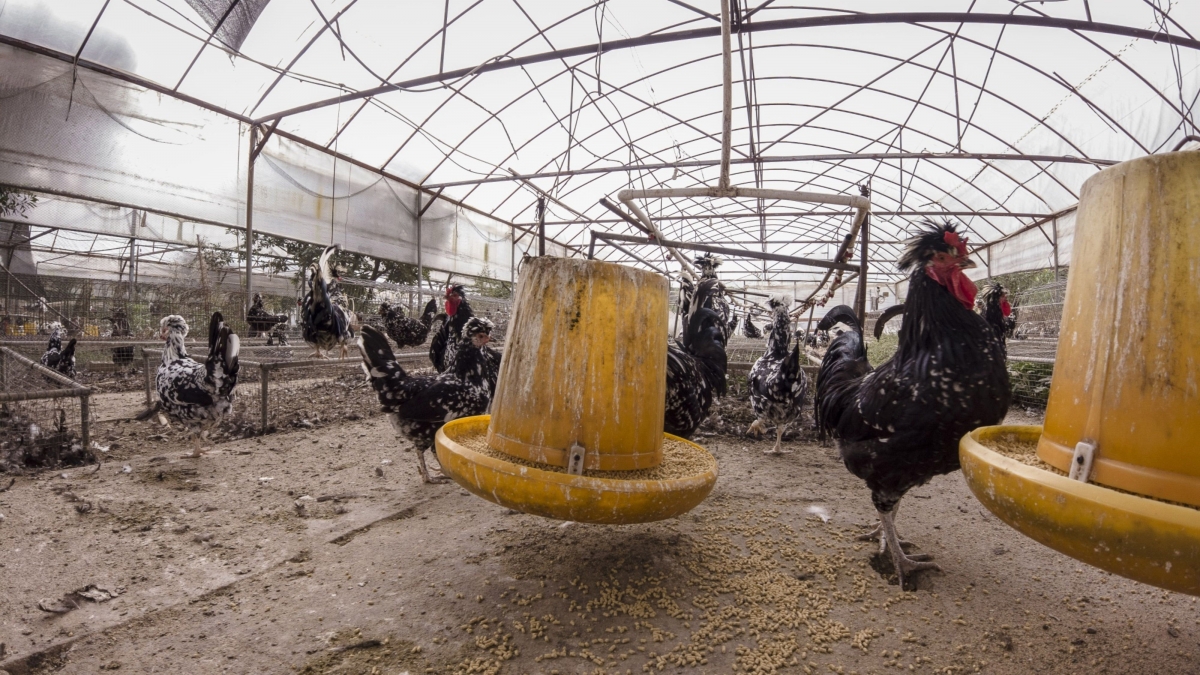
In Fujian along the eastern coast, Alibaba has provided chicken farmers with smart bracelets that track the health of their poultry, while under JD.com Inc.’s guidance, rice growers in China’s arid north have installed smart sensors to gain real-time insights for irrigation. Out west, scientists in Yunnan are teaming up with Pinduoduo Inc. to use artificial intelligence to automate strawberry planting.

“Agriculture is a critical area supported by the Chinese government,” said Liu Yue, an analyst with market research firm EqualOcean. With rural youths flocking to cities for better jobs and food safety increasingly threatened by pesticides and outdated farming methods, the country’s tech champions are eager to lend Beijing a hand, she said.

Chickens inside a shed at Fuxin Farm in Longyan, Fujian province, China, on Nov. 18, 2020. MUST CREDIT: Bloomberg photo by Qilai Shen

Chickens inside a shed at Fuxin Farm in Longyan, Fujian province, China, on Nov. 18, 2020. MUST CREDIT: Bloomberg photo by Qilai Shen

The driving force behind the e-commerce platforms’ push into smart agriculture is the boom in online groceries, which is expected to double to about 820 billion yuan ($127 billion) by 2023 from last year, according to iResearch. The category overtook consumer electronics as the biggest contributor at JD.com in the first half last year, while Alibaba is making a bigger push into the business by taking a larger stake in hypermart Sun Art Retail Group Ltd.

Meanwhile, a clutch of smaller rivals ranging from Xingsheng Youxuan and MissFresh– both backed by Tencent Holdings Ltd. — to Dingdong Maicai are in the process of raising billions of dollars to grab larger shares of the online fresh foods distribution market. That prompted state media to warn in December against overcrowding in the sector, saying instead that internet giants with immense data and advance algorithms should do more in technology innovation.

“Covid-19 has helped accelerate the conversion of such purchases to online channels,” said Vey-Sern Ling, an analyst with Bloomberg Intelligence. “It’s a large untapped market, and the companies have to participate or be left behind.”

At a time when Chinese leaders are clamping down on monopolies in areas from fintech to e-commerce, smart agriculture is one sphere where the tech giants’ commercial interests are aligned with the national agenda.

In guidelines issued on Sunday, the State Council called for increased private investment to develop modern farming techniques and empower villages using advanced technologies. Breeding and cultivation sciences were also listed as one of Beijing’s top tech priorities for the next five years, alongside AI, quantum computing and computer chips. JD has said its smart farm projects are at least 50% funded by government subsidies.

Despite the efforts, the growing appetite for fresh fruits and vegetables has left most of China’s traditionally labor-intensive farms — roughly 98% of the 200 million operators are families or small businesses — struggling to keep up. The country’s restrictions on land ownership and diverse terrain spanning the steppes of Inner Mongolia to the tropical shores of Hainan island in the south make it difficult to implement the industrial-scale farming that’s commonly seen in the U.S. and Europe. Data from the National Bureau of Statistics also show that about a third of farmworkers are aged 55 or older, and the birthrate is at record lows, driving labor costs higher.

Lei Jinrong is one farmer who’s benefited from partnering with the online retailers. The owner of Fuxin Farm in Fujian province has equipped 1,000 of his chickens with Apple Watch-style bracelets supplied by Alibaba. The devices digitally track the number of steps the birds take each day and anything below 20,000 would be an early sign of illness, he said, adding that he no longer needs to patrol his fields in search of sick poultry.

The grower has also deployed street lamp-like devices that monitor air temperature, humidity and the level of toxic ammonia gas generated from bird waste, all displayed in real-time on a computer screen at his office. That has enabled Lei to expand production without hiring more workers — good news as average salaries in his village have almost quadrupled over the past decade.

A worker uses data link equipment at Fuxin Farm in Longyan, Fujian province, China, on Nov. 18, 2020. MUST CREDIT: Bloomberg photo by Qilai Shen

A worker uses data link equipment at Fuxin Farm in Longyan, Fujian province, China, on Nov. 18, 2020. MUST CREDIT: Bloomberg photo by Qilai Shen

In the eastern province of Shandong, peach farmers increased revenue by 50% last year after using JD’s blockchain technology to encrypt each step of the planting process and increase trust and transparency, attracting consumers long weary of food scandals from tainted milk powder to imitation eggs.

“The improved efficiency and the economies of scale will drive down costs while higher-quality produce will yield better prices,” said Charlie Chen, head of consumer research at China Renaissance in Hong Kong. This will benefit both farmers and the e-commerce operators, he said.

Pinduoduo, which raised $6.1 billion in November in part to finance its agricultural innovations, is counting on these efforts to help it quadruple sales of farm products to 1 trillion yuan by 2025. The company expects the initiatives to help it diversify beyond online retail, as it aims to license cutting-edge farming technology down the road, according to David Liu, vice president of strategy.

Many of these initiatives are still in their infancy and scaling up will take time, as farmers have only recently started to collect data — the foundation of running AI and other next-generation technologies — and test new methods of growing. But the twin drivers of surging demand for online produce and Beijing’s push for self-sufficiency in food supplies means the tech behemoths’ forays into modernizing China’s farms have only just begun.

“Smart agriculture is really the way to move forward,” said Lei, the chicken farmer. “We all have to innovate.”

China urges Biden to scrap tariffs, restore goodwill #SootinClaimon.Com

#SootinClaimon.Com : ขอบคุณแหล่งข้อมูล : หนังสือพิมพ์ The Nation.

https://www.nationthailand.com/news/30402934

China urges Biden to scrap tariffs, restore goodwill

InternationalFeb 23. 2021

By Syndication Washington Post, Bloomberg

China urged the Biden administration to take steps to “build up goodwill,” including removing tariffs and sanctions, as Beijing continued to put the onus on Washington to repair their fractured relationship.

Chinese Foreign Minister Wang Yi told a forum Monday in Beijing that the two sides should reopen dialogue platforms cut off under former President Donald Trump and back away from some of the previous administration’s policies. He reiterated the need to remove “unreasonable tariffs,” abandon “irrational suppression” of China’s technology progress, and cited curbs on Chinese media and students as another issue of concern.

“Under the current circumstances, the two sides may start from easier things, interact actively and build up goodwill,” Wang said, adding that Beijing and Washington were still capable of “getting big things done” for the world. “We hope that the U.S. side will adjust its policies as soon as possible.”

The speech represents China’s most high-profile comment on ties since U.S. President Joe Biden and China’s Xi Jinping spoke by phone before the Lunar New Year holiday earlier this month. While both sides want to stabilize a relationship shaken during Trump’s term, Biden has signaled a desire to maintain many of his predecessor’s China policies.

As China waits for the U.S. to make a first move, the Biden team has been making efforts to rebuild bonds with America’s partners. On Friday, the president urged U.S. allies to uphold democracy, warning that the world faces an “inflection point” in history that could result in a tilt toward autocracy. While a Feb. 19 readout from the Group of Seven industrialized nations’ meeting offered little detail on China, leaders discussed the country “at length,” Bloomberg News reported, citing a European Union official with knowledge of the conversation.

Other speakers at Monday’s event included Hank Paulson, the former U.S. treasury secretary, Kevin Rudd, the former Australian prime minister and Maurice Greenberg, former chairman and CEO of American International Group Inc.

Paulson said it falls on both countries to work to improve ties. “The U.S. and China must decide how and where to compete and how to avoid conflict,” he said. “If we don’t, the world will be very dangerous place.”

In his call with Xi, Biden expressed concern about what he said were China’s coercive and unfair economic practices” as well as human rights abuses in the Xinjiang region. Xi cautioned Biden against interfering in what it considers its own internal affairs and urged the U.S. help reestablish communication mechanisms to avoid misunderstanding and miscalculation.

Wang’s comments Monday about easing visa pressure on Chinese students and media, which echoed remarks by top Chinese diplomat Yang Jiechi earlier this month, pointed to one possible area of compromise. Biden’s Indo-Pacific coordinator Kurt Campbell said in January that the U.S. could reverse such actions to build confidence with China.

“From China’s perspective, the responsibility of deterioration in China-U.S. relations during the Trump administration lies mainly with the U.S.,” said Zhou Qi, director of Institute of Global Governance and Development at Tongji University. “To get the ties back on track, the U.S. needs to change its attitude first.”

Johnson opts for slow end to lockdown #SootinClaimon.Com

#SootinClaimon.Com : ขอบคุณแหล่งข้อมูล : หนังสือพิมพ์ The Nation.

https://www.nationthailand.com/news/30402933

Johnson opts for slow end to lockdown

InternationalFeb 23. 2021A social-distancing floor marker sits in a classroom at All Saints Catholic College in Manchester, England, on Sept. 1, 2020. MUST CREDIT: Bloomberg photo by Anthony DevlinA social-distancing floor marker sits in a classroom at All Saints Catholic College in Manchester, England, on Sept. 1, 2020. MUST CREDIT: Bloomberg photo by Anthony Devlin

By Syndication Washington Post, Bloomberg · Emily Ashton, Alex Morales

British Prime Minister Boris Johnson declared the end of the pandemic is “in sight” for England as he set out his aim to ease lockdown rules in a series of stages over the next four months.

Johnson detailed a four-step plan that will reopen schools from March 8, outdoor hospitality from mid-April and sports stadiums by mid-May. From June 21 all remaining businesses, such as nightclubs, will resume operations and rules on social contact will be scrapped.

The premier warned that his blueprint for a return to normality depends on keeping the virus under control. More deaths will inevitably follow the ending of lockdown but if infection rates surge dramatically again, restrictions will have to stay, he said.

“This road map should be cautious but also irreversible,” Johnson told members of Parliament in London. “The end really is in sight and a wretched year will give way to a spring and a summer that will be very different and incomparably better than the picture we see around us today.”

While U.K. leisure and travel stocks jumped as Johnson revealed his timeline, he is already facing pressure to move faster after the economy endured its deepest recession in more than 300 years. Chancellor of the Exchequer Rishi Sunak will announce more support for pandemic-hit businesses in his budget next week.

England has been under lockdown since early January, and even under Johnson’s plan, government guidance asking people to work from home where possible will remain in place at least until June 21, when social distancing measures will be reviewed.

Each move will be taken uniformly across England, with authorities in Scotland, Wales and Northern Ireland making their own plans.

The government said there must be a five-week gap between the key stages in the plan to allow officials to evaluate the impact of relaxing the rules on the spread of the virus before moving on to the next step. Further easing will depend on the vaccine program working, hospitals remaining safe from a surge in cases, and new strains not threatening to increase the risks.

There will be a review of social distancing measures such as face coverings, and a task force will be set up to explore how to enable more international travel while managing the risk of new variants entering the country. Johnson also announced a review into whether proof of vaccines could be used to give people access to venues or workplaces domestically, having acknowledged that such documentation would likely be necessary for travel to certain countries.

“There may well be a role for certification. We just need to get it right,” he said at a press conference on Monday. “There are clearly some quite complex issues, some ethical issues about discrimination and to what extent government can either compel or forbid use of such certification.”

With cases and deaths now falling rapidly, an influential group of Conservative backbenchers wants to see all restrictions lifted by the end of April.

Johnson’s predecessor, Theresa May, welcomed the return of pupils to schools but urged him to move faster to open up the aviation industry. Former Conservative leader Iain Duncan Smith also urged Johnson to reopen the hospitality sector more quickly.

Falling case numbers and a significant acceleration of the U.K.’s vaccination program have fueled calls to lift the curbs. All adults are due to be offered a vaccine shot by the end of July and everyone over 50 by mid-April. More than 17.7 million people have had a vaccine so far.

Still, Johnson’s top medical and scientific advisers used a televised press conference to warn the public that the fight against the virus will outlast the government’s lockdown exit plan. Chief Scientific Officer Patrick Vallance said it may be necessary to wear face masks next winter, while Chief Medical Officer Chris Whitty said coronavirus will be a risk to vulnerable members of the population for the foreseeable future.

“We cannot persist indefinitely with restrictions that debilitate our economy, our physical and mental well-being, and the life-chances of our children,” Johnson said. “We are setting out on what I hope and believe is a one-way road to freedom.”

Beijing soars to 78 degrees, its warmest winter temperature on record #SootinClaimon.Com

#SootinClaimon.Com : ขอบคุณแหล่งข้อมูล : หนังสือพิมพ์ The Nation.

https://www.nationthailand.com/news/30402932

Beijing soars to 78 degrees, its warmest winter temperature on record

InternationalFeb 23. 2021

By The Washington Post · Matthew Cappucci

It’s only February, but it feels like May in Beijing. Temperatures some 40 degrees above normal brought historically warm winter weather to China, Japan and other parts of Asia over the weekend.

Beijing’s temperature shot up to 78 degrees Sunday, its highest temperature ever observed between December and February by 10 degrees.

“Record pulverized,” wrote Maximiliano Herrera, a climate historian known for meticulously keeping track of temperature extremes across the world. He noted that Sunday’s reading surpassed previous marks for warm weather in each of the three core winter months. The December record stands at 57.7 degrees, with 58.4 degrees the record for January.

The springlike weather began in Beijing on Saturday, when the mercury soared to 69.4 degrees Fahrenheit, the first time on record the city has climbed above 20 degrees Celsius (68 Fahrenheit) during the month of February. That set a new record, beating out the high of 67.6 degrees observed on Feb. 13, 1996. Then it hit 78 degrees the next day.

Breaking a record alone is rare, but to do so by 10 degrees is virtually unheard of; usually records fall by margins of only a fraction of a degree.

The warmth seen in Beijing would be the equivalent of New York climbing into the mid-80s, or Denver or Washington, D.C., flirting with 90 in late February.

The situation bears resemblance to the extreme heat wave that swallowed Europe in July 2019, when temperatures in Paris and Germany climbed to 109 degrees and in Belgium and the Netherlands to 107. Records then fell by between 3 and 6 degrees.

The extreme February temperatures in eastern China were preceded by a pair of national records in Mongolia. The country set an all-time February record on Friday in Tsetserleg, a city in central Mongolia, when a high temperature of 59.7 degrees was measured. The previous record of 58.4 degrees was set in 1992 in Dalanzadgad, farther to the southeast.

That same newly-claimed record was edged out on Saturday when Hanbogd in south central Mongolia popped up to 60.4 degrees.

Temperatures in Mongolia are usually cooler than in China. Mongolia is farther north and has a cool desert or semi-aid climate; winters can feature Arctic cold down to minus-70 degrees. Mongolia is the 18th largest country in the world but has a population just over 3.2 million.

According to Herrera, the extreme heat in Asia can be traced back to Europe. He tweeted that Uzbekistan nicked 90 degrees on Thursday.

While affecting China, the same warm air mass spread to Japan and the Korean Peninsula over the weekend. One hundred-and-nine cities in Japan observed new February temperature records. South Korea enjoyed unusually mild temperatures too.

The record warmth in Japan is a sharp departure from early January when the country saw a barrage of ocean-effect snowstorms that each produced mind-boggling totals of up to 7 feet.

The anomalous warmth was a product of both surface and upper-air features that overlapped to push much of Asia into record territory. A ridge of high pressure at the mid levels brought sinking motion and clear skies, favoring warm weather. Similarly, surface high pressure reinforced the sunshine, while also inducing a channel of warm, southerly winds that pumped in a toasty air mass from the south.

In addition, the air was dry, allowing for it to warm up more easily. That meant balmy daytime highs along with big nighttime temperature fluctuations. While Beijing soared to near 80 on Sunday, it started the day in the upper 30s.

The heat in Asia can be tied to the same northern hemispheric weather pattern that brought historic cold and snow to Texas. It’s a high amplitude pattern, meaning the jet stream is extra wavy. Over the United States, the jet stream dove southward, allowing a tongue of cold air to spill down across the central Lower 48. That same jet stream screamed north over Europe, with the resulting ridging of high pressure to its south introducing atypical mildness.

Beijing should see a return to more seasonable weather Tuesday and Wednesday with temperatures in the 40s. An additional warm-up is possible late week.

India wields colonial-era sedition law to detain farm protesters #SootinClaimon.Com

#SootinClaimon.Com : ขอบคุณแหล่งข้อมูล : หนังสือพิมพ์ The Nation.

https://www.nationthailand.com/news/30402931

India wields colonial-era sedition law to detain farm protesters

InternationalFeb 23. 2021A police officer in riot gear stands guard beyond razor wire coils along a highway in Ghazipur on the outskirts of New Delhi, India, on Feb. 6, 2021. MUST CREDIT: Bloomberg photo by Anindito MukherjeeA police officer in riot gear stands guard beyond razor wire coils along a highway in Ghazipur on the outskirts of New Delhi, India, on Feb. 6, 2021. MUST CREDIT: Bloomberg photo by Anindito Mukherjee

By Syndication Washington Post, Bloomberg · Archana Chaudhary, Bibhudatta Pradhan, Sudhi Ranjan Sen

In its struggle to quell unrelenting farmer protests, Prime Minister Narendra Modi’s administration is using a colonial-era sedition law that has been used to lock up dissidents often without bail while they await trial — sometimes for years.

Delhi police this month arrested environmental campaigner Disha Ravi, 22, at her home in the southern city of Bangalore for editing and sharing a “tool kit” tweeted by teenage climate activist Greta Thunberg in support of the farmers. Police said the document aimed to “spread disaffection against the Indian state” in a tweet that tagged the prime minister’s office.

Ravi joined at least seven others hit with similar charges since the farmer protests began almost three months ago, including a former foreign minister, journalists, authors and academics, part of a growing number of sedition cases under Modi. The total number of cases has risen from 43 when he first took office in 2014 to more than 100 each of the past two years, according to research group Article14. Since multiple individuals can be charged in one case, it said, the number of people affected stretches into the thousands.

A relic of the British colonial government once used against Mahatma Gandhi, India’s 19th-century sedition statute gives police broad powers to make arrests ahead of filing formal charges if an act or speech by an individual is “regarded to be disloyal to or threatening to the state.” The maximum penalty can be a life term in prison.

Still, many cases rarely even reach that stage: Only 10 people have been convicted under the law in the five years to 2019, according to data presented to parliament. For the government, the real use of the law is the ability to deny bail and keep people locked up for years while their cases trudge through the court system.

“The process is truly the punishment now,” said Lubhyathi Rangarajan, head of the sedition database of Article 14. “Cases are being filed at multiple places, arrests made, remand periods extended and bail denied.”

The farmers — many of them Sikhs from the northern states of Punjab and Haryana — want Modi to repeal three laws passed in September that allow them to sell crops directly to private firms instead of licensed middlemen at state-controlled markets. While Modi has said the laws will help them earn more cash, farmers fear those companies won’t give them minimum prices set by the government.

Members of the ruling Bharatiya Janata Party have alleged the protesters have connections to a Sikh separatist movement dating back to the 1980s, and Delhi Police also linked Ravi’s arrest to connections with those groups. Her family or lawyers couldn’t be reached for comment. Protest leaders have repeatedly denied any links to separatists.

Farmers sit inside a tractor trailer at a protest site at a roadblock on the Delhi-Haryana border crossing in Singhu, Delhi, India, on Dec. 3, 2020. MUST CREDIT: Bloomberg photo by Prashanth Vishwanathan

Farmers sit inside a tractor trailer at a protest site at a roadblock on the Delhi-Haryana border crossing in Singhu, Delhi, India, on Dec. 3, 2020. MUST CREDIT: Bloomberg photo by Prashanth Vishwanathan

The protests were largely peaceful until Jan. 26, when a rally on India’s Republic Day led to clashes that left one demonstrator dead. Since then police have put cement barricades and razor wire around the protest sites, while using targeted internet blackouts that have drawn criticism from the U.S. State Department. Some 152 people have been arrested over the clashes apart from the sedition charges, according to reports.

Celebrities have weighed in on behalf of the farmers, including Thunberg, pop singer Rihanna, actress Susan Sarandon and Meena Harris, the niece of U.S. vice president Kamala Harris. The government has dismissed the international reaction as “vested interests” trying to “mobilize international support against India.”

“Suddenly, activists are being villainized and journalists harassed,” said Vinod Jose, executive editor of The Caravan magazine who was among six journalists charged with sedition, along with former minister and opposition lawmaker Shashi Tharoor. “The jailing of civil liberties activists in the last three-four years have shown us the decline in freedom of press and rule of law.”

While the U.S. has criticized the internet blackouts, President Joe Biden has a “delicate balancing act” given India has become a key partner on issues such as climate change and countering China in the Indo-Pacific, said Akhil Bery, Washington-based South Asia analyst at risk consultancy Eurasia Group.

“If the Modi government continues to arrest activists for nonviolent protests, pressure will grow on the Biden administration to address this more publicly,” he said.