10 days of struggle in Biden’s vaccine push #SootinClaimon.Com

#SootinClaimon.Com : ขอบคุณแหล่งข้อมูล : หนังสือพิมพ์ The Nation.

10 days of struggle in Biden’s vaccine push

InternationalJan 31. 2021US President Joe BidenUS President Joe Biden

By The Washington Post · Ashley Parker, Isaac Stanley-Becker, Annie Linskey

WASHINGTON – For the first five days of President Joe Biden’s administration, he and his aides promised 100 million coronavirus shots in 100 days.

But then on the sixth day, Biden surprised everyone, including many of his own aides, by upping the ante – to 150 million.

“I think, with the grace of God, and the goodwill of the neighbor, and the creek not rising, as the old saying goes, I think we may be able to get that to 1.5 million a day, rather than 1 million a day,” Biden said. “But we have to meet that goal of a million a day.”

The number Biden floated was not a figure that was planned in advance, but rather a hypothetical possibility based on private briefings with his covid-19 task force, senior administration officials said. Biden’s comments prompted his team to reiterate that their official goal was still 100 million but also to stress that vaccinating more Americans would be preferable.

Andy Slavitt, Biden’s senior adviser for covid-19 response, said during a briefing that the 100 million vaccines in 100 days was “a floor, not a ceiling.”

“What we have tasked our team with is as many vaccines as possible into as many arms as possible,” he said.

The lack of clarity on vaccine targets underscores that the new administration is still reckoning with the complexity of conducting a mass vaccination campaign – while trying to control the messaging about its timing and scope. Biden’s advisers are scrambling to manage an ever-changing pandemic that has infected more than 25 million Americans, decimated the economy and strained the country’s social fabric – a challenge exacerbated by the patchwork approach they inherited from the previous administration and their early inability to immediately deliver on the full range of their promises.

The new administration has sought to provide better forecasting of vaccine allocation to the states and to outline a more robust federal role in the administering of the shots, enlisting the Federal Emergency Management Agency and taking steps to augment the public health workforce that is able to act as vaccinators.

But in expanding supply – among the most critical hurdles to a return to normalcy – Biden has relied on strides made under the previous administration, hoping that he and his team can help further expedite production and keep the country ahead of dangerous virus variants spreading in the population. Biden’s advisers have maintained that the Trump administration’s strategy was too reliant on existing infrastructure for vaccine delivery, failing to anticipate that state and local authorities would require not just expanded federal funding but also would need more direct coordination and assistance in carrying out immunizations.

The stakes for both the Biden team and the nation could not be higher: The deadly contagion has killed more than 436,000 Americans and continues to course through the country. One of Biden’s central promises on the campaign trail was that he would “shut down the virus” if elected president, and his administration’s handling of the crisis is likely to be critical to the success of his presidency.

Los Angeles Mayor Eric Garcetti, an ally of the president’s, said that in his earliest conversations with Biden, he stressed that progress on coronavirus would be the key to all other aims of his presidency.

“I tried to underscore with him the only thing that’s going to matter to America is covid and the economy coming back,” Garcetti said. “This will make or break our country, and certainly how people see this administration.”

So far, Biden has signed more than a dozen executive orders aimed at combating the pandemic, some of them symbolic statements of aspiration and others tangible directives already being implemented. The executive actions include creating a task force aimed at ensuring racial equity in the administration’s response; reversing the decision by former president Donald Trump to withdraw the United States from the World Health Organization; and reimbursing states up to 100% for using their National Guards to help fight covid-19.

On Tuesday, the administration told governors that because of increased manufacturing, they will get 16% more vaccine doses for the next three weeks. The announcement that Biden’s advisers also were seeking an additional 200 million doses of the two vaccines already authorized for emergency use in the United States will bring the nation’s total to at least 600 million doses, officials said, meaning enough for 300 million people to be fully vaccinated with the two-dose regimens.

Whether those additional doses can really be delivered by summer will be a test of the new administration’s capacity to augment supply beyond forecasts made last year. Biden and his advisers, for instance, have assured the public that they are making greater use of the Defense Production Act – a Korean War-era law that can be used to prioritize certain contracts and compel production of specific goods – but the behind-the-scenes reality is more complicated.

White House Chief of Staff Ron Klain recently said the administration had “used the Defense Production Act authority to order the production” of specialized syringes needed to extract a sixth dose from vaccine vials produced by Pfizer, as well as to speed production of N95 masks. The administration has not taken new steps under the Defense Production Act in either case but is relying on existing ratings and could soon take further action, according to Tim Manning, the supply coordinator for the White House’s coronavirus response.

One of the main syringe suppliers, Retractable Technologies, already had a priority rating, and the government has been able to secure enough of the equipment through other contracts to avoid ordering the company to take over more of the market. When it comes to masks, the administration is still assessing why there are shortages in some areas and surpluses in others, Manning said.

Where the administration has taken new steps, he said, is largely in engaging the private sector about the possibility of using loans and purchase agreements to pursue long-term expansion of the industrial base, which could mean additional production lines for a range of products including vaccine ingredients and specialized needles.

In a statement, White House spokesman Kevin Munoz said, “With regards to the Defense Production Act, we recognize the need to educate the American public around this process – and next week, you will see us do just that.”

Senior members of the new president’s team continue to accuse the Trump administration of inadequate planning, saying, in the words of one official, that the system they inherited was “so disorganized and unclear” that they’re still trying to locate all the vaccine. Yet the federal government tracks vaccine to the more than 100,000 enrolled providers across the country. What happens next, in terms of vaccine administration and reporting, is managed by provider agreements handled by the Centers for Disease Control and Prevention.

Rochelle P. Walensky, the new CDC director, has faulted Tiberius, a software for vaccine allocation developed by Palantir, according to people with knowledge of her views, while career officials have recoiled at her criticism of ongoing efforts. The CDC did not respond to a request for comment.

On Wednesday, just hours after the new administration’s first White House covid-19 briefing, the Dow Jones industrial average fell more than 600 points – its worst drop in almost three months – amid concerns about coronavirus vaccine distribution.

Former Chicago mayor Rahm Emanuel, who also served as chief of staff under President Barack Obama, said the growing pains of the Biden administration were of a different magnitude from what he characterized as the dangerous disregard of the crisis by the Trump administration.

“Look, we’re having a different qualitative argument,” Emanuel said. “We’re discussing 100 million or 150 million vaccines, and whether 100 million was a low bar, and also having a president who is leading by example with best practices, versus a White House that became a superspreader event and was hawking Lysol as a medical treatment. It’s literally night and day.”

Administration officials say Biden is regularly briefed about the pandemic and often asks about top-line issues as well as about how different communities are being affected, while largely leaving the technical specifics to public health officials and other government experts.

“The way that the president comes across is, ‘Don’t PowerPoint me. Don’t talk in fancy terms. What is really going on, and what is really going on at the ground level?’ ” Slavitt said in a phone interview. ” ‘And by the way, I don’t want to just know what’s going on with the average American. I want to know what’s going on with Black and Brown Americans. I want to know what’s going on with rural Americans. If this is hard, then there’s some people this is even harder for.’ “

Yet as the administration works to get up to speed, the challenges it faces are mounting, experts say.

Christopher Murray, the director of the University of Washington’s Institute for Health Metrics and Evaluation, said the three major hurdles facing the Biden team are increasing the rate of vaccinations, working to track and halt the new virus variants, and making sure that Americans who have been vaccinated do not overreact and engage in risky behavior.

After several months, Murray said, the administration should be able to begin vaccinating people at a rate of 3 million a day – roughly the rate of seasonal flu vaccinations.

“The current official ambition of one million a day is extremely conservative because we’re already doing one million a day,” Murray said. “We are a long way to go, and there’s obviously lots of logistical challenges, et cetera, but we should be able to get to three million quickly and then get beyond that.”

Biden’s transition team, signaling an aggressive approach to speeding distribution of the vaccine, announced this month, before Biden was inaugurated, that the new president would release all available vaccine supply. It was an apparent departure from a policy – introduced in December at the program’s outset – of keeping a reserve of second doses necessary for the two-dose regimens that have gained emergency use authorization in the United States.

Four days later, Trump’s health secretary, Alex Azar, said the federal government had gained enough confidence in the supply chain to make the reserve of second doses available to states. At the same time, he urged state and local officials to expand eligibility for the shots, leading health officers and medical providers to expect a windfall of vaccine.

But what Azar did not say was that the reserve of second doses had already been liquidated. The administration had shifted to a strategy of taking second doses directly off the manufacturing line, rather than holding them in reserve but had not announced the new approach.

Meanwhile, Azar’s instruction that states expand eligibility to adults 65 and older – not just those 75 and up – preempted one of the changes that Biden’s team was planning to pursue, according to two people familiar with the planning who spoke on the condition of anonymity because they were not authorized to discuss the matter.

Biden’s advisers objected to an additional instruction by the Trump administration that states also include those under 65 with a high-risk medical condition – a category they believed would open the floodgates and overwhelm health authorities. An administration official said they felt that individual states could expand their vaccine eligibility guidelines but worried that a blanket directive would cause unnecessary confusion.

Production is hardly seamless. A case study is the single-shot Johnson & Johnson vaccine that soon could gain federal clearance. The effectiveness and availability of the product could determine whether coronavirus vaccine is widely available by the summer or not until the fall. Because of production setbacks, only about 6 million or 7 million doses would initially be available, with significantly higher production not possible until March or April, according to two federal officials with knowledge of the estimates.

Better supply forecasting for states has been among the central objectives for Jeff Zients, Biden’s coronavirus coordinator, who has applied an “overarching strategy” to the effort that was lacking under Trump, in the words of one of the officials involved in the effort.

Zients has expedited the setting up of a system enabling increased reliance on pharmacies to receive and administer vaccine. And he was intent on rushing ramped-up supply from Moderna, which has overtaken Pfizer in manufacturing, out to the states in the coming week.

He announced the increase – from about 8.6 million doses to 10 million, distributed across the country – on a call Tuesday with governors. State leaders appreciated the estimates but remained frustrated by the lack of detail about when significant scale-up would occur, thus enabling access for members of the general public, according to two people who participated in the call.

Top Biden advisers say they are eager to assist the vaccine manufacturers with equipment and other needs, possibly using the Defense Production Act, but federal officials and outside experts see few opportunities to wield the law to speed up production in the short term.

“You can invoke the Defense Production Act for some things, perhaps some of the raw materials or other consumables that go into producing vaccines or administering vaccines,” said Céline Gounder, an infectious-disease specialist who was a member of Biden’s coronavirus advisory team during the transition. “But there are limits to that.”

The Trump administration already instructed suppliers to prioritize the needs of the six vaccine candidates in its portfolio. Pfizer, which sought the same status despite not taking research and development money from the government, gained priority under the law at the end of last year. The problem is the shortage – in the United States and globally – of biologic manufacturing capacity, which can take months, if not longer, to surge in the best of scenarios. Facility space is limited, as is the workforce with the expertise to manufacture the vaccines.

The act was used 18 times in relation to vaccine production under Trump, according to current and former federal officials, and retrofitting a plant or ordering a manufacturer to make a new product can take months to yield results.

On Tuesday, when pressed by reporters on the vaccine supply, White House press secretary Jen Psaki said the administration did have a handle on what quantities of doses were available in which states but declined to provide more details.

“We’ve been here for now six days,” Psaki said. “I’ll – at a certain point – stop saying that. But less than a week is not that long a period of time.”

Activists remove and save art on fence near Black Lives Matter Plaza in D.C. #SootinClaimon.Com

#SootinClaimon.Com : ขอบคุณแหล่งข้อมูล : หนังสือพิมพ์ The Nation.

Activists remove and save art on fence near Black Lives Matter Plaza in D.C.

InternationalJan 31. 2021Social activists remove and save art from Lafayette Square fencing near the White House on Saturday. Before they took the pieces down, activists photographed and packaged them for an archive. MUST CREDIT: Photo by Astrid Riecken for The Washington PostSocial activists remove and save art from Lafayette Square fencing near the White House on Saturday. Before they took the pieces down, activists photographed and packaged them for an archive. MUST CREDIT: Photo by Astrid Riecken for The Washington Post

By The Washington Post · Marissa J. LangWASHINGTON – The self-appointed guardians of the fence that separates Black Lives Matter Plaza in the District of Columbia from the federal parkland of Lafayette Square and the White House grounds gathered once again in the street Saturday as the sun rose.

They waved Black liberation flags and danced to the music of Pussy Riot, just as they have on many mornings before. Then, they did something new.

They carefully photographed each decorated panel of fence – 78 of them – and archived the contents, making detailed notes of each. Then, after a final look, the group began to take it all down.

They clipped zip ties and unfastened pipe cleaners, cut through thick layers of tape and unhooked bungee cords. Volunteers collected the pieces one by one in large plastic bags before carrying them to a waiting car.

Some of the pieces will be donated to museums and schools. Howard University and the Library of Congress have already selected some items for their respective collections. District Deputy Mayor John Falcicchio said recently that the District had reached out to the Smithsonian Institution about taking some of the works, though no official agreement had been reached.

National Park Service officials have prodded the Smithsonian, which in June sent representatives to collect artifacts that had accumulated in the square amid ongoing racial justice demonstrations. The Park Service also had planned to preserve some of the signs in the agency’s own museum collection, but Nadine Seiler, a racial justice activist and the unofficial curator of the display, said she had no word from the government about that.

“I haven’t heard from them at all,” she said Saturday as she unclipped an American flag from the metal. “It’s not like those people don’t know where to find me. I’m out here every day.”

Seiler, 55, had been among the hundreds of thousands of protesters who took to the streets of the District after the police killing of George Floyd in Minneapolis to demand criminal justice reform and protest the country’s long, painful history of racial inequality.

As signs carried by demonstrators began to accumulate on and around the security fence erected at Lafayette Square, Seiler started to do what she does best: organize.

Before the coronavirus pandemic made working in other people’s houses impossible, Seiler had been a professional home organizer. She helped others order their closets and inventory their collections. She enjoyed making order from chaos.

In August, Seiler began to make near-daily trips from her home in Waldorf, Md., to Black Lives Matter Plaza, where volunteer medics would gather for shifts throughout the day and protesters would meet for rallies or meandering marches about town.

Seiler, meanwhile, would tend to the pieces on the fence. She learned that each one had its own needs – more tape, a stronger foundation, a protective plastic coating.

Then, on Oct. 26, a small group of conservative activists who had come to the District for the confirmation of Supreme Court Justice Amy Coney Barrett, attacked the fence. They snatched signs, ripped posters, threw items to the ground. Many pieces were destroyed.

Seiler and a small army of volunteers restored what they could. Before long, a collection of salvaged signs and new additions refilled the fence.

But Seiler had made a decision. She would not let anything like that happen again.

That meant maintaining a vigil at the fence, day and night. It meant defending the fence with her body, raising her arms and standing between would-be vandals and the pieces they sought to destroy. It meant recruiting others to keep watch and feeding the homeless individuals who helped fill out her team of volunteers.

It meant being there all day, all night, no matter what.

Since that late October day, Seiler said, she has spent no more than a few hours at a time away from her post. She coordinates with others, including Karen Irwin, 45, so they can take turns sleeping, eating or using the bathroom.

The rest of her time is spent minding the pieces on display, negotiating with police officers who have closed the plaza several times over the past few months, or helping tourists with questions about the art, the protests, the best place to attempt a photo of the White House.

After President Joe Biden was inaugurated and Seiler had folded up her flags that opposed the former president – “He’s gone,” she had said, “so we don’t need these anymore” – Seiler decided the time had come to step away from the daily work of protecting the fence. Her protest of the former president was over, she said. It had become harder to imagine staying out there all day and night as temperatures fell and heaps of snow were forecast to hit the region.

So she and her team of volunteers conferred and determined that the best way to make sure the fence and its art would live on – with or without her standing watch – was to create a digital archive, to preserve the fence exactly as it was for anyone to see, forever.

Aliza Leventhal, an archivist with the Library of Congress, offered to help guide the group in recording and archiving each piece.

She told Seiler to number each panel of the fence, so every piece could be recorded and stored in order.

Over three days, Seiler adjusted the art a final time. She hung pieces that had fallen, made sure folded corners were upright.

By the time the sun rose on Saturday, several dozen panels had been photographed and recorded.

A team of six made quick work of the rest in the morning cold. Jogging in place at times to keep their feet from freezing, they plucked homemade shields, painted tarps, mixed-media works of art from their positions.

“This is going to be the ugliest fence in the world when we’re all done,” Irwin said.

Runners and dog walkers paused to watch the process. Some had questions.

“Where’s this stuff going to end up?” asked a man, his hands stuffed deep into the pockets of a puffy red jacket.

“Are you all taking this to a museum or something?” asked a young woman as she took pictures with her phone.

“Yes,” Seiler said, cutting through plastic zip ties.

“That’s awesome,” the woman said. “Thank you for taking care of this.”

By midday, only a handful of more than 1,200 pieces remained.

Colorful ribbons tied to the fence to form the words “we keep us safe” and “defend Black lives” would stay. So, too, would streamers on which activists had written the names of Black people killed by police. Items deemed too difficult to preserve in their current form – a circle of streamers, dried flower petals taped individually to the fence – were also left behind.

As she surveyed the rapidly emptying panels, Seiler was flooded with relief.

The art pieces and posters she cared so deeply about would be stored and protected from the elements and far-right groups that already were discussing plans to return to the District. They would not be torn down unceremoniously when federal law enforcement decides to remove the barricade – a date that has yet to be determined.

One of the last pieces to go was a black and blue painting of a man’s face. Across the top, the artist had scrawled the words, “free your mind,” but Seiler had spent all week worrying about it.

On Wednesday, she said, members of the white supremacist group Patriot Front wandered through the plaza, pasting “Biden lost” stickers on whatever they could find. Before she could intervene, Seiler said, a man slapped a sticker on the corner of the painting, which had been among those selected by the Library of Congress. She acted quickly, lifting one corner then another, trying to peel it off the paper.

She couldn’t sleep that night, worried about more trouble and afraid that the next time she looked away, someone could slap a sticker – or something worse – across the downcast eyes of the painting.

As the piece was unclipped Saturday, smoothed out and tucked away in a plastic bag, Seiler breathed in, then out.

She would sleep well Saturday night, knowing that the painting, and so many others, were safe, knowing her work at the fence was finally done.

Pelosi is trying to help lawmakers struggling with the trauma of the Capitol riot #SootinClaimon.Com

#SootinClaimon.Com : ขอบคุณแหล่งข้อมูล : หนังสือพิมพ์ The Nation.

Pelosi is trying to help lawmakers struggling with the trauma of the Capitol riot

InternationalJan 31. 2021House Speaker Nancy Pelosi, D-Calif, on the day of President Biden's inauguration in Washington. MUST CREDIT: Washington Post photo by Melina Mara.House Speaker Nancy Pelosi, D-Calif, on the day of President Biden’s inauguration in Washington. MUST CREDIT: Washington Post photo by Melina Mara.

By The Washington Post · Paul Kane

WASHINGTON – House Speaker Nancy Pelosi first saw the emotional wounds moments after she returned to the U.S. Capitol the evening of Jan. 6.

“The trauma that I saw in their eyes,” Pelosi said, pausing three seconds as she recalled the faces of her closest aides. “It was just overwhelming, just overwhelming. You know, our staffs are largely young. They come here with the sense of idealism and just love that they’re working in the Capitol.”

In addition to leading the impeachment of a former president and the inauguration of a new one, Pelosi, D-Calif., has also played a unique role these past few weeks: emotional shepherd to a flock of traumatized lawmakers, staff and police still reeling from the aftermath of rioters storming the Capitol in a bid to overturn the 2020 election.

Some of her staff members locked themselves in a windowless conference room, blocking the door with office furniture and hiding under a table for 21/2 hours as rioters tried to break down the door.

Lawmakers inside the House chamber donned gas masks and crawled across the floor, then ran to secure locations under the armed protection of U.S. Capitol Police.

Since then, the speaker’s office has served a leading role in providing the congressional community access to post-traumatic counseling. It convened online sessions for lawmakers and aides less than a week after the riot. On Jan. 21, lawmakers were invited to an in-person session inside a vast auditorium.

Pelosi followed up a few days ago with a letter to lawmakers encouraging them to take advantage of more counseling sessions. And, in an interview with The Washington Post, she talked about attending the meetings with lawmakers, and how she emotionally processed the attempted insurrection.

“I sat through it myself,” she said, explaining how the Office of the Attending Physician and Office of Employee Assistance run the sessions. “It was interesting.” Pelosi said she was especially “impressed by the section about resilience.”

Pelosi is not interested in forgiving “those thugs, those terrorists” who trashed the Capitol, taking a bit more of an Old Testament view of healing through justice.

“I was thinking, the human person is built for survival,” she said of the counseling session. “You know, we just are. But how do we come back? Not to ignore the seriousness of the situation, but to recognize that, to heal, you have to have some justice. You just really have to have justice. You cannot heal without it.”

These sessions have been pulled together in the post-riot fog of trauma, and many people may not be aware of them. The critical thing Pelosi wants the Capitol Hill crowd to know is how common the struggles are, and that everyone can benefit from talking to a professional about their experience.

Pelosi admits that her reflexive posture is to eliminate emotion from events, so she can determine the right congressional response. That’s what she did when a Capitol Police security detail ushered her off the House dais to a secure, off-site location, where she monitored the situation and, in bipartisan fashion with other congressional leaders, charted the path to getting the House and Senate back into session as a show of democratic force.

“I have a responsibility to be, as I say, passionate about what’s happening, but dispassionate about how to deal with it,” Pelosi said. “So I almost have to remove myself immediately from the emotion of it all.”

But Jan. 6 was different from a budget standoff with an administration or even last year’s impeachment showdown with President Donald Trump over his effort to force Ukrainian officials to investigate the Biden family.

The lawmakers are still rattled, because they personally experienced the events in question.

So Pelosi has asked them to write an essay about their experience that day, partly as a therapeutic recollection of what they went through.

“Be your own historian, be part of writing the history of this, because there’s nobody who can be a better validator of what happened in your experience than you,” Pelosi said.

Republicans are furious that, without any hearings or testimony, Pelosi pushed Trump’s impeachment through the House one week after the insurrection. They have accused her of further dividing a nation that needs healing.

But she blames Republicans for standing by Trump in the hours after the attack, as about two-thirds of House Republicans opposed the certification of Biden as the victor in November’s election – effectively taking the side of the rioters.

She contrasted those divisive actions with the broad, bipartisan outpouring that followed the Sept. 11, 2001, terrorist attacks, which ended that night with a bipartisan singing of “God Bless America” on the steps of the Capitol.

“At least in 9/11, it was unifying, and there was no question that everyone was sympathetic to those who lost their loved ones, their families and the rest, and that we would get to the bottom of it,” Pelosi said.

She went through the images of that day, the mob using a door to crush a D.C. police officer. She thought of the Capitol Police officer who died as a result of injuries sustained during the riot.

“To just say, ‘Well, what’s the big deal? Let’s just turn the page.’ Turn the page? No, I don’t think so,” Pelosi said, reiterating that healing comes through justice.

Her impeachment effort will probably end without the conviction of Trump, because 45 Senate Republicans have already signaled their doubt in the case.

But the role of trauma shepherd will continue for months ahead, she knows, and she wants to hear everyone’s story.

Near the end of our interview, Pelosi asked me: Were you in the Capitol that day?

She listened to my terrifying tale: of being just above the stairwell where a heroic Capitol Police officer held off a mob, buying us time to get inside the Senate chamber as officers locked the doors, and of eventually evacuating with the Senate to a secure location, with armed police protection.

“You also experienced firsthand the trauma of it all,” she said. “The uncertainty: How is this going to proceed or end?”

Pelosi has given her colleagues one other instruction, beyond writing their firsthand account. She wants them, a month or two from now, to write another personal essay, telling the story again through a more distant lens, about how they felt in the interim and how it helped their recovery.

“When I say recovery, recovery from it,” she said. “Because this is, this is so historic. There’s nothing – there is nothing, nothing like it.”

FBI probe of U.S. Capitol riot finds evidence detailing coordination of an assault #SootinClaimon.Com

#SootinClaimon.Com : ขอบคุณแหล่งข้อมูล : หนังสือพิมพ์ The Nation.

FBI probe of U.S. Capitol riot finds evidence detailing coordination of an assault

InternationalJan 31. 2021With the U.S. Capitol in the background, the U.S. flag flies at half-staff near the Peace Monument at First Street NW and Pennsylvania Avenue NW on Jan. 8. MUST CREDIT: Washington Post photo by Melina Mara.With the U.S. Capitol in the background, the U.S. flag flies at half-staff near the Peace Monument at First Street NW and Pennsylvania Avenue NW on Jan. 8. MUST CREDIT: Washington Post photo by Melina Mara.

By The Washington Post · Devlin Barrett, Spencer S. Hsu, Aaron C. Davis

WASHINGTON – When die-hard supporters of President Donald Trump showed up at rally point “Cowboy” in Louisville on the morning of Jan. 5, they found the shopping mall’s parking lot was closed to cars, so they assembled their 50 or so vehicles outside a nearby Kohl’s department store. Hundreds of miles away in Columbia, S.C., at a mall designated rally point “Rebel,” other Trump supporters gathered to form another caravan to Washington. A similar meetup – dubbed “Minuteman” – was planned for Springfield, Mass.

That same day, FBI personnel in Norfolk, Va., were increasingly alarmed by the online conversations they were seeing, including warlike talk around the convoys headed to the nation’s capital. One map posted online described the rally points, declaring them a “MAGA Cavalry To Connect Patriot Caravans to StopTheSteal in D.C.” Another map showed the U.S. Congress, indicating tunnels connecting different parts of the complex. The map was headlined, “CREATE PERIMETER,” according to the FBI report, which was reviewed by The Washington Post.

“Be ready to fight. Congress needs to hear glass breaking, doors being kicked in,” read one posting, according to the report.

FBI agents around the country are working to unravel the various motives, relationships, goals and actions of the hundreds of Trump supporters who stormed the U.S. Capitol on Jan. 6. Some inside the bureau have described the Capitol riot investigation as their biggest case since the Sept. 11, 2001, attacks, and a top priority of the agents’ work is to determine the extent to which that violence and chaos was preplanned and coordinated.

Investigators caution there is an important legal distinction between gathering like-minded people for a political rally – which is protected by the First Amendment – and organizing an armed assault on the seat of American government. The task now is to distinguish which people belong in each category, and who played key roles in committing or coordinating the violence.

Video and court filings, for instance, describe how several groups of men that include alleged members of the Proud Boys appear to engage in concerted action, converging on the West Front of the Capitol just before 1 p.m., near the Peace Monument at First Street NW and Pennsylvania Avenue NW. Different factions of the crowd appear to coalesce, move forward and chant under the direction of different leaders before charging at startled police staffing a pedestrian gate, all in the matter of a few minutes.

An indictment Friday night charged a member of the Proud Boys, Dominic Pezzola, 43, of Rochester, N.Y., with conspiracy, saying his actions showed “planning, determination, and coordination.” Another alleged member of the Proud Boys, William Pepe, 31, of Beacon, N.Y., also was charged with conspiracy.

Minutes before the crowd surge, at 12:45 p.m., police received the first report of a pipe bomb behind the Republican National Committee headquarters at the opposite, southeast side of the U.S. Capitol campus. The device and another discovered shortly afterward at Democratic National Committee headquarters included end caps, wiring, timers and explosive powder, investigators have said.

Some law enforcement officials have suggested the pipe bombs may have been a deliberate distraction meant to siphon law enforcement away from the Capitol building at the crucial moment.

The FBI is also trying to determine how many people went to Washington seeking to engage in violence, even if they weren’t part of any formal organization. Some of those in the Louisville caravan said they were animated by the belief that the election was stolen, according to interviews they gave to the Louisville Courier-Journal.

Much of the discussion of potential violence occurred at TheDonald.win, where Trump’s supporters talked about the upcoming rally, sometimes in graphic terms, according to people familiar with the FBI investigation who spoke on the condition of anonymity to discuss an open matter.

After the riot, a statement posted on the website said moderators “had been struggling for some time to address a flood of racist and violent content that appeared to be coming primarily from a small group of extremists who were often brigading from other sites,” leading to inquiries from the FBI.

One of the comments cited in the FBI memo declared Trump supporters should go to Washington and get “violent. Stop calling this a march, or rally, or a protest. Go there ready for war. We get our President or we die.”

Some had been preparing for conflict for weeks.

Prosecutors say Jessica Marie Watkins – an Ohio bartender who had formed her own small, self-styled militia group and had joined Oath Keepers, according to prosecutors – began recruiting and organizing in early November for an “operation.”

Days after the election, Watkins allegedly sent text messages to a number of individuals who had expressed interest in joining her group, which called itself the Ohio State Regular Militia.

“I need you fighting fit by innaugeration,” she told one recruit, according to court papers.

The same day, she also asked a recruit to download Zello, an app that allows a cellphone to operate like a push-to-talk walkie-talkie, saying her group uses it “for operations.”

In conversations later that month, Watkins allegedly spoke in apocalyptic terms about the prospect of Joe Biden being sworn in as president on Jan. 20.

“If he is, our way of life as we know it is over. Our Republic would be over. Then it is our duty as Americans to fight, kill and die for our rights. . . . If Biden get the steal, none of us have a chance in my mind. We already have our neck in the noose. They just haven’t kicked the chair yet.”

In December, prosecutors say, Donovan Ray Crowl, a 50-year-old friend of Watkins’s, attended a training camp in North Carolina, while another friend, Thomas E. Caldwell, a 66-year-old Navy veteran from Berryville, Va., booked a room at an Arlington, Va., hotel, where Watkins also had a reservation for the days surrounding the Jan. 6 pro-Trump rally.

Prosecutors say Caldwell had written earlier to Watkins that “I believe we will have to get violent to stop this, especially the antifa maggots who are sure to come out en masse even if we get the Prez for 4 more years.”

In the week leading up to the rally and riot, Watkins and Caldwell were in regular contact as they talked about various groups of people meeting up on Jan. 5 and Jan. 6, according to an indictment filed this past week against them.

At different points, according to court filings and people familiar with the investigation, Watkins and Caldwell indicated a degree of impatience with Stewart Rhodes, the national leader of Oath Keepers, for not providing more direction.

Watkins messaged Caldwell that if Rhodes “isn’t making plans, I’ll take charge myself, and get the ball rolling,” according to the indictment. Caldwell replied that he was speaking to another person who expected a bus with 40 people to come from North Carolina. Caldwell allegedly told her that person, identified only as “Paul” in other court papers, “is committed to being the quick reaction force [and] bringing the tools if something goes to hell. That way the boys don’t have to try to schlep weps on the bus” – an apparent reference to weapons.

Caldwell added in a subsequent message that he didn’t know whether Rhodes “has even gotten out his call to arms but it’s a little friggin late. This is one we are doing on our own. We will link up with the north carolina crew,” according to court papers and the people familiar with the investigation.

On New Year’s Eve, according to the indictment, Watkins “responded with interest to an invitation to a ‘leadership only’ conference call” for what was described as a “DC op.”

Such exchanges are critical early clues in the planning and coordination that went on before, during and after the riot. Videos from the Capitol show Oath Keepers such as Watkins dressed in military-type gear, moving in coordination with Crowl through the crowds around the building.

Watkins used the walkie-talkie app to tell others she was part of a group of about 30 to 40 people who are “sticking together and sticking to the plan,” according to court documents.

Caldwell, for his part, posted images to Facebook, writing: “Us storming the castle. Please share. Sharon is right with me. I am such an instigator!” Sharon Caldwell, his wife, has not been charged with any crime; Caldwell, Crowl and Watkins are accused of conspiring to obstruct Congress and other violations.

Thomas Caldwell’s lawyer has said his client expects to see the charges dropped or to be acquitted at trial. Caldwell, the lawyer said, is not a member of Oath Keepers.

Watkins has previously denied committing any crimes. “I didn’t commit a crime. I didn’t destroy anything. I didn’t wreck anything,” Watkins told the Ohio Capital Journal, adding that the riot was a peaceful protest that turned violent.

Crowl’s lawyer has described his client as a law-abiding citizen who helped protect people during the riot.

In a phone interview this month, Rhodes, the founder of the Oath Keepers, told The Post that he gave no direction or signals to members of his group to storm the Capitol, and that he considers the entry by rioters a mistake that played into the hands of critics.

Rhodes said the only “mission” the Oath Keepers had organized to undertake in D.C. on Jan. 6 was dignitary protection for far-right personalities who had traveled to the city to participate in “Stop the Steal” events.

At the time of the riot, Rhodes said, he had just escorted one of the VIPs to a nearby hotel. Rhodes said one of his deputies “called and said, ‘People are storming the Capitol.’ I walked back over and found” fellow Oath Keepers, Rhodes said, but did not enter the building.

Rhodes disavowed any meaningful connection to Caldwell or Crowl. Rhodes said Watkins had played an important part in the group’s mobilization in opposition to demonstrations around police abuse in Louisville last year.

Former domestic terrorism investigators say the alleged discussion by Watkins and Caldwell about the group’s leader points to a longtime pattern among such extremists.

“Historically, within the right-wing extremist movements, leadership has produced rhetoric to spin up their members, increase radicalization and recruitment, and then stand back and let small cells or individual lone offenders follow through on that rhetoric with violent action,” said Thomas O’Connor, a former FBI agent who spent decades investigating domestic terrorists. “Domestic terrorism actually developed the leaderless resistance concept, taking the potential blame away from the leadership and putting it down into small groups or individuals, and I think that is what you’re starting to see here.”

Current law enforcement officials said they have not reached any conclusions about the interactions between leaders of extremist groups and their members or followers.

Investigators are examining who may have joined Caldwell and Watkins’s group, and whether any of those individuals, “known and unknown,” had links or communications with others at the Capitol that day or elsewhere.

Colin Clarke, a domestic terrorism expert at the Soufan Group, said the Jan. 6 attack represents a “proof of concept” for dangerous extremists.

“They talk about things like this in a lot of their propaganda, and the fact that the Capitol Police allowed this to happen, you can call it a security breach, or intelligence failure, but these people do not look at this as a failure, they look at it as an overwhelming success, and one that will inspire others for years.”

Putin thrusts global food markets into Russian politics #SootinClaimon.Com

#SootinClaimon.Com : ขอบคุณแหล่งข้อมูล : หนังสือพิมพ์ The Nation.

Putin thrusts global food markets into Russian politics

InternationalJan 31. 2021A worker monitors as harvested wheat grain is unloaded into a truck during the summer harvest on a farm operated by Progress Agroin Ust-Labinsk, Krasnodar, Russia, on July 3, 2020. MUST CREDIT; Bloomberg photo by Andreyi Rudakov.A worker monitors as harvested wheat grain is unloaded into a truck during the summer harvest on a farm operated by Progress Agroin Ust-Labinsk, Krasnodar, Russia, on July 3, 2020. MUST CREDIT; Bloomberg photo by Andreyi Rudakov.

By Syndication Washington Post, Bloomberg · Megan Durisin, Yuliya Fedorinova

Dmitry Bravkov is the kind of farmer that makes Vladimir Putin proud. The Russian president regularly touts his country’s rise to the top of the world’s agricultural exporters as another sign of its global power.

But after 14 years of running a dairy and grain farm 300 miles southwest of Moscow, Bravkov has suddenly found himself on the wrong end of Kremlin policy. In three weeks, he’ll get less for his wheat because of new tariffs and quotas designed to curb exports and drive domestic prices lower.

With Putin’s popularity barely back from record lows, the policy is an attempt to mollify a public battered by falling incomes and rising food costs. Protests demanding the release of jailed opposition leader Alexei Navalny now give Putin another reason to try to shore up support.

Russia’s position as the world’s biggest wheat exporter means the move is already reverberating through global markets, and a short-term domestic advantage could lead to longer-term damage to faith in the country as a reliable supplier.

“The introduction of the duty is an attempt to cash in on the farmers,” said Bravkov, 47, who employs 60 people in a village in the Bryansk region. “There’s plenty of wheat in the world. If Russia doesn’t supply it, someone else will.”

World grain prices have soared to the highest level in six years after poor weather hampered harvests in some key producers and China embarked on an agricultural buying spree. The knock-on effect is particularly acute for developing nations because food is a bigger share of household spending.

Uncertainty over Russia’s restrictions has already hurt some buyers, with top wheat importer Egypt canceling a tender on Jan. 12-a rare occurrence-after supply offers dried up.

“Russia wants to have it both ways,” said Abdolreza Abbassian, a senior economist at the UN’s Food & Agriculture Organization in Rome. “It wants to have a big chunk of the export market, and at the same time, not be exposed to problems within the global food sector. Usually such plans aren’t successful in the long-run.”

Vladimir Putin on Dec. 17., 2020. MUST CREDIT; Bloomberg photo by Andrey Rudakov.

Vladimir Putin on Dec. 17., 2020. MUST CREDIT; Bloomberg photo by Andrey Rudakov.

While Putin was boasting of a record harvest last year, ordinary Russians had to shell out 20% more for bread and 65% more for sugar than in 2019. Memories of food shortages in the Soviet Union and soaring inflation after its collapse have made prices a politically sensitive issue in Russia.

Russia’s history wasn’t lost on Putin as he scolded ministers on national television last month for not doing enough to stop rising prices, even as he boasted about huge grain exports. Russia’s wheat output has nearly doubled in the past two decades.

“Back then, they said that everything is available in the Soviet Union, just not enough for everyone, but there wasn’t enough because there were shortages,” he said. “Now there might not be enough because people don’t have enough money to buy certain products at the prices we see on the market.”

One day after the comments were aired-and three days before Putin was due to address the nation in his annual televised press conference-the government proposed a levy on wheat from mid-February though the end of June. The duty will start at 25 euros ($30.40) a ton before doubling from March 1. Wheat-export prices in Russia have climbed 43% in the past six months to $297 as of Jan. 20, data from consultancy IKAR show.

The government is also pressing ahead with a previously announced grain-export quota for the same period. Price curbs were looked at for other food products such as pasta, eggs and potatoes, though Russia’s Agriculture Ministry said on Monday it sees no need for further limits.

Russia has a history of disrupting the wheat market with restrictions and duties. The country imposed an export tax in 2007 to combat rising food costs, helping push global wheat prices to a record, and some researchers see an export ban in 2010 as an indirect contributor to the Arab Spring uprisings.

Indeed, few other exporters have dared to go down the protectionist route because the results can be counterproductive. The strategy is particularly risky because the Kremlin has worked so hard to overtake the U.S. and European Union and become the dominant global supplier of wheat.

The measures will cost wheat farmers as much as 135 billion rubles ($1.8 billion) in potential revenue losses, and more if export duties are extended to other foodstuffs, according to Andrey Sizov Jr., managing director at consultant SovEcon in Moscow.

Importers are already turning toward other suppliers such as Australia and even India, according to Evgeniya Dudinova, a member of the International Association of Operative Millers Eurasia leadership council. In the United Arab Emirates, where she’s based, purchases from Russia have totaled about 330,000 tons so far this season, a third of last year’s volume.

Key importers will try to avoid Russian wheat when the taxes kick in, said Muzzammil R. Chappal, chairman of the Cereal Association of Pakistan. The country is the fifth-largest importer of Russian wheat this season.

At his farm, Bravkov said he hasn’t received any help from the government in the past. He’s in the process of switching from dairy to grain farming after milk prices stagnated, which will force him to lay off workers to stay profitable. “With such measures our government just helps protect our European competitors,” Bravkov said.

From Cancun to Aruba, U.S. getaways rush to offer traveler tests #SootinClaimon.Com

#SootinClaimon.Com : ขอบคุณแหล่งข้อมูล : หนังสือพิมพ์ The Nation.

From Cancun to Aruba, U.S. getaways rush to offer traveler tests

InternationalJan 31. 2021Grupo Aeromexico aircraft at Benito Juarez International Airport in Mexico City on Oct. 7, 2020. MUST CREDIT: Bloomberg photo by Cesar Rodriguez.Grupo Aeromexico aircraft at Benito Juarez International Airport in Mexico City on Oct. 7, 2020. MUST CREDIT: Bloomberg photo by Cesar Rodriguez.

By Syndication Washington Post, Bloomberg · Andrea Navarro, Patrick Clark

Hotels, airports and airlines across Mexico and the Caribbean are rushing to set up covid-19 testing sites to meet new U.S. entry rules and salvage demand for the pandemic-hit travel industry.

In Mexico, tourist magnets like Cancun have set up multiple testing sites inside airports to accommodate travelers to the U.S., which on Tuesday started requiring proof of negative Covid results before allowing visitors to fly in from other nations. Hyatt Hotels Corp. is offering complimentary testing at its 19 Latin America resorts, while Marriott International Inc. is providing a mix of on-site testing and assistance coordinating with local facilities.

The U.S. requirements are meant to help airlines regain at least some of their lucrative international business by helping to assuage fears of contracting the virus. Yet any difficulty in obtaining tests also stands to dent demand from Americans fleeing to vacation spots who would potentially face trouble returning home. In places like Mexico, tests are hard to come by, can cost as much as $200 and results can take days — leading travel companies to step in.

“In an environment for hotels where demand is down dramatically, anything they can do to make travel feel safer is a win in their eyes,” said Michael Bellisario, an analyst at Robert W. Baird & Co. “There’s a lot of uncertainty and anything to expedite the process and make traveling simpler and safer is helpful for all parties.”

The new rules require that travelers receive a test within three days before leaving for the U.S. and provide written documentation of a negative result. Both PCR and rapid antigen tests are accepted, and passengers who have already had the virus can also show proof of recovery instead.

Beyond Cancun, the state of Guanajuato, home to San Miguel de Allende, is also offering airport tests and is working with hotels so they can do it too. Yucatan is doing the same.

Among hotels, testing sites are most prominent at luxury resorts, where wealthier travelers can secure results ahead of their departure without having to leave the premises. Marriott’s locations with on-property testing include the Ritz-Carlton Cancun, the JW Marriott Los Cabos Beach Resort & Spa and the Dominican Republic’s Westin Puntacana Resort & Club, according to a spokeswoman.

For Hilton Worldwide Holdings Inc., on-site testing is available at properties such as the Hilton Aruba Caribbean Resort & Casino and the Conrad Punta de Mita. Others are providing access to a local testing provider.

In the two days since the requirement took effect, local media showed a chaotic scene at the Mexico City airport, where many passengers had no idea they needed a test. Some of them were able to get a rapid one there, while others missed their flight, according to a report on Imagen TV.

In Cancun, 120 Cuban travelers had tests that were done more than three days before their flights and weren’t allowed to board, according to newspaper and TV station Milenio Noticias. At the Dominican Republic’s Las Americas airport, hundreds of passengers missed their flights on Tuesday and Wednesday because they didn’t have tests, radio station NotiUno reported.

Volaris, Mexico’s biggest airline, set up a testing site at the Marriott hotel inside the Mexico City airport. The low-cost airline has managed to bounce back to pre-pandemic traffic yet has seen its shares fall 12% this year as the new U.S. rules were announced.

The company didn’t yet have statistics on how many tests it has administered, but a spokeswoman said they have conducted more than they expected since passengers from other airlines have taken advantage of the offer.

For its part, Grupo Aeromexico is offering discounts with certain labs for people to get tested days before heading to the airport. The carrier also is working to set up sites across the terminals where it operates, a spokesman said.

The costs for tests vary by location and company. At Marriott’s JW Marriott Cancun Resort & Spa and Marriott Cancun Resort, it’s included in the room rate, while for others it’s not, said spokeswoman Kerstin Sachl. Hilton’s Aruba resort offers PCR tests for $125 and antigen tests for $50, according to its website.

“It makes you feel more comfortable as a traveler,” Bellisario said. “And from the hotels’ perspective, it brings in incremental demand and limits cancellations.”

Ukraine stayed quiet during Trump-era pressures. Now it’s sharing some Giuliani tales. #SootinClaimon.Com

#SootinClaimon.Com : ขอบคุณแหล่งข้อมูล : หนังสือพิมพ์ The Nation.

Ukraine stayed quiet during Trump-era pressures. Now it’s sharing some Giuliani tales.

InternationalJan 31. 2021Rudy Giuliani listens as then-President Trump held a news briefing at the White House on Sept. 27, 2020. MUST CREDIT: Washington Post photo by Salwan Georges.Rudy Giuliani listens as then-President Trump held a news briefing at the White House on Sept. 27, 2020. MUST CREDIT: Washington Post photo by Salwan Georges.
By The Washington Post · David L. Stern

KYIV, Ukraine – There was a consistent message from Ukraine’s leadership over everything from the Trump campaign’s dirt digging to Ukraine’s central role in the first impeachment proceedings: No comment.

But now, as the Biden administration settles in, some close allies of Ukraine President Volodymyr Zelensky are opening up about one of the longest-running dramas from the Trump era – the blitz of meetings, messages and public statements in Ukraine by former president Donald Trump’s personal lawyer, Rudy Giuliani.

Among the accounts emerging from Ukrainian officials is a July 2019 phone call between Giuliani and Andriy Yermak, formerly one of Zelensky’s top aides and now his chief of staff. Yermak said the conversation was the first direct contact between Giuliani and the Zelensky administration and, until now, was only discussed in general terms.

The new disclosures from Ukraine do not offer any bombshell revelations about Giuliani’s dealings. But they help fill in some blanks on his frantic – and unsuccessful – quest to press Ukraine to make statements seen as potentially helpful to the Trump reelection bid.

Giuliani’s overall goal, according to the accounts, was to have Zelensky’s government validate the Trump campaign’s unsupported claims – including that Joe Biden’s son, Hunter, engaged in corrupt dealings in Ukraine and that then vice president Biden attempted to cover it up.

Giuliani, saying he was acting on President Donald Trump’s behalf, also was promoting a false narrative that the Ukrainian government colluded to interfere in the 2016 U.S. presidential elections against Trump – an unproven claim that sought to deflect attention from Russia’s interference in the campaign.

Ukraine’s willingness to discuss Giuliani’s forays also lands at a difficult time for the former New York mayor as he faces mounting personal battles, including a $1.3 billion defamation lawsuit by Dominion Voting Systems over alleged false claims about ballot rigging in the 2020 election.

Giuliani did not respond to a list of questions sent to him, and also through his lawyer. Kurt Volker, the former State Department’s special envoy to Ukraine for peace negotiations, who was also on the call with Yermak, declined to comment.

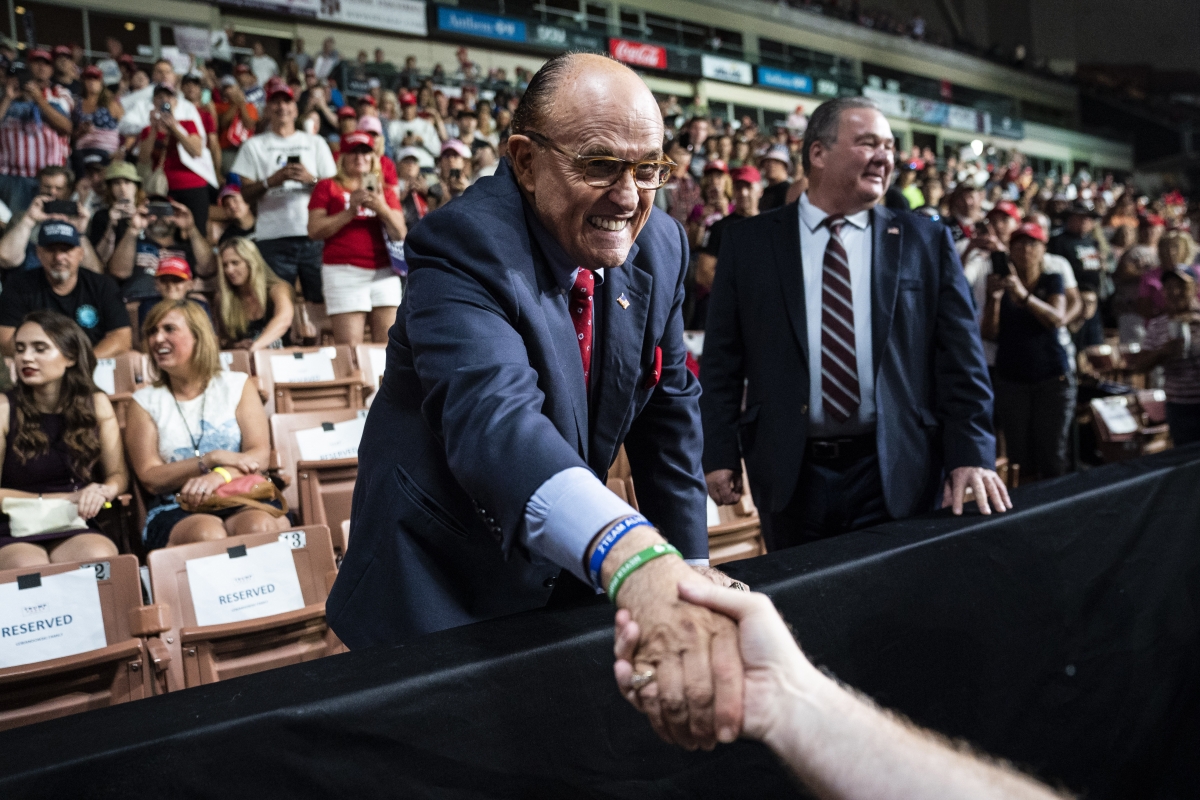
Rudy Giuliani greets supporters before then-President Donald Trump's arrival at a rally at Southern New Hampshire University Arena on Aug 15, 2019 in Manchester, N.H. MUST CREDIT: Washington Post photo by Jabin Botsford.

Rudy Giuliani greets supporters before then-President Donald Trump’s arrival at a rally at Southern New Hampshire University Arena on Aug 15, 2019 in Manchester, N.H. MUST CREDIT: Washington Post photo by Jabin Botsford.

The Zelensky team’s decision to talk about Giuliani’s tactics coincides with efforts for a reset in relations with President Biden, who dealt closely with Ukraine during his eight years as vice president.

“We’ve gotten through all these trials, despite criticism at home and abroad,” said Yermak. “And today, this feeling that Ukraine – the mention of Ukraine – is associated with various scandals should disappear.”

Giuliani’s tone and actions during his dealings with the Ukrainians were “aggressive and threatening,” said one Zelensky insider, who spoke on the condition of anonymity because of the sensitivity of the issue.

But the Ukrainians, he said, steadfastly refused to “play ball.”

The accusations against Biden centered on his son, Hunter, and his previous position on the board of the Ukrainian energy company Burisma, which is under investigation for alleged corrupt dealings. Trump and his allies claimed, without evidence, that Joe Biden, then vice president, used his clout to end the investigations.

Ukrainian investigations into Burisma and its founder, Mykola Zlochevsky, are ongoing. But authorities say that none of the cases involve Hunter Biden. A Senate report in September described the younger Biden’s position at the company as “problematic” but found no wrongdoing by Joe Biden.

Giuliani’s pressure began almost from the moment of Zelensky’s election in April 2019. The former New York mayor planned to travel to Ukraine the following month.

But Giuliani canceled at the last moment, claiming that Zelensky was surrounded by “enemies” of Trump. This set off concerns in Zelensky’s inner circle that Giuliani would poison Zelensky’s relations with the White House.

In July 2019, Yermak asked Volker to introduce him to Giuliani in an effort to clear the air.

Ukrainians needed U.S. diplomatic and financial muscle to bolster them in their ongoing battles with Kremlin-backed insurgents in eastern Ukraine, a conflict that has killed more than 13,000 people since 2014.

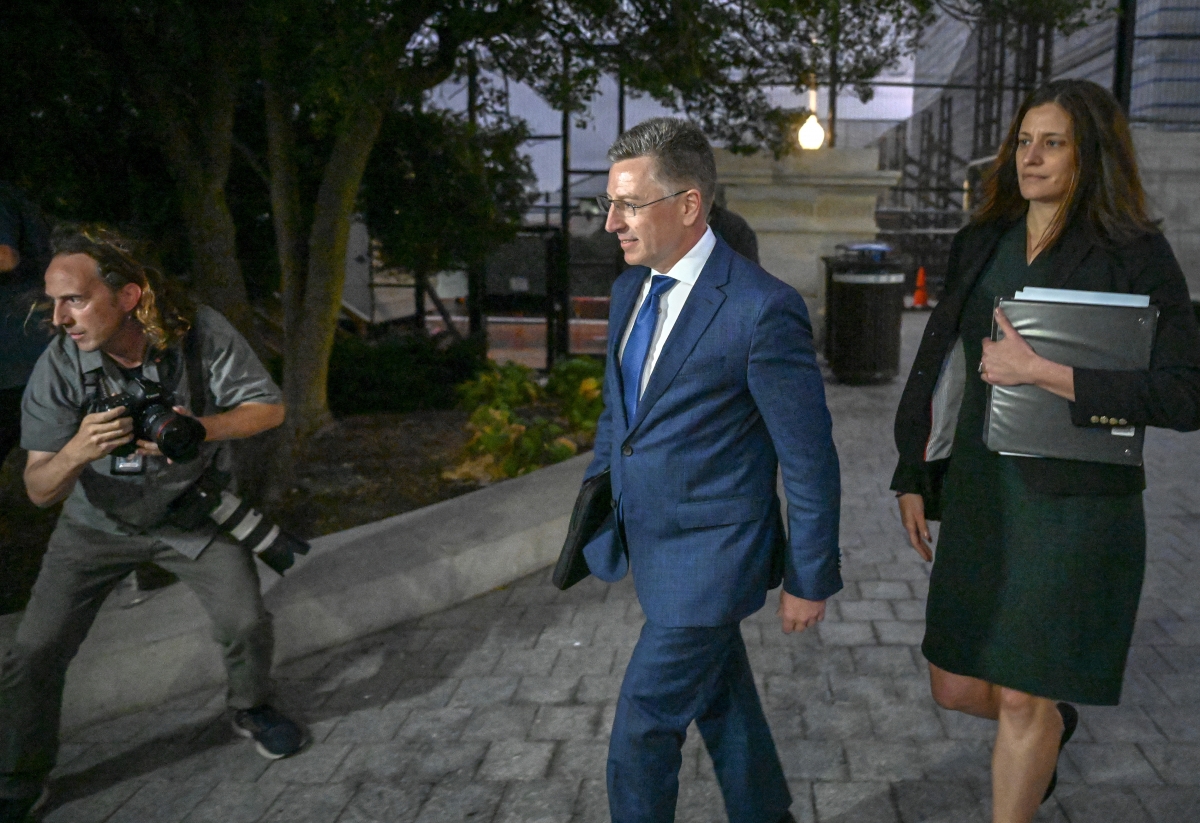
Former envoy to Ukraine, Kurt Volker, departs the Capitol on Oct. 3, 2019 after meeting with the House Intelligence Committee as part of investigations into the then President Donald Trump's dealings with that country. MUST CREDIT: Washington Post photo by Bill O'Leary.

Former envoy to Ukraine, Kurt Volker, departs the Capitol on Oct. 3, 2019 after meeting with the House Intelligence Committee as part of investigations into the then President Donald Trump’s dealings with that country. MUST CREDIT: Washington Post photo by Bill O’Leary.

“Until we were 100% certain that Rudy was the go-to guy, and nothing would happen without him, we were trying to avoid him as much as possible,” said Igor Novikov, who served an adviser to Zelensky until August and was a member of the team tasked with responding to U.S. overtures during the Trump administration.

“But then toward the end of June, we realized that we couldn’t achieve anything with Trump without talking to Rudy first,” Novikov said.

To this end, Volker set up an introductory phone call on July 22, 2019 between himself, Yermak and Giuliani, according to Volker’s testimony during the impeachment proceedings. Novikov, unknown to Giuliani and Volker, sat next to Yermak and took notes.

Volker mentioned the phone call briefly in his testimony, saying that it was short and that he did not remember any discussion of Ukraine opening investigations.

Novikov, however, said the call lasted more than 40 minutes, during which Giuliani spelled out what he wanted.

The Giuliani wish list, according to Novikov: Zelensky would publicly announce the launch of investigations into Burisma and allegations that Ukrainian officials conspired to interfere in the 2016 presidential elections.

“Just let these investigations go forward, get someone to investigate them,” Novikov recalled Giuliani saying. Furthermore, Giuliani wanted a public statement from Zelensky “at the right time” saying that he supports the investigations. It would “clear the air really well,” Giuliani said, according to Novikov’s notes.

According to Novikov, Giuliani told the Ukrainians that Zelensky should “be careful” of the people surrounding him or he could find himself “in trouble.”

Ukrainian officials believe Giuliani later played a key role in setting up the July 25, 2019 call in which Trump asked Zelensky to “do us a favor.” The call became the centerpiece of the House impeachment later that year. Trump later was acquitted by the Senate.

“Trump took the phone call because Rudy said Zelensky would say the right things,” said the official involved in the Ukrainian discussions. “But the Americans’ tone changed after the call. Trump apparently didn’t hear what he wanted to hear.”

After the phone call, Giuliani ratcheted up his efforts for the Ukrainians to open investigations.

In early August 2019, Giuliani and Yermak met in Madrid, according to testimony during the impeachment hearing. Also present was Lev Parnas, an associate of Giuliani’s who is now under federal indictment for campaign finance violations and wire fraud. He has pleaded not guilty.

“In Madrid, Rudy was like a confident mobster, with a smirk and a smile,” Parnas said in an interview. “He was like, ‘We don’t care, you need this more than we do.’ “

Yermak, however, said that Giuliani did not pressure him in Madrid and that Burisma was mentioned only briefly.

In the meantime, the Ukrainians found out from American media that $250 million in U.S. military aid had been put on hold.

Members of Zelensky’s team contemplated giving Giuliani and Trump what they desired, and considered having Zelensky announce the investigations during a planned interview with CNN. Some advisers objected strongly to this, however, and the announcement was canceled.

“Can you imagine what would have been the reaction one second after that interview?” said Oleksandr Danyliuk, the former head of Zelensky’s security council. “Zelensky would be looked upon as a toy, as a soft toy – not as a president. Nobody would have respected him.”

Some Zelensky aides now say it was a mistake to open channels with Giuliani. But Ukraine’s rebuff of the demands, said Novikov, was a victory in keeping the country out of U.S. affairs.

“Without our actions,” he asserted, “the U.S. presidential race would have been very different.”

Transgender girls are at the center of America’s culture wars, yet again #SootinClaimon.Com

#SootinClaimon.Com : ขอบคุณแหล่งข้อมูล : หนังสือพิมพ์ The Nation.

Transgender girls are at the center of America’s culture wars, yet again

InternationalJan 30. 2021

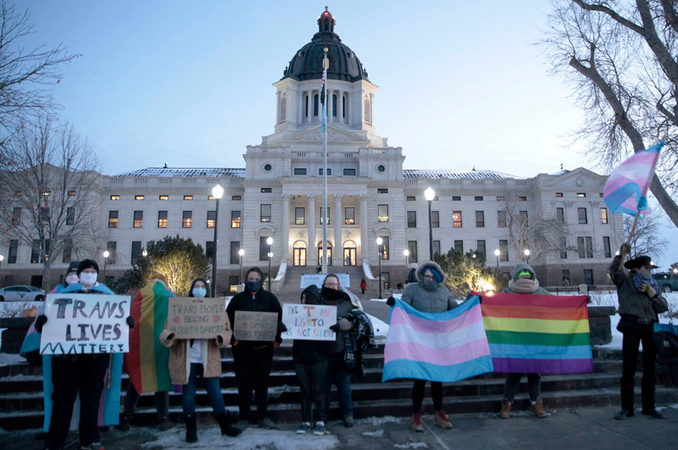
A group of LGBTQ advocates gathered outside the South Dakota Capitol in Pierre on Tuesday, to protest a bill that would have banned people from updating the sex on their birth certificates. (Stephen Groves/ AP)

A group of LGBTQ advocates gathered outside the South Dakota Capitol in Pierre on Tuesday, to protest a bill that would have banned people from updating the sex on their birth certificates. (Stephen Groves/ AP)

By The Washington Post, Emily Wax-Thibodeaux, Samantha Schmidt

WASHINGTON – On the day that President Joe Biden signed an executive order allowing transgender people to serve in the military, Republican lawmakers 2,100 miles away in Montana’s capital advanced a law to ban transgender youth from competing in girls’ sports.

Less than a month into their 2021 sessions, GOP state legislators across the United States are relaunching campaigns to restrict transgender people’s access to medical care and school athletics. But this time, their efforts are clashing with the agenda of a Democratic president who has been called the most pro-transgender in history.

Biden signed an executive order on his first day in office to reinstate protections for gender identity that were curbed by the Trump administration. Meanwhile, lawmakers in at least a dozen states have proposed bills in recent weeks that challenge such protections. Some were carried over from 2020 sessions, when a record number of anti-trans bills were filed in state legislatures, according to the ACLU.

Many of those bills target youth and collegiate sports, with supporters arguing that transgender girls have an unfair physiological advantage in girls’ sports, an edge that can affect access to scholarships.

State Rep. Bruce Griffey, a Republican, who has a cisgender daughter on a school golf team, is backing/sponsoring a bill in Tennessee that would only allow school competition based on the gender listed on one’s birth certificate.

“What if one of the boys is not doing well, so he pretends to be transgender to win?” he asked. “I’m protecting a discriminated class: that’s girls and women in sports.”

But detractors say arguments about biological advantages among transgender athletes are based on limited research and put an outsize focus on a tiny fraction of young competitors. About 2% of high school students in the United States identify as transgender, according to data published in 2019 by the Centers for Disease Control and Prevention.

While studies on the issue are limited, advocates say young transgender athletes also face hurdles that affect their athletic performance, including discrimination, trauma and gender dysphoria.

Bills targeting transgender rights have a history of failing in state legislatures or getting tied up in legal battles. They often elicit protests and boycotts from LGBTQ activists and their supporters or create legal issues around discrimination and privacy.

The Montana House on Tuesday narrowly voted down a bill that would have punished doctors who provided certain medical treatments to transgender minors. Some Republican opponents were critical of bringing government into doctors’ offices and worried it would risk the state’s economy by attracting the kind of boycotts that North Carolina experienced after passing a “bathroom bill” in 2016 that banned transgender people from using public facilities that match their gender identity.

The Montana youth athlete bill has passed the state House on a 61-to-38 vote. It will now move to the state Senate.

Democratic opponents of these bills and some political experts charge that the legislative efforts amount to a political power play to rally the conservative base around an issue they see as threatening traditional gender roles.

The Alliance Defending Freedom, a legal advocacy group for socially conservative causes, published a blog post this week that charges transgender athletes with hijacking competitive opportunities and calls Biden’s executive order a threat to “gut legal protections for women and girls.”

“Alliance Defending Freedom will stand against any attempt by the Biden administration to advance an unconstitutional agenda,” the post reads.

“They just see it as an easy win,” said Don Haider-Markel, chair of political science at the University of Kansas and an expert on public opinion on LGBTQ issues. “It’s an easy way for them to show that Democrats have just gone over the edge, that there is no limit to how far they will push these radical ideas.”

But some Republican lawmakers say the issue is deeper than that. After seeing similar legislation pursued in other states, South Carolina Rep. Ashley Trantham, a Republican, and 18 other state lawmakers sponsored the Save Women’s Sports Act, which would restrict middle- and high school students to sports that correspond to their assigned sex at birth. The bill, pre-filed in December, has been referred to a committee.

School athletics are “an extremely competitive environment,” said Trantham, whose daughter was a high school basketball player. “If it was my daughter and she needed that scholarship to go to college, it would be very important to me that she was playing on an even playing field.”

Trantham said one of the first people she notified when she decided to file the bill was the head of the LGBTQ advocacy group South Carolina Equality.

“I want to make sure you guys understand this is not me trying to hurt the transgender community,” Trantham said she told him. “This is me trying to protect girls in women’s sports.”

LGBTQ activists and many pediatricians say that the medical treatments transgender youth receive to align their bodies with their gender identity mitigate the physical disparities in athletics. They note that those same treatments – including hormones and puberty blockers – also have also been targets of Republican lawmakers, with about a dozen bills introduced this month seeking to restrict transgender minors’ access to them.

While bills limiting transgender athletes are spreading, more than 16 states already have instituted laws and guidance that support full inclusion of transgender youth in sports that correspond to their identities, according to GLSEN, an advocacy group for LGBTQ youth.

“I’ve seen arguments that this will be the end of women’s sports,” said Katrina Karkazis, a cultural anthropologist and bioethicist. “If so, it should have ended already.”

Since the Supreme Court ruled in favor of same-sex marriage in 2015, statehouses have launched more than 300 bills seeking to restrict LGBTQ rights, many targeting transgender issues as well as conversion therapy and same-sex adoption, according to the Equality Federation, a national advocacy organization. Some have attempted to criminalize doctors who provide hormone treatment to transgender youth and others mandate written parental approval for teens who want to use a pronoun different from their sex at birth.

Many of the bills use the same language and are written by conservative advocacy groups. Almost all of them have failed in statehouses or are stuck in court litigation.

After Idaho became the first state to institute restrictions on transgender youth athletes and order “sex examinations” before they could play, a federal judge in August granted a preliminary injunction. Judge David Nye wrote: “The state has not identified a legitimate interest served by the Act . . . other than an invalid interest of excluding transgender women and girls from women’s sports entirely, regardless of their physiological characteristics.”

He wrote that being subjected to physical examinations of their gender “is itself humiliating.”

In South Dakota, which has been at the forefront of legislation that limits transgender rights, state Rep. Fred Deutsch, a Republican, sponsored a bill last February that sought to criminalize medical professionals for treating transgender youths with hormone blockers or surgery. Despite the state having a majority-Republican legislature, the bill failed after hundreds of people protested.

In a November interview, Deutsch said he would not pursue any transgender bills this year, and instead would focus on the state’s high coronavirus infection rates. “My focus is on pandemic related issues for 2021. It’s a more urgent need.”

But he later changed his mind, putting forward a bill that would ban people from changing the sex designation on their birth certificates, unless there was a clerical error or a person has ambiguous genitalia.

“Values always matter and there’s a divide in our country over values,” Deutsch said in a phone interview Thursday. “I stood up and said this is not a hate bill. It’s about biology. It’s science. You can’t change your sex. You can look like a boy, you can take hormones and sex operations but it doesn’t make you a boy. Your gender can be a boy, but you can never change your sex.”

Deutsch’s bill has passed the House and is moving to a Senate committee.

South Dakota state Rep. Linda Duba, a Democrat, who has consistently voted against legislation that restricts transgender rights, said she was taken aback by Deutsch’s about-face.

“Again? What a waste of time. We need to focus on legislation to help those who are impacted by covid,” said Duba, who said she worries about the stakes of such legislation for a population with a disproportionately high rate of suicide and homelessness. “Why discriminate and focus on a group of people who already feel marginalized? We have so many other problems.”

These state-level legislative efforts come as more than 8 in 10 Americans say they favor laws that would protect LGBTQ people against discrimination in jobs, public accommodations and housing, according to a Public Religion Research Institute 2020 American Values Survey.

But while public opinion polls across the board show support for transgender military service and other transgender rights, support softens when it comes to public accommodations and sports, Haider-Markel said.

“These things make people feel uncomfortable,” Haider-Markel said. “When you combine that with close contact . . . whether it be in bathrooms or in sports, that disgust becomes more threatening.”

But transgender athlete Juniper Eastwood, 23, a cross-country runner, said she hopes public sentiments will soon shift, just as many conservatives have come to accept the gay community.

“It’s just going to take a long time,” she said. “It won’t happen this year.”

Paul Crutzen, Nobel laureate who studied ozone and named new ‘Anthropocene’ era, dies at 87 #SootinClaimon.Com

#SootinClaimon.Com : ขอบคุณแหล่งข้อมูล : หนังสือพิมพ์ The Nation.

Paul Crutzen, Nobel laureate who studied ozone and named new ‘Anthropocene’ era, dies at 87

InternationalJan 30. 2021

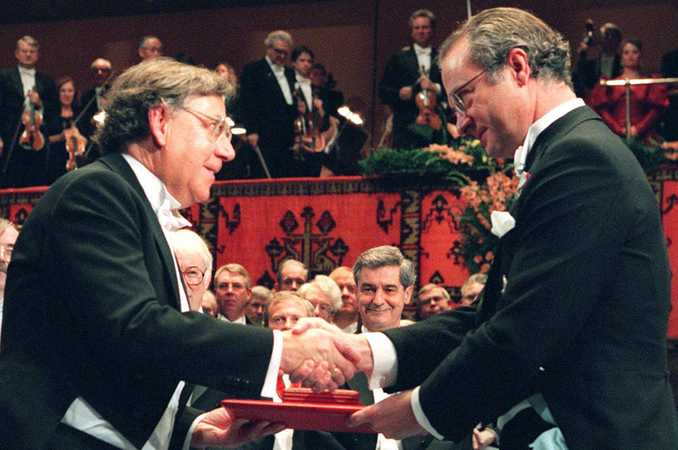
Dutch atmospheric chemist Paul J. Crutzen, left, receives the 1995 Nobel Prize in chemistry from Swedish King Carl XVI Gustaf. (Eric Roxfelt/ AP)

Dutch atmospheric chemist Paul J. Crutzen, left, receives the 1995 Nobel Prize in chemistry from Swedish King Carl XVI Gustaf. (Eric Roxfelt/ AP)

By The Washington Post, Harrison Smith

Paul Crutzen, a Nobel-winning chemist who revealed threats to the ozone layer, developed the concept of “nuclear winter” and concluded that humans were having such a profound impact on the planet that it was time to recognize a new geological epoch – the Anthropocene – died Jan. 28 at a hospital in Mainz, Germany. He was 87.

His death was announced by the Max Planck Institute for Chemistry in Mainz, where Dr. Crutzen directed the atmospheric chemistry department from 1980 until retiring in 2000. A spokeswoman for the institute, Susanne Benner, said he “suffered from several years of illness” but did not specify the cause.

Crutzen was raised in the Nazi-occupied Netherlands and initially worked as an engineer, not a scientist. Though he dreamed of an academic career, he enrolled at a technical school to spare his parents the cost of a university education, and built bridges in Amsterdam before starting a new life for himself in Sweden.

When he spotted a newspaper ad for a computer programming job at Stockholm College, he saw an opportunity. Despite lacking any experience, he applied for the position and got the job – and was soon sitting in on college classes, accumulating enough credits to get a master’s degree and apply for a doctorate program in meteorology.

Crutzen went on to spend decades investigating the interplay between humans and the atmosphere, studying the causes of air pollution, the impact of wildfires, the consequences of nuclear war and the depletion of the ozone layer, which earned him a share of the 1995 Nobel Prize in chemistry. For all his accomplishments, he was perhaps best known in recent years for popularizing “the Anthropocene,” a poetic new term that he first used in 2000.

“I was at a conference where someone said something about the Holocene, the long period of relatively stable climate since the end of the last ice age,” he told Fred Pearce, author of the climate-change book “With Speed and Violence” (2007). “I suddenly thought that this was wrong. The world has changed too much. So I said: ‘No, we are in the Anthropocene.’ I just made up the word on the spur of the moment. Everyone was shocked.”

He later learned that he was not the first to use the term “Anthropocene,” which biologist Eugene Stoermer had employed in the 1980s. Nor was he the first to offer a name for this human-dominated epoch of shrinking forests, rising temperatures and soaring population, which journalist Andrew Revkin once suggested calling the Anthrocene.

But Crutzen’s proposal, formalized in a 2002 Nature article titled “Geology of Mankind,” quickly took off, spurring an ongoing debate over whether it is time to rewrite geology textbooks and add a new epoch to the planet’s timetable, one that emphasizes the powerful role that humans play in shaping the Earth.

“Paul was very good at launching ideas that resonate with a lot of people, and that start to become a central theme of something,” said Guy Brasseur, a distinguished scholar at the National Center for Atmospheric Research in Boulder, Colo. In a phone interview, he called Crutzen a master of developing “simple ideas, simple models, that show the essence of a process.”

Crutzen was initially known for his work on the ozone layer, the thin atmospheric shield that protects plants and animals from ultraviolet radiation. In 1970, he demonstrated that compounds known as nitrogen oxides – spewed out by microbes in the soil – play a central role in controlling the level of ozone in the stratosphere.

His discovery marked a fundamental breakthrough in understanding the chemistry of the ozone layer, and shook up the debate over manufacturing supersonic transport planes such as the Concorde. Drawing on Crutzen’s research, some scientists feared that fleets of supersonic aircraft would pose a threat to the ozone layer by releasing nitrogen oxide into the atmosphere. (The transport planes were never built in large numbers.)

Inspired by his research, chemists Mario Molina and F. Sherwood Rowland published a 1974 article that identified a threat to the ozone layer from chlorofluorocarbons, or CFCs, which were used in everything from air conditioners and refrigerators to hair spray and deodorant. British researchers later discovered a vast “ozone hole” over the South Pole, which Crutzen and other scientists linked to the CFCs.

Their findings paved the way for the Montreal Protocol, a landmark 1987 treaty that phased out the use of ozone-destroying gases. In awarding the Nobel Prize to Crutzen, Rowland and Molina, who died in October, the Royal Swedish Academy of Sciences said that “the three researchers have contributed to our salvation from a global environmental problem that could have catastrophic consequences.”

The loss of the ozone was far from the only environmental catastrophe that Crutzen studied. In a 1982 article memorably subtitled “Twilight at Noon,” he and chemist John Birks warned of a climate disaster caused by a nuclear war, in which fires rage through cities, forests and oil fields. The resulting smoke would blot out the sun, they concluded, cooling the surface of the planet and jeopardizing agricultural production.

Their theory gained further traction when five others, including astronomer Carl Sagan, co-authored a 1983 Science paper titled “Nuclear Winter.” Sagan later discussed the concept on television and campaigned against nuclear weapons, along with researchers such as Crutzen.

“Although I do not count the ‘nuclear winter’ idea among my greatest scientific achievements . . . I am convinced that, from a political point of view, it is by far the most important,” Crutzen said in his Nobel Prize lecture. The theory, he added, “magnifies and highlights the dangers of a nuclear war and convinces me that in the long run mankind can only escape such horrific consequences if nuclear weapons are totally abolished by international agreement.”

Paul Jozef Crutzen was born in Amsterdam on Dec. 3, 1933. His mother worked in a hospital kitchen, and his father waited tables but was often unemployed. The family later struggled to find food and fuel during the German occupation, amid a nationwide famine that became known as the “hunger winter.”

Several of Crutzen’s classmates died before the Swedish Red Cross began dropping packages of food by parachute, and nearly all his classmates lost a year of schooling because they had only a few hours of instruction each week. With special help from a teacher, Crutzen carried on.

In his telling, he excelled in math and physics but, “because of a heavy fever,” struggled in his high school final exam. His grades kept him from receiving a university stipend, setting him on a path to join the Amsterdam bridge construction bureau.

In 1958 he married Terttu Soininen, a Finn, and moved to northern Sweden. He joined the meteorology department at Stockholm College (now a university) the next year, and soon learned machine code that he used to program weather prediction models. He received a master’s degree in 1963, a PhD in 1968 and a doctor of science degree in 1973.

Crutzen was a postdoctoral fellow at the University of Oxford and worked at the National Center for Atmospheric Research before joining the Max Planck Institute for Chemistry, where he mentored younger researchers such as Birks, his collaborator on the “nuclear winter” paper.

“Paul Crutzen mentored at least hundreds and promoted the careers of thousands of scientists around the world,” Birks said in an email. “Besides being a brilliant scientist, he one of the most caring and generous people I have ever known.”

Survivors include his wife, two daughters and three grandchildren.

Long after he helped keep pollutants out of the atmosphere through his ozone research, Crutzen made a bold proposal to flood the air with sulfur in an effort to combat global warming. Such “geoengineering” efforts were worth further study, Crutzen argued, especially if humanity did not act quickly to stem emissions and alter consumption habits.

“Imagine our descendants in the year 2200 or 2500. They might liken us to aliens who have treated the Earth as if it were a mere stopover for refueling, or even worse, characterize us as barbarians who would ransack their own home,” he wrote in a 2011 essay with journalist Christian Schwägerl. “Living up to the Anthropocene means building a culture that grows with Earth’s biological wealth instead of depleting it. Remember, in this new era, nature is us.”

Biden’s national security adviser suggests a fast timeline to rejoin Iran deal #SootinClaimon.Com

#SootinClaimon.Com : ขอบคุณแหล่งข้อมูล : หนังสือพิมพ์ The Nation.

Biden’s national security adviser suggests a fast timeline to rejoin Iran deal

InternationalJan 30. 2021

Jake Sullivan, President Biden's new national security adviser, helped shape the Iran nuclear deal struck in 2015. (Demetrius Freeman/ The Washington
Post)

Jake Sullivan, President Biden’s new national security adviser, helped shape the Iran nuclear deal struck in 2015. (Demetrius Freeman/ The Washington Post)

By The Washington Post, Anne Gearan

WASHINGTON – President Joe Biden is eyeing an urgent restoration of the international nuclear deal with Iran as a first step to deal with a range of threats from that country, new national security adviser Jake Sullivan said Friday, suggesting a faster timeline than the administration has previously outlined.

Sullivan did not mention Biden’s oft-stated precondition that Iran make the first move by rolling back nuclear activities to come back into compliance with terms of the 2015 deal. Iran is closer to building a bomb now than it was when President Donald Trump pulled the United States out of the deal, and putting the nuclear program “in a box” is the first imperative, Sullivan said.

“We are going to have to address Iran’s other bad behavior, malign behavior across the region, but from our perspective, a critical early priority has to be to deal with what is an escalating nuclear crisis as they move closer to having enough fissile material for a weapon,” Sullivan said. “And we would like to make sure that we reestablish some of the parameters and constraints around the program that have fallen away over the course of the past two years.”

Containing Iran’s ability to produce bombmaking nuclear material was the central rationale the Obama administration applied in seeking the deal that Sullivan helped to shape.

The timing of a U.S. return to the deal, as well as new concessions or promises made to Iran and the scope of a potential follow-on agreement, is one of the first major foreign policy tests for the Biden administration.

Sullivan did not spell out a preferred timeline, and the issue is now being debated among White House and State Department advisers. But Sullivan’s emphasis on a pressing need to contain Iran suggests he may push for an accelerated response.

Secretary of State Antony Blinken has adopted a skeptical tone about any fast action, saying on his first full day in office Wednesday that a U.S. return to the deal is still far off.

“Iran is out of compliance on a number of fronts. And it would take some time, should it make the decision to do so, for it to come back into compliance and time for us then to assess whether it was meeting its obligations,” Blinken said during a news conference at the State Department. “We’re not there yet, to say the least.”

As a 2020 presidential candidate, Biden committed to returning to the international compact that Trump had run in 2016 on reversing. After Trump pulled the United States out in 2018, Iran began breaking its obligations under the agreement.

Biden set the condition that Iran would have to return to complying with the agreement first, and said a restored deal would then be a starting point for negotiation of a larger agreement that addresses long-standing concerns over Iran’s ballistic missile capability, its support for terrorism, and aggressions toward Israel and Persian Gulf neighbors.

Sullivan mentioned those concerns in remarks to the United States Institute of Peace, and said the threats have only gotten worse because of Trump’s decision.

“Our view is that if we can get back to diplomacy and can put Iran’s nuclear program in a box, that will create a platform upon which to build a global effort, including partners and allies in the region and in Europe and elsewhere, to take on the other significant threats Iran poses, including on the ballistic missile issue,” Sullivan said.

With key decisions about the pace and scope of U.S. outreach on hold, the administration on Friday named former Obama administration Middle East adviser and veteran diplomat Robert Malley to be a special envoy on Iran.

Conservatives including Sen. Tom Cotton, R-Ark., criticized the pick before it was announced, calling Malley too soft on Tehran. Other opponents of the 2015 deal said Malley has been too critical of Israel, whose leaders opposed the deal reached when Biden was vice president.

“As the President and Secretary Blinken have said, if Iran comes back into full compliance with its obligations under the JCPOA, the United States would do the same and then use that as a platform to build a longer and stronger agreement that also addresses other areas of concern,” State Department spokesman Ned Price said in a statement Friday.

The 2015 deal is formally known as the Joint Comprehensive Plan of Action.

“But we are a long way from that point as Iran is out of compliance on a number of fronts, and there are many steps in the process that we will need to evaluate,” Price said, promising coordination with allies and with Congress, where skepticism about a return to the deal is widespread.

Malley will lead a team of “clear-eyed experts with a diversity of views,” as the new administration decides what to do, Price said.

Iran has said the United States must make the first move.

Iran’s parliament has tried to raise pressure on the new administration, threatening to suspend some U.N. nuclear inspections unless the United States lifts sanctions by Feb. 21.

Iranian Foreign Minister Mohammad Javad Zarif responded to Blinken’s remarks with a tweet in English.

“Reality check for @SecBlinken: The US violated (the) JCPOA,” Zarif tweeted.

Sullivan spoke during an event that also featured his predecessor, Trump national security adviser Robert C. O’Brien. Sullivan and O’Brien agreed on other major priorities, including confronting China and Russia and extending Trump’s effort to forge diplomatic and economic agreements between Israel and Arab neighbors.

Israeli Prime Minister Benjamin Netanyahu objected to the 2015 agreement and tried to derail it. Sullivan did not mention Israel in his remarks Friday but did say Iran’s threats against other nations in the Middle East are rising.