Moderna’s coronavirus vaccine shows encouraging early results in human safety trial #ศาสตร์เกษตรดินปุ๋ย

#ศาสตร์เกษตรดินปุ๋ย : ขอบคุณแหล่งข้อมูล : หนังสือพิมพ์ The Nation.

https://www.nationthailand.com/lifestyle/30388068?utm_source=category&utm_medium=internal_referral

Moderna’s coronavirus vaccine shows encouraging early results in human safety trial

May 18. 2020
By The Washington Post · Carolyn Y. Johnson · NATIONAL, HEALTH 

Moderna, the Massachusetts biotechnology company behind a leading effort to create a coronavirus vaccine, announced promising early results from its first human safety tests Monday and a plan to launch a large clinical trial in July aimed at showing whether the vaccine works.

The company reported that in eight patients who had been followed for a month and a half, the vaccine at low and medium doses triggered blood levels of virus-fighting antibodies that were similar or greater than those found in patients who had recovered. The antibody-rich blood plasma donated by patients who have recovered is separately being tested to determine whether it is an effective therapy for covid-19.

The vaccine showed no worrisome safety signals, aside from redness at the injection site for one patient and some “systemic” symptoms in three patients given the highest dose, the company said.

The interim data Moderna announced come from a clinical trial aimed at showing the safety of its experimental vaccine and helping the company select the correct dose. The company has not yet picked the dose or announced the size or length of the large trial that it will start in July, which will be the key one that regulators consider to decide whether the vaccine is safe and effective.

“We are very, very happy because first the vaccine was generally safe,” Stephane Bancel, chief executive of Moderna said in an interview. “The piece that was really exciting and was the big question, of course, was can you find antibodies in people in enough quantities” to prevent disease.

Moderna also reported that the vaccine protected mice who were vaccinated and then exposed to the virus, preventing it from multiplying in their lungs. The animal and human data being released by the company have not yet been published.

Moderna’s vaccine uses a genetic material called messenger RNA that codes for the distinctive spike protein that studs the outside of the novel coronavirus. The vaccine delivers the messenger RNA to cells, which then follows the genetic instructions to create the virus protein – allowing the body to learn to recognize and neutralize the pathogen.

Moderna’s announcement comes days after one of its board members, Moncef Slaoui, stepped down from the board to become chief scientist for Operation Warp Speed, a White House initiative to speed up vaccine development. Slaoui still owns stock options in Moderna, and made an apparent reference to the early data in a Rose Garden news conference on Friday afternoon.

The girl who died twice #ศาสตร์เกษตรดินปุ๋ย

#ศาสตร์เกษตรดินปุ๋ย : ขอบคุณแหล่งข้อมูล : หนังสือพิมพ์ The Nation.

https://www.nationthailand.com/lifestyle/30388020?utm_source=category&utm_medium=internal_referral

The girl who died twice

May 17. 2020
By The Washington Post · Ariana Eunjung Cha, Chelsea Janes · NATIONAL, HEALTH 

The day Juliet Daly’s heart gave out started much like every other Monday during the quarantine.

The 12-year-old from Covington, Louisiana, padded out of her room in her PJs shortly after 7 a.m., ate a half-bowl of Rice Krispies, and got on a Zoom call with her sixth-grade social studies class. She had been feeling unwell all weekend with twisting abdominal pains, vomiting and a fever of 101.5, but she seemed to be on the mend.

The weird thing, she recalled, was that her lips looked bluish in the mirror and she was super tired. In fact, she kept falling asleep unexpectedly. On the couch. In front of her computer. In the bath.

“I thought I was feeling a bit better,” she said, “but I couldn’t keep my eyes open.”

With all the news swirling around them about the pandemic, her parents, Sean and Jennifer Daly, had been monitoring their daughter’s illness closely. She had been healthy and did not have a cough, shortness of breath or other typical symptoms of covid-19, so Jennifer, a radiologist, initially suspected appendicitis, some kind of stomach bug, or perhaps the flu.

That afternoon, they took Juliet to the emergency department, where doctors noticed an unusual constellation of symptoms pointing to a different problem. Her heart rate was extraordinarily low, jumping around in the 40s when it should have been between 70 to 120 beats per minute. And when they squeezed her nails, they turned white and stayed white when they should have gone back to pink.

Juliet was in a kind of toxic shock, and her heart had become so inflamed it was barely beating.

It was still relatively early in the outbreak, April 6, and the hospital hadn’t seen other children in this condition. But the doctors knew enough about the pathogen’s effects on adults that they immediately suspected the coronavirus.

– – –

Cases like Juliet’s, a puzzling inflammatory syndrome in children believed linked to covid-19, had been popping up in different parts of the world for months, but it wasn’t until recently that health authorities began tracking the phenomenon.

The number of infected children, while still small, is estimated to be a few hundred – larger than anyone anticipated for a disease thought to inflict little, if any, harm on children. Doctors in Britain and Italy had issued alerts in April, and the American Heart Association warned last week that some pediatric patients “are becoming very ill extremely quickly,” urging providers to evaluate them right away.

On Thursday night, the Centers for Disease Control and Prevention issued an advisory and gave the unusual condition a name – multisystem inflammatory syndrome in children, or MIS-C.

More than 100 children are believed to have it in New York state, with about half in New York City, where three have died. In recent days, medical centers in 14 other states have reported similar cases. Scientists still believe most children and young people experience only mild illness or none at all if they become infected with the coronavirus. But they’re concerned about the critical nature of the inflammatory syndrome cases, which seem to be appearing in children weeks after a wave of infections in their communities.

“We’ve been seeing kids steadily for two months,” said Roberta DeBiasi, infectious disease specialist at Children’s National Hospital in the District. “But this presentation is clearly different. It’s not that we just didn’t notice this before. It’s a new presentation. And the fact that it’s happening two months after the initial circulation of the virus gives weight to the idea that it’s an immune-mediated phenomena.”

Jennifer Owensby, a pediatric intensivist at Rutgers’s Robert Wood Johnson University Hospital in New Brunswick, New Jersey, said the first group of children she saw with covid-19 appeared to have classic respiratory symptoms, such as shortness of breath. Now, she said, “The vast majority are coming in with symptoms of cardiac failure, which is extremely rare in pediatrics, especially in normal, healthy kids – which is why this is so alarming.”

Writing in the Lancet medical journal this week, Italian doctors reported on a cluster of 10 children struck with the inflammatory condition in the coronavirus epicenter of Bergamo. The cases appear to have characteristics of an illness first identified in Japan known as Kawasaki disease, which causes inflammation in blood vessels and includes a persistent fever. But these children were older than is typical with Kawasaki, which usually strikes those younger than 5, and they had more serious heart issues.

Just like Juliet, who is among the first known children in the United States to develop multisystem inflammatory syndrome.

– – –

Sean Daly was at the hospital with “Jules,” as he sometimes called her, while Jennifer was on the phone from work.

A transportation planning consultant with no medical background, Sean remembers feeling confused as doctors told him they were giving his daughter an epinephrine drip to help her heart, and were sending her to a larger hospital with more expertise and equipment. They said they would put her on a ventilator to stabilize her for the helicopter trip to Ochsner Medical Center, about 50 miles away in New Orleans.

Sean, unaware of the gravity of his daughter’s condition, thought ridiculous thoughts about the absurdity of his shorts and flip-flops amid the alien-looking hospital workers in head-to-toe protective equipment. And he thought about how, just a few minutes earlier, his daughter had been well enough to walk across the parking lot and into the ER. He heard an announcement about something called a “code blue” and wondered why more and more people kept rushing into her room.

When the attending doctor finally popped out, Sean recalled, she was shaking. She said Juliet had gone into cardiac arrest, and it took them nearly two minutes of CPR, or cardiopulmonary resuscitation, to revive her.

“It didn’t process all that well with me,” he said. “She was telling me Juliet was ‘back,’ and I was like, ‘That’s good. I didn’t know she had gone anywhere.’ Thankfully I was not in the room. I don’t think I would have handled that.”

Jennifer was hysterical.

“It was horrific. It was beyond anything. It was shocking how quickly it happened,” she recalled.

– – –

When Jennifer arrived at Ochsner, she didn’t understand how she could have possibly beaten her daughter there. She had driven for about an hour in a semicircle around Lake Pontchartrain while Juliet had been airlifted.

“I was crying and freaking out,” she recalled. By the time she was able to grab a nurse, she feared the worst. “I just need to know one thing now,” she demanded. “Is she alive?”

Juliet’s helicopter had been delayed because she had coded a second time and, again, doctors restarted her heart. But by the time they wheeled her into the pediatric intensive care unit in the new hospital, some of her other organs had begun failing, too, probably because the heart was unable to pump the oxygen-filled blood they needed.

Juliet’s liver and kidneys were in shock. There was blood in her lungs. Her pancreas was inflamed.

Heartbeats are controlled by electrical impulses that travel down the right and left branches of the heart at the same speed. Somewhere in Juliet’s heart, a block was causing the system to go haywire.

A team of pediatric cardiology specialists gave Jennifer a name for her daughter’s condition: acute fulminant myocarditis – a sudden onset of heart failure, shock or life-threatening arrhythmias.

The doctors began medications, requisitioned a heart bypass machine in case it was needed, and prepared Jennifer for the possibility that Juliet might need a transplant.

“They were not sure she was going to make it the first night,” Jennifer said. “It was a total nightmare.”

Meanwhile, Juliet’s nasal swabs came back positive for the coronavirus and adenovirus, one cause of the common cold. The results were bewildering because none of the other family members – Sean, Jennifer or Juliet’s brothers, ages 5 and 16 – had been the least bit sick. But if her condition was post-viral, occurring weeks after infection – as scientists increasingly suspect in such cases – there were any number of ways she could have been exposed, since school had still been in session and stay-at-home orders had not yet been issued.

Since none of Juliet’s family had symptoms and test kits were in short supply in the area, doctors opted not to test them.

After confirming the coronavirus diagnosis, doctors gave Juliet an immunoglobulin product used successfully on Kawasaki patients. They ruled out using hydroxychloroquine, the anti-malarial touted by President Donald Trump, because they were worried about cardiac side effects given her already fragile heart condition.

As Jennifer sat in the room with full protective equipment, including a face shield, mask and gown, she held her daughter’s hand. Only one parent was allowed, so Sean stayed at home with the boys.

Unable to sleep, Jennifer started a group text chat so she could keep family and friends updated. She played Juliet’s favorite song – Maroon 5′s “Moves Like Jagger” – vowed to be as optimistic as possible and prayed.

– – –

That first night was torture. Juliet’s heart was starting and stopping, beating too fast and then too slow, as doctors adjusted the medications. But within 24 hours, almost miraculously, she seemed to be stabilizing. The numbers on her labs for her kidneys and liver were moving in the right direction, and the echocardiogram of her heart had improved.

While Jennifer joked with her husband about Juliet being a heavy sleeper, there were instances when her daughter woke up and seemed to understand her completely.

“We love you,” Jennifer would say. “You’re going to get better.”

She talked about an Easter egg hunt she would have in the yard with her brother, Dominic.

Juliet was able to give a thumbs up and squeeze her hand.

“I’m optimistic she is neurologically intact,” Jennifer texted to Sean. Her tone was clinical, but it had been one of her worst fears as a mother.

By Thursday, doctors were confident enough in Juliet’s progress that they took her off the ventilator, letting Juliet breathe on her own. She was still on a lot of medications and confused and upset about all the tubes coming out of her body.

Jennifer remembers reassuring her she was safe in the hospital, but that she was still very sick and weak.

Juliet’s reaction wasn’t what she expected: “No Mommy, I’m not weak. I’m strong!”

“The first day of regaining consciousness, I was freaking out. I wanted to go home badly,” Juliet recalled. She said she was terrified of how everyone kept stepping on all her cords, which were tangled and plugged in outside because the nurses wanted to limit how many times they came into her room. The Band-Aid on her neck was “way too sticky for humankind.” And she could taste the saline they were giving her via IV, and it was bad.

Then on April 15, almost as suddenly as she had been admitted nine days before, doctors told Juliet she was well enough to go home.

– – –

Juliet has no memories of when her heart stopped twice, and her parents are grateful for that.

She was discharged on four medications – two for the heart, a blood thinner and one for her pancreas – but bounced back physically in no time. She was able to return to her school’s online classes, in which she’s continuing her streak of As, and has no trouble riding her bike around the neighborhood.

Doctors monitoring her closely say the drugs are temporary and that they are hopeful she’ll make a full recovery. On Friday, she returned to Ochsner for the first time since her hospitalization for a one-month follow-up appointment. Jake Kleinmahon, the pediatric cardiologist who is treating her, said he was thrilled when the echocardiogram of her heart looked “completely normal.” Like other children with myocarditis, she is restricted from competitive sports for six months (Juliet’s parents say that’s not a problem as she doesn’t really like to sweat) but is otherwise free to engage in activities.

“I do not expect her to have any long-term complications or limitations, even though she came in so severely ill,” Kleinmahon said. “She is quite a fighter and such a brave young girl.”

The only odd change, Juliet said, is that she came out of the hospital with a monster craving for bacon, which she didn’t love before. And she no longer wanted doughnuts, which had been among her favorite foods. Such changes in taste are not uncommon after ICU stays, doctors say.

The emotional part of her recovery has been more challenging. Juliet thinks about other kids who might become sick with the same syndrome. She says she would advise them “not to freak out too much because freaking out makes things worse. Because that’s what I did, and that didn’t help at all.”

She worries more about her family and friends, their future and hers, and the strange world of viruses she knew nothing about before.

“I feel like I’m a bit self-conscious about my body because I don’t know what’s going to happen next,” she said. “I’m worried about how there’s a lot of other stuff you can get.”

France angered by suggestion that U.S. would get 1st access to vaccine by French company #ศาสตร์เกษตรดินปุ๋ย

#ศาสตร์เกษตรดินปุ๋ย : ขอบคุณแหล่งข้อมูล : หนังสือพิมพ์ The Nation.

https://www.nationthailand.com/lifestyle/30387868?utm_source=category&utm_medium=internal_referral

France angered by suggestion that U.S. would get 1st access to vaccine by French company

May 15. 2020
By The Washington Post · James McAuley · NATIONAL, BUSINESS, WORLD, EUROPE 

PARIS – It would be “unacceptable” for French pharmaceutical giant Sanofi to give first access to a potential covid-19 vaccine to the United States, French government officials said Thursday.

The pushback came after comments by Sanofi Chief Executive Paul Hudson.

“The U.S. government has the right to the largest preorder because it’s invested in taking the risk,” Hudson told Bloomberg News in a story published Wednesday. The United States, Hudson said, expanded its investment in the company’s vaccine research in February and thus expects that “if we’ve helped you manufacture the doses at risk, we expect to get the doses first.”

Those comments did not sit well in Paris.

“For us, it would be unacceptable if there were privileged access from this or that country under a pretext that would be a monetary pretext,” France’s state secretary for economy and finance, Agnès Pannier-Runacher, told France’s Sud Radio on Thursday.

Olivier Véran, France’s health minister, said he was shocked when he saw Hudson’s interview.

“When I read that, I took my phone – it was late, it would have been something like 11 at night – and I called the CEO of Sanofi France for an explanation,” Véran said, speaking Thursday to France’s BFM TV.

A covid-19 vaccine “should be a global public good,” Prime Minister Edouard Philippe tweeted. “Equal access for everyone to the vaccine is not negotiable.”

A spokesman for the Elysee Palace, the seat of the French presidency, said that President Emmanuel Macron was struck by Hudson’s comments in the same way as his ministers were, and that Hudson would meet Macron at the Elysee next week, although a date for that meeting had not yet been set.

The Elysee said it was “concentrating its efforts on a coordinated multilateral response so that a vaccine is available to all and at the same time, because it knows no borders.”

Early in the coronavirus outbreak, France came under heavy criticism for its reluctance to share protective medical equipment with its European neighbors. It subsequently has taken a more communal approach. And Macron, along with German Chancellor Angela Merkel, has been an especially vocal proponent of a global initiative to develop a successful covid-19 vaccine that would not favor any particular country.

“We need to make sure it is rendered accessible to all of those around the world,” he said in April.

Macron and Merkel, along with the World Health Organization, spearheaded a roughly $8.2 billion vaccine fundraising drive that culminated in a virtual summit this month, during which world leaders and prominent philanthropists pledged to fund vaccine research, testing kits and mass-produced drugs that could effectively fight the coronavirus.

The United States did not participate in the conference. It has instead partnered directly with pharmaceutical companies, contributing half a billion dollars to Johnson & Johnson’s vaccine effort and hundreds of millions of dollars to Sanofi and to Moderna, a biotech company in Massachusetts teaming with a Swiss company for vaccine manufacturing.

More than 100 covid-19 vaccine research efforts are in progress around the world, in laboratories in the United States, Britain, Germany, France and elsewhere. The question of national preference in these trials has been present from the beginning.

Heralding an Oxford University trial last month, for instance, British Health Secretary Matt Hancock said citizens of Britain should have preference if the trials proved successful. But Prime Minister Boris Johnson has talked about the importance of a globally available vaccine.

“The race to discover the vaccine to defeat this virus is not a competition between countries but the most urgent shared endeavor of our lifetimes,” Johnson said at the virtual vaccine summit.

The agency that approves medicine for the European Union said Thursday that in an optimistic scenario, a vaccine could be approved by early 2021.

Sanofi has two coronavirus candidate vaccines in pre-clinical evaluation.

The research behind the first, investigating a preclinical SARS (severa acute respiratory syndrome) candidate vaccine, was conducted in conjunction with British pharmaceutical conglomerate GlaxoSmithKline and supported by the Biomedical Advanced Research and Development Authority, part of the U.S. Department of Health and Human Services.

Sanofi said it expects to launch human trials for that vaccine in the second half of 2020.

The firm’s second candidate vaccine is being developed with Translate Bio, a Lexington, Massachusetts-based therapeutics company.

Hudson’s comments and additional messaging from Sanofi may be part of an effort to prod European governments to invest more in vaccine research. As Hudson told Bloomberg, his aim was partially to “to try to create a debate in Europe to say, ‘Don’t let Europe be left behind.’ ”

But by Thursday morning, the company appeared to be backpedaling somewhat.

Olivier Bogillot, head of Sanofi’s French division, told France’s BFMTV network that the vaccine would be available to Europeans at the same time as Americans if the European Union were as “efficient” a partner.

“If we discover a vaccine, it will be accessible to everyone – the Americans and the Europeans will have it at the same time,” Bogillot said. “The words of Paul Hudson were misunderstood; he was just calling on the European Union to be more efficient.

“For me, the debate is closed,” he said. “The vaccine, if discovered, will be made available to French patients.”

“GSK and Sanofi both believe that global access to COVID-19 vaccines is a priority,” the company said in a statement. “And we are committed to making any vaccine developed through the collaboration available and affordable through mechanisms that offer fair access to people around the globe, including the U.S.

“It is critical that governments support this goal and collaborate to help industry to make fair allocation decisions,” the company said.

Even finding a covid-19 vaccine won’t be enough to end the pandemic #ศาสตร์เกษตรดินปุ๋ย

#ศาสตร์เกษตรดินปุ๋ย : ขอบคุณแหล่งข้อมูล : หนังสือพิมพ์ The Nation.

https://www.nationthailand.com/lifestyle/30387689?utm_source=category&utm_medium=internal_referral

Even finding a covid-19 vaccine won’t be enough to end the pandemic

May 12. 2020
In the race to meet global demand, Emergent BioSolutions in Baltimore is gearing up to manufacture 300 million doses of an experimental vaccine against the novel coronavirus, even before clinical trials in people have begun. MUST CREDIT: Emergent

In the race to meet global demand, Emergent BioSolutions in Baltimore is gearing up to manufacture 300 million doses of an experimental vaccine against the novel coronavirus, even before clinical trials in people have begun. MUST CREDIT: Emergent
By The Washington Post · Christopher Rowland, Carolyn Y. Johnson, William Wan · NATIONAL 

Johnson & Johnson’s race to manufacture a billion doses of coronavirus vaccine is ramping up in a small biotechnology plant near Interstate 95 in Baltimore. But even as technicians prepare to lower 1,000-liter plastic bags of ingredients into steel tanks for brewing the first batches of experimental vaccine, international concern is bubbling about what countries will get the first inoculations.

The Baltimore plant is the second of four planned locations around the world where Johnson & Johnson plans to pump out vaccine on a massive scale, months before testing the first dose in a human being. The manufacturing head start is one part of a worldwide scramble to protect the human population from the virus that is not expected to vanish on its own.

If SARS-CoV-2 establishes itself as a stubborn, endemic virus akin to influenza, medical experts say there almost certainly will not be enough vaccine for at least several years, even with the unprecedented effort to manufacture billions of doses. About 70 percent of the world’s population – or 5.6 billion people – will likely need to be inoculated to begin to establish herd immunity and slow its spread, scientists say.

Yet the nationalistic priorities of individual nations could thwart the strategic imperative to tamp down hotspots wherever they are on the planet – including poor countries that can’t afford the vaccine. The United States in particular could be left in the cold if vaccines developed here as part of a go-it-alone approach turn out to be less effective than those produced in China or Europe.

The scenario public health experts fear most is a worldwide fight in which manufacturers sell only to the highest bidders, rich countries try to buy up the supplies, and nations where manufacturers are located hoard vaccines for their own citizens.

“The model of countries thinking only of themselves is not going to work. Even if you’re living somewhere that’s somehow perfectly without any infections. Your best efforts to fight the virus are going to fail unless you shut off all your borders and trade,” said Seth Berkley, CEO of Gavi, a public-private partnership that helps provide vaccines to developing countries. “This is a global problem that requires a global solution.”

International health advocates want to avoid a repeat of 2009, when wealthy countries – including the United States, which was led by the internationalist-leaning Barack Obama – were at the head of the line for H1N1 swine flu vaccine, leaving underdeveloped countries with little supply until after the pandemic subsided.

Such an approach will be sorely tested by President Donald Trump and other world leaders with nationalistic impulses and their own anxious populations who want to reduce the deadly threat and bring their economies back to life.

In the United States, the federal government agency in charge of emergency vaccine development indicated it is prioritizing domestic concerns – an “America First” mentality that has shaped much of the Trump administration’s pandemic response.

“Right now, we’re focused on the whole-of-America approach required to expedite the availability of vaccines,” said Gary Disbrow, acting director of the Biomedical Advanced Research and Development Authority (BARDA), in an emailed response to written questions from The Washington Post.

BARDA – which is tasked with protecting Americans from biological threats – is channeling nearly half a billion dollars in emergency funds to Johnson & Johnson to develop a vaccine. It also is providing hundreds of millions of dollars in financial support for vaccine efforts by Sanofi, the large French drug company, and Moderna, a biotech company in Massachusetts teaming with a Swiss company for vaccine manufacturing.

“By working with multiple companies, we have more ‘shots on goal’ to increase the chances that the U.S. will have one or more vaccines available as quickly as possible,” Disbrow said.

The global grab for protective equipment and ventilators that left poorer countries empty-handed suggests the competition over vaccines could be at least as fierce. Dozens of companies large and small are rushing to develop vaccines using different technologies and approaches. Avalere Health, a pharmaceutical consulting company, is tracking at least 120 separate vaccine projects sponsored by governments, universities, nonprofit institutes and private companies.

Large-scale manufacturing capacity will be required to produce viable products out of those experiments and clinical trials. Some vaccines may require two doses, putting greater pressure on manufacturing capacity. Some top officials in the Trump administration are raising attention to the issue. Francis Collins, the director of the National Institutes of Health, and Anthony Fauci, director of the National Institute for Allergy and Infectious Diseases, both physicians, were co-authors of an article published in the journal Science on Monday that urged international coordination.

“Cost, distribution system, cold-chain requirements, and delivery of widespread coverage are all potential constriction points in the eventual delivery of vaccines to individuals and communities,” they wrote. “All of these issues require global cooperation among organizations involved in health care delivery and economics.”

Recognizing the financial and logistical bottlenecks for smaller biotech firms, Bill Gates, the philanthropist and Microsoft founder, announced in April on The Daily Show with Trevor Noah that the Bill and Melinda Gates Foundation would make billions of dollars available to help seven undisclosed companies build out manufacturing capacity.

The race for a vaccine is full of risks because no one knows which projects will succeed. That forces companies to scale up to produce millions of doses of vaccine that might end up being worthless. There is another risk.

The United States might not be well-positioned if the best vaccines end up coming from other countries or international collaborations – such as a development and manufacturing cooperative that world leaders pledged billions toward this month at an online event the Trump administration skipped. A Trump administration official, not speaking for attribution this month under White House rules for speaking to reporters, said the United States supports such efforts despite skipping the pledge event.

“We need to lay the groundwork for global vaccine sharing now, before we know who is the winner. It’s basically negotiated – there’s not a global framework or protocol, there’s not a preexisting framework about how to do this,” said Jeremy Konyndyk, a senior policy fellow at the Center for Global Development, who worked on the U.S. government’s response to international disasters in the Obama administration. “What we don’t want is a situation of haves and have-nots, based on either who gets vaccine to work or who has the production capacity or who has the wealth.”

Much of the international outrage during the H1N1 swine flu pandemic 11 years ago centered on supply contracts western governments secured with vaccine manufacturers. The United States, under former President Barack Obama, had contracts in 2009 that entitled it to 600 million doses, The Washington Post reported at the time, a huge share of potential global supply.

Stronger frameworks for international planning have since been established for influenza vaccines. But those frameworks do not automatically apply to the coronavirus. David Fidler, adjunct senior fellow for cybersecurity and global health at the Council on Foreign Relations and a visiting professor at the Washington University School of Law in St. Louis, said the much larger threat of the coronavirus could make it more difficult for countries to act together – especially in the United States, which has experienced the highest covid-19 caseload and death toll in the world.

“Access to vaccine, as a safety valve to release that political and economic pressure, is going to be astronomical for anyone who is in the White House. That pressure is not going to dissipate if (presumptive Democratic nominee) Joe Biden wins in November,” he said.

Large drug companies may enter into vaccine contracts again as they face pressure to recoup their investments, Fidler added.

“For pharmaceutical companies that make vaccines, your best customer for return on investment are high-income countries,” Fidler said. “If you’re going to get a return on investment, somebody has to buy it.”

According to data from the Centers for Disease Control and Prevention, more than 80 million Americans were inoculated in the 2009 swine flu pandemic – an amount that roughly equals the total number of doses that were received in 77 different countries under a distribution plan organized by the World Health Organization.

“Rich countries monopolized the vaccine, poor countries were left behind. They got the vaccine later, and they got less of it,” Gavin Yamey, director of the Center for Policy Impact in Global Health at Duke University said in a university podcast. Allowing a repeat scenario in the battle against the coronavirus would be a devastating mistake, he said.

“Unless we make this vaccine globally available,” he said, “we are not going to be able to end the pandemic because . . . an outbreak anywhere is an outbreak everywhere.”

BARDA has not yet signed contracts with Johnson & Johnson or other companies for delivery of specific numbers of doses, a step Disbrow said would be “premature at this point.”

Johnson & Johnson “has indicated that approximately 300 million doses of vaccine would be available in the U.S. each year,” he said, which is enough to vaccinate 90 percent of the U.S. population of 330 million people. That number of doses matches up with the projected annual capacity at the Baltimore plant, which is operated by a publicly traded corporation called Emergent BioSolutions and receives funding as one of four federal Centers for Innovation in Advanced Development and Manufacturing.

Asked about Disbrow’s assertion, a top executive at Johnson & Johnson did not commit to specific volumes or timing of delivery of vaccine in the United States, citing the need to evaluate global priorities to stop the pandemic.

The company wants to produce 1 billion doses by the end of 2021, making the first doses available as early as this winter. Where vaccine will be most needed is not known, although health care workers will be a high priority, Paul Stoffels, Johnson & Johnson’s executive vice president and chief scientific officer, said in an interview.

Stoffels said Johnson & Johnson is committed to satisfying demand wherever it is most needed. The company also is not interested in making a profit on the coronavirus vaccine, he said.

“It’s very difficult to determine at the moment where the epidemic is then going to be,” Stoffels said in an interview. “We think honestly . . . that the priority should go to the people who need it most – first, that are probably the health care workers and people at high risk, and maybe wherever they are in the world.

“On the one hand, we work very much with the U.S.,” he added, “but on the other hand we also do our best to make sure we can serve the world.”

Johnson & Johnson says its vaccine technology is particularly well suited to underdeveloped regions because vials of doses can be shipped at relatively warm temperatures in the last stage of delivery. In addition to Baltimore, it will be producing a vaccine at its own plant in the Netherlands and is looking for at least two other locations in Asia and Europe, according to the company. It also is contracting with glass-vial manufacturers to buy 5-dose vials to ease shortages of packaging, Stoffels said.

Pfizer, which is testing multiple vaccine candidates, has identified factories in the United States and Belgium and is securing its supply chain, with the goal of having 10 to 20 million doses available by fall and hundreds of millions of doses next year, the company said.

“We’re thinking completely outside of what is, quote-unquote, normal. We come up with unique approaches, we’re getting into contract negotiations with suppliers, and we haven’t seen a single clinical data point,” said Kathrin Jansen, head of Vaccine Research and Development for Pfizer. “It’s unheard of.”

Pfizer’s vaccine contains genetic material encapsulated in a fat droplet made of four different lipids. Before it even knew which vaccine would move forward, Pfizer had to secure enough of each of those lipids. Pfizer managers need enzymes to make the genetic material, called RNA, so they had to find suppliers and secure enough supply for their anticipated demand.

Layered on top of the logistical supply chain is scientific uncertainty. Pfizer’s planning scenario is built on a “worst-case prediction” that the vaccine it ends up making will be the one that requires the highest dose. If the company succeeds with a different version – one that makes copies of itself once inside cells and thus is effective at about a tenth of the dose – Pfizer could be thinking about billions of doses as opposed to hundreds of millions.

“All those are wild cards, and the whole planning right now needs a certain amount of flexibility,” Jansen said. “We don’t want to have too little capacity, we don’t want to have too much capacity, we don’t know how much we need. It’s a very interesting dance going on right now to get it right, and none of us has ever done this.”

Jansen said that the global community will have to figure out how to distribute vaccine equitably through the world, through organizations like the WHO She did not say where Pfizer’s vaccines would go.

“I think by the time we will face the issue, I’m very confident there will be plans in place, to make sure that there’s an equitable roll out,” Jansen said.

Moderna has a factory in a suburb south of Boston capable of producing 100 million doses in a year. This month, the company announced a 10-year partnership with Lonza, a Swiss contract development and manufacturing firm that will help it scale up production, with the goal of beginning manufacturing in July. The partnership could expand manufacturing capabilities to 1 billion doses a year.

Stephane Bancel, chief executive of Moderna, said he hopes governments will place large orders with companies like his before the products are formally approved – so that they can spend the next 12 to 18 months making as much vaccine as they can, to be ready for the surge in demand if and when they get the regulatory okay.

“If we start stockpiling now,” he said, “all the products we make between now and launch are available the day of launch.”

Report says women consuming the most fiber overall are 8% less likely to develop breast cancer #ศาสตร์เกษตรดินปุ๋ย

#ศาสตร์เกษตรดินปุ๋ย : ขอบคุณแหล่งข้อมูล : หนังสือพิมพ์ The Nation.

https://www.nationthailand.com/lifestyle/30387679?utm_source=category&utm_medium=internal_referral

Report says women consuming the most fiber overall are 8% less likely to develop breast cancer

May 11. 2020
Photo credit: PxHere

Photo credit: PxHere
By Special To The Washington Post · Linda Searing · HEALTH

Besides aiding digestion and staving off constipation, a high-fiber diet may reduce a woman’s risk for breast cancer.

Harvard researchers found that women who consumed the most fiber overall were 8% less likely to develop breast cancer than those who consumed the least, according to a report in the journal Cancer, based on analysis of data involving more than 8.5 million women. They found that the risk reduction applied to women of all ages, both pre- and postmenopausal, although studies that focused solely on premenopausal women revealed a greater effect, with risk 18% lower for women who consumed the most fiber, compared with those who consumed the least.

The researchers noted that the risk-reduction benefit was similar for all fiber-containing foods that had been tracked, including cereals, fruits, vegetables and legumes such as beans and peas. Health experts tend to believe that the beneficial effects of dietary fiber on breast cancer risk relate to the ability of fiber to help control blood sugar and decrease estrogen levels.

Current dietary guidelines call for the average adult woman to consume about 25 grams of fiber a day to achieve the most benefit (38 grams a day for men), although people often fall short of that goal – a situation described as America’s “fiber gap.” People adding dietary fiber to their daily menu are advised to do so gradually and to drink plenty of water, to avoid the gas, bloating and cramping that can develop as the digestive system adjusts to the change.

How risky is it right now to get non-coronavirus medical care? #ศาสตร์เกษตรดินปุ๋ย

#ศาสตร์เกษตรดินปุ๋ย : ขอบคุณแหล่งข้อมูล : หนังสือพิมพ์ The Nation.

https://www.nationthailand.com/lifestyle/30387629?utm_source=category&utm_medium=internal_referral

How risky is it right now to get non-coronavirus medical care?

May 10. 2020
Amy Barr recovers from surgery during which a metal plate and pins were inserted into her left wrist. Before going to the hospital for her broken wrist, she and her husband called to see what precautions were being taken for non-coronavirus patients. MUST CREDIT: Brad Barr

Amy Barr recovers from surgery during which a metal plate and pins were inserted into her left wrist. Before going to the hospital for her broken wrist, she and her husband called to see what precautions were being taken for non-coronavirus patients. MUST CREDIT: Brad Barr
By Special To The Washington Post · Steven Petrow · HEALTH

Palm Sunday was a beautiful day in New York’s Hudson Valley, a little more than two hours north of New York City where the country’s largest coronavirus pandemic was then raging. Amy Barr, observing the state’s stay-at-home order with her husband, two sons, and a daughter-in-law, joined in a family game of pickle ball in the afternoon.

“I ran backwards to hit the Wiffle ball and I slipped, fell and broke my fall with my left wrist,” she told me. She was in enough pain to know an X-ray was in order, but did she dare go to the emergency room, where she could be exposed to the novel coronavirus?

Barr’s husband called the hospital to ask what precautions they were taking in the ER to protect patients.

Upon arrival, she would be directed to a separate entrance, and the hospital staff assured the Barrs that heightened sanitizing protocols were in place. Before entering, she encountered a security booth in the parking lot staffed with a nurse, who, Amy Barr says, “asked questions about where I’ve been, how I felt, if I had a fever – and then she instructed my husband that he could not go inside.”

The hospital’s no-visitors policy protects everyone from needless exposure and follows the Centers for Disease Control and Prevention guidelines for health-care facilities, which specifically call for: screening for fever, cough and difficulty breathing before entering a facility; ensuring proper use of personal protective equipment by personnel who come in close contact with “confirmed or possible patients with covid-19”; and considering strategies to prevent patients who can be cared for at home from coming into a facility.

Barr didn’t have much choice about whether to go to the hospital – she ended up with a broken wrist that needed a metal plate, multiple pins and a cast. But for many others, the answer is less clear. And it’s apparent from friends, acquaintances and others around the country that there’s real fear in many places about interacting in person with the health-care system.

Poet Kathryn Levy says she’s “trying to avoid doctors at all costs.” Many others, such as George Bishopric, who lives in South Florida, are putting off routine appointments because “a doctor’s office seems like high-risk environment,” he said. Brooke Shelby Biggs, who works as a media literacy educator and at Trader Joe’s in San Francisco, postponed a hysterectomy “until the worst is past, not out of fear but so as not to tax the health-care system.” She’s lucky she had any choice – many hospitals canceled all elective surgeries in March (although some are starting to slowly restart those procedures).

Caity McArthur, a North Carolinian who had a baby boy last month, said it has been “a very scary time to be giving birth.” She had a Caesarean-section delivery at her hospital, fearful all the while for her asthmatic husband facing greater risk from covid-19.

Hospitals across the country have seen a sharp decline in patients coming in with heart attack, stroke, cardiac arrest – even appendicitis – out of fears about covid-19. Recently, the American Heart Association, the American College of Emergency Physicians and several other medical groups issued a joint statement urging those experiencing symptoms of such threatening conditions to call 911 and go straightaway to the hospital.

So how do we balance the risk of contracting covid-19 at a health facility against the risk of not seeking care? Several moms told me they hover over stir-crazy kids’ risky behaviors to reduce the chance of needing an ER, but children (and even adults) break bones and can get sick. How do we stay safe when it’s necessary to get care?

“Hospitals and clinics are reducing the on-site transmission risk by limiting or restricting visitors, postponing elective procedures, screening staff for illness before they start their shifts and accelerating the use of telehealth,” Amy Williams, a physician and executive dean for practice at Mayo Clinic, said in an email.

The CDC issued covid-19 care guidelines, which specify ideal infection control procedures, but Williams acknowledges “resource constraints are making it nearly impossible to meet guidelines.” It doesn’t mean hospitals aren’t providing good care, she says. It means, “they are providing the best care they can in extremely difficult circumstances.”

That puts some of the burden back on us, the patients, to stay safe and be proactive. Arthur Caplan, director of the division of medical ethics at the NYU Grossman School of Medicine, suggests following the new normal precautions.

“Make sure you’re not all sitting in a waiting room together,” he says. “If the waiting room looks crowded, I might yell, ‘Are we going to do social distancing, or what’s happening here? Can’t we spread the seats in the hall?’ ”

I’m not sure I would shout, but I would definitely speak to the receptionist or office manager – pronto. We all need to take responsibility for safeguarding one another from exposure.

Caplan also recommends a mask, even if it is not required, just to be safer. (When I went to check out my hospital for this column, all but one person in the largely empty lobby was masked.) Before meeting your health-care provider, Caplan recommends washing your hands or using hand sanitizer (bring it with you, just in case). When you get home, wash your hands, your clothes and that mask (or throw it away), and take a shower, he cautions.

I wondered whether it was safer to seek treatment at a small local facility, where covid-19 might be less prevalent than at a large urban hospital. Mayo Clinic’s Williams says “the risk of exposure in a hospital or clinic is related to the level of infection in the community where it is located. … (F)amilies must make the best decisions for themselves (in consultation with their doctors).”

After Amy Barr learned that her broken wrist required surgery, and had returned home, one of her sons wanted her to get a second opinion at a university medical center. Barr told him she felt comfortable with the orthopedic surgeon at the local hospital, who had done hundreds of similar surgeries.

“I also didn’t want to expose myself to the virus in another hospital, or go to New York (City),” she added.

Deciding whether to go to an ER or doctor can be tough decisions, especially since we can’t turn to Yelp or Healthgrades to see which hospitals, clinics and doctors are tightly following CDC guidelines for covid-19. If I needed surgery right now, I’d have to balance the number of coronavirus patients in a particular hospital with the expertise of the surgeon there. And what if I did get sick with covid-19? It’s a tough question.

“Hospitals that have the resources and highly trained and experienced clinical care teams will be able to care for these very sick patients more successfully than hospitals that do not,” Williams says. So a small local clinic for a broken arm and a large urban hospital for the virus? It’s a conundrum and often not that black and white.

Regardless, Williams said, their campuses expect “to operate in a covid environment for the next year or longer … where infections will be within our hospitals and the communities we serve.”

For visits that don’t require face-to-face contact, there’s a great alternative: telemedicine, aka video visits. The Mayo Clinic, for instance, has gone from 40 scheduled video appointments a day in early March to more than 2,000 daily by late April, Williams says.

NYU’s Caplan says, “If you can do it by telemedicine, then do it by telemedicine.” It’s not only safer, but “it’s not taking anybody’s resources away,” he says.

As for Amy Barr, who didn’t have a choice, she said she felt safe at the hospital and is home sporting a cast.

“They were wearing masks and I was wearing a mask, but they had to touch me,” she says. “And I thought, ‘How scary for them that they have to touch a stranger.’ It really struck me as such an act of selflessness and bravery that every single day they’re touching people.”

‘Sunken forest’ appears anew as snowmelt fills lake #ศาสตร์เกษตรดินปุ๋ย

#ศาสตร์เกษตรดินปุ๋ย : ขอบคุณแหล่งข้อมูล : หนังสือพิมพ์ The Nation.

https://www.nationthailand.com/lifestyle/30387991?utm_source=category&utm_medium=internal_referral

‘Sunken forest’ appears anew as snowmelt fills lake

May 17. 2020
The

The “sunken forest” at Shirakawa Dam in Iide, Yamagata Prefecture, Japan. MUST CREDIT: The Yomiuri Shimbun
By Syndication Washington Post, Japan News-Yomiuri · No Author · WORLD, ASIA-PACIFIC 

IIDE, Yamagata – The annual spectacle of a “sunken forest” has appeared in a lake at Shirakawa Dam in Iide, Yamagata Prefecture, creating a beautiful contrast of fresh green and the reflected blue sky on the water.

The impressive sight is only available at this time of year, as the shiroyanagi willows that grow in clusters at the lakeside are submerged in meltwater from snow, which raises the water level of the lake.

According to the Land, Infrastructure, Transport and Tourism Ministry’s Shirakawa Dam management branch office, the willows began to be submerged in the water around late March. The water level is expected to gradually fall in the days ahead as the meltwater decreases.

Usually many people would enjoy rowing out in canoes and kayaks to enjoy the fantastic scenery. But the request by the management branch office to refrain from engaging in leisure activities on the lake to prevent the spread of the coronavirus infection was in place as of Friday.

On Thursday, shiroyanagi leaves were seen fluttering in the wind coursing over the deserted lake.

These towns love their federal prison. But covid-19 is straining the relationship. #ศาสตร์เกษตรดินปุ๋ย

#ศาสตร์เกษตรดินปุ๋ย : ขอบคุณแหล่งข้อมูล : หนังสือพิมพ์ The Nation.

https://www.nationthailand.com/lifestyle/30387598?utm_source=category&utm_medium=internal_referral

These towns love their federal prison. But covid-19 is straining the relationship.

May 10. 2020
A person walks by a storefront display of dog mannequins wearing masks in Lompoc, Calif. MUST CREDIT: photo for The Washington Post by Karla Gachet.

A person walks by a storefront display of dog mannequins wearing masks in Lompoc, Calif. MUST CREDIT: photo for The Washington Post by Karla Gachet.
By The Washington Post · Kimberly Kindy, Miranda Green, Catherine Clabby, Marie Elizabeth Oliver · NATIONAL, HEALTH, COURTSLAW

LOMPOC, Calif. – Residents in this central California agricultural community are keenly aware of their town’s reputation. Wedged in a valley just north of ritzy coastal Santa Barbara, the town established originally as a temperance colony is 30 percent low-income, had its highest number of homicides ever last year and is home to a federal prison.

The medium- and low-security prison in Lompoc has largely been seen as a bright light, offering stable jobs with good benefits. But now residents fear a new stigma they won’t be able to shake: Their town is home to the nation’s largest covid-19 outbreak in a federal prison.
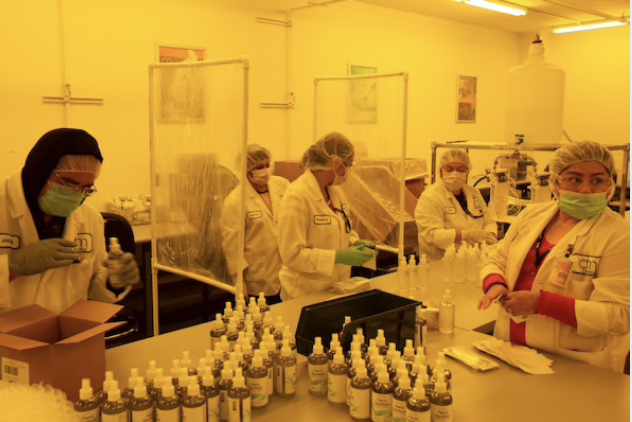
Employees of DenMat, who had been laid off, were called back to work in Lompoc, Calif. The business, which used to produce dental supplies, has been transformed to make hand sanitizer and surface cleaners during the covid-19 pandemic. MUST CREDIT: photo for The Washington Post by Karla Gachet.

Employees of DenMat, who had been laid off, were called back to work in Lompoc, Calif. The business, which used to produce dental supplies, has been transformed to make hand sanitizer and surface cleaners during the covid-19 pandemic. MUST CREDIT: photo for The Washington Post by Karla Gachet.

“The prison is in our city limits, the sick inmates are filling our local hospital beds, yet I have no control over any of it because it’s a federal facility,” said Lompoc Mayor Jenelle Osborne. “I’m getting emails and phone calls from people who are afraid, who are asking me to do something, and I have to tell them I am powerless to do anything.”

As the coronavirus bolted through one-third of the Federal Bureau of Prisons’ 122 facilities last month, cracks began to appear in the once symbiotic relationship between the prisons and their towns. The bureau’s fumbling of the crisis, which enabled the virus to percolate within the prisons and beyond, is stoking fear and resentment of the prisons – and sometimes of prison staff who live in those communities.

So far, 45 inmates across the country have died. The Bureau of Prisons announced last week that 70 % of tests of inmates for covid-19 have come back positive. As of Friday, 3,701 of the bureau’s roughly 140,000 inmates had tested positive for the disease. No prison staff have died but nationwide, 527 have tested positive, according to federal data.

Residents in Lompoc and other prison towns, including Butner, North Carolina, and Oakdale, Louisiana, say having a prison with a high infection rate unnerves them, especially when they encounter unmasked and ungloved prison staff in grocery stores, pharmacies or restaurants.

“We have people who come in with prison uniforms two to three times a week,” said Antonio de Jesus Rodriguez, owner of Floriano’s Mexican restaurant, which provides pickup orders to customers. “Some are wearing a mask, but some are without one. It’s kind of mind-boggling. As I’m taking their order I’m thinking, ‘You are in a hot spot; why aren’t you taking this more seriously?’ ”

The Washington Post reported last month that the Bureau of Prisons allowed the virus to fester in dozens of prisons before taking action to stop its progress.

It did not provide masks to correctional officers or inmates until after dozens of inmates were quarantined, and often after inmates had died. Prisoners with coughs and body aches continued to line up, just a few feet apart, for their meals and medication. And temperature checks, for both inmates and staff, did not become routine until the disease had permeated dormitory-style settings where 100 or more prisoners sleep and live within a few feet of one another.

In a statement, the bureau said it began responding to the coronavirus threat as early as January, and is using “screening, testing, appropriate treatment, prevention, education, and infection control measures.”

It also said that starting April 1, it began to minimize gatherings and that “inmate movement in small numbers” is being allowed for essential activities, such as visits to the commissary, laundry, showers, telephone and health care.

The Bureau of Prisons’ mishandling of the coronavirus threat prompted Rep. Frederick Keller, R-Pa., to introduce legislation last week that would require the bureau’s director to be confirmed by the Senate. Michael Carvajal, the current director, was appointed by the U.S. attorney general, as past directors have been.

At the Lompoc Federal Correctional Complex, two inmates have died of covid, 905 inmates had tested positive and 34 staff members had contracted the disease as of Friday, federal data shows. Nearly one-quarter of the covid-19 cases in federal prisons nationwide are at the Lompoc prison.

The number of inmates who have tested positive at the prison is double the number of positive cases in all of Santa Barbara County – which has reported 450 non-prison cases among its population of nearly 450,000. The prison has 2,700 inmates.

The prison’s coronavirus cases are a burden on the compact town of 40,000, where locals and the prison system share the same fire department and hospital. The mayor believes the spread of coronavirus in the community is largely due to the prison and could have been curbed if prison leaders acted sooner and were more transparent. She estimates that nearly 60 percent of prison employees live in Lompoc.

“We’ve reached out, but either a lack of experience or lack of leadership has caused them to circle the wagons and say, ‘We will deal with it internally,’ Osborne said. “This secrecy does not build trust with the community.”

The Bureau of Prisons responded: “We have an open line of communication with public officials surrounding our facilities.”

The prison, though, has argued that details of how the pandemic are being handled must be kept private.

The bureau has asked local officials not to publicly disclose information regarding internal controls, the number of hospitalized inmates or the location of hospitalized inmates. “The BOP believes that such disclosure creates a security and safety risk,” reads the request obtained by The Post.

It’s a 15-minute drive from one side of Lompoc – past ranch-style homes, the heavily muraled downtown off Ocean Avenue and the railroad that runs through town – to the prison on the city’s other edge. The razor-wired top of the prison rises out of planted fields of kale, artichokes and lettuce that surround it, immediately next door to Vandenberg Air Force Base.

Five miles from the prison in downtown Lompoc, American Host Restaurant owner Dennis Block said “it’s a little scary” for him and his employees to know “that there’s 100 cases down the street.”

In April, when a local doctor donated $1,000 to the breakfast and lunch spot to provide free meals to the community, Block and his crew took steps to protect themselves.

More than 150 burritos were delivered to the local hospital, police department and convalescent home. For the prison workers, Block’s employees set up a table on the patio next to the parking lot, loaded about 50 tinfoil-wrapped burritos onto it, then watched from inside the diner until the prison worker who collected them drove away.

Block said his greatest worry isn’t exposure at his restaurant – it’s down the street from him at Lompoc Valley Medical Center, where coronavirus-infected prisoners are being treated and sometimes dying. “Basically, they are importing the virus into our community,” he said.

Nick Clay, director of the Santa Barbara County Emergency Medical Services Agency, said the prison has converted an old factory on the prison grounds into a medical ward that will treat up to 20 inmates with severe covid-19 symptoms. “They’re really taking active measures that are focused on resolving this issue,” Clay said, defending the prison response.

The Rev. Jane Quandt of the Valley of the Flowers United Church of Christ drives by the prison a few times a week. Construction of the ward did not begin until mid-April, three days before the first inmate’s death, and after many had landed in the local hospital. It opened Wednesday.

Quandt said she hopes the community does not blame the prison for the spread of the virus. “This is a federal institution. So ultimately it’s got to be run by the federal administration” in Washington, she said. “This is one of their babies and they’re not taking very good care of it, at least not here in Lompoc.”

– – –

Just north of the Falls Lake reservoir sits the town of Butner in rural Granville County, North Carolina, about 30 miles north of Raleigh. Tidy brick and siding-wrapped homes line grid-patterned streets dating back to World War II, when it was Camp Butner.

In 2008, Butner residents opposed efforts to add a federal biodefense research center to a cluster of government-owned facilities that dominate the region. Along with the federal prison, there’s a state prison, psychiatric hospital, addiction-treatment center and a facility caring for disabled people.

At the time, Butner residents said they feared lethal pathogens – with no known treatment or vaccine – could escape the facility.

Now, similar fears have been renewed with covid-19 and the prison. As of Wednesday, seven inmates have died. At least 306 of the 4,500 inmates have tested positive, along with 39 staff members who have been infected.

In early April, Pine Grove Missionary Baptist Church introduced social distancing and protective gear to its twice-monthly food bank. As volunteers in masks and gloves carted boxes of pasta, frozen meat and canned goods to cars and trucks of local families, conversation repeatedly turned to their collective anxiety over the prison.

“They were concerned with the possible spread of the virus within the community, considering that many of the [prison] workers live in the community,” said Michelle Ross, who helps run the food bank, about six miles from the prison.

In March, the outbreak crept closer to the Rev. Marcos León of St. Bernadette Catholic Church in Butner.

Three parishioners – two nurses and a doctor working at the prison complex – told him in confidence that they were exposed on the job and had to self-quarantine at home. They were “truly afraid,” León said. “It was the fear they were going to die. Then it was: ‘I feel so bad because of my children. I’m living in a house where I have to be separated from them.’ ”

The church’s prison ministry regularly offered Mass, confession and one-on-one spiritual guidance to inmates until March, when prisons banned visitors.

Butner and Granville County officials say they don’t expect the covid-19 outbreak will alter appreciation for the prison as a local employer offering good-paying jobs. But correctional officers who live in and around Butner say they know some people fear them, said William Boseman, a retired Butner correctional officer and union representative for the officers.

When people see the prison workers in their dark-gray uniforms walking down the street, they cross to the opposite side. In grocery stores, people scoot to the next aisle.

“They are being ostracized,” Boseman said. “When people know you work at this place where there has been an outbreak, they treat you different. They treat you as if you are automatically contagious.”

– – –

The first covid-19 death of a federal inmate took place six weeks ago – on March 28 – at a prison in Oakdale, Louisiana. As of Friday, six more of the 1,800 inmates had died. There have been 115 cases of covid-19 among the prisoners and 26 among the staff.

On the boot-shaped state of Louisiana, Oakdale sits just above the ankle. About 110 miles west of Baton Rouge, past the flooded rice-field crawfish ponds of the Cajun prairie, a meandering country road lined with towering Southern pines subtly opens into a meticulously planned, four-lane highway that drops you into the town of fewer than 8,000 people.

It only takes five minutes to drive from the center of town to the Oakdale Federal Correctional Complex. Along an access road to the complex, a long row of fluorescent pink and white signs with handwritten biblical psalms and motivational quotes flickers in the spring breeze: “Fear is a reaction. Courage is a decision.”

Jane Willis and her husband, Greg Willis, are in their mid-50s and have been the pastors at the Christ Church of Oakdale for 15 years. They broke ground on a new church near the prison to house their growing congregation a few months ago, before the pandemic.

As the news broke of the covid-19 outbreak at the prison, Jane Willis felt called to do something for the shift workers driving in and out of the prison complex, past their property each day. So she made signs.

“I saw the workers going back and forth and it broke my heart for them,” she said. “I was thinking of a way we can encourage them as they go to work to know they’re not alone.”

The couple’s son works at the prison, as do 15 members of their congregation. One of them, Aubrey Melder, 53, a correctional officer, said when he saw the signs on his way to work the first time, his eyes filled with tears. Melder has felt supported by the community, but he has also felt its fear.

“When they look at you, you can tell they are uneasy,” he said, describing the few times he went to the grocery store in his uniform. “It scares them a little bit.”

Corey Trammel, a union president representing the correctional officers, said the community of Oakdale has long supported the prison workers, and he doesn’t blame them for being afraid of contracting the virus.

“I hate it for the community, and I hate it for our employees,” said Trammel. “If our prison would have let people know what was going on and our warden would have protected us and our community, then people would not have to look at us like that.”

In response, the bureau said in a statement: “We do everything we can to maintain open lines of communication with public officials. Our Executive staff are willing to discuss with them everything they are doing to combat this virus.”

Gene Paul, mayor of Oakdale and a lifelong resident, said the outbreak at the prison created chaos and left people in the community panicked. “Everyone is wondering, ‘Am I going to be next?’ ”

Paul said he now is in close contact with the warden, but he wishes the Bureau of Prisons would have handled the crisis better from the beginning. He said buses of newly sentenced inmates were continuing to arrive at the prison until a few weeks ago.

The bureau said that, overall, inmate movement is down 95 percent. However, they are legally obligated to accept new inmates brought by the U.S. Marshals Service. Those inmates are being quarantined for 14 days before entering the general prison population.

Paul estimates that half of the prison staff live in Oakdale and, although many are angry with the bureau, that rage is not directed at the people who work at the Oakdale facility.

In early April, Paul pulled a brown SUV into the Christ Church of Oakdale parking lot for a “Park and Praise” event to boost prison staff morale.

As prison employees zipped by on the access road, Paul and dozens of other Oakdale residents waved and honked their horns. Christian music blared and several people stretched their hands to the sky. A woman waved a sign that read: “Not all Heroes Wear Capes.” The prison workers smiled and waved back.


Women have been hit hardest by job losses in the pandemic. And it may only get worse. #ศาสตร์เกษตรดินปุ๋ย

#ศาสตร์เกษตรดินปุ๋ย : ขอบคุณแหล่งข้อมูล : หนังสือพิมพ์ The Nation.

https://www.nationthailand.com/lifestyle/30387595?utm_source=category&utm_medium=internal_referral

Women have been hit hardest by job losses in the pandemic. And it may only get worse.

May 10. 2020
Ilanne Dubois, a 36-year-old single mother who was laid off in mid-March, completes her grocery shopping in New York. MUST CREDIT: photo for The Washington Post by Michael Noble, Jr.

Ilanne Dubois, a 36-year-old single mother who was laid off in mid-March, completes her grocery shopping in New York. MUST CREDIT: photo for The Washington Post by Michael Noble, Jr.
By The Washington Post · Samantha Schmidt · NATIONAL, BUSINESS, CAREER-WORKPLACE 

The last time Americans faced an economic crisis, it was called a “Mancession.” As millions of people lost their jobs in the Great Recession, 70 percent were men, many in construction and manufacturing.

This time, as job losses linked to the coronavirus pandemic dwarf what the country experienced in the 2007-2009 crisis, the heaviest toll is falling on women.

Waitresses, day-care workers, hairstylists, hotel maids and dental hygienists are among the 20.5 million people who watched their jobs vanish in April – the most devastating spike in unemployment since the Great Depression.

“I had a good rhythm going. I wasn’t rich, I couldn’t complain saying I was poor,” said Ilanne Dubois, a 36-year-old single mother in Long Island who worked as a waitress at a Manhattan hotel. “Now, all of that stability is gone. We’re falling into a hole.”

Women have never experienced an unemployment rate in the double digits since the Bureau of Labor Statistics began reporting data by gender in 1948 – until now. At 16.2%, women’s unemployment in April was nearly three points higher than men’s, according to Labor Department rates released Friday. But a closer look at the numbers shows deeper disparities.

Not only are women overrepresented in some of the hardest-hit industries, such as leisure and hospitality, health care and education, but women – especially black and Hispanic women – lost jobs in those sectors at disproportionate rates.

Before the pandemic, women held 77% of the jobs in education and health services, but they account for 83% of the jobs lost in those sectors, according to an analysis by the National Women’s Law Center. Women made up less than half of the retail trade workforce, but they experienced 61% of the retail job losses. Many of these women held some of the lowest-paying jobs – the cashiers, hotel clerks, office receptionists, hospital technicians, teachers’ aides.

The pandemic has wiped out the job gains women made over the past decade, just months after women reached the majority of the paid U.S. workforce for only the second time in American history.

“How are we supposed to ever come back?” said Jasmine Tucker, director of research at the National Women’s Law Center (NWLC). “I think it’s going to take a really long time to even reach that point again. A lot of people are going to be stuck.”

Labor experts worry that even as states reopen, many workers, especially in leisure and hospitality, will continue to suffer cuts to hours, wages and tips. Low-wage workers, who are disproportionately female, will be the least likely to be rehired, economists say.

Even when men experienced the greatest initial job losses during the Great Recession, women took much longer to recover. Between June 2009 and June 2011, women lost 281,000 jobs while men gained 805,000. Those losses were driven by public-sector job cuts.

As local and state governments slash their budgets in the coming months, government workers will face painful job losses, and those will affect more women, who hold nearly 58% of public-sector posts, said Betsey Stevenson, a professor of public policy and economics at the University of Michigan. Many of these jobs are in public schools.

“That’s only going to make things worse for women,” Stevenson said.

Working mothers face an especially daunting recovery because they rely on schools and day-care centers that remain closed. Even if hotels and restaurants and stores reopen, some women might not be able to find the child care necessary to return to work.

“If summer camps don’t open up, if schools don’t open in the fall, who goes back to work?” Stevenson said.

That’s the question facing Dubois, the single mother on Long Island. For the past decade, she has built a career working at different high-end hotels in Manhattan, often working overnight and 16-hour shifts as a waitress to support her 6-year-old son. But she’s been out of work since March, when the Dominick hotel, formerly the Trump SoHo hotel, closed temporarily.

Now she’s relying on unemployment assistance to feed her son. She’s fallen behind on her mortgage, cut her car insurance and has dug into the little savings she has to pay the bills.

She’s heard the hotel may not reopen until July. And even if she could find a different job before then, maybe as a delivery driver, she doesn’t know how she’d be able to leave her son, with schools and child-care centers closed.

“I can’t afford to pay the babysitter anymore,” she said. “I haven’t thought of what I could possibly do next.”

At the start of this year, for only the second time, women reached a significant milestone: They outnumbered men in the U.S. paid workforce, bolstered by surges in health care and education.

Women have made inroads in traditionally male industries, but their job gains have primarily been in traditionally female-oriented sectors – working with people in jobs that are often lower paying. Cornell University economists Francine Blau and Lawrence Kahn found that differences in the occupations chosen by men and women was the single largest factor accounting for the gender pay gap.

A recent report from the NWLC found that nearly two-thirds of the 22.2 million workers in the country’s 40 lowest-paying jobs are women. It also found that more than two-thirds of mothers in the low-paid workforce are the sole or primary breadwinners for their families.

Not only do women make about 82% of what men make, but they also have less savings. And time away from work tends to depress women’s wages, potentially exacerbating the country’s persistent gender pay gap, said Emily Martin, vice president for education and workplace justice at the NWLC.

Many women were already barely bringing in enough money to cover child-care costs.

“Now let’s just add in the fact that your job just got a lot more dangerous,” Stevenson said. “You’re sending your kid to child care, where you’re also risking you might get sick. You start doing all that math, and it just doesn’t make sense anymore.”

While women overall were more likely than men to be unemployed, black and Hispanic women were hit the hardest, at 16.4 and 20.2% unemployment respectively.

Among them are women like Racaél Guzmán, a 46-year-old mother of three who was temporarily laid off from her custodial job at office buildings in Alexandria, Virginia, but cannot apply for unemployment because she is an undocumented immigrant.

She has worked for the company since she came to the United States from El Salvador in 2004. Guzmán, who has high blood pressure, is worried that her health care will run out at the end of 60 days. Volunteers from a local church brought her bags of cereal, cooking oil and other food for her and her family. But she’s worried about how she will pay for groceries if she can’t return to work in the coming weeks.

She barely managed to pay the rent last month.

“Purely thanks to the holy Mary, we were able to make it,” she said. “But I don’t know about the next month.”

Sabrina Baptiste, a single mother of 15-month-old twins in Washington D.C., was down to about three days’ worth of diapers last week before a church group stopped by her apartment with more. Since mid-March, she has not been able to return to her work as a bartender.

“I had a good thing going,” she said. “I was able to do everything I wanted to do.” She had found an affordable day care for the twins and was able to make a steady income with generous tips. “Now it just took a drastic turn.”

She’s barely been able to make partial payments on her rent and utilities. She’s not been able to access unemployment assistance or a stimulus check. Even if she can go back to her job, will the child-care center reopen for her children?

“I really don’t want to go ahead and think about that,” she said. “If it gets any worse, it’s like, ‘Come on,’ I don’t know how I’ll be able to manage.”

Michelle Utterback has been a hairdresser for more than 35 years. She never made a lot of money, she said, but she always had enough to support herself.

“My dad always said it was more important to get a trade because you know you can always have a job,” said Utterback, 59. “If you’re doing hair, you know you can always get a job.”

With her salon closed because of the pandemic, she worries she’ll lose the clientele she worked hard to build up. She fears she might be laid off permanently and will struggle to find another job.

Dubois also has wondered whether she will have to change careers. For more than a decade, she has loved the hotel industry. “I am a hospitality person,” she said. “I’ve always been a friendly, talkative person.”

After years of working three different hotel jobs, and many overnight shifts, she saved up enough money to buy a condominium in a quiet neighborhood. She was able to give her son his own room and a small yard. She was even able to take him on a vacation to Mexico recently.

“I started making something for myself, building a life for my son,” she said. “Now it’s like I don’t know what to do. I don’t know what’s next.”

‘I apologize to God for feeling this way’ #ศาสตร์เกษตรดินปุ๋ย

#ศาสตร์เกษตรดินปุ๋ย : ขอบคุณแหล่งข้อมูล : หนังสือพิมพ์ The Nation.

https://www.nationthailand.com/lifestyle/30387188?utm_source=category&utm_medium=internal_referral

‘I apologize to God for feeling this way’

May 03. 2020
Gloria Jackson at home in Minnesota. She has health conditions that elevate the risk she faces from covid-19. MUST CREDIT: Photo by Jenn Ackerman for The Washington Post

Gloria Jackson at home in Minnesota. She has health conditions that elevate the risk she faces from covid-19. MUST CREDIT: Photo by Jenn Ackerman for The Washington Post
By The Washington Post · As told to Eli Saslow · NATIONAL, HEALTH
Virus-Voices

I try to remember that I’m one of the lucky ones in all this. What do I have to complain about? I’m not dead. I’m not sick. I haven’t lost my job or gone broke. I’m bored and I’m lonely, and so what? Who’s really going to care about my old-lady problems? Lately, when I see people talking about the elderly, it’s mostly about how many of us are dying off and how we’re forcing them to shut down the economy.

I tell myself I should be more positive. I should be grateful. Sometimes I can make that last for an hour or two.

A day can drag on forever when you’re isolated all by yourself. I sleep as late as I can. I try not to look at the clock. I go on Facebook and read about all the ways this country is going to hell in a handbasket. I turn on the TV to hear a bit of talking. It’s been almost seven weeks since I’ve spent time with a real, live person. I haven’t touched or really even looked at anyone, and it’s making me start to think recklessly. The other day I went to Walgreens to pick up my medications, and I sat in the parking lot and thought about going inside. I was wearing my mask and I had my inhaler. I wanted run a normal errand, look at the chocolates, maybe find my way into a conversation. But I stayed in the car and went to the drive-through. I put on my gloves and handed my card to the clerk through a hole in the glass window. I took the medicines and gave a little wave.

If I get this virus, I’m afraid it would be the end of me. I’m 75. I’ve got all I can handle already with my asthma, fibromyalgia and an autoimmune disorder. The best way for me to survive is by sitting in my house for however many weeks or months it’s going to take. But how many computer games can you play before you start to lose it? How many mysteries can you read? I realize time is supposed to be precious, especially since mine is short, but right now I’m trying every trick I know to waste time away.

Negative thoughts creep up like that. I start getting crabby. It’s waves of anger and depression, and I beat myself up for it. People have it a whole lot worse. Obviously.

I’ve got two daughters out of town who call me and check in, but I don’t want to guilt them. I’ve got a high school friend who dropped off groceries. I’ve got a dog and two cats that need to be cared for, which gives me something to do. I’ve got my own manufactured home with flowers blooming all over the house. A lot of people don’t realize there’s a big difference between a trailer park and a mobile home community. I’ve spent hours lately driving up and down every block of this neighborhood, looking at people’s yards, checking out whatever might be poking through the dirt. One morning I drove my dog to the river. People were walking on the path, and I was worried about the droplets and all that. We sat in the car and cracked the windows and listened to the water.

It feels like everybody here is trying so hard to be cheerful, but boy does it take an effort. The other day was supposed to be the beginning of baseball season, and I love baseball, and the anchor came onto the local news and said: “Let’s all try to look on the bright side! Let’s find a way to celebrate opening day even though nobody is playing.” He showed pictures of fans wearing their Minnesota Twins T-shirts, or rubbing hand sanitizer onto a baseball to play catch, and I thought: You know what I’d really like to do right now if I’m being honest? I’d like to find a bat and a ball and go break a few windows.

I apologize to God for feeling this way, but he made me how I am. I’m over this whole thing. I used to be an optimist, but I’m not anymore.

I’ve never been this angry, and it’s an ugly way to feel. Maybe when you don’t get to see anybody for weeks, emotions get bottled up and have nowhere to go. I get sucked into Facebook, and I keep scrolling down from one thing to the next, yelling at my computer as the posts get more and more insane. Mike Pence was just here in Minnesota, visiting patients at the Mayo Clinic, and he went against their policy and refused to wear a mask. It’s like: “Really? How arrogant can you be?” Next it’s someone posting pictures of people crowded together like sardines at a beach in California. “You idiots. Do you care about anyone but yourself?” Then it’s the president’s saying it might be a good idea to inject some kind of bleach or disinfectant. “No thank you, but you go right ahead if you want to poison yourself.” Then it’s a militia group taking over a state capitol. It’s doctors who have to wear garbage bags instead of gowns. It’s that we still don’t have enough tests. It’s how at least most of the deaths are people over 70 with preexisting conditions. “Oh, what a relief! Who cares about them?” It’s some stockbroker or whatever saying the elderly are holding this country back from reopening, and maybe it’s their patriotic duty to be sacrificed for the sake of the economy. “Sorry to be an inconvenience to your financial portfolio. Sorry I’m still breathing.”

It enrages me. I spent my career working for the federal government at Veterans Affairs. I raised my kids by myself. I basically had to raise my ex-husbands. I marched and fought for women’s rights. I volunteered for political campaigns. I pay taxes and fly a flag outside my house because I’m a patriot, no matter how far America falls. But now in the eyes of some people, all I am to this country is a liability? I’m expendable? I’m holding us back?

Sometimes, before I know it, I’ve been writing comments on Facebook posts for hours: “To hell with you then.” “You idiot.” “How dumb can you be?” “Moron.” “Racist.” “Selfish pig.” “Idiot.” “Idiot.”

Everyone knows me as a kind person. I used to wear a peace necklace. I’ve gotten old enough that I just say whatever I think with no filter, but I don’t always like what comes out. This isn’t how I used to be.

There’s a lot I don’t recognize about what’s happening now. This country is so completely different from the one I came into. My uncle was at the Battle of the Bulge the day I was born. I arrived right near the end of the war, and most of my life was American boom times. We were the leading country in everything when I was young. My dad left for a while to work as a chef on the Alaskan Highway, and he traveled through Canada so we could carve a road 2,000 miles over the Rockies in the dead of winter. We did whatever we wanted just to show that we could. That’s how it felt. I graduated from high school and started working when I turned 18, and within about a year I was earning more than my parents. That’s how it went. It was up, up, up.

And what are we now? We’re mean. We’re selfish. We’re stubborn and sometimes even incompetent. That’s the face we’re showing to the world. It seems like some of these other countries almost feel sorry for us. New Zealand and South Korea beat this virus back in a few weeks. We’ve gone from ten thousand deaths to thirty thousand to sixty-some, so I guess we’re still leading the world in that.

We can’t get out of our own way. Are we shutting down or opening up? It’s the states against the feds. It’s conservatives against liberals. There’s no leadership and no solidarity, so everybody’s doing whatever they want and fighting only for themselves, which means everyone who’s vulnerable is losing big. Minorities. Poor people. Sick people. Immigrants. Elderly. We’re the ones who will die from this virus and the ones who will never recover. That’s the truth I’m learning about this country, even if I should have known it earlier.

I don’t like feeling this way. Maybe somewhere in this we’ll see a great lightning strike of American ingenuity. I doubt it, but maybe. There’s no choice but to be hopeful. I’m staying alive and sitting in my house and waiting. Where else am I going to go? I’ll be here.