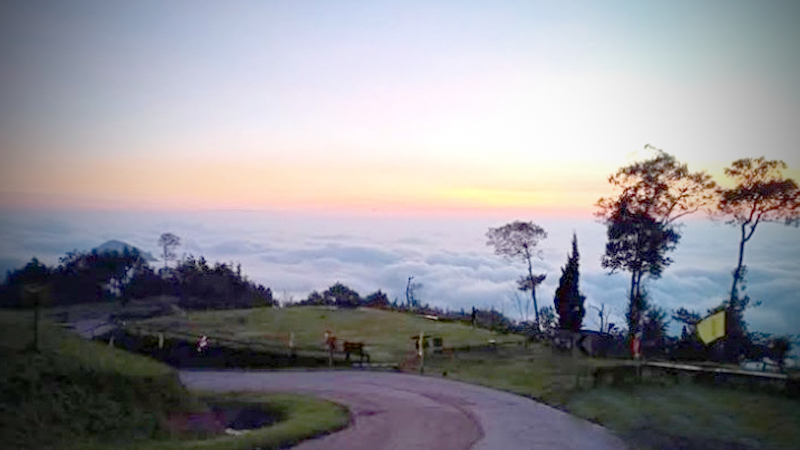
The Thailand Meteorological Department forecast on Monday that the rather strong high-pressure system covering upper Thailand would bring cool to cold weather with strong winds.
The temperature is expected to drop 1-2 degrees Celsius. The mountaintops will be cold to very cold with frost in some areas.
Meanwhile, the moderate northeast monsoon prevailing across the Gulf and the South brings isolated thundershowers to the South. Waves in the Gulf are expected to rise about two metres high and over two metres high during thundershowers. All ships should proceed with caution and keep off thundershowers, the department said.
The weather forecast for the next 24 hours:
North: Cold weather; minimum temperature 13-17 degrees Celsius, maximum 28-31°C; temperature on hilltops likely to drop to 3-13°C with frost in some areas.
Northeast: Cool to cold weather with strong winds; minimum temperature 13-18°C, maximum 27-30°C; temperature on hilltops is likely to drop to 7-13°C.
Central: Cool weather in the morning; minimum temperature 17-20°C, maximum 29-31°C.
East: Cool weather in the morning with strong winds; minimum temperature 17-22°C, maximum 30-32°C; waves a metre high and 1-2 metres off shore.
South (east coast): Partly cloudy with thundershowers in 10 per cent of the areas; minimum temperature 22-26°C, maximum 30-31°C; waves two metres high and over two metres during thundershowers.
South (west coast): Partly cloudy with thundershowers in 10 per cent of the areas; minimum temperature 22-25°C, maximum 32-33°C; waves a metre high and two metres during thundershowers.
Bangkok and surrounding areas: Cool weather in the morning with strong winds; minimum temperature 20-21°C, maximum 29-31°C.
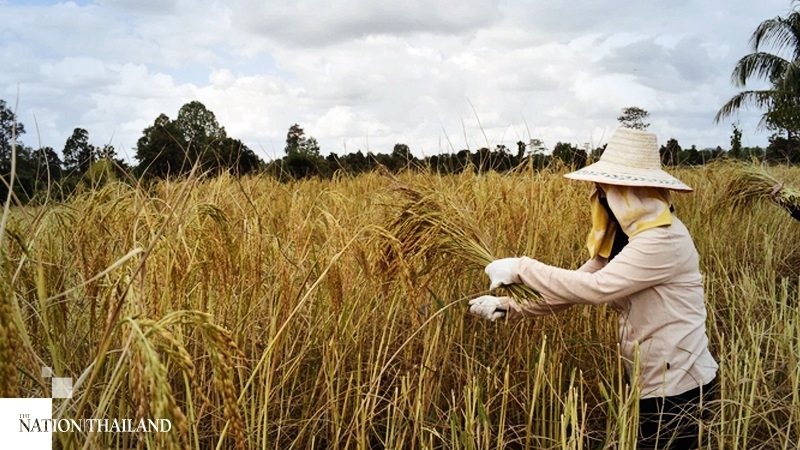
The Bank for Agriculture and Agricultural Cooperatives (BAAC) will disburse Bt20.4 billion to some 2.4 million farmers on Wednesday after the Cabinet approved an additional budget of Bt28 billion for the government’s rice price guarantee scheme.
This amount is in addition to the originally santioned budget of Bt18 billion.
The scheme aims to compensate nationwide rice farmers of over 4.56 million households.
“The reason why the scheme needs a higher budget is that this year’s rice prices have dropped more than previously estimated,” said Kasab Ngernrungrong, BAAC deputy manager.
“The price of Hom Mali [jasmine] rice is currently Bt2,899 per tonne lower than the guarantee price, round rice is Bt877 per tonne lower, Pathum fragrant rice is Bt1,039 per tonne lower, and sticky rice is Bt933 per tonne lower.”
The scheme limits the maximum amount of rice guaranteed per household: Hom Mali rice is capped at 14 tonnes, round and Pathum fragrant rice at 25 tonnes and sticky rice at 16 tonnes.
The BAAC also has earmarked Bt15.28 billion as subsidy for farmers who keep unmilled rice in their barns instead of selling to the mills in a bid to prevent oversupply which will cause the rice price to plummet further.
“Farmers who keep unmilled rice would get Bt1,500 subsidy per tonne, and they would be allowed to sell their rice when the price situation improves,” he said.
“We estimate that towards the year-end more than 200,000 farmers will apply under the campaign.
“The bank would try to disburse the money under related schemes to rice farmers before the year-end so that they could invest in next year’s cultivation as well as spend during the new year festival. We estimate that when combined with all available measures, a rice farmer could receive up to Bt70,000 from the BAAC,” he added.
Besides rice, the BAAC is also responsible for price guarantee schemes of other crops, including rubber with a budget of Bt9.7 billion, tapioca (Bt9.5 billion), corn for animal feed (Bt1.8 billion), oil palm (Bt8.8 billion), and longan (Bt3.4 billion).
Padeang Industry (PDI), which is engaged in the renewable energy business, is investing Bt2.8 billion to pick up a 51 per cent stake in two hotels — Four Seasons Bangkok at Chao Phraya River and Capella Bangkok – which will be opened completely in 2021.Tommy Taechaubol, PDI managing director, said that the board of directors had approved acquisition of stake in both hotels.Tommy explained that Four Seasons Bangkok is controlled by a company named “Urban Resort Hotel”, while Capella Bangkok is held by “Waterfront Hotel”. His company will purchase 51 per cent of shares of both hotel holders from “Landmark Holdings” at a total price of Bt2.8 billion.Tommy added that total revenue generated from both hotels in 2021 would be more than PDI’s revenue from its renewable energy business.
The Department of Internal Trade (DIT) is taking action against stores that are abusing privileges under the government’s subsidised shopping scheme.
The DIT said that 277 people had filed complaints via the department’s hotline 1569 about stores taking undue advantage of the “Khon La Khrueng” (Let’s Go Halves) scheme.
DIT deputy director-general Wattanasak Sur-iam said after the government launched the scheme on October 23, the department had cooperated with provincial commerce offices in inspecting stores that participated in the scheme to prevent retailers from taking advantage of people.
He said125 people had filed complaints about Blue Flag stores and 152 had complained about stores taking part in the subsidy scheme. He said retailers used various methods to take advantage of people, such as jacking up prices, removing price tags on products, showing price tags in other languages and violating rules.
“The department has filed a lawsuit under The Price of Goods and Services Act, BE 2542 (1999) against these stores,” he said. “Meanwhile, we found that most of the stores under the scheme had jacked-up product prices to receive the government’s subsidy.”
He added that those who take advantage of people would face more than just the Bt140,000 fine or seven years imprisonment or both.
“The department would also suspend privileges of Blue Flag shops who violate the rules,” he added.
Digital full bank licences went to the Grab-Singtel consortium and tech giant Sea.
The Monetary Authority of Singapore also granted digital wholesale bank licences to Jack Ma’s Ant Group as well as a consortium comprising Greenland Financial Holdings, Linklogis Hong Kong and Beijing Co-operative Equity Investment Fund Management.
The eagerly awaited announcement, expected in June, was delayed after the assessment period for the award was extended due to the Covid-19 pandemic.
At stake were five digital bank licences, which included up to two full bank licences and up to three wholesale bank licences.
1. What’s a digital full bank?
A digital full bank can serve both retail and corporate customers.
Like any traditional bank, it can provide ordinary Singaporeans with services like having an account, deposits, loans, debit and credit cards, payments and investment products.
But all banking services will be done online, with the digital bank not having a physical branch or ATMs.
This is different from having traditional banks put some banking services online via the Internet or mobile apps.
2. What’s a digital wholesale bank?
They will serve non-retail customers only, like small and medium-sized enterprises.
3. How were the winners chosen?
A total of 21 applications were submitted for the licences and 14 were shortlisted.
The bidders included e-commerce companies, tech and telco firms, and fintechs such as crowdfunding platforms and payment services providers.
The winners were judged on the following criteria:
– Their value proposition and business model
– The sustainability of their digital banking business
– Their innovative use of technology
– Growth prospects and other contributions to Singapore’s financial centre
4. How will Singaporeans benefit from digital banks?
Higher interest rates: With less overhead, branchless digital banks may offer higher rates on deposits.
Lower fees for financial products are also likely, as there will be no middleman used.
Under-served groups in Singapore like entrepreneurs and micro enterprises can be better reached with the lower costs of digital banks. They may offer the opening of deposit accounts without a minimum amount, for example, or adopt a different credit risk assessment approach.
More convenience for customers, with all banking services at their fingertips 24/7.
More personalised services, for example with product recommendations, can also be provided, with the use of technology to gather and mine data.
More innovative services can also be offered due to more competition, with banking opened up to non-bank players.
5. Any downsides?
Possible drawbacks include:
– Technology and service interruptions
– Security and identity theft concerns
– Lack of personal banker relationship
6. Do other countries have digital banks?
They are not new. Here are some examples around the world:
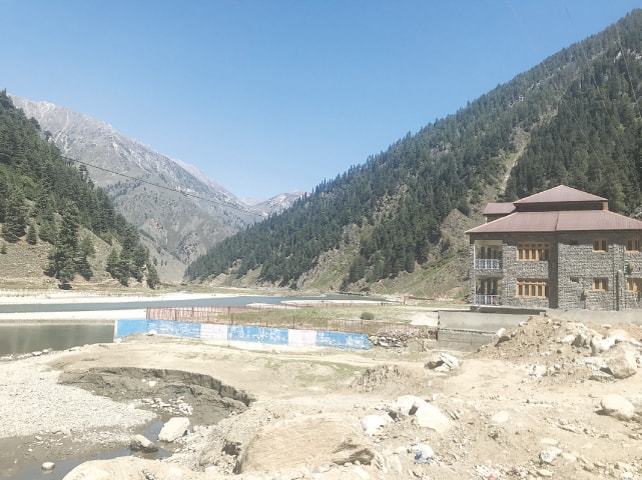
ColumnsDec 06. 2020Sand and gravel excavators and dumpers near Sohach Bridge in what locals say is ‘the biggest-ever gravel-lifting operation in the Kunhar riverbed’ | Photos by the author / White Star
By DawnDriving from Gilgit to Kaghan, the glittery alpine scenery on the Karakoram Highway (KKH) abruptly changes to a rather desolate — but equally breathtaking — landscape, as one crosses the Indus at Raikot Bridge. A sharp left turn and a hair-raising 45-minute jeep ride to Tattu village, followed by a 2-hour trek, put you in pole position for a night stay at the 13,000-feet-high Fairy Meadows.
The meadows offer a dazzling view of the ‘Killer Mountain’, Nanga Parbat, the world’s ninth highest peak at 26,660 feet. On KKH, 50 kilometres ahead lies Chilas — the gateway to the Kaghan Valley. And after another 30 steep and twisty miles, the dazed driver is on top of Babusar — a mountain pass at 13,700 feet in the north of the valley.
The mountain ranges of Kaghan are offshoots of the great Himalayas, entering from the east through Kashmir. The ones flanking the east bank of Kunhar River are home to the 17,200-feet-high Malika Parbat, and the 13,378-feet-high Musa ka Musalla in the west.
Far from the madding city crowds, to be surrounded by so much natural beauty is a rare treat. The treat however is short-lived. Unfortunately, it seems, humankind cannot help but interfere with nature.
‘A river doesn’t just carry water, it carries life.’ The Kunhar River, which runs all the way from the upper Kaghan Valley to below Muzaffarabad in Azad Jammu and Kashmir is not just an integral part of Pakistan but home to breathtaking landscapes, biodiversity and habitation. But unregulated construction, encroachments, extraction and pollution along it is putting this lifeline under threat
The Kunhar River basin is a humid, sub-tropical zone. Thick forests are still present across the valley but, because of extensive exploitation, thickets are mostly found in the unapproachable areas, especially on the higher slopes.
Another 15 miles from Babusar Top leads to emerald green waters, gleaming with the reflection of the snow-capped mountains fencing Lulusar Lake; the centre of the faerie Lulusar-Dudipatsar National Park. But signs of gradual environmental degradation and callous human behaviour — indicative of unsustainable tourism and a runaway native population growth rate — are starting to show.
To keep this destructive behaviour in check, the Lulusar-Dudipatsar National Park and Saiful Muluk National Parks were established in 2003. The Khyber Pakhtunkhwa Wildlife and Biodiversity (Protection, Preservation, Conservation and Management) Act 2015 extensively covers the do’s and don’ts at National Parks. The Act prohibits many actions that would impact the scenery, flora and fauna of the parks. Prohibited actions include, “logging, felling, tapping, burning or in any way damaging or destroying, taking, collecting or removing any plant or tree”, and “polluting or poisoning water flowing in and through the National Park.”
The Lulusar-Dudipatsar National Park and the Saiful Muluk National Park are true representatives of the alpine ecosystem and an excellent landscape that harbour scores of unspoilt alpine lakes, rich in their unique fauna and flora.
Taking it all in, I decide to make a pit stop at the Demanchi restaurant, perched a little high on the left side of Lulusar Lake. Demanchi offers Pakistani dishes, barbecue and trout fish on the menu, and provides an opportunity for travellers and locals to mingle.
“Is there a place to stay at night near the lake?” I ask one local.
“The Frontier Works Organisation is constructing their rest house in the middle of the lake that should be ready soon,” the local curtly responds, pointing towards the long wall being constructed across the Lake.
But isn’t there a local motel or hotel at present?
“For the last 20 years, no one was allowed to construct in the precincts of the national park,” he says. “You will have to wait for them,” the same chap retorts sarcastically.
Constructions vs the river
Intrigued, I drive to the 1,500-foot under-construction wall. Attempts to encroach upon 20 acres of land around a smaller lake on the western bank of Lulusar are on open display here. One can see boulders and rocks being pushed into the lake.
When I return to Demanchi, the loquacious chap has left and my attempts to engage other wary locals about the blatant violations prove to be futile.
Through sheer abuse of political power, wholesale corruption in the system and the turning of a blind eye by the Suki Kinari consortium, massive illegal mining activity continues unabated till date.
General prohibitions of the North-West Frontier (now Khyber Pakhtunkhwa) Rivers Protection Ordinance, 2002 provide that:
(a) No person shall: construct, or undertake any related physical works of any commercial building or non-commercial building, or undertake any other developmental work, within 200 feet to be measured along the slope (lay of land) beyond high water limit on either side of the rivers or their tributaries or on a space within the limits between the banks of a river; (b) place or deposit or release, directly or indirectly, any substance into the river or their tributaries, in excess of the National Environmental Quality Standards (NEQS) notified by Government from time to time…
The degradation of the Kunhar River seems to have started in Lulusar, but it does not end there. Due to heavy erosion and subsequent degradation, especially in the upper reaches of the valley, these beautiful alpine lakes and glimmering streams are under tremendous threat of erosion and extensive sedimentation.
Driving through Besal, Jalkhand, Burawai and Battakundi, I am struck by the number of local hotels, restaurants, tea shops, fresh and dry fruit vendors, and by the rate of rampant commercialisation. Liquid and solid waste can be seen flowing into the Kunhar.
But these locals are far from the biggest disruptors to nature in the area.
The absence of any meaningful building bylaws or zoning regulations seems to be the reason for the ominous and painful destruction of Kunhar River and this beautiful valley. And the laws that are in place seem not to apply to the rich and powerful.
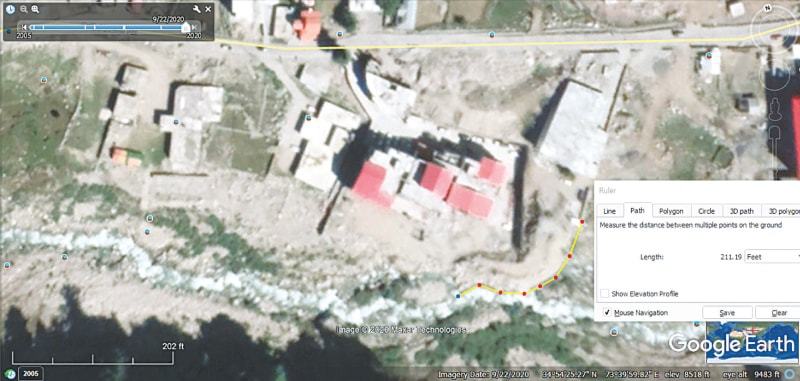
Kunhar River diverted at Sohach for gravel and sand mining (above: Sept 2006; below: Sept 2020) | Dawn GIS
The North-West Frontier Rivers Protection Ordinance, 2002 prohibits construction in the bed of the river. The ordinance also forbids lifting of the gravel in the riverbed. And yet, unfortunately, Kaghan Valley and Kunhar River are both playfields for the well-heeled.
A drive from Battakundi to Kiwai is a sombre testament to the ignorance and callousness of the locals and visitors alike. Heading towards Naran, once considered to be the jewel of the Kaghan Valley, one comes across excavators, dumpers and other earth-moving machines crawling near Sahoch Bridge, inside the riverbed.
Locals feasting in Naran’s Punjab Tikka House say that this is the biggest-ever gravel lifting operation they have witnessed in the Kunhar riverbed and that the excavations are being carried out round the clock for the last six months, in full view of public and district authorities.
According to Deputy Director Kaghan Development Authority (KDA), Mazhar Hussain, when KDA arrested the truck and excavator operators carrying out this massive operation in the riverbed, Syed Humayoun Shah, the brother-in-law of Mansehra’s PTI MPA Syed Ahmed Shah came to defend them. Eventually, the magistrate let them all off with minor fines. However, all attempts to contact Syed Ahmed Shah on the phone and Whatsapp remained unsuccessful and, despite several promises, he did not return calls.
The culprits were also able to brandish leases issued to them by the Khyber Pakhtunkhwa (KP) Mines and Minerals department. According to sources in the district authority, their attempts to stop riverbed mining also attracted the ire of none other than the Secretary, Mines and Minerals, KP.
Locals estimate that around 75 dumpers cross the Naran Bypass everyday, loaded with 8-10 cubic metres of sand and gravel from the riverbed near Sahoch, to the Suki Kinari Dam construction site. This dumper traffic has rendered Naran Bypass in complete shambles. It is estimated that, during the last six months, 125,000 cubic metres, or 200,000 tons, of gravel and sand has been lifted from the riverbed.
The Suki Kinari Hydro Power (SKHP) is an under-construction, run-of-the-river hydropower project being constructed some 20 miles downstream Naran on Kunhar River at Paludrah. The project was originally conceived in 1960 but remained dormant until March 2005, when the Private Power Infrastructure Board invited proposals for its construction. Yet, the project could not advance beyond the feasibility stage for one reason or the other.
Recently, Suki Kinari got a new lease of life. It is now being built under the China Pakistan Economic Corridor’s (CPEC’s) ‘Early Harvest’ projects. In August 2016, the KP government awarded the contract to a Sino-Pak consortium led by the Chinese state-owned Gezhouba Group and the SK Hydro group on a ‘Build, Own, Operate and Transfer’ basis. The Suki Kinari project cost is estimated at 1.8 billion US dollars and is being financed by the Industrial and Commercial Bank of China.
After completion, the dam shall be 54.5 metres high and 336 metres wide. The two-gated spillways and a three-kilometre long reservoir shall hold 9 million cubic metres of water. Its four turbines are expected to generate 870 MW of electricity. However, not only is the dam likely to disturb fish populations and silt-flow downstream, the sand and gravel lifting for its construction upstream will affect water-flow gradients during floods and create more erosion that could lead to the dam silting up at a much faster rate, impacting the long-term feasibility of this expensive project.
Encroachments in the riverbed
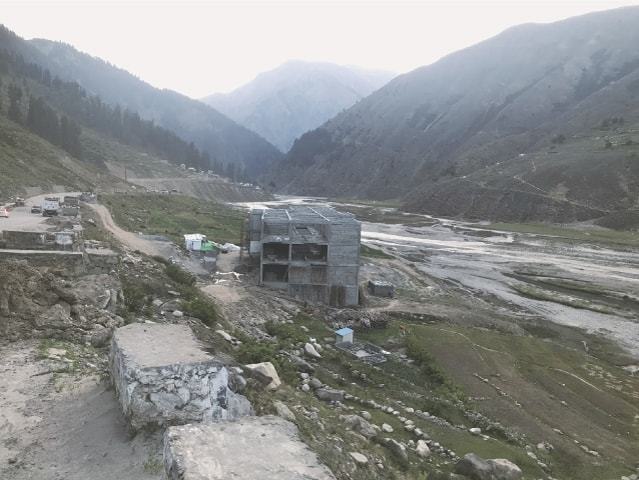
The illegally constructed NHA rest house near Naran currently lies sealed
According to sources in the Mansehra district administration, there are 257 blatant encroachments in the Kunhar riverbed and its tributaries. The district administration claims that they plan to move against these soon.
Near Sahoch a hotel is being built on an acre of land that’s either reclaimed in the riverbed or barely on the left bank of the Kunhar. Either way, it’s in violation of general prohibitions under the River Protection Ordinance 2002. It is widely alleged to be owned by a retired lieutenant general of the Pakistan army.
The next peculiar reclamation of land out of the Kunhar riverbed is between Dum Dama and Naran, where three acres of the riverbed have been encroached upon by the military-run Frontier Works Organisation (FWO), for a helipad and a maintenance base for trucks, excavators and other earth-moving machines — with muck and grease oozing into the river. Another six acres of the adjoining riverbed have also been fenced for unknown reasons.
Just a little ahead, the National Highway Authority (NHA) has built their rest house on an acre of reclaimed land inside the left bank. In an attempt to protect the rest house from the vagaries of the Kunhar, the NHA had to reclaim an additional acre of land upstream. Because of blatant violations of the River Protection Ordinance 2002, and illegal construction of the rest house in the riverbed, the KDA sealed the property and is awaiting orders for its demolition. Meanwhile, NHA bosses seem to be in a quandary, as they had already sublet the property to a private operator before the sealing orders, according to sources within the NHA.
The FWO has encroached on the riverbed between Dum Dama and Naran for helipad and maintenance base for vehicles | Dawn GIS
Naran town is situated on the left bank, about a mile off Kunhar River. Dozens of hotels have also been built on two sides of the Naran-Saiful Muluk Road. The town has changed beyond recognition during the last 10 years, with hundreds of densely built hotels, shops and restaurants in the town centre dominating the scenery. More than 60 percent of the 5,000 or so hotel-rooms in Kaghan valley are cramped up in less than a quarter of a square mile, with an equal number of rooms sprouting up in Naran by the day.
Further up in the mountains, Lake Saiful Muluk, another key contributor to the Kunhar River, is located at the foot of Malika Parbat, east of Naran. The lake is rich in biodiversity, stuffed with large brown trout, many species of blue-green algae and over two dozen species of vascular and flowering plants. About a mile long, and half a mile wide, with an average depth of 150 feet, Saiful Muluk covers an area of over 12,000 acres, and is categorised as a glacier-fed lake. It is part of what is classified as a ‘permanent snow, alpine meadow’. Once known for stories of leprechauns dancing on its clear blue waters, Saiful Muluk is also racing towards an environmental disaster.
Thousands of tourists, encouraged by the increasingly dreadful sanitary conditions, callously toss their empty tetra pack cartons, plastic bags and oily newspapers that once held samosas and pakorras, in and around the lake. Occasionally, used baby diapers and other refuse can also be seen floating in the once pristine blue waters.
The North-West Frontier Rivers Protection Ordinance, 2002 prohibits construction in the bed of the river. The ordinance also forbids lifting of the gravel in the riverbed. And yet, unfortunately, Kaghan Valley and Kunhar River are both playfields for the well-heeled.
Many auto-workshops have also cropped up near the lake for the emergency service and repair of vintage Toyota Jeepsters, which are the primary means of transport for the tourists. Most of these open-air workshops service overheated engines, faulty hydraulics etc.
The land around the Kunhar tributary from Saiful Muluk drops 2,500 feet along the six-mile road to Naran, and belongs mostly to the forest department. However, several massive hotels are fast cropping up between the road and the Saiful Muluk nullah. Some of these hotels are encroaching well into the bed of the stream, known for flash floods. The largest of these hotels being built is in the name of Shamail Khan, son of another retired general, and encroaching on 200 feet of the nullah bed.
According to one of the directors of the KDA, the provincial secretary of his department, who raided the subject hotel, “appeared extremely remorseful the next day for having done so.”
Land along the Kunhar tributary from Lake Saiful Muluk has been encroached by a hotel being constructed by the son of a retired general | Dawn GIS
However, the North-West Frontier Rivers Protection Ordinance, 2002 provides that:
(1) Where an offence of encroachment upon a river or its tributary or indiscriminate disposal of solid waste or flow of untreated water into a river or their tributary is committed by a body corporate or a firm, then every director, manager, secretary, or officer of servant of the body corporate, or every partner, manager or official actively concerned in the conduct of business of such firm, as the case may be, shall be deemed to have committed the offence, unless he proves that the offence was committed without his knowledge or that he used all his efforts to prevent the commission of such an offence.
(2) Any offence committed by any person under this Ordinance shall be deemed to have been committed at the instance of the owner, landlord, employer, lessor, licenser, mortgager, manager and any other person in charge of the premises, building or land for the time being, and the burden of proving otherwise shall lie upon such person.
On the matter of punishments, the Ordinance states:
(1) Whoever is found guilty of an offence under the provisions of this Ordinance, shall be punished, with imprisonment which may extend to six months, or with fine which may extend to five hundred thousand rupees, or with both: Provided that the punishment of imprisonment, in no case, shall be less than one month and the amount of fine, in no case, shall be less than ten thousand rupees.
(2) Whoever fails to remove an encroachment within ten days of the receipt of a legal notice shall also be punished with the same punishment as mentioned in subsection (1)
Gravel and sand mining
For thousands of years, sand and gravel have been used in the construction of roads and buildings. However, unregulated sand mining has resulted in the erosion of riverbanks, increasing flooding and causing a severe threat to biodiversity.
“Channel incision is the most common physical impact of sand and gravel mining whereas habitat disturbance, alteration of riparian zones, and changes to downstream sediment transport are other serious impacts of this uncontrolled activity,” says Muhammad Moazzam Khan, Technical Adviser to WWF Pakistan. “Ecosystem attributes affected included macroinvertebrate drift, fish movements, species abundance and community structures, and food web dynamics.”
According to a post on the IUCN ‘Red List of Ecosystems’ website, despite the countless benefits that river ecosystems bring, today they are among the most threatened on the planet. The increasing use of land and associated channeling (dams and hydroelectric plants) have led to the deterioration of the functions and services of these river landscapes.
The illicit gravel and sand mining in the Kunhar riverbed is a serious cause of concern for environmental experts. Mindless excavation lowers the riverbed in different spots, which results in localised changes in gradient and sudden consequent increase in flow velocities. During flood seasons, an abrupt change in bed-gradient amplifies the rate of bed erosion, triggering massive quantities of gravel and sand to move downstream.
Another under-construction hotel in the riverbed near Sahoch allegedly owned by a another retired general
According to sources in the Mansehra district administration, no government agency has conducted any study to assess as to where or how much sand and gravel mining is possible in the bed of Kunhar River.
On September 22, 2020, Dawn reported, “…the chief secretary has written a letter to the Mines and Mineral secretary saying the river sand and gravel [that] is widely being exploited as aggregate for construction is often mined directly from the river channel, floodplain and adjacent river terrace deposits.”
The letter noted that the Mines and Minerals department, in most cases, had issued leases and licences for such mining. “Also, there are reportedly illegal extractions along riverbanks in the province, especially in [the] tourist areas of Malakand and Hazara divisions,” the letter had further stated.
The chief secretary’s office had added that KP Chief Minister Mahmood Khan had ordered a halt to riverbed mining in a recent cabinet meeting, claiming that the impact on the environment was much more than the revenue generated for the government from such activity.
Even earlier, the deputy commissioner Mansehra had repeatedly imposed Section 144, banning the lifting of sand and gravel in the Kunhar riverbed. But through sheer abuse of political power, wholesale corruption in the system and the turning of a blind eye by the Suki Kinari consortium, massive illegal mining activity continues unabated till date.
Killing it softly
Of late, Pakistan has been struck by more than a dozen furious storms, followed by massive flooding, substantial loss of lives and damage to infrastructure. Such events match the World Meteorological Organisation’s projections of frequent and intense weather events during the years to come.
Thoughtless construction and quick solutions only exacerbate the problem.
Desirable change can be brought about if the government is vigilant. We have seen this the past. In December 2010, the Poonch River, its tributaries and their beds were designated as River Poonch Mahseer National Park. According to Sardar Javaid Ayub, secretary Wildlife, Fisheries & Tourism in Azad Jammu and Kashmir (AJK), over the past decade, ever since there have been checks on the illegal lifting of gravel and sand and illegal fishing, the population of the Mahseer fish has multiplied “several folds.”
The Kunhar River | Dawn GIS
“Due to human interventions, usually illegal mining and in-bed constructions by the powerful and the greedy, water channels erode laterally and vertically,” Ayub tells Eos. “Such activities result in flooding, and damage to the natural habitat of endangered species and existing infrastructure in and around the channel.”
Writer Amit Kalantri once wrote, “A river doesn’t just carry water, it carries life.” And so the death of a river doesn’t just impact water, but the life within it. While Kunhar River is an integral part of Pakistan, it is also a natural habitat for many species.
A study conducted by Khalid Usman et al to identify fish fauna at different sampling sites in River Kunhar was published in the Journal of Entomology and Zoology Studies in 2016. Fish samples were identified by using various keys and literature. According to the study, Cyprinidae also known as “carp” are the most commonly found fish in Kunhar River. But other species, such as Nemacheilidae or stone loaches (pathar chatta), a family of traditional bony fish, Salmonidae — ray-finned fishes which include salmon and trout — and Sisoridae — catfish that live in fast-moving waters and often have adaptations that allow them to cling to things in their habitats — are also plentiful in the river.
The study concluded that an increase in anthropogenic activities and pollution — resulting from human activity, illegal fishing and tourism — is threatening the decline of fish fauna in River Kunhar. If requisite conservation steps are not taken, it will result in the endangerment of fish in the river Kunhar.
While the Kaghan Development Authority has recently acquired some machines and equipment for solid waste management, because of topographic challenges, the safe disposal of the solid waste or sewage generated by tourists and the local population appears to be a Herculean task.
Over-pumping of underground water is also putting great pressure on the Kunhar. A rampant VIP culture and political compromises, and an extremely weak enforcement effort by the wildlife department is acutely affecting the safety of migratory and resident fowl, as well as other threatened wildlife.
It is high time we took thoughtful action and learnt to co-exist with nature. We must let the rivers flow freely, and not force them to fight back. Because humankind is no match for Nature’s wrath when it comes.
The writer is a former administrator of Karachi, currently working with the Dawn Media Group
Actress whips up a storm online with caustic questions for PM
PoliticsDec 06. 2020Actress Focus Jeerakul posts a provocative message about flood victims on her Facebook page on December 5, drawing the attention of the public and the government.
By The Nation
A Facebook post by an actress, scathing in its criticism of Prime Minister Prayut Chan-o-cha, has drawn the attention of netizens after she posed: “Apart from praising the monarchy, are you competent on other issues?” The post drew netizens’ attention to the severe floods in the South and the intensified political unrest. In
In her post, actress Focus Jeerakul questioned the government’s allocation of a budget to build a new Parliament building, for use of water cannons and containers to block anti-establishment protesters, but does not seem to have a budget to help people in the South currently suffering from devastating floods. She said she wanted to donate money to support the affected people and wanted to ask “Loong” (referring to Prayut as uncle in Thai) five questions:
▪︎Is it the duty of the people (to help flood victims)?
▪︎What does the government spend its budget on, if it does not have a budget to support the people in the South?
▪︎Could you reduce the military budget, reduce budget spending to counter the protesters, and use the money saved to support flood victims?
▪︎Apart from praising the monarchy, are you competent to deal with other issues?
▪︎Apart from loving the monarchy, do you love the people?
Focus posed her questions on Saturday when the government organised grand events to pay tribute to the late King Rama IX on his birthday.
Her comments come in the backdrop of floods devastating many southern provinces, affecting more than 400,000 people and costing nine lives.
About 100,000 netizens reacted emotionally to Focus’s post, clicking like, love and amused signs, over 3,000 made comments and over 10,000 shared her post.
Focus is known for supporting the youth-led protesters who are demanding reform of the country, including curbing the power of the monarchy.
Mallika Boonmeetrakool Mahasook, adviser to the Commerce Minister, hit back at the actress via her Twitter account, saying Focus should investigate the matter before making a comment, as the government has an emergency budget to deal with floods in the South.
In her rejoinder, Focus said she had asked the questions because she is a citizen and if she knows so much about the issue, she will not ask. Focus also chided Mallika for her retort, saying the questions were not for her to answer.
Others have also posted their critical views about activities on December 5, which is celebrated as Father’s Day and National Day.
National Artist Suchart Sawatsi, posting on his Facebook page, demanded that National Day be celebrated on June 24, the day that marked Thailand’s shift from absolute monarchy to constitutional monarchy after the 1932 Revolution.
After the revolution, June 24 was marked as National Day but the dictatorship government under Field Marshal Sarit Thanarat in 1960 changed it to December 5.
Pavin Chachavalpongpun, an academic living in exile in Japan, also questioned the government spending a large budget for organising events to celebrate the late King Rama IX’s birthday at the expense of the taxpayers and at a time when people in the South were suffering from severe floods.
In response to Focus’s questions, Rachada Dhanadirek, deputy government spokeswoman, assured on Sunday that the government had adequate budget to support flood victims in the South.
At Georgia rally, Trump spouts election falsehoods, amplifies old grievances
InternationalDec 06. 2020Supporters of President Trump turn out in Valdosta, Ga., to hear him speak at a rally tied to the state’s upcoming runoffs. The results in Georgia will determine which party has control of the U.S. Senate. MUST CREDIT: Washington Post photo by Jabin Botsford
By The Washington Post · Cleve R. Wootson Jr., David Weigel, Amy B Wang · NATIONAL, POLITICS
VALDOSTA, Ga. – In his first rally since losing the election last month, President Donald Trump continued to spout conspiracy theories about voter fraud, falsely claiming that he had defeated President-elect Joe Biden.
“We’ve never lost an election. We’re winning this election,” Trump declared soon after he took the stage outside a hangar at Valdosta Regional Airport on Saturday night.
It was the first in a fire hose of falsehoods Trump offered up to a largely unmasked crowd of thousands, who cheered him on and repeatedly chanted “Four more years!”
Trump was ostensibly in the state to whip up support for Republican Sens. David Perdue and Kelly Loeffler, who are locked in tight Jan. 5 special election races with their respective Democratic challengers, Jon Ossoff and the Rev. Raphael Warnock. At stake is control of the Senate, where Republicans hold 50 seats. If Democrats win both seats in Georgia, they will effectively have a majority, with Vice President-elect Kamala Harris serving as a tie-breaking vote if needed.
But Trump mostly focused on himself. People held “Make America Great Again” placards and draped themselves in giant “Trump 2020” flags, and there was little noticeable signage for Perdue or Loeffler. Both incumbents addressed the crowd about 90 minutes before Trump took the stage at 7 p.m.
Once at the lectern, Trump spent most of his time airing grievances and falsehoods about the presidential race, occasionally weaving in mention of the Senate runoffs. He knocked Ossoff and Warnock as “radical Democrats” who would be “total pawns” of Senate Minority Leader Charles Schumer, D-N.Y. He also attacked Gov. Brian Kemp and Secretary of State Brad Raffensperger, both Georgia Republicans who have repeatedly vouched for the integrity of the state’s elections.
There has been no evidence of widespread voter fraud, nor of any fraud that would overturn the election results, as Trump has alleged.Trump’s legal team has lost nearly all of its cases in key states. Even Attorney General William Barr has said the Justice Department had found no evidence of voting fraud that could have changed the outcome of the election.
“I’ve probably worked harder in the last three weeks than I ever have in my life,” Trump told the crowd at one point, referring to his unprecedented personal efforts to overturn Biden’s victory since November.
Trump was introduced Saturday night by a surprise guest – first lady Melania Trump – who seemed to stick to prepared remarks, encouraging the crowd to vote for Loeffler and Perdue without mentioning her husband’s claims of a “rigged” election.
“President Trump continues to fight for you every single day. Do not let your voices be silenced,” she said. “We must keep our seats in the Senate. It is more important than ever that you exercise your right as an American citizen and vote.”
But the president quickly veered off course, bringing to lifesome Republicans’ concerns that Trump’s visit to Georgia would do more harm than good by continuing to erode GOP voters’ trust in the election system. Trump has said he would never concede to Biden, and emphasized that again on Saturday.
“If I lost, I’d be a very gracious loser. If I lost, I would say I lost and I’d go to Florida and I’d take it easy and I’d go around and I’d say I did a good job,” Trump said. “But you can’t ever accept when they steal and rig and lie.”
Nearly an hour into his remarks, Trump tried to thread the needle between claiming the election was rigged and to encourage his supporters to still vote in the Jan. 5 special election.
“You know, you’re angry because so many votes were stolen. It was taken away. And you say, ‘Well, we’re not going to do it.’ We can’t do that. We have to actually do just the opposite,” Trump said. “If you don’t vote, the socialists and the communists win, they win. Georgia patriots must show up and vote for these two incredible people.”
Sharon Tanner, a school bus driver, had traveled with her family from Moultrie, Ga., to attend the rally. When asked who was going to be inaugurated Jan. 20, Tanner said she thought it would be Trump, not Biden.
“God’s going to open their mouths and let the truth come out,” she said.
Tanner, 53, said she didn’t know enough about Trump’s dispute with Raffensperger to comment, but she maintained that there had been enough fraud to overturn the election – and that she was planning to vote for Loeffler and Perdue on Jan. 5.
“I feel like we need to vote more now. [Trump] still needs us to do our part no matter what. I’m telling all my folks to come out and vote,” she said. “I believe he’s God’s anointed, that God chose him to fix our country.”
Both Democrats and Republicans ramped up the intensity of their campaigning in Georgia this weekend, sending high-profile surrogates to the Peach State in a frenetic final push to excite voters before voter registration for the Senate runoff election ends Monday.
Speaking at a virtual get-out-the-vote event Friday with Ossoff and Warnock, former president Barack Obama told Democrats that many of his first term’s signature accomplishments came about because he had a Democratic Senate. Even then, he admitted, it was a struggle to pass legislation “because of the way the U.S. Senate was set up.”
“The Senate is a place where, even with a big majority, it’s tough to get legislation through,” Obama said. “And if you don’t have a majority, if the Senate is controlled by Republicans who are interested in obstruction and gridlock rather than progress and helping people, they can block everything.”
Later, he added, “Once [Senate Majority Leader] Mitch McConnell was controlling that gavel and controlling the agenda in the Senate, we saw a lot of progress stop.”
Obama also knocked Republican lawmakers for politicizing measures that could be taken to bring the coronavirus under control, and referred to accusations of unethical financial trades both Perdue and Loeffler have faced.
“When you’ve got a bunch of senators who are downplaying a pandemic . . . and then as they’re downplaying it, as they’re ignoring the science and epidemiologists, suggesting that this is some partisan issue instead of something that Americans should rally around, at the same time, behind closed doors, they’re calling their brokers, that’s not public service,” Obama said. “That alone should motivate Georgians to say we want somebody in there who’s working for us.”
The virtual event also featured former Georgia gubernatorial Democratic candidate Stacey Abrams, whose work over the past two years organizing and mobilizing new voters, especially voters of color, is being credited for helping flip the state for the Democrats.
While Obama was speaking, Vice President Pence arrived at an airfield in Savannah in Air Force Two for a rally for Loeffler and Perdue. He spoke about the importance of the race but also weighed in on the GOP controversy over whether Republicans upset about Trump’s baseless voter fraud claims should skip the runoffs.
“I know we’ve all got our doubts about the last election, and I’ve heard some people say just don’t vote,” Pence told the crowd of hundreds. “My fellow Americans, if you don’t vote, they win.”
Pence, making his second trip to the state for the Senate runoffs, arrived the day after GOP legislators organized a hearing in which Trump attorney Rudolph W. Giuliani suggested that there were enough allegations of irregularity to reverse the results of the presidential election. A recount, demanded by the Trump campaign, wrapped up the same day, and Republican election officials have suggested that Biden’s narrow victory would be certified again.
“I’ve heard many of you ask me: ‘Well, why should I vote? It’s rigged,’ ” said Rep. Earl Carter, a Republican, who represents Savannah in the House. “You have to get out. The president is out there making sure this was a transparent and honest election.”
Pence was not the only Republican acknowledging that questions about election integrity had sapped some voters’ enthusiasm. Soothing Republicans who think the election was stolen, while telling them to vote again in a few weeks, has been tricky for GOP leaders.
“We’re going to continue to fight for our president, Donald Trump,” said Republican National Committee Chairwoman Ronna McDaniel at the rally, telling the crowd to reelect their senators to “fight for election integrity so that this never happens again.”
“Don’t be pressed by somebody saying, ‘I’m just going to sit it out, I don’t like what they did in the general election,’ ” Georgia Public Service Commissioner Lauren “Bubba” McDonald said. “You’ve got to get over it. Please, get over it.”
Loeffler did not attend the rally, canceling her appearance after the death of a staffer in a car crash. Perdue did not mention the election challenges in his remarks, which focused on the liberal policies that could be approved if Republicans lose the Senate.
But Pence repeatedly referred to the election contest, promising to fight “until every legal vote” is counted, while urging Republicans to vote early or request absentee ballots – even as conservative activists suggest that those ballots were at the center of conspiracies to rig the vote.
“We’re on them this time,” Pence said. “We’re watching. We’re going to secure our polls. We’re going to secure our drop boxes. So get an absentee ballot and turn it in today.”
Several Republicans who came to see Pence acknowledged the controversy and said that they, too, had questions about the vote but that they still intended to cast ballots.
“I’m keeping the faith,” said Kevin Volland, 45, as he waited for Pence to speak in Savannah on Friday. “How is there a Senate runoff, anyway? Did they swing votes away from Perdue and Loeffler? Possibly. I don’t feel 100 percent confident about Jan. 5, but I’ll be there, because I have faith. I have to.”
Harold Holifield, 59, an Army veteran from Effingham County, Ga., said he hoped Republicans would stay together.
“You don’t destroy each other trying to get toward a common goal,” Holifield said. “Hopefully [Republicans are] working for a common goal. If not, they’re turning into cannibals and eating their own.”
By The Washington Post · Yeganeh Torbati, Beth Reinhard · NATIONAL, BUSINESS, WORLD, POLITICS
In her nine years helming Washington’s leading liberal think tank, Neera Tanden mingled with deep-pocketed donors who made their fortunes on Wall Street, in Silicon Valley and in other powerful sectors of corporate America.
At formal pitches and swanky fundraisers, Tanden personally cultivated the bevy of benefactors fueling the $45 to 50 million annual budget of the Center for American Progress.
Now that President-elect Joe Biden has picked Tanden to run the Office of Management and Budget at the White House, her ties to some of the most powerful players in the U.S. economy are drawing scrutiny from some progressives and advocates for accountability in government.
The OMB acts as the nerve center of the federal government, executing the annual spending plan, setting fiscal and personnel policy for agencies, and overseeing the regulatory process across the executive branch. As OMB director, Tanden would have a hand in policies that touch every part of the economy after years spent courting corporate and foreign donors. These regulatory decisions will have profound implications for a range of U.S. companies, dictating how much they pay in taxes, the barriers they face and whether they benefit from new stimulus programs.
Between 2014 and 2019, CAP received at least $33 million in donations from firms in the financial sector, private foundations primarily funded by wealth earned on Wall Street and in other investment firms, and current or former executives at financial firms such as Bain Capital, Blackstone and Evercore, according to a Washington Post analysis of CAP’s donor disclosures and some of the foundations’ public tax filings. In the same time period, CAP received between $4.9 million and $13 million from Silicon Valley companies and foundations, including Facebook and founder Mark Zuckerberg’s philanthropic organization.
CAP reports its donations only in wide ranges, making an exact figure impossible to determine. Other notable corporate donors include retail giant Walmart, insurer CareFirst BlueCross BlueShield, defense contractor Northrop Grumman and for-profit college operator DeVry Education Group.
“CAP has been one of the most aggressive (think tanks) in courting corporate donors,” said Zephyr Teachout, a law professor at Fordham University in New York who has campaigned for elected office on curbing the power of special interests. Those donors, she said, “believe they can shape the worldview of the people whose voices are going to be heard and powerful with the next president.”
CAP says less than 2.5% of its funding last year came from corporate sources, down from 7% in 2011, and that corporate money does not support the think tank’s direct research. CAP’s accounting of corporate donors is limited to money that flows directly from businesses and doesn’t include money from corporate executives or foundations whose wealth comes from Wall Street.
CAP spokesman Jesse Lee said the organization “retains complete control” over its work and that all contributions come without strings attached. The organization advocates a progressive agenda that would adversely affect the bottom line for some major donors – a tax on financial transactions, upping oversight of “shadow banks” such as hedge funds and investment firms, antitrust scrutiny of big tech, a public option for health insurance, and a reversal of President Trump’s corporate tax cuts and regulatory rollbacks.
“There are many instances where the work we do cuts against the business or financial interests of our donors,” Lee said. “CAP’s policy work has always been, and will always be, independent and driven by solutions that we believe will create a more equitable and just country.”
Tanden has told staff that she will remain as CAP president through her confirmation, but Lee said she suspended her involvement in fundraising after Biden announced her nomination.
The Post reached out to all the individual and corporate donors mentioned in this story for comment. Zuckerberg’s foundation, the Chan Zuckerberg Initiative, said in a statement that its funding for CAP mainly went toward criminal justice reform efforts. A CareFirst BlueCross BlueShield representative said the insurer “engages with many partners to ensure our members have access to affordable, high-quality care.” Other donors could not be reached, did not respond or declined to comment.
As a think tank, CAP provides research and advocacy about economics, criminal justice, health care, immigration and other issues. It was a popular landing place for former Obama administration officials such as Tanden, who served in a top role at the Department of Health and Human Services during the fight over the Affordable Care Act. She became CAP’s president in 2011 and received $396,063 in compensation last year from the think tank and its political arm, according to tax filings.
If she clears a potentially arduous Senate confirmation hearing, Tanden will enter the White House at a time of dire economic crisis, facing pressure from Republicans to dramatically cut spending. At the same time, progressives are pushing the new administration to rebuild the nation’s safety net for families devastated by the coronavirus pandemic, reverse Trump’s deregulatory drive and tackle what progressives see as the monopolistic practices of Silicon Valley tech giants.
The Biden transition team declined to make Tanden available for an interview about CAP’s fundraising, referring to her comments when she was officially named to Biden’s economic team. She vowed to “help shape those budgets and programs to keep lifting Americans up, to pull families back from the brink.” Tanden’s nomination has received widespread praise from high-profile progressive Democrats, including Sens. Elizabeth Warren of Massachusetts and Sherrod Brown of Ohio.
Sen. Bernie Sanders, I-Vt., the former presidential candidate – who, after a swipe at his personal wealth by the former media arm of CAP’s political affiliate, accused CAP last year of being beholden to corporate donors – declined to comment on Tanden’s OMB nomination. Tanden expressed regret about the attack on Sanders at the time and said she had no editorial control over the media site.
Some past OMB directors in Democratic administrations previously worked in the federal government, while others had fundraising backgrounds from serving in Congress or working at foundations and private companies. The current director, Russell Vought, served as vice president of Heritage Action for America, a conservative advocacy group.
The Biden team will take over the executive branch from an administration which, despite Trump’s pledge to “drain the swamp,” regularly and dramatically flouted ethical norms. A review last year by ProPublica found that the Trump administration had employed 281 lobbyists, quadruple the number the Obama administration had employed six years into office. And Trump’s refusal to divest himself from his hotel businesses means that he financially benefited from the presidency, with his properties receiving at least $2.5 million in taxpayer funds since he took office.
A White House spokesman, Judd Deere, said Trump “has always taken his responsibility seriously to uphold the rule of law and govern this nation ethically and soundly.”
Progressives are demanding that a Biden administration serve as the starkest possible ethical contrast to the Trump administration.
“Neera Tanden has spent the last decade raising money from the top companies and highest-net-worth individuals in the country, which is a bit at odds with what Biden pitched during the campaign,” said Matt Bruenig, president of the People’s Policy Project, a left-wing think tank that accepts only small donations.
CAP’s ties to corporate and foreign interests are not unique among Washington think tanks. Though frequently cast as independent, scholarly sources of expertise, many think tanks are backed by the same businesses and foreign governments that hire Capitol Hill influence peddlers. These think tanks essentially operate as unregistered lobbyists, reaping the benefits of tax-exempt status while disclosing limited information about their donors.
The fiercest criticism of CAP’s fundraising has targeted its acceptance of between $1.5 million and $3 million from the United Arab Emirates in recent years. The country is one of the United States’ staunchest allies in the Middle East and plays a key role in supporting Trump’s hard-line approach to Iran. But human rights advocates condemn the UAE for fighting alongside Saudi Arabia in a civil war that has ravaged Yemen, one of the world’s poorest countries, and for joining with the Saudis in a blockade of neighboring Qatar.
After Washington Post columnist Jamal Khashoggi’s 2018 murder at the hands of Saudi officials, CAP put out a statement denouncing the “heinous and reprehensible act” but stopping short of demanding specific consequences to punish the kingdom. The think tank also declined to go to bat for a bipartisan resolution in the Senate aimed at ending U.S. involvement in the war in Yemen.
In another, previously unreported example of what some in and outside CAP viewed as UAE influence on the think tank, an unsigned essay in 2017 welcomed the ascension of Mohammed bin Salman as the new Saudi crown prince, saying he would usher in a “long era of stability at the top” and “economic and social reforms.”
“That reads like something that would be distributed by a Saudi foreign agent,” said Ben Freeman, who monitors foreign influence at the Center for International Policy. “Thousands of civilians had already been killed in Yemen, and we knew that MBS was the architect of that war. It’s hard for me to understand how CAP could support someone some so oppressive and a regime with absolutely egregious human rights issues.”
Lee pointed to other policy papers and statements on CAP’s website that called for an end to the war and criticized the crown prince’s authoritarian tactics, as well as a foreign policy event in 2018 with a keynote speech by Sen. Chris Murphy of Connecticut, a Democrat who has been a leading critic of U.S. involvement in Yemen.
In early 2019, CAP said that though contributions did not influence its foreign policy positions, the think tank would no longer accept donations from the UAE and other anti-democratic governments. Lee said Tanden was not involved in arranging the UAE donations and did not meet with their representatives until after CAP stopped accepting the funding.
The UAE and Saudi embassies did not respond to requests for comment.
But it’s not just think tanks’ dependency on donations from corporate and foreign interests that is problematic, critics said. They argued that the hundreds of hours of relationship-building that goes into securing large donations from big corporations and wealthy individuals gives private interests the opportunity to subtly influence the views of Tanden and others in her position.
In 2018, CAP received a donation of between $50,000 and $99,999 directly from Blackstone, a powerhouse in private equity, as well as a separate one in the same range from Hamilton “Tony” James, Blackstone’s executive vice chairman. That year CAP hosted an event featuring James’s book, in which the billionaire lays out potential solutions to the retirement crisis facing many Americans. Tanden gave introductory remarks at the event for James, who also sits on CAP’s trustee advisory board.
Members of CAP’s board include Andrew Hauptman, chairman of investment firm Andell; Glenn Hutchins, a private equity investor; Eric Mindich, a former hedge fund manager; and Kristin Mugford, a former executive at Bain Capital.
Mindich, who along with his wife has made large donations to CAP in recent years, said the think tank has “some of the most brilliant policy thinkers in the country working to advance values that I share” and that Tanden has a record of turning those values into reality.
“CAP isn’t trying to advance my financial interests. If anything, the opposite,” he said. “They advance the kind of country I want to see.”
“Anyone who thinks Neera would put corporate interests above what she believes is best for America clearly doesn’t know Neera Tanden,” said Mugford, who left Bain in 2013 and now lectures at Harvard Business School. Mugford has made sizable donations to CAP in recent years, which she said reflected her belief in its effectiveness on issues such as economic security, jobs, and education.
“Their policy solutions often go against my personal economic interest, but they reflect my values and will help move our country forward,” she wrote in an emailed statement.
Jeff Hauser, who scrutinizes executive branch appointees at the Center for Economic and Policy Research, called the corporate money that flows into CAP “corrosive,” though he added that the think tank plays an important role in a civil society that lacks public support for policymaking institutions. Founded in 2003 by allies of Bill and Hillary Clinton, CAP is widely viewed as a Democratic administration-in-waiting, with a revolving door between the think tank and the White House.
While CAP certainly doesn’t toe the line of all of its donors, Hauser said it can serve as a moderating influence.
“It’s soft influence but it’s very powerful, and it amounts to influence laundering in terms of the money because people don’t associate CAP with big tech or Wall Street, they associate it with the Democratic Party,” he said. “Being associated with the Center for American Progress is a way to build credibility in Washington. And it’s a way for companies to navigate risk because you have an open line of communication with a government in waiting.”
Michael Ettlinger, director of the University of New Hampshire’s Carsey School of Public Policy and a former vice president for economic policy at CAP, said he did not think Tanden’s experience raising money from the corporate world would affect how she approached the OMB position.
“You don’t buy Neera,” he said. “She’s got her strong views and I don’t think she’s going to be hugely influenced.”
During his time at CAP, which he left in 2013, the money the think tank received from corporate donors “never directly affected what we were doing,” he said, though he sensed an extra level of scrutiny if their work had bearing on a donor.
“If we were going to do something that would offend a funder, we were just asked to be really careful that we were positive we were right,” he said.
Potential funders who did ask for quid pro quos in exchange for donations were rejected by the think tank, Ettlinger said. He declined to give specific examples.
Tanden’s experience leading CAP, which publishes policy recommendations for many domestic and foreign issues, has given her the policy chops needed to lead OMB, Ettlinger said. The president-elect called Tanden “a brilliant policy mind with critical practical experience across government” and noted that she was raised by a single mother on food stamps.
“She will be in charge of laying out my budget that will help us control the virus, deal with the economic crisis and build back better,” Biden said. “But above all, she believes what I believe – a budget should reflect our values.”
Chiang Rai has found nine new cases of Covid-19 linked to the 1G1 Hotel in Myanmar, provincial officials said.
All the nine were women aged 20-44 years, who had travelled through legal channels.
Chiang Rai administration officials held a press conference on Sunday regarding the Covid-19 situation in the province.
They said the nine women had travelled across the Thai-Myanmar Friendship Bridge and entered the quarantine process as soon as they had returned to the country without being exposed to the community at all.
In total, there are 20 cases in Chiang Rai in the last two weeks, 14 of whom were found during quarantine in the state local quarantine facility, five had sneaked in through a natural channel, and one local was infected from a patient who had entered illegally.
Chiang Rai Governor Prachon Pratsakul said that the infections were all linked to 1G1 Hotel in the Tachilek district of Myanmar. He said the new nine cases were not unexpected, as they all worked and lived together. The province is still open to receiving Thai people who want to return, he said.
So far, 171 people have returned from Tachileik province and are all admitted to Chiang Rai Prachanukerah Hospital.
“He urged those who had sneaked in earlier to report to public health officials as soon as possible.
“I believe the situation can be controlled because most of the cases found in the state local quarantine have limited contact groups, so I believe that after 14-25 days, Chiang Rai would be safe as a New Year 2021 gift to people and tourists who want to continue visiting,” said the governor.
Dr Tosthep Boonthong, from Chiang Rai Public Health, said all the nine patients had travelled together in a group of 16. The remaining seven are not found to be infected.
As for the case of one infected local person found in the Muang district of Chiang Rai province, the authorities detected 22 high-risk people because they had visited Singha Park and many other entertainment venues. There were around 200 people at risk, but all test results showed that the risk group was negative.
Dr Chaiwetch Thanapaisal, director of Chiang Rai Prachanukroh Hospital, said the hospital had room to accommodate up to 30 beds. The first patient from this new group of patients will complete the scheduled treatment on December 8.



 Sand and gravel excavators and dumpers near Sohach Bridge in what locals say is ‘the biggest-ever gravel-lifting operation in the Kunhar riverbed’ | Photos by the author / White Star


 Actress Focus Jeerakul posts a provocative message about flood victims on her Facebook page on December 5, drawing the attention of the public and the government.
  Supporters of President Trump turn out in Valdosta, Ga., to hear him speak at a rally tied to the state’s upcoming runoffs. The results in Georgia will determine which party has control of the U.S. Senate. MUST CREDIT: Washington Post photo by Jabin Botsford
  Neera Tanden
 SootinClaimon.Com