The clip of an SUV losing control and speeding into a parking lot outside a commercial building in Bangkok went viral on Saturday. The car nearly hit an elderly woman pushing her vending cart down the street. Here’s what happened:
Facebook user Anusorn Suksri posted the clip of an SUV losing control and speeding into a parking lot in front of a commercial building in Bangkok on Saturday. The vehicle narrowly missed an elderly woman pushing her cart down the street.
Anusorn said a similar accident had taken place outside his store on May 21, when another out-of-control car knocked over six second-hand motorcycles on display.
The beauty of hornbills in Thailand’s forest sanctuaries.
We invite you on a journey through the natural abundance of Thailand’s preserved forests, where different species of hornbills live together and forage for food in wildlife sanctuaries.
This video reveals the hornbills in their preserved forests in provinces across the country – Uthai Thani, Phetchabun, Prachuap Khiri Khan, Kanchanaburi and Tak. The abundance of hornbills is an indicator of the natural integrity of the forest.
Thailand is home to 13 species of hornbills, named for their distinctive features. These are the great hornbill, oriental pied hornbill, wreathed hornbill, plain-pouched hornbill, rufous-necked hornbill, helmeted hornbill, black hornbill, bushy-crested hornbill, wrinkled hornbill, Tickell’s brown hornbill, Austen’s brown hornbill, rhinoceros hornbill and the white-crowned hornbill.
Thailand boasts many beautiful national parks and wildlife sanctuaries, all bursting with pristine natural abundance. Each species of hornbill has its own unique ecology and habitat. Hornbills are omnivorous birds, taking full advantage of the forest’s rich bounty by eating fruit, insects and also small animals. Hornbills help preserve the forest by spreading seeds and controlling the population of small animals that destroy trees. Hornbills play an important role in the ecosystem and are a crucial indicator of the forest’s natural integrity.
Mahidol University’s Faculty of Dentistry has patented a new mouthwash that reduces the spread of new coronavirus via patient’s saliva.
The new mouthwash was developed in research with Mahidol University’s Faculty of Tropical Medicine to find a formula that help reduces the spreading of Covid-19.
“We use a safe amount of hydrogen peroxide as an anti-viral agent plus other ingredients that will not irritate the oral cavity,” said Dr Surakit Wisutthiwatthanakorn, director of Mahidol University’s Dentistry Hospital.
Surakit added that the trial phase among patients at the Dentistry Hospital revealed that the mouthwash is capable of killing more than 99.9 per cent of new coronavirus in patients’ saliva.
“For example, if a patient has 100,000 units of Covid-19 virus in their saliva, after using this mouthwash for one minute, only 41 units will still be alive,” he said. “Furthermore, the mouthwash is able to tackle mutated variants of the virus, as it eliminates the fat layer protecting the virus, rendering it incapable of multiplying.”
The anti-Covid mouthwash does not affect the colour of the user’s teeth and can be stored at room temperature for more than a year, he added.
Mahidol University is planning to distribute the new mouthwash to field hospitals at prisons and military camps, where the risk of infection from patients and medical professionals is high due to limited space and protective gear.
The Public Health Ministry has come up with a roadmap to help boost Thailand’s economy and reopen the country safely. The aim is to have 70 per cent of the population fully vaccinated by December this year.
The ministry admitted that eradicating the disease is not possible at this point, but the roadmap provides guidelines on living with it in the short term.



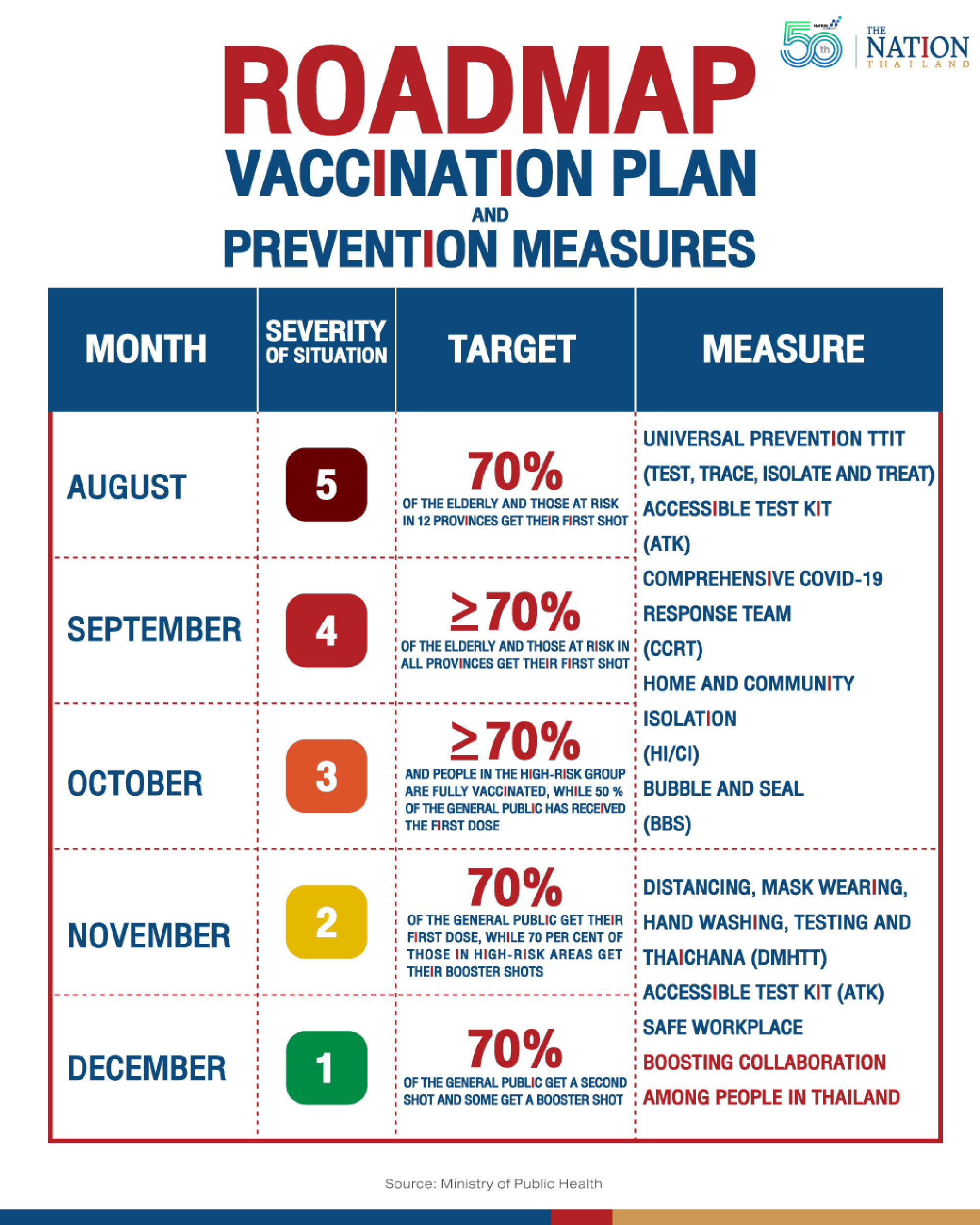 Roadmap for Thailand’s reopening and recovery
.png)


.jpg)




 SootinClaimon.Com