Portal: M’sian High Commission official summoned over Dr M’s citizenship law remarks #ศาสตร์เกษตรดินปุ๋ย

#ศาสตร์เกษตรดินปุ๋ย : ขอบคุณแหล่งข้อมูล : หนังสือพิมพ์ The Nation

https://www.nationthailand.com/ann/30379732?utm_source=category&utm_medium=internal_referral

Portal: M’sian High Commission official summoned over Dr M’s citizenship law remarks

Dec 22. 2019
India’s Ministry of External Affairs summoned Malaysia’s acting head of mission in the country to convey its displeasure over the remarks by Tun Dr Mahathir Mohamad on their recently-approved Citizenship Amendment Act.

India’s Ministry of External Affairs summoned Malaysia’s acting head of mission in the country to convey its displeasure over the remarks by Tun Dr Mahathir Mohamad on their recently-approved Citizenship Amendment Act.
By The Star/ANN

806 Viewed

PETALING JAYA: India’s Ministry of External Affairs summoned Malaysia’s acting head of mission in the country to convey its displeasure over the remarks by Tun Dr Mahathir Mohamad on their recently-approved Citizenship Amendment Act, reported an Indian news website.

The Wire said the official was summoned to the ministry on Saturday (Dec 21), one day after the ministry issued a statement saying that Dr Mahathir’s statement was factually incorrect and told him not to comment on India’s internal affairs.

A source said the Malaysian High Commission official was told that “such remarks are neither in keeping with accepted diplomatic practice of non-interference in each other’s internal affairs, nor with the state of our bilateral relations”.

“It was also conveyed that such remarks are both ill-informed and insensitive.

“Malaysia was asked to take a long-term and strategic view of the bilateral relations,” added sources quoted by the Wire.

Dr Mahathir had said that the law was regrettable as it was discriminatory to Muslims.

The Prime Minister said he was sorry to see India, a secular state, acting to deprive some Muslims of citizenship.

“Already people are dying because of this law, so why is there a necessity to do this thing when all this while, for 70 years almost, they have lived together as citizens without any problems?

“If we do that here, you know what will happen.

“There will be chaos, there will be instability and everyone will suffer,” he told reporters after visiting the media centre during the Kuala Lumpur Summit on Friday (Dec 21).

India’s parliament recently passed a law offering citizenship to non-Muslim migrants from Pakistan, Bangladesh and Afghanistan.

It allows fast-track citizenship for religious minorities, including Hindus, Sikhs, Buddhists, Jains, Parsis and Christians from the three neighbouring countries.

However, it does not mention those of Islamic faith.

As a result, there have been violent demonstrations all over the country.

A few months ago, Dr Mahathir had also ruffled feathers in India for his comments on the situation in Kashmir.

Extinction Rebellion Indonesia urges govt to declare climate emergency #ศาสตร์เกษตรดินปุ๋ย

#ศาสตร์เกษตรดินปุ๋ย : ขอบคุณแหล่งข้อมูล : หนังสือพิมพ์ The Nation

https://www.nationthailand.com/ann/30379731?utm_source=category&utm_medium=internal_referral

Extinction Rebellion Indonesia urges govt to declare climate emergency

Dec 22. 2019
Climate crisis: Members of Extinction Rebellion Indonesia march along Jl. Sudirman in Central Jakarta during the Rebellion Week campaign on Oct. 13. The activists demanded the government declare a climate emergency, as seen on the banner. (Extinction Rebellion Indonesia/Nabila Andrawina)

Climate crisis: Members of Extinction Rebellion Indonesia march along Jl. Sudirman in Central Jakarta during the Rebellion Week campaign on Oct. 13. The activists demanded the government declare a climate emergency, as seen on the banner. (Extinction Rebellion Indonesia/Nabila Andrawina)
By The Jakarta Post/ANN

770 Viewed

Reinaldi Yusuf, 24, has personally seen the negative impacts of climate change, such as rice crop failures in Pelabuhan Ratu in Sukabumi, West Java, and rising sea levels that frequently inundate homes along Bahagia Beach in Bekasi, West Java.

That experience encouraged him to join Extinction Rebellion (XR) Indonesia, a social movement concerned with climate issues, and took part in its Rebellion Week march along Jl. Sudirman in Central Jakarta on Oct. 13. “We spend billions to find life on other planets, but trillions on killing life on earth,” read a sign carried by Reinaldi on the march.

“I have the same vision as XR Indonesia to save Planet Earth,” said Reinaldi, when asked why he wanted to participate in XR Indonesia’s campaign.

XR Indonesia, established in July 2019, is the first social movement to demand the government declare a climate emergency and to achieve net zero carbon emissions by 2025 because the earth has already reached a point of crisis.

“We are facing a climate crisis,” XR Indonesia national coordinator Defio Nandi told The Jakarta Post recently. He added that the government’s plan to tackle the crisis was not enough.

XR Indonesia’s climate-crisis claims refer to the Intergovernmental Panel on Climate Change’s (IPCC) Global Warming of 1.5 Degrees Celsius report, which implies that the earth will face catastrophic risks if its temperature rises above 2 degrees Celsius, or 1.5 degrees Celsius best-case scenario, by 2030 from the pre-industrial level. The earth’s temperature has risen by 1 degree Celsius since the Industrial Revolution.

Referring to the IPCC’s report, senior manager for forest and climate of the World Resource Institute (WRI) Arief Wijaya agreed that Indonesia was facing a climate crisis.

“If the temperature rises beyond 2 degrees Celsius, the impact will be catastrophic on the earth and humans,” Arief told the Post, adding that there would be extreme disasters such as uncertain harvests, forest fires, extreme heat, rising sea levels and El Nino climate phenomenon.

Such catastrophes can be avoided if the earth’s temperature is kept below 1.5 degrees Celsius. “We only have 11 years until 2030 to avoid [the catastrophic damage],” Arief said.

Indonesia has committed to keeping global warming below 2 degrees Celsius, or 1.5 degrees Celsius under the 2015 Paris Agreement, reducing its emissions unconditionally by 29 percent and conditionally by 41 percent from the business-as-usual scenario by 2030 as the country’s nationally determined contribution (NDC).

However, Defrio said that even Indonesia’s NDC was not enough to solve the climate crisis. This is supported by the IPCC’s report, which showed that the Paris Agreement’s pathway would not prevent the temperature from rising above 1.5 degrees Celsius.

Acknowledging the situation, XR Indonesia argues that the government needs to declare a climate emergency in order to bring about climate policy reform.

However, the Environment and Forestry Ministry’s climate change management director-general, Ruandha Agung Sugardiman, said that declaring a climate emergency would not make any sudden changes in the government or among the public. He said that Indonesia should instead focus on raising public awareness about climate issues, adding that the demands for development of the country remained high.

Environment director of the National Development Planning Agency (Bappenas) Medrilzam added that the current climate situation had yet to reach a point of crisis. “We are in a climate crisis when we reach dreadful and unlivable conditions,” he said. “We have not reached that stage yet.”

Bappenas has published the Low Carbon Development Indonesia (LCDI) report that outlines policy plans to reduce its emissions. By utilizing its natural resources sustainably as well as reducing its carbon and energy intensity, the plan expects the country’s greenhouse gas emissions to be reduced by 43 percent.

Indonesia’s carbon dioxide emissions were 543 million tons in 2018, according to the 2019 BP Statistical Review of World Energy. It was an increase of 5.2 percent, from 516.1 million tons in 2017. Indonesia alone shared 1.6 percent of the total world’s emissions in 2018. In the 2007–2017 period, the country’s emissions growth was 2.9 percent.

In 2011, several provinces set targets for their emissions reduction by 2020. East Java, for example, planned to reduce carbon emissions by 37.4 percent, Bengkulu by 10 percent and South Sulawesi by 46 percent. But the three provinces have exceeded their emission targets since 2014, according to data from the WRI.

In one of its policy plans, the LCDI aims to advance the transition to renewable sources of energy and away from coal. Upping the share of renewable energy from 8 percent in 2018 to 23 percent in 2030 and 30 percent in 2045.

The government needs to provide incentives to attract investment in renewable energy, Defrio said. “This is an effective top-down approach.” (dfr/mfp)

IMF chief economist Gita Gopinath says regulatory uncertainty played role in India’s slowdown #ศาสตร์เกษตรดินปุ๋ย

#ศาสตร์เกษตรดินปุ๋ย : ขอบคุณแหล่งข้อมูล : หนังสือพิมพ์ The Nation

https://www.nationthailand.com/ann/30379727?utm_source=category&utm_medium=internal_referral

IMF chief economist Gita Gopinath says regulatory uncertainty played role in India’s slowdown

Dec 22. 2019
International Monetary Fund (IMF) chief economist Gita Gopinath speaks during a press conference in Washington D.C., the United States, on Oct. 15, 2019. The International Monetary Fund (IMF) on Tuesday lowered its global growth forecast for 2019 to 3 percent in the newly-released World Economic Outlook (WEO) report, down 0.2 percentage point from its estimation in July. (Xinhua/Liu Jie/IANS)

International Monetary Fund (IMF) chief economist Gita Gopinath speaks during a press conference in Washington D.C., the United States, on Oct. 15, 2019. The International Monetary Fund (IMF) on Tuesday lowered its global growth forecast for 2019 to 3 percent in the newly-released World Economic Outlook (WEO) report, down 0.2 percentage point from its estimation in July. (Xinhua/Liu Jie/IANS)
By The Statesman/ANN

874 Viewed

Indian economy is witnessing a slowdown for several quarters now, and country’s regulatory uncertainty is one of the reasons for the ongoing economic slowdown, said International Monetary Fund (IMF) Chief Economist Gita Gopinath on Friday.

“I believe, in the slowdown, regulatory uncertainty has played a role. That’s another factor that needs to be addressed. It’s important for India to take up reforms but to be able to do this with greater clarity and greater certainty would help,” Gopinath said at an event here in the national capital.

The IMF Chief Economist said that although reforms are important for an economy, they should come with clarity and certainty on the policies and regulations.

“Economies need reforms and they are important but there also needs to be an environment of regulatory certainty, which is the clear rules of the game, what the particular policies are and how it impacts you. There has to be clarity on that,” she said at industry chamber FICCI’s 92nd Annual Convention.

Gopinath further pointed out the opacity and confusion caused by India’s biggest tax reform, the Goods and Services Tax (GST), she said that more needs to be done to bring clarity and certainty regarding the regulations and tax rates.

“GST, which has been very important for formalising the Indian economy, but again there… certainly more needs to be done on what the rules are, what the rates are going to be…”

On her recent announcement that the IMF may sharply revise India’s growth outlook for the current fiscal, she said that some high frequency indicators do not show an increase in India’s growth in the third and fourth quarters as was anticipated earlier.

“Our expectation was that the first two quarters of fiscal 2019-20 would be a slowing scenario and then there would be an uptick in the third and fourth quarter. Looking at some of the high frequency indicators we are not seeing the kind of uptick we were projecting, so this is why I mentioned that we will be revising the numbers again in January.”

New Toyota plant in Cambodia targets Thai market #ศาสตร์เกษตรดินปุ๋ย

#ศาสตร์เกษตรดินปุ๋ย : ขอบคุณแหล่งข้อมูล : หนังสือพิมพ์ The Nation

https://www.nationthailand.com/ann/30379724?utm_source=category&utm_medium=internal_referral

New Toyota plant in Cambodia targets Thai market

Dec 22. 2019
By The Phnom Penh Post
Asia News Network
Phnom Penh

938 Viewed

Toyota Motor Corp’s (TM) trading arm Toyota Tsusho Corp (TYO) is to build a second rental plant on Cambodia’s border with Thailand to support the Japanese firm’s plans to further expand into the Thai market.

The plant is being planned in Techno Park Poi Pet, in Cambodia’s Banteay Meanchey province.

Naoto Sugita, the business park’s deputy managing director, told NNA News that TYO’s wholly owned, Poipet-based subsidiary Techno Park Poi Pet Pvt Corp had signed a contract with Japanese-Cambodian venture Sanco

Cambo Investment Group Corp, which operates a special economic zone (SEZ) in Poipet, to build the facility.

According to the report, TYO is set to complete construction of the 8,000-square-metre factory in Techno Park Poi Pet – four hours from Bangkok – in August next year.

The investment amount was not disclosed.

Official Council for the Development of Cambodia (CDC) data shows there were 141 Japanese investment projects in Cambodia as of September, with US$2.5 billion in capital investment.

Of these, 66 are located in SEZs with an estimated capital investment of $340 million, according to the CDC.

Cambodia Chamber of Commerce vice-president Lim Heng, an investor in several rental warehouses and factories, said the move was indicative of the increased demand to invest in Cambodia’s manufacturing sector.

Heng told The Post that a growing number of investors from China, South Korea and Japan had sought out Cambodia as a manufacturing base to export automotive parts, consumer electronics and other goods for the global market.

“The high demand for rental factories has increased rental prices to $2.50 per square metre, up from $1.80 last year,” he said.

Poipet has become an increasingly attractive destination for Japanese firms who are struggling with rising wages in Thailand.

The new rental factory is to provide other services such as logistics, staffing, education and customs clearance.

TYO said it may build a third facility in Cambodia if there is the demand.

In 2016, TYO built its first rental factory in Techno Park, where five other firms also produce automotive and electrical components and other goods.

Two new airlines set to take off next year #ศาสตร์เกษตรดินปุ๋ย

#ศาสตร์เกษตรดินปุ๋ย : ขอบคุณแหล่งข้อมูล : หนังสือพิมพ์ The Nation

https://www.nationthailand.com/business/30379707?utm_source=category&utm_medium=internal_referral

Two new airlines set to take off next year

Dec 23. 2019
By THE NATION

2,997 Viewed

Thai Eastar Jet and Thai Summer Airways — two new airlines — are expected to get off the ground next year, according to Civil Aviation Authority of Thailand (CAAT) director-general Chula Sukmanop.

Thai Eastar is a joint venture between Thai investors and South Korean carrier Eastar Jet, while the latter is between Thai and China investors.

Chula said that Thai Eastar Jet was expected to obtain the CAAT’s air operator certificate next month. CAAT is in the process of issuing a certificate to Thai Summer.

He added that both carriers could recruit 100 per cent Thai pilots given that CAAT’s current Air Operating Licence does not set the ratio of foreign pilots the carriers have to hire.

According to Thai Summer Airways’ homepage, it is a regional low-cost airline registered in Thailand. It was established in early 2018 and is scheduled to be officially opened in January 2020. The company is headquartered in Bangkok, and its operations base is located at the U-Tapao Rayong-Pattaya International Airport.

Korean tech giants to showcase advanced AI for life at CES 2020 #ศาสตร์เกษตรดินปุ๋ย

#ศาสตร์เกษตรดินปุ๋ย : ขอบคุณแหล่งข้อมูล : หนังสือพิมพ์ The Nation

https://www.nationthailand.com/business/30379729?utm_source=category&utm_medium=internal_referral

Korean tech giants to showcase advanced AI for life at CES 2020

Dec 22. 2019
LG ThinQ appliances (LG Electronics)

LG ThinQ appliances (LG Electronics)
By The Korea Herald/ANN

1,625 Viewed

South Korean tech companies said Sunday they are gearing up for the Consumer Electronics Show 2020 in Las Vegas slated for January, making all-out efforts to showcase how far their artificial intelligence technologies have advanced with the ability to make life much easier.

LG Electronics is putting its AI platform ThinQ at the forefront of its exhibition at the event with a plan to introduce a seamless lifestyle with the help of advanced solutions making users feel homey anywhere.

Under the main theme of “Anywhere is home,” LG said it will allocate a third of its booth for ThinQ-equipped appliances and services.

Compared to the 2019 show, the company aims to demonstrate its expansion in utilization of AI solutions that help connect life at home and outside seamlessly.

The company will, for the first time, introduce a smart door that has a fresh food storage and a parcel locker that can be securely accessed by deliverymen. The door verifies homeowners with biometrics like 3D facial scanning and vein recognition.

Inside the ThinQ home, LG will showcase a proactive customer care service that demonstrates how its AI platform is designed to control home appliances, including the washing machine, refrigerator, dryer, oven and dish washer, in accordance with users’ lifestyles and daily patterns.

In collaboration with automotive seating supplier Adient, the Korean tech giant will also debut its connected car solution Web OS Auto for the first time.

The system will offer visitors an experience of a connected car that is linked with homes, which will enable drivers to continue household chores behind the wheel.

“We aim to show our vision for AI,” said Kim Jeon-hong, senior vice president at LG. “The LG ThinQ platform will help expand AI solutions at home and outside to make users’ lives much easier.”

Samsung Electronics will also be proclaiming a clearer vision for AI at the 2020 show.

Samsung CEO Kim Hyun-suk will take the stage to deliver a keynote speech on lifestyle innovation driven by AI, internet of things and 5G.

As announced earlier, the tech giant is likely to unveil some new robots featuring Samsung’s AI Bixby to square off against LG’s CLOi bots.

Samsung limited a showcase of the first wearable robots for medical use at this year’s show.

“To enhance its AI vision, Samsung may introduce some robots, including a caring bot, for the first time,” said an industry official.

Baht to remain strong: Kasikorn Research Centre #ศาสตร์เกษตรดินปุ๋ย

#ศาสตร์เกษตรดินปุ๋ย : ขอบคุณแหล่งข้อมูล : หนังสือพิมพ์ The Nation

https://www.nationthailand.com/business/30379749?utm_source=category&utm_medium=internal_referral

Baht to remain strong: Kasikorn Research Centre

Dec 23. 2019
Kasikorn Research Centre expects the baht to move within a range of 30.10-30.50 per US dollar this week.

Kasikorn Research Centre expects the baht to move within a range of 30.10-30.50 per US dollar this week.
By The Nation

516 Viewed

The value of the baht this week (December 23-27) is expected to remain strong, according to KBank’s research arm.

Kasikorn Research Centre expects the baht to move within a range of 30.10-30.50 per US dollar. A key domestic factor to be monitored closely is November’s export data. External factors will include preparation for the first phase of the US-China trade deal. US economic data, to be released this week, includes new home sales in November and durable goods orders data. Meanwhile, the trading volume will likely be thin as most global markets enter the period of year-end holidays.

The baht last week stayed within a tight range, Kasikorn Research Centre said. The currency fell briefly before the Bank of Thailand’s MPC meeting, as investors awaited its economic forecast revision and signals for a policy rate outlook . However, the baht rose later in the week despite BOT’s decision to keep its policy rate unchanged as expected by the market. And the US dollar faced a sell-off against safe-haven currencies, including the yen and the baht, after US President Donald Trump was impeached by the House of Representatives. Weaker-than-expected US home sales for November, and the Philly Fed Business outlook survey for December also weighed down US dollar sentiment. On Friday, December 20, the baht closed at 30.17/dollar versus 30.21 reported for Friday, December 13.

Central bank governor foresees growth rate higher in 2020 #ศาสตร์เกษตรดินปุ๋ย

#ศาสตร์เกษตรดินปุ๋ย : ขอบคุณแหล่งข้อมูล : หนังสือพิมพ์ The Nation

https://www.nationthailand.com/business/30379748?utm_source=category&utm_medium=internal_referral

Central bank governor foresees growth rate higher in 2020

Dec 23. 2019
Central bank governor Veerathai Santiprabhob,left, says  today (December 23) GDP will expand 2.8 per cent next year.

Central bank governor Veerathai Santiprabhob,left, says today (December 23) GDP will expand 2.8 per cent next year.
By The Nation

650 Viewed

The Thai economy will grow next year but its rate of growth is likely to be well below its potential, says Veerathai Santiprabhob, central bank governor.

Speaking at the Thailand Economic Outlook hosted by Krungthep Turakij newspaper, Veerathai said today (December 23) GDP will expand 2.8 per cent next year. “The growth would be higher next year than this year, but it remains below potential of 3.5-4 per cent,” he told the seminar’s participants.

Exports would return to growth next year and drive the economy forward, he said.

The central bank recently cut its growth forecast to 2.5 per cent this year and predicted exports of goods and services to contract by 4.8 per cent in 2019 before returning to growth of 1.4 per cent next year.

As for the appreciation of the baht, Veerathai blamed the structure of the Thai economy.

Structural issues have emerged during economic slowdown; labour and baht appreciation are by-products of the underlying forces, he said.

“When we get a cough, it may be caused by inflammation inside our body and while medicine will relieve the symptoms, it cannot cure the real illness,” he said alluding to how cuts in the policy rate would not restrain baht appreciation.

Exporters and businesses have long complained about the rising baht against the US dollar and other key currencies, while academics say the large current account surplus combined with weak investment have been the real cause of baht appreciation. The baht has risen about 7 per cent against US dollar since early this year.

The central bank cut the policy rate twice this year, bringing it to the low level of 1.25 per cent.

The cut partly aimed to deter investors from parking their money in Thailand hoping to gain from the strengthening baht but has done nothing to make the baht weaker.

Exports down but certainly not out #ศาสตร์เกษตรดินปุ๋ย

#ศาสตร์เกษตรดินปุ๋ย : ขอบคุณแหล่งข้อมูล : หนังสือพิมพ์ The Nation

https://www.nationthailand.com/business/30379746?utm_source=category&utm_medium=internal_referral

Exports down but certainly not out

Dec 23. 2019
By The Nation

333 Viewed

Export value in November was US$19.657 billion from $20.8 billion in October, a decrease of 7.39 per cent due to the slowing economy, trade war, and other factors affecting international trade and export in many countries including Thailand, Pimchanok Vonkorpon, director-general of the Office of Trade Policy and Strategy Office, said on Monday.

However, exports still maintained their value better than many countries in the region including South Korea, Indonesia and Singapore, during the first 11 months of 2019 when Thailand saw an export value $227.09 billion, a decrease of just 2.77 per cent compared to the previous year.

Trading places: Chengdu’s Jinniu District makes a pitch for Thai investment #ศาสตร์เกษตรดินปุ๋ย

#ศาสตร์เกษตรดินปุ๋ย : ขอบคุณแหล่งข้อมูล : หนังสือพิมพ์ The Nation

https://www.nationthailand.com/business/30379742?utm_source=category&utm_medium=internal_referral

Trading places: Chengdu’s Jinniu District makes a pitch for Thai investment

Dec 23. 2019
By THE NATION

593 Viewed

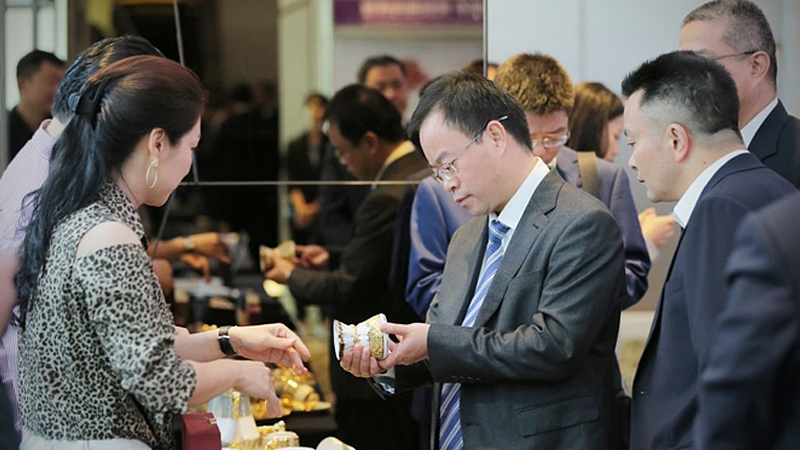
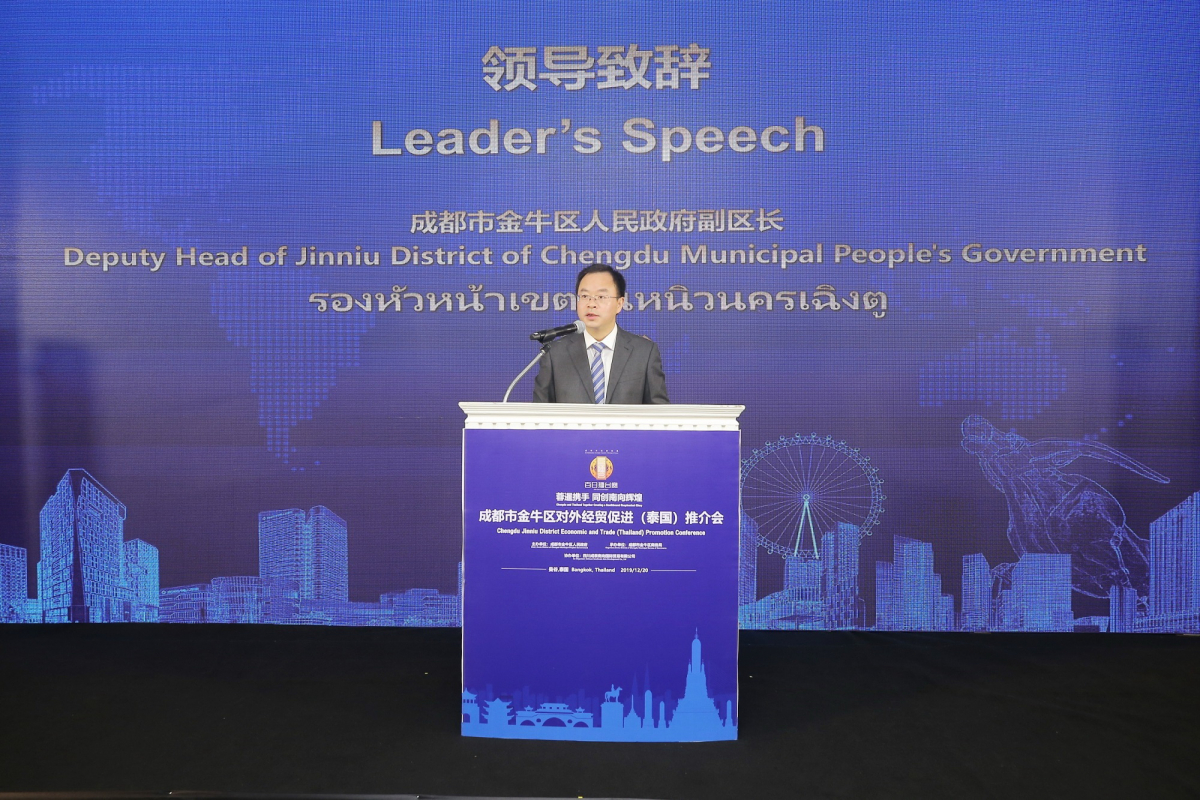
An urban district is Sichuan’s Chengdu Municipality, Jinniu is working hard to firm up trade ties with Thailand, recently organizing a conference on the theme “Creating a Southbound Resplendent Glory” at Windsor Suites Hotel Bangkok that brought together more than 40 leading companies from Jinniu and Thailand.

The conference is the latest in a series of measures aimed at promote Jinniu District and enhancing the economic and trade cooperation between the two countries.

“Jinniu District is among the five central urban areas of Chengdu City and an important commodity manufacturing base. The number of traditional commodity markets accounts for more than half of Chengdu City’s total, making it the No 1 economic area in the west of China,” said Yu Jian, deputy head of Jinniu District.

Jinniu has the potential to support overseas investments as it has a convenient logistics network and good transportation access. Situated around 20 kilometres from Shuangliu International Airport, it is the hub of urban tourism, medicine and health, and cutting-edge technology. Jinniu District’s major projects include Yisha Chengdu International Trade City, Yinxing Plaza, and Group 3, 5, and 6 commercial projects on Wukuaishi street, the electronic and artificial intelligence equipment manufacturing base that is seeking Thai investors to help it expand.

 “Jinniu District has the potential to support overseas investments as it has convenient logistics network and transportation.” – Yu Jian, deputy head of Jinniu District of Chengdu Municipal People’s Government.

The deputy head pointed to Yisha Chengdu International Trade City, the giant trade and exhibition centre showcasing products and services from worldwide manufacturers, luring more than 38,000 investors to invest in China, attracting 80,000-100,000 visitors daily, and with a value of 60 billion yuan (Bt258.5 billion) per year. The international trade city features more than 20 categories of products covering 400,000-plus items. The first phase comprises 7 exhibition zones covering clothes and apparel, fashion, IT, electrical items, and home décor accessories, as well as herbal products and traditional Chinese medicines for which Jinniu District is famed.

“Yisha Chengdu International Trade City also provides trade and exhibition centres for its member countries including Spain, Russia, Sri Lanka, and Japan. Thailand’s trade and exhibition centre is also being constructed to serve Thai businesses seeking a venue to display and market products in China, especially agricultural products which are popular in Chengdu. Investors, who want to invest in Jinniu Commerce Area, will be benefited from the VIP One-Stop Service provided by the government department which includes license and taxes benefits. Plus, there will be assistance on e-commerce knowledge transfer to leverage skills excellency and trade collaboration. Interpreters in different languages will also be provided to facilitate the communication,” said Yu Jian.

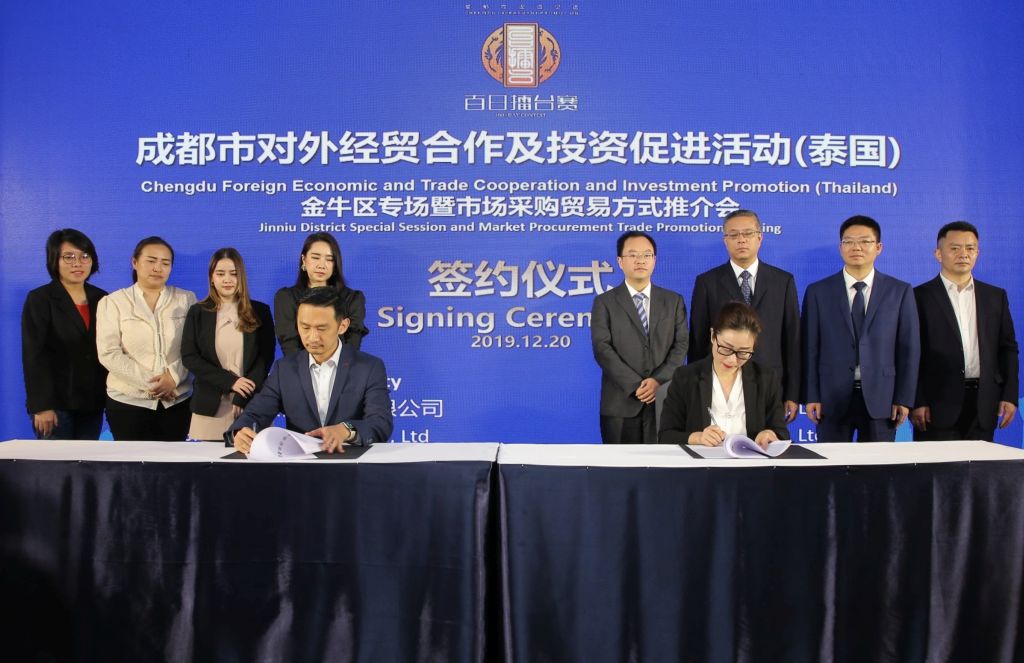
During the conference, Yisha Chengdu International Trade City and Sichuan Huiji Food signed agreements with major Thai companies MR DIY Bangkok and Active Plus Blue. It expects Thai investors to better understand the investment and business environment of Jinniu District and to promote and develop economic collaborations between the two countries further.

 The signing ceremony between Thai and Chinese companies