Fund managers are advising investors to buy tech shares for long-term returns in line with global trends.
Tech shares have generated the highest returns in the previous year even though their prices are likely to move in a narrow range this year.
Thanavut Pornrojnangkool, chief investment officer at Bangkok Capital Asset Management (BCAP), said tech shares have generated significant returns despite volatility from the Covid-19 outbreak.
“We recommend investors to buy small- and medium-tech shares that have gained from disruptive technology, such as Alibaba and Tencent, instead of large US tech shares, like Google and Apple, as their prices have limited growth potential,” he said.
He said the company will focus on investments in line with global trends such as disruptive technology, environment, healthcare, and lifestyle, adding that BCAP will launch new funds in the second quarter of this year.
Isara Pudtalsri, chief executive officer of We Asset Management said tech shares would generate long-term returns as the internet technology still has the potential to grow in line with business and society.
He added that the We Next Generation Internet Fund, which focuses on generating returns from internet technology, will be offered until January 28.
“We recommend investing in Tesla, Roku and Square,” he added.
Jumpon Saimala, chief executive officer of Principal Asset Management, said investing in shares linked to rapid growth in technology will help generate long-term returns.
He recommended investing in the Principal Global Opportunity Fund, which covers shares with growth potential amid disruptive technology, such as Amazon, DSV and Hermes.
“The fund’s return last year was 52.91 per cent, while returns in the past three years were 21.84 per cent annually,” he added.
Thailand’s economy has been severely impacted by Covid-19 and is estimated to have shrunk by 6.5 per cent in 2020, with growth projected to expand by 4.0 per cent in 2021, according to the latest World Bank Thailand Economic Monitor report “Restoring Incomes, Recovering Jobs” released on Wednesday.
The report stresses that sustained employment recovery will be essential to helping the country bounce back in 2021 and 2022.
In 2020, weak global demand, a sharp decline in international tourist arrivals and domestic mobility restrictions depressed goods and services exports and private consumption, it said. Exports and private investment are estimated to have declined by 18.5 per cent and 4.4 per cent, respectively, while household consumption declined by 1.3 per cent.
The resulting declines in income have created economic hardship for many, though the government has made good progress in implementing a substantial package of measures to support households and firms, the report continued. Nevertheless, projections indicate that an additional 1.5 million people may have entered poverty in 2020 due to the economic impact from Covid-19, based on a poverty line of US$5.50 (2011 PPP) per day.
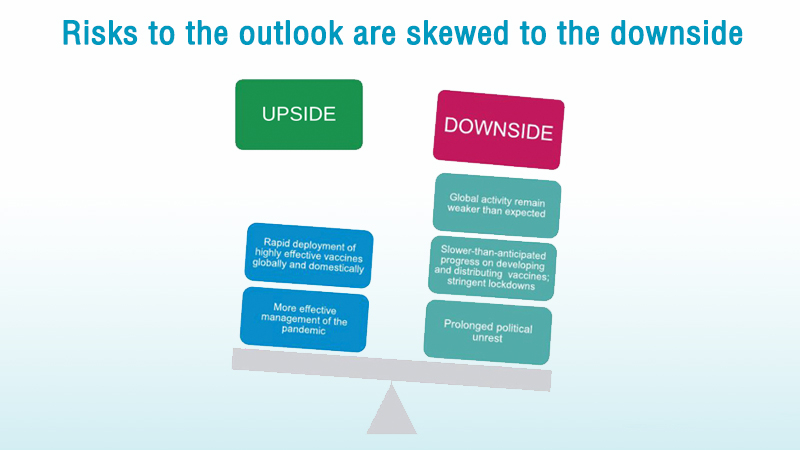
This year, the economy is expected to recover gradually, despite the second Covid-19 wave, and growth is forecast to pick up to 4.7 per cent in 2022. However, recovery remains vulnerable to downside risks, including from an extended resurgence of the pandemic resulting in a prolonged stagnation in tourism and domestic activity, a weaker-than-expected global recovery that could lead to continuing trade and supply chain disruptions, and high household debt levels, the report warned.
The pandemic has had a significant impact on Thailand’s labour market, with unemployment increasing especially among young people. The number of hours worked fell, as did monthly incomes. And while the decrease in the number of hours worked have not been restored to normal levels, employment in several sectors including manufacturing remains smaller than a year ago. This means the labour market is in a vulnerable position to confront any future shocks, including a resurgence of Covid-19, it said.
“The Covid-19 crisis and its economic impact have highlighted a key vulnerability for Thailand: the declining number of working-age people, which compounds the challenge of recovering the economic losses of last year,” said World Bank country manager for Thailand Birgit Hansl.
“Improvements in employment, productivity and labour incomes, especially among the poor, will be necessary for a sustainable recovery,” Hansl added.
The report recommends that in the short term the government put in place training programmes to improve workers’ skills and provide financial support while they get back to work. Ongoing efforts are required to ensure that education and training matches the needs of employers. In the longer term, the government can increase employment in the care sector, make childcare more accessible and decrease its cost to help increase female labour force employment.
The report also recommends increasing the retirement age and putting in place performance-based compensation schemes and flexible working arrangements to extend the working lives of older people.
“The decline in the working age population will reduce labour supply and economic output over the coming decades,” World Bank senior economist for Thailand Kiatipong Ariyapruchya said.
“Good jobs will need to be created in high-productivity sectors associated with Thailand’s emerging knowledge economy. Policies to boost labour productivity and labour market participation of older people and women can help promote a sustainable recovery from Covid-19 while addressing challenges associated with an aging population,” Kiatipong added.
GSB has granted around 110,000 loans in the first four days of its borrowing scheme for grassroots customers.
The scheme is also open to self-employed customers who took GSB emergency loans last year. They can register for a loan via the MyMo app from January 23.
The BTS Group Holdings (BTSG)’s board of directors on Monday decided to approve Bt0.15 per share interim dividend payment based on operating results from April 1 to September 30, 2020 and retained earnings.
The ex-dividend date is set for January 29, with dividends scheduled to be paid on February 16.
BTSG is a privately-owned conglomerate that engages in four business sectors, namely mass transit, media, property and services. Listed on the Stock Exchange of Thailand, BTSG is a constituent member of the SET50 “Bluechip” Index, MSCI Asia Pacific Index, FTSE4Good, Dow Jones Sustainability Indices (DJSI) and one of the largest companies in Thailand.
KBank wins ‘best home loan product’ award from the Asian Banker
Jan 19. 2021Chalarat Phinitbenchaphol (left), Chaiyot Tunpisut (right)
By The Nation
Asia’s leading financial magazine, The Asian Banker, recently held its “Southeast Asia Awards Virtual Ceremony 2020”, in which it recognised Kasikornbank for the “Best Home Loan Product”.
KBank was lauded for its new income verification standards for businessowners, freelancers and refinancing customers. KBank’s new verification system cuts the income appraisal process and document preparation time, making it easier for people affected by the Covid-19 fallout to get access to funds.
The virtual award was accepted by Chalarat Phinitbenchaphol, KBank’s executive vice president, and Chaiyot Tunpisut, first senior vice president.
By Syndication Washington Post, Bloomberg · Akshat Rathi
Breakthrough Energy Ventures, the clean-tech venture capital fund led by Bill Gates, has raised $1 billion for a second round of investments after backing 45 start-ups with its first billion.
Created in 2016, BEV began funding start-ups just as the second wave of clean-tech investments was gaining momentum. Since then, interest in the sector has exploded. VC money flowing into start-ups that can help cut emissions has soared to $16 billion in 2019 from $400 million in 2013, a 40-times increase, according to a PwC report published last year.
The first clean-tech boom was a disappointment. VCs lost more than half the $25 billion invested between 2006 and 2011. The financial crisis compounded the losses, but experts believe there were bigger problems with the underlying investment philosophy. First, VCs were looking to replicate the success they had seen in internet start-ups, expecting returns from clean-tech investments in less than five years. Second, the types of technologies they invested in were mostly limited to renewable electricity, biofuels and electric vehicles-all of which depended heavily on government regulations to grow.
BEV learned from that failure. It launched a “patient” fund that would run for 20 years, instead of expecting returns in just five years. It also pursued a larger set of technologies, including agriculture, buildings, transportation, and manufacturing. Profit remains the ultimate objective, but BEV set another criteria: companies needed to show a path to scaling up that would cut at least 500 million metric tons of annual CO₂ emissions-about 1% of global emissions.
Software start-ups can be nimble, moving from one idea to another when a business plan doesn’t pan out. That kind of pivot is rare for clean-tech companies because of the length of time and amount of money that needs to be spent before failure becomes apparent.
That’s why BEV relies on a team that consists of academics, entrepreneurs, former government officials, and bankers, along with VC investors. Their mission goes beyond judging an idea and the people behind it to rigorously evaluate the feasibility and potential of new technologies.
“We have built a great technical team and our ability to close a second fund is a testament to their good work,” said Eric Toone, BEV’s technical lead. The first round included investments in complex technologies including energy storage, lithium mining, electric aviation, synthetic palm oil, zero-carbon steel, hydropower turbines and even nuclear fusion.
Even though BEV invests in early-stage start-ups and doesn’t expect returns quickly, the proliferation of clean-energy companies going public via SPACs helped it score its first exit. QuantumScape, which makes next-generation lithium-ion batteries, listed on the New York Stock Exchange in September. Its valuation has shot up to $20 billion from $3 billion even though its batteries won’t hit the market before 2025. “We may have some early wins, but the ultimate impact of many of our investments will require a longer time horizon,” said Rodi Guidero, BEV’s executive director.
As its portfolio begins to mature, BEV will also start focusing on how best to bring the innovations to consumers. “Many of our companies are focused on sectors where policy and regulation play an important role in shaping markets,” said Guidero. “We need to fully understand these factors and the challenges and opportunities they bring to our companies.”
Among the principal investors of BEV’s first fund were Jeff Bezos of Amazon Inc., Mukesh Ambani of Reliance Industries Ltd., Richard Branson of Virgin Group, Jack Ma of Alibaba Group, and hedge fund manager Chris Hohn. Mike Bloomberg, founder and majority owner of Bloomberg LP, is also a backer of BEV. Guidero said many of BEV’s original investors are involved in the second round, along with some new ones, but declined to provide names.
The next $1 billion will go to between 40 and 50 start-ups. While BEV is still interested in a broad set of technologies, it’ll place special focus on “tougher climate challenges” in greener steel and cement, long-haul transport, direct air capture and hydrogen.
In some areas where BEV might not find enough investable start-ups, it intends to launch new companies itself relying on its own technical expertise. “This model has already been successfully executed more than once but the companies have yet to be disclosed,” said Toone.
The Finance Ministry will fully exercise its right to buy 153.34 million shares in the PTT Oil and Retail Business (PTTOR) initial public offering, said State Enterprise Policy Office director general Prapas Kong-Ied on Tuesday.
PTTOR will go public late this month to raise up to Bt54 billion in what looks set to be one of Thailand’s largest listings this year.
“We expect good dividend payments as PTTOR businesses are expected to achieve high growth rates,” Prapas said.
To fund its investment in PTTOR, the ministry will sell about 5 per cent of its Bangchak Corp shares to the Vayupak Fund, he said. The Finance Ministry is the Vayupak Fund’s largest shareholder.
Meanwhile, BBL Asset Management CEO Peerapong Jiraservijinda said his mutual fund will buy 143.15 million PTTOR shares. A cornerstone investor, BBL Asset is making the second largest investment after the Finance Ministry.
PTTOR shares are good long-term investments despite risks including technology disruption, as PTT’s management have shown their capability in managing the group’s businesses, Peerapong said.
PTT is Thailand’s largest filling station operator, while its retail arm PTTOR is best known for its Amazon chain of coffee shops. The company has potential to expand both its filing-station and coffee businesses abroad, he added.
PTT boast a 39 per cent share of the filling station market, operating 1,900 stations in Thailand and 318 in other Asean countries. PTT’s dealer-owned model reduces its risks, said Peerapong, adding the company is in a strong position to make merger and acquisition deals.
The target price of PTTOR shares is estimated at Bt25-Bt27 in the next three years, with projected earnings per share of Bt1.25-Bt1.35, he said. With an IPO price of Bt18 per share, its price-to-earnings (P/E) ratio is 20 times.
PTT’s non-oil business is a world leader due to high growth rate, added Peerapong.
Chavinda Hanratanakool, CEO and managing director at Krung Thai Asset Management, was also confident that PTTOR’s business would continue to grow. Changing consumer behaviour has seen filling stations become rest stops for travellers, so their convenience and coffee shops are benefiting from travel spending, she said. As such, PTTOR’s share price is expected to rise, said Chavinda.
UOB Kay Hian Securities strategist Kitpon Pripisankit reckoned the IPO price of Bt16-Bt18 is quite high given PTTOR’S past performance of P/E at 23.9-26.9 times. But taking into account its profit forecast this year, its projected P/E is just 16-18 times – making the Bt16-Bt18 IPO price attractive to investors due to potential growth of its retail oil and non-oil businesses, he said. A fair price would be Bt22 per share, he added.
Investors expect PTT will set the IPO price at Bt18, which has upside potential of 20 per cent, said Kitpon.
The Government Savings Bank (GSB) has approved around 110,000 loans in the first four days of its borrowing scheme for low-income customers, said president Vitai Ratanakorn.
The bank has set aside Bt10 billion for the scheme, which has received an enthusiastic response from grassroots customers since launching on January 15. Borrowers can apply for loans of up to Bt50,000 via GSB’s MyMo application.
The scheme is also open to self-employed customers who took GSB’s emergency Covid-19 loans last year. They can apply for loans of up to Bt20,000 via the MyMo app from January 23.
Ratch pays Bt2.7bn for 15.53% stake in Bangkok Aviation Fuel Service
CorporateJan 19. 2021Ratch CEO Kijja Sripatthangkura
By The Nation
Ratch Group today said it had completed the purchase of a 15.53 per cent stake (98,983,125 shares) in Bangkok Aviation Fuel Service (BAFS) from Thai Airways International in a deal worth Bt2.7 billion.
The announcement comes exactly a month after Ratch joined an e-auction of BAFS shares on December 19. The BAFS share-purchase agreement with Thai Airways International (THAI) was made later on December 29, 2020.
THAI transferred the BAFS shares today (January 19).
Ratch CEO Kijja Sripatthangkura said the company is committed to long-term investment in BAFS and will support collaboration to accomplish future growth targets of both parties.
Ratch Group, Thailand’s largest private power producer by capacity, plans to expand investment in infrastructure and energy-related businesses as well as seek strong alliances.
While the investment in BAFS corresponds with the company’s strategic plan, the deal will also strengthen its business via stable revenues from dividend income gained on its investment.
“The transaction was funded by internal company capital. The bidding offer was fair for the growth potential of BAFS. [Ratch], working closely with a financial adviser, cautiously studied prospects of the aviation business, aviation fuel service, and BAFS’s operating performance and business plan and goals,” Kijja said.
Ratch sees good prospects from a synergy between both companies on renewable-energy power plants, digital technology, and businesses related to fuels and energy.
Two of Thailand’s financial giants – LH Financial Group (LHFG) and Tisco Financial Group (Tisco) – saw their net profits fall sharply last year amid the Covid-19 crisis.
LHFG’s net profit in 2020 fell to Bt2.05 billion, down Bt1.15 billion or 36 per cent from Bt3.21 billion in 2019.
Tisco’s net profit in 2020 dropped to Bt6.06 billion, down Bt1.20 billion or 16.6 per cent from Bt7.27 billion in 2019.
LHFG’s net profit in the fourth quarter of 2020 alone was Bt205 million, down Bt674 million or 76.6 per cent compared to Bt879 million in the previous year. Its fourth-quarter net profit also dropped by Bt318 million quarter on quarter.
LHFG said the decline came after it used Bt1.09 billion in reserves to support debtors against the risk of non-performing loans (NPLs), resulting in an NPL ratio at the bank of 119.8 per cent.
LHFG’s net interest income last year rose by 4.4 per cent after the net interest margin (NIM) increased to 2.17 per cent from 2.11 per cent in the previous year. Meanwhile, LHFG’s net non-interest income rose by 17.2 per cent year on year from an increase in gains on investment.
Tisco’s fourth-quarter net profit last year was Bt1.63 billion, down Bt229 million or 12.27 per cent from Bt1.86 billion in the previous year. However the bank’s Q4 net profit rose by Bt25 million or 1.55 per cent quarter on quarter.
Tisco said the decline in net profit was due to the economic slowdown amid the Covid-19 outbreak, causing a drop in revenue from the bank’s core businesses, as well as an increase in reserve funds to deal with credit loss.
Tisco’s net interest income in 2020 rose by 2.4 per cent year on year from effective cost management amid a low-interest rate, while its net non-interest income fell by 12.6 per cent year on year due to a decline in fee income.

.jpg)


 Chalarat Phinitbenchaphol (left), Chaiyot Tunpisut (right)
 Bill Gates

 Ratch CEO Kijja Sripatthangkura