France keen on more investment from Thailand #ศาสตร์เกษตรดินปุ๋ย

#ศาสตร์เกษตรดินปุ๋ย : ขอบคุณแหล่งข้อมูล : หนังสือพิมพ์ The Nation

https://www.nationthailand.com/business/30380726?utm_source=category&utm_medium=internal_referral

France keen on more investment from Thailand
Jan 18. 2020
By Wichit Chaitrong
The Nation

France is looking forward to more Thai investment in the country, says its ambassador to Thailand Jacques Lapouge in an exclusive interview with The Nation.

With its excellent research and development facilities, a deep talent pool and a skilled work force, France is an ideal destination for foreign direct investment, he said.

People may see Yellow Vest protesters marching on the streets, but the reality is not a country in chaos,   Lapouge assured.

France has an advantage in location, sitting at the centre of one of the world’s biggest markets, with an outstanding infrastructure: the biggest airport in Europe, advanced rail system, modern power and internet networks, he said.

It also boasts a deep talent pool and a skilled workforce with 44 per cent of those between 25 to 34 years old possessing tertiary education certification. It produces about 38,000 graduates in engineering very year.

“Our workforce is great in quality with one million engineers, which is probably the first motivation for foreign investors,” Lapouge said, adding that it is now the first destination for industrial  and R&D investment in Europe.

France has been touted as the most favorable tax incentive for R& D among OECD members. The country offer 30 per cent reduction of R & D expense for startups.

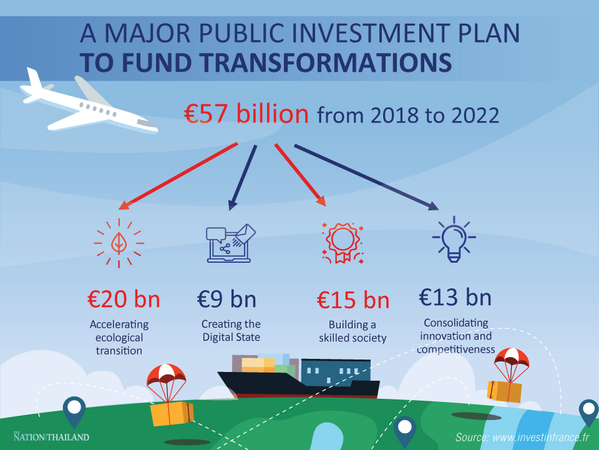
President Emmanuel Macron has initiated many reforms to boost the economy, reduce inequality and facilitate ecological transition. The corporate tax rate will be cut to 25 per cent by 2022 from 33.3 per cent in 2017, 31 per cent in 2019 for companies having revenue less than Euro 250 million, 28 per cent this year and 26.5 per cent next year, according to www.investinfrance.fr.

According to the CBRE’s quarterly study published in November 2019, Paris has knocked London off the top spot in the ranking of the world’s most attractive cities for foreign investment in real estate.

The British capital was downgraded to second place due to uncertainty surrounding Brexit.

Some large Thai corporates have already invested in France, for instances, Thai Union has modernised its existing canned seafood plant in Quimper and has established a European R&D Centre in French Brittany for its European subsidiaries while Indorama Venture has acquired companies in technical fibre and recycling business in Grand Est Region.

Double A, having invested in a paper plant in Normandy, has re-injected about Euro 40 million into a biomass power generation plant last year. SEA Value has announced expansion of its existing interest and new investment for 2020, according to the French Embassy in Bangkok.

Meanwhile, two Thai business executives have been invited to a business summit at the Palace of Versailles in Paris on January 20.

Regarding two-way trade, Thailand’s exports to France amounted to Euro 2.81 billion in 2018 while imports from France stood at Euro 1.87 billion, resulting in Euro 941 million of trade surplus for Thailand.


Recent news report suggested that the French government had made a concession on pension fund reform after unions’ protests nationwide.

Headwinds unabated, SCB analysts foresee 2.7% rise for Thai economy #ศาสตร์เกษตรดินปุ๋ย

#ศาสตร์เกษตรดินปุ๋ย : ขอบคุณแหล่งข้อมูล : หนังสือพิมพ์ The Nation

https://www.nationthailand.com/business/30380712?utm_source=category&utm_medium=internal_referral

Headwinds unabated, SCB analysts foresee 2.7% rise for Thai economy

Jan 17. 2020
Yunyong Thaicharoen

Yunyong Thaicharoen
By THE NATION

Siam Commercial Bank’s Economic Intelligence Centre expects the Thai economy to grow 2.7 per cent in 2020, representing a modest improvement from the 2.5 per cent projected for 2019.

Yunyong Thaicharoen, the centre’s chief economist, said on Friday (January 17) the expansion would be driven by an anticipated gradual recovery of merchandise exports following signs of restored health in global trade, which is due in part to the Phase 1 trade agreement between the United States and China.

Also supporting growth are more accommodative monetary and fiscal stimulus measures being enacted by many countries.

Nevertheless, the baht, which has appreciated by more than 24 per cent against other currencies in the past six years and is expected to maintain its strength, will continue to cut into exporter earnings and render Thai exports less competitive.

Tourism income is due for a decline with foreigners tending to spend less individually. The number of visitors is expected to rise, but Yunyong sees the rate of growth likely moderating.

Private domestic demand is projected to expand more slowly than last year. Even with exports expected to recover, private consumption and investment are forecast to cool further due to several adverse factors.

A decline in employment especially in manufacturing, deterioration of consumer confidence, a contraction in non-farm income, a reduction in farm income due to drought, and the high level of household debt will together choke household spending, particularly on durable goods, he said.

Private investment is expected to slow, in line with subdued domestic purchasing power.

Low capital utilisation and high inventory in the manufacturing sector will contribute to a deceleration in private investment in coming quarters.

In addition, the persistent contraction in consumer and commercial vehicle sales, as well as a decline in real estate construction due to LTV (loan-to-value) requirements from the previous period, will likely further weigh on domestic demand.

However, the government is expected to play a larger role in supporting growth in 2020 through the use of stimulus packages, short-term support for vulnerable groups and infrastructure investments.

It will also enable the private sector to take part in supporting growth, such as auctioning off 5G-spectrum licences, which should set in motion additional investments in telecommunications and related sectors.

With regard to domestic financial conditions, interest rates are expected to remain low throughout the year, while the baht should continue to face appreciation pressures.

Yunyong expects the Monetary Policy Committee to maintain an accommodative stance to lend support to economic recovery.

It will likely keep the policy rate unchanged at 1.25 per cent throughout 2020. The centre still sees the probability of a rate cut in the first half of 30 per cent on three possible conditions – weaker-than-expected growth, much higher non-performing loans and the baht’s continued appreciation.

Supported by a massive current-account surplus, the baht is expected to remain persistently strong, closing 2020 at 29.5-30.5 per US dollar.

Additional relaxation in capital outflows, both for overseas business operations and investment in foreign assets, will only marginally help ease pressure on the baht in the short run. More time is needed to tackle structural limitations such as financial literacy, foreign investment capabilities and impeding rules and regulations.

Only after that would capital outflow be sizeable enough to significantly mitigate appreciation pressures on the baht.

There are three key risk factors for the Thai economy in 2020 – trade war uncertainties, geopolitical risks and household and business financial vulnerabilities.

Despite completion of the Phase 1 trade deal between the US and China, many uncertainties remain around America’s protectionist policies that can impact global trade, such as the next phase of the negotiation, potential trade retaliations with Europe, and the decision to cut GSP privileges for many trading partners.

At the same time, geopolitical risks, especially from the conflict between the US and Iran, the prolonged protests in Hong Kong, and Brexit, will continue to pose challenges for global growth recovery.

Domestically, key risks to growth include financial vulnerabilities among households and businesses, particularly those with high debt and whose income suffers from the economic slowdown, technological disruptions and increasing competition.

World Bank lists steps for stalled Thailand to become high-income nation #ศาสตร์เกษตรดินปุ๋ย

#ศาสตร์เกษตรดินปุ๋ย : ขอบคุณแหล่งข้อมูล : หนังสือพิมพ์ The Nation

https://www.nationthailand.com/business/30380708?utm_source=category&utm_medium=internal_referral

World Bank lists steps for stalled Thailand to become high-income nation

Jan 17. 2020
By THE NATION

The Thai economy is projected to grow a modest 2.7 per cent this year thanks to recovering private consumption recovers and investment in large public infrastructure projects, the World Bank said in its “Thailand Economic Monitor” report released on Friday (January 17).

It said Thai growth slowed to about 2.5 per cent in 2019 from 4.1 per cent in 2018 due to both external and domestic factors.

Boosting productivity and reviving private investment will be essential if Thailand is to meet its goal of being a “high-income status” country by 2037, the report said.

Global economic growth is forecast to edge up to 2.5 per cent this year as investment and trade gradually regain strength, but risks persist.

These include a re-escalation of trade tensions and trade policy uncertainty, a sharper-than-expected downturn in major economies, and financial turmoil in emerging markets and developing economies.

“A continued deceleration of economic activity in China, the euro area and the United States could have adverse repercussions across East Asia through weaker demand for exports and the disruptions of global value chains,” said Birgit Hansl, World Bank country manager for Thailand.

“Financial investment, commodity and confidence channels could further weaken the global economy and adversely impact Thailand’s exports.”

In 2019, declining exports and weakening domestic demand were the main factors slowing Thailand’s growth.

Agricultural exports declined by 7 per cent in the first three quarters of 2019, led by sharp decreases in export volumes for major products such as rice and rubber.

Manufacturing exports declined by 6 per cent in the same period, with electronics exports hardest hit. Thailand’s strong currency, which has appreciated by 8.9 per cent since last year – making the baht the strongest it has been in six years – has also impacted foreign tourism and merchandise exports.

The government responded swiftly through accommodative monetary policies and a fiscal stimulus package to boost economic growth, the World Bank said.

The report recommends that it next consider policies to enhance the effectiveness of the stimuli by focusing on major public investment projects, improving efficiency in public-investment management and providing social protection coverage for vulnerable families.

The slowdown highlighted Thailand’s long-standing structural constraints with sluggish investment and low productivity growth.

Thai productivity growth has fallen to 1.3 per cent over 2010-2016 from 3.6 per cent over 1999-2007.

Private investment has halved, from 30 per cent of GDP in 1997 to 15 per cent in 2018, as foreign direct investments shrank and progress stalled on the Eastern Economic Corridor.

The report projects that, if current trends continue, with no significant pickup in investment and productivity growth, Thailand’s average annual growth rate will remain below 3 per cent.

To become a high-income country by 2037, it said, Thailand must sustain long-run growth rates above 5 per cent, which would require a productivity growth rate of 3 per cent and an increase in investment of to 40 per cent of GDP.

“Boosting productivity will be a critical part of Thailand’s long-term structural reform,” said Kiatipong Ariyapruchya, World Bank senior economist for Thailand. “Increasing productivity, particularly of manufacturing firms, will depend on increasing competition and openness to foreign direct investments, and improving skills.”

Sustaining higher productivity growth will require removing constraints that prevent new firms, especially foreign ones, and skilled professionals, from entering the domestic market.

These constraints include restrictive laws, particularly in the services sector, implementing the new Competition Act with clear guidelines related to state-owned enterprises and price controls, and developing policies to build the skills and human capital needed for an innovative knowledge-based economy.

Dissolution of Future Forward ‘will bring clash of generations’ #ศาสตร์เกษตรดินปุ๋ย

#ศาสตร์เกษตรดินปุ๋ย : ขอบคุณแหล่งข้อมูล : หนังสือพิมพ์ The Nation

https://www.nationthailand.com/news/30380705?utm_source=category&utm_medium=internal_referral

Dissolution of Future Forward ‘will bring clash of generations’

Jan 17. 2020
By THE NATION

Future Forward Party (FWP) secretary-general Piyabutr Saengkanokkul has warned of a clash of generations if the party were to be dissolved.

In a message and a video clip on his Facebook page on Friday (January 17), he highlighted the party’s strategy with the Constitutional Court set to pronounce its verdict on January 21 in a case filed by a lawyer, Nuttaporn Toprayoon.

Nuttaporn on June 18, 2019 accused FWP leader Thanathorn Juangroongruangkit, party secretary-general Piyabutr Saengkanokkul and four FWP board members of attempting to overthrow the democratic regime with the King as the head of state.

Piyabutr said that if his party were to be dissolved, he and Thanathorn would continue working in the political field but he warned of three harmful after-effects:

1 Dissolving Future Forward would destroy Thai people’s hopes of seeing a better political system.

2 A clash of generations in Thai society will be heightened.

3 Most importantly, this will be another example of the royal institution being used to eliminate political opponents, which could drive more people to be on the opposite side of royal supporters.

Piyabutr invited his supporters to a seminar named “Future is Now” on Saturday (January 18) at SC3 Building, Thammasat University (Rangsit Campus).

Mexico hopes new trade treaty will shield it from Trump threats #ศาสตร์เกษตรดินปุ๋ย

#ศาสตร์เกษตรดินปุ๋ย : ขอบคุณแหล่งข้อมูล : หนังสือพิมพ์ The Nation

https://www.nationthailand.com/news/30380745?utm_source=category&utm_medium=internal_referral

Mexico hopes new trade treaty will shield it from Trump threats

Jan 18. 2020
President Trump

President Trump
By The Washington Post · Mary Beth Sheridan

MEXICO CITY — Mexico expressed optimism on Friday that the new North American trade treaty would result in improved relations with the Trump administration and shield this country from the kind of economic threats that brought it to the brink of crisis last year.

President Donald Trump warned in June that he would impose crushing tariffs unless Mexico cracked down on the thousands of Central Americans transiting the country.

Jesús Seade, a senior Foreign Ministry official, said the new U.S.-Mexico-Canada treaty could alter Trump’s political calculus.

Last year’s threats “occurred under NAFTA, which is the worst treaty in the history of the planet, according to him [Trump],” Seade said in an interview. “So now we’re going to have the best treaty in the world, according to him.”

Not only is Trump more invested in the new pact, which was negotiated by his government, but many Democrats in Congress signed on after extracting commitments for tighter enforcement of labor regulations in Mexico, Seade noted.

And the treaty, known as USMCA, creates an elaborate mechanism to resolve disputes, with three-member panels of independent experts. While the system was designed to resolve labor disagreements, it could be used for other issues, said Seade.

“NAFTA never gave us effective defenses for disputes of this kind,” said Seade, who is the Foreign Ministry’s undersecretary for North America and also served as Mexico’s top negotiator on the treaty. The U.S.-Mexico-Canada pact provides “better defenses. We have a binational system, based in law, which is fair,” he said.

The new treaty was overwhelmingly ratified by the U.S. Senate on Thursday, after passing the House. Mexico has already endorsed it, and Canada’s Parliament is expected to follow suit.

Its completion comes as Mexico’s often rocky relations with Washington appear to have stabilized – for now.

Faced with the tariff threat, the leftist government of Andres Manuel Lopez Obrador drastically increased its detention of Central American migrants and asylum-seekers, contributing to a steep drop in apprehensions at the U.S. border.

But the Trump administration appears increasingly concerned about escalating violence in Mexico. The U.S. president recently warned he would label Mexican drug cartels as terrorist groups – a move that raised concerns of fallout for this country’s economy. Trump later backed off the decision.

Trump harshly attacked Mexico during the 2016 presidential campaign, saying it sent criminals and rapists across the border and is “not our friend.” Mexicans fear they could come under attack again in this year’s U.S. presidential race.

“From here to the elections, no one knows what will happen,” Seade said, noting that the U.S. government “has a very long track record of seeking unilateral measures, stemming from political needs.”

“Nobody is dreaming this will end,” he said, but added that he was optimistic about a “greater spirit of honoring” the treaty.

USMCA will replace the North American Free Trade Agreement, which took effect in 1994.

Mexico became the No. 1 American trade partner in 2019, amid Trump’s trade war with China.

Happiness gap between whites and nonwhites surged during Trump era, Gallup finds #ศาสตร์เกษตรดินปุ๋ย

#ศาสตร์เกษตรดินปุ๋ย : ขอบคุณแหล่งข้อมูล : หนังสือพิมพ์ The Nation

https://www.nationthailand.com/news/30380731?utm_source=category&utm_medium=internal_referral

Happiness gap between whites and nonwhites surged during Trump era, Gallup finds

Jan 18. 2020
President Donald Trump at the White House on Jan. 15, 2020. MUST CREDIT: Washington Post photo by Jabin Botsford

President Donald Trump at the White House on Jan. 15, 2020. MUST CREDIT: Washington Post photo by Jabin Botsford
By The Washington Post · Christopher Ingraham

The Trump era has ushered in the largest happiness gap between white and nonwhite Americans in nearly two decades, new Gallup polling shows.

More than 90% of white Americans say they are “very” or “fairly” happy these days, a number that has held steady since early 2000s. But only 77% of nonwhites can say the same, which is 11 percentage points lower than the last time Gallup posed the question early in the Obama years.

For most of the past two decades, whites and nonwhites were generally a few points apart on happiness. That briefly changed in 2005, when the federal government’s botched response to Hurricane Katrina in New Orleans was interpreted by many black Americans as a sign of institutional racism. That year, nonwhites were 10 percentage points less likely to report being happy than whites. But today 14-point gap is even larger.

Record nonwhite discontent in the era of a president who weaponizes racial resentment may not come as a particular surprise. In 2018, nearly half of American Latinos said their circumstances had worsened in the first year of the Trump administration. Last summer, 80% of black Americans and 55% of Hispanics told Quinnipiac they consider Trump a racist. The Trump era also has coincided with an upsurge in hate crimes, particularly against Hispanics.

The relative unhappiness of nonwhites has driven the overall level of American happiness to its lowest level in more than a half-century of polling. Overall, Gallup reports, 86% of Americans report being “somewhat” or “fairly” happy, marking the fifth time happiness has fallen below 90% in 23 readings since 1948. The share who say they’re “not too happy” has more than doubled since 2007.

Previous Gallup research has found that Americans have grown more stressed, worried and angry during the Trump era. Last year. the United Nations’ seventh World Happiness Report found the United States ranked 19th in the world for happiness, a slide of five places relative to 2017.

The growing gloominess is at odds with the many of the most closely watched economic indicators: U.S. stocks continue to break their own record highs; unemployment hovers near 50-year lows; and the United States is in the midst of its longest economic expansion in history.

For a time, many economists and policymakers assumed the top-line numbers could serve as a rough proxy for quality of life in America. This assumption made a fair amount of sense in the era of shared prosperity in the middle of the last century. Employee wages kept pace with shareholder profits. The necessities of life – a decent home, a quality education, good medical care – were more or less affordable for workers in the middle of the income distribution.

But in the past few decades, more and more of the economy’s spoils have flowed to the already wealthy, leaving less for everyone else. A surging stock market doesn’t mean much to the more than 50% of Americans who own no stocks. Unemployment may be low, but many workers find themselves stuck in low-paying jobs that don’t cover basic necessities.

Wuhan in all-out effort to curb outbreak of virus #ศาสตร์เกษตรดินปุ๋ย

#ศาสตร์เกษตรดินปุ๋ย : ขอบคุณแหล่งข้อมูล : หนังสือพิมพ์ The Nation

https://www.nationthailand.com/news/30380715?utm_source=category&utm_medium=internal_referral

Wuhan in all-out effort to curb outbreak of virus

Jan 17. 2020
By By ZHOU LIHUA in Wuhan and WANG XIAODONG in Beijing | China Daily |

Authorities in Wuhan, Hubei province, have intensified efforts to prevent the spread of a virus that has caused a pneumonia outbreak in the city, resulting in one death so far.

Outside China, a second case linked to the virus has been reported in Japan, following a case in Thailand.

All outbound travelers from Terminal 3 of Wuhan Tianhe International Airport, a major airport in Central China, have had to receive temperature tests before boarding flights since Wednesday, and those displaying fever symptoms are quarantined, the airport authority said on Thursday.

The airport authority said it had requested airlines to cooperate with affected travelers in refunding or changing tickets for free.

At Wuhan Railway Station, employees told China Daily on Thursday that they had received notification from the authorities to start checking travelers’ temperatures.

In the waiting room of Wuchang Railway Station, another major railway station in the city, medical services were provided to passengers in need on Thursday.

Forty-one confirmed cases of pneumonia caused by a new coronavirus had been reported in the city as of Wednesday night, including seven people who were cured and discharged from the hospital, six still in critical condition and one death, according to the Wuhan Health Commission.

The city authorities had traced 763 people who had close contact with the patients as of Wednesday night, and 313 of them were still under medical observation. Observation of the others had been discontinued, the commission said, adding that it has intensified monitoring and search efforts in hospitals and clinics across the city to identify suspected cases.

People confirmed to have the illness mostly displayed symptoms of fever and coughing at the early stage of the disease, it said.

Although investigations have shown no clear evidence that the new coronavirus can be transmitted between human beings, the possibility of human-to-human transmission cannot be ruled out, it said earlier.

Japan confirmed its first case of the virus, public broadcaster NHK reported on Thursday, quoting officials from Japan’s Ministry of Health, Labor and Welfare. The man was released from a hospital after his condition improved, and no related sickness has been found in his family or among the medical staff who treated him, the report said.

Earlier this week, the World Health Organization urged all countries to intensify monitoring and preparedness following the confirmation of the first case of the virus outside China.

“The possibility of cases being identified in other countries was not unexpected,” it said in a statement following the case in Thailand.

The US State Department issued a health alert update on Wednesday about travel to the Wuhan area. It referenced a Watch Level 1 Alert by the US Centers for Disease Control and Prevention, which urged people traveling in the region to avoid contact with animals, animal markets and animal products, among other precautions, Reuters reported.

Thai health authorities said on Wednesday they were stepping up monitoring of passengers arriving at airports ahead of the Lunar New Year holiday, when 800,000 Chinese tourists are expected to visit the country, the report said.

China’s National Health Commission and the WHO did not respond to questions from China Daily on Thursday.

Wang Yuedan, an immunology professor at Peking University’s Health Science Center, said he thought the virus would not spread globally to any great extent, due to the limited capacity of its human-to-human transmission.

In addition, the disease control and prevention measures taken by the authorities in Wuhan, such as temporary quarantines of people who have had close contact with patients, are very strict, and a pandemic similar to the SARS (severe acute respiratory syndrome) outbreak in 2003 is unlikely, he said.

Senate approves new USMCA trade deal with Canada and Mexico #ศาสตร์เกษตรดินปุ๋ย

#ศาสตร์เกษตรดินปุ๋ย : ขอบคุณแหล่งข้อมูล : หนังสือพิมพ์ The Nation

https://www.nationthailand.com/news/30380700?utm_source=category&utm_medium=internal_referral

Senate approves new USMCA trade deal with Canada and Mexico

Jan 17. 2020
By The Washington Post · Erica Werner, Rachel Siegel 

WASHINGTON – The Senate approved a sweeping economic pact between the United States, Canada and Mexico on Thursday, delivering on President Donald Trump’s promise of a new and better North American trade deal just ahead of his impeachment trial.

The vote was 89-10 as an overwhelming majority of senators of both parties supported the agreement, as expected. Last month, the House of Representatives approved the revised agreement by a similarly wide margin, after months of negotiations between Democrats and the White House produced pro-labor revisions and jettisoned drug exclusivity language sought by the pharmaceutical industry. The 12-million-strong AFL-CIO was closely involved in negotiating the changes and backed the agreement, along with some other major unions.

Speaking on the Senate floor Wednesday, Majority Leader Mitch McConnell, R-Ky., called passage of the deal “A major win for Kentucky and all 50 states. A major win for our country. A major win for the Trump administration.”

Indeed passage of the U.S.-Mexico-Canada Agreement hands Trump a key victory at a moment of political peril, with the Senate poised to begin his impeachment trial after the House delivered its articles of impeachment Wednesday evening. Trump made his opposition to the 25-year-old North American Free Trade Agreement a centerpiece of his campaign for president in 2016. He can now boast of delivering a new trade deal that includes major new protections for American workers, even though many of those were negotiated by House Democrats over the objection of Senate Republicans.

Trump must still sign the revised North American Free Trade Agreement, something he suggested he would likely do next week.

Senate Republicans had little influence in the process because Speaker Nancy Pelosi, D-Calif., held a make-or-break role in deciding whether to bring the deal up on the floor of the House, which by law had to act first on the agreement. The outsized role played by House Democrats and their allies in labor angered some Republicans, including Sen. Pat Toomey, R-Pa., the deal’s most outspoken opponent, who complained that the Senate got “rolled” in the process.

But supporters including Finance Chairman Charles Grassley, R-Iowa, said they had no choice but to support the deal that was before them. They called it good news for the U.S. economy and workers, pointing to initial projections from the International Trade Commission that it will add 176,000 U.S. jobs – although that amounts to an increase of just 0.12, a modest impact on the nearly $21 trillion U.S. economy.

One provision, allowing Mexican workers to lodge complaints about working conditions that could result in punitive action by the U.S., was included at the insistence of Sen. Sherrod Brown, D-Ohio, a leading trade protectionist who announced his support for USMCA after opposing all previous free trade agreements.

The deal created divisions in the Democratic presidential primary field. In a debate Tuesday night, Sen. Bernie Sanders, I-Vt., predicted that the agreement would lead to the continued outsourcing of U.S. jobs and said, “We could do much better than a Trump-led trade deal.” But other leading candidates, including former Vice President Joe Biden and Sen. Elizabeth Warren, D-Mass., support the deal. Warren called it a “modest improvement” that will deliver needed relief to farmers and workers hurt by Trump’s trade policies.

Senate Majority Leader Chuck Schumer, D-N.Y., voted against USMCA, saying that while the deal does include labor provisions, “it does not address climate change, the greatest threat facing the planet.” In a statement, Schumer said that the Trump administration is giving incentives for manufacturers to move businesses and jobs from the U.S. to Mexico, which has weaker clean air and water regulations.

“The Trump administration also included handouts for the oil and gas industry, such as lifting tariffs on tar sands, and refused to include any mention of the climate crisis in the agreement,” Schumer said.

Thursday’s vote came a day after Trump signed a partial economic deal with China, nearly two years into a protracted trade war with Beijing. As part of the deal, China committed to purchasing an additional $200 billion in American exports above previous levels. With the USMCA vote, Trump has back-to-back victories on trade that may calm the waters after the president has provoked trade wars around the global and leveled tariffs on friends and foes.

The USMCA was signed more than a year ago by Trump and the leaders of Mexico and Canada, but still had to be approved by the legislatures in all three nations. Mexico has already acted, and Canada’s parliament is expected to follow the U.S. and approve the deal in the next several months. After some additional procedural steps the deal is expected to enter into effect later this year.

House Democrats called for substantial changes to the initial draft of USMCA, and worked directly with U.S. Trade Representative Robert Lighthizer in months of secretive talks that stayed largely on track even as the House moved forward to impeach the president.

House Democrats pointed to wins on stronger environmental and enforcement language, protections for workers in Mexico, and killing a provision sought by pharmaceutical companies that would have guaranteed 10 years of market exclusivity for a costly class of drugs called biologics. Many labor unions were also encouraged by the deal, which could help keep American and Canadian jobs from going to lower-paying markets in Mexico or Asia. Under the deal, at least 30% of cars (and 40% by 2023) must be made by workers earning $16 an hour, which is about three times the manufacturing wage in Mexico today.

USMCA also gives American dairy farmers more access to the Canadian market, especially for “Class 7” milk products like milk powder and milk proteins. The deal puts some restrictions on how much dairy Canada can export, which could help American dairy farmers edge into foreign markets.

USMCA also includes new rules for digital trade, something that barely existed when the original NAFTA was written. Among these, however, is a provision that provides protections to big tech companies by giving legal immunity to internet platforms over content posted by users. Pelosi opposed the provision but was unsuccessful in keeping it out of the deal in the final throes of talks last month. She cited it as her one disappointment in how the deal turned out.

Economists also worry that USMCA will spur a spike in car prices, especially on smaller cars that used to be produced in Mexico but may be subject to duties at the border. U.S. tariffs on Canadian steel are also still in place.

And while tensions have now cooled between Washington and Beijing after nearly two years of trade escalation, there are few details about what phase II of a trade agreement will look like – even as many American sectors and businesses say they are still pinned under tariffs that remain in place.

Judge upholds Gov. Northam’s ban on guns outside state Capitol #ศาสตร์เกษตรดินปุ๋ย

#ศาสตร์เกษตรดินปุ๋ย : ขอบคุณแหล่งข้อมูล : หนังสือพิมพ์ The Nation

https://www.nationthailand.com/news/30380698?utm_source=category&utm_medium=internal_referral

Judge upholds Gov. Northam’s ban on guns outside state Capitol

Jan 17. 2020
Governor Ralph Northam talks about gun safety in Richmond, Virginia, in early 2020. MUST CREDIT: Washington Post photo by Bill O'Leary

Governor Ralph Northam talks about gun safety in Richmond, Virginia, in early 2020. MUST CREDIT: Washington Post photo by Bill O’Leary
By The Washington Post · Gregory S. Schneider

RICHMOND, Va. – A Circuit Court judge upheld Gov. Ralph Northam’s temporary ban on firearms in Capitol Square ahead of Monday’s gun rights rally, which is expected to draw thousands of armed activists from around the country.

From Friday night until Tuesday, weapons of any kind will be prohibited on the grounds of the Capitol under a state of emergency. Northam, a Democrat, said the precaution was necessary because of “credible intelligence” that militias and gun rights advocates are threatening violence at the rally.

“This is the right decision,” Northam said in a statement about Richmond Chief Judge Joi Jeter Taylor’s ruling on Thursday afternoon. “These threats are real – as evidenced by reports of neo-Nazis arrested this morning after discussing plans to head to Richmond with firearms.”

Earlier Thursday, the FBI arrested three alleged members of a white supremacist group on gun charges, in part out of concern over the potential for violence at the planned rally in Richmond. The three were to appear in court in Maryland.

Northam announced the gun ban Wednesday and it was quickly challengedin court by the Virginia Citizens Defense League (VCDL), the rally’s primary organizer, as well as Gun Owners of America.

Taylor held a whirlwind hearing Thursday afternoon and promised to rule quickly, to allow time for appeals.

Arguing for the pro-gun groups, lawyer David Browne told the judge that Northam’s order was “an unconstitutional restraint on rallygoers” that violated state law and infringed on protesters’ rights to arms, assembly and speech.

Taylor rejected that argument. “The Second Amendment right to bear arms is not unlimited,” the judge wrote, citing a federal case that upheld a ban on weapons on U.S. Postal Service property.

The gun rights groups filed an appeal to the Virginia Supreme Court late Thursday.

“Basically I didn’t hear anything in her ruling that made any sense in our case, so on to the next level,” Philip Van Cleave, president of the VCDL, said earlier in the day.


A Democratic-controlled rules committee last week imposed a permanent ban on carrying guns inside the Capitol and a legislative office building; the court case heard Thursday did not challenge that ban.

Led by Northam, Democrats who gained majorities in both chambers of the General Assembly in last fall’s elections have pledged to enact a package of gun-control measures this year.

The Senate passed three gun-control bills on Thursday, sending them to the House for its consideration. They would require background checks on all firearms sales, cap handgun purchases at one per month, and let local governments ban weapons from government buildings, parks and certain events.

Two Republicans, Siobhan Dunnavant of Henrico and Emmett Hanger Jr. of Augusta, joined Democrats to support the background check bill. The others passed on party lines, 21-19.

A proposed ban on assault weapons has stalled as some Democrats waver on particulars. A “red flag” law allowing authorities to temporarily seize weapons from someone deemed a threat was approved in a Senate committee but has not yet been taken up by the full chamber.

The prospect of Democratic action, after 26 years of Republican control had effectively blocked all gun restrictions, has stirred anger among gun advocates in Virginia and beyond.

In recent weeks, militias and extremist groups around the country have urged thousands of people to descend on Richmond on Monday to protest. Law enforcement officials say they’ve been monitoring threatening language on websites and social media, including promises of violent insurrection and civil war.

Organizers are trying to get more than 50,000 people to attend, and law enforcement authorities are taking that prospect seriously.

“To those who would come here intending to incite violence I simply say stay home. Don’t come to Virginia. Don’t come to Richmond,” state Attorney General Mark Herring, a Democrat, whose solicitor general had defended the ban, said Thursday in a statement.

Browne, the lawyer for the VCDL, told the judge Thursday that he did not dispute the governor’s decision to declare a state of emergency. “We understand why he did that in order to have additional resources to manage an event that’s expected to be very large,” Browne said.

But Browne cited a law passed by the General Assembly in 2012 that prohibits the governor from using an emergency declaration “to in any way limit or prohibit the rights of people to keep and bear arms.”

He insisted that the VCDL intends the rally to be peaceful but acknowledged that “I don’t think anybody can predict what is going to happen at an event that is several days away.”

Like Northam, Browne invoked the specter of the 2017 Unite the Right rally in Charlottesville, in which armed militias clashed with counterprotesters and one young woman was killed when a white supremacist ran his car into a crowd of people.

But Browne said Northam’s actions “ironically would increase the chances of another Charlottesville-type event,” by restricting armed attendees to the streets around Capitol Square, where they would be more likely to clash with opponents.

Virginia Solicitor General Toby Heytens said that Northam’s “targeted, limited” ban does not infringe constitutional rights; that protesters will be free to speak and hold signs; and that public safety is a paramount concern.

Taylor ruled that Northam has the authority to impose the ban as part of his duties to ensure safety around the Capitol. When a governor declares an emergency, she wrote, previous decisions established that ” ‘courts must give deference to the professional judgment’ of those tasked with making ‘complex, subtle, and professional decisions.’ ”

SET will miss market cap target for 2023 ‘due to economic slowdown’ #ศาสตร์เกษตรดินปุ๋ย

#ศาสตร์เกษตรดินปุ๋ย : ขอบคุณแหล่งข้อมูล : หนังสือพิมพ์ The Nation

https://www.nationthailand.com/news/30380752?utm_source=category&utm_medium=internal_referral

SET will miss market cap target for 2023 ‘due to economic slowdown’

Jan 18. 2020
Pakorn

Pakorn
By THE NATION

The Stock Exchange of Thailand (SET) said this week that its estimated market capitalisation target of 150 per cent of gross domestic product (GDP) in 2023 will likely miss the target due to the slowdown in the Thai economy.

SET president Pakorn Peetathawatchai said: “This slowdown will affect the growth rate of registered companies, which used to be at more than 10 per cent on average annually. However, the growth rate could improve if more foreign investors are interested in net purchase of Thai companies’ stocks and increase their profitability.”

Meanwhile, Manpong Senanarong, SET senior executive vice president – issuer marketing, said that in 2020 the SET estimates market capitalisation at Bt550 billion. “Bt250 billion will come from IPO [initial public offering], while the other Bt250 billion will come from existing registered companies that raise additional funds,” he said. “This estimate was adjusted down from the 2019 tally when market capitalisation was Bt780 billion — Bt380 billion from IPOs and Bt400 billion from companies’ fundraising.”

Regarding the SET’s operational plan for 2020, the bourse president said it would focus on three main areas:

Grow with efficiency: Improving business operations by removing overlapping procedures and promoting one-stop service to registered companies, as well as expanding the network of business partners.

Grow with new opportunities: Connecting with capital markets both domestic and overseas, especially the CLMV group (Cambodia, Laos, Myanmar and Vietnam), as well as supporting fundraising opportunities of small and medium-sized enterprises and startups.

Grow with stakeholders and sustainable society: Improving the ease of doing business and measures to protect investors, as well as creating basic infrastructure for users of the stock market to help reduce the operational cost of businesses and industries.