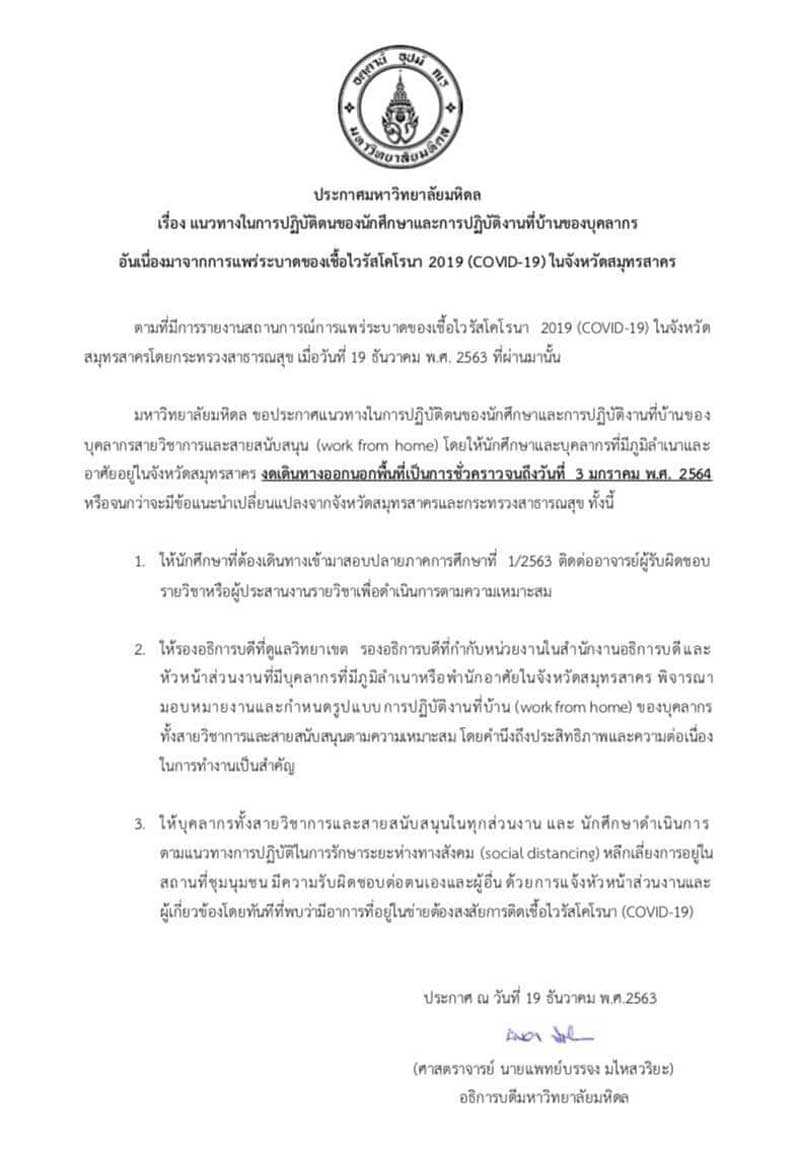
‘ม.มหิดล’ ประกาศนักศึกษา-บุคลากรที่อยู่ ‘สมุทรสาคร’ ให้ทำงานที่บ้าน-งดเดินทางถึง 3 ม.ค.64 #SootinClaimon.Com

#SootinClaimon.Com : ขอบคุณแหล่งข้อมูล : หนังสือพิมพ์แนวหน้า

ในประเทศ – ‘ม.มหิดล’ประกาศนักศึกษา-บุคลากรที่อยู่‘สมุทรสาคร’ ให้ทำงานที่บ้าน-งดเดินทางถึง 3 ม.ค.64 (naewna.com)

‘ม.มหิดล’ประกาศนักศึกษา-บุคลากรที่อยู่‘สมุทรสาคร’ ให้ทำงานที่บ้าน-งดเดินทางถึง 3 ม.ค.64

‘ม.มหิดล’ประกาศนักศึกษา-บุคลากรที่อยู่‘สมุทรสาคร’ ให้ทำงานที่บ้าน-งดเดินทางถึง 3 ม.ค.64

วันอาทิตย์ ที่ 20 ธันวาคม พ.ศ. 2563, 08.40 น.

‘ม.มหิดล’ประกาศนักศึกษา-บุคลากรที่อยู่‘สมุทรสาคร’ ให้ทำงานที่บ้าน-งดเดินทางถึง 3 ม.ค.64

20 ธันวาคม 2563 มหาวิทยาลัยมหิดล ออกประกาศ ระบุว่า ตามที่มีการรายงานสถานการณ์การแพร่ระบาดของโควิด -19 ในจังหวัดสมุทรสาคร นั้น ทางมหาวิทยาลัยขอให้นักศึกษาและบุคลากรที่มีภูมิลำเนาและอาศัยอยู่ในจังหวัดสมุทรสาคร งดเดินทางออกนอกพื้นที่เป็นการชั่วคราวจนถึงวันที่ 3 มกราคม 2564 หรือจนกว่าจะมีข้อแนะนำเปลี่ยนแปลงจากจังหวัดสมุทรสาครและกระทรวงสาธารณสุข ทั้งนี้

1. ให้นักศึกษาที่ต้องเดินทางเข้ามาสอบปลายภาคการศึกษาที่ 1/2563 ติดต่ออาจารย์ผู้รับผิดชอบรายวิชาหรือผู้ประสานงานรายวิชาเพื่อดำเนินการตามความเหมาะสม

2. ให้รองอธิการบดีที่ดูแลวิทยาเขต รองอธิการบดีที่กำกับหน่วยงานในสำนักงานอธิการบดีและหัวหน้าส่วนงานที่มีบุคลากรที่มีภูมิลำเนาหรือพำนักอาศัยในจังหวัดสมุทรสาคร พิจารณามอบหมายงานและกำหนดรูปแบบการปฏิบัติงานที่บ้าน ของบุคลากรทั้งสายวิชาการและสายสนับสนุนตามความเหมาะสม โดยคำนึงถึงประสิทธิภาพและความต่อเนื่องในการทำงานเป็นสำคัญ

3. ให้บุคลากรทั้งสายวิชาการและสายสนับสนุนในทุกส่วนงาน และนักศึกษาดำเนินการตามแนวทางการปฏิบัติในการรักษาระยะห่างทางสังคม หลีกเลี่ยงการอยู่ในสถานที่ชุมนุมชน มีความรับผิดชอบต่อตนเองและผู้อื่น ด้วยการแจ้งหัวหน้าส่วนงานและผู้เกี่ยวข้องโดยทันทีที่พบว่ามีอาการที่อยู่ในข่ายต้องสงสัยการติดเชื้อโควิด-19

‘I needed something good to happen’ #SootinClaimon.Com

#SootinClaimon.Com : ขอบคุณแหล่งข้อมูล : หนังสือพิมพ์ The Nation.

‘I needed something good to happen’ (nationthailand.com)

‘I needed something good to happen’

Health & BeautyDec 20. 2020Dr. Val Briones-Pryor, an internal medicine specialist, is pictured outside of the University of Louisville hospital in Louisville, Ky., on Dec. 17, 2020. MUST CREDIT: Photo by Luke Sharrett for The Washington PostDr. Val Briones-Pryor, an internal medicine specialist, is pictured outside of the University of Louisville hospital in Louisville, Ky., on Dec. 17, 2020. MUST CREDIT: Photo by Luke Sharrett for The Washington Post 

By The Washington Post · As told to Eli Saslow · NATIONAL, HEALTH, SCIENCE-ENVIRONMENT, HEALTH-FEATURES 

I was one of the first people to get vaccinated in Kentucky. The whole thing was surreal. It happened in a small auditorium, and the governor gave a speech. I walked onstage and pulled up my sleeve with the cameras rolling. A few people clapped when the needle went in. Some of us were crying. It felt like this amazing victory celebration, and then I went back to check on my patients.

One coded on me that morning. Oxygen deprivation. He was my 27th covid death. Then I had another guy who’s been with me 14 days, and I thought he was finally getting better, but covid schools me all the time. Suddenly, he couldn’t breathe while he was doing physical therapy, and we had to rush him onto 100 percent oxygen to get him stabilized. Then I checked on a patient who can’t keep anything down. She’s young, and her breathing is fine, and she should have gone home by now, but that’s not how this virus works. Lately, it feels like my batting average isn’t very good. I sent one patient home, but I had four more going in the other direction and getting worse, so I transferred them to the ICU.

So, yeah. That’s how it’s gone lately. I guess the best part of my day was a little arm soreness.

I’m desperate for this to be over. That’s why I’m so thankful for this vaccine. It’s safe. It’s effective. It’s incredible. I wish I could sit here and say: “OK! That’s it! We’re done!” But even with the vaccine, the reality in our hospital hasn’t changed, and we’ve got months more to go. I’ve been in charge of our covid unit since we opened March 17th. It’s wave after wave. Treat covid. Study covid. Worry about covid. That’s all I do. I shower at work, change clothes, and wrap my son in a blanket before I give him a hug so I don’t bring covid home.

We started our covid unit with 15 beds, and that was enough for a while. Then we moved to another unit that had 22 beds, and now we need both. I usually get patients in that eight-to-14-day window after they’ve contracted the virus, when they could go either way. They come through the emergency room and get admitted to me. Most of them are here for a while – could be a week or 10 days. We use steroids and sometimes an anti-viral, but a lot of hospital medicine comes down to observation. You’re examining a patient and looking for clues. What are their breathing patterns? How do they look when they’re eating? Has their color started to change? Our nurses are so dedicated, and they monitor these patients 24 hours a day. They’re not allowed to have any visitors, so I try to sit in their rooms when I can. I get to know them. I do a lot of watchful waiting.

I started thinking back over some of my patients while I was getting the vaccine – my list of 27. In a normal year, I might lose a total of four or five. It’s been a lot to handle. A few weeks ago, I had nine deaths in nine days. It’s been a lot of older people, and some had made the decision that they didn’t want to be on a ventilator. We had an older Hispanic gentleman, and he didn’t speak English, so I had to communicate to him using an iPad as our interpreter. He got so scared at the end that he couldn’t be alone. He didn’t want the nurses to leave his room. I had a 33-year-old who kept getting worse for a while, and then I had to tell him he was going to the ICU. He tried to negotiate with me. He was wearing this high-flow oxygen mask, and he was crying all over it. He said: “Please, give me one more day. I know I can get better.”

One of my first deaths was a Catholic priest. He’d come from a nursing home that had an outbreak, and four of those patients died. It was my mission to make sure he got anointed before he passed. I called up my supervisor and said, “I know we’re not allowing visitors, but I really need this favor.” Luckily, we were able to get a priest who volunteered to come, and we got him all dressed up in PPE, and he gave last rites. It was beautiful. I’m Catholic, and after everybody left, I sat there and held his hand. I’m a cantor at my church. I sang to him and told him it was okay to go.

I try my best to be connected. It’s an honor to be with someone in those last moments, but it should be a loved one. It shouldn’t be me.

This pandemic has taken me through the stages of grief. There was that initial denial, and some people got stuck there. Then it was anger, and I definitely had that. I was mad at my neighbors because they were having people over. Then I was bargaining – maybe if we lock down or do this or that, it won’t be so bad. Then depression. Then acceptance.

But the problem with acceptance when you’re in the middle of a pandemic is you start to get numb. I’ve gotten numb to where I almost couldn’t feel anything. For a while, I could just come in to work and do my job and put that smile on my face and deal with it, but eventually it gets to you. I worked 21 days in a row at one point. You get beaten down. It’s never-ending. You discharge four people and then five more cases come in. At some point, you almost have to depersonalize it, and that doesn’t feel right, either. You start thinking: “I’m done. I’m on empty. I don’t know how much longer I can do this.”

A few weeks ago, I started having heart palpitations. It’s something I see in my patients, because covid can impact your heart, so the first thing I thought was: “Oh no. What if I finally got it?” My son overheard me talking to my husband, and he started to cry. He said, “I don’t want you to die.” He’s 7, but he’s smart, and he pays attention to everything. He sees how we’ve changed everything to avoid this virus, so now he thinks that way.

I got tested and it was negative. I went to see my cardiologist. My blood pressure was up. My doctor said it was probably stress built up over all these months. We were up to having, like, 35 covid patients between the two units at that point. My husband was getting worried about me. One of my partners said: “You can’t keep going like this. It’s too much.” We decided I’d hand over the second covid unit, so now I’m just in charge of one, and that’s enough. I’m exhausted.

I needed something good to happen – something to pull me out. As soon as I heard we were getting a shipment of the vaccine, I put my whole heart into that. I’ve been waiting for this a long time. I mean – I’m tearing up now just thinking about it. It’s great to know I’ll have protection against this virus, but it’s more than that. It’s a profound relief. I can finally see a way out of this, even if we aren’t there yet. It’s a reason to hope.

Britain tightens lockdowns over virus mutation with ‘significantly faster’ transmission #SootinClaimon.Com

#SootinClaimon.Com : ขอบคุณแหล่งข้อมูล : หนังสือพิมพ์ The Nation.

Britain tightens lockdowns over virus mutation with ‘significantly faster’ transmission (nationthailand.com)

Britain tightens lockdowns over virus mutation with ‘significantly faster’ transmission

Health & BeautyDec 20. 2020

By The Washington Post · William Booth · WORLD, HEALTH, EUROPE 

LONDON – Faced with a newly emerging coronavirus mutation with “significantly faster” transmission rates, Britain on Saturday announced tightened pandemic restrictions that returned London and parts of the country to virtual lockdown and reversed earlier promises for relaxed rules over the holidays.

The new mutation, or variant, was first detected in southeast England in September and is quickly becoming the dominant strain in London and other regions in Britain. Experts said it does not appear more deadly or resistant to vaccines.

At a news conference from 10 Downing Street, British Prime Minister Boris Johnson said the new variant “may be up to 70 percent more transmissible” than previous versions of the virus here.

“This is spreading very fast,” he said, announcing local and international travel bans and other extreme measures for about 18 million people in England beginning Sunday. Wales and Scotland followed with their own tightened restrictions, including banning all but essential movement around the isle.

Many countries have reimposed tough social distancing measures as coronavirus cases roared back in second and third waves. Britain, however, appears to be the first to point to a specific coronavirus variant for a surge in infections and the need to bring back the toughest measures.

“We have alerted the World Health Organization and are continuing to analyze the available data,” said England’s chief medical adviser, Chris Whitty. It was not immediately clear if the new variant had moved beyond Britain.

Britain’s chief science adviser, Patrick Vallance, said the “virus has taken off” after being observed for months.

“And it’s moving fast and has led to a sharp increase in hospitalizations,” he said, calling the need for new restrictions a “horrible moment.”

He went on, however, to say that the outbreak of the new strain “is controllable and there is light at the end of the tunnel with the vaccinations having started.” Britain was the first to approve the new Pfizer-BioNTech vaccine and the first to begin a mass immunization program earlier this month.

The researchers stressed that this kind of mutation is not surprising. Sharon Peacock, director of the Covid-19 Genomics UK Consortium and a professor of microbiology at the University of Cambridge, stressed that thousands of mutations in the coronavirus have been identified since it emerged.

“The vast number have no impact,” she said. “Mutations are a part of natural life.”

Many viruses mutate and evolve, becoming more transmissible but less deadly. But to date, the decline in mortality among infected people during the pandemic has been attributed to improvements in treatments.

Johnson and his government have been fighting to “save Christmas.” They put Britain in countrywide lockdown in November, hoping that would slow transmission and allow for a greater relaxation of restrictions for a five-day period during the holidays, to allow families and friends to gather.

Now London and the southeast and east of England will enter the highest level of “Tier 4” restrictions.

That means all nonessential shops will be closed, as will gyms, hair salons, pubs, restaurants and theaters. Travel to and out of the Tier 4 areas will not be allowed. People should leave their homes only to shop for food and medicines, attend medical appointments, take outdoor exercise and travel to and from work, if they cannot work from home. Gatherings are banned, though there are exceptions for religious services. People will be able to meet only one other person from another household in an outdoor space only.

Christmas gatherings of more than one family will be banned in the Tier 4 zone – but permitted for one day in other areas.

“We, of course, bitterly regret the changes,” Johnson said.

“When the virus changes its method of attack, we as a country have to change our method of defense,” he said.

British scientists have been following the spread of the new variant for nearly three months, eventually seeing it in samples taken from more than 1,100 people, most of whom lived in the southeast of England.

John Edmunds, an infectious diseases expert at the London School of Hygiene & Tropical Medicine, told reporters that scientists need to answer three questions: Is the variant more deadly, can it bypass previous infection antibodies or vaccination, and is it transmissible? 

“At present we have no information on the first two questions, but over the last few days we have begun to get an answer for the third, and the answer is very bad news,” he said. “It looks like this virus is significantly more infectious than the previous strains.”

On Saturday, the chief science adviser said there were 23 different mutations in this new variant. Most were in a segment of the virus’s genome that encodes for the spike protein, the protruding structure essential to the pathogen’s ability to bind with the receptor cells in a person who gets exposed and then infected. 

The virus trackers briefed reporters from various media, including The Washington Post, in recent days. What surprised them was the sudden prevalence of the variant. 

“This lineage came up quite rapidly,” said Nick Loman, a professor of microbial genomics at the University of Birmingham.

Peter Openshaw, professor of experimental medicine at Imperial College London, called the British government’s data on the new variant “of great concern,” noting that the “variant does seem about 40 to 70 percent more transmissible.”

He said the number of cases could double in “just six or seven days” at the current rate.

“So it is really vital that we get this under control,” he told science reporters on Saturday.

FDA authorizes a second coronavirus vaccine, a turning point in the pandemic #SootinClaimon.Com

#SootinClaimon.Com : ขอบคุณแหล่งข้อมูล : หนังสือพิมพ์ The Nation.

FDA authorizes a second coronavirus vaccine, a turning point in the pandemic (nationthailand.com)

FDA authorizes a second coronavirus vaccine, a turning point in the pandemic

Health & BeautyDec 19. 2020

By The Washington Post · Carolyn Y. Johnson, Laurie McGinley

WASHINGTON – A second coronavirus vaccine received emergency authorization Friday, an unprecedented scientific feat that gives the United States two powerful tools to fight a pandemic that emerged almost exactly a year ago, sparked by a few cases of mysterious pneumonia that exploded into the biggest global public health crisis in a century.

The Food and Drug Administration’s decision to clear the vaccine, developed by Massachusetts biotechnology company Moderna in partnership with the National Institute of Allergy and Infectious Diseases, arrives at the end of a historic week in medicine – as health-care workers began receiving inoculations of the first coronavirus vaccine, developed by Pfizer and BioNTech, which was cleared by the agency Dec. 12.

The first shots in a national mass vaccination campaign this week delivered great hope but also exposed the distribution and supply challenges that will now move to the forefront, as companies, the federal government and states attempt to work in concert to maintain ambitious timelines. Two health-care workers in the United Kingdom had treatable allergic reactions after being vaccinated with the Pfizer-BioNTech shot a little over a week ago. In the United States, the FDA said Friday night, the agency is investigating “about five” reports of allergic reactions. The cases highlight the challenges that could lie ahead as public health experts work to build trust in the vaccines.

“To get another very important vaccine into play is just, yet again, another step toward what the ultimate goal is: to get enough people vaccinated so you could essentially end the epidemic as we know it in this country,” Anthony Fauci, director of the National Institute of Allergy and Infectious Diseases, said. “I believe that’s possible.”

The authorization of a second vaccine – which came as the death toll from the virus in the United States surpassed 312,000 – will have an immediate practical impact that may begin to ease some of the logistical challenges, doubling to roughly 20 million the number of people government officials say they can vaccinate with a first shot before the end of the year. It will free the country from the precarious position of being reliant on a single manufacturer as production ramps up of a type of vaccine that has never been made on a massive scale. And it adds a vaccine that can be stored in a regular freezer, making it easier to distribute to large swaths of the country, in contrast to the specialized ultracold freezers and dry ice coolers needed for the Pfizer-BioNTech vaccine.

The successes also represent a decisive moment in scientific history. Scientists took a novel technology and leveled it against a new virus, developing and deploying in under a year two vaccines that are 94% to 95% effective in clinical trials, rivaling some of the most effective vaccines in the world’s medicine cabinet.

“It’s astonishing. Not in our wildest dreams would we imagine the results that we received,” said Lisa Jackson, a senior investigator at Kaiser Permanente Washington Health Research Institute who has worked on more than 60 vaccine trials. In mid-March, she launched what could be the most consequential one – a small safety test of the Moderna vaccine in 45 healthy, young volunteers. “To have two such vaccines – it’s just amazing.”

In a media call Friday night, FDA officials called the authorization of a second vaccine a milestone and said they are looking into reports of allergic reactions related to the Pfizer-BioNTech vaccine. Peter Marks, director of the FDA’s Center for Biologics Evaluation and Research, which regulates vaccines, said the FDA and the Centers for Disease Control and Prevention have met daily to evaluate the reports, including a case in Alaska in which a woman was hospitalized.

He said scientists don’t know what might be causing the reactions but speculated a possible “culprit” could be polyethylene glycol, a component in both the Pfizer-BioNTech and Moderna vaccines. The substance is commonly used in pharmaceutical preparations, and scientists are wondering if more people react to it than was thought.

The FDA, in its patient information sheets, says individuals who know they are allergic to any components in the authorized vaccines should not receive the shots. The government requires that medical supplies to treat severe allergic reactions be available wherever vaccines are being administered.

The development of the vaccines is a testament to a single-minded focus by private industry and the government, which built on decades of basic research to accomplish an urgent goal. Tens of thousands of volunteers agreed to roll up their sleeves in hopes they could play a small part in bringing the world back to normal. One of those volunteers was Jennifer Haller, 44, of Seattle, who was the first person to receive the Moderna vaccine March 16 – at a time when it remained unclear what trajectory the pandemic would take.

“This was a way that I could contribute,” Haller said. “I have a lot of stability in my life – I have a full-time job, friends and family nearby. I wanted to take a risk like this when so many others can’t. They have so many more pressing, immediate needs that they need to take care of.”

The first doses of the Moderna vaccine, which is authorized for people 18 and older, will probably ship this weekend, with nearly 6 million expected to be distributed during the first week to health-care workers and nursing home residents. An additional 2 million doses of the Pfizer-BioNTech vaccine are expected to be shipped. The clearance of both vaccines marks a transition from an uncertain scientific quest to a massive logistics enterprise – one that already experienced missteps this week as several trays of the Pfizer-BioNTech vaccine shipped to Alabama and California got too cold, and had to be returned, and states questioned why their shipments for next week had been slashed.

In that way, the Moderna vaccine offers a clear advantage. While the Pfizer-BioNTech vaccine must be kept at ultracold temperatures in specialized freezers or carefully maintained dry ice containers, the Moderna vaccine can be stored at regular freezer temperatures long-term and at refrigerator temperatures for up to a month. That will expand the settings where it can be used to rural areas, pharmacies or medical offices that lack specialized equipment.

“Moderna is much easier in terms of transportation; it has a more forgiving cold chain. It doesn’t have to be kept as cold,” Amesh Adalja, senior scholar at the Johns Hopkins Center for Health Security, said.

At an FDA advisory committee meeting Thursday on the Moderna vaccine, Gwen Schell, a nurse from Panhandle Health District’s home health care in Idaho, said the shots are desperately needed in rural areas. “We have very limited nursing staff in this part of the United States,” Schell said. “We have seen an uptick in people being sent home from the hospital who are not meant to be home.”

Having a second supplier, particularly at a time when there are not enough doses, could ease the delays and hiccups that many vaccine experts think are likely to occur over the next months. Bloomberg News reported Thursday that 400,000 doses of a recent manufacturing batch from Moderna had to be tossed after a filtration problem.

Bruce Lee, a professor of health policy and management at City University of New York Graduate School of Public Health and Health Policy, said that during the 2009 H1N1 pandemic, he was part of a team trying to project where limited vaccine doses could have the greatest impact. A recurring theme was vaccine companies missing their targets, requiring last-minute recalculations.

“On a weekly basis, we would get updated vaccine production numbers – and it was consistently, week after week, delayed,” Lee said. “We would basically run scenarios to show folks at [the Department of Health and Human Services], ‘This is what it means, given the fact you have limited vaccines, about who should get the vaccines first: In these neighborhoods, it would have a greater impact on the pandemic.'”

Kendall Hoyt, a vaccine and biosecurity expert at Dartmouth College, said the addition of vaccine manufacturers such as Moderna to Pfizer-BioNTech’s pioneering effort is badly needed because there is no way to know how vaccine makers will be affected by what she predicted could be severe supply shortages.

“There is going to be a global crush of demand for all the ingredients – the vials, the syringes, the raw materials,” she said. “We have never tried to make as much vaccine at once.”

One of the challenges of scaling up vaccine production is that the technology in the Pfizer-BioNTech and Moderna vaccines has never been used in approved medical products or produced in such large amounts at pharmaceutical quality standards.

Since 1961, scientists have known about messenger RNA, genetic material that makes life possible, taking instructions inscribed in DNA and delivering them to the protein-making parts of the cell. Both the Moderna and Pfizer-BioNTech vaccines harness this natural process in a vaccine, delivering to the body’s cells synthetic RNA that carries the blueprint to build the spiky proteins on the coronavirus surface. The cells follow the instructions to make the spike proteins, and the immune system learns from those spikes to recognize the real thing.

There isn’t yet a long safety track record for the technology, but the platform has been in human tests for years, including in tens of thousands of people in the coronavirus vaccine trials in recent months. While most infectious-disease experts are focused on finding ways to deploy the technology as quickly as possible so that vaccines can begin to blunt the crisis this winter, many are also thinking of the inevitability of the next pandemic – and the proof-of-concept that these two successes represent.

“This is all we’ve been doing for nine months: It’s eat, sleep, vaccinate, and that’s been an exhilarating but exhausting time for all of us,” said Buddy Creech, director of the Vanderbilt Vaccine Research Program. “When we got word that the vaccines were over 90% effective, I think there was a collective sigh across all of vaccinology that recognized both the impact for this pandemic but also how we can respond very quickly to future pandemics.”

Krutika Kuppalli, an infectious-disease specialist at the Medical University of South Carolina, said there is intense interest among health workers to be vaccinated quickly. She said 600 to 700 health-care workers were vaccinated with the Pfizer-BioNTech shots Tuesday, the first day of inoculation. Slots for coming days are filling rapidly, she said.

With demand for coronavirus vaccines sure to outstrip demand for many months and beyond, Kuppalli welcomed the authorization of the Moderna product. “We are going to need multiple vaccines” to inoculate the nearly 8 billion people on Earth, she said.

The FDA authorization capped months of frenzied activity at the agency, whose vaccine experts have been working intensely with manufacturers to bring coronavirus vaccines to market.

Pfizer-BioNTech applied to the agency for emergency authorization Nov. 20, and Moderna filed its request just 10 days later. Federal officials have said two more manufacturers – Johnson & Johnson and AstraZeneca – could seek FDA clearance early next year. Novavax is expected to start its large trial in coming weeks, but a sixth vaccine backed by the U.S. government from Sanofi and GlaxoSmithKline has been delayed after its shot failed to trigger a strong enough response in older adults.

Operation Warp Speed, the Trump administration’s initiative to accelerate the availability of vaccines, has invested almost $4.1 billion in Moderna’s vaccine development, clinical trials and manufacturing. The government has bought 200 million doses of the vaccine and retains options for hundreds of millions more. In a break from traditional practice, manufacturing began while the vaccine still was being tested in a clinical trial – to speed distribution once cleared by the FDA.

Rattanon regains winning touch as birdie in playoff gives him first title in two years #SootinClaimon.Com

#SootinClaimon.Com : ขอบคุณแหล่งข้อมูล : หนังสือพิมพ์ The Nation.

Rattanon regains winning touch as birdie in playoff gives him first title in two years (nationthailand.com)

Rattanon regains winning touch as birdie in playoff gives him first title in two years

Dec 20. 2020Rattanon Wannasrichan Rattanon Wannasrichan 

By THE NATION

Rattanon Wannasrichan pulled off a much-needed birdie to outplay veteran Prayad Marksaeng in the play-off to win the Bt3 million Singha-SAT Khon Kaen Championship on Saturday.

The win will go a long way for him to regain the confidence that he still has what it takes to win.

Since his last triumph — coincidentally also here at the Singha Park Khon Kaen Golf Club in 2018 — Rattananon’s form had been going downhill. He missed the cut in more than 10 events in 2019.

He started to make some cuts and posted a top 10 finish after the Covid-19 outbreak earlier this year before ending the two-year title drought at the par-72 7,557-yard course.

“2019 was by far the worst year of my career,” said the 25-year-old Rattanon, who chipped in a 45- yard eagle to catch up with Prayad on top of the leaderboard at 11-under-par 205 in regulation.

“I had some muscle problem, which could be contracted by sitting in a plane for too long. I couldn’t hit the ball straight and my confidence was gone,” said the Chanthaburi-based player who sealed his victory with a three-foot-birdie putt on the par-5 hole 18 play-off after the 54-year-old Prayad had missed a six-foot birdie earlier.

As the pandemic led to suspension of tournaments for months, it also allowed the 2017 Thailand Open champion to put behind the disastrous memories of 2019.

“I was so disappointed last year because I was able to play on the Japan Tour but I didn’t perform well. Luckily, the Covid-19 outbreak allowed me to stop thinking of the game. Gradually, the ghost of 2019 vanished. I became more relaxed and at the same time tried to get the old good feelings back,” added Rattanon.

On Saturday, he walked away with the champion’s prize money of Bt360,000.

“It means a lot to me psychologically to finally win again. At least I know I still have the game,” said Rattanon, who now takes a long holiday before his next event in January.

Meanwhile, Prayad as a runner-up had to be content with a Bt198,000 cheque.

However, the 2020 Order of Merit title belongs to Panuphol Phittayarat who earned a gross total of Bt630,911. Prayad came in second with Bt607,216.

Sei takes 54-hole lead at CME Group Tour Championship #SootinClaimon.Com

#SootinClaimon.Com : ขอบคุณแหล่งข้อมูล : หนังสือพิมพ์ The Nation.

Sei takes 54-hole lead at CME Group Tour Championship (nationthailand.com)

Sei takes 54-hole lead at CME Group Tour Championship

Dec 20. 2020Sei Young Kim (Photo credit to LPGA)Sei Young Kim (Photo credit to LPGA) 

By THE NATION

In 2019, Sei Young Kim led the CME Group Tour Championship after 54 holes and went on to win her ninth career victory and the largest winner’s prize in women’s golf history.

One year later, Kim is in the same position heading into the final day in Naples, Fla., as she leads by one stroke at -13 after a third-round 67.

“I think I feel I got good feeling, because I wasn’t good shot striking ball the last week, but I try to figure out,” said Kim. “I got something in there, yeah, I was able to play, yeah, very solid this week.”

Kim carded six birdies through her first 13 holes and was blemish-free on the scorecard until No. 18. After a tricky putt off the green went whirling past the hole, Kim missed on a makeable par putt from 5 feet that grazed the left side of the hole, leading to her first bogey since No. 9 on Friday.

A win on Sunday would be the first time Kim has successfully defended a title in her career, as she looks to become the only three-time winner of the 2020 season.

“Well, my position is really good chance to the chase the everything. So, yeah, I don’t have any the defend champion, so it’s really — if I play well tomorrow, yeah, good chance to everything. So yeah, I just keep doing,” said Kim.

World No. 1 Jin Young Ko’s 3-under 70, her second consecutive bogey-free round, kept her firmly in title contention. Ko birdied holes 3 and 7 and then produced nine straight pars until No. 17. With a birdie on the second-to-last hole and the bogey finish by Kim, Ko sits at -12 with her first win of the 2020 season in sight.

“I just try to make birdies, and then I said yesterday my goal is like just bogey-free round on the weekend, so I made it today,” said Ko, whose best finish in Naples is T11. “I’m looking forward to tomorrow.”

Ko will join Kim in Sunday’s final grouping along with fellow major champion Georgia Hall after Hall’s 4-under 68 landed her in solo third at -10. Hall had a relatively quiet start with eight pars and a lone bogey on No. 5 but rebounded on her back nine with five birdies in her last eight holes to keep herself in the mix at the Tour’s season finale.

“I hit it pretty good today as well. I just didn’t hole many on the front nine, so I had to stay patient.

Yeah, managed to get a couple early in the back nine and then just followed in from there really,” said Hall, who earned her second career victory earlier this season at the Cambia Portland Classic. “Very happy with my back nine to get me especially into contention for tomorrow.”

Five players are tied for fourth at -9, four shots back from Kim, including past CME champions Charley Hull (2016) and Lexi Thompson (2018), and Brooke Henderson, one of six players to card the day’s low round of 6-under-66. Mina Harigae, playing in her first CME Group Tour Championship since she tied for 26th in 2012, is tied for ninth with major champions Cristie KerrLydia Ko and Hannah Green. Green was near the top of the leaderboard at -10 after three birdies in her first 17 holes, but a double bogey on No. 18 curbed any chances of a spot in Sunday’s final grouping.

I made a great par save on 9; holed nearly a 10-foot putt for par and gave myself a good opportunity on 10. Missed it. Then gave myself another good opportunity on 12 and 13 and missed it again. Just couldn’t get the pace of the greens today. Then on the last kind of just hit my second putt, third putt a bit too quickly and tugged it left,” said Green. “I’m going to do some putting, try and make sure I’m not getting too quick on my stroke and wanting to get the ball in the hole too quickly. Hopefully I can get good numbers into greens like I did today and capitalize on that.”

WITH A WIN

Sei Young Kim would earn her second consecutive CME Group Tour Championship title and become the first multiple winner in championship history

With the $1.1 million winner’s check, Sei Young Kim would move to $2,307,438 in 2020 earnings and win the Official Money Title; she would also move to $10,974,114 in career earnings and become the 18th player in LPGA Tour history to cross the $10 million threshold

Projections show that Sei Young Kim could move to No. 1 in the Rolex Women’s World Golf Rankings with a win and a Jin Young Ko finish of solo 10th or worse

With the $1.1 million winner’s check, Jin Young Ko would move to $5,600,824 in career earnings and become the 71st player in LPGA Tour history to cross the $5 million threshold

Georgia Hall would earn her second victory of 2020, joining the Cambia Portland Classic

With her third career victory, Georgia Hall would tie Trish Johnson for the third-winningest LPGA Tour player from England, following Laura Davies (20 victories) and Alison Nicholas (four victories)

SEI YOUNG THE LIONHEARTED STALKING AN AGGRESSIVE TITLE DEFENSE

Players handle pressure in different ways. Some show signs of cracking. Some calm themselves with slow, deep breaths. Some never crack a smile, the intensity of the moment etched in each deepening line on their face.

Then, there is Sei Young Kim, who doesn’t just elevate her game as pressure intensifies, she seems to get happier as she does it.

When you look at the career of the third-round leader of the CME Group Tour Championship, you could easily say that holing a chip to get in a playoff and then holing an approach to beat a Hall of Famer for your second career win was a stroke of good luck. You could certainly look at shooting 31-under to set an all-time scoring record as a lightning-in-a-bottle kind of week. Sure, you could say that holing a curling 22-footer to win the largest paycheck in women’s golf at the CME Tour Championship a year ago was a great finish with a little bit of fortune. But when you combine all of those things together, throw in a near flawless major championship at Aronimink, and sprinkle a 5-0 playoff record on top, suddenly you look at Kim like a superhero – James Bond straightening the Windsor knot of a tie while saving the world.

It happens every time she’s in contention. As the stage gets bigger and the pressure intensifies, Kim’s game gets more aggressive while her personality goes the other way. In the hottest moments, Kim is as cool as Steve McQueen in a Mustang.  

“My vibe was really good because of the warmer weather,” Kim said after a five-under 67 on Saturday, a round that gave her a one-shot lead of this CME Group Tour Championship going into the final round. “Then I was paired with Jin Young (Ko) and Lexi (Thompson). Those are my favorite players to play with, so yeah, it was fun.” Then she quickly added, “We didn’t talk much but it was very comfortable and chill out there.”

JIN YOUNG KO SEES A PUTTING LESSON WITH STEVE STRICKER IN THE NEAR FUTURE

Saturday at the CME Group Tour Championship was a doubly successful day for Rolex Ranking No. 1 Jin Young Ko. Not only did she keep a spot near the top of the leaderboard at -12, one stroke off the lead held by Sei Young Kim, but she also met one of her icons, 12-time PGA Tour winner Steve Stricker, and even got him to promise a date on the putting green.

“I met him before the tee off today and then I said, ‘Hi. I’m your fan.’ He said, ‘Okay, good luck. And thank you,’” said Ko of her interaction with Stricker, who is moonlighting as a on-course commentator for Golf Channel during the weekend broadcast coverage. “I asked him on the course, maybe hole number 12, I asked to him, ‘How long of a time do you practice putting?’ He said, ‘A lot.’ I said, ‘So how many times?’ ‘A lot,’ [he said.] And then I said, ‘I want to ask you about putting. Teach me.’ And then he said, ‘Any time.’ He was really good. He was nice.”

Only one round left before the 2020 LPGA Tour season wraps up, Ko knows that Sunday is her final opportunity to win her first tournament of the pandemic-stained season. And, of course, capture her first Race to the CME Globe title.

“Win? Well, I never finished top 10 for this course, Tiburon, so if I win it’s going to be a big one to me. So I will try for the win, but I don’t want to get too greedy,” said Ko.

BROOKE HENDERSON TAKES FULL ADVANTAGE OF CME MOVING DAY

Brooke Henderson said she feels she’s improving each year at Tiburon Golf Club, and it showed with an impressive moving day at the CME Group Tour Championship. After starting the first round with a 1-over 73, Henderson quickly gained ground this Saturday after carding seven birdies and a long bogey on No. 9 to record a 6-under 66 and sit in a tie for fourth at -10.

“I feel like every year I get a little bit more comfortable out here, learn the course a little bit more, which is good. And working hard with Brit, my caddie, and also my dad, my coach, is usually out here, too,” said Henderson. “Just trying to get a better plan and strategize our way around here. I just — every hole I feel like there is opportunity for birdie, so that makes it really exciting when you step up to every tee.”

It is the Canadian’s sixth appearance in the Tour’s season finale, where she has never finished worse than T25. Last year, Henderson finished in solo fifth, her career-best result in the event. Today’s round ties her lowest 18-hole score at Tiburon, last recorded in 2015 when she finished 13th. The 23-year-old said she misses the “Brooke Brigade,” and the heavy contingent of fans that follow the Hendersons at the Tour Championship.

“It’s very strange not to see the big stands. Normally there is a lot the snowbirds, Canadians following me around all four days, so it’s definitely been strange,” said Henderson, who also takes residence in Naples when not in Canada. “I really miss the energy and the little bit of adrenaline that the fans bring, but at the end of the day it’s just a competitive round and you’re just trying to do the best you can.”

MINJEE LEE RIDES HOT BACK NINE INTO SUNDAY IN NAPLES

She found an early bogey in the third round of the CME Group Tour Championship on No. 3, but Minjee Lee bounced back with a vengeance. The five-time LPGA Tour champion eventually made the turn in red numbers before making a run on the back nine that included five straight birdies from Nos. 13-17 to cap a 6-under par 66 performance.

“It was a nice stretch,” said Lee, who hit all 14 fairways and 13 greens today. “I hit really good iron shots into a lot of those holes, so it was nice to have little putts for birdie. A good momentum swing and after the first two days, you work hard those two days, really want to climb that leaderboard.”

Lee will be joined in the penultimate grouping tomorrow by Charley Hull and Brooke Henderson, both also firing rounds of 66 this afternoon. The Australian heads into the final 18 holes four shots back of the lead and in a tie for fourth at -9 overall.

“Looking at the leaderboard, I think Sei Young is kind of running away with it. I’m probably going to have to start really fast and make a lot of birdies tomorrow,” Lee said. “Just play my game, be aggressive and try to hole a lot of putts.

“I think she [Kim] starts off well and she ends well. If she’s on, she’s on. It’s kind of really hard to keep up if she’s really on her game. Just means we have to step it up a little bit.”

CME GROUP SCORES 1 FOR ST. JUDE THIS SEASON

When players showed up at the Ritz Carlton Golf Resort in Naples for obligatory COVID testing before the CME Group Tour Championship, they looked like road-weary travelers in the TSA line. While everyone is grateful for the sponsors, staff, volunteers and venues providing opportunities to play, a summer and fall filled with nasal swabs and temperature checks has deadened the eyes of those who traversed that gauntlet.

But the ballroom at the Ritz was different. After their tests, players were treated to unexpected gifts – headcovers from CME Group adorned with art by patients from St. Jude Children’s Research Hospital.

More than one player teared up at the gift. Others couldn’t wait to put the headcovers in play. All agreed to sign an additional cover to be auctioned off to benefit St. Jude. 

Throughout the 2020 LPGA Tour season, CME Group supported St. Jude by donating $20,000 for every hole-in-one made in competition. The program is called “Score 1 For St. Jude,” and has seen 14 aces coming into the week. 

Danielle Kang was so moved by the success of the program, and some of the comments that came from a St. Jude patient who attended her pre-tournament virtual press conference, that she agreed to donate $1,000 for every birdie she made this week. “I might not make a hole-in-one, but I know I’m going to make some birdies,” Kang said. “Hopefully I can make 20 birdies this week and donate $20,000.” 

Why CP group got the nod for takeover of Tesco #SootinClaimon.Com

#SootinClaimon.Com : ขอบคุณแหล่งข้อมูล : หนังสือพิมพ์ The Nation.

Why CP group got the nod for takeover of Tesco (nationthailand.com)

Why CP group got the nod for takeover of Tesco

CorporateDec 19. 2020

By THE NATION

The Office of Trade Competition Commission (OTCC) on Friday published a report on its decision regarding Charoen Pokphand’s (CP) acquisition of Tesco’s Thailand business from Ek-Chai Distribution System.

The OTCC on November 6 voted 4:3 in favour of the US$10-billion (Bt302.5 billion) takeover deal.

According to the report, the majority of the commissioners who voted for the acquisition argued that the acquisition was necessary for business operation and would help create revenue for the country’s economy. It would also help preserve the sales channels of domestic products as well as expand exports to Malaysia, as CP would also acquire Tesco Lotus in Malaysia under this deal.

“The deal would subsequently increase domestic sales and exports, create more employment and promote both retail and manufacturing industries,” said the commissioners.

The majority of the commissioners also said that the deal would not create serious negative impact on the economy, as it would not create unemployment in other related sectors, such as wholesale, which is responsible for 50 per cent of the country’s GDP.

“The deal would instead create up to 1.1 million jobs in the small, medium and large industrial supply chain while keeping the manufacturing sector uninterrupted,” they added.

“It will not add to the impact of Covid-19 that has resulted in recession in the macro economy and caused uncertainty among future investors, both domestic and overseas.”

Meanwhile, a minority of commissioners who voted against the acquisition argued that the acquisition could affect Thailand’s economy as it could lead to monopoly, unfair market dominance and socio-economic disparity, as CP is already the largest manufacturer of agricultural and consumer products that are vital to daily life, while the acquired party holds a large market share in wholesale and retail modern trade.

“The acquisition could also result in an obstacle for new entrepreneurs to enter the market, while other businesses would need to adjust their strategies and lower their costs and selling price to remain in the market,” said the minority of commissioners.

“As the biggest player in the market, CP will have more bargaining power against suppliers of products and raw materials, while SME manufacturers will be at a disadvantage when negotiating trade terms with suppliers.

“Furthermore, the acquisition will result in fewer number of competitors, and in the long term consumers will have limited choices of products and prices,” they added.

The OTCC also set terms and conditions that the acquisition parties: CP Retail Development Ltd and Tesco Stores (Thailand) Ltd, as well as their parent companies: CP All and Ek-Chai Distribution System, must follow:

1. The acquisition parties must not acquire other businesses in a similar sector for three years, excluding those in e-commerce.

2. CP All and Ek-Chai must increase the sales of SME products, including agricultural products, community products and OTOP in 7-Eleven and Tesco Lotus stores by at least 10 per cent annually for a period of five years.

3. The acquisition parties must not share related marketing information to product distributors, manufacturers or suppliers of raw materials. The information shall be classified as a trade secret.

4. Ek-Chai will abide by conditions stated in the contract or agreement that they have made with product distributors or manufacturers for a period of two years, unless product distributors or manufacturers agree to change the terms of the contract or agreement.

5. CP All and Ek-Chai must promote SMEs by providing credit terms of 30 days for agricultural products, community products and OTOP, and 45 days for other types of products for a period of five years.

6. CP All and Ek-Chai must submit their business operations report to the OTCC every three month for a period of three years.

7. Acquisition parties must set the business code of conduct to be displayed to the public, while they shall uphold the code of conduct as well as abide by regulations stated in the Trade Competition Act BE 2560.

Related Story: OTCC sets new criteria for businesses to be considered monopolies

Lawmakers hit major roadblock over GOP plan to limit Federal Reserve, imperiling weekend deal for emergency relief package #SootinClaimon.Com

#SootinClaimon.Com : ขอบคุณแหล่งข้อมูล : หนังสือพิมพ์ The Nation.

Lawmakers hit major roadblock over GOP plan to limit Federal Reserve, imperiling weekend deal for emergency relief package (nationthailand.com)

Lawmakers hit major roadblock over GOP plan to limit Federal Reserve, imperiling weekend deal for emergency relief package

EconDec 20. 2020Fed building/ file photoFed building/ file photo 

By The Washington Post · Mike DeBonis, Jeff Stein, Rachel Siegel, Seung Min Kim · NATIONAL, BUSINESS, POLITICS, CONGRESS, WHITEHOUSE 

WASHINGTON – Senior congressional lawmakers attempting to complete an emergency coronavirus relief package this weekend slammed into a major roadblock on Saturday over Republican demands to limit the authority of the Federal Reserve.

A late push from Sen. Patrick Toomey, R-Pa., to rein in the nation’s central bank had already divided lawmakers over the last several days. But the impasse appeared to grow significantly wider on Saturday, as congressional leadership and rank-and-file senators on both sides of the aisle dug in over the issue, imperiling prospects for a deal before Monday.

Toomey, a conservative lawmaker on the Senate’s banking committee, has demanded provisions be included in the covid relief package that would curb the ability of the Fed to restart emergency lending programs for localities and small businesses.

Senate Majority Leader Mitch McConnell, R-Ky., told Senate Republicans on a private call Saturday afternoon that the party should stick by Toomey’s plan, according to two people who requested anonymity to share details of the call.

But Senior Democrats have balked at agreeing to what they see as a nakedly political attempt to limit the economic tools available to the Biden administration. Throughout Friday and Saturday, a chorus of Senate Democrats emerged urging party leadership not to budge on the issue. Democrats have already agreed to drop aid to state and local governments from the relief package, and some lawmakers have hoped the central bank could serve as a backstop for assisting ailing municipalities.

The Toomey proposal would amount to one of the most significant intrusions into the central bank’s autonomy in years. Former Federal Reserve chair Ben Bernake weighed in on the dispute in an unusual public statement on Saturday, saying that the central bank’s emergency lending authorities should be at a minimum as robust as they were before passage of the Cares Act in March. Bernake said that it was “vital” that the central bank’s ability to “respond promptly to damaging disruptions in credit markets not be circumscribed.”

The intensifying dispute threatened to derail delicate negotiations for a nearly $1 trillion relief package that would provide hundreds of billions in emergency aid to the unemployed and small businesses; funding for vaccine distribution and health care facilities; and another round of stimulus checks to millions of Americans.

The need for such a package has only grown as the coronavirus rampages the nation and several emergency programs protecting tens of millions of Americans are set to expire in a matter of days.

House Speaker Nancy Pelosi, D-Calif., on Saturday called the dispute over Toomey’s proposal “the big thing” holding back an agreement.

Asked about the latest in negotiations, Sen. Richard Durbin, D-Ill., the No. 2 ranking Senate Democrat, said: “Toomey, Toomey, Toomey.”

The approaching Christmas holiday, a looming pair of Senate special elections in Georgia and the prospect of a partial government shutdown also are adding to the pressure for negotiators to finalize a deal this weekend.

Congressional leaders had given themselves until Sunday midnight to close out talks. President Donald Trump Friday night signed a two-day spending bill to keep the government open until midnight Sunday. If no deal is reach on the stimulus package, lawmakers would have to pass another temporary measure before Monday, otherwise parts of the federal government would shut down.

In an ominous sign for the relief talks, rank-and-file senators in both parties signaled they would be unwilling to move forward if they did not get their way over the Toomey proposal.

Sen. Elizabeth Warren, D-Mass., on Saturday denounced the Toomey plan and said “Democrats should stay firm” to resist the changes. Sen. Angus King, I-Me., a moderate who caucuses with the Democrats, said such an idea would “cripple the next administration’s ability to deal with a recession.”

On the Republican side, Sen. Tom Cotton, R-Ark., tweeted that Democrats were seeking a “slush fund for their political cronies.” Cotton added that Toomey’s position “is in fact the position of the Republican Senate Conference.” Sen. John Neely Kennedy, R-La., a member of the Senate Banking Committee, told reporters Democrats were trying to use the central bank’s authorities “as a backdoor to do what they couldn’t do through the front door.”

Kennedy added of Republicans approach to the issue: “I think we ought to stand firm.”

Sens. Toomey, Cotton, and Mitt Romney, R-Utah, met in Senate Minority Leader Charles Schumer’s, D-N.Y., office Saturday afternoon to resolve the dispute. Toomey expressed optimism about the possibility of a compromise following the meeting. But Romney, who has sought a compromise, sounded more downbeat, telling reporters: “I can’t predict what the result is going to be. I don’t know whether they’re going to be able to bridge the divide or not.”

McConnell, the Senate majority leader, has said lawmakers will not leave Washington for the holidays until a deal is done. And on Friday night he expressed optimism that a deal would get done. But on Saturday, multiple lawmakers and aides on Capitol Hill who were not authorized to speak about the negotiations publicly, conceded that it was hard to imagine a swift resolution to the stalemate over the Federal Reserve.

Lawmakers have also yet to resolve several other lingering issues. Those include eligibility for small business relief; how to structure unemployment aid; and the criteria for sending out a $600 per person stimulus check. Pelosi also told House Democrats on a call on Saturday that lawmakers remained divided over the amount of money necessary for food assistance, according to a person who spoke on the condition of anonymity to share her private remarks.

However, many aides close to talks expressed optimism these issues could be addressed fairly quickly if the dispute over the Fed is resolved. Sen. John Thune, R-S.D., the No. 2 ranking Republican senator, said Saturday that the “probably more likely scenario” is that negotiations stretch into Monday.

“But I think we’re in the homestretch, we’re on the glide path,” Thune said. “I think we’re going to get this done and help out the American people.”

Still, Treasury Secretary Steven Mnuchin told Senate Republicans on a 1 p.m. call on Saturday that Toomey’s demands had not been resolved, a person familiar with the internal call said. McConnell also told Senate Republicans on the call that the GOP needed to support Toomey’s efforts.

“I think we need to stick with where we are,” McConnell said, according to two people familiar with the call.

Republicans say the Fed’s programs, initially funded with a $500 billion congressional appropriation under the March relief bill, were of marginal utility earlier in the pandemic and are no longer necessary in any case. Toomey gave a floor speech Saturday afternoon aggressively defending his efforts.

Romney appears to be the only Republican to break with Toomey so far. Romney told reporters on Saturday that elements of Toomey’s proposals could be resolved after the current relief package is passed.

Democrats have argued the Toomey proposal represents an unusual political intervention into the independence of the Federal Reserve, limiting emergency lending powers it has possessed since 1932. Senate Minority Leader Charles Schumer, D-N.Y., also said that Federal Reserve Chair Jerome Powell opposes the proposed changes.

The central bank declined to give a public response to the heated debate.

“It’s no surprise that Republicans are drawing a line in the sand over their ability to sabotage the economy, and tie the Biden administration’s hands,” Sen. Ron Wyden, D-Ore., the ranking Democrat on the finance committee, said in a statement.

Democrats have signaled they might be willing to accept language that restricts use of Treasury funds appropriated under the March aid bill, but not language that would restrict the Fed from doing similar lending using its own assets.

“I think we could go with one part and not the other,” House Majority Leader Steny Hoyer, D-Md., said Friday. “And that’s the deal I think we ought to make.”

Hoyer told House members Friday not to expect votes until 1 p.m. Sunday at the earliest – just 11 hours before the next shutdown deadline. House Democratic leaders have scheduled a noon videoconference Saturday to update members on the negotiations.

Likely to run many hundreds of pages, the package is not only expected to carry the $900 billion covid relief deal but also $1.4 trillion in year-long appropriations for federal agencies; the extension of tens of billions of dollars in expiring tax breaks; a bipartisan energy bill; a long-delayed bipartisan solution to surprise medical billing; and dozens of other potential add-ons that a vast corps of lobbyists and congressional aides are hoping to include in this last legislative vehicle of 2020.

Lawmakers will almost certainly be asked to vote on a sweepingly broad piece of legislation with only hours to review it.

Outcome of MPC meeting to influence SET, baht next week #SootinClaimon.Com

#SootinClaimon.Com : ขอบคุณแหล่งข้อมูล : หนังสือพิมพ์ The Nation.

Outcome of MPC meeting to influence SET, baht next week (nationthailand.com)

Outcome of MPC meeting to influence SET, baht next week

EconDec 19. 2020

By The Nation

Investors have been advised to keep an eye on the Monetary Policy Committee (MPC) meeting on December 23, as it would impact the Stock Exchange of Thailand (SET) Index and the baht next week.

The SET Index on Friday closed at 1,482.38, down 1.51 points or 0.10 per cent, with transactions amounting to Bt117.09 billion due to uncertainty over the US move to impose lockdown measures during the Christmas festival period.

Local institutions and foreign investors made net sales of Bt3.63 billion and Bt5.60 billion respectively, while proprietary trading and local individuals made net buys of Bt57.12 million and Bt9.18 billion respectively.

An analyst at Kasikorn Securities expected the SET next week to move between 1,465 and 1,500, advising investors to follow the MPC meeting, Thai exports in November, the Covid-19 situation, the US-China conflict and Brexit negotiations.

Among international factors, he advised following the US third-quarter gross domestic product (GDP), home sales, personal income and durable good orders, as well as China’s loan prime rate and Bank of Japan’s meeting.

The baht on Friday closed at 29.80 to the US dollar on Friday, strengthening from 30.03 at close on December 9, due to the US move to place Thailand on its monitoring list for currency manipulation and the Federal Reserve’s move to maintain bond purchases.

A strategist at Kasikornbank expected the baht next week to move between 29.60 and 30.00 to the dollar, advising investors to follow the MPC meeting, foreign funds flows, Thailand’s exports in November and the US economic stimulus package.

Among international factors, he advised investors to follow the US consumer confidence index, third-quarter GDP, home sales, personal income, durable good orders and inflation rate.

Gold on Friday closed at US$1,882.17 per ounce, while in Thailand it closed at Bt26,640 per baht weight amid the US-China conflict and the rollout of US economic stimulus package.

A strategist at YLG Bullion International advised investors to buy gold when its price drops and sell some of the precious metal when its price rises, with the support line between $1,853 and $1,866 per ounce.

“If the price rises over the resistance line at $1,899 per ounce, investors can wait to sell at the next resistance line,” he said.

2020 and beyond – the Good, Bad and Ugly #SootinClaimon.Com

#SootinClaimon.Com : ขอบคุณแหล่งข้อมูล : หนังสือพิมพ์ The Nation.

2020 and beyond – the Good, Bad and Ugly (nationthailand.com)

2020 and beyond – the Good, Bad and Ugly

ColumnsDec 19. 2020President-elect Joe BidenPresident-elect Joe Biden 

By Andrew Sheng for Asia News Network

2020 must be one of the toughest years in living memory.

 In one year, more than 300,000 people died from coronavirus in the United States, more than the number killed in four years of her involvement in the Second World War.   World growth is down between 5-7 percent and many millions are struggling with their health, jobs and livelihood.  Many more millions have been driven below the poverty line. 

What does the coming 2020s decade portend?   Instead of predicting an unknowable future, let’s paint three possible scenarios – using the Italian spaghetti Western movie title, the Good, the Bad and Ugly. 

The good scenario is that the incoming Biden Administration will heal America, rebuild the multilateral order, growth will recover in 2021, global trade tensions are reduced, and continued trade will bring better cooperation amongst the Great Powers.  Gradually, climate change issues are addressed, social inequality is reduced, there are better jobs from green infrastructure investments, and we have a decade of peace and prosperity.   Stock markets will continue to rise as central banks commit to low interest rates, whilst technology companies are rewarded for game-changing innovation. 

The bad scenario is more muddling through.  This was the opportunity missed during the last 2007/2009 global financial crisis.   Instead of addressing fundamental inequality, clean up the bad management that messed up the banks and derivatives, everyone got rewarded with more central bank money.  We ended up with worse climate change, huge debt overhang, big asset bubbles, rich got richer and poor were so depressed from failing states that they migrated.   The middle class felt they were worst off, blamed immigrants, foreigners, globalization and voted in Brexit and Mr. Trump.

In short, instead of making real structural reforms, most rich countries doubled down on loose monetary policy and avoided rocking the boat.  EU Commission Jean-Claude Juncker summed up this period: “We all know what to do, but we don’t know how to get re-elected once we have done it.”  

Toxic politics got us where we are today, in a bad place with nowhere to hide.

Today, most politicians are repeating the same mistakes, with bad money politics selling out the interests of the majority to keep a minority in power.  Everyone hopes that the vaccine will help the economy recover, but relying only on hope is not good policy.  The pandemic is truly a global crisis, because without close cooperation, no single economy is powerful enough to get out of secular stagnation.   That Britain can risk a No Deal Brexit signals to the world that emotional nationalism triumphs over economic rationalism. 

The recent US Presidential elections reflected this deep polarisation.  With a record voter turnout, it was supposed to be a celebration of rationalism over anger.   Instead, 47% of voters are backing Trump and the Republican leadership in challenging the legitimacy of the Biden victory in the courts.   Although the institutional checks and balances held, it augers badly for the future.  

There is an ugly scenario that I could not have dreamed possible even as late as last year.

For 70 years, the world has assumed that the United States will always be united, land of the free, welcoming to immigrants, opportunities and stood for fairness, rule of law and global peace.  When Democrat President Franklin Delano Roosevelt created the New Deal and President Truman launched the Marshall Plan, the United States was capitalist but left-leaning in caring for the weak and downtrodden.  The United States won world leadership by standing up against the Fascist far right in the Second World War.  

What if America swings to the Far Right to set a scene for a very different world?  An America that stands for world interests is very different from an America First philosophy that changed the game fundamentally as played by Trump.   The Republican Party has moved sharply to the right, and represents today more the white minority that feels threatened by the rising plurality and diversity in US population and cultural values.  The roots of the resentment of the Trump supporters are complex, but they signal an emotional anger that most non-Americans have difficulty comprehending.   The Democratic Left united just in time to hold back this Right Wing tide.  Even they are surprised by the Republicans playing by different rules. 

This ugly scenario will unfold if the Republicans block all Biden initiatives, domestic and foreign, to ensure that he does not deliver.  By 2022 mid-term elections, the Republicans will regain majority in Congress, and with the Republican Party controlling the Senate, House and Supreme Court, the right wing shift in American values and ideology will be difficult to reverse.  Whose rules apply when the game is fixed?

What does that mean for the Rest of the World?  No one will feel secure with radical changes in US foreign policy that swing from moderation to possible extremism and back.  All will feel insecure and few will think and act for the long-term. 

Historically, the Greek and Roman empires went through the same shift, from an open Republican era to an Imperial and autocratic phase.  The British empire did not go through this phase because it was always checked by the Europeans and then over-taken by their American cousins.  Global neoliberal rules of the game will not hold if the strongest military power will not play by its own rules.   Great Power politics will definitely get uglier.

Since we don’t want to spoil the mood for the Christmas festive season, let us hope that the bad and ugly scenarios do not unfold.  Most Hollywood films end up with the good guys winning.  

But as the Good cowboy (Clint Eastwood) won over the Bad (Lee Van Cleef), it was the Ugly (Eli Wallach), who asked the question many asked themselves during this pandemic: “If you work for a living, why do you kill yourself working?”

The answer is that most have no choice.  So let us pray for the Good outcome in 2021.