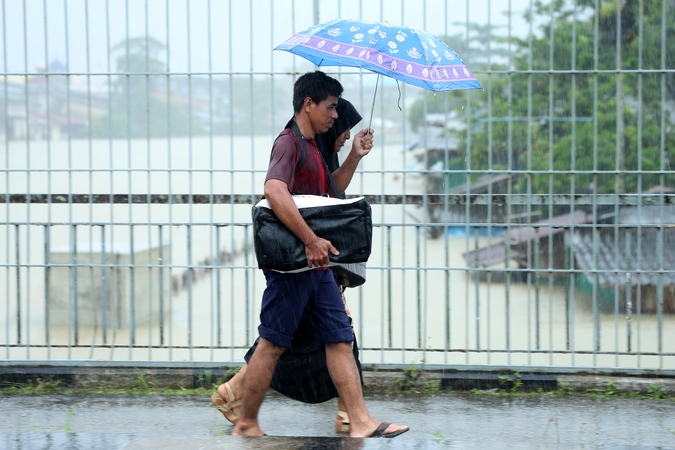
People in the South should beware of severe weather conditions that may cause flash floods, the Thailand Meteorological Department said on Friday.
A rather strong northeast monsoon covers the Gulf and the South, bringing thundershowers and isolated heavy to very heavy rain, the department said. Waves in the Gulf are about two metres high and above two metres in thundershowers. All ships should proceed with caution.
Meanwhile, a rather strong high-pressure system from China has extended to cover upper Thailand and the South China Sea. The department predicted cool to cold weather with temperature falling by 1-2 degrees Celsius and strong winds over upper Thailand. Mountaintops remain cold to very cold.
The weather forecast for the next 24 hours:
North: Cool to cold weather with fog in the morning; minimum temperature 15-21 degrees Celsius, maximum 30-34°C; temperature on hilltops is likely to drop to 5-14°C with frost in some areas.
Northeast: Cool to cold weather with strong winds; minimum temperature 13-19°C, maximum 29-31°C; temperature on hilltops is likely to drop to 8-14°C.
Central: Cool weather in the morning; minimum temperature 20-22°C, maximum 31-34°C.
East: Cool weather in the morning with strong winds; minimum temperature 20-23°C, maximum 32-34°C; waves a metre high and 1-2 metres off shore.
South (east coast): Mostly cloudy with thundershowers in 70 per cent of the areas and isolated heavy to very heavy rain; minimum temperature 22-23°C, maximum 27-33°C; waves two metres high and over two metres during thundershowers.
South (west coast): Mostly cloudy with thundershowers in 60 per cent of the areas and isolated heavy rain; minimum temperature 22-24°C, maximum 26-32°C; waves a metre high and 1-2 metres during thundershowers.
Bangkok and surrounding areas: Cool weather in the morning; minimum temperature 21-23°C, maximum 32-34°C.
The second phase of the “We Travel Together” tourism stimulus campaign may be scrapped over corruption fears, according to a source familiar with the matter.
So far, more than 200 people have been prosecuted for defrauding this and other government schemes to stimulate the pandemic-hit economy.
According to the source, plans to extend the “We Travel Together” campaign with another one million discounted rooms may be cancelled. Meanwhile plans to issue more Bt600 and Bt900 daily food and travel coupons under the scheme are on hold pending investigation of corruption.
PM Prayut Chan-o-cha was reportedly furious when he heard details of the graft while chairing Thursday’s meeting of the Centre for Covid-19 Situation Administration (CCSA) executive. Afterwards he instructed Deputy Police Chief Piya Utayo to find ways of punishing the culprits.
He also sought the public’s cooperation in bringing the cheats to justice.
“Solving the problem of corruption is not just the responsibility of the state,” Prayut said after the CCSA meeting.
“All parties must cooperate – givers, receivers and service providers. They must help each other by providing information so that we can arrest these fraudsters,” he added.
Prayut pointed out that “We Travel Together” was aimed at helping hotel and other tourism-related businesses recover from the impact of the Covid-19 crisis. The PM and government agencies were scrambling to find budget and set up projects, only to see them end in corruption, he complained.
Government corruption hit a new high under the post-coup National Council for Peace (NCPO) junta, according to a report released by the National Anti-Corruption Commission recently .
Prime Minister Prayut Chan-o-cha, who led the NCPO junta after staging the 2014 coup, acknowledged the report’s findings but said the figures drew mostly on complaints of corruption rather than proven cases.
He said that people would always try to cheat the system but said he did not want to reveal the names of the culprits.
Instead, he ordered the Prime Minister’s Office to publicise the achievements of his government to show how “well it had served the people”.
Asked whether each ministry would now be inspected for corruption, he said monitoring for government graft was the media’s job. He added that government officials preferred working behind closed doors because they were afraid of being attacked by the media if they were too transparent.
 PM Prayut Chan-o-cha
  Prayut Chan-o-cha
  คณะกรรมการจัดงานเคาท์ดาวน์นิวยอร์กไม่อนุญาตให้ประชาชนเข้าพื้นที่จัดงานย่านไทม์สแควร์ แต่จะถ่ายทอดสดให้ประชาชนได้ชมเพื่อป้องกันโควิดแพร่ระบาด
 กูเกิลออกแถลงการณ์ขอโทษผู้ใช้งานหลังระบบ Gmail เกิดปัญหาล่มซ้ำเป็นวันที่2 ในช่วงเช้ามืดวันนี้ตามเวลาในประเทศไทย ส่งผลกระทบต่อผู้ใช้ทั่วโลก













 SootinClaimon.Com