Bangkok’s new central station derailed by diesel smoke, car damage and typos
WEDNESDAY, JANUARY 25, 2023
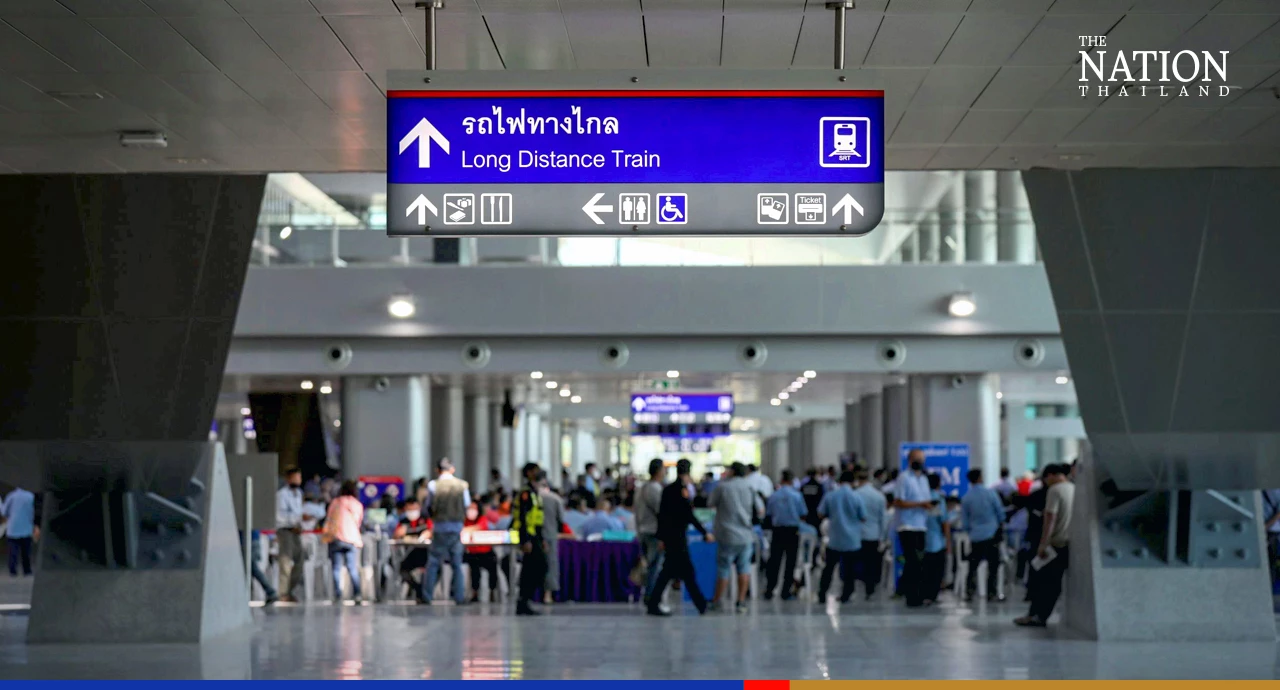
State Railway of Thailand (SRT) has vowed improvements at Bangkok’s Krung Thep Aphiwat Central Terminal after numerous complaints from passengers.
The agency admitted “many issues” had arisen at the new 34-billion-baht national terminus in Chatuchak district after it became the hub for long-distance trains running North, Northeast and South last week.
“SRT governor Nirut Maneepan has ordered its officials to improve services in response to passengers’ complaints as soon as possible,” SRT public relations director Ekarat Sriarayanpong said on Tuesday.
Delays caused by damage to carriages would be solved as soon as possible by procuring new carriages, he said.
He said staffing levels would be beefed up to ensure timely information is conveyed over loudspeakers and in person to passengers.
He also apologised for confusion caused by misspelling of destinations.
“Regarding typos on trains’ destination signs that went viral on social media, the SRT would like to apologise for this failure,” he said.
The signs should be corrected this week, he added.
Meanwhile, air purifiers have been installed to solve the problem of smoke pollution on second-floor platforms caused by diesel trains.
He added that the SRT plans to use electric locomotives to tackle the pollution issue in the long term.
Phuket blasts Covid gloom with 2.6-billion-baht Chinese New Year weekend
WEDNESDAY, JANUARY 25, 2023
More than 158,000 Thai and foreign tourists visited Phuket over the Chinese New Year last weekend (January 21-22), generating 2.6 billion baht in revenue after three years of Covid devastation.
The island’s Old Town was bustling with visitors from Europe, Russia and China who came to take photos of the heritage Sino-Portuguese shophouses and purchase souvenirs. Thai tourists arriving for the weekend added to the crowds, filling streets that were deserted a year ago with holidaymakers. Locals on the tourism-dependent island were in a festive mood, driving out the Covid gloom with fireworks and crackers to welcome the Year of the Rabbit.
Phuket is home to a large Chinese-Thai community with unique traditions rooted in history.
Travel restrictions in China were lifted on January 8, just in time for Chinese travellers to book Lunar New Year holidays in the southern province.
Nanthasiri Ronnasiri, Tourism Authority of Thailand (TAT) director for Phuket, confirmed accommodation and attractions on the island were doing brisk business.
“Phuket’s hotel occupancy rate on January 21-22 was 71.96%,” she said, adding that Phuket Airport saw 121 flights over the weekend.
The province’s local Chinese New Year festival continues this weekend, while traditional lanterns will light up the Old Town and Limelight Avenue mall until February 5.
Cross-country motorways, Koh Lanta bridge on Thailand’s THB31bn road menu
WEDNESDAY, JANUARY 25, 2023
Thailand will spend 30.95 billion baht on building roads this year, including interprovincial highways (motorways), expressways, and missing links, according to the government.
About 11.2 billion baht of this investment will come from state budget, while 19.75 billion baht will come from other sources, government spokeswoman Trisulee Trisaranakul said on Tuesday.
She added that the construction of the M6 motorway (Bang Pa-In to Nakhon Ratchasima) is now 98% complete while the M81 motorway (Bang Yai to Kanchanaburi) is 85% complete. Both motorways should be ready for public use in 2025.
The Rama III-Dao Khanong-Western Bangkok Outer Ring Expressway, which will increase traffic flow to the South, is now 45.25% complete, while the M82 motorway (Bang Khun Tian-Ekachai-Ban Phaeo) is 77.22% complete. Both projects are also expected to open for traffic in 2025.
Two transport projects are expected to finish next year, namely the fifth Thai-Laos Friendship Bridge (Bueng Kan-Bolikhamxai), and the road connecting the Aircraft Repair Station and the third Thai-Laos Friendship Bridge in Nakhon Phanom.
Two missing link projects were approved by the Cabinet in 2022 and will start this year. They are the Songkhla Lake Bridge to connect Songkhla and Phatthalung, and the Koh Lanta Bridge to link Koh Lanta Klang and Koh Lanta Noi in the Andaman Sea.
The projects will aid people’s transport, promote tourism, and boost economies at the regional level, Trisulee said.
Deputy PM Anutin Charnvirakul has tasked the Transport Ministry with ensuring that these transport mega projects finish within deadlines, she added.
Sustainable development is main focus of Thai Children’s Day event at UNESCAP
WEDNESDAY, JANUARY 25, 2023
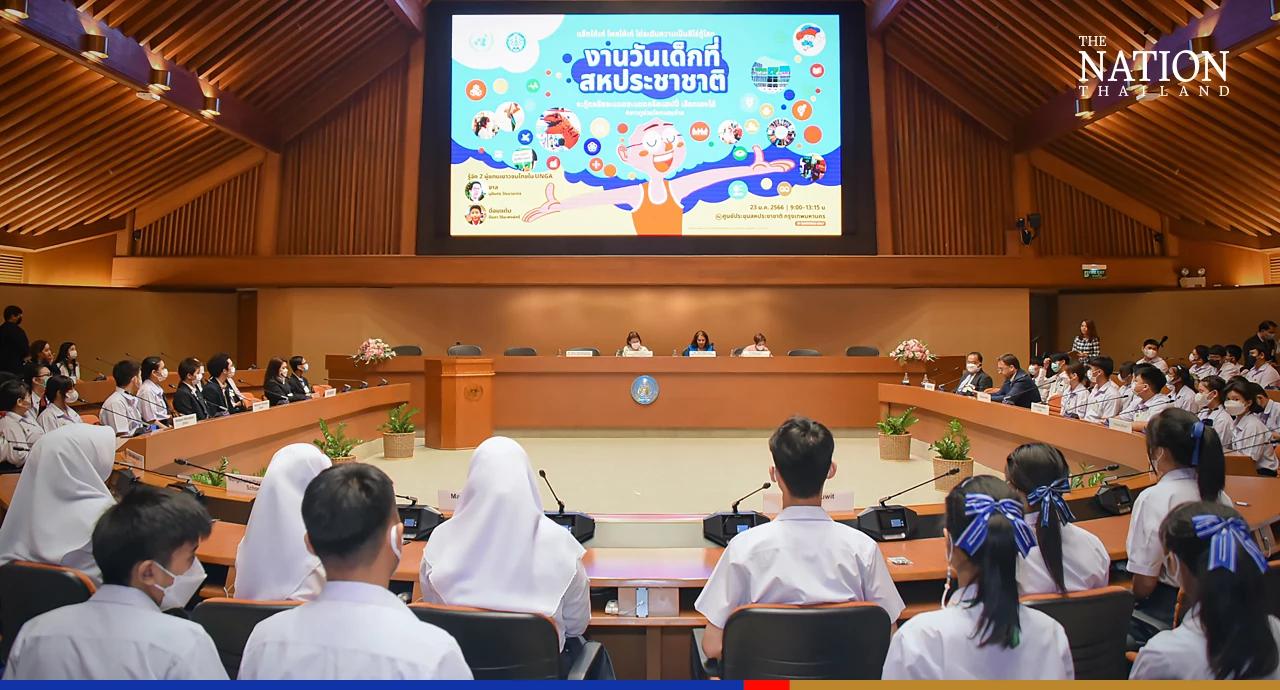
On January 23, Eksiri Pintaruchi, Director-General of Department of International Organizations, together with Gita Sabharwal, Resident Coordinator for Thailand, and Atchara Seriputra, Vice President of the United Nations Association of Thailand (UNAT) delivered the opening remarks at the Thai Children’s Day event organized at the United Nations Conference Centre under the theme “Youth and Sustainable Development”.
Sanon Wangsrangboon, Deputy Governor of Bangkok also attended the event and gave a keynote speech on the same topic.
In her opening remarks, Eksiri emphasised the important role of youth in promoting sustainable development and accelerating the implementation of the Sustainable Development Goals (SDGs). She highlighted that SDGs are closely linked to the daily lives of youth in various dimensions and encouraged young people to be involved in Thailand’s implementation of SDGs, especially during the Decade of Action where the international community must achieve these Goals by 2030.
Eksiri also commented on one of the Ministry of Foreign Affairs’ initiatives to promote youth participation in multilateral diplomacy by selecting representatives of the Thai youth to join Thailand’s official delegation at the United Nations General Assembly (UNGA).
Sabharwal reaffirmed the commitments of the 21 agencies of the UN Country Team (UNCT) in working closely with the Royal Thai Government. She also added that the initial idea for today’s event came directly from young people she met last year. She commended Thailand’s efforts in promoting sustainable development and achieving SDGs through its home-grown approaches including the Sufficiency Economy Philosophy (SEP) and the Bio-Circular-Green Economy Model (BCG).
During his keynote remarks, the Deputy Bangkok Governor highlighted the importance of youth as the future of cities and bearers of their own future. In this regard, he mentioned numerous initiatives by the Bangkok Metropolitan Authority (BMA) to support the city in achieving SDGs as well as empowering and building capacity for the children and youth of Bangkok. These initiatives include, for example, fostering equitable access to education and creating space for youth to express themselves.
In addition, Munithorn Wattanayakorn and Pinda Wiriyapongsri, Thai youth delegates at the UNGA73 (2018) and UNGA77 (2022) shared their experience of representing Thai youth at the UN General Assembly in New York. They also exchanged views with the students on the role of youth in promoting sustainable development and SDGs.
The Thai Children’s Day event at UNESCAP is a collaboration between the Ministry of Foreign Affairs, the Office of the UN Resident Coordinator, the Bangkok Metropolitan Authority and the United Nations Association of Thailand. The event was well-attended by over 150 students and teachers from 11 middle and high schools under the BMA. Many UN agencies also took part in organizing activity booths, including the United Nations Development Programme (UNDP), United Nations Children’s Fund (UNICEF), and the United Nations Educational, Scientific and Cultural Organization (UNESCO).
Capital investment up by THB200m in 2022, but nearly 22,000 businesses fold up
WEDNESDAY, JANUARY 25, 2023
As many as 21,880 businesses with a total registered capital of 127.04 billion baht ceased operations in 2022, the Department of Business Development said on Wednesday.
“This is in line with liquidation trends in the past five years,” said Thosapone Dansuputra, the department’s director-general.
The top three types of businesses going into liquidation were: 2,012 general building construction enterprises, which accounted for 9% of total enterprises that went into liquidation, followed by 1,023 real estate firms (5%), and 623 restaurant businesses (3%).
Businesses with less than 1 million baht capital accounted for 71.52%, or 15,649 businesses. It was followed by 5,200 businesses with capital of 1-5 million baht (23.77%); 916 businesses with 5-100 million baht capital (4.19%), and 115 businesses exceeding 100 million baht capital (0.53%).
In 2022, 76,488 new businesses were established across the country, 3,530 — or 5% — more than in 2021.
The top three businesses were general construction (7,061), accounting for 9%; real estate (4,833), accounting for 6%; and restaurant (3,014) accounting for 4%.
Total capital investment of newly established business was 429.82 billion baht in 2022, up 200.02 billion baht, — 87.04% — over 2021.
Of the newly established businesses, 52,674 (68.84%) have capital of less than 1 million baht; 22,583 businesses (29.52%) have capital in the range of 1-5 million baht; 1,014 businesses (1.33%) have capital of 5-100 million baht; and 217 businesses (0.28%) have capital of over 100 million baht.
As many as 850,480 businesses with a total capital of 21.19 trillion baht are operating in Thailand, as of December 2022.
Of the total, 200,437 — 23.57% — were limited partnership and registered ordinary partnership; 648,661 — 76.27% — were limited companies; and 1,382 — 0.16% — were public limited companies.
Meanwhile, 499,669 businesses — 58.75% — have less than 1 million baht in capital, followed by 257,061 businesses (30.22%) with 1-5 million baht capital, 76,340 businesses (8.98%) with 5-100 million baht capital, and 17,410 businesses (2.05%) with more than 100 million baht.
Despite global slowdown, Asia’s economies show resilience and growth for 2023
WEDNESDAY, JANUARY 25, 2023
Asia can defy a global economic slowdown in 2023 through an acceleration in digital transformation, greater regional coordination, and balanced monetary policies, according to new research from the London-based think tank, Asia House.
The Asia House Annual Outlook 2023 examines how Asia’s economies can prevail and deliver robust growth through increased domestic demand for goods and services, countering the global headwinds of high inflation, tighter monetary policy and increasing geopolitical tensions.
Key among the Annual Outlook’s recommendations are those relating to prioritising innovation – to spur carbon pricing, lower green premiums for zero-carbon alternatives, and boost underfunded and high-impact projects with blended finance.
‘Asia is likely to prove resilient if investment and financial flows are directed to digital and green innovation to underpin sustainable growth and investment,’ the Annual Outlook finds.
However, and mirroring the global outlook, Asia is susceptible to risk and faces multiple and multi-faceted shocks, such as energy-price volatility, geopolitical conflict, and higher borrowing costs.
Asia House assessed eight key economies in Asia across metrics conducive to meeting these challenges. In two indices published today, the think tank analyses the performance of China, India, Indonesia, Japan, Malaysia, the Philippines, Thailand, and Vietnam in the critical areas of green finance and digitalisation readiness – areas that will unlock future productivity and enable sustainable growth across the continent.
Asia House’s Economic Readiness Indices suggest that prioritising economic readiness to tackle both climate change and digitalisation, and the policies that link the two, will create higher growth.
China will see increased growth – albeit sluggish – having abandoned its zero-Covid policies. It also shows an improvement in its scores for economic readiness for green finance.
India will see continued economic recovery and is on track to be one of the fastest-growing economies globally. However, the country is susceptible to financial volatility and it has the lowest readings in readiness for both green finance and digitalisation.
Japan is likely to bear the brunt of multiple financial shocks, including a weak yen and higher energy prices – both of which reduced its Readiness Index for green finance. Japan’s digital readiness scores improved for 2023.
Vietnam is likely to register one of the strongest economic growth rates in 2023, owing in part to its vibrant external sector and domestic policy settings that will catalyse inward investment.
Malaysia is making significant strides, underpinned by the strength of domestic demand and digitalisation.
Thailand‘s economic readiness readings for green finance registered the largest rise according to Asia House.
Indonesia will show economic resilience in 2023. It has struck the right balance in monetary policy in terms of encouraging growth while taming inflation.
The Philippines is likely to grow, which presents an opportunity for the country’s policymakers to improve the domestic ecosystem for green finance and digitalisation.
Asia House comment
Michael Lawrence, Chief Executive of Asia House: “Against the backdrop of a weak global economic outlook for 2023, Asia’s economies may defy the trend and deliver robust growth despite the challenges of high inflation, rising interest rates, fuel price volatility and geopolitical tensions.
“The Asia House Annual Outlook is published to give key insights into the region’s economies and increase understanding of the opportunities and obstacles in Asia in an increasingly unpredictable and turbulent world”.
Phyllis Papadavid, Director of Research and Advisory, Asia House: “Our outlook indicates that Asia’s growth prospects continue to hinge on an acceleration in digital transformation, greater regional coordination, and striking the right balance in broader monetary policy across the region.
“Furthermore, the Asia House Economic Readiness Indices suggest that prioritising economic readiness for both climate change and digitalisation, and the policies that link the two, will be essential for Asia’s higher growth trajectory.”
Policy recommendations
Drawing on the Indices, the Asia House Annual Outlook 2023 report includes several recommendations for policymakers across Asia.
Scaled-up regional coordination in Asia is necessary to bolster economic integration further, particularly in the form of expanded economic zones and investment corridors.
Enhanced and coordinated reserve management is needed at a time when Asia’s reserves are declining.
By adopting carbon-pricing mechanisms, the ‘green-premium’, or the additional costs of opting for green technology, will be reduced. The leveraging of private investment and risk absorption will support scaled-up sustainable finance.
Innovations in blended finance – using development funds to spur private investment – need to funnel capital into high-impact and under-capitalised green projects.
Asia’s broader digital access and digital skills, particularly in the rural sectors in its larger economies, is a policy gap.
Thai exports fell for third successive month in December
WEDNESDAY, JANUARY 25, 2023
Thai exports fell for a third consecutive month in December but the 2022 total rose 5.5% year on year to US$287.06 billion (9.406 trillion baht), according to the Commerce Ministry.
Total imports last year rose 13.6%, leading to a trade deficit of $16.122 billion (528.56 billion baht).
December saw exports contract 14.6% year on year while imports shrank 12%, generating a trade deficit of US$1.03 billion (33.85 billion baht).
December’s export contraction was driven by industrial products (down 15.7%), agricultural products (down 11.6%), and agro-industrial products (down 10.8%).
Thai export markets that saw the biggest expansion in 2022 were the Middle East, United Kingdom, Canada, United States, CLMV, other Asean countries and South Asia.
Thai export growth last year was led by sugar, telephones, gems and jewellery, vegetable/animal fats and oil, transformers and components, semiconductors, and processed chicken.
The Commerce Ministry has targeted a 1-2% export expansion in 2023, lower than the 4% targeted in 2022. It said the lower target was due to the stagnating global economy, baht strengthening, rising fuel prices, and manufacturing costs.
Export expansion this year would be driven by the reopening of border checkpoints, increasing global food demand, and easing of global logistics problems including the container shortage, it added.



















 SootinClaimon.Com