มาย ไลฟ์ แอส อะลิ โธมัส (My Life As Ali Thomas) หลังจากเปิดตัวเพลงแรกในอัลบั้มชุดที่สอง ที่ปล่อยออกมาให้ฟังกันกับเพลง “Dear All The Universe” เมื่อเดือนกันยายนที่ผ่านมา พร้อมมีการแสดงเล็กๆ แนะนำตัวงานให้แฟนๆ และสื่อมวลชนได้รู้จัก ซึ่งแสดงให้เห็นภาพลักษณ์และมุมมองใหม่ๆ ในตัวเพลงได้อย่างชัดเจน โดยเฉพาะความสดใสของเรื่องราว และดนตรีที่ฟังผ่อนคลายมากขึ้น
วันนี้ มาย ไลฟ์ แอส อะลิ โธมัส วงดนตรีไทยวงแรกที่ได้เล่นในงานเซาธ์บายเซาธ์เวสท์ (SXSW)งานสำคัญของอุตสาหกรรมบันเทิงในสหรัฐอเมริกา เมื่อปี 2019 จะพาไปพบกับซิงเกิ้ลที่สอง “Baby, I Love You” ในเพลงนี้วงจะนำเสนอเรื่องราวความรักในแบบ “สมจริง” เพราะ “Baby, I Love You” ไม่ใช่เพลงรักแบบหนุ่ม-สาว ที่เต็มไปด้วยความฝัน หรือไม่ได้บอกเล่าความพยายามชนะใจใครบางคน หากเป็นการถ่ายทอดความรู้สึกดีๆ ที่มีต่อคนที่เรารัก แสดงออกถึงความสุขที่มีเขาหรือเธออยู่ในชีวิต รวมไปถึงความสำคัญของคนคนนั้น
ชมมิวสิกวีดีโอที่จับใจเหลือเกินของ “Baby, I Love You” รวมไปถึงเพลงอื่นๆ ของวงกันได้ที่ YouTube Channel : My Life As Ali Thomas แล้วกลางปี 2021 เรามาสัมผัสกับงานชุดใหม่ของ มาย ไลฟ์ แอส อะลิ โธมัส ที่การันตีได้เลยว่า สมค่าการรอคอยแน่นอน โดยวอร์นเนอร์ มิวสิค
แชมป์แกะสลักหิมะนานาชาติโชว์แกะสลักน้ำแข็งเพ้นท์ควายไทยในงาน UBON ART FEST 2020
วันศุกร์ ที่ 11 ธันวาคม พ.ศ. 2563, 19.17 น.
อาชีวะอุบลฯแชมป์แกะสลักหิมะนานาชาติโชว์แกะสลักน้ำแข็งสุดประทับใจ เพ้นท์ควายไทย และแสดงศิลปะในงาน UBON ART FEST 2020 เสพงานศิลป์วิถี New Normal งานศิลปะครั้งแรกที่ยิ่งใหญ่ในอุบล
By The Washington Post · Laurie McGinley, Carolyn Y. Johnson
WASHINGTON – The Food and Drug Administration on Friday gave emergency use authorization to the nation’s first coronavirus vaccine, launching what scientists hope will be a critical counteroffensive against a pathogen that has killed more than 290,000 Americans, shredded the nation’s social and political fabric and devastated the economy.
The historic authorization of the vaccine from Pfizer and BioNTech, just 336 days after the genetic blueprint of a novel coronavirus was shared online by Chinese scientists, sets in motion a highly choreographed and complex distribution process aimed at speeding vaccines throughout the United States to curb the pandemic.
The FDA action came after White House Chief of Staff Mark Meadows on Friday told FDA commissioner Stephen Hahn to be prepared to submit his resignation if the agency did not clear the vaccine by day’s end, according to people familiar with the situation who spoke on the condition of anonymity because they were not authorized to discuss what happened.
Meadows’s threat followed months of efforts by FDA scientists to try to ward off President Donald Trump’s importuning on the vaccine and keep the review process apolitical and transparent in hopes of boosting public confidence in the shots. The FDA already had planned to clear the vaccine Saturday morning, and accelerating the authorization to Friday night was not expected to change the delivery timeline of the first shots.
The nation set a record for covid-19 deaths Thursday for the second day in a row, surpassing 3,300. The death tally for Friday was 2,950, only slightly lower, bringing the U.S. death toll to nearly 295,000.
Federal officials have said distribution of the first 2.9 million doses of the highly effective vaccine would begin within 24 hours of an authorization. Meanwhile, an advisory committee for the Centers for Disease Control and Prevention, which has recommended that health-care workers and nursing home residents be the first recipients, was expected to bless the vaccine on Saturday, paving the way for inoculations to begin early next week.
The vaccine achievement creates a paradigm for vaccine development, proving that fast and flexible technologies paired with a single-minded focus by pharmaceutical companies and government can accomplish in 11 months what typically takes years. And it marks a rare triumph for the Trump administration, which in many other areas – such as ensuring adequate testing supplies and providing consistent guidance on whether to wear masks – has failed to produce a coherent and sustained response to the crisis.
“It’s an all-capital-letters, followed by several exclamation points,” accomplishment, said Howard Markel, a medical historian at the University of Michigan who predicted that the scientists who were responsible will be lionized for ending the pandemic.
Daniel Carpenter, a political scientist at Harvard University, said it was unprecedented to go from the discovery of a disease to the development of a vaccine in 11 months. The shortest timeline previously was for the mumps vaccine, which took four years. Most vaccines are produced for ailments that have been around for a long time, after years of research often marked by failures and disappointments. In the case of AIDS, there still is no vaccine, nearly four decades after HIV was identified.
Pfizer and its Germany-based partner, BioNTech, harnessed a fast, flexible genetic technology that had been in development for decades but never deployed in an approved medical product. It was used to build a vaccine that surpassed all expectations by being 95 percent effective at preventing disease in a clinical trial with tens of thousands of participants. The vaccine has already been approved in Britain, Canada, Saudia Arabia and Bahrain.
Meanwhile, the FDA, working closely with the companies, conducted an accelerated review that compressed into three weeks the typical months-long scrutiny of safety, effectiveness and data on manufacturing quality.
Operation Warp Speed, the administration’s effort to accelerate the development and distribution of coronavirus vaccines and treatments, has spent billions of dollars on a portfolio of vaccines, with Pfizer-BioNTech’s being the first to cross the finish line. Unlike the other companies, Pfizer and BioNTech did not take government money for research and development, but they did receive a $1.95 billion contract for 100 million doses, about 25 million of which will be delivered this year.
“To get there has required a host of innovations. . . . Any one of those would have been cause for considerable amazement,” said Francis Collins, director of the National Institutes of Health. “But when you put them together, it’s a path so revolutionary it would be hard to imagine somebody contemplating it five years ago.”
But while the vaccine enterprise has been impressive, its credibility has been repeatedly threatened by Trump, who for months pressured the FDA to authorize a vaccine before Election Day and, when that did not happen, bitterly accused the agency and Pfizer of deliberately orchestrating delays to harm his reelection prospects. On Friday, he continued his criticism on Twitter, calling the agency “a big, old, slow turtle,” adding, “Get the dam vaccines out NOW.”
The White House maneuvers seemed designed to ensure Trump gets credit just as the vaccine crosses the finish line. But experts said his behavior risked undermining public confidence – not because it would force a vaccine through prematurely but because it could create the appearance that politics, not science, drove the decision.
“There was no plausible way the FDA would not authorize this vaccine . . . but this makes it appear [their decision] is politically motivated,” said Dorit Reiss, a professor of law who writes about vaccine policy at the University of California Hastings College of the Law. “Making it appear there was political pressure will undermine trust.”
Hahn, in a statement Friday, dismissed reports that his job was threatened. “This is an untrue representation of the phone call with the Chief of Staff,” he said. “The FDA was encouraged to continue working expeditiously on Pfizer-BioNTech’s EUA request. FDA is committed to issuing this authorization quickly, as we noted in our statement this morning.”
The White House said in an email that “we don’t comment on private conversations, but the Chief regularly requests updates on progress toward a vaccine.”
The political machinations are in sharp contrast to the impressive scientific achievement of producing a vaccine in record time. The Pfizer-BioNTech product, and the one right on its heels, from biotechnology company Moderna, use a snippet of genetic material encapsulated in a fat bubble to instruct cells to build the spiky proteins that dot the coronavirus. These shots will be the first time the genetic technology has been used in people outside clinical trials.
The government’s big bet on the promising method, which allowed for much faster vaccine development, was controversial but is paying off: Moderna’s shot is expected to be authorized shortly after a review by the FDA’s outside advisers scheduled for Thursday. The biotech companies behind the vaccines, Moderna and BioNTech, have never made a commercial product but ballooned into pharmaceutical heavyweights, with Moderna valued at $60 billion and BioNTech at $30 billion.
“I feel focused, and I feel also that this is a huge task,” said Ugur Sahin, chief executive of BioNTech.
While a potential lifesaver for those who receive it, the new coronavirus vaccine is not likely to have a dramatic impact on the immediate course of the pandemic. The supply of vaccines will initially fall far short of the 300 million doses some officials had hoped for last spring, when Operation Warp Speed was created.
In addition, formidable challenges lay ahead involving the massive scale-up of manufacturing and a complicated distribution plan overseen by cash-strapped states. On scientific questions, experts still do not know how long the vaccine’s protection lasts.
While the CDC’s Advisory Committee on Immunization Practices has recommended that health-care workers and nursing home residents be first in line for the vaccine, states ultimately will have the final say on which groups get priority. Much of the general population – including younger people who do not have underlying health conditions or jobs that put them at risk – are unlikely to be offered the vaccine before late spring or early summer. And if a significant proportion of Americans spurn the shot, efforts to banish the coronavirus or turn it into a low-level threat could be made much more difficult.
Still, the unquestionably good news on the Pfizer shot arrives as other vaccines also have moved forward: AstraZeneca and the University of Oxford published results in a peer-reviewed journal, China’s Sinopharm announced positive results, and Russia has reported promising data on a vaccine. But even multiple successful vaccines may not prove enough to reach all the world’s people.
“The entire world is seeing the light at the end of the tunnel, but for most of the world, they are still in a very, very long tunnel, and that’s the problem,” said Richard Hatchett, chief executive of the Coalition for Epidemic Preparedness Innovations, a nonprofit group that funds vaccine development. “The reason we’ve developed the vaccine is to end the pandemic, and you don’t end the pandemic until you . . . protect the most vulnerable people, who are globally distributed.”
The FDA’s action came the day after an agency advisory committee found that the benefits of the Pfizer vaccine exceeded the known risks and recommended that an emergency use authorization be granted for people 16 and older. The agency directed Pfizer to keep a close eye on possible allergic reactions after British health authorities reported two recipients had severe allergic responses after being vaccinated Tuesday.
FDA emergency authorizations are temporary approvals used to accelerate the availability of medical products during a public health emergency. They require less data than regular approvals and can be issued based on a lower standard. In the case of a vaccine, however, the FDA has said it would use rigorous criteria because millions of healthy people are expected to receive it.
The first 2.9 million shots are expected to be shipped to more than 600 sites – mostly large health-care systems – from Pfizer’s freezer farm in Kalamazoo, Mich., in special coolers packed with 50 pounds of dry ice. The vaccines must be kept at sub-Antarctic temperatures, by refreshing the coolers or by storing doses in an ultra-low-temperature freezer.
The government is holding back another 2.9 million doses for the second shot, to be administered 21 days later, and reserving 500,000 doses in case some are lost or spoiled. Officials say it will take time for nursing homes to coordinate with the pharmacy chains responsible for administering shots at those sites. CVS Health plans to administer the first shots of the Pfizer-BioNTech vaccine in nursing homes Dec. 21, according to spokesman T.J. Crawford.
Government officials project that Moderna and Pfizer will be able to deliver 40 million doses of vaccine this year, enough for 20 million people to receive the full regimen. The pace of vaccination is projected to increase in the first months of next year as manufacturing capacity increases and as other vaccines potentially come online. Data on the effectiveness of a one-shot vaccine from Johnson & Johnson is expected in early January.
But long-term questions about the supply remain. The United States has secured only 300 million shots – enough for 150 million people – from Pfizer-BioNTech and Moderna and needs hundreds of millions of additional doses to cover the populace. The country has secured additional doses from other vaccine makers, but it is still uncertain whether those vaccines will be successful.
FDA scientists, in their review of the Pfizer data, confirmed the vaccine was safe and highly effective at preventing illness after two shots spaced three weeks apart. They identified a promising signal that the vaccine appeared to provide a level of protection even after a single shot, meaning that vaccinations could begin to have an impact sooner than many had expected.
In its effort to clear the first coronavirus vaccine, the FDA has faced daunting technical and political challenges.
For months, the agency has tried to balance pressures to expedite the vaccine with the need to keep standards high, to reassure the public that a vaccine produced in record time would be safe and effective.
Adding to the sensitivity was the agency’s effort to bolster its own credibility. Its image was tarnished when earlier in the year it authorized hydroxychloroquine, a malaria medicine that Trump repeatedly touted as a covid-19 treatment, then revoked that authorization when subsequent data showed it could be harmful.
In August, Hahn overstated the benefits of another treatment, convalescent plasma, during a briefing with Trump. Stung by criticism from the scientific community, Hahn apologized and began speaking out about the importance of agency career scientists’ making independent decisions.
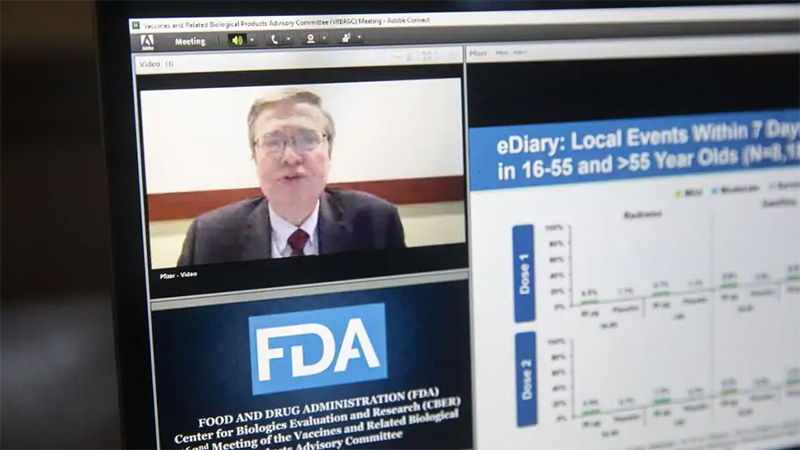
Peter Marks, director of the agency’s Center for Biologics Evaluation and Research, which oversees vaccines, said during a recent American Medical Association webinar that the FDA helped expedite the clinical trial process by eliminating “dead spaces” that typically occur between phases of investigation by vaccine makers.
To ensure that companies understood the FDA’s expectations, the agency took the unusual step of issuing guidelines in June that specified any vaccine should be at least 50 percent effective compared with a placebo, or saltwater shot. A few months later, after it became clear the agency would employ an emergency use authorization to clear the vaccine, the FDA spelled out detailed standards and called for the manufacturers to produce two months of safety data on half of the trial participants.
That safety requirement meant any vaccine would be delayed until after Election Day, infuriating Trump, who tweeted angrily about the FDA and Pfizer. White House ire intensified when Britain authorized the vaccine first, on Dec. 2.
On the AMA webinar, Marks acknowledged that the agency had paid a price for its careful scrutiny. “Unfortunately, there is a cost to being this careful. Another regulatory agency made the vaccine available before we did,” he said. “That’s because we are really taking care to make sure when people get this vaccine, we will have really vetted it for safety.”
Harvard’s Carpenter said being careful will pay off in the long run with greater acceptance of the vaccine, boosting public health. “You need to think about the confidence effects,” he said.
By The Washington Post · Laurie McGinley, Carolyn Y. Johnson, William Wan
WASHINGTON – The Food and Drug Administration was poised Friday evening to authorize the nation’s first coronavirus vaccine, launching what scientists hope will be a critical counteroffensive against a pathogen that has killed more than 290,000 Americans, shredded the nation’s social and political fabric and devastated the economy.
The vaccine’s clearance was moved up by about 12 hours after the White House pressured the agency Friday to complete its work by day’s end. White House Chief of Staff Mark Meadows on Friday told FDA Commissioner Stephen Hahn to be prepared to submit his resignation if the agency did not authorize the vaccine by the end of the day, according to people familiar with the situation who spoke on the condition of anonymity because they were not authorized to discuss what happened.
Meadows’s threat followed months of efforts by FDA scientists to keep the review process apolitical and transparent in hopes of boosting public confidence in the shots. The FDA already had planned to clear the vaccine Saturday morning, and accelerating the authorization to Friday night was not expected to change the timeline for the first shots.
The last-minute injection of chaos and pressure into the approval process comes at a crucial inflection point, with record-setting daily death tolls projected to worsen this winter, even as federal, state and local officials prepare an unprecedented mass vaccination effort.
The nation set a record for covid-19 deaths on Thursday, the second day in a row with more than 3,300 reported. The death tally for Friday was 2,950, only slightly lower, while more than 237,000 new infections were reported.
While a potential lifesaver for those who receive it, the vaccine is not likely to have a dramatic impact on the immediate course of the pandemic. The initial supply of vaccines will fall far short of the 300 million doses some officials had hoped for last spring, when Operation Warp Speed was created. On Friday, federal officials announced they would purchase an additional 100 million doses of Moderna’s soon-to-be approved vaccine, bringing the expected supply of the two leading vaccines to 300 million, probably by midyear.
Still, many saw the imminent arrival of even a limited supply as a source of hopeamid forecasts of a deadly winter.The two-shot vaccine, which has been shown to be 95 percent effective in randomized trials involving tens of thousands of people, has already been cleared by Britain, Canada, Bahrain and Saudi Arabia.
The vaccine from Pfizer and German firm BioNTech was expeceted to be authorized just 336 days after the genetic blueprint of a novel coronavirus was shared online by Chinese scientists. Its clearance would set in motion a highly choreographed and complex distribution process aimed at speeding vaccines throughout the United States.
Federal officials have said distribution of the first 2.9 million doses would begin within 24 hours of the agency’s announcement. An advisory panel for the Centers for Disease Control and Prevention has recommended that health-care workers and nursing home residents be the first recipients, and is expected to give its final blessing to the vaccine this weekend, paving the way for inoculations to begin early next week.
The record-breaking time frame of the vaccine’s development creates a new paradigm, proving that fast and flexible technologies paired with a single-minded focus by pharmaceutical companies and government can accomplish in 11 months what typically takes years. It also marks a rare triumph for the Trump administration, which in many other areas – such as ensuring adequate testing supplies and providing consistent guidance on masks – has failed to produce a coherent and sustained response to the crisis.
“It’s an all-capital-letters, followed by several exclamation points” accomplishment, said Howard Markel, a medical historian at the University of Michigan who predicted that the scientists who were responsible will be lionized for ending the pandemic.
Pfizer and its Germany-based partner, BioNTech, harnessed a fast, flexible genetic technology that had been in development for decades but never deployed in an approved medical product. It was used to build a vaccine that surpassed all expectations by being 95 percent effective at preventing disease in a large clinical trial.
Harvard political scientist Daniel Carpenter said it was unprecedented to go from the discovery of a disease to the development of a vaccine in 11 months. The shortest timeline previously was for the mumps vaccine, which took four years. Most vaccines are produced for ailments that have been around for a long time, after years of research often marked by failures and disappointments. In the case of AIDS, there still is no vaccine, nearly four decades after HIV was identified.
Meanwhile, the FDA, working closely with the companies, conducted an accelerated review that compressed into three weeks the typical months-long scrutiny of safety, effectiveness and data on manufacturing quality.
Operation Warp Speed, the administration’s effort to accelerate the development and distribution of coronavirus vaccines and treatments, has spent billions of dollars on a portfolio of vaccines, with Pfizer-BioNTech’s being the first to cross the finish line. Unlike the other companies, Pfizer and BioNTech did not take government money for research and development, but they did receive a $1.95 billion contract for 100 million doses, about 25 million of which will be delivered this year.
“To get there has required a host of innovations. . . . Any one of those would have been cause for considerable amazement,” said Francis S. Collins, director of the National Institutes of Health. “But when you put them together, it’s a path so revolutionary it would be hard to imagine somebody contemplating it five years ago.”
But while the vaccine enterprise has been impressive, its credibility has been repeatedly threatened by the president, who for months pressured the FDA to authorize a vaccine before Election Day and, when that did not happen, bitterly accused the agency and Pfizer of orchestrating delays to harm his reelection prospects. On Friday, he continued his criticism on Twitter, calling the agency “a big, old, slow turtle,” adding, “Get the dam vaccines out NOW.”
Experts said the president’s behavior risks undermining public confidence – not because it would force a vaccine through prematurely, but because it creates the appearance that politics, not science, drove the decisions.
“There was no plausible way the FDA would not authorize this vaccine . . . but this makes it appear [their decision] is politically motivated,” said Dorit Reiss, a professor of law at the University of California Hastings College of the Law who writes about vaccine policy. “Making it appear there was political pressure will undermine trust.”
The FDA has repeatedly said its scientists would review the vaccine and come to their own independent judgments, and on Friday, Hahn denied the White House brought pressure to speed the authorization.
“This is an untrue representation of the phone call with the Chief of Staff,” Hahn said in a statement. “The FDA was encouraged to continue working expeditiously on Pfizer-BioNTech’s EUA request. FDA is committed to issuing this authorization quickly, as we noted in our statement this morning.”
A White House official declined to comment on the latest pressure, saying, “We don’t comment on private conversations, but the Chief regularly requests updates on progress toward a vaccine.”
The political machinations are in sharp contrast to the scientific achievement in producing a vaccine in record time. Pfizer-BioNTech’s product, and another vaccine right on its heels from biotechnology company Moderna, both use a snippet of genetic material encapsulated in a fat bubble to instruct cells to build the spiky proteins that dot the coronavirus. These shots will be the first time the genetic technology has been used in people outside clinical trials.
The government’s big bet on the promising method, which allowed for much faster vaccine development, was controversial but is paying off: Moderna’s shot is expected to be authorized shortly after a review by the FDA’s outside advisers scheduled for Thursday.
Formidable challenges lay ahead involving the massive scale-up of manufacturing and a complicated distribution plan headed by cash-strapped states. On scientific questions, experts still do not know how long the vaccine’s protection lasts.
While the CDC has recommended who should get the shots first, starting with health-care workers and nursing home residents, states ultimately will have the final say on which groups get priority.
Much of the general population – including younger people who do not have underlying health conditions or jobs that put them at risk – is unlikely to be offered the vaccine before late spring or early summer. And if a significant proportion of Americans spurn the shot, efforts to banish the coronavirus or turn it into a low-level threat could be made much more difficult.
Pfizer vaccine allergic reactions probed by FDA before clearance
Health & BeautyDec 12. 2020Alex Azar, secretary of Health and Human Services, during a news conference at the White House in Washington on Aug. 23, 2020. MUST CREDIT: Bloomberg photo by Stefani Reynolds.
By Syndication Washington Post, Bloomberg · Anna Edney
The Food and Drug Administration is scrutinizing recent reports of allergic reactions to Pfizer Inc.’s covid-19 vaccine as it readies an emergency-use authorization — a step that could come as soon as this weekend, according to top U.S. health officials.
One of the last things the FDA does before clearing a product for public use is make sure the instructions for doctors and patients on the label include up-to-date information about who should use it and how.
In the past several days, there have been reports of serious allergic reactions to the vaccine in the U.K. After starting immunizations Tuesday, the U.K.’s National Health Service said people with a significant history of allergies shouldn’t receive the shot.
The FDA is seeking more information on the reactions from the U.K. drug regulator, Marion Gruber, director of the Office of Vaccines Research and Review, told a committee of agency advisers Thursday. The panel voted 17-4, with one abstention, that the benefits of Pfizer’s vaccine for people over the age of 16 outweighed any risks.
“That’s something we’re working with Pfizer right now on is the appropriate language for the doctors, is if you have a pre-existing serious allergic reaction to anything in these vaccines or medical allergies, you should exercise caution in getting these vaccines initially,” Health and Human Services Secretary Alex Azar said Friday in an interview with Fox Business News.
Still, any final hurdles are expected to be cleared in relatively short order. The FDA is working toward a rapid authorization of the shot, and has “notified the U.S. Centers for Disease Control and Prevention and Operation Warp Speed, so they can execute their plans for timely vaccine distribution,” the agency said in a statement Friday.
A formal go-ahead from the FDA would set in motion a nationwide distribution effort, starting with 2.9 million doses being made available to states. Azar told ABC that Americans may start getting shots as soon as Monday. He tweeted that Pfizer has already been advised that the authorization was coming.
President Donald Trump and his administration have placed tremendous political pressure on the FDA to clear the vaccine, which Canada has also approved. As of Friday, the pandemic had killed more than 292,000 Americans, and confirmed cases topped 15.6 million. A new surge of cases in the aftermath of the Thanksgiving holiday has strained hospital capacity nationwide.
Trump in a Friday tweet called the FDA “a big, old, slow turtle,” and demanded Stephen Hahn, the agency’s commissioner, “get the dam vaccines out NOW.”
Pfizer declined to comment. The shares fell as much as 2.5% as of 11:06 a.m. in New York. American depositary receipts of BioNTech, Pfizer’s partner in developing the shot, lost as much as 3.4%.
Thursday’s FDA advisory panel discussion touched on incidents of Bell’s palsy, a temporary facial paralysis that was experienced by four people who received Pfizer’s vaccine in clinical trials. No one in the placebo group reported the condition.
FDA staff said the number of Bell’s palsy cases was consistent with the rate of the condition in the general population, and there was no reason to believe it was related to the vaccine, but some advisers were skeptical.
The FDA has asked Pfizer to conduct surveillance for Bell’s palsy cases in vaccine users in the general public. The agency may want to flag the issue on the vaccine’s label, in light of the advisory panel’s discussion.
“At this point it’s really a matter of working out some of the final details — dotting the i’s, crossing the t’s, getting the fact sheet for the doctors,” Azar told Fox.
The panel also considered whether there was enough data to support the vaccine’s use in 16 and 17 year olds, leaving some members uncomfortable with voting in its favor. However, others said data from older trial participants could be extrapolated to younger people.
Clinical-trial data has shown that Pfizer’s vaccine is 95% effective in preventing symptomatic Covid-19. It isn’t yet known whether the vaccine can prevent transmission of the disease. Pfizer has said it plans to file with the FDA for a full approval for the shot in April.
































 Alex Azar, secretary of Health and Human Services, during a news conference at the White House in Washington on Aug. 23, 2020. MUST CREDIT: Bloomberg photo by Stefani Reynolds.
  SootinClaimon.Com